


Water-meadow

Encyclopedia
A water-meadow is an area of grassland
subject to controlled irrigation
to increase agricultural productivity
. Water-meadows were mainly used in Europe from the 16th to the early 20th centuries. Working water-meadows have now largely disappeared, but the field patterns and water channels of derelict water-meadows remain common in areas where they were used, such as parts of Italy
, Switzerland
and England
. Derelict water-meadows are often of importance as wetland wildlife habitats.
Water-meadows should not be confused with flood-meadow
s, which are naturally covered in shallow water by seasonal flood
ing from a river
. "Water-meadow" is sometimes used more loosely to mean any level grassland beside a river.
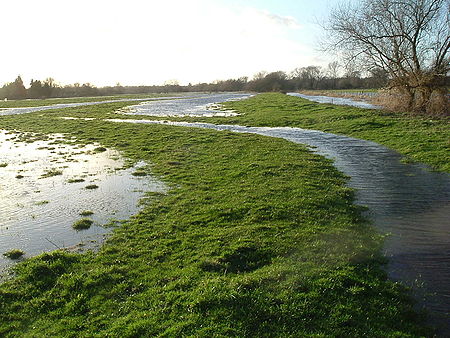 Bedwork or floated water-meadows were built on almost-level fields along broad river valleys, and required careful construction to ensure correct operation.
A leat
, called a main, carrier or top carrier, was used to divert water from the river and carry it down the valley at a gentler slope than the river, producing a hydrostatic head
between the two. Mains were often along the edge of the valley, each main supplying up to about 1 km (0.621372736649807 mi) of the valley. The water from the main was used to supply many smaller carriers, on the crests of ridges built across the fields. The channel on the crest of each ridge would overflow slowly down the sides (the panes) of the ridge, the channel eventually tapering to an end at the tip of the ridge. The seeping water would then be collected between the ridges, in drains or drawns, these joining to form a bottom carrier or tail drain which returned the water to the river. The ridges and the drains made an interlocking grid (like interlaced fingers), but the ridge-top channels and the drains did not connect directly. A by-carrier took any water not needed for irrigation straight from the main back to the river. The ridges varied in height depending on the available head – usually from around 10 to 50 cm (3.9 to 19.7 in). The pattern of carriers and drains was generally regular, but it was adapted to fit the natural topography of the ground and the locations of suitable places for the offtake and return of water.
The water flow was controlled by a system of hatches (sluice
gates) and stops (small earth or wooden-board dam
s). Irrigation could be provided separately for each section of water-meadow. Sometimes aqueduct
s took carriers over drains, and causeway
s and culvert
s provided access for wagon
s. The working or floating (irrigation) and maintenance of the water-meadow was done by a highly skilled craftsman called a drowner or waterman, who was often employed by several adjacent farmers.
The terminology used for watermeadows varied considerably with locality and dialect.
s off the ground and so allow the grass
to grow several weeks earlier, and in dry summer weather to keep the grass growing. It also allowed the ground to absorb any plant nutrient
s or silt
carried by the river water – this fertilised the grassland, and incidentally also reduced eutrophication
of the river water by nutrient pollution
. The grass was used both for making hay
and for grazing
by livestock
(usually cattle
or sheep).
topography, which is found on drier ground and has a very different origin in arable farming
). The drains in a derelict water-meadow are generally clogged and wet, and most of the carrier channels are dry, with the smaller ones on the ridge-tops often invisible. If any main carrier channels still flow, they usually connect permanently to the by-carriers. The larger sluices may be concealed under the roots of trees (such as crack willow
s), which have grown up from seedlings established in the brickwork. The complex mixture of wet and drier ground often gives derelict water-meadows particularly high wetland
biodiversity
.
Grassland
Grasslands are areas where the vegetation is dominated by grasses and other herbaceous plants . However, sedge and rush families can also be found. Grasslands occur naturally on all continents except Antarctica...
subject to controlled irrigation
Irrigation
Irrigation may be defined as the science of artificial application of water to the land or soil. It is used to assist in the growing of agricultural crops, maintenance of landscapes, and revegetation of disturbed soils in dry areas and during periods of inadequate rainfall...
to increase agricultural productivity
Agricultural productivity
Agricultural productivity is measured as the ratio of agricultural outputs to agricultural inputs. While individual products are usually measured by weight, their varying densities make measuring overall agricultural output difficult...
. Water-meadows were mainly used in Europe from the 16th to the early 20th centuries. Working water-meadows have now largely disappeared, but the field patterns and water channels of derelict water-meadows remain common in areas where they were used, such as parts of Italy
Italy
Italy , officially the Italian Republic languages]] under the European Charter for Regional or Minority Languages. In each of these, Italy's official name is as follows:;;;;;;;;), is a unitary parliamentary republic in South-Central Europe. To the north it borders France, Switzerland, Austria and...
, Switzerland
Switzerland
Switzerland name of one of the Swiss cantons. ; ; ; or ), in its full name the Swiss Confederation , is a federal republic consisting of 26 cantons, with Bern as the seat of the federal authorities. The country is situated in Western Europe,Or Central Europe depending on the definition....
and England
England
England is a country that is part of the United Kingdom. It shares land borders with Scotland to the north and Wales to the west; the Irish Sea is to the north west, the Celtic Sea to the south west, with the North Sea to the east and the English Channel to the south separating it from continental...
. Derelict water-meadows are often of importance as wetland wildlife habitats.
Water-meadows should not be confused with flood-meadow
Flood-meadow
A flood-meadow is an area of grassland or pasture beside a river, subject to seasonal flooding. Flood-meadows are distinct from water-meadows in that the latter are artificially created and maintained, with flooding controlled on a seasonal and even daily basis.- Examples :* Angel & Greyhound...
s, which are naturally covered in shallow water by seasonal flood
Flood
A flood is an overflow of an expanse of water that submerges land. The EU Floods directive defines a flood as a temporary covering by water of land not normally covered by water...
ing from a river
River
A river is a natural watercourse, usually freshwater, flowing towards an ocean, a lake, a sea, or another river. In a few cases, a river simply flows into the ground or dries up completely before reaching another body of water. Small rivers may also be called by several other names, including...
. "Water-meadow" is sometimes used more loosely to mean any level grassland beside a river.
Catchwork water-meadow
These were used for fields on slopes, and relatively little engineering skill was required to construct them. Water from a stream or spring was fed to the top of a sloping field, and gentle sloping terraces were formed along which the water could trickle in a zig-zag fashion down the field. The water could be used again for fields lower down the slope.Bedwork water-meadow
A leat
Leat
A leat is the name, common in the south and west of England and in Wales, for an artificial watercourse or aqueduct dug into the ground, especially one supplying water to a watermill or its mill pond...
, called a main, carrier or top carrier, was used to divert water from the river and carry it down the valley at a gentler slope than the river, producing a hydrostatic head
Hydrostatic head
When generating hydropower, the head is a general term used to describe the distance that a given water source has to fall before the point where power is generated. Ultimately the force responsible for hydropower is gravity, so a hydroelectricity plant with a tall/high head can produce more...
between the two. Mains were often along the edge of the valley, each main supplying up to about 1 km (0.621372736649807 mi) of the valley. The water from the main was used to supply many smaller carriers, on the crests of ridges built across the fields. The channel on the crest of each ridge would overflow slowly down the sides (the panes) of the ridge, the channel eventually tapering to an end at the tip of the ridge. The seeping water would then be collected between the ridges, in drains or drawns, these joining to form a bottom carrier or tail drain which returned the water to the river. The ridges and the drains made an interlocking grid (like interlaced fingers), but the ridge-top channels and the drains did not connect directly. A by-carrier took any water not needed for irrigation straight from the main back to the river. The ridges varied in height depending on the available head – usually from around 10 to 50 cm (3.9 to 19.7 in). The pattern of carriers and drains was generally regular, but it was adapted to fit the natural topography of the ground and the locations of suitable places for the offtake and return of water.
The water flow was controlled by a system of hatches (sluice
Sluice
A sluice is a water channel that is controlled at its head by a gate . For example, a millrace is a sluice that channels water toward a water mill...
gates) and stops (small earth or wooden-board dam
Dam
A dam is a barrier that impounds water or underground streams. Dams generally serve the primary purpose of retaining water, while other structures such as floodgates or levees are used to manage or prevent water flow into specific land regions. Hydropower and pumped-storage hydroelectricity are...
s). Irrigation could be provided separately for each section of water-meadow. Sometimes aqueduct
Aqueduct
An aqueduct is a water supply or navigable channel constructed to convey water. In modern engineering, the term is used for any system of pipes, ditches, canals, tunnels, and other structures used for this purpose....
s took carriers over drains, and causeway
Causeway
In modern usage, a causeway is a road or railway elevated, usually across a broad body of water or wetland.- Etymology :When first used, the word appeared in a form such as “causey way” making clear its derivation from the earlier form “causey”. This word seems to have come from the same source by...
s and culvert
Culvert
A culvert is a device used to channel water. It may be used to allow water to pass underneath a road, railway, or embankment. Culverts can be made of many different materials; steel, polyvinyl chloride and concrete are the most common...
s provided access for wagon
Wagon
A wagon is a heavy four-wheeled vehicle pulled by draught animals; it was formerly often called a wain, and if low and sideless may be called a dray, trolley or float....
s. The working or floating (irrigation) and maintenance of the water-meadow was done by a highly skilled craftsman called a drowner or waterman, who was often employed by several adjacent farmers.
The terminology used for watermeadows varied considerably with locality and dialect.
Uses of water-meadows
The aim of water-meadow irrigation was not to flood the ground, but to keep it continuously damp – there is no standing water in a working water-meadow. Irrigation was used in early spring, to keep frostFrost
Frost is the solid deposition of water vapor from saturated air. It is formed when solid surfaces are cooled to below the dew point of the adjacent air as well as below the freezing point of water. Frost crystals' size differ depending on time and water vapour available. Frost is also usually...
s off the ground and so allow the grass
Grass
Grasses, or more technically graminoids, are monocotyledonous, usually herbaceous plants with narrow leaves growing from the base. They include the "true grasses", of the Poaceae family, as well as the sedges and the rushes . The true grasses include cereals, bamboo and the grasses of lawns ...
to grow several weeks earlier, and in dry summer weather to keep the grass growing. It also allowed the ground to absorb any plant nutrient
Nutrient
A nutrient is a chemical that an organism needs to live and grow or a substance used in an organism's metabolism which must be taken in from its environment. They are used to build and repair tissues, regulate body processes and are converted to and used as energy...
s or silt
Silt
Silt is granular material of a size somewhere between sand and clay whose mineral origin is quartz and feldspar. Silt may occur as a soil or as suspended sediment in a surface water body...
carried by the river water – this fertilised the grassland, and incidentally also reduced eutrophication
Eutrophication
Eutrophication or more precisely hypertrophication, is the movement of a body of water′s trophic status in the direction of increasing plant biomass, by the addition of artificial or natural substances, such as nitrates and phosphates, through fertilizers or sewage, to an aquatic system...
of the river water by nutrient pollution
Nutrient pollution
Nutrient pollution, a form of water pollution, refers to contamination by excessive inputs of nutrient. It is a primary cause of eutrophication of surface waters, in which excess nutrients, usually nitrogen or phosphorus, stimulate algal growth...
. The grass was used both for making hay
Hay
Hay is grass, legumes or other herbaceous plants that have been cut, dried, and stored for use as animal fodder, particularly for grazing livestock such as cattle, horses, goats, and sheep. Hay is also fed to pets such as rabbits and guinea pigs...
and for grazing
Grazing
Grazing generally describes a type of feeding, in which a herbivore feeds on plants , and also on other multicellular autotrophs...
by livestock
Livestock
Livestock refers to one or more domesticated animals raised in an agricultural setting to produce commodities such as food, fiber and labor. The term "livestock" as used in this article does not include poultry or farmed fish; however the inclusion of these, especially poultry, within the meaning...
(usually cattle
Cattle
Cattle are the most common type of large domesticated ungulates. They are a prominent modern member of the subfamily Bovinae, are the most widespread species of the genus Bos, and are most commonly classified collectively as Bos primigenius...
or sheep).
Derelict water-meadows
Former water-meadows are found along many river valleys, where the sluice gates, channels and field ridges may still be visible (however the ridges should not be confused with ridge and furrowRidge and furrow
Ridge and furrow is an archaeological pattern of ridges and troughs created by a system of ploughing used in Europe during the Middle Ages. The earliest examples date to the immediate post-Roman period and the system was used until the 17th century in some areas. Ridge and furrow topography is...
topography, which is found on drier ground and has a very different origin in arable farming
Tillage
Tillage is the agricultural preparation of the soil by mechanical agitation of various types, such as digging, stirring, and overturning. Examples of human-powered tilling methods using hand tools include shovelling, picking, mattock work, hoeing, and raking...
). The drains in a derelict water-meadow are generally clogged and wet, and most of the carrier channels are dry, with the smaller ones on the ridge-tops often invisible. If any main carrier channels still flow, they usually connect permanently to the by-carriers. The larger sluices may be concealed under the roots of trees (such as crack willow
Crack Willow
Salix fragilis is a species of willow native to Europe and western Asia, usually growing beside rivers.It is a medium-sized to large deciduous tree, which grows rapidly to 10–20 m tall, with a trunk up to 1 m diameter and an irregular, often leaning crown. The bark is grey-brown, coarsely...
s), which have grown up from seedlings established in the brickwork. The complex mixture of wet and drier ground often gives derelict water-meadows particularly high wetland
Wetland
A wetland is an area of land whose soil is saturated with water either permanently or seasonally. Wetlands are categorised by their characteristic vegetation, which is adapted to these unique soil conditions....
biodiversity
Biodiversity
Biodiversity is the degree of variation of life forms within a given ecosystem, biome, or an entire planet. Biodiversity is a measure of the health of ecosystems. Biodiversity is in part a function of climate. In terrestrial habitats, tropical regions are typically rich whereas polar regions...
.
See also
- Flooded grasslands and savannasFlooded grasslands and savannasFlooded grasslands and savannas is a terrestrial biome. Its component ecoregions are generally located at subtropical and tropical latitudes, which are flooded seasonally or year-round...
- Flood-meadowFlood-meadowA flood-meadow is an area of grassland or pasture beside a river, subject to seasonal flooding. Flood-meadows are distinct from water-meadows in that the latter are artificially created and maintained, with flooding controlled on a seasonal and even daily basis.- Examples :* Angel & Greyhound...
- GrasslandGrasslandGrasslands are areas where the vegetation is dominated by grasses and other herbaceous plants . However, sedge and rush families can also be found. Grasslands occur naturally on all continents except Antarctica...
- IrrigationIrrigationIrrigation may be defined as the science of artificial application of water to the land or soil. It is used to assist in the growing of agricultural crops, maintenance of landscapes, and revegetation of disturbed soils in dry areas and during periods of inadequate rainfall...
- LynchetLynchetA lynchet is a bank of earth that builds up on the downslope of a field ploughed over a long period of time. The disturbed soil slips down the hillside to create a positive lynchet while the area reduced in level becomes a negative lynchet. They are also referred to as strip lynchets.They are a...
- MeadowMeadowA meadow is a field vegetated primarily by grass and other non-woody plants . The term is from Old English mædwe. In agriculture a meadow is grassland which is not grazed by domestic livestock but rather allowed to grow unchecked in order to make hay...
- Paddy fieldPaddy fieldA paddy field is a flooded parcel of arable land used for growing rice and other semiaquatic crops. Paddy fields are a typical feature of rice farming in east, south and southeast Asia. Paddies can be built into steep hillsides as terraces and adjacent to depressed or steeply sloped features such...
- Terrace (agriculture)Terrace (agriculture)Terraces are used in farming to cultivate sloped land. Graduated terrace steps are commonly used to farm on hilly or mountainous terrain. Terraced fields decrease erosion and surface runoff, and are effective for growing crops requiring much water, such as rice...
- Wet meadowWet meadowA wet meadow is a semi-wetland meadow which is saturated with water throughout much of the year. Wet meadows may occur because of poor drainage or the receipt of large amounts of water from rain or melted snow. They may also occur in riparian zones....
Further reading
Hadrian Cook and Tom Williamson (eds.), Water management in the English landscape: field, marsh and meadow. Edinburgh : Edinburgh University Press, 1999.External links
- 1911 Encyclopædia Britannica: Irrigation Includes detailed description of bedwork and catchwork water-meadows.
- Upper Test Valley Description of the upper River TestRiver TestThe River Test is a river in Hampshire, England. The river has a total length of 40 miles and it flows through downland from its source near Ashe, 10 km to the west of Basingstoke , to the sea at the head of Southampton Water...
valley in southern EnglandEnglandEngland is a country that is part of the United Kingdom. It shares land borders with Scotland to the north and Wales to the west; the Irish Sea is to the north west, the Celtic Sea to the south west, with the North Sea to the east and the English Channel to the south separating it from continental...
, including description of catchwork water-meadows. - Harnham Water Meadows Includes animation of water flow.
- Water Meadows: The lush pastures of the river valleys Description, terminology and diagrams of floated water-meadows.
- PhD thesis abstract on watermeadows