
The
watchmaker analogy, or
watchmaker argument, is a
teleological argumentA teleological or design argument is an a posteriori argument for the existence of God based on apparent design and purpose in the universe. The argument is based on an interpretation of teleology wherein purpose and intelligent design appear to exist in nature beyond the scope of any such human...
for the
existence of GodArguments for and against the existence of God have been proposed by philosophers, theologians, scientists, and others. In philosophical terms, arguments for and against the existence of God involve primarily the sub-disciplines of epistemology and ontology , but also of the theory of value, since...
. By way of an
analogyAnalogy is a cognitive process of transferring information or meaning from a particular subject to another particular subject , and a linguistic expression corresponding to such a process...
, the argument states that design implies a designer. The analogy has played a prominent role in
natural theologyNatural theology is a branch of theology based on reason and ordinary experience. Thus it is distinguished from revealed theology which is based on scripture and religious experiences of various kinds; and also from transcendental theology, theology from a priori reasoning.Marcus Terentius Varro ...
and the "argument from design," where it was used to support arguments for the existence of
GodGod is the English name given to a singular being in theistic and deistic religions who is either the sole deity in monotheism, or a single deity in polytheism....
and for the
intelligent designIntelligent design is the proposition that "certain features of the universe and of living things are best explained by an intelligent cause, not an undirected process such as natural selection." It is a form of creationism and a contemporary adaptation of the traditional teleological argument for...
of the universe.
The most famous statement of the teleological
argumentIn philosophy and logic, an argument is an attempt to persuade someone of something, or give evidence or reasons for accepting a particular conclusion.Argument may also refer to:-Mathematics and computer science:...
using the watchmaker analogy was given by
William PaleyWilliam Paley was a British Christian apologist, philosopher, and utilitarian. He is best known for his exposition of the teleological argument for the existence of God in his work Natural Theology, which made use of the watchmaker analogy .-Life:Paley was Born in Peterborough, England, and was...
in 1802. In 1838,
Charles DarwinCharles Robert Darwin FRS was an English naturalist. He established that all species of life have descended over time from common ancestry, and proposed the scientific theory that this branching pattern of evolution resulted from a process that he called natural selection.He published his theory...
's formulation of the
theoryA scientific theory comprises a collection of concepts, including abstractions of observable phenomena expressed as quantifiable properties, together with rules that express relationships between observations of such concepts...
of
natural selectionNatural selection is the nonrandom process by which biologic traits become either more or less common in a population as a function of differential reproduction of their bearers. It is a key mechanism of evolution....
was seen as providing a counter-argument to the watchmaker analogy. In the United States, starting in the 1980s, the concepts of evolution and natural selection became the subject of national debate, including a renewed interest in the watchmaker argument by atheists.
The Watchmaker argument
The watchmaker analogy consists of the comparison of some natural phenomenon to a
watchA watch is a small timepiece, typically worn either on the wrist or attached on a chain and carried in a pocket, with wristwatches being the most common type of watch used today. They evolved in the 17th century from spring powered clocks, which appeared in the 15th century. The first watches were...
. Typically, the analogy is presented as a prelude to the
teleological argumentA teleological or design argument is an a posteriori argument for the existence of God based on apparent design and purpose in the universe. The argument is based on an interpretation of teleology wherein purpose and intelligent design appear to exist in nature beyond the scope of any such human...
and is generally presented as:
- The complex inner workings of a watch necessitate an intelligent designer.
- As with a watch, the complexity of X (a particular organ or organism, the structure of the solar system, life, the universe, everything) necessitates a designer.
In this presentation, the watch analogy (step 1) does not function as a premise to an argument — rather it functions as a
rhetorical deviceIn rhetoric, a rhetorical device or resource of language is a technique that an author or speaker uses to convey to the listener or reader a meaning with the goal of persuading him or her towards considering a topic from a different perspective. While rhetorical devices may be used to evoke an...
and a
preambleA preamble is an introductory and expressionary statement in a document that explains the document's purpose and underlying philosophy. When applied to the opening paragraphs of a statute, it may recite historical facts pertinent to the subject of the statute...
. Its purpose is to establish the plausibility of the general premise:
you can tell, simply by looking at something, whether or not it was the product of intelligent design.
In most formulations of the argument, the characteristic that indicates intelligent design is left implicit. In some formulations, the characteristic is
orderliness or
complexity (which is a form of order). In other cases it is
clearly being designed for a purpose, where
clearly is usually left undefined.
The argument conflates the difference between the complexity that arises from living organisms that are able to reproduce themselves (and as such may change to become more complex over time) with the complexity of inanimate objects, unable to pass on any reproductive changes (such as the multitude of parts manufactured in a watch), the comparison breaks down because of this important distinction.
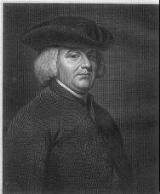
William Paley
Watches and timepieces have been used as examples of complicated technology in philosophical discussions throughout history.
CiceroMarcus Tullius Cicero , was a Roman philosopher, statesman, lawyer, political theorist, and Roman constitutionalist. He came from a wealthy municipal family of the equestrian order, and is widely considered one of Rome's greatest orators and prose stylists.He introduced the Romans to the chief...
,
VoltaireFrançois-Marie Arouet , better known by the pen name Voltaire , was a French Enlightenment writer, historian and philosopher famous for his wit and for his advocacy of civil liberties, including freedom of religion, free trade and separation of church and state...
and
René DescartesRené Descartes ; was a French philosopher and writer who spent most of his adult life in the Dutch Republic. He has been dubbed the 'Father of Modern Philosophy', and much subsequent Western philosophy is a response to his writings, which are studied closely to this day...
, for example, used timepieces in arguments regarding purpose. The watchmaker analogy, as described here, was used by
FontenelleBernard Le Bovier de Fontenelle , also called Bernard Le Bouyer de Fontenelle, was a French author.Fontenelle was born in Rouen, France and died in Paris just one month before his 100th birthday. His mother was the sister of great French dramatists Pierre and Thomas Corneille...
in 1686, but was most famously formulated by Paley.
William PaleyWilliam Paley was a British Christian apologist, philosopher, and utilitarian. He is best known for his exposition of the teleological argument for the existence of God in his work Natural Theology, which made use of the watchmaker analogy .-Life:Paley was Born in Peterborough, England, and was...
(1743–1805) used the watchmaker analogy in his book
Natural Theology, or Evidences of the Existence and Attributes of the Deity collected from the Appearances of Nature, published in 1802. In it, Paley wrote that if a
pocket watchA pocket watch is a watch that is made to be carried in a pocket, as opposed to a wristwatch, which is strapped to the wrist. They were the most common type of watch from their development in the 16th century until wristwatches became popular after World War I during which a transitional design,...
is found on a heath, it is most reasonable to assume that someone dropped it and that it was made by one or more watchmakers, and not by natural forces.
Paley went on to argue that the complex structures of living things and the remarkable adaptations of plants and animals required an intelligent designer. He believed the natural world was the creation of God and showed the nature of the creator. According to Paley, God had carefully designed "even the most humble and insignificant organisms" and all of their minute features (such as the
wingA wing is an appendage with a surface that produces lift for flight or propulsion through the atmosphere, or through another gaseous or liquid fluid...
s and
antennaeAntennae in biology have historically been paired appendages used for sensing in arthropods. More recently, the term has also been applied to cilium structures present in most cell types of eukaryotes....
of
earwigEarwigs make up the insect order Dermaptera, found throughout the Americas, Africa, Eurasia, Australia and New Zealand. With 1,800 species in 12 families, they are one of the smaller insect orders...
s). He believed therefore that God must care even more for humanity.
Paley recognised that there is great suffering in nature, and that nature appears to be indifferent to pain. His way of reconciling this with his belief in a
benevolentOmnibenevolence is defined by the Oxford English Dictionary as "unlimited or infinite benevolence". It is often held to be impossible, or at least improbable, for a deity to exhibit such property along side omniscience and omnipotence as a result of the problem of evil...
God was to assume that life had more pleasure than pain.
(See Problem of EvilIn the philosophy of religion, the problem of evil is the question of how to explain evil if there exists a deity that is omnibenevolent, omnipotent, and omniscient . Some philosophers have claimed that the existences of such a god and of evil are logically incompatible or unlikely...
).
As a side note, a charge of wholesale
plagiarismPlagiarism is defined in dictionaries as the "wrongful appropriation," "close imitation," or "purloining and publication" of another author's "language, thoughts, ideas, or expressions," and the representation of them as one's own original work, but the notion remains problematic with nebulous...
from this book was brought against Paley in
The AthenaeumThe Athenaeum was a literary magazine published in London from 1828 to 1921. It had a reputation for publishing the very best writers of the age....
for 1848, but the famous illustration of the watch was not peculiar to Nieuwentyt, and had been used by many others before either Paley or Nieuwentyt.
Criticism
There are three main arguments against the Watchmaker analogy. The first is that complex artifacts do not, in fact, require a designer, but can and do arise from "mindless" natural processes (as in the "
Infinite Monkey TheoremThe infinite monkey theorem states that a monkey hitting keys at random on a typewriter keyboard for an infinite amount of time will almost surely type a given text, such as the complete works of William Shakespeare....
"). The second argument is that the watch is a faulty analogy. The third argument is that the watchmaker is arguably a far more complex organism than the watch, and if complexity proves intelligent design, then the question arises: who designed such a complex designer?
David Hume
HumeDavid Hume was a Scottish philosopher, historian, economist, and essayist, known especially for his philosophical empiricism and skepticism. He was one of the most important figures in the history of Western philosophy and the Scottish Enlightenment...
gave the classic criticism of the design argument in
Dialogues Concerning Natural ReligionDialogues Concerning Natural Religion is a philosophical work written by the Scottish philosopher David Hume. Through dialogue, three fictional characters named Demea, Philo, and Cleanthes debate the nature of God's existence...
and
An Enquiry concerning Human UnderstandingAn Enquiry Concerning Human Understanding is a book by the Scottish empiricist philosopher David Hume, published in 1748. It was a revision of an earlier effort, Hume's A Treatise of Human Nature, published anonymously in London in 1739–40...
. He argued that for the design argument to be feasible, it must be true that order and purpose are observed only when they result from design. But order is observed regularly, resulting from presumably mindless processes like snowflake or crystal generation. Design accounts for only a tiny part of our experience with order and "purpose".
Furthermore, the design argument is based on an incomplete analogy: because of our experience with objects, we can recognize human-designed ones, comparing for example a pile of stones and a brick wall. But to point to a designed Universe, we would need to have an experience of a range of different universes. As we only experience one, the analogy cannot be applied. We must ask therefore if it is right to compare the world to a machine—as in Paley's watchmaker argument—when perhaps it would be better described as a giant inert animal. Even if the design argument is completely successful, it could not (in and of itself) establish a robust theism; one could easily reach the conclusion that the universe's configuration is the result of some morally ambiguous, possibly unintelligent agent or agents whose method bears only a remote similarity to human design. In this way it could be asked if the designer was God, or further still, who designed the designer?
Hume also reasoned that if a well-ordered natural world requires a special designer, then God's mind (being so well ordered) also requires a special designer. And then this designer would likewise need a designer, and so on ad infinitum. We could respond by resting content with an inexplicably self-ordered divine mind but then why not rest content with an inexplicably self-ordered natural world?
Charles Darwin
Charles DarwinCharles Robert Darwin FRS was an English naturalist. He established that all species of life have descended over time from common ancestry, and proposed the scientific theory that this branching pattern of evolution resulted from a process that he called natural selection.He published his theory...
's theory provided another explanation for complex artifacts, one where a design is not necessary.
When
Charles DarwinCharles Robert Darwin FRS was an English naturalist. He established that all species of life have descended over time from common ancestry, and proposed the scientific theory that this branching pattern of evolution resulted from a process that he called natural selection.He published his theory...
(1809–1882)
completed his studiesCharles Darwin's education gave him a foundation in the doctrine of Creation prevalent throughout the West at the time, as well as knowledge of medicine and theology. More significantly, it led to his interest in natural history, which culminated in his taking part in the second voyage of the...
of
theologyTheology is the systematic and rational study of religion and its influences and of the nature of religious truths, or the learned profession acquired by completing specialized training in religious studies, usually at a university or school of divinity or seminary.-Definition:Augustine of Hippo...
at
Christ's College, CambridgeChrist's College is a constituent college of the University of Cambridge.With a reputation for high academic standards, Christ's College averaged top place in the Tompkins Table from 1980-2000 . In 2011, Christ's was placed sixth.-College history:...
in 1831, he read Paley's
Natural Theology and believed that the work gave rational proof of the
existence of GodArguments for and against the existence of God have been proposed by philosophers, theologians, scientists, and others. In philosophical terms, arguments for and against the existence of God involve primarily the sub-disciplines of epistemology and ontology , but also of the theory of value, since...
. This was because living beings showed complexity and were exquisitely fitted to their places in a happy world.
Subsequently, on
the voyage of the BeagleThe second voyage of HMS Beagle, from 27 December 1831 to 2 October 1836, was the second survey expedition of HMS Beagle, under captain Robert FitzRoy who had taken over command of the ship on its first voyage after her previous captain committed suicide...
, Darwin found that nature was not so beneficent, and the distribution of
speciesIn biology, a species is one of the basic units of biological classification and a taxonomic rank. A species is often defined as a group of organisms capable of interbreeding and producing fertile offspring. While in many cases this definition is adequate, more precise or differing measures are...
did not support ideas of divine creation. In 1838, shortly after his return, Darwin
conceived his theoryThe inception of Darwin's theory occurred during an intensively busy period which began when Charles Darwin returned from the survey voyage of the Beagle, with his reputation as a fossil collector and geologist already established...
that
natural selectionNatural selection is the nonrandom process by which biologic traits become either more or less common in a population as a function of differential reproduction of their bearers. It is a key mechanism of evolution....
, rather than divine design, was the best explanation for gradual change in populations over many generations.
Darwin reviewed the implications of this finding in his autobiography:
The idea that nature was governed by laws was already common, and in 1833
William WhewellWilliam Whewell was an English polymath, scientist, Anglican priest, philosopher, theologian, and historian of science. He was Master of Trinity College, Cambridge.-Life and career:Whewell was born in Lancaster...
as a proponent of the
natural theologyNatural theology is a branch of theology based on reason and ordinary experience. Thus it is distinguished from revealed theology which is based on scripture and religious experiences of various kinds; and also from transcendental theology, theology from a priori reasoning.Marcus Terentius Varro ...
that Paley had inspired had written that "with regard to the material world, we can at least go so far as this—we can perceive that events are brought about not by insulated interpositions of Divine power, exerted in each particular case, but by the establishment of general laws." By the time Darwin published his theory,
liberal theologiansLiberal Christianity, sometimes called liberal theology, is an umbrella term covering diverse, philosophically and biblically informed religious movements and ideas within Christianity from the late 18th century and onward...
were already supporting such ideas, and by the late 19th century their modernist approach was predominant in theology. In science,
evolutionEvolution is any change across successive generations in the heritable characteristics of biological populations. Evolutionary processes give rise to diversity at every level of biological organisation, including species, individual organisms and molecules such as DNA and proteins.Life on Earth...
theory incorporating Darwin's natural selection became completely accepted.
Richard Dawkins
Dawkins also gives an explanation for complex artifacts, one where a design is not necessary.
Dawkins demonstrates through computer simulation that "highly complex" systems can be produced by a series of very small randomly generated yet
naturally selectedNatural selection is the nonrandom process by which biologic traits become either more or less common in a population as a function of differential reproduction of their bearers. It is a key mechanism of evolution....
steps, rather than an intelligent designer.
He further claims that the watchmaker analogy is a self-refuting argument: if complex things must have been intelligently designed by something more complex than themselves, then anything posited as this complex designer (i.e. God) must also have been designed by something yet more complex.
In a Horizon episode also entitled
The Blind Watchmaker (Blind watchmaker), Dawkins described Paley's argument "as mistaken as it is elegant". In both contexts he saw Paley as having made an incorrect proposal as to a certain problem's solution, but did not disrespect him for this. In his essay
The big bang,
Steven PinkerSteven Arthur Pinker is a Canadian-American experimental psychologist, cognitive scientist, linguist and popular science author...
discussed Dawkins' coverage of Paley's argument, adding: "Biologists today do not disagree with Paley's laying out of the problem. They disagree only with his solution."
In his book,
The God Delusion, Dawkins argues that life was the result of complex biological processes. Dawkins makes the argument that the comparison to the lucky construction of a watch is fallacious because proponents of evolution do not consider evolution "lucky"; rather than luck, the evolution of human life is the result of billions of years of natural selection. He therefore concludes that evolution is a fair contestant to replace God in the role of watchmaker.
Mandelbrot analogy
A similar objection is coined as the
MandelbrotThe Mandelbrot set is a particular mathematical set of points, whose boundary generates a distinctive and easily recognisable two-dimensional fractal shape...
Analogy. It relies on the observation that some complex patterns and behaviours, such as those seen in fractals and
chaotical systemsChaos theory is a field of study in mathematics, with applications in several disciplines including physics, economics, biology, and philosophy. Chaos theory studies the behavior of dynamical systems that are highly sensitive to initial conditions, an effect which is popularly referred to as the...
, arise naturally from simple systems. Therefore, the complexity of something is not a valid argument for the necessity of a designer.
Faulty analogy
Criticisms have found fault in the watch, or the alternative 'eye', analogy. Anthropologists Richerson and Boyd argue that one human could not make a watch on their own and therefore a watch does not have a designer. The book
Plato and a Platypus Walk Into a BarPlato and a Platypus Walk Into a Bar – Understanding Philosophy Through Jokes is a book that explains basic philosophical concepts through classic jokes. Thomas Cathcart and Daniel Klein, graduates of Harvard in philosophy, collaborated on the book...
argues that there is no reason why the Universe resembles a watch any more than it does a baby kangaroo, and that the same question can be asked of any god. And a watch is manufactured out of other materials, while the case with the Universe is unclear.
Creationist revival
In the early 20th century the modernist theology of higher criticism was contested in the United States by
Biblical literalistsBiblical literalism is the interpretation or translation of the explicit and primary sense of words in the Bible. A literal Biblical interpretation is associated with the fundamentalist and evangelical hermeneutical approach to Scripture, and is used almost exclusively by conservative Christians...
who campaigned successfully against the teaching of evolution and began calling themselves
CreationistsCreationism is the religious beliefthat humanity, life, the Earth, and the universe are the creation of a supernatural being, most often referring to the Abrahamic god. As science developed from the 18th century onwards, various views developed which aimed to reconcile science with the Genesis...
in the 1920s. When teaching of evolution was reintroduced into public schools in the 1960s they adopted what they called
creation scienceCreation Science or scientific creationism is a branch of creationism that attempts to provide scientific support for the Genesis creation narrative in the Book of Genesis and disprove generally accepted scientific facts, theories and scientific paradigms about the history of the Earth, cosmology...
which had a central concept of design in similar terms to Paley's argument. That idea was then relabelled
intelligent designIntelligent design is the proposition that "certain features of the universe and of living things are best explained by an intelligent cause, not an undirected process such as natural selection." It is a form of creationism and a contemporary adaptation of the traditional teleological argument for...
, which presents the same analogy as an argument against evolution by natural selection without explicitly stating that the "intelligent designer" was God. The argument from the complexity of biological organisms was now presented as the
irreducible complexityIrreducible complexity is an argument by proponents of intelligent design that certain biological systems are too complex to have evolved from simpler, or "less complete" predecessors, through natural selection acting upon a series of advantageous naturally occurring, chance mutations...
argument, the most notable proponent of which was
Michael BeheMichael J. Behe is an American biochemist, author, and intelligent design advocate. He currently serves as professor of biochemistry at Lehigh University in Pennsylvania and as a senior fellow of the Discovery Institute's Center for Science and Culture...
and, leveraging off the verbiage of
information theoryInformation theory is a branch of applied mathematics and electrical engineering involving the quantification of information. Information theory was developed by Claude E. Shannon to find fundamental limits on signal processing operations such as compressing data and on reliably storing and...
, the
specified complexitySpecified complexity is an argument proposed by William Dembski and used by him and others to promote intelligent design. According to Dembski, the concept is intended to formalize a property that singles out patterns that are both specified and complex...
argument, the most notable proponent of which was William Dembski.
The watchmaker analogy was referenced in the 2005
Kitzmiller v. Dover Area School DistrictTammy Kitzmiller, et al. v. Dover Area School District, et al. was the first direct challenge brought in the United States federal courts testing a public school district policy that required the teaching of intelligent design...
trial. Throughout the trial, the Reverend William Paley was mentioned several times, naming Paley the "posterboy" of
Intelligent DesignIntelligent design is the proposition that "certain features of the universe and of living things are best explained by an intelligent cause, not an undirected process such as natural selection." It is a form of creationism and a contemporary adaptation of the traditional teleological argument for...
. The defense's expert witness
John HaughtJohn F. Haught is a Roman Catholic theologian and Senior Research Fellow at the Woodstock Theological Center at Georgetown University. His area of expertise is systematic theology, with a special interest in issues of science, cosmology, ecology, and reconciling evolution and religion...
noted that both
Intelligent DesignIntelligent design is the proposition that "certain features of the universe and of living things are best explained by an intelligent cause, not an undirected process such as natural selection." It is a form of creationism and a contemporary adaptation of the traditional teleological argument for...
and the watchmaker analogy are both "reformulations" of the same theological argument.
On day 21 of the trial, Mr. Harvey walked Dr. Minnich through a modernized version of Paley's argument, substituting a cell phone for the watch.
In his ruling, the judge stated that the use of the argument from design by intelligent design proponents "is merely a restatement of the Reverend William Paley's argument applied at the cell level" and that the argument from design is
subjectiveSubjectivity refers to the subject and his or her perspective, feelings, beliefs, and desires. In philosophy, the term is usually contrasted with objectivity.-Qualia:...
.
External links
- Refutation of the 'by design' argument for theism
- Full text of Natural Theology; or, Evidences of the Existence and Attributes of the Deity
- Intelligent Design Deja Vu What would "intelligent design" science classes look like? All we have to do is look inside some 19th-century textbooks.
- Robert Hooke
- William Paley (1743–1805)
- The Autobiography of Charles Darwin
The Autobiography of Charles Darwin is the autobiography of the British naturalist Charles Darwin which was published in 1887, five years after his death....
, revised version published in 1958 by Darwin's granddaughter Nora BarlowEmma Nora Barlow was the granddaughter of the British naturalist Charles Darwin, who edited and published previously unseen examples of her grandfather's work.- Biography :...
.
- Recapitulation and Conclusion", By Charles Darwin.
- Natural History Magazine
- The Blind Watchmaker
The Blind Watchmaker: Why the Evidence of Evolution Reveals a Universe without Design is a 1986 book by Richard Dawkins in which he presents an explanation of, and argument for, the theory of evolution by means of natural selection. He also presents arguments to refute certain criticisms made on...
, Richard DawkinsClinton Richard Dawkins, FRS, FRSL , known as Richard Dawkins, is a British ethologist, evolutionary biologist and author...
- Chaos in the Solar System, by J Laskar
- Index to Creationist Claims
- The Watchmaker Analogy Animated and Dramatically Read