

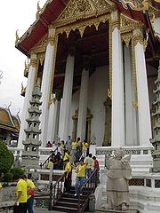
Wat

Encyclopedia
A wat is a monastery
temple
in Cambodia
, Thailand
, or Laos
. The word "wat" means "school".
In Cambodia, a wat is used to refer to all kinds of places of worship. Technically, wat generally refers to a Buddhist place of worship, but the technical term is (wat pootasasna). A Christian church can be referred as (vihear yeasu). Angkor Wat
means city of temples.
In everyday language in Thailand, a wat is any place of worship except a mosque
(Thai - su-rao; or - Thai rendering of masjid; a mosque may also be described as - bot khong Is-a-lam). Thus wat cheen is a Chinese temple (either Buddhist or Taoist
), wat khaek is a Hindu
temple, and wat kris or wat krit or wat farang is a Christian
church, though Thai ( bot) may be used descriptively as with mosque.
The living quarters of the monks, including the (Thai kuti or kut - monk cells) are separated from the sacred buildings.
The roofs of Thai temples are often adorned with chofah
s.
Monastery
Monastery denotes the building, or complex of buildings, that houses a room reserved for prayer as well as the domestic quarters and workplace of monastics, whether monks or nuns, and whether living in community or alone .Monasteries may vary greatly in size – a small dwelling accommodating only...
temple
Temple
A temple is a structure reserved for religious or spiritual activities, such as prayer and sacrifice, or analogous rites. A templum constituted a sacred precinct as defined by a priest, or augur. It has the same root as the word "template," a plan in preparation of the building that was marked out...
in Cambodia
Cambodia
Cambodia , officially known as the Kingdom of Cambodia, is a country located in the southern portion of the Indochina Peninsula in Southeast Asia...
, Thailand
Thailand
Thailand , officially the Kingdom of Thailand , formerly known as Siam , is a country located at the centre of the Indochina peninsula and Southeast Asia. It is bordered to the north by Burma and Laos, to the east by Laos and Cambodia, to the south by the Gulf of Thailand and Malaysia, and to the...
, or Laos
Laos
Laos Lao: ສາທາລະນະລັດ ປະຊາທິປະໄຕ ປະຊາຊົນລາວ Sathalanalat Paxathipatai Paxaxon Lao, officially the Lao People's Democratic Republic, is a landlocked country in Southeast Asia, bordered by Burma and China to the northwest, Vietnam to the east, Cambodia to the south and Thailand to the west...
. The word "wat" means "school".
Introduction
Strictly speaking a wat is a Buddhist sacred precinct with monks' quarters, the temple proper, an edifice housing a large image of Buddha, and a structure for lessons. A Buddhist site without a minimum of three resident monks cannot correctly be described as a wat, although the term is frequently used more loosely, even for ruins of ancient temples. (As a transitive or intransitive verb, wat means to measure, to take measurements; compare templum, from which temple derives, having the same root as template.)In Cambodia, a wat is used to refer to all kinds of places of worship. Technically, wat generally refers to a Buddhist place of worship, but the technical term is (wat pootasasna). A Christian church can be referred as (vihear yeasu). Angkor Wat
Angkor Wat
Angkor Wat is a temple complex at Angkor, Cambodia, built for the king Suryavarman II in the early 12th century as his state temple and capital city. As the best-preserved temple at the site, it is the only one to have remained a significant religious centre since its foundation – first Hindu,...
means city of temples.
In everyday language in Thailand, a wat is any place of worship except a mosque
Mosque
A mosque is a place of worship for followers of Islam. The word is likely to have entered the English language through French , from Portuguese , from Spanish , and from Berber , ultimately originating in — . The Arabic word masjid literally means a place of prostration...
(Thai - su-rao; or - Thai rendering of masjid; a mosque may also be described as - bot khong Is-a-lam). Thus wat cheen is a Chinese temple (either Buddhist or Taoist
Taoism
Taoism refers to a philosophical or religious tradition in which the basic concept is to establish harmony with the Tao , which is the mechanism of everything that exists...
), wat khaek is a Hindu
Hinduism
Hinduism is the predominant and indigenous religious tradition of the Indian Subcontinent. Hinduism is known to its followers as , amongst many other expressions...
temple, and wat kris or wat krit or wat farang is a Christian
Christianity
Christianity is a monotheistic religion based on the life and teachings of Jesus as presented in canonical gospels and other New Testament writings...
church, though Thai ( bot) may be used descriptively as with mosque.
Structure
A typical Buddhist wat consists of the following buildings:- chaideiStupaA stupa is a mound-like structure containing Buddhist relics, typically the remains of Buddha, used by Buddhists as a place of worship....
or chediStupaA stupa is a mound-like structure containing Buddhist relics, typically the remains of Buddha, used by Buddhists as a place of worship....
(Khmer ), (Thai ) (from SanskritSanskritSanskrit , is a historical Indo-Aryan language and the primary liturgical language of Hinduism, Jainism and Buddhism.Buddhism: besides Pali, see Buddhist Hybrid Sanskrit Today, it is listed as one of the 22 scheduled languages of India and is an official language of the state of Uttarakhand...
: chaitya, temple) - usually conical or bell-shaped buildings, often containing relics of Buddha - vihan (Khmer ),wihan (Thai ) from Sanskrit: viharaViharaVihara is the Sanskrit and Pali term for a Buddhist monastery. It originally meant "a secluded place in which to walk", and referred to "dwellings" or "refuges" used by wandering monks during the rainy season....
) - a meeting and prayer room - mondop (Thai ) (from Sanskrit: MandapaMandapaA mandapa in Indian architecture is a pillared outdoor hall or pavilion for public rituals.-Temple architecture:...
) - a usually open, square building with four arches and a pyramidal roof, used to worship religious texts or objects - salaSala (architecture)A Sala , also known as a sala Thai, is an open pavilion, used as a meeting place and to protect people from sun and rain. Most are open on all four sides. They are found throughout Thailand in Buddhist temple areas, or Wats, although they can also be located in other places. A person who builds a...
(Khmer សាលា), (Thai ) (from Sanskrit: Shala - School, from an earlier meaning of shelter) - a pavilion for relaxation or miscellaneous activities - bot or ubosothUbosothA phra ubosot is a building in a Buddhist Wat. It is the holiest prayer room, also called the "ordination hall" as it is where ordinations take place....
(from PaliPáli- External links :* *...
uposathaUposathaThe Uposatha is Buddhist day of observance, in existence from the Buddha's time , and still being kept today in Buddhist countries. The Buddha taught that the Uposatha day is for "the cleansing of the defiled mind," resulting in inner calm and joy...
) - the holiest prayer room, also called the "ordination hall" as it is where new monks take their vows. Architecturally it is similar to the vihara; the main differences are the eight cornerstones placed around the bot to ward off evil. The bot is usually more decorated than the viharn. - bibiloteca (Thai ) - TripitakaTripiṭaka' is a traditional term used by various Buddhist sects to describe their various canons of scriptures. As the name suggests, a traditionally contains three "baskets" of teachings: a , a and an .-The three categories:Tripitaka is the three main categories of texts that make up the...
library where Buddhist scripturesBuddhist textsBuddhist texts can be categorized in a number of ways. The Western terms "scripture" and "canonical" are applied to Buddhism in inconsistent ways by Western scholars: for example, one authority refers to "scriptures and other canonical texts", while another says that scriptures can be categorized...
are kept - drum tower (Thai )
- bell tower (Thai )
- multipurpose hall (ThaiThai languageThai , also known as Central Thai and Siamese, is the national and official language of Thailand and the native language of the Thai people, Thailand's dominant ethnic group. Thai is a member of the Tai group of the Tai–Kadai language family. Historical linguists have been unable to definitively...
: , study hall) is a building in a wat. In the past this hall was only for monks to study in, as parian is a PaliPáli- External links :* *...
word meaning 'educated monk' or 'monk student'.
The living quarters of the monks, including the (Thai kuti or kut - monk cells) are separated from the sacred buildings.
The roofs of Thai temples are often adorned with chofah
Chofah
Chofah is a Thai architectural decorative ornament that adorns the top at the end of Wat and palaces roof in most of the continental Southeast Asian countries, such as Thailand, Cambodia, Laos, and Myanmar. It resembles a tall thin bird and looks hornlike...
s.
Cambodia
- Angkor WatAngkor WatAngkor Wat is a temple complex at Angkor, Cambodia, built for the king Suryavarman II in the early 12th century as his state temple and capital city. As the best-preserved temple at the site, it is the only one to have remained a significant religious centre since its foundation – first Hindu,...
, Siem ReapSiem ReapSiem Reap is the capital city of Siem Reap Province in northwestern Cambodia, and is the gateway to Angkor region.Siem Reap has colonial and Chinese-style architecture in the Old French Quarter, and around the Old Market... - Silver Pagoda, Phnom PenhPhnom PenhPhnom Penh is the capital and largest city of Cambodia. Located on the banks of the Mekong River, Phnom Penh has been the national capital since the French colonized Cambodia, and has grown to become the nation's center of economic and industrial activities, as well as the center of security,...
- Wat BotumWat BotumWat Botum Vathey is a wat located at Oknha Suor Srun Street 7, Sangkat Chaktomuk, Khan Daun Penh, Phnom Penh, Cambodia. It is located to the south of the Royal Palace of Cambodia, on the western side of Wat Botum Park.-History:...
, Phnom PenhPhnom PenhPhnom Penh is the capital and largest city of Cambodia. Located on the banks of the Mekong River, Phnom Penh has been the national capital since the French colonized Cambodia, and has grown to become the nation's center of economic and industrial activities, as well as the center of security,... - Wat OunalomWat OunalomWat Ounalom also pronounce Wat Onalaom is a wat located on Sisowath Quay in Phnom Penh, Cambodia, near the Royal Palace of Cambodia.It is the most important wat of Phnom Penh, and the center of Cambodian Buddhism. It was established in 1443 and consists of 44 structures. It was damaged during the...
, Phnom PenhPhnom PenhPhnom Penh is the capital and largest city of Cambodia. Located on the banks of the Mekong River, Phnom Penh has been the national capital since the French colonized Cambodia, and has grown to become the nation's center of economic and industrial activities, as well as the center of security,...
Laos
- Pha That Luang, VientianeVientiane-Geography:Vientiane is situated on a bend of the Mekong river, which forms the border with Thailand at this point.-Climate:Vientiane features a tropical wet and dry climate with a distinct monsoon season and a dry season. Vientiane’s dry season spans from November through March. April marks the...
, LaosLaosLaos Lao: ສາທາລະນະລັດ ປະຊາທິປະໄຕ ປະຊາຊົນລາວ Sathalanalat Paxathipatai Paxaxon Lao, officially the Lao People's Democratic Republic, is a landlocked country in Southeast Asia, bordered by Burma and China to the northwest, Vietnam to the east, Cambodia to the south and Thailand to the west... - Wat Xieng ThongWat Xieng ThongWat Xieng Thong is a Buddhist temple , located on the northern tip of the peninsula of Luang Phrabang, Laos.-History:It was built in 1560 by King Setthathirath and was under royal patronage during the Kingdom of Laos. Like the royal palace, the wat was placed near the mekong. In 1880, the Tripitaka...
, Luang PrabangLuang PrabangLuang Prabang, or Louangphrabang , is a city located in north central Laos, where the Nam Khan river meets the Mekong River about north of Vientiane. It is the capital of Luang Prabang Province...
Thailand
- Bangkok
- Wat SuthatWat SuthatWat Suthat Thepphawararam is a royal temple of the first grade, one of ten such temples in Bangkok . Construction was begun by His Majesty King Rama I in 1807 . Further construction and decorations were carried out by King Rama II who helped carve the wooden doors, but the temple was not completed...
, BangkokBangkokBangkok is the capital and largest urban area city in Thailand. It is known in Thai as Krung Thep Maha Nakhon or simply Krung Thep , meaning "city of angels." The full name of Bangkok is Krung Thep Mahanakhon Amon Rattanakosin Mahintharayutthaya Mahadilok Phop Noppharat Ratchathani Burirom...
, ThailandThailandThailand , officially the Kingdom of Thailand , formerly known as Siam , is a country located at the centre of the Indochina peninsula and Southeast Asia. It is bordered to the north by Burma and Laos, to the east by Laos and Cambodia, to the south by the Gulf of Thailand and Malaysia, and to the... - Wat BenchamabophitWat BenchamabophitWat Benchamabophit Dusitvanaram is a Buddhist temple in the Dusit district of Bangkok, Thailand. Also known as the marble temple, it is one of Bangkok's most beautiful temples and a major tourist attraction...
(The Marble Temple) - Wat RatchanaddaWat RatchanaddaWat Ratchanaddaram is a buddhist temple located at the intersection between Ratchadamnoen Klang and Maha Chai Road, in Phra Nakhon district, Bangkok....
- Wat Phra KaewWat Phra KaewThe Wat Phra Kaew is regarded as the most sacred Buddhist temple in Thailand. It is a "potent religio-political symbol and the palladium of Thai society". It is located in the historic centre of Bangkok , within the precincts of the Grand Palace.The main building is the central ubosoth, which...
- Wat ArunWat ArunWat Arun Rajwararam is a Buddhist temple in the Bangkok Yai district of Bangkok, Thailand, on the Thonburi west bank of the Chao Phraya River. The full name of the temple is Wat Arunratchawararam Ratchaworamahawihan...
- Wat BowonniwetWat BowonniwetWat Bowonniwet Vihara Rajavaravihara is a major Buddhist temple in Phra Nakhon district, Bangkok, Thailand. The temple is a center of the Thammayut Nikaya school of Thai Theravada Buddhism and has been a major temple of patronage for the Chakri dynasty. It is the shrine-hall of Phra...
- Wat Suthat
- Lanna (Northern Thailand)
- Wat Phrathat Doi SuthepWat Phrathat Doi SuthepWat Phrathat Doi Suthep is a Theravada Buddhist temple in Chiang Mai Province, Thailand. The temple is often referred to as "Doi Suthep" although this is actually the name of the mountain it is located on. The temple is located 15 km from the city of Chiang Mai and is a sacred site to many Thai...
, Chiang MaiChiang MaiChiang Mai sometimes written as "Chiengmai" or "Chiangmai", is the largest and most culturally significant city in northern Thailand. It is the capital of Chiang Mai Province , a former capital of the Kingdom of Lanna and was the tributary Kingdom of Chiang Mai from 1774 until 1939. It is... - Wat Chiang ManWat Chiang ManWat Chiang Man is a Buddhist temple inside the old city of Chiang Mai, in northern Thailand.-History:...
, Chiang Mai - Wat Chedi LuangWat Chedi LuangWat Chedi Luang is a Buddhist temple in the historic center of Chiang Mai, Thailand. The current temple grounds were originally made up of three temples — Wat Chedi Luang, Wat Ho Tham and Wat Sukmin.-History:...
, Chiang Mai - Wat Phra SinghWat Phra SinghWat Phra Singh is a Buddhist temple in Chiang Mai, Northern Thailand....
, Chiang Mai - Wat Phra Maha Jinadhatucao Doi Tung (Wat Phrathat Doi Tung), Chiang RaiChiang Rai-Demographics:Official Population count: According to the Thailand National Statistical Office, as of September 2010, Chiang Rai municipal district has a population of 199,699...
- Wat Phra That Lampang LuangWat Phra That Lampang LuangWat Pra That Lampang Luang is a Lanna-style Buddhist temple in Lampang in Lampang Province, Thailand.-Etymology:The first element, prathat, means Buddha relic . The second element, Lampang, is the name of a location in Thailand. the third element, luang, means great...
, LampangLampangLampang, also called Nakhon Lampang to differentiate from Lampang Province, is the third largest town in northern Thailand and capital of Lampang Province and the Lampang district. Traditional names for Lampang include Wiang Lakon and Khelang Nakhon. The city is still growing rapidly as trading... - Wat PhuminWat PhuminThe city of Nan's most famous wat is renowned for its cruciform ubosoth which was constructed in 1596 and restored during the reign of Chao Ananta Vora Ritthi Det .-Exterior:...
, NanNan, ThailandNan is a town in Northern Thailand. It is located some 668 km north of Bangkok. Its population exceeds 24.000. It is situated in the centre of the province which bears its name, and of which it is the administrative capital. It covers the whole tambon Nai Wiang of Mueang Nan district, an area...
- Wat Phrathat Doi Suthep
- Other regions
- Wat Phra Pathom ChediPhra Pathom ChediPhra Pathom Chedi is the tallest stupa in the world with the height of . It is located in the town of Nakhon Pathom, Thailand.The name Phra Pathom Chedi means Holy chedi of the beginning. The stupa at the location is first mentioned in Buddhist scriptures of the year 675, however archaeological...
, Nakhon PathomNakhon PathomNakhon Pathom is a city in central Thailand, capital of the Nakhon Pathom Province. One of the most important landmarks is the giant Phra Pathom Chedi...
- Wat Phra Pathom Chedi