


Wasmuth Portfolio

Encyclopedia
Frank Lloyd Wright
Frank Lloyd Wright was an American architect, interior designer, writer and educator, who designed more than 1,000 structures and completed 500 works. Wright believed in designing structures which were in harmony with humanity and its environment, a philosophy he called organic architecture...
(1867-1959).
Titled Ausgeführte Bauten und Entwürfe von Frank Lloyd Wright, it was published in Germany in 1910 by the Berlin
Berlin
Berlin is the capital city of Germany and is one of the 16 states of Germany. With a population of 3.45 million people, Berlin is Germany's largest city. It is the second most populous city proper and the seventh most populous urban area in the European Union...
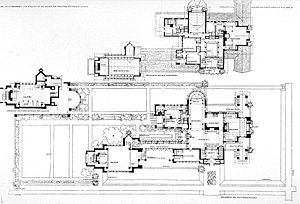
publisher Ernst Wasmuth, with an accompanying monograph by Wright. It contained plans and perspectives (in linework only) of buildings from 1893-1909. It was the first publication of any of Wright's work to appear anywhere in the world, as Wright had not published any of his work in his twenty previous years of activity in the United States
United States
The United States of America is a federal constitutional republic comprising fifty states and a federal district...
.
The portfolio is significant as a link between Wright's pioneering American architecture, and the first generation of modernist architects in Europe. Wright toured Europe for a year from October 1909 through October 1910, partly to support the publication of the portfolio, but also to experience firsthand a great deal of European architectural history.
Wright's early influence in northern Europe is unquestionable: Le Corbusier
Le Corbusier
Charles-Édouard Jeanneret, better known as Le Corbusier , was a Swiss-born French architect, designer, urbanist, writer and painter, famous for being one of the pioneers of what now is called modern architecture. He was born in Switzerland and became a French citizen in 1930...
is known to have had and shared a copy, Czech architect Antonin Raymond
Antonin Raymond
Antonin Raymond, or , born: was a Czech architect, who lived and worked in the USA and Japan...
and Austrian architects Rudolf Schindler
Rudolf Schindler
Rudolph Michael Schindler Rudolph Michael Schindler Rudolph Michael Schindler (born Rudolf Michael Schindler (1887 Vienna - 1953 Los Angeles) was an American, born in Austria, architect whose most important works were built in or near Los Angeles during the early to mid-twentieth century....
and Richard Neutra
Richard Neutra
Richard Joseph Neutra is considered one of modernism's most important architects.- Biography :Neutra was born in Leopoldstadt, the 2nd district of Vienna, Austria Hungary, on April 8, 1892. He was born into both-Jewish wealthy family...
all re-located to the United States in hopes of working for Wright, and one look at Willem Marinus Dudok
Willem Marinus Dudok
Willem Marinus Dudok , was a Dutch modernist architect, best known for the brick Hilversum City Hall....
's 1924 Hilversum Town Hall betrays its origins. At the time of the portfolio's publication, three major influential architects of the twentieth century (Le Corbusier, Ludwig Mies van der Rohe
Ludwig Mies van der Rohe
Ludwig Mies van der Rohe was a German architect. He is commonly referred to and addressed as Mies, his surname....
and Walter Gropius
Walter Gropius
Walter Adolph Georg Gropius was a German architect and founder of the Bauhaus School who, along with Ludwig Mies van der Rohe and Le Corbusier, is widely regarded as one of the pioneering masters of modern architecture....
) were all working essentially as apprentices in the atelier of Peter Behrens
Peter Behrens
Peter Behrens was a German architect and designer. He was important for the modernist movement, as several of the movements leading names worked for him when they were young.-Biography:Behrens attended the Christianeum Hamburg from September 1877 until Easter 1882...
in Berlin, where it has been said that work stopped for the day when the portfolio arrived. If this story is true, it reveals the magnitude of the immediate impact of Wright's architecture in European circles, since Behrens could have conceivably received a copy of the Wasmuth portfolio merely days or weeks after its publication.
Wright would never admit that the exchange worked both ways, always claiming that he took nothing from his year in Europe, but the work of Wright scholar Anthony Alofsin
Anthony Alofsin
Anthony Alofsin is an architect, artist, art historian, writer, and professor. Educated at Andover, Harvard, and Columbia University, he has been named a Fellow, Bogliasco Foundation, Liguria Study Center for the Arts and Humanities; Ailsa Mellon Bruce Senior Fellow, Center for Advanced Studies in...
suggests that Wright was heavily influenced by the work of the Vienna Secession
Vienna Secession
The Vienna Secession was formed in 1897 by a group of Austrian artists who had resigned from the Association of Austrian Artists, housed in the Vienna Künstlerhaus. This movement included painters, sculptors, and architects...
. In turn, the Dutch De Stijl
De Stijl
De Stijl , propagating the group's theories. Next to van Doesburg, the group's principal members were the painters Piet Mondrian , Vilmos Huszár , and Bart van der Leck , and the architects Gerrit Rietveld , Robert van 't Hoff , and J.J.P. Oud...
movement follows Wright's designs by just a few years. De Stijl's major contributors credit Wright with some influence.
Approximately half of the images in the Wasmuth portfolio are the work of architect and one-time Wright assistant Marion Mahony Griffin
Marion Mahony Griffin
Marion Griffin was an American architect and artist. She was one of the first licenced female architects in the world, and is considered an original member of the Prairie School.-Biography:...
, whose visual style has a lot to do with its success.
As of 2009, the Portfolio is in print as Drawings and Plans of Frank Lloyd Wright: The Early Period (1893-1909).
List of selected works contained in the Wasmuth Portfolio
- Edwin H. Cheney HouseEdwin H. Cheney HouseEdwin H. Cheney House located in Oak Park, Illinois, United States, was Frank Lloyd Wright's design of this residence for electrical engineer Edwin Cheney. The house is part of the Frank Lloyd Wright-Prairie School of Architecture Historic District...
- Como Orchard Summer Colony
- Coonley HouseCoonley HouseThe Avery Coonley House, also known as Coonley House, was designed by famous architect Frank Lloyd Wright. Constructed in 1907-1908, this is an estate of several buildings built on the banks of the Des Plaines River in Riverside, Illinois, a suburb of Chicago, Illinois, United States...
- Dana-Thomas House
- Thomas P. Hardy HouseThomas P. Hardy HouseThe Thomas P. Hardy House is a Frank Lloyd Wright designed Prairie school homein Racine, Wisconsin that was built in 1905. The house isunimpressive when seen from the street, but striking when viewed from the Lake Michiganshoreline....
- William R. Heath HouseWilliam R. Heath HouseThe William R. Heath House, was designed by Frank Lloyd Wright, built between 1904 & 1905, and is located at 76 Soldiers Place in Buffalo, New York. It is built in the Prairie School architectural style....
- Larkin Administration BuildingLarkin Administration BuildingThe Larkin Building was designed in 1904 by Frank Lloyd Wright and built in 1906 for the Larkin Soap Company of Buffalo, New York. The five story dark red brick building used pink tinted mortar and utilized steel frame construction. It was noted for many innovations, including air conditioning,...
- Darwin D. Martin HouseDarwin D. Martin HouseThe Darwin D. Martin House Complex, also known as the Darwin Martin House State Historic Site, was designed by Frank Lloyd Wright and built between 1903 and 1905...
- Park Inn HotelPark Inn HotelPark Inn Hotel and City National Bank are two adjacent commercial buildings located in downtown Mason City, Iowa which were designed in the Prairie School style by the renowned architect Frank Lloyd Wright. Completed in 1910, the Park Inn Hotel is the last remaining Frank Lloyd Wright designed...
- Robie HouseRobie HouseThe Frederick C. Robie House is a U.S. National Historic Landmark in the Chicago, Illinois neighborhood of Hyde Park at 5757 S. Woodlawn Avenue on the South Side. It was designed and built between 1908 and 1910 by architect Frank Lloyd Wright and is renowned as the greatest example of his Prairie...
- Unity TempleUnity TempleUnity Temple is a Unitarian Universalist church in Oak Park, Illinois, and the home of the Unity Temple Unitarian Universalist Congregation. It was designed by the American architect Frank Lloyd Wright, and built between 1905 and 1908. Unity Temple is considered to be one of Wright's most important...
- Westcott House
- Winslow House