


Warsaw concentration camp

Encyclopedia
The Warsaw concentration camp was an associated group of the German Nazi concentration camps, possibly including an extermination camp, located in German
-occupied Warsaw
, capital city
of Poland
. The various details regarding the camp are very controversial and remain subject of historical research and public debate.
, Warsaw was to be turned into a provincial German city. To accomplish this goal, the Jewish population was grouped together in the Warsaw Ghetto
before being eventually removed and mostly exterminated. The Nazis' next step in their plan was the removal of the gentile
population of the city, which thus became the target of the łapanka roundup policy of closing-off a street in an attempt to detain large numbers of civilians at random. Between 1942 and 1944, there were about 400 victims of such roundups in Warsaw daily and the detainees were being first transferred to the KL Warschau custody.
. The first commandant of the camp was SS-Obersturmbannführer
Wilhelm Goecke, the former commandant of Mauthausen-Gusen concentration camp
. In addition to its genocidal
purposes, the camp was designed to provide a work force to clean up the leveled ruins of the former Warsaw Ghetto and ultimately turn this area into a planned recreational park for the SS.
The exact date of the camp's creation remains unknown. Some historians have suggested that it was created following the orders of SS-Obergruppenführer Oswald Pohl
on June 11, 1943. However, others, among them historian and Institute of National Remembrance
(IPN) judge Maria Trzcińska, claimed that the camp has been already operational prior to the Warsaw Ghetto Uprising
of April 1943. The factual basis for this aforementioned claim is that on October 9, 1942, the SS head Heinrich Himmler
issued an order in which he stated, regarding the population of the Warsaw Ghetto: "I've issued orders and requested that all the so-called arms factories workers working only as tailors, furriers or bootmakers be grouped in the nearest concentration camps, that is in Warsaw and in Lublin
."
, also ethnic Ukrainians
and Latvians
from Trawniki concentration camp
.
The camp was composed of six small parts located in different areas of Warsaw, all of which were connected by railway and were under unified organization and one command. In chronological order of opening, those were:
The overall area of the camp was 1.2 km², with 119 barracks purposely built to hold approximately 40,000 prisoners, and its infrastructure included several crematoriums.
among the dead; smaller groups of victims included Greeks
, Romani people, Belarusians
and the German-interned officers of the Italian Army
.
According to IPN, most of these executed at the camp were killed by gunfire, mostly with machine gun
s, both in the camp and in an adjoining "security zone". Some of the hostage
s and prisoners were also publicly executed
in the streets of Warsaw by the means of firing squad shooting and hanging
. Numerous other victims were also gassed in the gas chamber
s at Gęsia Street, where a considerable quantity of Zyklon B
was found after the war. The first gassing there took place on October 17, 1943, killing at least 150 Poles caught in a street roundup and about 20 Belgian Jews
. A relatively small number of victims were sadistically killed by drunken guards in the so-called "amphitheatre
" at Gęsiówka, or hanged at the so-called "death wall" (ściana śmierci) at Koło. There was also a mysterious T-shaped structure in the forest near Koło where the prisoners were occasionally transported by trucks but were never seen again. Besides the outright murders, majority of deaths in the camps resulted from physical exhaustion and typhus
epidemics.
Dead bodies were either cremated in crematoriums or open-air pyre
s (including at a former sports stadium) or simply buried under collapsed buildings during the systematic demolition of the former ghetto. A team of the SS wearing white coats and posing as medical workers also patrolled the ruins in order to locate and shoot the remaining Jews still hiding since the end of the ghetto uprising.
Street near the train station Warszawa Zachodnia. The tunnel of 630 square meters would have been large enough to kill up to 1,000 people at one time, using poison gas like Zyklon B or carbon monoxide
if the new IPN
testimonies were accurate. According to the propagators of the mass gassing theory based on three eye-witness accounts from the 1980s, the tunnel had been used to kill multiple truckloads of prisoners. However, all known Nazi gas chambers were typically much smaller and lower and so the use of a large tunnel as a gas chamber would be highly irregular and inefficient, and therefore improbable.
The Bema Street tunnel was restored to street traffic after the war. In a further controversy, the alleged gas exhauster machinery and mysterious massive ventilators that might have been used to remove the gas into the atmosphere following the gassings were removed and scrapped during renovation works in 1996 and early 2000s. In recent years, the part of the tunnel was turned into an unofficial mausoleum
site by citizens of Warsaw. In 2001 the Polish parliament Sejm
appealed for construction of an official memorial
at the tunnel.
The controversy has been secretly, not publicly debated while almost completely unknown during the communist era of the Polish People's Republic (allegedly, the reason behind this secrecy was to inflate the casualty figures of the 1944 Warsaw Uprising by adding the victims of the camp to the uprising's actual death toll). In 2006, Sejm once more recommended to initiate the new investigation of the tunnel's past by new team of IPN, this time from the city of Łódź. Beginning 2007 the investigation is being once more conducted by the IPN's Warsaw team.
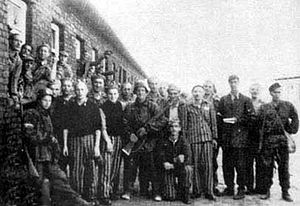 On July 20, 1943, SS-Obergruppenführer Wilhelm Koppe
ordered the complex to be liquidated and dismantled. The majority of prisoners were either executed or were transferred to other concentration camps, such as Dachau, Gross-Rosen
and Ravensbrück
. Between July 28 and July 31, four major railway transports left Warsaw, containing some 12,300 prisoners. Only a small group of several hundred inmates, mostly Jews from the other occupied countries, have been left in Pawiak and Gęsiówka to dig up and burn the bodies that were buried under the blown-up buildings of the ghetto. The camp's documentation was burnt and many of its structures and facalities were mined for demolition.
On August 5, 1944, during the first days of Warsaw Uprising, an assault group of Armia Krajowa
(AK) stormed the Gęsiówka sub-camp using a captured German tank and set free the remaining 360 men and women before they were forced to withdraw. On August 21, after a failed insurgent attack on Pawiak, the Germans executed almost all (except only seven) of the remaining inmates and the prison was blown up.
" political prisoners by the Soviet NKVD
and then by the Polish MBP
until 1954 (the last prisoners left in 1956). It was the second biggest prison after the Mokotów Prison
.
Germans
The Germans are a Germanic ethnic group native to Central Europe. The English term Germans has referred to the German-speaking population of the Holy Roman Empire since the Late Middle Ages....
-occupied Warsaw
Warsaw
Warsaw is the capital and largest city of Poland. It is located on the Vistula River, roughly from the Baltic Sea and from the Carpathian Mountains. Its population in 2010 was estimated at 1,716,855 residents with a greater metropolitan area of 2,631,902 residents, making Warsaw the 10th most...
, capital city
Capital City
Capital City was a television show produced by Euston Films which focused on the lives of investment bankers in London living and working on the corporate trading floor for the fictional international bank Shane-Longman....
of Poland
Poland
Poland , officially the Republic of Poland , is a country in Central Europe bordered by Germany to the west; the Czech Republic and Slovakia to the south; Ukraine, Belarus and Lithuania to the east; and the Baltic Sea and Kaliningrad Oblast, a Russian exclave, to the north...
. The various details regarding the camp are very controversial and remain subject of historical research and public debate.
Pabst Plan
According to the Nazi Pabst PlanPabst Plan
The Pabst Plan was a Nazi German urban plan to reconstruct the city of Warsaw as a Nazi model city. Named after its creator Friedrich Pabst, the Nazis' "Chief Architect for Warsaw", the plan assumed that Warsaw, the historical capital of Poland and a city of 1.5 million inhabitants, would be...
, Warsaw was to be turned into a provincial German city. To accomplish this goal, the Jewish population was grouped together in the Warsaw Ghetto
Warsaw Ghetto
The Warsaw Ghetto was the largest of all Jewish Ghettos in Nazi-occupied Europe during World War II. It was established in the Polish capital between October and November 15, 1940, in the territory of General Government of the German-occupied Poland, with over 400,000 Jews from the vicinity...
before being eventually removed and mostly exterminated. The Nazis' next step in their plan was the removal of the gentile
Gentile
The term Gentile refers to non-Israelite peoples or nations in English translations of the Bible....
population of the city, which thus became the target of the łapanka roundup policy of closing-off a street in an attempt to detain large numbers of civilians at random. Between 1942 and 1944, there were about 400 victims of such roundups in Warsaw daily and the detainees were being first transferred to the KL Warschau custody.
Establishment date controversy
The earliest official mention of the Warsaw concentration camp (KZ Warschau) is from June 19, 1943, which referred to the concentration camp in the ruins of the former Warsaw Ghetto. However, the term KZ Warschau was also used to describe similar camps that were discovered at an earlier date. Nevertheless, it is estimated that the camp was in operation from the autumn of 1942 until the Warsaw UprisingWarsaw Uprising
The Warsaw Uprising was a major World War II operation by the Polish resistance Home Army , to liberate Warsaw from Nazi Germany. The rebellion was timed to coincide with the Soviet Union's Red Army approaching the eastern suburbs of the city and the retreat of German forces...
. The first commandant of the camp was SS-Obersturmbannführer
Obersturmbannführer
Obersturmbannführer was a paramilitary Nazi Party rank used by both the SA and the SS. It was created in May 1933 to fill the need for an additional field grade officer rank above Sturmbannführer as the SA expanded. It became an SS rank at the same time...
Wilhelm Goecke, the former commandant of Mauthausen-Gusen concentration camp
Mauthausen-Gusen concentration camp
Mauthausen Concentration Camp grew to become a large group of Nazi concentration camps that was built around the villages of Mauthausen and Gusen in Upper Austria, roughly east of the city of Linz.Initially a single camp at Mauthausen, it expanded over time and by the summer of 1940, the...
. In addition to its genocidal
Genocide
Genocide is defined as "the deliberate and systematic destruction, in whole or in part, of an ethnic, racial, religious, or national group", though what constitutes enough of a "part" to qualify as genocide has been subject to much debate by legal scholars...
purposes, the camp was designed to provide a work force to clean up the leveled ruins of the former Warsaw Ghetto and ultimately turn this area into a planned recreational park for the SS.
The exact date of the camp's creation remains unknown. Some historians have suggested that it was created following the orders of SS-Obergruppenführer Oswald Pohl
Oswald Pohl
Oswald Pohl was a Nazi official and member of the SS , involved in the mass murders of Jews in concentration camps, the so-called Final Solution.-Early years:...
on June 11, 1943. However, others, among them historian and Institute of National Remembrance
Institute of National Remembrance
Institute of National Remembrance — Commission for the Prosecution of Crimes against the Polish Nation is a Polish government-affiliated research institute with lustration prerogatives and prosecution powers founded by specific legislation. It specialises in the legal and historical sciences and...
(IPN) judge Maria Trzcińska, claimed that the camp has been already operational prior to the Warsaw Ghetto Uprising
Warsaw Ghetto Uprising
The Warsaw Ghetto Uprising was the Jewish resistance that arose within the Warsaw Ghetto in German occupied Poland during World War II, and which opposed Nazi Germany's effort to transport the remaining ghetto population to Treblinka extermination camp....
of April 1943. The factual basis for this aforementioned claim is that on October 9, 1942, the SS head Heinrich Himmler
Heinrich Himmler
Heinrich Luitpold Himmler was Reichsführer of the SS, a military commander, and a leading member of the Nazi Party. As Chief of the German Police and the Minister of the Interior from 1943, Himmler oversaw all internal and external police and security forces, including the Gestapo...
issued an order in which he stated, regarding the population of the Warsaw Ghetto: "I've issued orders and requested that all the so-called arms factories workers working only as tailors, furriers or bootmakers be grouped in the nearest concentration camps, that is in Warsaw and in Lublin
Majdanek
Majdanek was a German Nazi concentration camp on the outskirts of Lublin, Poland, established during the German Nazi occupation of Poland. The camp operated from October 1, 1941 until July 22, 1944, when it was captured nearly intact by the advancing Soviet Red Army...
."
Organization
In the atlas Atlas zur deutschen Zeitgeschichte 1918-1968 published in 1986 in Deutschland KL, Warschau is signed as Hauptlager ("main camp") and as such it has the same status as KL Dachau. The guards included, besides Germans and the VolksdeutscheVolksdeutsche
Volksdeutsche - "German in terms of people/folk" -, defined ethnically, is a historical term from the 20th century. The words volk and volkische conveyed in Nazi thinking the meanings of "folk" and "race" while adding the sense of superior civilization and blood...
, also ethnic Ukrainians
Ukrainians
Ukrainians are an East Slavic ethnic group native to Ukraine, which is the sixth-largest nation in Europe. The Constitution of Ukraine applies the term 'Ukrainians' to all its citizens...
and Latvians
Latvians
Latvians or Letts are the indigenous Baltic people of Latvia.-History:Latvians occasionally refer to themselves by the ancient name of Latvji, which may have originated from the word Latve which is a name of the river that presumably flowed through what is now eastern Latvia...
from Trawniki concentration camp
Trawniki concentration camp
Trawniki concentration camp, in the village of Trawniki about 40 km southeast of Lublin in Poland, was an SS labour camp which provided forced labourers for a nearby industrial plant to work in appalling conditions with little food...
.
The camp was composed of six small parts located in different areas of Warsaw, all of which were connected by railway and were under unified organization and one command. In chronological order of opening, those were:
- Konzentrationslager (concentration camp) at Koło area (formerly a KreigsgefangenenlagerStalagIn Germany, stalag was a term used for prisoner-of-war camps. Stalag is a contraction of "Stammlager", itself short for Kriegsgefangenen-Mannschafts-Stammlager.- Legal definitions :...
POW camp for the Polish Army soldiers captured in 1939);) this part remains controversial since local residents claim Maria Trzcinska mistook buildings of "drewniane Kolo" housing project for a camp. - Vernichtungslager (extermination camp) near the Warszawa Zachodnia train stationTrain stationA train station, also called a railroad station or railway station and often shortened to just station,"Station" is commonly understood to mean "train station" unless otherwise qualified. This is evident from dictionary entries e.g...
(this part remains very controversial); - Gęsia Street (now: AnielewiczaMordechaj AnielewiczMordechaj Anielewicz was the leader of Żydowska Organizacja Bojowa , also known as ŻOB, during the Warsaw Ghetto Uprising from January to May 1943.-Biography:Anielewicz was born into a poor family in the small town of Wyszków near Warsaw...
Street) concentration camp (formerly ArbeitserziehungslagerArbeitslagerArbeitslager is a German language word which means labor camp.The German government under Nazism used forced labor extensively, starting in the 1930s but most especially during World War II....
, or "re-educational labour camp") in the former ghetto known as GęsiówkaGesiówkaGęsiówka , was a Nazi concentration camp in Warsaw, Poland.- History of Gęsiówka :Before the war, Gęsiówka was a military prison of the Polish Army on Gęsia Street . Beginning in 1939, after the German occupation of Poland, it became a re-education camp of the German security police...
; - a camp for foreign Jews located on Nowolipie Street;
- Bonifraterska Street camp near Muranowski Square in the former ghetto;
- the former GestapoGestapoThe Gestapo was the official secret police of Nazi Germany. Beginning on 20 April 1934, it was under the administration of the SS leader Heinrich Himmler in his position as Chief of German Police...
prison on Pawia Street known as PawiakPawiakPawiak was a prison built in 1835 in Warsaw, Poland.During the January 1863 Uprising, it served as a transfer camp for Poles sentenced by Imperial Russia to deportation to Siberia....
.
The overall area of the camp was 1.2 km², with 119 barracks purposely built to hold approximately 40,000 prisoners, and its infrastructure included several crematoriums.
Death in KL Warschau
The IPN estimates that the number of victims who were exterminated those camps to be "not less than tens of thousands". However, it refrains from making a more precise estimate due to scant evidence. Trzcińska's estimate however place the number of the camp's victims well above 212,000, mostly gentile Poles. Others estimate the amount of deaths at 20,000 to 35,000 (not including some 37,000 people executed at Pawiak), with a proportionally larger percentage of the Polish and other European including JewsJews
The Jews , also known as the Jewish people, are a nation and ethnoreligious group originating in the Israelites or Hebrews of the Ancient Near East. The Jewish ethnicity, nationality, and religion are strongly interrelated, as Judaism is the traditional faith of the Jewish nation...
among the dead; smaller groups of victims included Greeks
Greeks
The Greeks, also known as the Hellenes , are a nation and ethnic group native to Greece, Cyprus and neighboring regions. They also form a significant diaspora, with Greek communities established around the world....
, Romani people, Belarusians
Belarusians
Belarusians ; are an East Slavic ethnic group who populate the majority of the Republic of Belarus. Introduced to the world as a new state in the early 1990s, the Republic of Belarus brought with it the notion of a re-emerging Belarusian ethnicity, drawn upon the lines of the Old Belarusian...
and the German-interned officers of the Italian Army
Italian Army
The Italian Army is the ground defence force of the Italian Armed Forces. It is all-volunteer force of active-duty personnel, numbering 108,355 in 2010. Its best-known combat vehicles are the Dardo infantry fighting vehicle, the Centauro tank destroyer and the Ariete tank, and among its aircraft...
.
According to IPN, most of these executed at the camp were killed by gunfire, mostly with machine gun
Machine gun
A machine gun is a fully automatic mounted or portable firearm, usually designed to fire rounds in quick succession from an ammunition belt or large-capacity magazine, typically at a rate of several hundred rounds per minute....
s, both in the camp and in an adjoining "security zone". Some of the hostage
Hostage
A hostage is a person or entity which is held by a captor. The original definition meant that this was handed over by one of two belligerent parties to the other or seized as security for the carrying out of an agreement, or as a preventive measure against certain acts of war...
s and prisoners were also publicly executed
Public Execution
Public Execution is a Mouse and the Traps retrospective album that has been released in both LP and CD formats. The LP has an unusually large number of tracks , while the CD includes 4 bonus tracks and catalogues almost all of the released music by Mouse and the Traps and their associated bands: ...
in the streets of Warsaw by the means of firing squad shooting and hanging
Hanging
Hanging is the lethal suspension of a person by a ligature. The Oxford English Dictionary states that hanging in this sense is "specifically to put to death by suspension by the neck", though it formerly also referred to crucifixion and death by impalement in which the body would remain...
. Numerous other victims were also gassed in the gas chamber
Gas chamber
A gas chamber is an apparatus for killing humans or animals with gas, consisting of a sealed chamber into which a poisonous or asphyxiant gas is introduced. The most commonly used poisonous agent is hydrogen cyanide; carbon dioxide and carbon monoxide have also been used...
s at Gęsia Street, where a considerable quantity of Zyklon B
Zyklon B
Zyklon B was the trade name of a cyanide-based pesticide infamous for its use by Nazi Germany to kill human beings in gas chambers of extermination camps during the Holocaust. The "B" designation indicates one of two types of Zyklon...
was found after the war. The first gassing there took place on October 17, 1943, killing at least 150 Poles caught in a street roundup and about 20 Belgian Jews
History of the Jews in Belgium
Jews and Judaism have a long history in Belgium, from the 1st century CE until today. The Jewish community numbered 100,000 on the eve of the Second World War, but after the war and the Holocaust, is now less than half that number.-Early history:...
. A relatively small number of victims were sadistically killed by drunken guards in the so-called "amphitheatre
Amphitheatre
An amphitheatre is an open-air venue used for entertainment and performances.There are two similar, but distinct, types of structure for which the word "amphitheatre" is used: Ancient Roman amphitheatres were large central performance spaces surrounded by ascending seating, and were commonly used...
" at Gęsiówka, or hanged at the so-called "death wall" (ściana śmierci) at Koło. There was also a mysterious T-shaped structure in the forest near Koło where the prisoners were occasionally transported by trucks but were never seen again. Besides the outright murders, majority of deaths in the camps resulted from physical exhaustion and typhus
Typhus
Epidemic typhus is a form of typhus so named because the disease often causes epidemics following wars and natural disasters...
epidemics.
Dead bodies were either cremated in crematoriums or open-air pyre
Pyre
A pyre , also known as a funeral pyre, is a structure, usually made of wood, for burning a body as part of a funeral rite...
s (including at a former sports stadium) or simply buried under collapsed buildings during the systematic demolition of the former ghetto. A team of the SS wearing white coats and posing as medical workers also patrolled the ruins in order to locate and shoot the remaining Jews still hiding since the end of the ghetto uprising.
Bema Street tunnel controversy
A hotly-debated controversy surrounds the alleged existence of an enormous gas chamber in the pre-existing (Polish-built) road tunnel on Józef BemJózef Bem
Józef Zachariasz Bem was a Polish general, an Ottoman Pasha and a national hero of Poland and Hungary, and a figure intertwined with other European nationalisms...
Street near the train station Warszawa Zachodnia. The tunnel of 630 square meters would have been large enough to kill up to 1,000 people at one time, using poison gas like Zyklon B or carbon monoxide
Carbon monoxide
Carbon monoxide , also called carbonous oxide, is a colorless, odorless, and tasteless gas that is slightly lighter than air. It is highly toxic to humans and animals in higher quantities, although it is also produced in normal animal metabolism in low quantities, and is thought to have some normal...
if the new IPN
IPN
IPN may refer to:* Intuit PaymentNetwork* Independent Practitioners Network* Infectious pancreatic necrosis, disease in fishes* Instant Private Network, type of VPN...
testimonies were accurate. According to the propagators of the mass gassing theory based on three eye-witness accounts from the 1980s, the tunnel had been used to kill multiple truckloads of prisoners. However, all known Nazi gas chambers were typically much smaller and lower and so the use of a large tunnel as a gas chamber would be highly irregular and inefficient, and therefore improbable.
The Bema Street tunnel was restored to street traffic after the war. In a further controversy, the alleged gas exhauster machinery and mysterious massive ventilators that might have been used to remove the gas into the atmosphere following the gassings were removed and scrapped during renovation works in 1996 and early 2000s. In recent years, the part of the tunnel was turned into an unofficial mausoleum
Mausoleum
A mausoleum is an external free-standing building constructed as a monument enclosing the interment space or burial chamber of a deceased person or persons. A monument without the interment is a cenotaph. A mausoleum may be considered a type of tomb or the tomb may be considered to be within the...
site by citizens of Warsaw. In 2001 the Polish parliament Sejm
Sejm
The Sejm is the lower house of the Polish parliament. The Sejm is made up of 460 deputies, or Poseł in Polish . It is elected by universal ballot and is presided over by a speaker called the Marshal of the Sejm ....
appealed for construction of an official memorial
Memorial
A memorial is an object which serves as a focus for memory of something, usually a person or an event. Popular forms of memorials include landmark objects or art objects such as sculptures, statues or fountains, and even entire parks....
at the tunnel.
The controversy has been secretly, not publicly debated while almost completely unknown during the communist era of the Polish People's Republic (allegedly, the reason behind this secrecy was to inflate the casualty figures of the 1944 Warsaw Uprising by adding the victims of the camp to the uprising's actual death toll). In 2006, Sejm once more recommended to initiate the new investigation of the tunnel's past by new team of IPN, this time from the city of Łódź. Beginning 2007 the investigation is being once more conducted by the IPN's Warsaw team.
Liquidation
Wilhelm Koppe
Wilhelm Koppe was a German Nazi commander who was responsible for numerous atrocities against Poles and Jews in Reichsgau Wartheland and the General Government during the German occupation of Poland in World War II.-Biography:Born in Hildesheim, he fought in the First World War...
ordered the complex to be liquidated and dismantled. The majority of prisoners were either executed or were transferred to other concentration camps, such as Dachau, Gross-Rosen
Gross-Rosen concentration camp
KL Gross-Rosen was a German concentration camp, located in Gross-Rosen, Lower Silesia . It was located directly on the rail line between Jauer and Striegau .-The camp:...
and Ravensbrück
Ravensbrück concentration camp
Ravensbrück was a notorious women's concentration camp during World War II, located in northern Germany, 90 km north of Berlin at a site near the village of Ravensbrück ....
. Between July 28 and July 31, four major railway transports left Warsaw, containing some 12,300 prisoners. Only a small group of several hundred inmates, mostly Jews from the other occupied countries, have been left in Pawiak and Gęsiówka to dig up and burn the bodies that were buried under the blown-up buildings of the ghetto. The camp's documentation was burnt and many of its structures and facalities were mined for demolition.
On August 5, 1944, during the first days of Warsaw Uprising, an assault group of Armia Krajowa
Armia Krajowa
The Armia Krajowa , or Home Army, was the dominant Polish resistance movement in World War II German-occupied Poland. It was formed in February 1942 from the Związek Walki Zbrojnej . Over the next two years, it absorbed most other Polish underground forces...
(AK) stormed the Gęsiówka sub-camp using a captured German tank and set free the remaining 360 men and women before they were forced to withdraw. On August 21, after a failed insurgent attack on Pawiak, the Germans executed almost all (except only seven) of the remaining inmates and the prison was blown up.
Communist prison camp
After the Soviet takeover of Warsaw in January 1945, the remnants of the camp were used to as a POW camp and a place of detention of the "enemies of the people's powerEnemy of the people
The term enemy of the people is a fluid designation of political or class opponents of the group using the term. The term implies that the "enemies" in question are acting against society as a whole. It is similar to the notion of "enemy of the state". The term originated in Roman times as ,...
" political prisoners by the Soviet NKVD
NKVD
The People's Commissariat for Internal Affairs was the public and secret police organization of the Soviet Union that directly executed the rule of power of the Soviets, including political repression, during the era of Joseph Stalin....
and then by the Polish MBP
Ministry of Public Security of Poland
The Ministry of Public Security of Poland was a Polish communist secret police, intelligence and counter-espionage service operating from 1945 to 1954 under Jakub Berman of the Politburo...
until 1954 (the last prisoners left in 1956). It was the second biggest prison after the Mokotów Prison
Mokotów Prison
Mokotów Prison is a prison in Warsaw's borough of Mokotów, Poland, located at Rakowiecka 37 street. It was built by the Russians in the final years of the foreign Partitions of Poland...
.
See also
- Camps in Poland during World War II
- GęsiówkaGesiówkaGęsiówka , was a Nazi concentration camp in Warsaw, Poland.- History of Gęsiówka :Before the war, Gęsiówka was a military prison of the Polish Army on Gęsia Street . Beginning in 1939, after the German occupation of Poland, it became a re-education camp of the German security police...
- List of Nazi-German concentration camps
- Kaiser Wilhelm Institute of Anthropology, Human Heredity, and EugenicsKaiser Wilhelm Institute of Anthropology, Human Heredity, and EugenicsThe Kaiser Wilhelm Institute of Anthropology, Human Heredity, and Eugenics was founded in 1927. The Rockefeller Foundation supported both the Kaiser Wilhelm Institute of Psychiatry and the Kaiser Wilhelm Institute of Anthropology, Human Heredity and Eugenics...
- Research Materials: Max Planck Society ArchiveResearch Materials: Max Planck Society ArchiveAt the end of World War II, the Kaiser Wilhelm Society was renamed the Max Planck Society, and the institutes associated with the Kaiser Wilhelm Society were renamed "Max Planck" institutes. The records that were archived under the former Kaiser Wilhelm Society and its institutes were placed in the...
- Shark Island, German South West Africa
- Nazi crimes against ethnic PolesNazi crimes against ethnic PolesIn addition to about 2.9 million Polish Jews , about 2.8 million non-Jewish Polish citizens perished during the course of the war...
- PawiakPawiakPawiak was a prison built in 1835 in Warsaw, Poland.During the January 1863 Uprising, it served as a transfer camp for Poles sentenced by Imperial Russia to deportation to Siberia....
- Warsaw Ghetto UprisingWarsaw Ghetto UprisingThe Warsaw Ghetto Uprising was the Jewish resistance that arose within the Warsaw Ghetto in German occupied Poland during World War II, and which opposed Nazi Germany's effort to transport the remaining ghetto population to Treblinka extermination camp....
- Warsaw UprisingWarsaw UprisingThe Warsaw Uprising was a major World War II operation by the Polish resistance Home Army , to liberate Warsaw from Nazi Germany. The rebellion was timed to coincide with the Soviet Union's Red Army approaching the eastern suburbs of the city and the retreat of German forces...
Sources
- Andreas Mix: Warschau-Stammlager. In: Wolfgang BenzWolfgang BenzWolfgang Benz is a German historian. He has been the director of the Center for Research on Antisemitism of the Technische Universität Berlin since 1990.-Personal life:...
, Barbara Distel: Der Ort des Terrors. München 2008, ISBN 978-3-406-57237-1, Band 8, S. 93 - Norman Davies "Europe at War 1939–1945: No Simple Victory". Macmillan. ISBN 0-333-69285-3
- Maria Trzcińska, Obóz zagłady w centrum Warszawy, Polskie Wydawnictwo Encyklopedyczne, Radom 2002, ISBN 83-88822-16-0
- Bogusław Kopka, "Konzentrationslager Warschau Historia i następstwa", Instytut Pamięci Narodowej, Warszawa 2007, ISBN 83-60464-46-4
- Informacja o ustaleniach dotyczących Konzentrationslager Warschau - Institute of National RemembranceInstitute of National RemembranceInstitute of National Remembrance — Commission for the Prosecution of Crimes against the Polish Nation is a Polish government-affiliated research institute with lustration prerogatives and prosecution powers founded by specific legislation. It specialises in the legal and historical sciences and...
, June 2002 - Śmierć w Warschau, "PolitykaPolitykaPolityka is a centre-left weekly newsmagazine in Poland. With a circulation of 170,000 it is the country's biggest selling weekly, ahead of Newsweek's Polish edition and Wprost. Today, the magazine has a slightly intellectual, social liberal profile, setting it apart from the more conservative...
", 12 XI 2007
External links
- KZ Warschau Many documents about KL Warschau in original Polish Wikipedia article KL Warschau Wieniec i kamienie pamięci ku czci ofiar KL Warschau (Onet.plOnet.plOnet.pl is the largest Polish web portal. It is owned by the Kraków-based Grupa Onet.pl S.A. It was founded in 1996 by Optimus company. According to Alexa rankings, as of December 2007, it is the 45th most popular website worldwide and the 3rd most popular site in Poland.Onet is currently owned by...
) Zapomniany KL Warschau (Życie WarszawyZycie WarszawyŻycie Warszawy is a right leaning Polish newspaper published in Warsaw. It was founded in October 1944 as an initiative of Polish Workers' Party. Currently it is published by Dom Prasowy Sp. z o.o. and owned by Michał Sołowow....
) Dowody KL Warschau Czas upamiętnić ofiary KL Warschau