


Wallace Line

Encyclopedia
Asia
Asia is the world's largest and most populous continent, located primarily in the eastern and northern hemispheres. It covers 8.7% of the Earth's total surface area and with approximately 3.879 billion people, it hosts 60% of the world's current human population...
and Wallacea
Wallacea
Wallacea is a biogeographical designation for a group of Indonesian islands separated by deep water straits from the Asian and Australian continental shelves. Wallacea includes Sulawesi, the largest island in the group, as well as Lombok, Sumbawa, Flores, Sumba, Timor, Halmahera, Buru, Seram, and...
, a transitional zone between Asia and Australia
Australia
Australia , officially the Commonwealth of Australia, is a country in the Southern Hemisphere comprising the mainland of the Australian continent, the island of Tasmania, and numerous smaller islands in the Indian and Pacific Oceans. It is the world's sixth-largest country by total area...
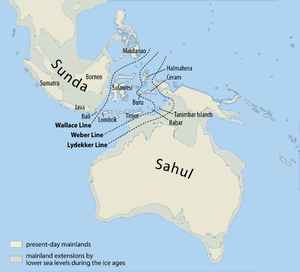
. West of the line are found organisms related to Asiatic species; to the east, a mixture of species of Asian and Australian origin is present. The line is named after Alfred Russel Wallace
Alfred Russel Wallace
Alfred Russel Wallace, OM, FRS was a British naturalist, explorer, geographer, anthropologist and biologist...
, who noticed this clear division during his travels through the East Indies
East Indies
East Indies is a term used by Europeans from the 16th century onwards to identify what is now known as Indian subcontinent or South Asia, Southeastern Asia, and the islands of Oceania, including the Malay Archipelago and the Philippines...
in the 19th century. The line runs through Indonesia
Indonesia
Indonesia , officially the Republic of Indonesia , is a country in Southeast Asia and Oceania. Indonesia is an archipelago comprising approximately 13,000 islands. It has 33 provinces with over 238 million people, and is the world's fourth most populous country. Indonesia is a republic, with an...
, between Borneo
Borneo
Borneo is the third largest island in the world and is located north of Java Island, Indonesia, at the geographic centre of Maritime Southeast Asia....
and Sulawesi
Sulawesi
Sulawesi is one of the four larger Sunda Islands of Indonesia and is situated between Borneo and the Maluku Islands. In Indonesia, only Sumatra, Borneo, and Papua are larger in territory, and only Java and Sumatra have larger Indonesian populations.- Etymology :The Portuguese were the first to...
(Celebes), and through the Lombok Strait
Lombok Strait
The Lombok Strait is a strait connecting the Java Sea to the Indian Ocean, located between the islands of Bali and Lombok in Indonesia. The Gili Islands are on the Lombok side....
between Bali
Bali
Bali is an Indonesian island located in the westernmost end of the Lesser Sunda Islands, lying between Java to the west and Lombok to the east...
and Lombok
Lombok
Lombok is an island in West Nusa Tenggara province, Indonesia. It forms part of the chain of the Lesser Sunda Islands, with the Lombok Strait separating it from Bali to the west and the Alas Strait between it and Sumbawa to the east...
. Antonio Pigafetta
Antonio Pigafetta
Antonio Pigafetta was an Italian scholar and explorer from the Republic of Venice. He travelled with the Portuguese explorer Ferdinand Magellan and his crew on their voyage to the Indies. During the expedition, he served as Magellan's assistant and kept an accurate journal which later assisted him...
had also recorded the biological contrasts between the Philippines
Philippines
The Philippines , officially known as the Republic of the Philippines , is a country in Southeast Asia in the western Pacific Ocean. To its north across the Luzon Strait lies Taiwan. West across the South China Sea sits Vietnam...
and the Maluku Islands
Maluku Islands
The Maluku Islands are an archipelago that is part of Indonesia, and part of the larger Maritime Southeast Asia region. Tectonically they are located on the Halmahera Plate within the Molucca Sea Collision Zone...
(Spice Islands) (on opposite sides of the line) in 1521 during the continuation of the voyage of Ferdinand Magellan
Ferdinand Magellan
Ferdinand Magellan was a Portuguese explorer. He was born in Sabrosa, in northern Portugal, and served King Charles I of Spain in search of a westward route to the "Spice Islands" ....
, after Magellan had been killed on Mactan.
The distance between Bali and Lombok is small, about 35 kilometers. The distributions of many bird
Bird
Birds are feathered, winged, bipedal, endothermic , egg-laying, vertebrate animals. Around 10,000 living species and 188 families makes them the most speciose class of tetrapod vertebrates. They inhabit ecosystems across the globe, from the Arctic to the Antarctic. Extant birds range in size from...
species observe the line, since many birds do not cross even the smallest stretches of open ocean water. Some bat
Bat
Bats are mammals of the order Chiroptera "hand" and pteron "wing") whose forelimbs form webbed wings, making them the only mammals naturally capable of true and sustained flight. By contrast, other mammals said to fly, such as flying squirrels, gliding possums, and colugos, glide rather than fly,...
s have distributions that cross the line, but other mammals are generally limited to one side or the other; an exception is the Crab-eating Macaque
Crab-eating Macaque
The Crab-eating macaque is a cercopithecine primate native to Southeast Asia. It is also called the "long-tailed macaque", and is referred to as the "cynomolgus monkey" in laboratories.-Etymology:...
. Other groups of plants and animals show differing patterns, but the overall pattern is striking and reasonably consistent.
Biogeography
Understanding of the biogeographyBiogeography
Biogeography is the study of the distribution of species , organisms, and ecosystems in space and through geological time. Organisms and biological communities vary in a highly regular fashion along geographic gradients of latitude, elevation, isolation and habitat area...
of the region centers on the relationship of ancient sea level
Sea level
Mean sea level is a measure of the average height of the ocean's surface ; used as a standard in reckoning land elevation...
s to the continental shelves
Continental shelf
The continental shelf is the extended perimeter of each continent and associated coastal plain. Much of the shelf was exposed during glacial periods, but is now submerged under relatively shallow seas and gulfs, and was similarly submerged during other interglacial periods. The continental margin,...
. Wallace's Line is visible geographically when the continental shelf contours are examined; it can be seen as a deep-water channel that marks the southeastern edge of the Sunda Shelf
Sunda Shelf
Geologically, the Sunda Shelf is a south east extension of the continental shelf of Southeast Asia. Major landmasses on the shelf include the Malay Peninsula, Sumatra, Borneo, Java, Madura, Bali and their surrounding smaller islands. It covers an area of approximately 1.85 million km2...
linking Borneo, Bali, Java, and Sumatra underwater to the mainland of southeastern Asia. Australia is likewise connected via the shallow ocean over the Sahul Shelf
Sahul Shelf
The Sahul Shelf is part of the continental shelf of Sahul and lies off the coast of Australia. The Sahul Shelf proper stretches northwest from Australia much of the way under the Timor Sea towards Timor, ending where the seabed begins descending into the Timor Trough...
to New Guinea; and the related biogeographic boundary known as Lydekker's Line
Richard Lydekker
Richard Lydekker was an English naturalist, geologist and writer of numerous books on natural history.-Biography:...
, which separates the eastern edge of Wallacea and the Australian region, has a similar origin. During ice age
Quaternary glaciation
Quaternary glaciation, also known as the Pleistocene glaciation, the current ice age or simply the ice age, refers to the period of the last few million years in which permanent ice sheets were established in Antarctica and perhaps Greenland, and fluctuating ice sheets have occurred elsewhere...
glacial advances
Glacial period
A glacial period is an interval of time within an ice age that is marked by colder temperatures and glacier advances. Interglacials, on the other hand, are periods of warmer climate within an ice age...
, when the ocean levels were up to 120 m lower, both Asia and Australia were united with what are now islands on their respective continental shelves as continuous land masses, but the deep water between those two large continental shelf areas was, for over 50 million years, a barrier that kept the flora and fauna of Australia separated from those of Asia. Wallacea
Wallacea
Wallacea is a biogeographical designation for a group of Indonesian islands separated by deep water straits from the Asian and Australian continental shelves. Wallacea includes Sulawesi, the largest island in the group, as well as Lombok, Sumbawa, Flores, Sumba, Timor, Halmahera, Buru, Seram, and...
consists of islands that were never recently connected by dry land to either of the continental land masses, and thus were populated by organisms capable of crossing the straits between islands. "Weber's Line" runs through this transitional area (to the east of centre), at the tipping point between dominance by species of Asian against those of Australian origin.
See also
- Australia (continent)Australia (continent)Australia is the world's smallest continent, comprising the mainland of Australia and proximate islands including Tasmania, New Guinea, the Aru Islands and Raja Ampat Islands...
- Lydekker's LineRichard LydekkerRichard Lydekker was an English naturalist, geologist and writer of numerous books on natural history.-Biography:...
- WallaceaWallaceaWallacea is a biogeographical designation for a group of Indonesian islands separated by deep water straits from the Asian and Australian continental shelves. Wallacea includes Sulawesi, the largest island in the group, as well as Lombok, Sumbawa, Flores, Sumba, Timor, Halmahera, Buru, Seram, and...
- Weber's Line
Borneo
- Abdullah, M. T. (2003). Biogeography and variation of Cynopterus brachyotis in Southeast Asia. PhD thesis. The University of Queensland, St Lucia, Australia.
- Hall, L. S., Gordon G. Grigg, Craig Moritz, Besar Ketol, Isa Sait, Wahab Marni and M. T. Abdullah (2004). "Biogeography of fruit bats in Southeast Asia". Sarawak Museum Journal LX(81):191-284.
- Wilson D. E., D. M. Reeder (2005). Mammal species of the world. Washington DC: Smithsonian Institution Press.
External links
- Too Many Lines; The Limits of the Oriental and Australian Zoogeographic Regions George Gaylord Simpson, Proceedings of the American Philosophical Society, Vol. 121, No. 2 (Apr. 29, 1977), pp. 107–120
- Wallacea Research Group
- Map of Wallace's, Weber's and Lydekker's lines