


Wallace Hartley

Encyclopedia
Wallace Henry Hartley was an English
violin
ist and bandleader on the on its maiden voyage. He became famous for leading the eight member band as the ship sank on 15 April 1912. He died in the sinking.
, Lancashire
, England
. Harley's father, Albion Hartley, was the choirmaster and Sunday school
superintendent at Bethel Independent Methodist Chapel, where the family attended worship services
. Hartley himself introduced the hymn “Nearer, My God, to Thee
” to the congregation
. Wallace studied at Colne’s Methodist day school, sang in Bethel’s choir and learned violin from a fellow congregation member.
Hartley later moved to Dewsbury
, West Yorkshire
and in 1909, he began working on Cunard Line
ocean liners, primarily on the . In 1912, Hartley worked for the music agency C.W. & F.N. Black, which supplied musicians for Cunard and the White Star Line
.
In April of that year, Hartley was assigned to be the bandmaster for the White Star Line ship . He was at first hesitant to again leave his fiancée, Maria Robinson, to whom he had recently proposed, but Hartley decided that working on the maiden voyage of the Titanic would give him possible contacts for future work.
His ticket number was "250654". He also had the cabin number: E. He was in the 2nd class and as the Head Bandmaster of the Titanic he did not have to pay for his ticket.
s. Many of the survivors said that he and the band continued to play until the very end. None of the band members survived the sinking and the story of them playing to the end became a popular legend. One survivor who clambered aboard 'Collapsible A' claimed to have seen Hartley and his band standing just behind the first funnel, by the Grand Staircase. He went on to say that he saw three of them washed off while the other five held on to the railing on top the Grand Staircase's deckhouse, only to be dragged down with the bow, just before Hartley exclaimed, "Gentlemen, I bid you farewell!" A newspaper at the time reported "the part played by the orchestra on board the Titanic in her last dreadful moments will rank among the noblest in the annals of heroism at sea."
 Though the final song played by the band is unknown, "Nearer, My God, to Thee
" has gained popular acceptance. Former bandmates claimed that Hartley said he would either play "Nearer, My God, to Thee" or "O God, Our Help in Ages Past" if he was ever on a sinking ship, but Walter Lord
's book A Night to Remember popularized wireless officer Harold Bride
's account of hearing the song "Autumn".
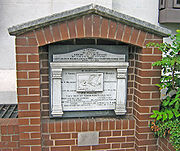
Hartley's body was recovered by the Mackay–Bennet as body number 224 almost two weeks after the sinking. He was transferred to the Arabic and sent to England. One thousand people attended his funeral, while 40,000 lined the route of his funeral procession. He is buried in Colne where a 10-foot monument, containing a carved violin at its base, was erected in his honour. Hartley's large Victorian
terraced house in West Park Street, Dewsbury
, West Yorkshire
, bears a blue plaque
to remind passers-by that this was the bandleader's home. As of 2001, Hartley's name was still being used when naming new streets and housing in the town of Colne.
English people
The English are a nation and ethnic group native to England, who speak English. The English identity is of early mediaeval origin, when they were known in Old English as the Anglecynn. England is now a country of the United Kingdom, and the majority of English people in England are British Citizens...
violin
Violin
The violin is a string instrument, usually with four strings tuned in perfect fifths. It is the smallest, highest-pitched member of the violin family of string instruments, which includes the viola and cello....
ist and bandleader on the on its maiden voyage. He became famous for leading the eight member band as the ship sank on 15 April 1912. He died in the sinking.
Life and career
Wallace Hartley was born and raised in ColneColne
Colne is the second largest town and civil parish in the Borough of Pendle in Lancashire, England, with a population of 20,118. It lies at the eastern end of the M65, 6 miles north-east of Burnley, with Nelson immediately adjacent, in the Aire Gap with two main roads leading into the Yorkshire...
, Lancashire
Lancashire
Lancashire is a non-metropolitan county of historic origin in the North West of England. It takes its name from the city of Lancaster, and is sometimes known as the County of Lancaster. Although Lancaster is still considered to be the county town, Lancashire County Council is based in Preston...
, England
England
England is a country that is part of the United Kingdom. It shares land borders with Scotland to the north and Wales to the west; the Irish Sea is to the north west, the Celtic Sea to the south west, with the North Sea to the east and the English Channel to the south separating it from continental...
. Harley's father, Albion Hartley, was the choirmaster and Sunday school
Sunday school
Sunday school is the generic name for many different types of religious education pursued on Sundays by various denominations.-England:The first Sunday school may have been opened in 1751 in St. Mary's Church, Nottingham. Another early start was made by Hannah Ball, a native of High Wycombe in...
superintendent at Bethel Independent Methodist Chapel, where the family attended worship services
Service of worship
In the Protestant denominations of Christianity, a service of worship is a meeting whose primary purpose is the worship of God. The phrase is normally shortened to service. It is also commonly called a worship service...
. Hartley himself introduced the hymn “Nearer, My God, to Thee
Nearer, My God, to Thee
"Nearer, My God, to Thee" is a 19th century Christian hymn by Sarah Flower Adams, based loosely on Genesis 28:11–19, the story of Jacob's dream. Genesis 28:11–12 can be translated as follows: "So he came to a certain place and stayed there all night, because the sun had set. And he took one of the...
” to the congregation
Local church
A local church is a Christian congregation of members and clergy.Local church may also refer to:* Local churches , a Christian group based on the teachings of Watchman Nee and Witness Lee, and associated with the Living Stream Ministry publishing house.* Parish church, a local church united with...
. Wallace studied at Colne’s Methodist day school, sang in Bethel’s choir and learned violin from a fellow congregation member.
Hartley later moved to Dewsbury
Dewsbury
Dewsbury is a minster town in the Metropolitan Borough of Kirklees, in West Yorkshire, England. It is to the west of Wakefield, east of Huddersfield and south of Leeds...
, West Yorkshire
West Yorkshire
West Yorkshire is a metropolitan county within the Yorkshire and the Humber region of England with a population of 2.2 million. West Yorkshire came into existence as a metropolitan county in 1974 after the passage of the Local Government Act 1972....
and in 1909, he began working on Cunard Line
Cunard Line
Cunard Line is a British-American owned shipping company based at Carnival House in Southampton, England and operated by Carnival UK. It has been a leading operator of passenger ships on the North Atlantic for over a century...
ocean liners, primarily on the . In 1912, Hartley worked for the music agency C.W. & F.N. Black, which supplied musicians for Cunard and the White Star Line
White Star Line
The Oceanic Steam Navigation Company or White Star Line of Boston Packets, more commonly known as the White Star Line, was a prominent British shipping company, today most famous for its ill-fated vessel, the RMS Titanic, and the World War I loss of Titanics sister ship Britannic...
.
In April of that year, Hartley was assigned to be the bandmaster for the White Star Line ship . He was at first hesitant to again leave his fiancée, Maria Robinson, to whom he had recently proposed, but Hartley decided that working on the maiden voyage of the Titanic would give him possible contacts for future work.
His ticket number was "250654". He also had the cabin number: E. He was in the 2nd class and as the Head Bandmaster of the Titanic he did not have to pay for his ticket.
Sinking of the Titanic
After the Titanic hit an iceberg and began to sink, Hartley and his fellow band members started playing music to help keep the passengers calm as the crew loaded the lifeboatLifeboat (shipboard)
A lifeboat is a small, rigid or inflatable watercraft carried for emergency evacuation in the event of a disaster aboard ship. In the military, a lifeboat may be referred to as a whaleboat, dinghy, or gig. The ship's tenders of cruise ships often double as lifeboats. Recreational sailors sometimes...
s. Many of the survivors said that he and the band continued to play until the very end. None of the band members survived the sinking and the story of them playing to the end became a popular legend. One survivor who clambered aboard 'Collapsible A' claimed to have seen Hartley and his band standing just behind the first funnel, by the Grand Staircase. He went on to say that he saw three of them washed off while the other five held on to the railing on top the Grand Staircase's deckhouse, only to be dragged down with the bow, just before Hartley exclaimed, "Gentlemen, I bid you farewell!" A newspaper at the time reported "the part played by the orchestra on board the Titanic in her last dreadful moments will rank among the noblest in the annals of heroism at sea."
Nearer, My God, to Thee
"Nearer, My God, to Thee" is a 19th century Christian hymn by Sarah Flower Adams, based loosely on Genesis 28:11–19, the story of Jacob's dream. Genesis 28:11–12 can be translated as follows: "So he came to a certain place and stayed there all night, because the sun had set. And he took one of the...
" has gained popular acceptance. Former bandmates claimed that Hartley said he would either play "Nearer, My God, to Thee" or "O God, Our Help in Ages Past" if he was ever on a sinking ship, but Walter Lord
Walter Lord
John Walter Lord, Jr. , was an American author, best known for his documentary-style non-fiction account A Night to Remember, about the sinking of the RMS Titanic.-Early life:...
's book A Night to Remember popularized wireless officer Harold Bride
Harold Sydney Bride
Harold Sydney Bride became the junior wireless officer on board the maiden voyage of the ocean liner RMS Titanic. The Titanic struck an iceberg at 11:40 pm 14 April 1912 and sank two hours and forty minutes later. Working with Jack Phillips, Bride helped inform Titanics Captain Smith about the...
's account of hearing the song "Autumn".
Hartley's body was recovered by the Mackay–Bennet as body number 224 almost two weeks after the sinking. He was transferred to the Arabic and sent to England. One thousand people attended his funeral, while 40,000 lined the route of his funeral procession. He is buried in Colne where a 10-foot monument, containing a carved violin at its base, was erected in his honour. Hartley's large Victorian
Victorian architecture
The term Victorian architecture refers collectively to several architectural styles employed predominantly during the middle and late 19th century. The period that it indicates may slightly overlap the actual reign, 20 June 1837 – 22 January 1901, of Queen Victoria. This represents the British and...
terraced house in West Park Street, Dewsbury
Dewsbury
Dewsbury is a minster town in the Metropolitan Borough of Kirklees, in West Yorkshire, England. It is to the west of Wakefield, east of Huddersfield and south of Leeds...
, West Yorkshire
West Yorkshire
West Yorkshire is a metropolitan county within the Yorkshire and the Humber region of England with a population of 2.2 million. West Yorkshire came into existence as a metropolitan county in 1974 after the passage of the Local Government Act 1972....
, bears a blue plaque
Blue plaque
A blue plaque is a permanent sign installed in a public place to commemorate a link between that location and a famous person or event, serving as a historical marker....
to remind passers-by that this was the bandleader's home. As of 2001, Hartley's name was still being used when naming new streets and housing in the town of Colne.
Portrayals
- Charles Belchier (1958) (A Night to Remember)
- Victor Langley (1979) (S.O.S. TitanicS.O.S. TitanicS.O.S. Titanic is a 1979 television movie that depicts the doomed 1912 voyage from the perspective of three distinct groups of passengers in First, Second, and Third Class, and respectively in a historically accurate fashion...
) - Jonathan Evans-Jones (1997) (TitanicTitanic (1997 film)Titanic is a 1997 American epic romance and disaster film directed, written, co-produced, and co-edited by James Cameron. A fictionalized account of the sinking of the RMS Titanic, it stars Leonardo DiCaprio as Jack Dawson, Kate Winslet as Rose DeWitt Bukater and Billy Zane as Rose's fiancé, Cal...
)
External links
- Wallace Hartley on Titanic-Titanic.com
- Wallace Hartley's Memorial on Titanic-Titanic.com
- http://www.encyclopedia-titanica.org/biography/442/Wallace Hartley Information on Encyclopedia TitanicaEncyclopedia TitanicaEncyclopedia Titanica is an online reference work containing extensive and constantly-updated information on the . The website, a nonprofit endeavor, is a database of passenger and crew biographies, deck plans, and articles submitted by historians or Titanic enthusiasts...
] - More on the Issue of Music Played Near the Climax of the Disaster
- Photo of Hartley's grave
- Wallace Hartley's Family Tree