
|
|
|
|
Walk the Line
|
| |
|
| |
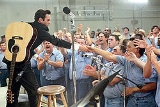
Walk the Line is a 2005 American biographical drama film, directed by James Mangold and based on the life of country singer-songwriter Johnny Cash. The film stars Joaquin Phoenix, Reese Witherspoon, Ginnifer Goodwin, and Robert Patrick.
The film focuses on Cash's younger life, his romance with June Carter, and his ascent to the country music scene, with material taken from his autobiographies. Walk the Line's production budget is estimated to have been US$28,000,000.
The film previewed at the Telluride Film Festival on September 4, 2005, and went into wide release on November 18.

Discussion
Ask a question about 'Walk the Line'
Start a new discussion about 'Walk the Line'
Answer questions from other users
|
Quotations
Love is a burning thing.

Encyclopedia
Walk the Line is a 2005 American biographical drama film, directed by James Mangold and based on the life of country singer-songwriter Johnny Cash. The film stars Joaquin Phoenix, Reese Witherspoon, Ginnifer Goodwin, and Robert Patrick.
The film focuses on Cash's younger life, his romance with June Carter, and his ascent to the country music scene, with material taken from his autobiographies. Walk the Line's production budget is estimated to have been US$28,000,000.
The film previewed at the Telluride Film Festival on September 4, 2005, and went into wide release on November 18. This film was nominated for five Academy Awards including Best Actor (Joaquin Phoenix), Best Actress (Reese Witherspoon) and Best Costume Design (Arianne Phillips). Witherspoon won the Oscar for Best Actress, the film's sole Oscar winner.
As of August 22, 2006, the film had grossed a total of $186,438,883 worldwide. On February 28, 2006, a single-disc DVD and a two-disc collector edition DVD were released; these editions sold three million copies on their first day of release. On March 25, 2008 a two-disc 'extended cut' DVD was released for region one. The feature on disc one is 17 minutes longer than the theatrical release, and disc two features eight extended musical sequences with introductions and documentaries about the making of the film.
Plot
The film details Johnny Cash's life from his growing up as the son of a cotton picker in Dyess, Arkansas, dealing with the death of his brother, his drug addiction, subsequent rescue by future wife June Carter, and his famous concert at Folsom State Prison.
The film opens in medias res with an exterior shot of Folsom Prison in 1968. The grounds are quiet except for the faint sound of music. Two guards on their tower peer at the main building. As we slowly approach the main building, the music begins to increase in volume. The camera tracks past empty cells and halls as the music becomes louder and more distinct; now cheering can be heard. Finally we see the source of the cheering: an audience of inmates for Johnny Cash's band, which is playing a vamp. In the next shot, a table saw rests on a table as a hand casually strokes the blade. After repeated calls, we are made aware that the hand is that of Johnny Cash. The blade reminds Johnny of his youth and particularly of the death of his brother. (Later we learn that the voice calling him onstage is that of the prison warden.)
In the next scene, it's 1944 and Cash is a boy. (His legal name was "J. R. Cash", as he did not adopt the name "John" until entering the Air Force.) He and his brother Jack are listening to the radio; the 15-year-old June Carter is singing.
Early in the movie, Cash and Jack discuss their respective strengths and weaknesses with regard to the Bible and hymns. Jack, who is training to become a pastor, and therefore "needs to know the Bible front to back," is much better at recalling the words and stories of the Bible. J.R., who can sing well like his mother, is adept with the hymns they sing at church. A few scenes later, Jack is sawing wood on a job for a neighbor with J.R. when J.R. abruptly announces that the task is boring. With Jack's permission, he leaves to go fishing. As he walks home later, he is intercepted by his father, Ray, who has visibly fresh blood stains on his overalls. "Where you been?" asks Ray. Jack has been fatally injured in an accident with the saw. J.R.'s relationship with Ray, already strained, becomes much more difficult after Jack's death. He often yells at J.R., telling him that "the devil took the wrong son."
In 1952, J.R. joins the United States Air Force and is posted to Germany. He seems not to enjoy his time there, but finds solace in playing a guitar he buys and writing songs - one of which will become "Folsom Prison Blues," inspired by a B-movie shown to the troops, Inside the Walls of Folsom Prison. Following his discharge, he marries his girlfriend Vivian Liberto.
In 1955, Vivian and John (as he is now generally known) live in Memphis in relative poverty while John works as a door-to-door salesman to support his growing family (Cash's eldest daughter Rosanne is an infant, and Vivian mentions "another one on the way"). One day, he walks past a recording studio and has an inspiration to organize a band (made up of guitarist Luther Perkins and bassist Marshall Grant, whom his wife describes as "two mechanics who can't hardly play") to play gospel music.
Cash's band auditions for Sam Phillips, the owner of Sun Records. As they play a pedestrian gospel song ("I Was There When It Happened"), Phillips interrupts and asks Cash to play a song that he really feels. Although his bandmates do not know the tune, he strikes up "Folsom Prison Blues." Cash begins the song hesitantly in the style of a slow, mournful blues tune, the way that he originally wrote it. However, as the song progresses and Cash gains confidence, the song picks up and the familiar "freight train" rhythm begins to assert itself as he picks up the tempo. Everyone in the room brightens as they realize that Cash now has something good and potentially marketable. The performance results in a contract, in fulfilment of which Cash begins touring in 1955 (as Johnny Cash and the Tennessee Two) with other young Sun artists. Among those he meets on the tour - along with Jerry Lee Lewis, Roy Orbison, Carl Perkins (no relation to Luther Perkins), Waylon Jennings and Elvis Presley - is June Carter, who performs as both a singer (although she claims to have no talent) and a comedienne.
Cash's career goes from strength to strength, and he finds himself spending more time with June, who divorces her husband at this time. After his romantic intentions are rebuffed one night in rural Texas in 1956, Cash is offered drugs and alcohol and soon begins to behave erratically.
On a subsequent tour, in 1958, June tells him (and many of the other artists on the tour) at one point that they cannot "walk the line," prompting Cash to write "I Walk the Line." The erratic behaviour peaks one night when Cash invites June on stage to sing a duet. Cash suggests a love song ("Time's A Wastin'") which June recorded with her first husband Carl Smith (whom she has recently divorced). She feels uncomfortable performing it with Cash, but he ignores her protests and kisses her in the middle of the performance. She storms off the stage and they go their separate ways, despite Cash's protest that "it was only a song."
In 1964, the still addicted Cash (his father tells him that he would do well to start "sleeping at night...or eating...or both") takes his wife to an awards program which June also attends. Despite his wife's objections to the level of interest he is paying her, Cash persuades June (who is divorcing her second husband, a stock car driver) to come out of semi-retirement and tour with him.
The tour is a great success (June is shown performing "Wildwood Flower" solo, and, with Cash, the hits "Jackson" and "It Ain't Me Babe"), but backstage Cash's wife is critical of June's influence. After one Las Vegas performance in 1965, Cash and June sleep together in her hotel room. The next morning, as June is on the phone with one of her daughters, she notices Cash taking several pills and begins to doubt the wisdom of continuing the previous night's relationship. At that evening's concert, Cash, upset by Carter's apparent rejection, is incoherent during his customary "Hello, I'm Johnny Cash" opening, forgets the lyrics to the song "I Got Stripes," loses control of the microphone stand, kicks out the footlights, and ultimately passes out. The remainder of the tour is cancelled. The distraught June disposes of Cash's drugs and begins to write "Ring of Fire", describing her feelings for Cash and her pain at watching him descend into addiction.
On his way home, Cash travels to Mexico to purchase more drugs and is busted in El Paso, Texas. Vivian is not pleased, however, and between his substance abuse and her awareness of his interest in June, the tensions in Cash's marriage rise when he tries to put up "pictures of my band" (most of which seem to be of June) at home over his wife's objections. After a final violent dispute, the pair separate and Cash moves to Nashville, where he shares living quarters with Waylon Jennings (played by Jennings' son Shooter) in 1966.
Cash tries to reconcile with June, which involves a long walk to her house (his car is in the shop and he has no cash to reclaim it). He is sent on his way, with June informing him that she misses her "old friend John" and doesn't like "this new guy, Cash." On the way back he collapses in the rain. After coming round the next day he sees a large house near a lake in Hendersonville, Tennessee and promptly buys it. His parents, and the extended Carter family (June, her daughters and her parents, Maybelle and Ezra) arrive for Thanksgiving, at which time the ever-critical Cash Sr. dismisses Cash's achievements and behavior, citing as an example of Cash's carelessness an expensive tractor stuck in the mud in view of the house. After a tense meal, Cash decides to prove his father wrong by freeing the tractor. June and her family watch in concern as Cash struggles with the machine; June's mother, apparently aware of her daughter's true feelings toward Cash, encourages her to go help him, because "he's mixed up." June at first refuses, but runs to Cash's aid when the tractor, in reverse, goes into the lake. Under the influence of the Carters (which extends to June's parents, shotguns in hand, chasing away Cash's drug dealer), Cash cleans himself up.
Stabilized, Cash notices in fan mail that many of his fans are prisoners, dresses in his customary black, visits his recording company (now Columbia Records) and makes a proposal to record an album live inside Folsom Prison. His record company is doubtful, arguing that the musical world has changed in the time Cash was rehabilitating, but he says bluntly that he will perform on a given date and the label can use the tapes if they think the music is any good.
At this point the film returns to the opening scene with the warden speaking to Cash in 1968. The warden requests that Cash not play any more songs that would remind the inmates that they are in prison. Cash laughs wryly and replies, "You think they forgot?"
At the Folsom Prison concert Cash tells how he always admired prisoners, explaining that his brief prison stay after his drug bust really made him "feel like I'd seen a thing or two, you know?" But, he continues, he now realizes his experiences really can't compare because "I ain't never had to drink this yellow water you got here at Folsom!" Performing "Cocaine Blues" to great acclaim from the prisoners, the concert is a great success, and Cash embarks on a tour with June and his old band.
The scene changes to a tour bus in the dead of night - still 1968. Cash, disturbed by "bad dreams...memories," goes to see June in the back of the bus. (On his way he removes a cigarette from the mouth of a sleeping Luther Perkins, who in real life died around this time when his house caught fire; in his biography Cash said he believed Luther Perkins' house fire was caused by a cigarette.) Waking June at 2 AM, he proposes to her, but she turns him down. Cash tells her that that was the last time; June tersely replies, "Good." and that she doesn't like "re-runs". At the concert, June tells Cash that he is allowed to speak to her only on stage.
The concert features "Ring of Fire", for which Cash acknowledges June. He then persuades her to join him in a duet of "Jackson". In the middle of the song, Cash breaks off; June looks concerned. Cash explains that he "just can't sing this song any more" unless she agrees to marry him. June is reluctant to give an answer, but Cash continues with his proposal:
- "Now I've asked you forty different ways and it's time you come up with a fresh answer...I'm asking you to marry me. I love you, June. Now I know I said and done a lotta things—that I hurt you—but I promise, I'll never do that again. I only want to take care of you. I will not leave you like that Dutch boy with your finger in the dam...You're my best friend. Marry me."
June tearfully agrees, and after a long embrace the scene fades to the deck of Cash's home in Hendersonville. Cash watches his father interact with his newest daughters Rosie and Carlene. He jokes with his father, their tense relationship having apparently begun to heal. The final shot shows Cash continuing down the stairs to the pier, looking up, and meeting June's eyes where she is fishing with her father. They look at each other and Cash smiles and the frame freezes; the scene then changes to footage of the couple performing together, with brief biographical information about Johnny Cash and June Carter Cash superimposed over it.
Cast
Reaction
Box office
Walk the Line was released on November 18, 2005 in 2,961 theaters, grossing USD $22.3 million on its opening weekend. The film went on to make $119.5 million in North America and $66.9 million in the rest of the world for a worldwide total of $186.4 million, well above its $28 million budget.
Reviews
Critics generally responded with positive reviews, garnering an 83% on Rotten Tomatoes, almost exactly the same score received by Ray, a biopic about Ray Charles, to which the film is often compared. Walk the Line also received a 72 metascore from Metacritic.
Phoenix's performance inspired notable film critic Roger Ebert to write, "Knowing Johnny Cash's albums more or less by heart, I closed my eyes to focus on the soundtrack and decided that, yes, that was the voice of Johnny Cash I was listening to. The closing credits make it clear it's Joaquin Phoenix doing the singing, and I was gob-smacked". In her review for the Los Angeles Times, Carina Chocano wrote, "Joaquin Phoenix and Reese Witherspoon do first-rate work — they sing, they twang, they play new-to-them instruments, they crackle with wit and charisma, and they give off so much sexual heat it's a wonder they don't burst into flames". A.O. Scott, in his review for the New York Times, had problems with Phoenix's performance: "Even though his singing voice doesn't match the original - how could it? - he is most convincing in concert, when his shoulders tighten and he cocks his head to one side. Otherwise, he seems stuck in the kind of off-the-rack psychological straitjacket in which Hollywood likes to confine troubled geniuses". In his review for Time, Richard Corliss wrote, "A lot of credit for Phoenix's performance has to go to Mangold, who has always been good at finding the bleak melodrama in taciturn souls ... If Mangold's new movie has a problem, it's that he and co-screenwriter Gill Dennis sometimes walk the lines of the inspirational biography too rigorously".
Andrew Sarris, in his review for The New York Observer praised Witherspoon for her "spine-tingling feistiness", and wrote, "This feat has belatedly placed it (in my mind, at least) among a mere handful of more-than-Oscar-worthy performances this year". Entertainment Weekly gave the film a "B+" rating and Owen Gleiberman wrote, "while Witherspoon, a fine singer herself, makes Carter immensely likable, a fountain of warmth and cheer, given how sweetly she meshes with Phoenix her romantic reticence isn't really filled in". Baltimore Sun reviewer Michael Sragow wrote, "What Phoenix and Witherspoon accomplish in this movie is transcendent. They act with every bone and inch of flesh and facial plane, and each tone and waver of their voice. They do their own singing with a startling mastery of country music's narrative musicianship". In his review for Sight and Sound, Mark Kermode wrote, "Standing ovations, too, for Witherspoon, who has perhaps the tougher task of lending depth and darkness to the role of June, whose frighteningly chipper stage act - a musical-comedy hybrid - constantly courts (but never marries) mockery".
However, the Cashs' daughter, Rosanne Cash was quite critical of the film. She saw a rough edit and described the experience like "having a root canal without anaesthetic" and was instrumental in having the filmmakers remove two scenes that were not flattering to her mother. Furthermore, she said, "The movie was painful. The three of them [in the film] were not recognisable to me as my parents in any way. But the scenes were recognisable, and the storyline, so the whole thing was fraught with sadness because they all had just died, and I had this resistance to seeing the screen version of my childhood".
Film critic Andrew Sarris ranked Walk the Line #7 in top films of 2005 and cited Reese Witherspoon as the best female performance of the year. Witherspoon was also voted Favorite Leading Lady at the 2006 People's Choice Awards. In addition, David Ansen of Newsweek ranked Witherspoon as one of the five best actresses of 2005.
Awards
| Academy Awards record |
|---|
| 1. Best Actress (Reese Witherspoon) | | Golden Globe Awards record |
|---|
| 1. Best Musical or Comedy Picture | | 2. Best M/C Actor (Joaquin Phoenix) | | 2. Best M/C Actress (Reese Witherspoon) | | BAFTA Awards record |
|---|
| 1. Best Actress (Reese Witherspoon) | | 2. Best Sound |
Witherspoon's performance was repeatedly recognized, including an Academy Award for Best Actress and awards such as the following:
Source material
External links
|
| |
|
|