

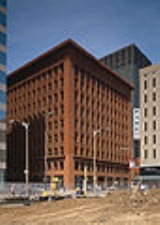
Wainwright Building

Encyclopedia
The Wainwright Building is a 10-story red brick
office building at 709 Chestnut Street in downtown
St. Louis, Missouri
. The Wainwright Building is among the first skyscraper
s in the world. It was designed by Dankmar Adler
and Louis Sullivan
in the Palazzo style
and built between 1890 and 1891. It was named for local brewer
, building contractor, and financier
Ellis Wainwright
.Sullivan also designed the Wainwright Tomb
in St. Louis's Bellefontaine Cemetery
for his wife Charlotte Dickson Wainwright.
The building, listed as a landmark
both locally and nationally, is described as "a highly influential prototype
of the modern office building" by the National Register of Historic Places
. Architect Frank Lloyd Wright
called the Wainwright Building "the very first human expression of a tall steel
office-building as Architecture
."
The building is currently owned by the State of Missouri and houses state offices.
. Wainwright needed office space to manage the St Louis Brewers Association. It was the second major commission for a tall building won by the Adler & Sullivan
firm, which had grown to international prominence after the creation of the ten-story Auditorium Building in Chicago (designed in 1886 and completed in 1889). As designed, the first floor of the Wainwright Building was intended for street-accessible shops, with the second floor filled with easily accessible public offices. The higher floors were for "honeycomb" offices, while the top floor was for water tanks and building machinery.
, featuring none of the neoclassical style
that Sullivan held in contempt.
Historian Carl W. Condit
described the Wainwright as "a building with a strong, vigorously articulated base supporting a screen that constitutes a vivid image of powerful upward movement." The base contained retail stores that required wide glazed openings; Sullivan's ornament made the supporting piers
read as pillars. Above it the semi-public nature of offices up a single flight of stairs are expressed as broad windows in the curtain wall
. A cornice
separates the second floor from the grid of identical windows of the screen wall, where each window is "a cell in a honeycomb, nothing more". The building's windows and horizontals were inset slightly behind columns and piers, as part of a “vertical aesthetic” to create what Sullivan called “a proud and soaring thing.” This perception has since been criticized as the skyscraper were designed to make money, not to serve as a symbol.
The ornamentation for the building includes a wide frieze
below the deep cornice
,which expresses the formalized yet naturalistic celery-leaf foliage typical of Sullivan and published in his System of Architectural Ornament, decorated spandrel
s between the windows on the different floors and an elaborate door surround at the main entrance. "Apart from the slender brick piers, the only solids of the wall surface are the spandrel panels between the windows..... They have rich decorative patterns in low relief, varying in design and scale with each story." The frieze is pierced by unobtrusive bull's-eye windows
that light the top-story floor, originally containing water tanks and elevator machinery. The building includes embellishments of terra cotta
, a building material that was gaining popularity at the time of construction.
One of Sullivan's primary concerns was the development of an architectural symbolism consisting of simple geometric, structural forms and organic ornamentation.The Wainwright Building where he juxtaposed the objective-tectonic and the subjective-organic was the first demonstration of this symbolism.
Unlike Sullivan, Adler described the building as a "plain business structure" stating:
The building is considered the first skyscraper to forgo the normal ornamentation used on skyscrapers at the time.
Some architectural elements from the building have been removed in renovations and taken to the Sauget, Illinois
storage site of the St. Louis Building Arts Foundation
.
In 1968, the building was designated as a National Historic Landmark
and in 1972 it was named a city landmark.
The Wainwright building was initially rescued from demolition by the National Trust for Historic Preservation
when the Trust took an option on the structure. Later, it was acquired by Missouri as part of a state office complex and the St. Louis Landmarks Association, in one of its early victories, is credited with having rescued the Wainwright Building from a construction project.
The neighboring Lincoln Trust building (later known as the Title Guaranty building; designed by Eames and Young
, built in 1898 at 706 Chestnut St.) was demolished to make way for the Gateway Mall in 1983. Carolyn Toft, Landmarks Association's executive director, stated that this building "... formed an ensemble with three other late-19th century commercial buildings, including [the Wainwright Building], that could not be equaled anywhere else in the country. Saving the Wainwright was important, but how much more important it would have been to save the entire group."Architect John D. Randall led an extensive letter-writing campaign to the governor and other noted officials; the campaign resulted in the restoration of the building as a state office building instead of its demolition.
After a period of neglect, the building now houses Missouri state offices.
Brick
A brick is a block of ceramic material used in masonry construction, usually laid using various kinds of mortar. It has been regarded as one of the longest lasting and strongest building materials used throughout history.-History:...
office building at 709 Chestnut Street in downtown
Downtown St. Louis
Downtown St. Louis is the central business district of St. Louis, Missouri, the hub of tourism and entertainment, and the anchor of the St. Louis metropolitan area. The downtown is bounded by Cole Street to the north, the river front to the east, Chouteau Avenue to the south, and Jefferson Avenue...
St. Louis, Missouri
St. Louis, Missouri
St. Louis is an independent city on the eastern border of Missouri, United States. With a population of 319,294, it was the 58th-largest U.S. city at the 2010 U.S. Census. The Greater St...
. The Wainwright Building is among the first skyscraper
Skyscraper
A skyscraper is a tall, continuously habitable building of many stories, often designed for office and commercial use. There is no official definition or height above which a building may be classified as a skyscraper...
s in the world. It was designed by Dankmar Adler
Dankmar Adler
Dankmar Adler was a celebrated German-born American architect.-Early years:...
and Louis Sullivan
Louis Sullivan
Louis Henri Sullivan was an American architect, and has been called the "father of skyscrapers" and "father of modernism" He is considered by many as the creator of the modern skyscraper, was an influential architect and critic of the Chicago School, was a mentor to Frank Lloyd Wright, and an...
in the Palazzo style
Palazzo style architecture
Palazzo style refers to an architectural style of the 19th and 20th centuries based upon the palazzi built by wealthy families of the Italian Renaissance...
and built between 1890 and 1891. It was named for local brewer
Brewer
Brewer may refer to:*Brewer, someone who makes beer by brewing*Brewer , a disambiguation page that lists people with the surname Brewer*Brewer, Maine, a city in southern Penobscot County, Maine, United States, near the city of Bangor...
, building contractor, and financier
Financier
Financier is a term for a person who handles typically large sums of money, usually involving money lending, financing projects, large-scale investing, or large-scale money management. The term is French, and derives from finance or payment...
Ellis Wainwright
Ellis Wainwright
Ellis Wainwright was an American capitalist, brewer, art collector and socialite from St. Louis, Missouri. He was President of the St. Louis Brewing Company and Director of the St. Louis and Suburban Company. He is best known for the Wainwright Building in Downtown St...
.Sullivan also designed the Wainwright Tomb
Wainwright Tomb
The Wainwright Tomb is a mausoleum located in Bellefontaine Cemetery at 4947 West Florissant Avenue north of the Walnut Park East neighborhood of St. Louis, Missouri. Originally constructed for Charlotte Dickson Wainwright in 1892, the tomb now also contains the remains of her husband, Ellis...
in St. Louis's Bellefontaine Cemetery
Bellefontaine and Calvary Cemeteries
Bellefontaine Cemetery and the Roman Catholic Calvary Cemetery in St. Louis, Missouri are adjacent burial grounds, which have numerous historic and extravagant tombstones and mausoleums. They are the necropolis for a number of prominent local and state politicians, as well as soldiers of the...
for his wife Charlotte Dickson Wainwright.
The building, listed as a landmark
Landmark
This is a list of landmarks around the world.Landmarks may be split into two categories - natural phenomena and man-made features, like buildings, bridges, statues, public squares and so forth...
both locally and nationally, is described as "a highly influential prototype
Prototype
A prototype is an early sample or model built to test a concept or process or to act as a thing to be replicated or learned from.The word prototype derives from the Greek πρωτότυπον , "primitive form", neutral of πρωτότυπος , "original, primitive", from πρῶτος , "first" and τύπος ,...
of the modern office building" by the National Register of Historic Places
National Register of Historic Places
The National Register of Historic Places is the United States government's official list of districts, sites, buildings, structures, and objects deemed worthy of preservation...
. Architect Frank Lloyd Wright
Frank Lloyd Wright
Frank Lloyd Wright was an American architect, interior designer, writer and educator, who designed more than 1,000 structures and completed 500 works. Wright believed in designing structures which were in harmony with humanity and its environment, a philosophy he called organic architecture...
called the Wainwright Building "the very first human expression of a tall steel
Steel
Steel is an alloy that consists mostly of iron and has a carbon content between 0.2% and 2.1% by weight, depending on the grade. Carbon is the most common alloying material for iron, but various other alloying elements are used, such as manganese, chromium, vanadium, and tungsten...
office-building as Architecture
Architecture
Architecture is both the process and product of planning, designing and construction. Architectural works, in the material form of buildings, are often perceived as cultural and political symbols and as works of art...
."
The building is currently owned by the State of Missouri and houses state offices.
Commission, design and construction
The Wainwright building was commissioned by Ellis Wainwright, a St. Louis brewerBrewer
Brewer may refer to:*Brewer, someone who makes beer by brewing*Brewer , a disambiguation page that lists people with the surname Brewer*Brewer, Maine, a city in southern Penobscot County, Maine, United States, near the city of Bangor...
. Wainwright needed office space to manage the St Louis Brewers Association. It was the second major commission for a tall building won by the Adler & Sullivan
Adler & Sullivan
Adler & Sullivan was an architectural firm founded by Dankmar Adler and Louis Sullivan. It is known for designing the Auditorium Building in Chicago and the Wainwright Building in St Louis...
firm, which had grown to international prominence after the creation of the ten-story Auditorium Building in Chicago (designed in 1886 and completed in 1889). As designed, the first floor of the Wainwright Building was intended for street-accessible shops, with the second floor filled with easily accessible public offices. The higher floors were for "honeycomb" offices, while the top floor was for water tanks and building machinery.
Architecture
Aesthetically, the Wainwright Building exemplifies Sullivan's theories about the tall building, which included a tripartite (three-part) composition (base-shaft-attic) based on the structure of the classical column, and his desire to emphasize the height of the building. He wrote: "[The skyscraper] must be tall, every inch of it tall. The force and power of altitude must be in it the glory and pride of exaltation must be in it. It must be every inch a proud and soaring thing, rising in sheer exultation that from bottom to top it is a unit without a single dissenting line." His 1896 article cited his Wainwright Building as an example. Despite the classical column concept, the building's design was deliberately modernModern architecture
Modern architecture is generally characterized by simplification of form and creation of ornament from the structure and theme of the building. It is a term applied to an overarching movement, with its exact definition and scope varying widely...
, featuring none of the neoclassical style
Neoclassical architecture
Neoclassical architecture was an architectural style produced by the neoclassical movement that began in the mid-18th century, manifested both in its details as a reaction against the Rococo style of naturalistic ornament, and in its architectural formulas as an outgrowth of some classicizing...
that Sullivan held in contempt.
Historian Carl W. Condit
Carl W. Condit
Carl Condit was an American historian of urban and architectural history, a writer, professor, and teacher. He wrote numerous books and articles on the history of American building, especially in Chicago, and founded the History of Science Department at Northwestern University, where he taught for...
described the Wainwright as "a building with a strong, vigorously articulated base supporting a screen that constitutes a vivid image of powerful upward movement." The base contained retail stores that required wide glazed openings; Sullivan's ornament made the supporting piers
Pier (architecture)
In architecture, a pier is an upright support for a superstructure, such as an arch or bridge. Sections of wall between openings function as piers. The simplest cross section of the pier is square, or rectangular, although other shapes are also common, such as the richly articulated piers of Donato...
read as pillars. Above it the semi-public nature of offices up a single flight of stairs are expressed as broad windows in the curtain wall
Curtain wall
A curtain wall is an outer covering of a building in which the outer walls are non-structural, but merely keep out the weather. As the curtain wall is non-structural it can be made of a lightweight material reducing construction costs. When glass is used as the curtain wall, a great advantage is...
. A cornice
Cornice
Cornice molding is generally any horizontal decorative molding that crowns any building or furniture element: the cornice over a door or window, for instance, or the cornice around the edge of a pedestal. A simple cornice may be formed just with a crown molding.The function of the projecting...
separates the second floor from the grid of identical windows of the screen wall, where each window is "a cell in a honeycomb, nothing more". The building's windows and horizontals were inset slightly behind columns and piers, as part of a “vertical aesthetic” to create what Sullivan called “a proud and soaring thing.” This perception has since been criticized as the skyscraper were designed to make money, not to serve as a symbol.
The ornamentation for the building includes a wide frieze
Frieze
thumb|267px|Frieze of the [[Tower of the Winds]], AthensIn architecture the frieze is the wide central section part of an entablature and may be plain in the Ionic or Doric order, or decorated with bas-reliefs. Even when neither columns nor pilasters are expressed, on an astylar wall it lies upon...
below the deep cornice
Cornice
Cornice molding is generally any horizontal decorative molding that crowns any building or furniture element: the cornice over a door or window, for instance, or the cornice around the edge of a pedestal. A simple cornice may be formed just with a crown molding.The function of the projecting...
,which expresses the formalized yet naturalistic celery-leaf foliage typical of Sullivan and published in his System of Architectural Ornament, decorated spandrel
Spandrel
A spandrel, less often spandril or splaundrel, is the space between two arches or between an arch and a rectangular enclosure....
s between the windows on the different floors and an elaborate door surround at the main entrance. "Apart from the slender brick piers, the only solids of the wall surface are the spandrel panels between the windows..... They have rich decorative patterns in low relief, varying in design and scale with each story." The frieze is pierced by unobtrusive bull's-eye windows
Oeil-de-Boeuf
Oeil-de-boeuf, also œil de bœuf, is a term applied to a relatively small oval window, typically for an upper storey, and sometimes set on a roof slope as a dormer, or above a door to give light. Windows of this type are commonly found in the grand architecture of Baroque France...
that light the top-story floor, originally containing water tanks and elevator machinery. The building includes embellishments of terra cotta
Glazed architectural terra-cotta
Glazed architectural terra-cotta is a ceramic masonry building material popular in the United States from the late 19th century until the 1930s, and still one of the most common building materials found in U.S. urban environments...
, a building material that was gaining popularity at the time of construction.
One of Sullivan's primary concerns was the development of an architectural symbolism consisting of simple geometric, structural forms and organic ornamentation.The Wainwright Building where he juxtaposed the objective-tectonic and the subjective-organic was the first demonstration of this symbolism.
Unlike Sullivan, Adler described the building as a "plain business structure" stating:
In a utilitarian age like ours it is safe to assume that the real-estate owner and the investor in buildings will continue to erect the class of buildings from which the greatest possible revenue can be obtained with the least possible outlay...The purpose of erecting buildings other than those required for the shelter of their owners is specifically that of making investments for profit.
The building is considered the first skyscraper to forgo the normal ornamentation used on skyscrapers at the time.
Some architectural elements from the building have been removed in renovations and taken to the Sauget, Illinois
Sauget, Illinois
Sauget is a village in St. Clair County, Illinois, United States. It is part of Greater St. Louis. The population was 249 at the 2000 census.-Geography:Sauget is located at ....
storage site of the St. Louis Building Arts Foundation
St. Louis Building Arts Foundation
The St. Louis Building Arts Foundation started as the personal collecting hobby of Larry Giles, a historic preservationist in St. Louis, Missouri, USA. It later received assistance and monetary aid from the developer Stephen Trampe....
.
History
Upon its initial completion, the Wainwright Building was "popular with the people" and received "favorably" by critics.In 1968, the building was designated as a National Historic Landmark
National Historic Landmark
A National Historic Landmark is a building, site, structure, object, or district, that is officially recognized by the United States government for its historical significance...
and in 1972 it was named a city landmark.
The Wainwright building was initially rescued from demolition by the National Trust for Historic Preservation
National Trust for Historic Preservation
The National Trust for Historic Preservation is an American member-supported organization that was founded in 1949 by congressional charter to support preservation of historic buildings and neighborhoods through a range of programs and activities, including the publication of Preservation...
when the Trust took an option on the structure. Later, it was acquired by Missouri as part of a state office complex and the St. Louis Landmarks Association, in one of its early victories, is credited with having rescued the Wainwright Building from a construction project.
The neighboring Lincoln Trust building (later known as the Title Guaranty building; designed by Eames and Young
Eames and Young
Eames and Young, American architecture firm based in St. Louis, Missouri, active nationally, and responsible for several buildings on the National Register of Historic Places.- History :...
, built in 1898 at 706 Chestnut St.) was demolished to make way for the Gateway Mall in 1983. Carolyn Toft, Landmarks Association's executive director, stated that this building "... formed an ensemble with three other late-19th century commercial buildings, including [the Wainwright Building], that could not be equaled anywhere else in the country. Saving the Wainwright was important, but how much more important it would have been to save the entire group."Architect John D. Randall led an extensive letter-writing campaign to the governor and other noted officials; the campaign resulted in the restoration of the building as a state office building instead of its demolition.
After a period of neglect, the building now houses Missouri state offices.
See also
- List of tallest buildings in St. Louis
- National Register of Historic Places listings in St. Louis, MissouriNational Register of Historic Places listings in St. Louis, MissouriNational Register of Historic Places listings in St. Louis are in both the independent city of St. Louis, Missouri and in the separate St. Louis County:* National Register of Historic Places listings in St. Louis , Missouri...