
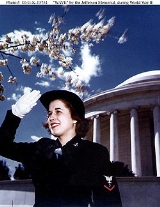
The
WAVES were a
World War IIWorld War II, or the Second World War , was a global conflict lasting from 1939 to 1945, involving most of the world's nations—including all of the great powers—eventually forming two opposing military alliances: the Allies and the Axis...
-era division of the
U.S. NavyThe United States Navy is the naval warfare service branch of the United States Armed Forces and one of the seven uniformed services of the United States. The U.S. Navy is the largest in the world; its battle fleet tonnage is greater than that of the next 13 largest navies combined. The U.S...
that consisted entirely of women. The name of this group is an acronym for "Women Accepted for Volunteer Emergency Service" (as well as an allusion to
ocean wavesIn fluid dynamics, wind waves or, more precisely, wind-generated waves are surface waves that occur on the free surface of oceans, seas, lakes, rivers, and canals or even on small puddles and ponds. They usually result from the wind blowing over a vast enough stretch of fluid surface. Waves in the...
); the word "emergency" implied that the acceptance of women was due to the unusual circumstances of the war and that at the end of the war the women would not be allowed to continue in Navy careers. The official title was
US Naval Reserve (Women's Reserve), but the title of WAVES stuck.
The WAVES began in August 1942, when Mildred McAfee, President of Wellesley College, was sworn in as a Naval Reserve Lieutenant Commander, the first female commissioned officer in U.S. Navy history, and the first director of the WAVES. This occurred two months after the WAAC (Women's Auxiliary Army Corps) was established and
Eleanor RooseveltAnna Eleanor Roosevelt was the First Lady of the United States from 1933 to 1945. She supported the New Deal policies of her husband, distant cousin Franklin Delano Roosevelt, and became an advocate for civil rights. After her husband's death in 1945, Roosevelt continued to be an international...
convinced Congress to authorize a women's component of the Navy.
Women entering as enlisted personnel in the Navy or Coast Guard attended the
V10 WAVE Enlisted Rating Volunteer Program. Women seeking to be officers in the WAVES or SPARS attended the
V9 WAVE Officer Candidate Volunteer Program. Officer candidates went through Basic Training rated as Seamen Recruits, then became Midshipmen during Officer Training, and graduated as Ensigns. WAVE Graduates from the V9 and V10 programs were considered part of the US Naval Reserve.
An important distinction between the WAAC and the WAVES was the fact that the WAAC was an "auxiliary" organization, serving
with the Army, not
in it. From the very beginning, the WAVES were an official part of the Navy, and its members held the same rank and ratings as male personnel. They also received the same pay and were subject to military discipline. The WAAC became the Women's Army Corps (WAC) in July, 1943, giving its members military status similar to that of the WAVES.
WAVES could not serve aboard
combat shipsA warship is a ship that is built and primarily intended for combat. Warships are usually built in a completely different way from merchant ships. As well as being armed, warships are designed to withstand damage and are usually faster and more maneuvrable than merchant ships...
or aircraft, and initially were restricted to duty in the continental United States. Late in World War II, WAVES were authorized to serve in certain overseas U.S. possessions, and a number were sent to Hawaii. The war ended before any could be sent to other locations.
Within their first year the WAVES were 27,000 strong. A large proportion of the WAVES did clerical work but some took positions in the aviation community,
Judge Advocate General's CorpsJudge Advocate General's Corps, also known as JAG or JAG Corps, refers to the legal branch or specialty of the U.S. Air Force, Army, Coast Guard, and Navy. Officers serving in the JAG Corps are typically called Judge Advocates. The Marine Corps and Coast Guard do not maintain separate JAG Corps...
, medical professions, communications, intelligence,
storekeeperStorekeeper is an enlisted rating in the United States Coast Guard; until 2009 it was also a United States Navy rating, the most common supply rate in US Navy vs. CS and SH and very much equivalent to the MOS 92 of the US Army...
, science and technology.
The WAVES did not initially accept African-American women into the division. In November 1944, Harriet Ida Pickens and Frances Wills graduated from the Naval Reserve Midshipmen's School (Women's Reserve) at Northampton, Massachusetts, became the first female African-American WAVE officers. From the fall of 1944 onwards, the Navy trained roughly one black woman for every 36 white women enlisted in the WAVES; this was about 2.77%, below the 10% cap agreed upon by the armed services in 1940.
With the passage of the
Women's Armed Services Integration ActWomen's Armed Services Integration Act, United States law enacted on June 12, 1948, enabled women to serve as permanent, regular members of the armed forces in the Army, Navy, Marine Corps, and the recently formed Air Force. Prior to this act, women, with the exception of nurses, served in the...
(Public Law 625) on June 12, 1948, women gained permanent status in the armed services. To reflect this, the V9 and V10 Volunteer Reserve programs were discontinued and renamed the
W9 Women's Officer Training and
W10 Women's Enlisted Training programs.
Although the WAVES now officially ceased to exist, the acronym was in common use well into the 1970s.
The first six enlisted women to be sworn into the regular Navy on July 7, 1948 were Kay Langdon, Wilma Marchal, Edna Young, Frances Devaney, Doris Robertson and Ruth Flora.
On October 15, 1948, the first eight women to be commissioned in the regular Navy,
Joy Bright HancockJoy Bright Hancock , a veteran of both the First and Second World Wars, was one of the first women officers of the United States Navy.-Biography:Joy Bright was born in Wildwood, New Jersey on 4 May 1898...
,
Winifred Quick CollinsWinifred 'Quick' Collins was Chief of Naval Personnel for Women in the United States Navy, and Director of the WAVES from 1957 to 1962.-Early life:...
, Ann King, Frances Willoughby, Ellen Ford, Doris Cranmore, Doris Defenderfer, and Betty Rae Tennant took their oaths as naval officers.
List of Directors
The director held the position of Assistant Chief of Naval Personnel for Women during the years of 1942-1972. In 1972, the office was disestablished in favor of integration of women into the main force. There still remained, however, the office of Bureau of Personnel Special Assistant for Women's Policy] (PERS-00W), which existed until 1991.
| • |
Captain Mildred McAfee Horton Mildred Helen McAfee Horton was an American academic who served during World War II as first director of the WAVES in the United States Navy.-Early life:...
|
|
( 1942 |
– 1946) |
| • |
Captain Jeanne T. Palmer |
|
( 1946 |
– 1946) |
| • |
Captain Joy Bright HancockJoy Bright Hancock , a veteran of both the First and Second World Wars, was one of the first women officers of the United States Navy.-Biography:Joy Bright was born in Wildwood, New Jersey on 4 May 1898... |
|
( 1946 |
– 1953) |
| • |
Captain Louise K. Wilde |
|
( 1953 |
– 1957) |
| • |
Captain Winifred Collins Winifred 'Quick' Collins was Chief of Naval Personnel for Women in the United States Navy, and Director of the WAVES from 1957 to 1962.-Early life:... |
|
( 1957 |
– 1962) |
| • |
Captain Viola B. Sanders Viola Brown Sanders served as deputy director of Women in the Navy from 1958 to 1960, and in 1962 was appointed as the 6th director of Women in the Navy .- Biography :... |
|
( 1962 |
– 1966) |
| • |
Captain Rita Lenihan |
|
( 1966 |
– 1970) |
| • |
Captain Robin L. Quigley |
|
( 1970 |
– 1972) |
WAVES song
The WAVES kept the homefront affairs of the US Navy going while the men were assigned to ships serving around the globe. While the official song of the US Navy men was "
Anchors Aweigh"Anchors Aweigh" is the fight song of the United States Naval Academy, and strongly associated with the United States Navy, composed in 1906 by Charles A. Zimmerman with lyrics by Alfred Hart Miles. Zimmerman was at the time a Lieutenant, and had been bandmaster of the United States Naval Academy...
", the WAVES official song was sung in counterpoint to the men:
-
- WAVES of the Navy
- WAVES of the Navy,
- There's a ship sailing down the bay.
- And she won't slip into port again
- Until that Victory Day.
- Carry on for that gallant ship
- And for every hero brave
- Who will find ashore, his man-sized chore
- Was done by a Navy WAVE.
Music and words to this and other songs sung by the WAVES can be found in
Marching to Victory, a 1943 booklet published at the Naval Reserve Midshipmen's School (WR), Northampton, Massachusetts.
See also
- SPARS
SPARS was the United States Coast Guard Women's Reserve, created 23 November 1942 with the signing of Public Law 773 by President Franklin Delano Roosevelt. The name is a contraction of the Coast Guard motto: Semper Paratus and its English translation Always Ready...
(the United States Coast Guard Women's Reserve)
- United States Marine Corps Women's Reserve
- Women Airforce Service Pilots
The Women Airforce Service Pilots and its predecessor groups the Women's Flying Training Detachment and the Women's Auxiliary Ferrying Squadron were pioneering organizations of civilian female pilots employed to fly military aircraft under the direction of the United States Army Air Forces...
(WASP)
- Women in the Air Force (WAF)
Women in the Air Force was a United States Air Force program which served to bring women into limited roles in the Air Force. WAF was formed in 1948, when President Truman signed the Women's Armed Services Integration Act, allowing women to serve directly in the military.WAF was distinct from the...
- Women in the United States Navy
Women have served in the United States Navy for over a century. Today, there are over 52,391 women serving on active duty in an array of traditional and non-traditional ratings or careers...
- Women's Army Corps (United States Army)
- Women's Auxiliary Air Force
The Women's Auxiliary Air Force , whose members were invariably referred to as Waafs , was the female auxiliary of the Royal Air Force during World War II, established in 1939. At its peak strength, in 1943, WAAF numbers exceeded 180,000, with over 2,000 women enlisting per week.A Women's Royal Air...
(British)
- Women's Royal Naval Service
The Women's Royal Naval Service was the women's branch of the Royal Navy.Members included cooks, clerks, wireless telegraphists, radar plotters, weapons analysts, range assessors, electricians and air mechanics...
(British)
External links