
Home      Discussion      Topics      Dictionary      Almanac
Signup       Login
Vostok spacecraft

Vostok spacecraft

Overview
The Vostok was a type of spacecraft
Spacecraft
A spacecraft or spaceship is a craft or machine designed for spaceflight. Spacecraft are used for a variety of purposes, including communications, earth observation, meteorology, navigation, planetary exploration and transportation of humans and cargo....

 built by the Soviet Union
Soviet Union
The Soviet Union , officially the Union of Soviet Socialist Republics , was a constitutionally socialist state that existed in Eurasia between 1922 and 1991....

. The first human spaceflight
Human spaceflight
Human spaceflight is spaceflight with humans on the spacecraft. When a spacecraft is manned, it can be piloted directly, as opposed to machine or robotic space probes and remotely-controlled satellites....

 in history was accomplished on this spacecraft on April 12, 1961
Cosmonautics Day
Cosmonautics Day is a holiday celebrated in Russia and some other former USSR countries on April 12. This holiday celebrates the first manned space flight made on April 12, 1961 by the 27-year old Soviet cosmonaut Yuri Gagarin. Gagarin circled the Earth for 1 hour and 48 minutes aboard the Vostok...

, by Soviet cosmonaut Yuri Gagarin
Yuri Gagarin
Yuri Alekseyevich Gagarin was a Soviet pilot and cosmonaut. He was the first human to journey into outer space, when his Vostok spacecraft completed an orbit of the Earth on April 12, 1961....

.
Discussion
Ask a question about 'Vostok spacecraft'
Start a new discussion about 'Vostok spacecraft'
Answer questions from other users
Full Discussion Forum
 
Unanswered Questions
Encyclopedia
The Vostok was a type of spacecraft
Spacecraft
A spacecraft or spaceship is a craft or machine designed for spaceflight. Spacecraft are used for a variety of purposes, including communications, earth observation, meteorology, navigation, planetary exploration and transportation of humans and cargo....

 built by the Soviet Union
Soviet Union
The Soviet Union , officially the Union of Soviet Socialist Republics , was a constitutionally socialist state that existed in Eurasia between 1922 and 1991....

. The first human spaceflight
Human spaceflight
Human spaceflight is spaceflight with humans on the spacecraft. When a spacecraft is manned, it can be piloted directly, as opposed to machine or robotic space probes and remotely-controlled satellites....

 in history was accomplished on this spacecraft on April 12, 1961
Cosmonautics Day
Cosmonautics Day is a holiday celebrated in Russia and some other former USSR countries on April 12. This holiday celebrates the first manned space flight made on April 12, 1961 by the 27-year old Soviet cosmonaut Yuri Gagarin. Gagarin circled the Earth for 1 hour and 48 minutes aboard the Vostok...

, by Soviet cosmonaut Yuri Gagarin
Yuri Gagarin
Yuri Alekseyevich Gagarin was a Soviet pilot and cosmonaut. He was the first human to journey into outer space, when his Vostok spacecraft completed an orbit of the Earth on April 12, 1961....

.

The spacecraft was part of the Vostok programme
Vostok programme
The Vostok programme was a Soviet human spaceflight project that succeeded in putting a person into Earth's orbit for the first time. The programme developed the Vostok spacecraft from the Zenit spy satellite project and adapted the Vostok rocket from an existing ICBM design...

 in which six manned spaceflights were made from 1961 to 1963. Two further manned space flights were made in 1964 and 1965 by Voskhod spacecraft, which were modified Vostok spacecraft. By the late 1960's both were superseded by the Soyuz spacecraft, which are still used as of 2011.

Development


The Vostok spacecraft was originally designed for use both as a camera platform (for the Soviet Union's first spy satellite program, Zenit
Zenit spy satellite
Zenit is the name of a series of military spy satellites launched by the Soviet Union between 1961 and 1994. To conceal their nature, all flights were given the public Kosmos designation...

) and as a manned spacecraft. This dual-use design was crucial in gaining Communist Party
Communist Party of the Soviet Union
The Communist Party of the Soviet Union was the only legal, ruling political party in the Soviet Union and one of the largest communist organizations in the world...

 support for the program. The basic Vostok design has remained in use for some forty years, gradually adapted for a range of other unmanned satellite
Satellite
In the context of spaceflight, a satellite is an object which has been placed into orbit by human endeavour. Such objects are sometimes called artificial satellites to distinguish them from natural satellites such as the Moon....

s. The descent module design was reused, in heavily-modified form, by the Voskhod programme
Voskhod programme
The Voskhod programme was the second Soviet human spaceflight project. Two manned missions were flown using the Voskhod spacecraft and rocket, one in 1964 and one in 1965....

.

Design


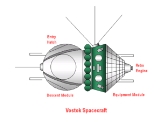
The craft consisted of a spherical descent module (mass 2.46 tonnes, diameter 2.3 meters), which housed the cosmonaut, instruments and escape system, and a conical instrument module (mass 2.27 tonnes, 2.25 m long, 2.43 m wide), which contained propellant and the engine system. On reentry, the cosmonaut would eject from the craft at about 7,000 m (23,000 ft) and descend via parachute, while the capsule would land separately.

There were several models of the Vostok leading up to the manned version:

Vostok 2K


Photo-reconnaissance and signals intelligence spacecraft . Later named Zenit spy satellite
Zenit spy satellite
Zenit is the name of a series of military spy satellites launched by the Soviet Union between 1961 and 1994. To conceal their nature, all flights were given the public Kosmos designation...

.

Vostok 3KA


The Vostok 3KA was the spacecraft used for the first human spaceflight
Human spaceflight
Human spaceflight is spaceflight with humans on the spacecraft. When a spacecraft is manned, it can be piloted directly, as opposed to machine or robotic space probes and remotely-controlled satellites....

s. They were launched from Baikonur Cosmodrome
Baikonur Cosmodrome
The Baikonur Cosmodrome , also called Tyuratam, is the world's first and largest operational space launch facility. It is located in the desert steppe of Kazakhstan, about east of the Aral Sea, north of the Syr Darya river, near Tyuratam railway station, at 90 meters above sea level...

 using Vostok 8K72K launch vehicles. The first flight of a Vostok 3KA occurred on March 9, 1961. The first flight with a crew -- Vostok 1
Vostok 1
Vostok 1 was the first spaceflight in the Vostok program and the first human spaceflight in history. The Vostok 3KA spacecraft was launched on April 12, 1961. The flight took Yuri Gagarin, a cosmonaut from the Soviet Union, into space. The flight marked the first time that a human entered outer...

 carrying Yuri Gagarin
Yuri Gagarin
Yuri Alekseyevich Gagarin was a Soviet pilot and cosmonaut. He was the first human to journey into outer space, when his Vostok spacecraft completed an orbit of the Earth on April 12, 1961....

 -- took place on April 12, 1961. The last flight -- Vostok 6
Vostok 6
-Backup crew:-Reserve crew:Vostok VI-Mission parameters:*Mass: *Apogee: *Perigee: *Inclination: 64.9°*Period: 87.8 minutes9090...

 carrying the first woman in space, Valentina Tereshkova
Valentina Tereshkova
Valentina Vladimirovna Tereshkova is a retired Soviet cosmonaut, and was the first woman in space. She was selected out of more than four hundred applicants, and then out of five finalists, to pilot Vostok 6 on the 16 June, 1963, becoming both the first woman and the first civilian to fly in...

 -- took place on June 16, 1963.

A total of 8 Vostok 3KA spacecraft were flown, 6 of them with a human crew.

Specifications for this version are:

Reentry Module: Vostok SA. SA stands for - descent or reentry system. It was nicknamed Sharik
Sharik
Sharik or Shariq may be either Arabic or Russian origin and may refer to:*Sharik Peninsula, Tunisia*Akhnas ibn Shariq*Sharik, a fictional dog in Bulgakov's novel Heart of a Dog*Sharik, a fictional dog in Dostoevsky's The House of the Dead...

 (little sphere).
  • Crew Size: 1
  • Diameter: 2.3 m sphere
  • Mass: 2,460 kg
  • Heat Shield Mass: 837 kg
  • Recovery equipment: 151 kg
  • Parachute deploys at 2.5 km altitude
  • Crew seat and provisions: 336 kg
  • Crew ejects at 7 km altitude
  • Ballistic reentry acceleration: 8 g (78 m/s²)


Equipment Module: Vostok PA. PA stands for - instrument section.
  • Length: 2.25 m
  • Diameter: 2.43 m
  • Mass: 2,270 kg
  • Equipment in pressurized compartment
  • RCS Propellants: Cold gas (nitrogen)
  • RCS Propellants: 20 kg
  • Main Engine (TDU): 397 kg
  • Main Engine Thrust: 15.83 kN
  • Main Engine Propellants: RFNA/amine
  • Main Engine Propellants: 275 kg
  • Main Engine Isp: 266 s (2.61 kN·s/kg)
  • Main Engine Burn Time: 1 minute (typical retro burn = 42 seconds)
  • Spacecraft delta v: 155 m/s
  • Electrical System: Batteries
  • Electric System: 0.20 average kW
  • Electric System: 24.0 kW·h

  • Total Mass:4,730 kg
  • Endurance: Supplies for 10 days in orbit
  • Launch Vehicle: Vostok 8K72K
  • Typical orbit: 177 km x 471 km, 64.9 inclinaton

Reentry


The Vostok capsule had limited thruster capability. As such, the reentry path and orientation could not be controlled after the capsule had separated from the engine system. This meant that the capsule had to be protected from reentry heat on all sides, thus explaining the spherical design (as opposed to Project Mercury
Project Mercury
In January 1960 NASA awarded Western Electric Company a contract for the Mercury tracking network. The value of the contract was over $33 million. Also in January, McDonnell delivered the first production-type Mercury spacecraft, less than a year after award of the formal contract. On February 12,...

's conical design), which allowed for maximum volume while minimizing the external surface. Some control of the capsule reentry orientation was possible by way of positioning of the heavy equipment to offset the vehicle center of gravity, which also maximized the chance of the cosmonaut surviving g-force
G-force
The g-force associated with an object is its acceleration relative to free-fall. This acceleration experienced by an object is due to the vector sum of non-gravitational forces acting on an object free to move. The accelerations that are not produced by gravity are termed proper accelerations, and...

s while in a horizontal position. Even then, the cosmonaut experienced 8 to 9g.

External links