
Home      Discussion      Topics      Dictionary      Almanac
Signup       Login
Volvo P1800

Volvo P1800

Overview

Discussion
Ask a question about 'Volvo P1800'
Start a new discussion about 'Volvo P1800'
Answer questions from other users
Full Discussion Forum
 
Unanswered Questions
Encyclopedia

History


The project was started in 1957 because Volvo wanted a sports car
Sports car
A sports car is a small, usually two seat, two door automobile designed for high speed driving and maneuverability....

, despite the fact that their previous attempt, the P1900
Volvo P1900
The Volvo Sport is a Swedish fiberglass-bodied roadster of which sixty-eight units were built between 1956 and 1957 by Volvo Cars....

, had been a disaster, with only 68 cars sold. The man behind the project was an engineering consultant to Volvo, Helmer Petterson, who in the 1940s was responsible for the Volvo PV444. The design work was done by Helmer's son Pelle Petterson
Pelle Petterson
Per "Pelle" Helmer Petterson in Stockholm is an award-winning Swedish sailor and yacht designer. He is the son of Helmer Petterson, and studied design at the leading Pratt Institute in New York from 1955 through 1957. He is probably best known for designing the Maxi Class sailing boats, which...

, who worked at Pietro Frua
Pietro Frua
Pietro Frua was one of the leading Italian coachbuilders and car designers during the 1950s and 1960s.-Early years:...

 at that time. Volvo insisted it was an Italian design by Frua and only officially recognized that Pelle Petterson designed it in 2009. The Italian Carrozzeria Pietro Frua design firm (then a recently acquired subsidiary of Ghia) built from Sep 1957 to spring 1958 the first three prototypes, later designated by Volvo in September 1958 : P958-X1, P958-X2 and P958-X3, (P:Project 9:September 58:Year 1958 = P958)

In December 1957 Helmer Petterson drove X1, (the first hand-built P1800 prototype) to Osnabrück
Osnabrück
Osnabrück is a city in Lower Saxony, Germany, some 80 km NNE of Dortmund, 45 km NE of Münster, and some 100 km due west of Hanover. It lies in a valley penned between the Wiehen Hills and the northern tip of the Teutoburg Forest...

, West Germany
West Germany
West Germany is the common English, but not official, name for the Federal Republic of Germany or FRG in the period between its creation in May 1949 to German reunification on 3 October 1990....

, headquarters of Karmann
Karmann
Wilhelm Karmann GmbH, commonly known simply as Karmann, in Osnabrück, Germany was until 2009 the largest independent motor vehicle manufacturing company in Germany...

. Petterson hoped that Karmann would be able to take on the tooling and building of the P1800. Karmann's engineers had already been preparing working drawings from the wooden styling buck at Frua. Petterson and Volvo chief engineer Thor Berthelius met there, tested the car and discussed the construction with Karmann. They were ready to build it and this meant that the first cars could hit the market as early as December 1958. But in February, Karmann's most important customer, Volkswagen VAG
Volkswagen Group
Volkswagen Group is a German multinational automobile manufacturing group. , Volkswagen was ranked as the world’s third largest motor vehicle manufacturer and Europe's largest....

, forbade Karmann to take on the job. They were afraid that the P1800 would compete with the sales of their own cars, and threatened to cancel all their contracts with Karmann if they took on the coachbuilding of this car. This setback almost caused the project to be abandoned.

Other German firms NSU
NSU Motorenwerke AG
NSU Motorenwerke AG, normally just NSU, was a German manufacturer of automobiles, motorcycles and pedal cycles, founded in 1873. It was acquired by Volkswagen Group in 1969...

, Drautz and Hanomag
Hanomag
Hanomag was a German producer of steam locomotives, tractors, trucks and military vehicles. Hanomag first achieved international fame by delivering a large number of steam locomotives to Romania and Bulgaria before World War I....

 were contacted but none of them were selected because Volvo did not believe these firms met their manufacturing quality control standards.

It began to appear that Volvo might never produce the P1800. This motivated Helmer Petterson to obtain financial backing from two financial firms with the intention of buying the components directly from Volvo, and marketing the car himself. At this point Volvo had made no mention of the P1800 and the factory would not comment. Then a press release surfaced with a photo of the car, putting Volvo in a position where they had to acknowledge the car's existence. These events influenced the company to renew its efforts, the car was presented to the public for the first time at the Brussels Motor Show
Organisation Internationale des Constructeurs d'Automobiles
The Organisation Internationale des Constructeurs d'Automobiles, commonly abbreviated OICA , is a federation of automobile manufacturers, based in Paris, founded in 1919...

 in January 1960 and Volvo turned to Jensen Motors
Jensen Motors
Jensen Motors Ltd was a British manufacturer of sports cars and commercial vehicles, based in the Lyng – West Bromwich...

 whose production lines were under capacity, and they agreed to a contract of 10,000 cars. The Linwood
Linwood
Linwood is a small town in Renfrewshire, Scotland, 14 miles south-west of Glasgow.Linwood is a commuter town, with proximity to Glasgow International Airport and the M8 motorway to Glasgow and Edinburgh...

, Scotland, body plant of manufacturer Pressed Steel
Pressed Steel Company
The Pressed Steel Company Limited was a British car body manufacturing company founded at Cowley near Oxford in 1926 as a joint venture between William Morris, the Budd Corporation and an American bank. Today at what was the company's Cowley plant, the BMW new MINI is assembled, this site is...

 was in turn contracted by Jensen to create the unibody shell, which then shipped via rail to be assembled at Jensen in West Bromwich
West Bromwich
West Bromwich is a town within the Metropolitan Borough of Sandwell, in the West Midlands, England. It is north west of Birmingham lying on the A41 London-to-Birkenhead road. West Bromwich is part of the Black Country...

, England. In September 1960, the first production P1800 (for the 1961 model year) left Jensen for an eager public.

P1800


The engine provided was the B18
Volvo B18 engine
This B18 was a straight-4 automobile engine produced by Volvo Cars from 1961 through 1968. The five-bearing, cam-in-block engine, had OHV overhead valves operated by pushrods. The B18 is quite different in design from its predecessor, the three-bearing B16....

 (B for the Swedish word for gasoline: Bensin; 18 for 1800 cc displacement) with dual SU carburettors, producing 100 hp (75 kW). This variant (named B18B) had a different camshaft
Camshaft
A camshaft is a shaft to which a cam is fastened or of which a cam forms an integral part.-History:An early cam was built into Hellenistic water-driven automata from the 3rd century BC. The camshaft was later described in Iraq by Al-Jazari in 1206. He employed it as part of his automata,...

 from, and higher compression than, the slightly less powerful twin-carb B18D used in the contemporary Amazon
Volvo Amazon
The Volvo Amazon was a mid-size car manufactured by Volvo Cars from 1956 to 1970, and introduced in the USA, as the 122S at the New York International Auto Show in April 1959....

 122S. The 'new' B18 was actually developed from the pre-existing B36 V8 engine
V8 engine
A V8 engine is a V engine with eight cylinders mounted on the crankcase in two banks of four cylinders, in most cases set at a right angle to each other but sometimes at a narrower angle, with all eight pistons driving a common crankshaft....

 employed in Volvo trucks at the time. This cut production costs, as well as furnishing the P1800 with a strong engine boasting five main crankshaft
Crankshaft
The crankshaft, sometimes casually abbreviated to crank, is the part of an engine which translates reciprocating linear piston motion into rotation...

 bearings
Plain bearing
A plain bearing, also known as a plane bearing or a friction bearing is the simplest type of bearing, comprising just a bearing surface and no rolling elements. Therefore the journal slides over the bearing surface. The simplest example of a plain bearing is a shaft rotating in a hole...

. The B18 was matched with the new and more robust M40
Volvo M40 transmission
M40 is a gearbox from Volvo used in Volvo Duett, Volvo Valp, Volvo Amazon, Volvo 142 and many more. It is a four speed gearbox. It was also available in s a stronger version called M400 and a three speed version called M30....

 manual
Manual transmission
A manual transmission, also known as a manual gearbox or standard transmission is a type of transmission used in motor vehicle applications...

 gearbox through 1963. From 1963 to 1972 the M41 gearbox with electrically actuated overdrive
Overdrive (mechanics)
Overdrive is a term used to describe a mechanism that allows an automobile to cruise at sustained speed with reduced engine RPM, leading to better fuel economy, lower noise and lower wear...

 was a popular option. Two overdrive types were used, the D-Type through 1969, and the J-type through 1973. The J-type had a slightly shorter ratio of 0.797:1 as opposed to 0.756:1 for the D-type. The addition of this overdrive gave the 1800 series a defacto fifth gear, allowing it greater fuel efficiency and decreased drivetrain wear. Cars sold without overdrive had a numerically lower geared differential, which had the interesting effect of giving them a somewhat higher top speed (just under 120 mph) than the more popular overdrive models. This was because the non-overdrive cars could reach the engine's redline in top gear, while the overdrive-equipped cars could not, giving the latter a top speed of roughly 110 mph (177 km/h).

1800S


As time progressed, Jensen had problems with quality control, so the contract was ended early at 6,000 cars. In 1963 production was moved to Volvo's Lundby Plant in Gothenburg
Gothenburg
Gothenburg is the second-largest city in Sweden and the fifth-largest in the Nordic countries. Situated on the west coast of Sweden, the city proper has a population of 519,399, with 549,839 in the urban area and total of 937,015 inhabitants in the metropolitan area...

 and the car's name was changed to 1800S (the 'S' indicating Swedish assembly). The engine was improved with an additional 8 hp (6 kW). In 1966 the four-cylinder
Straight-4
The inline-four engine or straight-four engine is an internal combustion engine with all four cylinders mounted in a straight line, or plane along the crankcase. The single bank of cylinders may be oriented in either a vertical or an inclined plane with all the pistons driving a common crankshaft....

 engine was updated to 115 hp (86 kW). Top speed was 175 km/h (108.7 mph). In 1969 the B18 engine was replaced with the 2-liter B20B variant of the B20 giving 118 bhp (89 kW), though it kept the designation 1800S.

1800E


For 1970 numerous changes came with the fuel-injected 1800E, which had the B20E engine with Bosch D-Jetronic
Jetronic
Jetronic is a trade name of an fuel injection technology for automotive petrol engines, developed and marketed by Robert Bosch GmbH from the 1960s onwards. Bosch licensed the concept to many automobile manufacturers. There are several variations of the technology offering technological development...

 fuel injection
Fuel injection
Fuel injection is a system for admitting fuel into an internal combustion engine. It has become the primary fuel delivery system used in automotive petrol engines, having almost completely replaced carburetors in the late 1980s....

 and a revised camshaft and produced 130 bhp from its 2-litres without sacrificing fuel economy. Top speed was around 190 km/h (just under 120 mph) and acceleration from 0–100 km/h (0-62.1 mph) was 9.5 seconds. In addition, the 1970 model was the first 1800 to appear with four-wheel disc brakes. Prior to this, the 1800 series had front discs and rear drums.

1800ES


In 1972 came the last model, the 1800ES, a coupé station wagon
Station wagon
A station wagon is a body style variant of a sedan/saloon with its roof extended rearward over a shared passenger/cargo volume with access at the back via a third or fifth door , instead of a trunk lid...

 with an all-glass tailgate, sometimes described as a shooting-brake
Shooting-brake
Shooting-brake, shooting brake or shooting break is a term for a car body style that has evolved through several distinct meanings over its history....

. The final design was chosen after two prototypes had been built by Sergio Coggiola
Sergio Coggiola
Sergio Coggiola is an Italian designer mainly known for his design of automobiles. He has worked on Saab Sonett III, Volvo 262C, Lancia Thema Coupé, Fiat Punto Surf, Fiat Brava Sentiero, Pontiac CF 428 , and many more.-External links:*...

 and Pietro Frua
Pietro Frua
Pietro Frua was one of the leading Italian coachbuilders and car designers during the 1950s and 1960s.-Early years:...

. Frua's very unusual looking prototype, Raketen ("the Rocket", on the right), currently resides in the Volvo Museum. Both of the Italian prototypes were considered too futuristic, and instead in-house designer Jan Wilsgaard
Jan Wilsgaard
Jan Wilsgaard was the Chief Designer at Volvo Cars from 1950–1990, having studied at Gothenburg School of Applied Arts before joining Volvo when co-founder Assar Gabrielsson still headed the company. Wilsgaard was followed at Volvo by the noted designer Peter Horbury.Wilsgaard's father was a...

's proposal was accepted. The ES engine was downgraded to 125 bhp (92 kW) by reducing the compression ratio with a thicker head gasket (engine variant B20F); although maximum power was slightly down the engine was less "peaky" and the real-world performance was actually improved.

The ESs rear backrest folded down to create a long flat loading area. In addition to the usual four-speed plus overdrive manual transmission, a Borg-Warner three-speed automatic was also available in the 1800ES. With stricter American safety and emissions standards looming for 1974, Volvo did not see fit to spend the considerable amount that would be necessary to redesign the small-volume 1800 ES. Only 8,077 of the ES were built in its two model years.

Influence


The all-glass tailgate of the ES-model would prove to be very popular with future Volvo-designers. A similar design was used on the Volvo 480
Volvo 480
The Volvo 480 is a car with an unusual 4-seat, 3-door hatchback body, somewhere between liftback and estate in form, though marketed as a coupé...

, and on multiple concept cars. The Volvo C30
Volvo C30
The Volvo C30 is a small family car produced by Volvo Cars. The C30 is a three-door, four-seat hatchback powered by straight-4 and straight-5 engines. The car is a hatchback version of the S40/V50/C70 range, and uses the same Ford C1 platform. It is being marketed as a premium hatchback or a...

 also uses this design.

End of the line


For the last model year, 1973, only the 1800ES was produced. Total production of the 1800 line from 1961 through 1973 was 47,492 units. Production ended on June 27, 1973, although Volvo was in negotiations with Coggiola concerning a possible P1800ESC. The cause of the P1800's demise was its competition; The Volvo P1800 was introduced at the same time as the Jaguar E-Type
Jaguar E-type
The Jaguar E-Type or XK-E is a British automobile, manufactured by Jaguar between 1961 and 1975. Its combination of good looks, high performance, and competitive pricing established the marque as an icon of 1960s motoring...

 and in the US
United States
The United States of America is a federal constitutional republic comprising fifty states and a federal district...

 the P1800's price was not much less than the Jaguar. In fact, in the UK
United Kingdom
The United Kingdom of Great Britain and Northern IrelandIn the United Kingdom and Dependencies, other languages have been officially recognised as legitimate autochthonous languages under the European Charter for Regional or Minority Languages...

 it was slightly more expensive than an E-Type.

While Volvo never produced factory convertibles of the 1800, these were produced in the aftermarket
Aftermarket
Aftermarket may refer to:* Aftermarket , the addition of non-factory parts, accessories and upgrades to a motor vehicle.* Aftermarket , , is the market for trading securities that have already been issued.* Aftermarket , any market where customers who buy one product or service are likely to buy a...

.

The Saint's Volvo 1800


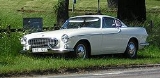
A white Volvo P1800 (with licence plate ST1) driven by Simon Templar
Simon Templar
Simon Templar is a British fictional character known as The Saint featured in a long-running series of books by Leslie Charteris published between 1928 and 1963. After that date, other authors collaborated with Charteris on books until 1983; two additional works produced without Charteris’s...

, played by Roger Moore
Roger Moore
Sir Roger George Moore KBE , is an English actor, perhaps best known for portraying British secret agent James Bond in seven films from 1973 to 1985. He also portrayed Simon Templar in the long-running British television series The Saint.-Early life:Moore was born in Stockwell, London...

, was featured in the TV series The Saint
The Saint (TV series)
The Saint was an ITC mystery spy thriller television series that aired in the UK on ITV between 1962 and 1969. It centred on the Leslie Charteris literary character, Simon Templar, a Robin Hood-like adventurer with a penchant for disguise. The character may be nicknamed The Saint because the...

beginning in 1962 and played a prominent role throughout the entire run of the show.

Two new cars were introduced at the Geneva Motor Show in 1961, a Jaguar E-type
Jaguar E-type
The Jaguar E-Type or XK-E is a British automobile, manufactured by Jaguar between 1961 and 1975. Its combination of good looks, high performance, and competitive pricing established the marque as an icon of 1960s motoring...

 and the Volvo P1800. Jaguar was first offered the opportunity to provide an E-Type for the series but declined, feeling they had too much demand already and did not see the need for additional press. When asked for a P1800, Volvo jumped at the chance which led to an increase of sales of the P1800 and the creation of a 1960s' icon. Later, in the 1970s when The Return of the Saint was created, Jaguar made up for their mistake and offered the new XJ-S for the series.

Volvo lent two cars initially for the series - one for static studio shots and the other for moving shots. When the P1800S came along, one of the earlier cars was cut up to allow better interior shots.

Roger Moore was so smitten with the Volvo that he bought one for his own personal use.

Record-breaking 1800


A 1966 Volvo 1800S and its owner Irv Gordon
Irv Gordon
Irving "Irv" Gordon is a Guinness World Record holding Volvo owner and retired science teacher from East Patchogue Long Island, New York.Over the last 44 years, he and his 1966 Volvo P1800 have covered an incredible 2.8 million miles...

 of East Patchogue, New York
East Patchogue, New York
East Patchogue is a census-designated place in the Suffolk County town of Brookhaven, New York, United States. The population was 20,824 at the 2000 census. The CDP is a proximate representation of the East Patchogue hamlet used for statistical purposes of the Census Bureau...

, USA own the Guinness world record for highest mileage
Car longevity
Car longevity is of interest to many car owners and concerns several things: maximum service life in either miles or time , relationship of components to this lifespan, identification of factors that might afford control in extending the lifespan. Barring an accidental end to the lifespan, a car...

 in the same vehicle he has been driving for more than 45 years. It had covered in excess of 2219751 miles (3,572,334.1 km) by March 2004, and passed the 2600000 miles (4,184,284 km) mark by October 2007. As of August, 2009, the car is at 2.7 million miles and the owner is now targeting the three million mile mark.

He has driven about 26,000 of those miles outside of the U.S., in Canada and Mexico, as well as in Europe. "In Sweden, we drove to Volvo's global headquarters to see where the P1800 was born", Gordon said.

On April 2, 2002, Gordon and his 1800S were guests on The Tonight Show with Jay Leno, after reaching the two million milestone.

As of July 2010, Gordon reached 2.8 million miles for his 70th birthday, and announced that he hopes to reach 3 million by the time he turns 73. That feat will require him to drive an average of around 5,500 miles per month.

Irv Gordon and his Volvo were featured on PBS's Nova scienceNow in January 2011.

50th Anniversary


A major and much acclaimed 50th Anniversary of the P1800 took place in France on June 13, 2010 during the Viking Classic Auto Show, celebrating the first presentation of the P1800 to the public at the Brussels Motor Show in 1960. The show with more than 350 Volvo cars gathered the rarely seen number of 80 Volvo P1800 of all types and from all over Europe and the prototype P958-X1 in presence of yacht designer Pelle Petterson
Pelle Petterson
Per "Pelle" Helmer Petterson in Stockholm is an award-winning Swedish sailor and yacht designer. He is the son of Helmer Petterson, and studied design at the leading Pratt Institute in New York from 1955 through 1957. He is probably best known for designing the Maxi Class sailing boats, which...

 as well as Irv Gordon. The event was promoted with the support of Volvo Cars Heritage.

External links

concerning the Volvo 1800 (notchback coupé) and the Volvo 1800 ES (sports estate).