
All Topics  
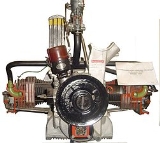
Volkswagen air cooled engine


   Email Print
   Bookmark   Link


Volkswagen air cooled engine


The Volkswagen air cooled engine is one of the most widely used and versatile internal combustion engine
Internal combustion engine

The internal combustion engine is an engine in which the combustion of a fuel occurs in a combustion chamber inside and integral to the engine. In an internal combustion engine it is always the expansion of the high temperature and pressure gases that are produced by the combustion which apply force to the movable component of the engine, such as...
s in the world. Variations of this engine were produced by Volkswagen
Volkswagen

Volkswagen Passenger Cars, also known as VW, is an automobile manufacturer based in Wolfsburg, Germany and is the original as well as the largest brand by sales volume within the Volkswagen Group....
 plants around the world from 1936 until 2006.

iron cylinders, forged crankshaft and connecting rods, and cast aluminum heads and pistons were hallmarks of the design.

the Beetle, the first Transporters (bus) used the Volkswagen air cooled engine, a 1.2 L, 25 hp (19 kW), air-cooled four-cylinder boxer engine mounted in the rear.


Discussion
Ask a question about 'Volkswagen air cooled engine'
Start a new discussion about 'Volkswagen air cooled engine'
Answer questions from other users
Full Discussion Forum


Encyclopedia


The Volkswagen air cooled engine is one of the most widely used and versatile internal combustion engine
Internal combustion engine

The internal combustion engine is an engine in which the combustion of a fuel occurs in a combustion chamber inside and integral to the engine. In an internal combustion engine it is always the expansion of the high temperature and pressure gases that are produced by the combustion which apply force to the movable component of the engine, such as...
s in the world. Variations of this engine were produced by Volkswagen
Volkswagen

Volkswagen Passenger Cars, also known as VW, is an automobile manufacturer based in Wolfsburg, Germany and is the original as well as the largest brand by sales volume within the Volkswagen Group....
 plants around the world from 1936 until 2006.

Development

Cast iron cylinders, forged crankshaft and connecting rods, and cast aluminum heads and pistons were hallmarks of the design.

"Type 1"


Like the Beetle, the first Transporters (bus) used the Volkswagen air cooled engine, a 1.2 L, 25 hp (19 kW), air-cooled four-cylinder boxer engine mounted in the rear. The 36 hp (22 kW) version became standard in 1955 while an unusual early version of the 40 hp (25 kW) engine debuted exclusively on the Type 2 in 1959. This engine proved to be so uncharacteristically troublesome that Volkswagen recalled all 1959 Transporters and replaced the engines with an updated version of the 40 hp (25 kW) engine. Any 1959 models that retain that early engine today are true survivors. Since the engine was totally discontinued at the outset, no parts were ever made available.

This second-generation Type 2 lost its distinctive split front window and was slightly larger and considerably heavier than its predecessor. Its common nicknames are Breadloaf and Bay-window, or Loaf and Bay for short. At 1.6 L and 48 DIN hp (35 kW), the engine was also slightly larger.

The T2b was introduced by way of gradual change over three years. The 1971 Type 2 featured a new, 1.6 L engine with dual intake ports on each cylinder head and was rated at 50 DIN hp (37 kW). An important change came with the introduction of front disc brakes and new wheels with brake ventilation holes and flatter hubcaps.

The Type 3 (sedan, notchback, fastback) was initially equipped with a 1.5 L (1493 cc) engine based on the air-cooled flat-4
Flat-4

A flat-4 or horizontally-opposed-4 is a flat engine with four cylinders arranged horizontally in two banks of two cylinders on each side of a central crankcase....
 found in the Type 1. While the long block
Long block

Long block is an automotive term describing an engine sub-assembly consisting of the following:* Short block. The long block is always a superset of the corresponding short block....
 remained the same as the Type 1, the engine cooling was drastically changed to allow for a much lower engine profile. This resulted in increased area for cargo stowage with the so-called "Pancake" or "Suitcase" engine. This engine's displacement would later increase to 1600cc.

Originally a single- or dual-carburetted 1.5 L engine, (1500 N, 45 hp or 1500S, 54 hp) the Type 3 engine got a larger displacement (1.6l 1600 cc) and modified in 1968 to include Bosch
Robert Bosch GmbH

Robert Bosch Gesellschaft mit beschr?nkter Haftung is a German diversified technology-based corporation which was started in 1886 by Robert Bosch in Stuttgart, Germany....
 D-Jetronic
Jetronic

Jetronic is a trade name for a type of fuel injection technology marketed by Robert Bosch GmbH from the 1960s forward. Bosch licensed the concept to many automobile manufacturers....
 electronic fuel injection as an option, making it one of the first mass production consumer cars with such a feature (the first was the Type 4 VW 411
Volkswagen Type 4

The Volkswagen Type 4 was a mid-sized 2 or 4-door sedan or 2-door station wagon built by Volkswagen of Germany. It was produced between 1968 and 1974....
).

"1100"
  • 1945 - 1953 Volkswagen Beetle
    Volkswagen Beetle

    The Volkswagen Type 1 is an economy car produced by the Germany auto maker Volkswagen from 1938 until 2003. The car was originally known as K?fer, the German language word for "beetle," from which the popular English nickname originates....
  • 1950 - 1953 Volkswagen Type 2
    Volkswagen Type 2

    The Volkswagen Type 2 was the second automotive line introduced by Germany automaker Volkswagen. It was a van introduced in 1950, initially based on Volkswagen's first model, the Type 1, also known as the "Volkswagen Beetle"....


"1200"

"1300"
Europe 1966-1995 dual port version of 1300cc 1966 only

"1500"
1967 - 1971

"1600"
1972 on

"Single Port"
In the US, the 1600 single port was used on the following models:
  • 1966 - 1970 Type 3
    Volkswagen Type 3

    The Volkswagen Type 3, also referred to as the Volkswagen 1500 and later the Volkswagen 1600, was a range of small cars from Germany manufacturer Volkswagen ....
  • 1968 - 1970 Type 2
    Volkswagen Type 2

    The Volkswagen Type 2 was the second automotive line introduced by Germany automaker Volkswagen. It was a van introduced in 1950, initially based on Volkswagen's first model, the Type 1, also known as the "Volkswagen Beetle"....
  • 1970 Beetle
    Volkswagen Beetle

    The Volkswagen Type 1 is an economy car produced by the Germany auto maker Volkswagen from 1938 until 2003. The car was originally known as K?fer, the German language word for "beetle," from which the popular English nickname originates....
  • 1970 Karmann Ghia
    Volkswagen Karmann Ghia

    The Karmann Ghia was marketed from 1955 to 1974 by Volkswagen as a 2+2 coupe and as a convertible — both incorporating the commonplace chassis and mechanicals of the Volkswagen Beetle, evocative styling by the Italian carrozzeria Carrozzeria Ghia, and hand-built bodywork by German coachbuilding Karmann....


"Dual Port"
In the US, the 1600 dual port was used on the following models:
  • 1971 Type 2
    Volkswagen Type 2

    The Volkswagen Type 2 was the second automotive line introduced by Germany automaker Volkswagen. It was a van introduced in 1950, initially based on Volkswagen's first model, the Type 1, also known as the "Volkswagen Beetle"....
  • 1971 - 1979 Beetle
    Volkswagen Beetle

    The Volkswagen Type 1 is an economy car produced by the Germany auto maker Volkswagen from 1938 until 2003. The car was originally known as K?fer, the German language word for "beetle," from which the popular English nickname originates....
  • 1971 - 1974 Karmann Ghia
    Volkswagen Karmann Ghia

    The Karmann Ghia was marketed from 1955 to 1974 by Volkswagen as a 2+2 coupe and as a convertible — both incorporating the commonplace chassis and mechanicals of the Volkswagen Beetle, evocative styling by the Italian carrozzeria Carrozzeria Ghia, and hand-built bodywork by German coachbuilding Karmann....


"Type 4"


In 1968, Volkswagen introduced a new vehicle, the Type 4
Volkswagen Type 4

The Volkswagen Type 4 was a mid-sized 2 or 4-door sedan or 2-door station wagon built by Volkswagen of Germany. It was produced between 1968 and 1974....
. The model 411, and later the model 412, offered many new features to the Volkswagen lineup.

While the Type 4 was discontinued in 1974 when sales dropped, its engine became the power plant for Volkswagen Type 2
Volkswagen Type 2

The Volkswagen Type 2 was the second automotive line introduced by Germany automaker Volkswagen. It was a van introduced in 1950, initially based on Volkswagen's first model, the Type 1, also known as the "Volkswagen Beetle"....
s ("Kombis") produced from 1972 to 1979: it continued in modified form in the later "Vanagon" which was air-cooled from 1980 until mid-1983. The engine that superseded the Type 4 engine in late 1983 retained Volkswagen Type 1 architecture, yet featured water-cooled cylinder heads and cylinder jackets. The Wasserboxer
Wasserboxer

The Wasserboxer is a water cooling overhead valve flat engine petrol engine developed by Volkswagen. This engine is unique to the Volkswagen Type 2 , having never been used in any other vehicle....
, VW speak for a water-cooled, opposed-cylinder (flat or boxer engine), did not enjoy the reputation for longevity that the original air-cooled design had forged. From the very start, the engine suffered cylinder-to-head sealing problems, mostly due to galvanic corrosion, often a result of slack maintenance schedules. Volkswagen discontinued the engine in 1992, upon the introduction of the Eurovan.

The Type 4 engine was also used on the Volkswagen version of the Porsche 914
Porsche 914

The Porsche 914 was a Mid-engine design sports car built and sold collaboratively by Volkswagen and Porsche from 1969 through 1976....
. Volkswagen versions originally came with an 80 hp fuel-injected 1.7 L flat-4 engine based on the Volkswagen air cooled engine. In Europe, the four-cylinder cars were sold as Volkswagen-Porsches, at VW dealerships. This "tainted" the car in the opinion of many automotive critics of that era, and a little of that attitude persists to this day.

Slow sales and rising costs prompted Porsche to discontinue the 914/6 variant in 1972 after producing 3,351 of them; its place in the lineup was filled by a variant powered by a new 95 HP 2.0 L, fuel-injected version of Volkswagen's Type 4 engine in 1973. For 1974, the 1.7 L engine was replaced by a 76HP 1.8 L, and the new Bosch L-Jetronic fuel injection system was added to American units to help with emissions control. 914 production ended in 1976. The 2.0 L engine continued to be used in the Porsche 912E
Porsche 912

File:PolitieTarga.JPGThe Porsche 912 was a sports car manufactured by Porsche of Germany between 1965 and 1969 as their entry-level model. The 912 was a nimble-handling compact performance four-seat vehicle, delivering 90 Horsepower at 5800 Revolutions Per Minute....
, which provided an entry-level model until the Porsche 924
Porsche 924

The Porsche 924 is an automobile produced by Porsche Aktiengesellschaft of Germany from 1976 to 1988. A two-door, 2+2 coup?, the 924 replaced the Porsche 914 as the company's entry-level model, and was the model that finally retired the Porsche 912....
 was introduced.

For the Volkswagen Type 2
Volkswagen Type 2

The Volkswagen Type 2 was the second automotive line introduced by Germany automaker Volkswagen. It was a van introduced in 1950, initially based on Volkswagen's first model, the Type 1, also known as the "Volkswagen Beetle"....
, 1972's most prominent change was a bigger engine compartment to fit the larger 1.7 to 2.0 L engines from the VW Type 4, and a redesigned rear end which eliminated the removable rear apron. The air inlets were also enlarged to accommodate the increased cooling air needs of the larger engines.

This all-new, larger engine is commonly called the Type 4 engine as opposed to the previous Type 1 engine first introduced in the Type 1 Beetle. This engine was called "Type 4" because it was originally designed for the Type 4 (411 and 412) automobiles. There is no "Type 2 engine" or "Type 3 engine", because those vehicles did not feature new engine designs when introduced. They used the "Type 1" engine from the Beetle with minor modifications such as rear mount provisions and different cooling shroud arrangements.

In the Type 2, the VW Type 4 engine was an option for the 1972 model year onward. This engine was standard in models destined for the US and Canada. Only with the Type 4 engine did an automatic transmission become available for the first time in the 1973 model year. Both engines displaced 1.7 L, rated at 66 DIN hp (49 kW) with the manual transmission and 62 DIN hp (46 kW) with the automatic. The Type 4 engine was enlarged to 1.8 L and 68 DIN hp (50 kW) for the 1974 model year and again to 2.0 L and 70 DIN hp (52 kW) for the 1976 model year. As with all Transporter engines, the focus in development was not on power, but on low-end torque. The Type 4 engines were considerably more robust and durable than the Type 1 engines, particularly in transporter service.

The T2c, so called since it got a slightly raised roof — by about 10 cm — in the early 1990s, was built for the South American and Central American markets. The T2c was produced in Mexico until 1991* with the 1.6 L air-cooled Type 1 engine, and from 1991 until 1996 with water-cooled engines from the VW Golf (a VW/Audi 1.4L). Since 1997, the T2c has been built in Brazil with air-cooled engines for the Brazilian market and with water-cooled engines for the Mexican market, the latter easily identified by their large, black-coloured, front-mounted radiators. 1

Since production of the original Beetle was halted in late 2003, the T2 remained the only Volkswagen model with the traditional air-cooled, rear-mounted boxer engine when the Brazilian model shifted to water-cooled on December 23, 2005. Previously, the watercooled T2c was sold in Mexico between 1991-2002.

1.7 L

Usage

The aircooled 4-cylinder opposed cylinder Beetle engines have been used for other purposes as well. Especially interesting is its use as an experimental aircraft engine. This type of Beetle engine deployment started in the sixties. A number of companies still produce aero engines that are VW Beetle engine derivatives: Limbach, Hapi, Revmaster and others. Kitplanes or plans built experimental aircraft were specifically designed to utilize these engines.

During the 70's, in Brazil, Volkswagen made available the 1700cc engine for it's regular production car SP-2. The 1700cc engine was, of course, the same engine as the 1600cc, but with enlarged cylinder bores.

Up until 2001, Beetle engines were also used to run several of the ski lifts at the Thredbo ski resort in NSW, Australia, and were maintained to a high standard by expert VW mechanics.

Also in Australia, in remote opal-mining communities VW motors were modified to air compressors for jack hammers etc. They used 2 cylinders on one side as a motor and modified the head on the other side to produce a flow of compressed air. The opal fields are very dry and hot, so an air-cooled compressor has an advantage over liquid cooled.

Aircraft


  • Aerosport Quail
    Aerosport Quail

    The Aerosport Quail was an Ultralight aviation designed for homebuilt aircraft by Harris Woods. It was a high-wing monoplane with an enclosed cabin and tricycle undercarriage....
  • Druine Turbulent
    Druine Turbulent

    The Druine D.31 Turbulent is a France single-seat ultralight Homebuilt aircraft designed by Roger Druine....
  • Evans VP-1 Volksplane
    Evans VP-1 Volksplane

    The Evans VP-1 Volksplane is an United States designed aircraft for amateur construction designed by aeronautical engineer William Samuel Evans of La Jolla, California....
  • Monnett Sonerai
    Monnett Sonerai

    The Sonerai is a small, VW powered homebuilt aircraft designed by John Monnett in the early 1970s. The Sonerai began as a single seat mid-wing Formula-V racer....


Industrial


In 1967-68, portable sawmill maker, Mighty Mite of Portland, OR., used VW gasoline engines to power the circular saw blades of light sawmills. Later as the US market for VW Beetles declined, the sawmill was modified for other power.