

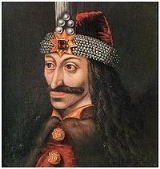
Vlad III the Impaler

Encyclopedia
Vlad III, Prince of Wallachia (1431–1476), also known by his patronymic
Dracula (son of the Dragon (Vlad II) Dracul
), and posthumously dubbed Vlad the Impaler (Romanian: Vlad Țepeș ˈvlad ˈt͡sepeʃ), was a three-time Voivode of Wallachia, ruling mainly from 1456 to 1462, the period of the incipient Ottoman conquest of the Balkans. His father was a member of the Order of the Dragon (Dracul) and Dracula means son of the Dragon to indicate his father's title within the Order of the Dragon.
Vlad III is remembered for spending much of his rule campaigning efforts against the Ottoman Empire
and its expansion
and for the impaling
of enemies.
Already during his lifetime, his reputation of excessive cruelty spread abroad, to Germany and elsewhere in Europe
. The total number of his victims is estimated in the tens of thousands. The name of the vampire
Count Dracula
in Bram Stoker
's 1897 novel Dracula
was inspired by Vlad's patronymic.
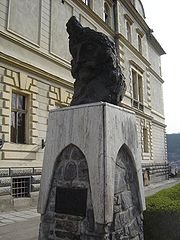
During his life Vlad wrote his name in Latin documents as Wladislaus Dragwlya, vaivoda partium Transalpinarum (1475).
His Romanian patronymic Dragwlya (or Dragkwlya)
is a diminutive of the epithet Dracul "the Dragon" carried by his father Vlad II
, who in 1431 was inducted as a member of the Order of the Dragon
, a chivalric order
founded by Sigismund of Hungary
in 1408.
Dracul is the Romanian definite form, the -ul being the suffigated definite article (deriving from Latin ille).
The noun drac "dragon" itself continues Latin draco.
In Modern Romanian, the word drac has adopted the meaning of "devil" (the term for "dragon" now being balaur). This has led to misinterpretations of Vlad's epithet as characterizing him as "devilish".
Vlad's moniker of Țepeș ("Impaler
") identifies his favourite method of execution. It was attached to his name posthumously, in ca. 1550.
, Transylvania
, in the winter of 1431 to Vlad II Dracul
, future voivode of Wallachia
and son of the celebrated Voivode Mircea the Elder. His mother is believed to be the second wife of Vlad Dracul, Princess Cneajna of Moldavia
, eldest daughter of Alexandru cel Bun
and aunt to Stephen the Great of Moldavia
. He had two older half-brothers, Mircea II and Vlad Călugărul
, and a younger brother, Radu III the Beautiful.
In the year of his birth Vlad's father, known under the nickname Dracul, had traveled to Nuremberg
where he had been vested into the Order of the Dragon
. At the age of five, young Vlad was also initiated into the Order.
Vlad and Radu spent their early formative years in Sighișoara under the care and tutelage of their mother and the wives of other exiled boyar
s. During the first reign of their father, Vlad II Dracul, the Voivode brought his young sons to Târgoviște
, the capital of Wallachia at that time.
The Byzantine chancellor Mikhail Doukas showed that, at Târgoviște, the sons of boyars and ruling princes were well-educated by Romanian or Greek scholars commissioned from Constantinople. Vlad is believed to have learned combat skills, geography, mathematics, science, languages (Old Church Slavonic
, German, Latin), and the classical arts and philosophy.
(tax on non-Muslims) to the Sultan and also send his two legitimate sons, Vlad III and Radu, to the Ottoman court, to serve as hostages of his loyalty.
Vlad III was imprisoned and often whipped and beaten because of his verbal abuse towards his trainers and his stubborn behavior, while his younger brother Radu
was much easier to control. Radu converted to Islam
, entered the service of Sultan Murad II
's son, Mehmed II
(later known as the Conqueror), and was allowed into the Topkapı Palace
. Radu was also honored by the title Bey
and was given command of the Janissary
contingents.
These years presumably had a great influence on Vlad's character and led to Vlad's well-known hatred for the Ottoman Turks, the Janissary
, his brother Radu for converting to Islam and the young Ottoman prince Mehmed II (even after he became sultan). He was envious of his father's preference for his elder brother, Mircea II and half brother, Vlad Călugărul
. He also distrusted the Hungarians and his own father for trading him to the Turks and betraying the Order of the Dragon
's oath to fight the Ottoman Empire
.
Vlad was later released under probation and taken to be educated in logic, the Quran and the Turkish
and Persian
languages and works of literature
. He would speak these languages fluently in his later years. He and his brother were also trained in warfare and riding horses. The boys' father, Vlad Dracul, was awarded the support of the Ottomans and returned to Wallachia and took back his throne from Basarab II
and some unfaithful Boyar
s.
by the name of Cnaejna (Princess) Bathory of Transylvania
with whom he had two sons: Radu (1435–1482) and Vlad Dracula IV (Vlad Țepeluș, ?-1500). Radu lived with the Bishop of Oradea in Transylvania until 1482, when he fell ill. He returned to Buda
, where he died in his mother's presence. Vlad Tepelus was married to Neacsa Ujlaki and he was an unsuccessful claimant to the Wallachian throne between 1476 and 1488.
, with whom he had two sons: Mihnea I "the Bad" (Mihnea I cel Rău, ?-1510) and Mihail (?-1485).
According to local legend, she died during the siege of Poenari Castle, which was surrounded by the Ottoman army led by his brother Radu Bey
and the Wallachian Janissary
. A woodland archer, having seen the shadow of Vlad's wife behind a window, shot an arrow through the window into Vlad's main quarters with a message warning him that Radu's army was approaching. McNally and Florescu explain that the archer was one of Vlad's relatives who sent the warning out of loyalty despite having converted to Islam
and served in the ranks of Radu Bey
. Upon reading the message, Vlad's wife threw herself from the tower into a tributary of the Argeș River
flowing below the castle, saying she would rather rot and be eaten by the fish of the Argeș than be led into captivity by the Turks. Today, the tributary is called Râul Doamnei
(the "Lady's River", also called the Princess's River).
of Wallachia
, a cousin of the king, and in the years before his final release in 1474, lived with her in a house in the Hungarian capital. Ilona and Vlad had one daughter, Zaleska who died in 1510 without known offsprings.
, descendant of Vlad the Impaler, joined the British Royal Family in 1893 upon her marriage to HRH Prince George, Duke of York, who became King George V
in 1910. In October 2011, Prince Charles publically claimed that genealogy proves that he is a distant relative of Vlad the Impaler. The claim accompanied his announcement of a pledge to help conserve the forested areas of Transylvania.
s in league with the Hungarian regent John Hunyadi
rebelled against Vlad Dracul II and killed him in the marshes near Bălteni. Mircea, Dracul's eldest son and heir, was blinded and buried alive at Târgoviște
.
To prevent Wallachia from falling into the Hungarian fold, the Ottomans invaded Wallachia and put young Vlad III on the throne. However, this rule was short-lived as Hunyadi himself now invaded Wallachia and restored his ally Vladislav II
, of the Dănești
clan, to the throne.
Vlad fled to Moldavia, where he lived under the protection of his uncle, Bogdan II. In October 1451, Bogdan was assassinated and Vlad fled to Hungary. Impressed by Vlad's vast knowledge of the mindset and inner workings of the Ottoman Empire as well as his hatred of the new sultan Mehmed II, Hunyadi reconciled with his former rival and made him his advisor.
After the Fall of Constantinople
to Mehmed II
in 1453, Ottoman influence began to spread from this base through the Carpathians, threatening mainland Europe, and by 1481 conquering
the entire Balkans peninsula.
Vlad's rule thus falls entirely within the three decades of the Ottoman conquest of the Balkans.
In 1456, three years after the Ottomans had conquered Constantinople, they threatened Hungary by besieging Belgrade
. Hunyadi began a concerted counter-attack in Serbia
: while he himself moved into Serbia and relieved the siege (before dying of the plague), Vlad led his own contingent into Wallachia, reconquered his native land and killed Vladislav II in hand-to-hand combat.
Vlad had three aims for Wallachia: to strengthen the country's economy, its defense and his own political power. He took measures to help the peasants' well-being by building new villages and raising agricultural output. He understood the importance of trade for the development of Wallachia. He helped the Wallachian merchants by limiting foreign merchant trade to three market towns: Târgșor, Câmpulung and Târgoviște.
Vlad considered the boyars the chief cause of the constant strife as well as of the death of his father and brother. To secure his rule, he had many leading nobles killed and gave positions in his council, traditionally belonging to the greatest boyars, to persons of obscure origins, who would be loyal to him alone, and some to foreigners. For lower offices, Vlad preferred knights and free peasants to boyars. In his aim of fixing up Wallachia, Vlad gave new laws punishing thieves and robbers. Vlad treated the boyars with the same harshness, believing them guilty of weakening Wallachia through their personal struggles for power.
The army was also strengthened. He had a small personal guard, mostly made of mercenaries, who were rewarded with loot and promotions. He also established a militia or ‘lesser army’ made up of peasants called to fight whenever war came.
Vlad Dracula built a church at Târgșor (allegedly in the memory of his father and older brother who were killed nearby), and he contributed with money to the Snagov Monastery and to the Comana Monastery fortifications.
, Vlad also acted against them by eliminating their trade privileges and raiding their cities. In 1459, he had several Saxon settlers of Brașov
(Kronstadt) impaled.
called for a new crusade against the Ottomans, at the Congress of Mantua
. In this crusade, the main role was to be played by Matthias Corvinus, son of John Hunyadi
(János Hunyadi), the King of Hungary. To this effect, Matthias Corvinus received from the Pope 40,000 golden coins, an amount that was thought to be enough to gather an army of 12,000 men and purchase 10 Danube warships. In this context, Vlad allied himself with Matthias Corvinus, with the hope of keeping the Ottomans out of the country (Wallachia was claimed as a part of the Ottoman Empire by Sultan Mehmed II).
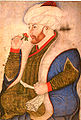 Later that year, in 1459, Ottoman
Sultan
Mehmed II sent envoys to Vlad to urge him to pay a delayed Jizya
(tax on non-Muslims) of 10,000 ducats and 500 recruits into the Ottoman forces. Vlad refused, because if he had paid the 'tribute', as the tax was called at the time, it would have meant a public acceptance of Wallachia as part of the Ottoman Empire. Vlad, just like most of his predecessors and successors, had as a primary goal to keep Wallachia as independent as possible. Vlad had the Turkish envoys killed on the pretext that they had refused to raise their "hats" to him, by nailing their turbans to their heads.
Meanwhile, the Sultan received intelligence reports that revealed Vlad's domination of the Danube
. He sent the Bey
of Nicopolis and Hamza Pasha, to make peace and, if necessary, eliminate Vlad III.
Vlad Țepeș planned to set an ambush. Hamza Pasha, the Bey of Nicopolis brought with him 10,000 cavalry and when passing through a narrow pass north of Giurgiu, Vlad launched a surprise attack. The Wallachians had the Turks surrounded and defeated. The Turks' plans were thwarted and almost all of them caught and impaled, with Hamza Pasha impaled on the highest stake to show his rank.
In the winter of 1462, Vlad crossed the Danube and devastated the entire Bulgarian land in the area between Serbia
and the Black Sea
. Disguising himself as a Turkish
Sipahi
, he infiltrated and destroyed Ottoman camps. In a letter to Corvinus dated 2 February, he wrote:
I have killed peasants men and women, old and young, who lived at Oblucitza and Novoselo, where the Danube flows into the sea, up to Rahova
, which is located near Chilia, from the lower Danube up to such places as Samovit and Ghighen. We killed 23,884 Turks without counting those whom we burned in homes or the Turks whose heads were cut by our soldiers...Thus, your highness, you must know that I have broken the peace with him (Sultan
Mehmet II).
In response to this, Sultan Mehmed II
raised an army of around 60,000 troops and 30,000 irregulars, and in spring of 1462 headed towards Wallachia. Commanding at best only 30,000 to 40,000 men (depending of the source), Vlad was unable to stop the Ottomans from crossing the Danube at June 4, 1462 and entering Wallachia. He was constantly organizing small attacks and ambushes on the Turks, such as The Night Attack
when 15,000 Turks were killed. Vlad III defeated Ottoman Sipahi
commanders such as Iosuf Bey, Ömer Bey Turahanoğlu and Evrenos Bey. This infuriated Mehmed II, who then crossed the Danube. With the exception of some Turkish references, all the other chronicles at the time that mention the 1462 campaign state that the Sultan was defeated. Apparently, the Turks retreated in such a hurry that by July 11, 1462 the Sultan was already in Adrianopolis
. According to the Byzantine historian Chalcocondil, Radu the Beautiful, brother of Vlad III and ingratiate of the Sultan, was left behind in Targoviste with the hope that he would be able to gather an anti-Vlad clique that would ultimately get rid of Vlad as Voivode of Wallachia and crown Radu as the new ruler.
Vlad the Impaler's attack was celebrated by the Saxon cities of Transylvania, the Italian states and the Pope. A Venetian envoy, upon hearing about the news at the court of Corvinus on 4 March, expressed great joy and said that the whole of Christianity should celebrate Vlad Țepeș's successful campaign. The Genoese from Caffa also thanked Vlad, for his campaign had saved them from an attack of some 300 ships that the sultan planned to send against them.
to victory at all expense by Sultan
Mehmet II. After the Sipahi
s' incursions failed to subdue Vlad, the few remaining Sipahi
s were killed in a night raid by Vlad III in 1462. However, as the war raged on, Radu and his formidable Janissary
battalion were well supplied with a steady flow of gunpowder
and dinar
s; this allowed them to push deeper into the realm of Vlad III. Radu and his well-equipped forces finally besieged Poenari Castle, the famed lair of Vlad III. After his difficult victory Radu was given the title Bey of Wallachia by Sultan
Mehmet II.
Vlad III's defeat at Poenari was due in part to the fact that the Boyars, who had been alienated by Vlad's policy of undermining their authority, had joined Radu under the assurance that they would regain their privileges. They may have also believed that Ottoman
protection was better than Hungarian
. It was said as well that Radu (through his spies or traitors) found the place where some Boyars' families were hidden during the war (probably some forests around Snagov) and blackmailed them to come to his side.
By 8 September, Vlad won another three victories, but continuous war had left him without any money and he could no longer pay his mercenaries. Vlad travelled to Hungary to ask for help from his former ally, Matthias Corvinus. Instead of receiving help, he found himself arrested and thrown into the dungeon for high treason. Corvinus, not planning to get involved in a war after having spent the Papal money meant for it on personal expenses, forged a letter from Vlad III to the Ottomans where he supposedly proposed a peace with them, to give an explanation for the Pope and a reason to abandon the war and return to his capital.
When Vlad came to him to ask for his help with fighting the war, Matthias Corvinus arrested him using false documents: a forged letter, in which Vlad supposedly pledged loyalty to Mehmed II and promised to strike an agreement with the Ottomans over Wallachia.
Vlad was imprisoned at Oratia, a fortress located at Podu Dâmboviței Bridge. A period of imprisonment in Visegrád
near Buda followed, where the Wallachian prince was held for 10 years. Then he was imprisoned in Buda.
The exact length of Vlad's period of captivity is open to some debate, though indications are that it was from 1462 until 1474. Diplomatic correspondence from Buda
seems to indicate that the period of Vlad's effective confinement was relatively short. Radu's openly pro-Ottoman policy as voivode probably contributed to Vlad's rehabilitation. Moreover, Ștefan ce Mare, Voievod of Moldavia
and relative of Vlad intervened on his behalf to be released from prison as the Ottoman pressure on the territories north of Danube was increasing.
 After the sudden death of his brother Radu III the Fair in the year 1475, Vlad III declared his third reign in 26 November 1476. Vlad began preparations for the reconquest of Wallachia and in 1476, with Hungarian support. Vlad’s third reign had lasted little more than two months when he was assassinated. The exact date of his death is unknown, presumably the end of December 1476, but it is known that he was dead by 10 January 1477.
The exact location of his death is also unknown, but it would have been somewhere along the road between Bucarest and Giurgiu
.
Vlad's head was taken to Constantinople as a trophy, and his body was buried unceremoniously by his rival, Basarab Laiota, possibly at Comana
, a monastery founded by Vlad in 1461. The Comana monastery was demolished and rebuilt from scratch in 1589.
In the 19th century, Romanian historians cited a "tradition", apparently without any kind of support in documentary evidence, that Vlad was buried at Snagov
, an island monastery located near Bucharest. To support this theory, the so-called Cantacuzino Chronicle was cited, which cites Vlad as the founder of this monastery. But as early as 1855, Alexandru Odobescu
had established that this is impossible as the monastery had been in existence before 1438. Since excavations carried out by Dinu V Rosetti in June–October 1933, it has become clear that Snagov monastery was founded during the later 14th century, well before the time of Vlad III. The 1933 excavation also established that there was no tomb below the supposed "unmarked tombstone" of Vlad in the monastery church. Rosetti (1935) reported that “Under the tombstone attributed to Vlad there was no tomb. Only many bones and jaws of horses." In the 1970s, speculative attribution of an anonymous tomb found elsewhere in the church to Vlad Tepes was published by Simion Saveanu, a journalist who wrote a series of articles on the occasion of the 500th anniversary of Vlad's death. Most Romanian historians today favor the Comana
monastery as the final resting place for Vlad Tepes.
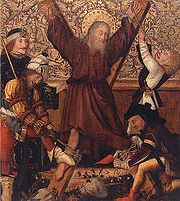 Even during his lifetime, Vlad III Țepeș became famous as a tyrant taking sadistic pleasure in torturing and killing.
He is shown in cryptoportraits made during his lifetime in the role of cruel rulers or executioners such as Pontius Pilate
ordering the torture and execution of Jesus Christ, or as Aegeas, the Roman proconsul in Patras, overseeing the crucifixion of Saint Andrew
. After Vlad's death, his cruel deeds were reported with macabre gusto in popular pamphlets in Germany, reprinted from the 1480s until the 1560s, and to a lesser extent in Tsarist Russia.
Estimates for number of his victims range from 40,000 to 100,000, comparable to the cumulative number of executions over four centuries of European witchhunts. According to the German stories the number of victims he had killed was at least 80,000. In addition to the 80,000 victims mentioned he also had whole villages and fortresses destroyed and burned to the ground.
Impalement
was Vlad's preferred method of torture and execution. Several woodcuts from German pamphlets of the late 15th and early 16th centuries show Vlad feasting in a forest of stakes and their grisly burdens outside Brașov, while a nearby executioner cuts apart other victims. It was reported that an invading Ottoman
army turned back in fright when it encountered thousands of rotting corpses impaled on the banks of the Danube. It has also been said that in 1462 Mehmed II
, the conqueror of Constantinople
, a man noted for his own psychological warfare tactics, returned to Constantinople after being sickened by the sight of 20,000 impaled corpses outside Vlad's capital of Târgoviște.
Allegedly, Vlad's reputation for cruelty was actively promoted by Matthias Corvinus, who tarnished Vlad’s reputation and credibility for a political reason: as an explanation for why he had not helped Vlad fight the Ottomans in 1462, for which purpose he had received money from most Catholic states in Europe. Matthias employed the charges of Southeastern Transylvania, and produced fake letters of high treason, written on 7 November 1462.
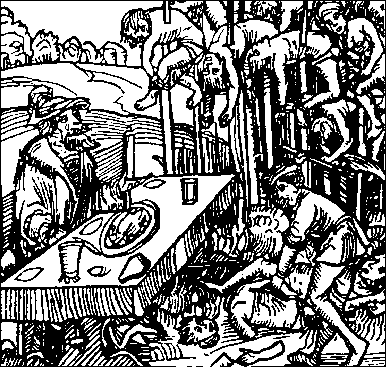 The German stories circulated first in manuscript
form in the late 15th century and the first manuscript was probably written in 1462 before Vlad's arrest. The text was later printed in Germany and had major impact on the general public, becoming a best-seller of its time with numerous later editions adding and altering the original text.
In addition to the manuscripts and pamphlets the German version of the stories can be found in the poem of Michael Beheim
. The poem called "Von ainem wutrich der hies Trakle waida von der Walachei" ("Story of a Madman Named Dracula of Wallachia") was written and performed at the court of Frederick III, Holy Roman Emperor
during the winter of 1463.
To this day four manuscripts and 13 pamphlets are found as well as the poem by Michel Beheim. The surviving manuscripts date from the last quarter of the 15th century to the year 1500 and the found pamphlets date from 1488 to 1559–1568.
Eight of the pamphlets are incunabula
: they were printed before 1501. The German stories about Vlad the Impaler consist of 46 short episodes, although none of the manuscripts, pamphlets or the poem of Beheim contain all 46 stories.
All of them begin with the story of the old governor, John Hunyadi
, having Vlad's father killed, and how Vlad and his brother renounced their old religion and swore to protect and uphold the Christian faith. After this, the order and titles of the stories differs by manuscript and pamphlet editions.
(1486), on 13 February; then transcribed by me, the sinner Efrosin, in the year 6998 (1490), on 28 January". The Tales of Prince Dracula is neither chronological nor consistent, but mostly a collection of anecdotes of literary and historical value concerning Vlad Țepeș.
There are 19 anecdotes in The Tales of Prince Dracula which are longer and more constructed than the German stories. It can be divided into two sections: The first 13 episodes are non-chronological events most likely closer to the original folkloric oral tradition about Vlad. The last six episodes are thought to have been written by a scholar who collected them, because they are chronological and seem to be more structured. The stories begin with a short introduction and the anecdote about the nailing of hats to ambassadors' heads. They end with Vlad's death and information about his family.
Of the 19 anecdotes there are ten that have similarities to the German stories. Although there are similarities between the Russian and the German stories about Vlad, there is a clear distinction with the attitude towards him. The Russian stories tend to portray him in a more positive light: he is depicted as a great ruler, a brave soldier and a just sovereign. Stories of atrocities tend to seem to be justified as the actions of a strong ruler. Of the 19 anecdotes, only four seem to have exaggerated violence. Some elements of the anecdotes were later added to Russian stories about Ivan the Terrible of Russia.
The nationality and identity of the original writer of the anecdotes Dracula is disputed. The two most plausible explanations are that the writer was either a Romanian priest or a monk from Transylvania, or a Romanian or Moldavian from the court of Stephen the Great in Moldavia. One theory claims the writer was a Russian diplomat named Fyodor Kuritsyn.
's Ambras Castle
. This original has been lost to history, but a larger copy, painted anonymously in the first half of the 16th century, now hangs in the same gallery.
This copy, unlike the cryptoportraits contemporary with Vlad III, seems to have given him a Habsburg lip.
An Italian writer, Michael Bocignoli from Ragusa
, in his writings from 1524, he refers to Vlad Tepes as:
(In Latin in the original text: Inter eos aliquando princeps fuit, quem voievodam appellant, Dragulus nomine, vir acer et militarium negotiorum apprime peritus.)
In "Letopisetul cantacuzinesc", a historic chronicle written by Stoica Ludescu from the Cantacuzino family around 1688, Vlad orders the boyars to build the fortress Poenari with their own hands. Later in the document, Ludescu refers to the (re)crowning of Vlad as a happy event:
(In Romanian in the original text: De aciia șăzu în scaun Vladul-vodă și veni țara de i să închină, și aduse daruri multe și să întoarseră iarăși cine pre la case-și cu mare bucurie. Iar Vladul-vodă cu ajutorul lui Dumnezeu creștea întru mai mari bunătăți și în cinste pân' cât au ținut sfatul acelui neam drept.)
Around 1785, Ioan Budai-Deleanu, a Romanian writer and historian, wrote a Romanian epic heroic poem, "Țiganiada", in which prince Vlad Țepeș stars as a fierce warrior fighting the Ottomans. Later, in 1881, Mihai Eminescu
, one of the biggest Romanian poets, in "Letter 3", popularizes Vlad's image in modern Romanian patriotism, having him stand as a figure to contrast with presumed social decay under the Phanariotes
and the political scene of the 19th century. The poem is even suggesting that Vlad's violent methods be applied as a cure. In the final lyrics, the poet makes a call to Vlad Tepes (i.e. Dracula) to come, to sort the contemporaries into two teams: fool and rotten and then set fire to the prison and to the fools' home.
Petre Tutea
, Romanian filosofer characterized Vlad Tepes as follows:
(In Romanian in the original text: "Vlad Țepeș...are meritul de a fi pus pe tronul Moldovei pe cel mai mare voievod român, pe Ștefan cel Mare. Cu armele! Are meritul că a coborât morala absolută prin țepele puse în cur la nivel absolut. Dormeai cu punga de aur la cap și ți-era frică să n-o furi tu de la tine. Ăsta-i voievod absolut, Vlad Țepeș. Păi fără ăsta istoria românilor e o pajiște cu miei!")
In contrast, documents of Germanic, Saxonic, and Hungarian origin portray Vlad as a tyrant, a monster so cruel that needs to be stopped. For example, Johan Christian Engel characterizes Vlad as "a cruel tyrant and a monster of humankind". Several authors and historians believe that this may be the result of a bad image campaign initiated by the Transylvanian saxons
who were actively persecuted during Vlad's reign and later maintained and spread by Matthias Corvinus. It is conceivable that these actions were not beyond the Hungarian King since he already framed Vlad Tepes by producing a forged letter to incriminate Vlad of coalition with the Turks; however, there is incontestable evidence, both in Romanian and foreign documents, including Vlad's own letters, that he killed in horrible ways tens of thousands of people.
, who probably found the name of his Count Dracula
character in William Wilkinson's
book, An Account of the Principalities of Wallachia and Moldavia: with various Political Observations Relating to Them. It is known that Stoker made notes about this book. It is also suggested that Stoker may have heard of Vlad through his friend, Hungarian professor Ármin Vámbéry
, from Budapest
. The fact that character Dr. Abraham Van Helsing
states in the 1897 novel that the source of his knowledge about Count Dracula is his friend Arminius appears to support this hypothesis.
, known for his numerous portrayals of the fictional Dracula in films ranging from the 1950s to the 1970s.
In 1979, a Romanian film called Vlad Țepeș (sometimes known, in other countries, as The True Story of Vlad the Impaler) was released, based on his six-year reign and brief return to power in late 1476. The character is portrayed in a mostly positive perspective, though the film also mentions the excesses of his regime and his practice of impalement. The lead character is played by Ștefan Sileanu.
Vlad was depicted in his youth in the 1989 Romanian film Mircea
, which focused on the reign of his grandfather, Mircea I of Wallachia
(AD 1386-1418).
's novel Dracula
and original works derived from it have incorporated Vlad the Impaler's history into the fictional Count Dracula's past, depicting them as the same person. These include, among others: the 1972–1979 comic book series The Tomb of Dracula from Marvel Comics
, the 1973 film Dracula
, starring Jack Palance
, the 1979 BBC/Masterpiece Theater production Dracula, starring Louis Jordan, or in the 1992 film Bram Stoker's Dracula, starring Gary Oldman
as Dracula.
Dark Prince: The True Story of Dracula
, a television film released in 2000, tells the life story of Vlad the Impaler mostly accurately, but has a fictitious ending in which Vlad rises from the grave as an immortal with supernatural powers, implying he has now become the legendary vampire character. Vlad is portrayed in the film by German actor Rudolf Martin
.
Another popular novel which mentions Vlad the Impaler is Elizabeth Kostova's The Historian
, which tells an incredibly realistic and historical tale of historians searching for the tomb of the supposedly dead Vlad. In the novel, Vlad the Impaler is not just a horrifying tyrant but a vampire whose whereabouts the historians are hurriedly trying to discover before something bad happens. The book is not only rich in suspense and superstition, but also gives an accurate biography of the prince of Wallachia.
Kelly Jacobs's 2011 novel "The Diary of Drakula, volume one," expands heavily on the pop culture version of the historic Viovode, blending the fictional Count of Bram Stoker fame with his inspiration, the real life Viovode of Wallachia, Vlad the Impaler, in a composite biography. The novel is the first part of a two part series which is written in the same style as the original by Bram Stoker, as a collection of diary entries, letters and various documents. Although the novel has non-historical elements for entertainment value, most of the events depicted therein have a real historical basis, such as the fall of Constantinople
, the night attack of 1462, and Vladislav's political stance and legal actions against Saxon merchants.
, you have to fulfill some missions, that refer to Vlad the Impaler. In Assassin's Creed: Brotherhood
one has to find 7 coins belonging to Vlad the Impaler to complete a side mission. In Assassin's Creed: Revelations
, there is a Downloadable Content in which you have to investigate the dungeon in which Vlad the Impaler was jailed. One can find his sword,as one of the the best weapons in the game, in his grave. Vlad the Impaler also makes an appearance in Assassin's Creed: Revelations multiplayer as a playable persona.
Vlad the Impaler is also a playable character in Deadliest Warrior: Legends
.
Patronymic
A patronym, or patronymic, is a component of a personal name based on the name of one's father, grandfather or an even earlier male ancestor. A component of a name based on the name of one's mother or a female ancestor is a matronymic. Each is a means of conveying lineage.In many areas patronyms...
Dracula (son of the Dragon (Vlad II) Dracul
Vlad II Dracul
Vlad II , known as Vlad Dracul , was a voivode of Wallachia. He reigned from 1436 to 1442, and again from 1443 to 1447...
), and posthumously dubbed Vlad the Impaler (Romanian: Vlad Țepeș ˈvlad ˈt͡sepeʃ), was a three-time Voivode of Wallachia, ruling mainly from 1456 to 1462, the period of the incipient Ottoman conquest of the Balkans. His father was a member of the Order of the Dragon (Dracul) and Dracula means son of the Dragon to indicate his father's title within the Order of the Dragon.
Vlad III is remembered for spending much of his rule campaigning efforts against the Ottoman Empire
Ottoman Empire
The Ottoman EmpireIt was usually referred to as the "Ottoman Empire", the "Turkish Empire", the "Ottoman Caliphate" or more commonly "Turkey" by its contemporaries...
and its expansion
Ottoman wars in Europe
The wars of the Ottoman Empire in Europe are also sometimes referred to as the Ottoman Wars or as Turkish Wars, particularly in older, European texts.- Rise :...
and for the impaling
Impalement
Impalement is the traumatic penetration of an organism by an elongated foreign object such as a stake, pole, or spear, and this usually implies complete perforation of the central mass of the impaled body...
of enemies.
Already during his lifetime, his reputation of excessive cruelty spread abroad, to Germany and elsewhere in Europe
Europe
Europe is, by convention, one of the world's seven continents. Comprising the westernmost peninsula of Eurasia, Europe is generally 'divided' from Asia to its east by the watershed divides of the Ural and Caucasus Mountains, the Ural River, the Caspian and Black Seas, and the waterways connecting...
. The total number of his victims is estimated in the tens of thousands. The name of the vampire
Vampire
Vampires are mythological or folkloric beings who subsist by feeding on the life essence of living creatures, regardless of whether they are undead or a living person...
Count Dracula
Count Dracula
Count Dracula is a fictional character, the titular antagonist of Bram Stoker's 1897 Gothic horror novel Dracula and archetypal vampire. Some aspects of his character have been inspired by the 15th century Romanian general and Wallachian Prince Vlad III the Impaler...
in Bram Stoker
Bram Stoker
Abraham "Bram" Stoker was an Irish novelist and short story writer, best known today for his 1897 Gothic novel Dracula...
's 1897 novel Dracula
Dracula
Dracula is an 1897 novel by Irish author Bram Stoker.Famous for introducing the character of the vampire Count Dracula, the novel tells the story of Dracula's attempt to relocate from Transylvania to England, and the battle between Dracula and a small group of men and women led by Professor...
was inspired by Vlad's patronymic.
Name
During his life Vlad wrote his name in Latin documents as Wladislaus Dragwlya, vaivoda partium Transalpinarum (1475).
His Romanian patronymic Dragwlya (or Dragkwlya)
is a diminutive of the epithet Dracul "the Dragon" carried by his father Vlad II
Vlad II Dracul
Vlad II , known as Vlad Dracul , was a voivode of Wallachia. He reigned from 1436 to 1442, and again from 1443 to 1447...
, who in 1431 was inducted as a member of the Order of the Dragon
Order of the Dragon
The Order of the Dragon was a monarchical chivalric order for selected nobility,founded in 1408 by Sigismund, King of Hungary and later Holy Roman Emperor The Order of the Dragon (Latin Societas Draconistrarum) was a monarchical chivalric order for selected nobility,founded in 1408 by Sigismund,...
, a chivalric order
Chivalric order
Chivalric orders are societies and fellowships of knights that have been created by European monarchs in imitation of the military orders of the Crusades...
founded by Sigismund of Hungary
Sigismund, Holy Roman Emperor
Sigismund of Luxemburg KG was King of Hungary, of Croatia from 1387 to 1437, of Bohemia from 1419, and Holy Roman Emperor for four years from 1433 until 1437, the last Emperor of the House of Luxemburg. He was also King of Italy from 1431, and of Germany from 1411...
in 1408.
Dracul is the Romanian definite form, the -ul being the suffigated definite article (deriving from Latin ille).
The noun drac "dragon" itself continues Latin draco.
In Modern Romanian, the word drac has adopted the meaning of "devil" (the term for "dragon" now being balaur). This has led to misinterpretations of Vlad's epithet as characterizing him as "devilish".
Vlad's moniker of Țepeș ("Impaler
Impalement
Impalement is the traumatic penetration of an organism by an elongated foreign object such as a stake, pole, or spear, and this usually implies complete perforation of the central mass of the impaled body...
") identifies his favourite method of execution. It was attached to his name posthumously, in ca. 1550.
Early life
Vlad was born in SighișoaraSighisoara
Sighişoara is a city and municipality on the Târnava Mare River in Mureş County, Romania. Located in the historic region Transylvania, Sighişoara has a population of 27,706 ....
, Transylvania
Transylvania
Transylvania is a historical region in the central part of Romania. Bounded on the east and south by the Carpathian mountain range, historical Transylvania extended in the west to the Apuseni Mountains; however, the term sometimes encompasses not only Transylvania proper, but also the historical...
, in the winter of 1431 to Vlad II Dracul
Vlad II Dracul
Vlad II , known as Vlad Dracul , was a voivode of Wallachia. He reigned from 1436 to 1442, and again from 1443 to 1447...
, future voivode of Wallachia
Wallachia
Wallachia or Walachia is a historical and geographical region of Romania. It is situated north of the Danube and south of the Southern Carpathians...
and son of the celebrated Voivode Mircea the Elder. His mother is believed to be the second wife of Vlad Dracul, Princess Cneajna of Moldavia
Moldavia
Moldavia is a geographic and historical region and former principality in Eastern Europe, corresponding to the territory between the Eastern Carpathians and the Dniester river...
, eldest daughter of Alexandru cel Bun
Alexandru cel Bun
Alexander cel Bun was a Voivode of Moldavia, reigning between 1400 and 1432, son of Roman I Mușat. He succeeded Iuga to the throne, and, as a ruler, initiated a series of reforms while consolidating the status of the Moldavian Principality....
and aunt to Stephen the Great of Moldavia
Stephen III of Moldavia
Stephen III of Moldavia was Prince of Moldavia between 1457 and 1504 and the most prominent representative of the House of Mușat.During his reign, he strengthened Moldavia and maintained its independence against the ambitions of Hungary, Poland, and the...
. He had two older half-brothers, Mircea II and Vlad Călugărul
Vlad Calugarul
Vlad IV Călugărul, translated as Vlad the Monk, was the pious half-brother of Vlad III , and one of many rulers of Wallachia during the 15th century...
, and a younger brother, Radu III the Beautiful.
In the year of his birth Vlad's father, known under the nickname Dracul, had traveled to Nuremberg
Nuremberg
Nuremberg[p] is a city in the German state of Bavaria, in the administrative region of Middle Franconia. Situated on the Pegnitz river and the Rhine–Main–Danube Canal, it is located about north of Munich and is Franconia's largest city. The population is 505,664...
where he had been vested into the Order of the Dragon
Order of the Dragon
The Order of the Dragon was a monarchical chivalric order for selected nobility,founded in 1408 by Sigismund, King of Hungary and later Holy Roman Emperor The Order of the Dragon (Latin Societas Draconistrarum) was a monarchical chivalric order for selected nobility,founded in 1408 by Sigismund,...
. At the age of five, young Vlad was also initiated into the Order.
Vlad and Radu spent their early formative years in Sighișoara under the care and tutelage of their mother and the wives of other exiled boyar
Boyar
A boyar, or bolyar , was a member of the highest rank of the feudal Moscovian, Kievan Rus'ian, Bulgarian, Wallachian, and Moldavian aristocracies, second only to the ruling princes , from the 10th century through the 17th century....
s. During the first reign of their father, Vlad II Dracul, the Voivode brought his young sons to Târgoviște
Târgoviste
Târgoviște is a city in the Dâmbovița county of Romania. It is situated on the right bank of the Ialomiţa River. , it had an estimated population of 89,000. One village, Priseaca, is administered by the city.-Name:...
, the capital of Wallachia at that time.
The Byzantine chancellor Mikhail Doukas showed that, at Târgoviște, the sons of boyars and ruling princes were well-educated by Romanian or Greek scholars commissioned from Constantinople. Vlad is believed to have learned combat skills, geography, mathematics, science, languages (Old Church Slavonic
Old Church Slavonic
Old Church Slavonic or Old Church Slavic was the first literary Slavic language, first developed by the 9th century Byzantine Greek missionaries Saints Cyril and Methodius who were credited with standardizing the language and using it for translating the Bible and other Ancient Greek...
, German, Latin), and the classical arts and philosophy.
Life in Edirne
In 1436, Vlad II Dracul ascended the throne of Wallachia. He was ousted in 1442 by rival factions in league with Hungary, but secured Ottoman support for his return by agreeing to pay the JizyaJizya
Under Islamic law, jizya or jizyah is a per capita tax levied on a section of an Islamic state's non-Muslim citizens, who meet certain criteria...
(tax on non-Muslims) to the Sultan and also send his two legitimate sons, Vlad III and Radu, to the Ottoman court, to serve as hostages of his loyalty.
Vlad III was imprisoned and often whipped and beaten because of his verbal abuse towards his trainers and his stubborn behavior, while his younger brother Radu
Radu cel Frumos
Radu III the Fair, Radu III the Handsome or Radu III the Beautiful , also known by his Turkish name Radu Bey , was the younger brother of Vlad Ţepeş and voivode of the principality of Wallachia, of the four brothers he converted to Islam and entered Ottoman service...
was much easier to control. Radu converted to Islam
Islam
Islam . The most common are and . : Arabic pronunciation varies regionally. The first vowel ranges from ~~. The second vowel ranges from ~~~...
, entered the service of Sultan Murad II
Murad II
Murad II Kodja was the Sultan of the Ottoman Empire from 1421 to 1451 ....
's son, Mehmed II
Mehmed II
Mehmed II , was Sultan of the Ottoman Empire for a short time from 1444 to September 1446, and later from...
(later known as the Conqueror), and was allowed into the Topkapı Palace
Topkapi Palace
The Topkapı Palace is a large palace in Istanbul, Turkey, that was the primary residence of the Ottoman Sultans for approximately 400 years of their 624-year reign....
. Radu was also honored by the title Bey
Bey
Bey is a title for chieftain, traditionally applied to the leaders of small tribal groups. Accoding to some sources, the word "Bey" is of Turkish language In historical accounts, many Turkish, other Turkic and Persian leaders are titled Bey, Beg, Bek, Bay, Baig or Beigh. They are all the same word...
and was given command of the Janissary
Janissary
The Janissaries were infantry units that formed the Ottoman sultan's household troops and bodyguards...
contingents.
These years presumably had a great influence on Vlad's character and led to Vlad's well-known hatred for the Ottoman Turks, the Janissary
Janissary
The Janissaries were infantry units that formed the Ottoman sultan's household troops and bodyguards...
, his brother Radu for converting to Islam and the young Ottoman prince Mehmed II (even after he became sultan). He was envious of his father's preference for his elder brother, Mircea II and half brother, Vlad Călugărul
Vlad Calugarul
Vlad IV Călugărul, translated as Vlad the Monk, was the pious half-brother of Vlad III , and one of many rulers of Wallachia during the 15th century...
. He also distrusted the Hungarians and his own father for trading him to the Turks and betraying the Order of the Dragon
Order of the Dragon
The Order of the Dragon was a monarchical chivalric order for selected nobility,founded in 1408 by Sigismund, King of Hungary and later Holy Roman Emperor The Order of the Dragon (Latin Societas Draconistrarum) was a monarchical chivalric order for selected nobility,founded in 1408 by Sigismund,...
's oath to fight the Ottoman Empire
Ottoman Empire
The Ottoman EmpireIt was usually referred to as the "Ottoman Empire", the "Turkish Empire", the "Ottoman Caliphate" or more commonly "Turkey" by its contemporaries...
.
Vlad was later released under probation and taken to be educated in logic, the Quran and the Turkish
Turkish language
Turkish is a language spoken as a native language by over 83 million people worldwide, making it the most commonly spoken of the Turkic languages. Its speakers are located predominantly in Turkey and Northern Cyprus with smaller groups in Iraq, Greece, Bulgaria, the Republic of Macedonia, Kosovo,...
and Persian
Persian language
Persian is an Iranian language within the Indo-Iranian branch of the Indo-European languages. It is primarily spoken in Iran, Afghanistan, Tajikistan and countries which historically came under Persian influence...
languages and works of literature
Literature
Literature is the art of written works, and is not bound to published sources...
. He would speak these languages fluently in his later years. He and his brother were also trained in warfare and riding horses. The boys' father, Vlad Dracul, was awarded the support of the Ottomans and returned to Wallachia and took back his throne from Basarab II
Basarab II
Basarab II was a ruler of the principality of Wallachia , and the son of former Wallachian ruler Dan II of Wallachia. Basarab II ruled during a turbulent time in Wallachia, now part of present day Romania, with his rule falling between that of the father and son rule of Vlad Dracul and Mircea II...
and some unfaithful Boyar
Boyar
A boyar, or bolyar , was a member of the highest rank of the feudal Moscovian, Kievan Rus'ian, Bulgarian, Wallachian, and Moldavian aristocracies, second only to the ruling princes , from the 10th century through the 17th century....
s.
First marriage
Vlad's first wife was a noblewoman from TransylvaniaTransylvania
Transylvania is a historical region in the central part of Romania. Bounded on the east and south by the Carpathian mountain range, historical Transylvania extended in the west to the Apuseni Mountains; however, the term sometimes encompasses not only Transylvania proper, but also the historical...
by the name of Cnaejna (Princess) Bathory of Transylvania
Transylvania
Transylvania is a historical region in the central part of Romania. Bounded on the east and south by the Carpathian mountain range, historical Transylvania extended in the west to the Apuseni Mountains; however, the term sometimes encompasses not only Transylvania proper, but also the historical...
with whom he had two sons: Radu (1435–1482) and Vlad Dracula IV (Vlad Țepeluș, ?-1500). Radu lived with the Bishop of Oradea in Transylvania until 1482, when he fell ill. He returned to Buda
Buda
For detailed information see: History of Buda CastleBuda is the western part of the Hungarian capital Budapest on the west bank of the Danube. The name Buda takes its name from the name of Bleda the Hun ruler, whose name is also Buda in Hungarian.Buda comprises about one-third of Budapest's...
, where he died in his mother's presence. Vlad Tepelus was married to Neacsa Ujlaki and he was an unsuccessful claimant to the Wallachian throne between 1476 and 1488.
Second marriage
Vlad's second wife was Jusztina Szilagyi of MoldaviaMoldavia
Moldavia is a geographic and historical region and former principality in Eastern Europe, corresponding to the territory between the Eastern Carpathians and the Dniester river...
, with whom he had two sons: Mihnea I "the Bad" (Mihnea I cel Rău, ?-1510) and Mihail (?-1485).
According to local legend, she died during the siege of Poenari Castle, which was surrounded by the Ottoman army led by his brother Radu Bey
Radu cel Frumos
Radu III the Fair, Radu III the Handsome or Radu III the Beautiful , also known by his Turkish name Radu Bey , was the younger brother of Vlad Ţepeş and voivode of the principality of Wallachia, of the four brothers he converted to Islam and entered Ottoman service...
and the Wallachian Janissary
Janissary
The Janissaries were infantry units that formed the Ottoman sultan's household troops and bodyguards...
. A woodland archer, having seen the shadow of Vlad's wife behind a window, shot an arrow through the window into Vlad's main quarters with a message warning him that Radu's army was approaching. McNally and Florescu explain that the archer was one of Vlad's relatives who sent the warning out of loyalty despite having converted to Islam
Islam
Islam . The most common are and . : Arabic pronunciation varies regionally. The first vowel ranges from ~~. The second vowel ranges from ~~~...
and served in the ranks of Radu Bey
Radu cel Frumos
Radu III the Fair, Radu III the Handsome or Radu III the Beautiful , also known by his Turkish name Radu Bey , was the younger brother of Vlad Ţepeş and voivode of the principality of Wallachia, of the four brothers he converted to Islam and entered Ottoman service...
. Upon reading the message, Vlad's wife threw herself from the tower into a tributary of the Argeș River
Arges River
Argeș is a river of Southern Romania. It starts at the junction of headwaters Buda and Capra in the Făgăraș Mountains, in the Southern Carpathians and flows into the Danube at Oltenița.The main city on the Argeş is Piteşti...
flowing below the castle, saying she would rather rot and be eaten by the fish of the Argeș than be led into captivity by the Turks. Today, the tributary is called Râul Doamnei
Râul Doamnei
Râul Doamnei is a left tributary of the Argeş River . It is formed at the junction of headwaters Valea Rea and Zârna River...
(the "Lady's River", also called the Princess's River).
Third marriage
Gradually winning back King Matthias's favour, he married Ilona SzilágyiIlona Szilágyi
Ilona Szilágyi was the second wife of Vlad III the Impaler.After Vlad, Voivod of Wallachia, had been imprisoned by his former ally Matthias Corvinus, King of Hungary, in 1462, he gradually won back the king's favour and married Ilona, daughter of Michael Szilagy, a Hungarian nobleman allied to...
of Wallachia
Wallachia
Wallachia or Walachia is a historical and geographical region of Romania. It is situated north of the Danube and south of the Southern Carpathians...
, a cousin of the king, and in the years before his final release in 1474, lived with her in a house in the Hungarian capital. Ilona and Vlad had one daughter, Zaleska who died in 1510 without known offsprings.
Genealogy
The descendents of Vlad Tepes' sons, Vlad Țepeluș and Mihnea I "the Bad", are ancestors of Elizabeth II, Queen of England. Mary of TeckMary of Teck
Mary of Teck was the queen consort of the United Kingdom and the British Dominions, and Empress of India, as the wife of King-Emperor George V....
, descendant of Vlad the Impaler, joined the British Royal Family in 1893 upon her marriage to HRH Prince George, Duke of York, who became King George V
George V
George V was king of the United Kingdom and its dominions from 1910 to 1936.George V or similar terms may also refer to:-People:* George V of Georgia * George V of Imereti * George V of Hanover...
in 1910. In October 2011, Prince Charles publically claimed that genealogy proves that he is a distant relative of Vlad the Impaler. The claim accompanied his announcement of a pledge to help conserve the forested areas of Transylvania.
First reign and exile
In December 1447, boyarBoyar
A boyar, or bolyar , was a member of the highest rank of the feudal Moscovian, Kievan Rus'ian, Bulgarian, Wallachian, and Moldavian aristocracies, second only to the ruling princes , from the 10th century through the 17th century....
s in league with the Hungarian regent John Hunyadi
John Hunyadi
John Hunyadi John Hunyadi (Hungarian: Hunyadi János , Medieval Latin: Ioannes Corvinus or Ioannes de Hunyad, Romanian: Iancu (Ioan) de Hunedoara, Croatian: Janko Hunjadi, Serbian: Сибињанин Јанко / Sibinjanin Janko, Slovak: Ján Huňady) John Hunyadi (Hungarian: Hunyadi János , Medieval Latin: ...
rebelled against Vlad Dracul II and killed him in the marshes near Bălteni. Mircea, Dracul's eldest son and heir, was blinded and buried alive at Târgoviște
Târgoviste
Târgoviște is a city in the Dâmbovița county of Romania. It is situated on the right bank of the Ialomiţa River. , it had an estimated population of 89,000. One village, Priseaca, is administered by the city.-Name:...
.
To prevent Wallachia from falling into the Hungarian fold, the Ottomans invaded Wallachia and put young Vlad III on the throne. However, this rule was short-lived as Hunyadi himself now invaded Wallachia and restored his ally Vladislav II
Vladislav II of Wallachia
Vladislav II was a ruler of the principality of Wallachia, from 1447 to 1448, and again from 1448 to 1456.Vladislav assassinated Vlad II Dracul, ruler of Wallachia, and was subsequently placed on the throne by John Hunyadi. On July 22, 1456, Dracul's son, Vlad III Dracula killed Vladislav in...
, of the Dănești
House of Danesti
The House of Dănești was one of the two main lineages of the Wallachian noble family House of Basarab. They were descended from Dan I of Wallachia.The other lineage of the Basarabs is the House of Drăculești....
clan, to the throne.
Vlad fled to Moldavia, where he lived under the protection of his uncle, Bogdan II. In October 1451, Bogdan was assassinated and Vlad fled to Hungary. Impressed by Vlad's vast knowledge of the mindset and inner workings of the Ottoman Empire as well as his hatred of the new sultan Mehmed II, Hunyadi reconciled with his former rival and made him his advisor.
After the Fall of Constantinople
Fall of Constantinople
The Fall of Constantinople was the capture of the capital of the Byzantine Empire, which occurred after a siege by the Ottoman Empire, under the command of Ottoman Sultan Mehmed II, against the defending army commanded by Byzantine Emperor Constantine XI...
to Mehmed II
Mehmed II
Mehmed II , was Sultan of the Ottoman Empire for a short time from 1444 to September 1446, and later from...
in 1453, Ottoman influence began to spread from this base through the Carpathians, threatening mainland Europe, and by 1481 conquering
Ottoman wars in Europe
The wars of the Ottoman Empire in Europe are also sometimes referred to as the Ottoman Wars or as Turkish Wars, particularly in older, European texts.- Rise :...
the entire Balkans peninsula.
Vlad's rule thus falls entirely within the three decades of the Ottoman conquest of the Balkans.
In 1456, three years after the Ottomans had conquered Constantinople, they threatened Hungary by besieging Belgrade
Belgrade
Belgrade is the capital and largest city of Serbia. It is located at the confluence of the Sava and Danube rivers, where the Pannonian Plain meets the Balkans. According to official results of Census 2011, the city has a population of 1,639,121. It is one of the 15 largest cities in Europe...
. Hunyadi began a concerted counter-attack in Serbia
Serbia
Serbia , officially the Republic of Serbia , is a landlocked country located at the crossroads of Central and Southeast Europe, covering the southern part of the Carpathian basin and the central part of the Balkans...
: while he himself moved into Serbia and relieved the siege (before dying of the plague), Vlad led his own contingent into Wallachia, reconquered his native land and killed Vladislav II in hand-to-hand combat.
Internal policy
Vlad found Wallachia in a wretched state: constant war had resulted in rampant crime, falling agricultural production, and the virtual disappearance of trade. Regarding a stable economy essential to resisting external enemies, he used severe methods to restore order and prosperity.Vlad had three aims for Wallachia: to strengthen the country's economy, its defense and his own political power. He took measures to help the peasants' well-being by building new villages and raising agricultural output. He understood the importance of trade for the development of Wallachia. He helped the Wallachian merchants by limiting foreign merchant trade to three market towns: Târgșor, Câmpulung and Târgoviște.
Vlad considered the boyars the chief cause of the constant strife as well as of the death of his father and brother. To secure his rule, he had many leading nobles killed and gave positions in his council, traditionally belonging to the greatest boyars, to persons of obscure origins, who would be loyal to him alone, and some to foreigners. For lower offices, Vlad preferred knights and free peasants to boyars. In his aim of fixing up Wallachia, Vlad gave new laws punishing thieves and robbers. Vlad treated the boyars with the same harshness, believing them guilty of weakening Wallachia through their personal struggles for power.
The army was also strengthened. He had a small personal guard, mostly made of mercenaries, who were rewarded with loot and promotions. He also established a militia or ‘lesser army’ made up of peasants called to fight whenever war came.
Vlad Dracula built a church at Târgșor (allegedly in the memory of his father and older brother who were killed nearby), and he contributed with money to the Snagov Monastery and to the Comana Monastery fortifications.
Raids into Transylvania
Since the Wallachian nobility was linked to the Transylvanian SaxonsTransylvanian Saxons
The Transylvanian Saxons are a people of German ethnicity who settled in Transylvania from the 12th century onwards.The colonization of Transylvania by Germans was begun by King Géza II of Hungary . For decades, the main task of the German settlers was to defend the southeastern border of the...
, Vlad also acted against them by eliminating their trade privileges and raiding their cities. In 1459, he had several Saxon settlers of Brașov
Brasov
Brașov is a city in Romania and the capital of Brașov County.According to the last Romanian census, from 2002, there were 284,596 people living within the city of Brașov, making it the 8th most populated city in Romania....
(Kronstadt) impaled.
War with the Ottomans
In 1459, Pope Pius IIPope Pius II
Pope Pius II, born Enea Silvio Piccolomini was Pope from August 19, 1458 until his death in 1464. Pius II was born at Corsignano in the Sienese territory of a noble but decayed family...
called for a new crusade against the Ottomans, at the Congress of Mantua
Council of Mantua (1459)
The Council of Mantua of 1459, or Congress of Mantua, was a religious meeting convoked by Pope Pius II, who had been elected to the Papacy in the previous year and was engaged in planning war against the Ottoman Turks, who had taken Constantinople in 1453...
. In this crusade, the main role was to be played by Matthias Corvinus, son of John Hunyadi
John Hunyadi
John Hunyadi John Hunyadi (Hungarian: Hunyadi János , Medieval Latin: Ioannes Corvinus or Ioannes de Hunyad, Romanian: Iancu (Ioan) de Hunedoara, Croatian: Janko Hunjadi, Serbian: Сибињанин Јанко / Sibinjanin Janko, Slovak: Ján Huňady) John Hunyadi (Hungarian: Hunyadi János , Medieval Latin: ...
(János Hunyadi), the King of Hungary. To this effect, Matthias Corvinus received from the Pope 40,000 golden coins, an amount that was thought to be enough to gather an army of 12,000 men and purchase 10 Danube warships. In this context, Vlad allied himself with Matthias Corvinus, with the hope of keeping the Ottomans out of the country (Wallachia was claimed as a part of the Ottoman Empire by Sultan Mehmed II).
Ottoman Empire
The Ottoman EmpireIt was usually referred to as the "Ottoman Empire", the "Turkish Empire", the "Ottoman Caliphate" or more commonly "Turkey" by its contemporaries...
Sultan
Sultan
Sultan is a title with several historical meanings. Originally, it was an Arabic language abstract noun meaning "strength", "authority", "rulership", and "dictatorship", derived from the masdar سلطة , meaning "authority" or "power". Later, it came to be used as the title of certain rulers who...
Mehmed II sent envoys to Vlad to urge him to pay a delayed Jizya
Jizya
Under Islamic law, jizya or jizyah is a per capita tax levied on a section of an Islamic state's non-Muslim citizens, who meet certain criteria...
(tax on non-Muslims) of 10,000 ducats and 500 recruits into the Ottoman forces. Vlad refused, because if he had paid the 'tribute', as the tax was called at the time, it would have meant a public acceptance of Wallachia as part of the Ottoman Empire. Vlad, just like most of his predecessors and successors, had as a primary goal to keep Wallachia as independent as possible. Vlad had the Turkish envoys killed on the pretext that they had refused to raise their "hats" to him, by nailing their turbans to their heads.
Meanwhile, the Sultan received intelligence reports that revealed Vlad's domination of the Danube
Danube
The Danube is a river in the Central Europe and the Europe's second longest river after the Volga. It is classified as an international waterway....
. He sent the Bey
Bey
Bey is a title for chieftain, traditionally applied to the leaders of small tribal groups. Accoding to some sources, the word "Bey" is of Turkish language In historical accounts, many Turkish, other Turkic and Persian leaders are titled Bey, Beg, Bek, Bay, Baig or Beigh. They are all the same word...
of Nicopolis and Hamza Pasha, to make peace and, if necessary, eliminate Vlad III.
Vlad Țepeș planned to set an ambush. Hamza Pasha, the Bey of Nicopolis brought with him 10,000 cavalry and when passing through a narrow pass north of Giurgiu, Vlad launched a surprise attack. The Wallachians had the Turks surrounded and defeated. The Turks' plans were thwarted and almost all of them caught and impaled, with Hamza Pasha impaled on the highest stake to show his rank.
In the winter of 1462, Vlad crossed the Danube and devastated the entire Bulgarian land in the area between Serbia
Serbia
Serbia , officially the Republic of Serbia , is a landlocked country located at the crossroads of Central and Southeast Europe, covering the southern part of the Carpathian basin and the central part of the Balkans...
and the Black Sea
Black Sea
The Black Sea is bounded by Europe, Anatolia and the Caucasus and is ultimately connected to the Atlantic Ocean via the Mediterranean and the Aegean seas and various straits. The Bosphorus strait connects it to the Sea of Marmara, and the strait of the Dardanelles connects that sea to the Aegean...
. Disguising himself as a Turkish
Turkish people
Turkish people, also known as the "Turks" , are an ethnic group primarily living in Turkey and in the former lands of the Ottoman Empire where Turkish minorities had been established in Bulgaria, Cyprus, Bosnia and Herzegovina, Georgia, Greece, Kosovo, Macedonia, and Romania...
Sipahi
Sipahi
Sipahi was the name of several Ottoman cavalry corps...
, he infiltrated and destroyed Ottoman camps. In a letter to Corvinus dated 2 February, he wrote:
I have killed peasants men and women, old and young, who lived at Oblucitza and Novoselo, where the Danube flows into the sea, up to Rahova
Rahova
Rahova is a neighbourhood of southwest Bucharest, Romania, situated in Sector 5, west of Dâmboviţa River. It is named after the Bulgarian town Rahovo , site of a battle in the Romanian War of Independence....
, which is located near Chilia, from the lower Danube up to such places as Samovit and Ghighen. We killed 23,884 Turks without counting those whom we burned in homes or the Turks whose heads were cut by our soldiers...Thus, your highness, you must know that I have broken the peace with him (Sultan
Sultan
Sultan is a title with several historical meanings. Originally, it was an Arabic language abstract noun meaning "strength", "authority", "rulership", and "dictatorship", derived from the masdar سلطة , meaning "authority" or "power". Later, it came to be used as the title of certain rulers who...
Mehmet II).
In response to this, Sultan Mehmed II
Mehmed II
Mehmed II , was Sultan of the Ottoman Empire for a short time from 1444 to September 1446, and later from...
raised an army of around 60,000 troops and 30,000 irregulars, and in spring of 1462 headed towards Wallachia. Commanding at best only 30,000 to 40,000 men (depending of the source), Vlad was unable to stop the Ottomans from crossing the Danube at June 4, 1462 and entering Wallachia. He was constantly organizing small attacks and ambushes on the Turks, such as The Night Attack
The Night Attack
The Night Attack of Târgovişte was a skirmish fought between forces of Vlad III the Impaler of Wallachia and Mehmed II of the Ottoman Empire on Thursday, June 17, 1462. The conflict initially started with Vlad's refusal to pay the Jizya to the Sultan and intensified when Vlad Ţepeş invaded...
when 15,000 Turks were killed. Vlad III defeated Ottoman Sipahi
Sipahi
Sipahi was the name of several Ottoman cavalry corps...
commanders such as Iosuf Bey, Ömer Bey Turahanoğlu and Evrenos Bey. This infuriated Mehmed II, who then crossed the Danube. With the exception of some Turkish references, all the other chronicles at the time that mention the 1462 campaign state that the Sultan was defeated. Apparently, the Turks retreated in such a hurry that by July 11, 1462 the Sultan was already in Adrianopolis
Adrianópolis
Adrianópolis is a town and municipality in the state of Paraná in the Southern Region of Brazil.-References:...
. According to the Byzantine historian Chalcocondil, Radu the Beautiful, brother of Vlad III and ingratiate of the Sultan, was left behind in Targoviste with the hope that he would be able to gather an anti-Vlad clique that would ultimately get rid of Vlad as Voivode of Wallachia and crown Radu as the new ruler.
Vlad the Impaler's attack was celebrated by the Saxon cities of Transylvania, the Italian states and the Pope. A Venetian envoy, upon hearing about the news at the court of Corvinus on 4 March, expressed great joy and said that the whole of Christianity should celebrate Vlad Țepeș's successful campaign. The Genoese from Caffa also thanked Vlad, for his campaign had saved them from an attack of some 300 ships that the sultan planned to send against them.
Defeat
Vlad III's younger brother, the highly capable Radu Bey, and his Janissary battalions were given the task of leading the Ottoman EmpireOttoman Empire
The Ottoman EmpireIt was usually referred to as the "Ottoman Empire", the "Turkish Empire", the "Ottoman Caliphate" or more commonly "Turkey" by its contemporaries...
to victory at all expense by Sultan
Sultan
Sultan is a title with several historical meanings. Originally, it was an Arabic language abstract noun meaning "strength", "authority", "rulership", and "dictatorship", derived from the masdar سلطة , meaning "authority" or "power". Later, it came to be used as the title of certain rulers who...
Mehmet II. After the Sipahi
Sipahi
Sipahi was the name of several Ottoman cavalry corps...
s' incursions failed to subdue Vlad, the few remaining Sipahi
Sipahi
Sipahi was the name of several Ottoman cavalry corps...
s were killed in a night raid by Vlad III in 1462. However, as the war raged on, Radu and his formidable Janissary
Janissary
The Janissaries were infantry units that formed the Ottoman sultan's household troops and bodyguards...
battalion were well supplied with a steady flow of gunpowder
Gunpowder
Gunpowder, also known since in the late 19th century as black powder, was the first chemical explosive and the only one known until the mid 1800s. It is a mixture of sulfur, charcoal, and potassium nitrate - with the sulfur and charcoal acting as fuels, while the saltpeter works as an oxidizer...
and dinar
Dinar
The dinar is the official currency of several countries.The history of the dinar dates to the gold dinar, an early Islamic coin corresponding to the Byzantine denarius auri...
s; this allowed them to push deeper into the realm of Vlad III. Radu and his well-equipped forces finally besieged Poenari Castle, the famed lair of Vlad III. After his difficult victory Radu was given the title Bey of Wallachia by Sultan
Sultan
Sultan is a title with several historical meanings. Originally, it was an Arabic language abstract noun meaning "strength", "authority", "rulership", and "dictatorship", derived from the masdar سلطة , meaning "authority" or "power". Later, it came to be used as the title of certain rulers who...
Mehmet II.
Vlad III's defeat at Poenari was due in part to the fact that the Boyars, who had been alienated by Vlad's policy of undermining their authority, had joined Radu under the assurance that they would regain their privileges. They may have also believed that Ottoman
Ottoman Empire
The Ottoman EmpireIt was usually referred to as the "Ottoman Empire", the "Turkish Empire", the "Ottoman Caliphate" or more commonly "Turkey" by its contemporaries...
protection was better than Hungarian
Hungary
Hungary , officially the Republic of Hungary , is a landlocked country in Central Europe. It is situated in the Carpathian Basin and is bordered by Slovakia to the north, Ukraine and Romania to the east, Serbia and Croatia to the south, Slovenia to the southwest and Austria to the west. The...
. It was said as well that Radu (through his spies or traitors) found the place where some Boyars' families were hidden during the war (probably some forests around Snagov) and blackmailed them to come to his side.
By 8 September, Vlad won another three victories, but continuous war had left him without any money and he could no longer pay his mercenaries. Vlad travelled to Hungary to ask for help from his former ally, Matthias Corvinus. Instead of receiving help, he found himself arrested and thrown into the dungeon for high treason. Corvinus, not planning to get involved in a war after having spent the Papal money meant for it on personal expenses, forged a letter from Vlad III to the Ottomans where he supposedly proposed a peace with them, to give an explanation for the Pope and a reason to abandon the war and return to his capital.
Captivity in Hungary
Matthias Corvinus had received consistent financial support from the Pope to fight against the Turks. But he had spent the money on completely different purposes. He now had the Ottomans at his borders and needed someone to use as a scapegoat.When Vlad came to him to ask for his help with fighting the war, Matthias Corvinus arrested him using false documents: a forged letter, in which Vlad supposedly pledged loyalty to Mehmed II and promised to strike an agreement with the Ottomans over Wallachia.
Vlad was imprisoned at Oratia, a fortress located at Podu Dâmboviței Bridge. A period of imprisonment in Visegrád
Visegrád
Visegrád is a small castle town in Pest County, Hungary.Situated north of Budapest on the right bank of the Danube in the Danube Bend, Visegrád has a population 1,654 as of 2001...
near Buda followed, where the Wallachian prince was held for 10 years. Then he was imprisoned in Buda.
The exact length of Vlad's period of captivity is open to some debate, though indications are that it was from 1462 until 1474. Diplomatic correspondence from Buda
Buda
For detailed information see: History of Buda CastleBuda is the western part of the Hungarian capital Budapest on the west bank of the Danube. The name Buda takes its name from the name of Bleda the Hun ruler, whose name is also Buda in Hungarian.Buda comprises about one-third of Budapest's...
seems to indicate that the period of Vlad's effective confinement was relatively short. Radu's openly pro-Ottoman policy as voivode probably contributed to Vlad's rehabilitation. Moreover, Ștefan ce Mare, Voievod of Moldavia
Moldavia
Moldavia is a geographic and historical region and former principality in Eastern Europe, corresponding to the territory between the Eastern Carpathians and the Dniester river...
and relative of Vlad intervened on his behalf to be released from prison as the Ottoman pressure on the territories north of Danube was increasing.
Third reign and death
The exact location of his death is also unknown, but it would have been somewhere along the road between Bucarest and Giurgiu
Giurgiu
Giurgiu is the capital city of Giurgiu County, Romania, in the Greater Wallachia. It is situated amid mud-flats and marshes on the left bank of the Danube facing the Bulgarian city of Rousse on the opposite bank. Three small islands face the city, and a larger one shelters its port, Smarda...
.
Vlad's head was taken to Constantinople as a trophy, and his body was buried unceremoniously by his rival, Basarab Laiota, possibly at Comana
Comana, Giurgiu
Comana is a commune in Giurgiu County, Romania. It is composed of five villages: Comana, Vlad Ţepeş, Budeni, Falaştoaca and Grădiştea.Comana monastery was founded by Vlad III "Ţepeş" in 1461, and is possibly the site of his tomb....
, a monastery founded by Vlad in 1461. The Comana monastery was demolished and rebuilt from scratch in 1589.
In the 19th century, Romanian historians cited a "tradition", apparently without any kind of support in documentary evidence, that Vlad was buried at Snagov
Snagov
Snagov is a commune, located 40 km north of Bucharest in Ilfov County, Romania. According to the 2002 census, 99.2% of the population is ethnic Romanian and 0.4% are Roma...
, an island monastery located near Bucharest. To support this theory, the so-called Cantacuzino Chronicle was cited, which cites Vlad as the founder of this monastery. But as early as 1855, Alexandru Odobescu
Alexandru Odobescu
Alexandru Ioan Odobescu was a Romanian author, archaeologist and politician.-Biography:He was born in Bucharest, the second child of General Ioan Odobescu and his wife Ecaterina. After attending Saint Sava College and, from 1850, a Paris lycée, he took the baccalauréat in 1853 and studied...
had established that this is impossible as the monastery had been in existence before 1438. Since excavations carried out by Dinu V Rosetti in June–October 1933, it has become clear that Snagov monastery was founded during the later 14th century, well before the time of Vlad III. The 1933 excavation also established that there was no tomb below the supposed "unmarked tombstone" of Vlad in the monastery church. Rosetti (1935) reported that “Under the tombstone attributed to Vlad there was no tomb. Only many bones and jaws of horses." In the 1970s, speculative attribution of an anonymous tomb found elsewhere in the church to Vlad Tepes was published by Simion Saveanu, a journalist who wrote a series of articles on the occasion of the 500th anniversary of Vlad's death. Most Romanian historians today favor the Comana
Comana, Giurgiu
Comana is a commune in Giurgiu County, Romania. It is composed of five villages: Comana, Vlad Ţepeş, Budeni, Falaştoaca and Grădiştea.Comana monastery was founded by Vlad III "Ţepeş" in 1461, and is possibly the site of his tomb....
monastery as the final resting place for Vlad Tepes.
Reputation for cruelty
He is shown in cryptoportraits made during his lifetime in the role of cruel rulers or executioners such as Pontius Pilate
Pontius Pilate
Pontius Pilatus , known in the English-speaking world as Pontius Pilate , was the fifth Prefect of the Roman province of Judaea, from AD 26–36. He is best known as the judge at Jesus' trial and the man who authorized the crucifixion of Jesus...
ordering the torture and execution of Jesus Christ, or as Aegeas, the Roman proconsul in Patras, overseeing the crucifixion of Saint Andrew
Saint Andrew
Saint Andrew , called in the Orthodox tradition Prōtoklētos, or the First-called, is a Christian Apostle and the brother of Saint Peter. The name "Andrew" , like other Greek names, appears to have been common among the Jews from the 3rd or 2nd century BC. No Hebrew or Aramaic name is recorded for him...
. After Vlad's death, his cruel deeds were reported with macabre gusto in popular pamphlets in Germany, reprinted from the 1480s until the 1560s, and to a lesser extent in Tsarist Russia.
Estimates for number of his victims range from 40,000 to 100,000, comparable to the cumulative number of executions over four centuries of European witchhunts. According to the German stories the number of victims he had killed was at least 80,000. In addition to the 80,000 victims mentioned he also had whole villages and fortresses destroyed and burned to the ground.
Impalement
Impalement
Impalement is the traumatic penetration of an organism by an elongated foreign object such as a stake, pole, or spear, and this usually implies complete perforation of the central mass of the impaled body...
was Vlad's preferred method of torture and execution. Several woodcuts from German pamphlets of the late 15th and early 16th centuries show Vlad feasting in a forest of stakes and their grisly burdens outside Brașov, while a nearby executioner cuts apart other victims. It was reported that an invading Ottoman
Ottoman Empire
The Ottoman EmpireIt was usually referred to as the "Ottoman Empire", the "Turkish Empire", the "Ottoman Caliphate" or more commonly "Turkey" by its contemporaries...
army turned back in fright when it encountered thousands of rotting corpses impaled on the banks of the Danube. It has also been said that in 1462 Mehmed II
Mehmed II
Mehmed II , was Sultan of the Ottoman Empire for a short time from 1444 to September 1446, and later from...
, the conqueror of Constantinople
Fall of Constantinople
The Fall of Constantinople was the capture of the capital of the Byzantine Empire, which occurred after a siege by the Ottoman Empire, under the command of Ottoman Sultan Mehmed II, against the defending army commanded by Byzantine Emperor Constantine XI...
, a man noted for his own psychological warfare tactics, returned to Constantinople after being sickened by the sight of 20,000 impaled corpses outside Vlad's capital of Târgoviște.
Allegedly, Vlad's reputation for cruelty was actively promoted by Matthias Corvinus, who tarnished Vlad’s reputation and credibility for a political reason: as an explanation for why he had not helped Vlad fight the Ottomans in 1462, for which purpose he had received money from most Catholic states in Europe. Matthias employed the charges of Southeastern Transylvania, and produced fake letters of high treason, written on 7 November 1462.
German sources
Manuscript
A manuscript or handwrite is written information that has been manually created by someone or some people, such as a hand-written letter, as opposed to being printed or reproduced some other way...
form in the late 15th century and the first manuscript was probably written in 1462 before Vlad's arrest. The text was later printed in Germany and had major impact on the general public, becoming a best-seller of its time with numerous later editions adding and altering the original text.
In addition to the manuscripts and pamphlets the German version of the stories can be found in the poem of Michael Beheim
Michael Beheim
Michael Beheim was a wandering singer from the modern-day German state Baden-Württemberg. He is an author of a number of songs and two versed chronicles, Buch von den Wienern, Das Leben Friedrichs I von der Pfalz. -References:...
. The poem called "Von ainem wutrich der hies Trakle waida von der Walachei" ("Story of a Madman Named Dracula of Wallachia") was written and performed at the court of Frederick III, Holy Roman Emperor
Frederick III, Holy Roman Emperor
Frederick the Peaceful KG was Duke of Austria as Frederick V from 1424, the successor of Albert II as German King as Frederick IV from 1440, and Holy Roman Emperor as Frederick III from 1452...
during the winter of 1463.
To this day four manuscripts and 13 pamphlets are found as well as the poem by Michel Beheim. The surviving manuscripts date from the last quarter of the 15th century to the year 1500 and the found pamphlets date from 1488 to 1559–1568.
Eight of the pamphlets are incunabula
Incunabulum
Incunable, or sometimes incunabulum is a book, pamphlet, or broadside, that was printed — not handwritten — before the year 1501 in Europe...
: they were printed before 1501. The German stories about Vlad the Impaler consist of 46 short episodes, although none of the manuscripts, pamphlets or the poem of Beheim contain all 46 stories.
All of them begin with the story of the old governor, John Hunyadi
John Hunyadi
John Hunyadi John Hunyadi (Hungarian: Hunyadi János , Medieval Latin: Ioannes Corvinus or Ioannes de Hunyad, Romanian: Iancu (Ioan) de Hunedoara, Croatian: Janko Hunjadi, Serbian: Сибињанин Јанко / Sibinjanin Janko, Slovak: Ján Huňady) John Hunyadi (Hungarian: Hunyadi János , Medieval Latin: ...
, having Vlad's father killed, and how Vlad and his brother renounced their old religion and swore to protect and uphold the Christian faith. After this, the order and titles of the stories differs by manuscript and pamphlet editions.
Russian sources
The Russian or the Slavic version of the stories about Vlad the Impaler called "Skazanie o Drakule voevode" ("The Tale of Warlord Dracula") is thought to have been written sometime between 1481 and 1486. Copies were made from the 15th century to the 18th century, of which some twenty-two extant manuscripts survive in Russian archives. The oldest one, from 1490, ends as follows: "First written in the year 6994 of the Byzantine calendarByzantine calendar
The Byzantine calendar, also "Creation Era of Constantinople," or "Era of the World" was the calendar used by the Eastern Orthodox Church from c. 691 to 1728 in the Ecumenical Patriarchate. It was also the official calendar of the Byzantine Empire from 988 to 1453, and in Russia from c...
(1486), on 13 February; then transcribed by me, the sinner Efrosin, in the year 6998 (1490), on 28 January". The Tales of Prince Dracula is neither chronological nor consistent, but mostly a collection of anecdotes of literary and historical value concerning Vlad Țepeș.
There are 19 anecdotes in The Tales of Prince Dracula which are longer and more constructed than the German stories. It can be divided into two sections: The first 13 episodes are non-chronological events most likely closer to the original folkloric oral tradition about Vlad. The last six episodes are thought to have been written by a scholar who collected them, because they are chronological and seem to be more structured. The stories begin with a short introduction and the anecdote about the nailing of hats to ambassadors' heads. They end with Vlad's death and information about his family.
Of the 19 anecdotes there are ten that have similarities to the German stories. Although there are similarities between the Russian and the German stories about Vlad, there is a clear distinction with the attitude towards him. The Russian stories tend to portray him in a more positive light: he is depicted as a great ruler, a brave soldier and a just sovereign. Stories of atrocities tend to seem to be justified as the actions of a strong ruler. Of the 19 anecdotes, only four seem to have exaggerated violence. Some elements of the anecdotes were later added to Russian stories about Ivan the Terrible of Russia.
The nationality and identity of the original writer of the anecdotes Dracula is disputed. The two most plausible explanations are that the writer was either a Romanian priest or a monk from Transylvania, or a Romanian or Moldavian from the court of Stephen the Great in Moldavia. One theory claims the writer was a Russian diplomat named Fyodor Kuritsyn.
Ambras Castle portrait
A contemporary portrait of Vlad III, rediscovered by Romanian historians in the late 19th century, had been featured in the gallery of horrors at InnsbruckInnsbruck
- Main sights :- Buildings :*Golden Roof*Kaiserliche Hofburg *Hofkirche with the cenotaph of Maximilian I, Holy Roman Emperor*Altes Landhaus...
's Ambras Castle
Ambras Castle
Ambras Castle is a schloss in Innsbruck, Austria. Situated in the hills above Innsbruck, the Castle of Ambras is one of the most important sights of the city...
. This original has been lost to history, but a larger copy, painted anonymously in the first half of the 16th century, now hangs in the same gallery.
This copy, unlike the cryptoportraits contemporary with Vlad III, seems to have given him a Habsburg lip.
Romanian patriotism
Romanian and Slavic documents starting with 1481 and on portray Vlad as a hero, a true leader, that used harsh yet fair methods to reclaim the country from the corrupt and rich boyars. Moreover, all his military efforts were directed against the Ottoman Empire which explicitly wanted to conquer Wallachia. Excerpt from "The Slavonic Tales":- And he hated evil in his country so much that, if anyone committed some harm, theft or robbery or a lye or an injustice, none of those remained alive. Even if he was a great boyar or a priest or a monk or an ordinary man, or even if he had a great fortune, he couldn't pay himself from death.
An Italian writer, Michael Bocignoli from Ragusa
Republic of Ragusa
The Republic of Ragusa or Republic of Dubrovnik was a maritime republic centered on the city of Dubrovnik in Dalmatia , that existed from 1358 to 1808...
, in his writings from 1524, he refers to Vlad Tepes as:
- It was once (in Valahia), a prince Dragul by his name, a very wise and skillful man in war.
(In Latin in the original text: Inter eos aliquando princeps fuit, quem voievodam appellant, Dragulus nomine, vir acer et militarium negotiorum apprime peritus.)
In "Letopisetul cantacuzinesc", a historic chronicle written by Stoica Ludescu from the Cantacuzino family around 1688, Vlad orders the boyars to build the fortress Poenari with their own hands. Later in the document, Ludescu refers to the (re)crowning of Vlad as a happy event:
- Voievod Vlad sat on the throne and all the country came to pay respect, and brought many gifts and they went back to their houses with great joy. And Voievod Vlad with the help of God grew into much good and honor as long as he kept the reign of those just people.
(In Romanian in the original text: De aciia șăzu în scaun Vladul-vodă și veni țara de i să închină, și aduse daruri multe și să întoarseră iarăși cine pre la case-și cu mare bucurie. Iar Vladul-vodă cu ajutorul lui Dumnezeu creștea întru mai mari bunătăți și în cinste pân' cât au ținut sfatul acelui neam drept.)
Around 1785, Ioan Budai-Deleanu, a Romanian writer and historian, wrote a Romanian epic heroic poem, "Țiganiada", in which prince Vlad Țepeș stars as a fierce warrior fighting the Ottomans. Later, in 1881, Mihai Eminescu
Mihai Eminescu
Mihai Eminescu was a Romantic poet, novelist and journalist, often regarded as the most famous and influential Romanian poet. Eminescu was an active member of the Junimea literary society and he worked as an editor for the newspaper Timpul , the official newspaper of the Conservative Party...
, one of the biggest Romanian poets, in "Letter 3", popularizes Vlad's image in modern Romanian patriotism, having him stand as a figure to contrast with presumed social decay under the Phanariotes
Phanariotes
Phanariots, Phanariotes, or Phanariote Greeks were members of those prominent Greek families residing in Phanar , the chief Greek quarter of Constantinople, where the Ecumenical Patriarchate is situated.For all their cosmopolitanism and often Western education, the Phanariots were...
and the political scene of the 19th century. The poem is even suggesting that Vlad's violent methods be applied as a cure. In the final lyrics, the poet makes a call to Vlad Tepes (i.e. Dracula) to come, to sort the contemporaries into two teams: fool and rotten and then set fire to the prison and to the fools' home.
Petre Tutea
Petre Tutea
- Early years: from Marxism to the Legionary Movement :Petre Ţuţea was born in the village of Boteni, Muscel region . His father, Petre Bădescu, was a Romanian Orthodox priest and his mother, Ana Ţuţea, was of peasant stock. After the First World War, Ţuţea left his village to finish high school in...
, Romanian filosofer characterized Vlad Tepes as follows:
- Vlad Țepeș... has the merit of placing on the Moldavian throne the greatest of the Romanian voievods, Stephen the Great. With weapons! He has the merit that he lowered the absolute ethics through the spikes put in the buttocs at absolute level. You were sleeping with your bag of gold near your head and were afraid to steal it yourself. This is the absolute voievod, Vlad Țepeș. Because without this one the Romanian history is a lambs' medow!
(In Romanian in the original text: "Vlad Țepeș...are meritul de a fi pus pe tronul Moldovei pe cel mai mare voievod român, pe Ștefan cel Mare. Cu armele! Are meritul că a coborât morala absolută prin țepele puse în cur la nivel absolut. Dormeai cu punga de aur la cap și ți-era frică să n-o furi tu de la tine. Ăsta-i voievod absolut, Vlad Țepeș. Păi fără ăsta istoria românilor e o pajiște cu miei!")
In contrast, documents of Germanic, Saxonic, and Hungarian origin portray Vlad as a tyrant, a monster so cruel that needs to be stopped. For example, Johan Christian Engel characterizes Vlad as "a cruel tyrant and a monster of humankind". Several authors and historians believe that this may be the result of a bad image campaign initiated by the Transylvanian saxons
Transylvanian Saxons
The Transylvanian Saxons are a people of German ethnicity who settled in Transylvania from the 12th century onwards.The colonization of Transylvania by Germans was begun by King Géza II of Hungary . For decades, the main task of the German settlers was to defend the southeastern border of the...
who were actively persecuted during Vlad's reign and later maintained and spread by Matthias Corvinus. It is conceivable that these actions were not beyond the Hungarian King since he already framed Vlad Tepes by producing a forged letter to incriminate Vlad of coalition with the Turks; however, there is incontestable evidence, both in Romanian and foreign documents, including Vlad's own letters, that he killed in horrible ways tens of thousands of people.
Bram Stoker
The connection of the name "Dracula" with vampirism was made by Bram StokerBram Stoker
Abraham "Bram" Stoker was an Irish novelist and short story writer, best known today for his 1897 Gothic novel Dracula...
, who probably found the name of his Count Dracula
Count Dracula
Count Dracula is a fictional character, the titular antagonist of Bram Stoker's 1897 Gothic horror novel Dracula and archetypal vampire. Some aspects of his character have been inspired by the 15th century Romanian general and Wallachian Prince Vlad III the Impaler...
character in William Wilkinson's
William Wilkinson (diplomat)
William Wilkinson was British Consul to the principalities of Wallachia and Moldavia.He wrote a book An Account of the Principalities of Wallachia and Moldavia: With Various Political Observations Relating to Them ....
book, An Account of the Principalities of Wallachia and Moldavia: with various Political Observations Relating to Them. It is known that Stoker made notes about this book. It is also suggested that Stoker may have heard of Vlad through his friend, Hungarian professor Ármin Vámbéry
Ármin Vámbéry
Ármin Vámbéry, Arminius Vámbéry born Hermann Bamberger, or Bamberger Ármin , was a Hungarian orientalist and traveler...
, from Budapest
Budapest
Budapest is the capital of Hungary. As the largest city of Hungary, it is the country's principal political, cultural, commercial, industrial, and transportation centre. In 2011, Budapest had 1,733,685 inhabitants, down from its 1989 peak of 2,113,645 due to suburbanization. The Budapest Commuter...
. The fact that character Dr. Abraham Van Helsing
Van Helsing
Van Helsing is a 2004 American action horror film directed by Stephen Sommers. It stars Hugh Jackman as vigilante monster hunter Gabriel Van Helsing, and Kate Beckinsale...
states in the 1897 novel that the source of his knowledge about Count Dracula is his friend Arminius appears to support this hypothesis.
Documentaries
Unlike the fictional Dracula films, there have been comparatively few movies about the man who inspired the vampire. The 1975 documentary In Search of Dracula explores the legend of Vlad the Impaler. He is played in the film by Christopher LeeChristopher Lee
Sir Christopher Frank Carandini Lee, CBE, CStJ is an English actor and musician. Lee initially portrayed villains and became famous for his role as Count Dracula in a string of Hammer Horror films...
, known for his numerous portrayals of the fictional Dracula in films ranging from the 1950s to the 1970s.
In 1979, a Romanian film called Vlad Țepeș (sometimes known, in other countries, as The True Story of Vlad the Impaler) was released, based on his six-year reign and brief return to power in late 1476. The character is portrayed in a mostly positive perspective, though the film also mentions the excesses of his regime and his practice of impalement. The lead character is played by Ștefan Sileanu.
Vlad was depicted in his youth in the 1989 Romanian film Mircea
Mircea (film)
Mircea is a 1989 film about Mircea I of Wallachia, the Christian king of Wallachia who repelled the attempts at conquest made by the Ottoman Empire in the late 1300s and early 1400s...
, which focused on the reign of his grandfather, Mircea I of Wallachia
Mircea I of Wallachia
Mircea the Elder was ruler of Wallachia from 1386 until his death. The byname "elder" was given to him after his death in order to distinguish him from his grandson Mircea II...
(AD 1386-1418).
Vampire films and novels
Numerous film adaptations of Bram StokerBram Stoker
Abraham "Bram" Stoker was an Irish novelist and short story writer, best known today for his 1897 Gothic novel Dracula...
's novel Dracula
Dracula
Dracula is an 1897 novel by Irish author Bram Stoker.Famous for introducing the character of the vampire Count Dracula, the novel tells the story of Dracula's attempt to relocate from Transylvania to England, and the battle between Dracula and a small group of men and women led by Professor...
and original works derived from it have incorporated Vlad the Impaler's history into the fictional Count Dracula's past, depicting them as the same person. These include, among others: the 1972–1979 comic book series The Tomb of Dracula from Marvel Comics
Marvel Comics
Marvel Worldwide, Inc., commonly referred to as Marvel Comics and formerly Marvel Publishing, Inc. and Marvel Comics Group, is an American company that publishes comic books and related media...
, the 1973 film Dracula
Dracula (1973)
Dracula is a 1973 television adaptation of Bram Stoker's 1897 novel Dracula written by Richard Matheson and directed by Dark Shadows creator Dan Curtis.-Plot summary:"Bistritz, Hungary May 1897"....
, starring Jack Palance
Jack Palance
Jack Palance , was an American actor. During half a century of film and television appearances, Palance was nominated for three Academy Awards, all as Best Actor in a Supporting Role, winning in 1991 for his role in City Slickers.-Early life:Palance, one of five children, was born Volodymyr...
, the 1979 BBC/Masterpiece Theater production Dracula, starring Louis Jordan, or in the 1992 film Bram Stoker's Dracula, starring Gary Oldman
Gary Oldman
Gary Leonard Oldman is an English actor, voice actor, filmmaker and musician.A member of the 1980s Brit Pack, Oldman came to prominence via starring roles in British films Meantime , Sid and Nancy and Prick Up Your Ears , with his performance in the latter bringing him his first BAFTA Award...
as Dracula.
Dark Prince: The True Story of Dracula
Dark Prince: The True Story of Dracula
Dark Prince: The True Story of Dracula is a horror-war television film, which premiered in the United States on the USA Network on Halloween, October 31, 2000...
, a television film released in 2000, tells the life story of Vlad the Impaler mostly accurately, but has a fictitious ending in which Vlad rises from the grave as an immortal with supernatural powers, implying he has now become the legendary vampire character. Vlad is portrayed in the film by German actor Rudolf Martin
Rudolf Martin
Rudolf Martin is a German actor working mainly in the US. He first appeared in off-Broadway productions and then moved on to extensive TV and film work. He has made guest appearances on numerous hit television series and recently started working in Germany as well. He currently resides in Los...
.
Another popular novel which mentions Vlad the Impaler is Elizabeth Kostova's The Historian
The Historian
The Historian interweaves the history and folklore of Vlad Ţepeş, a 15th-century prince of Wallachia known as "Vlad the Impaler", and his fictional equivalent Count Dracula together with the story of Paul, a professor; his 16-year-old daughter; and their quest for Vlad's tomb...
, which tells an incredibly realistic and historical tale of historians searching for the tomb of the supposedly dead Vlad. In the novel, Vlad the Impaler is not just a horrifying tyrant but a vampire whose whereabouts the historians are hurriedly trying to discover before something bad happens. The book is not only rich in suspense and superstition, but also gives an accurate biography of the prince of Wallachia.
Kelly Jacobs's 2011 novel "The Diary of Drakula, volume one," expands heavily on the pop culture version of the historic Viovode, blending the fictional Count of Bram Stoker fame with his inspiration, the real life Viovode of Wallachia, Vlad the Impaler, in a composite biography. The novel is the first part of a two part series which is written in the same style as the original by Bram Stoker, as a collection of diary entries, letters and various documents. Although the novel has non-historical elements for entertainment value, most of the events depicted therein have a real historical basis, such as the fall of Constantinople
Fall of Constantinople
The Fall of Constantinople was the capture of the capital of the Byzantine Empire, which occurred after a siege by the Ottoman Empire, under the command of Ottoman Sultan Mehmed II, against the defending army commanded by Byzantine Emperor Constantine XI...
, the night attack of 1462, and Vladislav's political stance and legal actions against Saxon merchants.
Video Games
In the game series of Assassin's CreedAssassin's Creed
Assassin's Creed is an award-winning historical third person, stealth action-adventure video game developed by Ubisoft for PlayStation 3, Xbox 360 and Microsoft Windows. The bulk of the game takes place during the Third Crusade, with the plot revolving around a sect known as the Secret Order of...
, you have to fulfill some missions, that refer to Vlad the Impaler. In Assassin's Creed: Brotherhood
Assassin's Creed: Brotherhood
Assassin's Creed: Brotherhood is a historical third person, stealth action-adventure video game developed by Ubisoft for PlayStation 3, Xbox 360, Microsoft Windows and Mac OS X. It was released for PlayStation 3 and Xbox 360 in November 2010, Microsoft Windows in March 2011 and Mac OS X in May 2011...
one has to find 7 coins belonging to Vlad the Impaler to complete a side mission. In Assassin's Creed: Revelations
Assassin's Creed: Revelations
Assassin's Creed: Revelations is a video game in the Assassin's Creed franchise developed and published by Ubisoft Montreal. The game was released for PlayStation 3 and Xbox 360 on November 15, 2011. For Microsoft Windows, the game is delayed until December 2, 2011...
, there is a Downloadable Content in which you have to investigate the dungeon in which Vlad the Impaler was jailed. One can find his sword,as one of the the best weapons in the game, in his grave. Vlad the Impaler also makes an appearance in Assassin's Creed: Revelations multiplayer as a playable persona.
Vlad the Impaler is also a playable character in Deadliest Warrior: Legends
Deadliest Warrior: Legends
Deadliest Warrior: Legends is a fighting game developed by Pipeworks Software and published by 345 Games & Spike Games. Based on the Spike documentary TV series Deadliest Warrior and the sequel to Deadliest Warrior: The Game, Deadliest Warrior: Legends allows players to take control of various...
.
See also
- WallachiaWallachiaWallachia or Walachia is a historical and geographical region of Romania. It is situated north of the Danube and south of the Southern Carpathians...
- Ottoman wars in EuropeOttoman wars in EuropeThe wars of the Ottoman Empire in Europe are also sometimes referred to as the Ottoman Wars or as Turkish Wars, particularly in older, European texts.- Rise :...
- Elizabeth BáthoryElizabeth BáthoryCountess Elizabeth Báthory de Ecsed was a countess from the renowned Báthory family of Hungarian nobility. Although in modern times she has been labelled the most prolific serial killer in history, the number of murders has been debated...
- Johann Conrad DippelJohann Conrad DippelJohann Konrad Dippel was a German pietist theologian, alchemist and physician.-Life:He was born at Castle Frankenstein near Mühltal and Darmstadt, and therefore once the addendum Franckensteinensis and once the addendum Franckensteina-Strataemontanus was used.He studied theology, philosophy and...
External links
- Road map to Dracula Castle, inside gallery pictures,history and origin (ro)&(en) - How to get to Dracula Castle,pictures,entry fees,and taxes
- The Tale of Dracula Russian manuscript circa 1490, with English translation
- Original coins issued by Vlad III the Impaler