
All Topics  
Vivarium

 
Vivarium

   Email Print
   Bookmark   Link


Vivarium


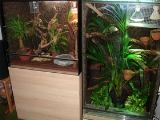
A vivarium (Latin, literally for "place of life"; plural: vivaria or vivariums) is a usually enclosed area for keeping and raising animals or plants for observation or research. Often, a portion of the ecosystem
Ecosystem

An ecosystem is a natural unit consisting of all plants, animals and micro-organisms in an area functioning together with all of the non-living physical factors of the environment....
 for a particular species is simulated on a smaller scale, with controls for environmental conditions.

A vivarium may be small enough to sit on a desk or table, such as a terrarium or an aquarium
Aquarium

An aquarium is a vivarium consisting of at least one transparent side in which water-dwelling plants or animals are kept. fishkeeping use aquaria to keep fish, invertebrates, amphibians, marine mammals, turtles, and aquatic plants....
, or may be a very large structure, possibly outdoors.


Discussion
Ask a question about 'Vivarium'
Start a new discussion about 'Vivarium'
Answer questions from other users
Full Discussion Forum


Recent Posts


Encyclopedia


Terrarium2


A vivarium (Latin, literally for "place of life"; plural: vivaria or vivariums) is a usually enclosed area for keeping and raising animals or plants for observation or research. Often, a portion of the ecosystem
Ecosystem

An ecosystem is a natural unit consisting of all plants, animals and micro-organisms in an area functioning together with all of the non-living physical factors of the environment....
 for a particular species is simulated on a smaller scale, with controls for environmental conditions.

A vivarium may be small enough to sit on a desk or table, such as a terrarium or an aquarium
Aquarium

An aquarium is a vivarium consisting of at least one transparent side in which water-dwelling plants or animals are kept. fishkeeping use aquaria to keep fish, invertebrates, amphibians, marine mammals, turtles, and aquatic plants....
, or may be a very large structure, possibly outdoors. Large vivaria, particularly those holding organisms capable of flight, typically include some sort of a dual-door mechanism such as a sally port
Sally port

The primary modern meaning for sally port is a small controlled space, usually into a fortification. The entrance is usually protected in some way, such as with a fixed wall blocking the door which must be circumvented before entering, but which prevents direct enemy fire from a distance....
 for entry and exit, so that the outer door can be closed to prevent escape before the inner door is opened.

Flora and Fauna


There are various forms of terrarium, including:
  • Aquarium
    Aquarium

    An aquarium is a vivarium consisting of at least one transparent side in which water-dwelling plants or animals are kept. fishkeeping use aquaria to keep fish, invertebrates, amphibians, marine mammals, turtles, and aquatic plants....
    , simulating a water habitat; for instance a river, lake or sea; but only the submerged area of these natural habitats. Plants in the water will use some nitrogen present within the system, and will provide areas for organisms to hide and forage.
  • Insectarium, containing insects.
    • Formicarium
      Formicarium

      A formicarium is a vivarium which is designed primarily for the study of ant ant colony and how ants Behavior. "Ant Farms," similar to these, are popular subjects for school projects....
      , with species of ants.
  • Paludarium
    Paludarium

    A paludarium comes from the latin word paludal meaning marshes or swamps and arium which means an enclosed container. Paludariums are usually enclosed containers containing land and water portions intended for aesthetic reasons or for nurturing plants to grow in aquariums....
    , simulating a rain forest or swamp
    Swamp

    A swamp is a wetland featuring temporary or permanent inundation of large areas of land, by shallow bodies of water. A swamp generally has a substantial number of hammock , or dry-land protrusions, covered by aquatic vegetation, or vegetation that tolerates periodical inundation....
     environment. It also can be seen as an aquarium interconnected with a terrarium, having both the underwater area as well as the shore.
    • Riparium, a paludarium with circulating current through different-leveled pools
  • Terrarium, simulating a dry habitat, for instance desert or savannah.


Many kinds of plants are suitable for these habitats, including bromeliads, African Violets and Crassulaceae
Crassulaceae

The Crassulaceae, or orpine family, is a family of dicotyledons. They store water in their succulent leaves. They are found worldwide, but mostly occur in the Northern Hemisphere and southern Africa, typically in dry and/or cold areas where water may be scarce....
. Animals commonly held for observation include reptile
Reptile

Reptiles, or members of the class Reptilia, are air-breathing, cold-blooded vertebrates that have skin covered in scale as opposed to hair or feathers....
s, amphibian
Amphibian

Amphibians , such as frogs, toads, salamanders, newts and caecilians, are cold-blooded animals that metamorphose from a juvenile, water-breathing form to an adult, air-breathing form....
s, insect
Insect

Insects are the biggest class of arthropods and the only ones with wings. They are the most diverse group of animals on the planet. They are most diverse at the equator and their diversity declines toward the poles....
s, spider
Spider

Spiders are air-breathing chelicerate arthropods that have eight legs, and chelicerae modified into fangs that inject venom. In their bodies the usual arthropod segments are fused into two Tagma , the cephalothorax and abdomen, joined by a small, cylindrical pedicel....
s, scorpion
Scorpion

Scorpions are any arachnid of the order Scorpionida. They are members of the order Scorpiones within the class Arachnida. There are about 2,000 species of scorpions, found widely distributed south of about Latitude, except New Zealand and Antarctica....
s, and small birds.

Size and materials

It is usually made of a clear container (often plastic or glass). Unless it is an aquarium, it doesn't need to withstand the pressure of water, so it can also be made out of wood or metal, with at least one transparent side. The new fashion in vivariums are those constructed from epoxy-coated plywood and fitted with sliding glass doors. Coating the inside of a plywood vivarium helps to retain the natural effect of the environment. Epoxy-coated plywood vivariums retain heat better than glass or plastic enclosures and are able to withstand high degrees of humidity. They may be cubical, spherical, rectangular, or other shapes. The choice of materials depends on the desired size and weight of the entire ensemble, resistance to high humidity, the cost and the desired quality.

The ground surface must be calculated to be enough for the species living inside, at their adult size. The height can also be important for the larger plants, climbing plants, or for tree climbing animal species. The width must be big enough to create the sensation of depth, both for the pleasure of the spectator and the good of the species inside.

Most used substrates are : common soil, small pebbles, sand, peat, chips of various trees, wood mulch, vegetable fibres (of coconut for example), or a combination of them. The choice of the substrate depends on the needs of the plants (type of ground), or of the animals (need to dig galleries for example), moisture (resistance to mold, conservation of water), the risks involved (e.g. the risk of absorption by an animal) and aesthetic aspects. Sterile vivariums sometimes used to ensure high levels of hygiene (especially during quarantine periods), generally have very straightforward, easily removable substrates such as paper tissue, wood chips and even newspaper.

Environmental controls


Lighting

A lighting system is necessary, always adapted to the requirements of the animal and plant species. For example, certain reptiles in their natural environment need to heat themselves by the sun, so various bulbs may be necessary to simulate this in a terrarium.

Also, certain plants or diurnal animal
Diurnal animal

Scientific term refered to as an animal behavior, diurnality indicates an animal that is active during the daytime and rests during the night. Animals that are not diurnal might be Nocturnality or crepuscular .  Many animal species are diurnal, including many mammals, insects and birds....
s need a source of UV to help synthesize Vitamin D
Vitamin D

Vitamin D is a group of fat-soluble prohormones, the two major forms of which are vitamin D2 and vitamin D3 . The term vitamin D also refers to metabolites and other analogues of these substances....
 and assimilate calcium. Such UV can be provided by specialized fluorescent tubes.

A day/night regulator might be needed to simulate with accuracy the alternation of light and dark periods. The duration of the simulated day and night depends on the conditions in the natural habitat
Habitat (ecology)

A habitat is an ecological or Natural_environment area that is inhabited by a particular animal or plant species. It is the natural environment in which an organism lives, or the physical environment that surrounds a species population....
 of the species and the season desired.

Temperature

The temperature can be a very important parameter for species that cannot adapt to other conditions than those found in their natural habitat.

Heating can be provided by several means, all of which are usually controlled by a thermostat:

  • heating lamps or infrared lamps
  • hot plates and heat mats, providing heat at the base or sides of a terrarium
  • heating cords or heat mats placed beneath the substrate
    Substrate (biology)

    In biology a substrate is the surface a plant or animal lives upon. The substrate can include biotic or abiotic materials. For example, encrusting algae that lives on a rock can be substrate for another animal that lives above the algae on the rock....
  • more complex equipment generating or producing hot air to the inside of the vivarium


Similar to lighting, a decrease in temperature might be needed for the simulated night periods, thus keeping living species healthy. Such variation need to be coherent to those found in the natural habitats of the species. Thermo-control systems are often used to regulate light cycles and heating, as well as humidity (coupled to built-in misting or rain systems). Light-dependent resistors or photo-diodes connected to the lighting are frequently used to simulate daytime, evening and nighttime light cycles, as well as timers to switch lighting and heating on and off when necessary.

Humidity

Many plants and animals have quite limited tolerance to the variation of moisture.

The regulation of humidity can be done by several means:

  • regular water pulverization
  • water evaporation inside (from a basin, or circulation of water)
  • automated pulverization systems and humidifiers


Ventilation and openings

Access inside the vivarium is required for the purpose of maintenance, to take care of the plants and animals, or for the addition and withdrawal of food. In the case of some animals, a frontal opening is preferable because accessing a vivarium from the top is associated by some species with the presence of predators and can therefore cause unncessary stress.

Ventilation is not just important for circulating air, but also for preventing the growth of mold and development and spread of harmful bacteria. This is especially important in warm, humid vivariums. The traditional method consists of placing a suction fan (or ventilation slits) at a low level and another exhaust fan at a higher level, which allows the continual circulation of fresh air.

See also

  • Ecosphere
    Ecosphere

    Ecosphere has several different meanings:* In ecology the term ecosphere can refer to the global ecosystem of the planet .* In astronomy an ecosphere is an imaginary shell of space surrounding stars where conditions are such that life might survive....
  • Closed ecological system
    Closed ecological system

    Closed ecological systems are ecosystems that do not rely on matter exchange with any part outside the system.Although the Earth itself fits this definition, the term is most often used to describe much smaller wikt:manmade ecosystems....
  • Ecosystem
    Ecosystem

    An ecosystem is a natural unit consisting of all plants, animals and micro-organisms in an area functioning together with all of the non-living physical factors of the environment....
  • Biome
    Biome

    Biomes are Climateally and geographically defined areas of ecologically similar climatic conditions such as Community of plants, animals, and Soil biology, and are often referred to as ecosystems....
  • Biosphere
    Biosphere

    The biosphere is the global sum of all ecosystems. From the broadest Geophysiology point of view, the biosphere is the global ecology system integrating all living beings and their relationships, including their interaction with the elements of the lithosphere, hydrosphere, and Earth's atmosphere....
  • Wardian case
    Wardian case

    The Wardian case, the direct forerunner of the modern terrarium was invented by Dr Nathaniel Bagshaw Ward , of London, in about 1829 after an accidental discovery inspired him....


External links

  • See http://groups.yahoo.com/group/TheNaturalisticVivarium for an online Vivarium group.
  • Basic tutorials on terrarium making