


Vision for Space Exploration

Encyclopedia
The Vision for Space Exploration (VSE) is the United States space policy
which was announced on January 14, 2004 by President George W. Bush
. It is seen as a response to the Space Shuttle Columbia disaster
, the state of human spaceflight
at NASA
, and a way to regain public enthusiasm for space exploration
. It was largely written by Bretton Alexander . It was replaced by the U.S. National Space Policy of the Barack Obama administration in June 2010.
In pursuit of these goals, the Vision called for the space program to complete the International Space Station
by 2010; retire the Space Shuttle
by 2010; develop a new Crew Exploration Vehicle
(later renamed Orion
) by 2008, and conduct its first human spaceflight mission by 2014; explore the Moon
with robotic spacecraft
missions by 2008 and crewed missions by 2020, and use lunar exploration to develop and test new approaches and technologies useful for supporting sustained exploration of Mars and beyond; explore Mars
and other destinations with robotic and crewed missions; pursue commercial transportation to support the International Space Station and missions beyond low Earth orbit.
Outlining some of the advantages, U.S. President George W. Bush addressed the following:
One of the stated goals for the Constellation program is to gain significant experience in operating away from Earth
's environment, as the White House
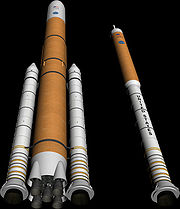
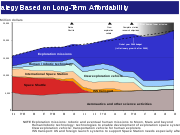
contended, to embody a "sustainable course of long-term exploration." The Ares boosters
are a cost-effective approach — entailing the Ares V
's enormous, unprecedented cargo-carrying capacity — transporting future space exploration resources to the Moon's weaker gravity field. While simultaneously serving as a proving ground for a wide range of space operations and processes, the Moon may serve as a cost-effective construction, launching and fueling site for future space exploration
missions. For example, future Ares V missions could cost-effectively deliver raw material
s for future spacecraft
and missions to a Moon-based space dock positioned as a counterweight
to a Moon-based space elevator.
 NASA has also outlined plans for manned missions to the far side of the Moon
. All of the Apollo missions have landed on the near side. Unique products may be producible in the nearly limitless extreme vacuum
of the lunar surface, and the Moon's remoteness is the ultimate isolation for biologically hazardous
experiments. The Moon would become a proving ground also toward the development of In-Situ Resource Utilization
, or "living off the land" (i.e., self-sufficiency) for permanent human outposts.
In a position paper issued by the National Space Society
(NSS), a return to the Moon should be considered a high space program priority, to begin development of the knowledge and identification of the industries unique to the Moon. The NSS believes that the Moon may be a repository of the history and possible future of our planet, and that the six Apollo
landings only scratched the surface of that 'treasure'. According to NSS, the Moon's far side, permanently shielded from the noisy Earth, is an ideal site for future radio astronomy
(for example, signals in the 1-10 MHz range cannot be detected on Earth because of ionosphere
interference.)
When the Vision was announced in January 2004, the U.S. Congress and the scientific community gave it a mix of positive and negative reviews. For example, Rep. Dave Weldon
(R-Fla.) said, "I think this is the best thing that has happened to the space program in decades." Though physicist and outspoken manned spaceflight opponent Robert L. Park
stated that robotic spacecraft "are doing so well it's going to be hard to justify sending a human," the vision announced by the President states that "robotic missions will serve as trailblazers — the advanced guard to the unknown." Others, such as the Mars Society
, have argued that it makes more sense to avoid going back to the Moon and instead focus on going to Mars first.
Throughout much of 2004, it was unclear whether the U.S. Congress would be willing to approve and fund the Vision for Space Exploration. However, in November 2004, Congress passed a spending bill
which gave NASA the $16.2 billion that President Bush had sought to kick-start the Vision. According to then-NASA chief Sean O'Keefe
, that spending bill “was as strong an endorsement of the space exploration vision, as any of us could have imagined.” In 2005, Congress passed S.1281, the NASA Authorization Act of 2005
, which explicitly endorses the Vision.
Former NASA Administrator Michael Griffin
is a big supporter of the Vision, but modified it somewhat, saying that he wants to reduce the four year gap between the retirement of the Space Shuttle and the first manned mission of the Crew Exploration Vehicle.
, which launched in June 2009 on board an Atlas V
. The preliminary design review was completed in February 2006 and the critical design review was completed in November 2006. An important function of the orbiter will be to look for further evidence that the increased concentrations of hydrogen discovered at the moon's poles is in the form of lunar ice
. After this the lunar flights will make use of the new Ares I
and Ares V rockets.
 In December 2003, Buzz Aldrin
voiced criticism for NASA's vision and objectives, stating that the goal of sending astronauts back to the moon was "more like reaching for past glory than striving for new triumphs". In February 2009, the Aerospace Technology Working Group released an in-depth report asserting that the Vision had several fundamental problems with regard to politics, financing, and general space policy issues and that the initiative should be rectified or replaced.
Another concern noted is that funding for VSE could instead be harnessed to advance science and technology, such as in aeronautics, commercial spacecraft and launch vehicle technology, environmental monitoring, and biomedical sciences. However, VSE itself is poised to propel a host of beneficial Moon science activities, including lunar telescopes, selenological studies and solar energy beams.
With or without VSE, human spaceflight will be made sustainable. However, without VSE, more funds could be directed toward reducing human spaceflight costs sufficiently for the betterment of low Earth orbit
research, business, and tourism. Alternatively, VSE could afford advances in other scientific research (astronomy
, selenology), in-situ lunar business industries, and lunar-space tourism.
The VSE budget required termination the Space Shuttle by 2010 and of any US role in the International Space Station by 2017. This would have required, even in the most optimistic plans, in a period of years without human spaceflight capability form the US. Termination of the Space Shuttle program in 2011 ended virtually all US capability for reusable launch vehicles, and resulted in the loss of the only workforce experienced in the maintenance of reusable spacecraft.
"A large portion of the scientific community" concurs that NASA is not "expanding our scientific understanding of the universe" in "the most effective or cost efficient way."p. 8. Proponents for VSE argue that a permanent settlement on the moon would drastically reduce costs for further space exploration missions. President George W. Bush voiced this sentiment when the vision was first announced (see quote above), and the United States Senate
has re-entered testimony by Space Frontier Foundation
founder Rick Tumlinson
offered previously to the United States Senate Committee on Commerce, Science and Transportation
advocating this particular perspective. The reason that the National Space Society
regards a return to the Moon as a high space program priority is to begin development of the knowledge and identification of the industries unique to the Moon, because "such industries can provide economic leverage and support for NASA activities, saving the government millions."p. 13.
As Tumlinson additionally notes, the goal is to "open space ... to human settlement ... to create ways to harvest the resources ... not only saving this precious planet, but also ... assuring our survival."pp. 6-7. Regarding "the Moon, NASA should support early exploration now...."p. 14.
U.S. National Space Policy
The George W. Bush administration's space policy is mainly associated with the Vision for Space Exploration, announced in 2004. A formal National Space Policy was released in 2006.- Vision for Space Exploration :...
which was announced on January 14, 2004 by President George W. Bush
George W. Bush
George Walker Bush is an American politician who served as the 43rd President of the United States, from 2001 to 2009. Before that, he was the 46th Governor of Texas, having served from 1995 to 2000....
. It is seen as a response to the Space Shuttle Columbia disaster
Space Shuttle Columbia disaster
The Space Shuttle Columbia disaster occurred on February 1, 2003, when shortly before it was scheduled to conclude its 28th mission, STS-107, the Space Shuttle Columbia disintegrated over Texas and Louisiana during re-entry into the Earth's atmosphere, resulting in the death of all seven crew members...
, the state of human spaceflight
Human spaceflight
Human spaceflight is spaceflight with humans on the spacecraft. When a spacecraft is manned, it can be piloted directly, as opposed to machine or robotic space probes and remotely-controlled satellites....
at NASA
NASA
The National Aeronautics and Space Administration is the agency of the United States government that is responsible for the nation's civilian space program and for aeronautics and aerospace research...
, and a way to regain public enthusiasm for space exploration
Space exploration
Space exploration is the use of space technology to explore outer space. Physical exploration of space is conducted both by human spaceflights and by robotic spacecraft....
. It was largely written by Bretton Alexander . It was replaced by the U.S. National Space Policy of the Barack Obama administration in June 2010.
Outline
The Vision for Space Exploration seeks to implement a sustained and affordable human and robotic program to explore the solar system and beyond; extend human presence across the solar system, starting with a human return to the Moon by the year 2020, in preparation for human exploration of Mars and other destinations; develop the innovative technologies, knowledge, and infrastructures both to explore and to support decisions about the destinations for human exploration; and to promote international and commercial participation in exploration to further U.S. scientific, security, and economic interests.In pursuit of these goals, the Vision called for the space program to complete the International Space Station
International Space Station
The International Space Station is a habitable, artificial satellite in low Earth orbit. The ISS follows the Salyut, Almaz, Cosmos, Skylab, and Mir space stations, as the 11th space station launched, not including the Genesis I and II prototypes...
by 2010; retire the Space Shuttle
Space Shuttle program
NASA's Space Shuttle program, officially called Space Transportation System , was the United States government's manned launch vehicle program from 1981 to 2011...
by 2010; develop a new Crew Exploration Vehicle
Crew Exploration Vehicle
The Crew Exploration Vehicle was the conceptual component of the U.S. NASA Vision for Space Exploration that later became known as the Orion spacecraft...
(later renamed Orion
Orion (spacecraft)
Orion is a spacecraft designed by Lockheed Martin for NASA, the space agency of the United States. Orion development began in 2005 as part of the Constellation program, where Orion would fulfill the function of a Crew Exploration Vehicle....
) by 2008, and conduct its first human spaceflight mission by 2014; explore the Moon
Moon
The Moon is Earth's only known natural satellite,There are a number of near-Earth asteroids including 3753 Cruithne that are co-orbital with Earth: their orbits bring them close to Earth for periods of time but then alter in the long term . These are quasi-satellites and not true moons. For more...
with robotic spacecraft
Robotic spacecraft
A robotic spacecraft is a spacecraft with no humans on board, that is usually under telerobotic control. A robotic spacecraft designed to make scientific research measurements is often called a space probe. Many space missions are more suited to telerobotic rather than crewed operation, due to...
missions by 2008 and crewed missions by 2020, and use lunar exploration to develop and test new approaches and technologies useful for supporting sustained exploration of Mars and beyond; explore Mars
Mars
Mars is the fourth planet from the Sun in the Solar System. The planet is named after the Roman god of war, Mars. It is often described as the "Red Planet", as the iron oxide prevalent on its surface gives it a reddish appearance...
and other destinations with robotic and crewed missions; pursue commercial transportation to support the International Space Station and missions beyond low Earth orbit.
Outlining some of the advantages, U.S. President George W. Bush addressed the following:
One of the stated goals for the Constellation program is to gain significant experience in operating away from Earth
Earth
Earth is the third planet from the Sun, and the densest and fifth-largest of the eight planets in the Solar System. It is also the largest of the Solar System's four terrestrial planets...
's environment, as the White House
White House
The White House is the official residence and principal workplace of the president of the United States. Located at 1600 Pennsylvania Avenue NW in Washington, D.C., the house was designed by Irish-born James Hoban, and built between 1792 and 1800 of white-painted Aquia sandstone in the Neoclassical...
contended, to embody a "sustainable course of long-term exploration." The Ares boosters
Ares (rocket)
In terms of rocketry, Ares could mean:*Three Shuttle-Derived Launch Vehicles under development for NASA's Project Constellation program:**The Ares I Crew Launch Vehicle , designed to launch the Orion ....
are a cost-effective approach — entailing the Ares V
Ares V
The Ares V was the planned cargo launch component of the Constellation program, which was to have replaced the Space Shuttle after its retirement in 2011. Ares V was also planned to carry supplies for a human presence on Mars...
's enormous, unprecedented cargo-carrying capacity — transporting future space exploration resources to the Moon's weaker gravity field. While simultaneously serving as a proving ground for a wide range of space operations and processes, the Moon may serve as a cost-effective construction, launching and fueling site for future space exploration
Space exploration
Space exploration is the use of space technology to explore outer space. Physical exploration of space is conducted both by human spaceflights and by robotic spacecraft....
missions. For example, future Ares V missions could cost-effectively deliver raw material
Raw material
A raw material or feedstock is the basic material from which a product is manufactured or made, frequently used with an extended meaning. For example, the term is used to denote material that came from nature and is in an unprocessed or minimally processed state. Latex, iron ore, logs, and crude...
s for future spacecraft
Spacecraft
A spacecraft or spaceship is a craft or machine designed for spaceflight. Spacecraft are used for a variety of purposes, including communications, earth observation, meteorology, navigation, planetary exploration and transportation of humans and cargo....
and missions to a Moon-based space dock positioned as a counterweight
Counterweight
A counterweight is an equivalent counterbalancing weight that balances a load.-Uses:A counterweight is often used in traction lifts , cranes and funfair rides...
to a Moon-based space elevator.
Far side of the Moon
The far side of the Moon is the lunar hemisphere that is permanently turned away, and is not visible from the surface of the Earth. The far hemisphere was first photographed by the Soviet Luna 3 probe in 1959, and was first directly observed by human eyes when the Apollo 8 mission orbited the Moon...
. All of the Apollo missions have landed on the near side. Unique products may be producible in the nearly limitless extreme vacuum
Vacuum
In everyday usage, vacuum is a volume of space that is essentially empty of matter, such that its gaseous pressure is much less than atmospheric pressure. The word comes from the Latin term for "empty". A perfect vacuum would be one with no particles in it at all, which is impossible to achieve in...
of the lunar surface, and the Moon's remoteness is the ultimate isolation for biologically hazardous
Biological hazard
Biological hazards, refer to biological substances that pose a threat to the health of living organisms, primarily that of humans. This can include medical waste or samples of a microorganism, virus or toxin that can impact human health. It can also include substances harmful to animals...
experiments. The Moon would become a proving ground also toward the development of In-Situ Resource Utilization
In-Situ Resource Utilization
In space exploration, in-situ resource utilization describes the proposed use of resources found or manufactured on other astronomical objects to further the goals of a space mission....
, or "living off the land" (i.e., self-sufficiency) for permanent human outposts.
In a position paper issued by the National Space Society
National Space Society
The National Space Society is an international nonprofit 501, educational, and scientific organization specializing in space advocacy...
(NSS), a return to the Moon should be considered a high space program priority, to begin development of the knowledge and identification of the industries unique to the Moon. The NSS believes that the Moon may be a repository of the history and possible future of our planet, and that the six Apollo
Project Apollo
The Apollo program was the spaceflight effort carried out by the United States' National Aeronautics and Space Administration , that landed the first humans on Earth's Moon. Conceived during the Presidency of Dwight D. Eisenhower, Apollo began in earnest after President John F...
landings only scratched the surface of that 'treasure'. According to NSS, the Moon's far side, permanently shielded from the noisy Earth, is an ideal site for future radio astronomy
Radio astronomy
Radio astronomy is a subfield of astronomy that studies celestial objects at radio frequencies. The initial detection of radio waves from an astronomical object was made in the 1930s, when Karl Jansky observed radiation coming from the Milky Way. Subsequent observations have identified a number of...
(for example, signals in the 1-10 MHz range cannot be detected on Earth because of ionosphere
Ionosphere
The ionosphere is a part of the upper atmosphere, comprising portions of the mesosphere, thermosphere and exosphere, distinguished because it is ionized by solar radiation. It plays an important part in atmospheric electricity and forms the inner edge of the magnetosphere...
interference.)
When the Vision was announced in January 2004, the U.S. Congress and the scientific community gave it a mix of positive and negative reviews. For example, Rep. Dave Weldon
Dave Weldon
David Joseph Weldon, is an American politician and physician. He was a Republican member of the United States House of Representatives, representing .-Early life:...
(R-Fla.) said, "I think this is the best thing that has happened to the space program in decades." Though physicist and outspoken manned spaceflight opponent Robert L. Park
Robert L. Park
Robert Lee Park , also known as Bob Park, is an emeritus professor of physics at the University of Maryland, College Park and a former Director of Public Information at the Washington office of the American Physical Society...
stated that robotic spacecraft "are doing so well it's going to be hard to justify sending a human," the vision announced by the President states that "robotic missions will serve as trailblazers — the advanced guard to the unknown." Others, such as the Mars Society
Mars Society
The Mars Society is an international space advocacy non-profit organization dedicated to promoting the human exploration and settlement of the planet Mars. It was founded by Robert Zubrin and others in 1998 and attracted the support of notable science fiction writers and filmmakers, including Kim...
, have argued that it makes more sense to avoid going back to the Moon and instead focus on going to Mars first.
Throughout much of 2004, it was unclear whether the U.S. Congress would be willing to approve and fund the Vision for Space Exploration. However, in November 2004, Congress passed a spending bill
Bill (proposed law)
A bill is a proposed law under consideration by a legislature. A bill does not become law until it is passed by the legislature and, in most cases, approved by the executive. Once a bill has been enacted into law, it is called an act or a statute....
which gave NASA the $16.2 billion that President Bush had sought to kick-start the Vision. According to then-NASA chief Sean O'Keefe
Sean O'Keefe
Sean O'Keefe is the CEO of EADS North America, a subsidiary of the European aerospace firm EADS, a former Administrator of NASA, and former chancellor of Louisiana State University . O'Keefe is also a former member of the board of directors of DuPont...
, that spending bill “was as strong an endorsement of the space exploration vision, as any of us could have imagined.” In 2005, Congress passed S.1281, the NASA Authorization Act of 2005
NASA Authorization Act of 2005
The NASA Authorization Act of 2005 is an act of the United States Congress. It was signed by the then President George W. Bush and became Public Law 109-155 on December 30, 2005....
, which explicitly endorses the Vision.
Former NASA Administrator Michael Griffin
Michael D. Griffin
Michael Douglas Griffin is an American physicist and aerospace engineer. From April 13, 2005 to January 20, 2009 he served as Administrator of NASA, the space agency of the United States...
is a big supporter of the Vision, but modified it somewhat, saying that he wants to reduce the four year gap between the retirement of the Space Shuttle and the first manned mission of the Crew Exploration Vehicle.
Lunar Architecture
NASA's "Lunar Architecture" forms a key part of its Global Exploration Strategy, also known as the Vision for Space Exploration. The first part of the Lunar Architecture is the Lunar Reconnaissance OrbiterLunar Reconnaissance Orbiter
The Lunar Precursor Robotic Program is a program of robotic spacecraft missions which NASA will use to prepare for future human spaceflight missions to the Moon. Two LPRP missions, the Lunar Reconnaissance Orbiter and the Lunar Crater Observation and Sensing Satellite , were launched in June 2009...
, which launched in June 2009 on board an Atlas V
Atlas V
Atlas V is an active expendable launch system in the Atlas rocket family. Atlas V was formerly operated by Lockheed Martin, and is now operated by the Lockheed Martin-Boeing joint venture United Launch Alliance...
. The preliminary design review was completed in February 2006 and the critical design review was completed in November 2006. An important function of the orbiter will be to look for further evidence that the increased concentrations of hydrogen discovered at the moon's poles is in the form of lunar ice
Lunar ice
Lunar water is water that is present on the Moon. Liquid water cannot persist at the Moon's surface, and water vapour is quickly decomposed by sunlight and lost to outer space...
. After this the lunar flights will make use of the new Ares I
Ares I
Ares I was the crew launch vehicle that was being developed by NASA as part of the Constellation Program. The name "Ares" refers to the Greek deity Ares, who is identified with the Roman god Mars...
and Ares V rockets.
Critical perspectives
Buzz Aldrin
Buzz Aldrin is an American mechanical engineer, retired United States Air Force pilot and astronaut who was the Lunar Module pilot on Apollo 11, the first manned lunar landing in history...
voiced criticism for NASA's vision and objectives, stating that the goal of sending astronauts back to the moon was "more like reaching for past glory than striving for new triumphs". In February 2009, the Aerospace Technology Working Group released an in-depth report asserting that the Vision had several fundamental problems with regard to politics, financing, and general space policy issues and that the initiative should be rectified or replaced.
Another concern noted is that funding for VSE could instead be harnessed to advance science and technology, such as in aeronautics, commercial spacecraft and launch vehicle technology, environmental monitoring, and biomedical sciences. However, VSE itself is poised to propel a host of beneficial Moon science activities, including lunar telescopes, selenological studies and solar energy beams.
With or without VSE, human spaceflight will be made sustainable. However, without VSE, more funds could be directed toward reducing human spaceflight costs sufficiently for the betterment of low Earth orbit
Low Earth orbit
A low Earth orbit is generally defined as an orbit within the locus extending from the Earth’s surface up to an altitude of 2,000 km...
research, business, and tourism. Alternatively, VSE could afford advances in other scientific research (astronomy
Astronomy
Astronomy is a natural science that deals with the study of celestial objects and phenomena that originate outside the atmosphere of Earth...
, selenology), in-situ lunar business industries, and lunar-space tourism.
The VSE budget required termination the Space Shuttle by 2010 and of any US role in the International Space Station by 2017. This would have required, even in the most optimistic plans, in a period of years without human spaceflight capability form the US. Termination of the Space Shuttle program in 2011 ended virtually all US capability for reusable launch vehicles, and resulted in the loss of the only workforce experienced in the maintenance of reusable spacecraft.
"A large portion of the scientific community" concurs that NASA is not "expanding our scientific understanding of the universe" in "the most effective or cost efficient way."p. 8. Proponents for VSE argue that a permanent settlement on the moon would drastically reduce costs for further space exploration missions. President George W. Bush voiced this sentiment when the vision was first announced (see quote above), and the United States Senate
United States Senate
The United States Senate is the upper house of the bicameral legislature of the United States, and together with the United States House of Representatives comprises the United States Congress. The composition and powers of the Senate are established in Article One of the U.S. Constitution. Each...
has re-entered testimony by Space Frontier Foundation
Space Frontier Foundation
The Space Frontier Foundation is a space advocacy nonprofit corporation organized to promote the interests of increased involvement of the private sector, in collaboration with government, in the exploration and development of space...
founder Rick Tumlinson
Rick Tumlinson
Rick Tumlinson is the co-founder of the Space Frontier Foundation and a space activist. He has testified on space-related topics before the U.S. Congress six times since 1995...
offered previously to the United States Senate Committee on Commerce, Science and Transportation
United States Senate Committee on Commerce, Science and Transportation
The United States Senate Committee on Commerce, Science, and Transportation is a standing committee of the United States Senate in charge of all senate matters related to the following subjects:* Coast Guard* Coastal zone management* Communications...
advocating this particular perspective. The reason that the National Space Society
National Space Society
The National Space Society is an international nonprofit 501, educational, and scientific organization specializing in space advocacy...
regards a return to the Moon as a high space program priority is to begin development of the knowledge and identification of the industries unique to the Moon, because "such industries can provide economic leverage and support for NASA activities, saving the government millions."p. 13.
As Tumlinson additionally notes, the goal is to "open space ... to human settlement ... to create ways to harvest the resources ... not only saving this precious planet, but also ... assuring our survival."pp. 6-7. Regarding "the Moon, NASA should support early exploration now...."p. 14.
See also
- Aurora programmeAurora ProgrammeThe Aurora programme is a human spaceflight programme of the European Space Agency established in 2001 with the primary objectives of creating, and then implementing, a European long-term plan for exploration of the Solar System using robotic spacecraft and human spaceflight...
- Colonization of the MoonColonization of the MoonThe colonization of the Moon is the proposed establishment of permanent human communities on the Moon. Advocates of space exploration have seen settlement of the Moon as a logical step in the expansion of humanity beyond the Earth. Recent indication that water might be present in noteworthy...
- Crew Exploration VehicleCrew Exploration VehicleThe Crew Exploration Vehicle was the conceptual component of the U.S. NASA Vision for Space Exploration that later became known as the Orion spacecraft...
- Crew Space Transportation System
- Decadal Planning TeamDecadal Planning TeamThe NASA Decadal Planning Team and its successor, the NASA Exploration Team , were influential behind-the-scenes efforts to develop a major new direction for the space agency early in the 21st Century....
- DIRECTDIRECTDIRECT is a proposed alternative heavy lift launch vehicle architecture supporting NASA's Vision for Space Exploration, which would replace the space agency's planned Ares I and Ares V rockets...
- Exploration Systems Architecture StudyExploration Systems Architecture StudyThe Exploration Systems Architecture Study is the official title of a large-scale, system level study released by the National Aeronautics and Space Administration in November 2005 in response to American president George W...
- Google Lunar X PrizeGoogle Lunar X PrizeThe Google Lunar X PRIZE, abbreviated GLXP, sometimes referred to as Moon 2.0, is a space competition organized by the X Prize Foundation, and sponsored by Google. It was announced at the Wired Nextfest on 13 September 2007...
- Human Lunar Return studyHuman Lunar Return studyNASA began its "Human Lunar Return study" in September 1995 to identify ways it could conduct future human spaceflight missions to the Moon. The final Human Lunar Return briefing took place on August 7, 1996...
- Human spaceflightHuman spaceflightHuman spaceflight is spaceflight with humans on the spacecraft. When a spacecraft is manned, it can be piloted directly, as opposed to machine or robotic space probes and remotely-controlled satellites....
- Lunar Reconnaissance OrbiterLunar Reconnaissance OrbiterThe Lunar Precursor Robotic Program is a program of robotic spacecraft missions which NASA will use to prepare for future human spaceflight missions to the Moon. Two LPRP missions, the Lunar Reconnaissance Orbiter and the Lunar Crater Observation and Sensing Satellite , were launched in June 2009...
- Project ConstellationProject ConstellationConstellation Program is a human spaceflight program within NASA, the space agency of the United States. The stated goals of the program were to gain significant experience in operating away from Earth's environment, develop technologies needed for opening the space frontier, and conduct...
- Space advocacySpace advocacySpace advocacy can be described as the general position supporting, pleading or arguing for the idea or cause of space exploration and settlements...
- Space explorationSpace explorationSpace exploration is the use of space technology to explore outer space. Physical exploration of space is conducted both by human spaceflights and by robotic spacecraft....
- Space Exploration InitiativeSpace Exploration InitiativeOn July 20, 1989, the 20th anniversary of the Apollo 11 Moon landing, George H. W. Bush — then President of the United States — announced plans for what came to be known as the Space Exploration Initiative...