
Home      Discussion      Topics      Dictionary      Almanac
Signup       Login
Virgo Cluster

Virgo Cluster

Overview
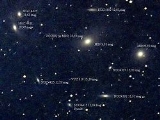
The Virgo Cluster is a cluster of galaxies
Galaxy cluster
A galaxy cluster is a compact cluster of galaxies. Basic difference between a galaxy group and a galaxy cluster is that there are many more galaxies in a cluster than in a group. Also, galaxies in a cluster are more compact and have higher velocity dispersion. One of the key features of cluster is...

 whose center is 53.8 ± 0.3
1 E22 m
To help compare different orders of magnitude, this page lists distances starting at 10 Zm .Distances shorter than 10 Zm* 24 Zm — 2.5 million light years — Distance to the Andromeda Galaxy...

 Mly (16.5 ± 0.1 Mpc
Parsec
The parsec is a unit of length used in astronomy. It is about 3.26 light-years, or just under 31 trillion kilometres ....

)
Discussion
Ask a question about 'Virgo Cluster'
Start a new discussion about 'Virgo Cluster'
Answer questions from other users
Full Discussion Forum
 
Unanswered Questions
Encyclopedia
The Virgo Cluster is a cluster of galaxies
Galaxy cluster
A galaxy cluster is a compact cluster of galaxies. Basic difference between a galaxy group and a galaxy cluster is that there are many more galaxies in a cluster than in a group. Also, galaxies in a cluster are more compact and have higher velocity dispersion. One of the key features of cluster is...

 whose center is 53.8 ± 0.3
1 E22 m
To help compare different orders of magnitude, this page lists distances starting at 10 Zm .Distances shorter than 10 Zm* 24 Zm — 2.5 million light years — Distance to the Andromeda Galaxy...

 Mly (16.5 ± 0.1 Mpc
Parsec
The parsec is a unit of length used in astronomy. It is about 3.26 light-years, or just under 31 trillion kilometres ....

)
away in the constellation
Constellation
In modern astronomy, a constellation is an internationally defined area of the celestial sphere. These areas are grouped around asterisms, patterns formed by prominent stars within apparent proximity to one another on Earth's night sky....

 Virgo
Virgo (constellation)
Virgo is one of the constellations of the zodiac. Its name is Latin for virgin, and its symbol is . Lying between Leo to the west and Libra to the east, it is the second largest constellation in the sky...

. Comprising approximately 1300 (and possibly up to 2000) member galaxies, the cluster forms the heart of the larger Local Supercluster, of which the Local Group
Local Group
The Local Group is the group of galaxies that includes Earth's galaxy, the Milky Way. The group comprises more than 30 galaxies , with its gravitational center located somewhere between the Milky Way and the Andromeda Galaxy...

 is an outlying member. It is estimated that its mass is 1.2 M
Solar mass
The solar mass , , is a standard unit of mass in astronomy, used to indicate the masses of other stars and galaxies...

 out to 8 degrees of the cluster's center or a radius of about 2.2 Mpc.

Many of the brighter galaxies in this cluster, including the giant elliptical galaxy
Elliptical galaxy
An elliptical galaxy is a galaxy having an approximately ellipsoidal shape and a smooth, nearly featureless brightness profile. They range in shape from nearly spherical to highly flat and in size from hundreds of millions to over one trillion stars...

 Messier 87
Messier 87
Messier 87 is a supergiant elliptical galaxy. It was discovered in 1781 by the French astronomer Charles Messier, who cataloged it as a nebulous feature. The second brightest galaxy within the northern Virgo Cluster, it is located about 16.4 million parsecs from Earth...

, were discovered in the late 1770s and early 1780s and subsequently included in Charles Messier
Charles Messier
Charles Messier was a French astronomer most notable for publishing an astronomical catalogue consisting of deep sky objects such as nebulae and star clusters that came to be known as the 110 "Messier objects"...

's catalogue of non-cometary fuzzy objects. Described by Messier as nebula
Nebula
A nebula is an interstellar cloud of dust, hydrogen gas, helium gas and other ionized gases...

e without stars, their true nature was not recognized until the 1920s.

The cluster subtends a maximum arc of approximately 8 degrees centered in the constellation Virgo. Many of the member galaxies of the cluster are visible with a small telescope.

The cluster is a fairly heterogeneous mixture of spirals and ellipticals., it is believed that the spirals of the cluster are distributed in an oblong prolate
Prolate spheroid
A prolate spheroid is a spheroid in which the polar axis is greater than the equatorial diameter. Prolate spheroids stand in contrast to oblate spheroids...

 filament, approximately 4 times as long as wide, stretching along the line of sight from the Milky Way
Milky Way
The Milky Way is the galaxy that contains the Solar System. This name derives from its appearance as a dim un-resolved "milky" glowing band arching across the night sky...

. The elliptical galaxies are more centrally concentrated than the spiral galaxies.

The cluster is an aggregrate of at least three separate subclumps centered on the galaxies M87, M86, and M49. Of the three subclumps, the one centered on M87 is the dominant one, with a mass of approximately 1014 solar mass
Solar mass
The solar mass , , is a standard unit of mass in astronomy, used to indicate the masses of other stars and galaxies...

es, which is approximately an order of magnitude larger than the other two subclumps.

The large mass of the cluster is indicated by the high peculiar velocities
Peculiar velocity
Peculiar motion or peculiar velocity refers to the true velocity of an object, relative to a rest frame.-Galactic astronomy:In galactic astronomy, the term peculiar motion refers to the motion of an object through space.Local objects are usually related in terms of proper motion and radial...

 of many of its galaxies, sometimes as high as 1,600 km
Kilometre
The kilometre is a unit of length in the metric system, equal to one thousand metres and is therefore exactly equal to the distance travelled by light in free space in of a second...

/s
Second
The second is a unit of measurement of time, and is the International System of Units base unit of time. It may be measured using a clock....

 with respect to the cluster's center.

The Virgo cluster lies within the Local Supercluster, and its gravitational effects slow down the nearby galaxies. The large mass of the cluster has the effect of slowing down the recession of the Local Group from the cluster by approximately ten percent.

See also

  • Coma Cluster, another large, nearby cluster of galaxies
  • Fornax Cluster
    Fornax Cluster
    At a distance of approximately 62.0 Mly , the Fornax Cluster is the second richest cluster of galaxies within 100 million light-years, although it is much smaller than the Virgo Cluster. It lies primarily in the constellation Fornax, and may be associated with the nearby Eridanus Group...

    , a smaller nearby cluster of galaxies

External links