

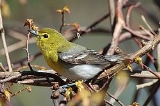
Vireo

Encyclopedia
The vireos are a group of small to medium-sized passerine
bird
s (mostly) restricted to the New World
. They are typically dull-plumaged and greenish in color, the smaller species resembling wood warblers
apart from their heavier bills. They range in size from the Choco Vireo
, Dwarf Vireo
and Lesser Greenlet
, all at around 10 centimeters and 8 grams, to the peppershrike
s and shrike-vireos at up to 17 centimeters and 40 grams (Forshaw & Parkes 1991).
of these birds make up the family
Vireonidae, and are believed to be related to the crow-like birds in family Corvidae
and the shrikes in family Laniidae. Recent biochemical studies have identified two babbler
genera (Pteruthius and Erpornis) which may be Old World
members of this family (Reddy & Cracraft 2007). Observers have commented on the vireo-like behaviour of the Pteruthius shrike-babblers, but apparently no-one suspected the biogeographically unlikely possibility of vireo relatives in Asia.
The family can be conveniently though perhaps inaccurately categorised by genus as the true vireos, the greenlets, the shrike-vireos and the peppershrikes. Preliminary genetic studies by Johnson et al. revealed large interspecific genetic distances between clades within Vireo and Hylophilus
of a similar magnitude to differences between Cyclarhis and Vireolanius
. Furthermore some vireo and greenlet species may be closer to the peppershrikes than to their respective congeners. A more comprehensive study may reveal this family to be considerably undersplit at both the generic and species level.
s and other arthropod
s. They take prey from leaves and branches; true vireos also flycatch
, and the Gray Vireo
takes 5 percent of its prey from the ground (Salaman & Barlow 2003).
and northern South America
. Thirteen species of true vireos occur farther north, in the United States
and Canada
; of these all but Hutton's Vireo
are migratory
. Members of the family seldom fly long distances except in migration (Salaman & Barlow 2003). They inhabit forest environments, with different species preferring forest canopies, undergrowth, or mangrove
swamps (Forshaw & Parkes 1991).
The resident species occur in pairs or family groups that maintain territories all year (except Hutton's Vireo, which joins mixed feeding flocks
). Most of the migrants defend winter territories against conspecifics. The exceptions are the complex comprising the Red-eyed Vireo
, the Yellow-green Vireo
, the Black-whiskered Vireo
, and the Yucatan Vireo
, which winter in small wandering flocks (Salaman & Barlow 2003).
 Males of most species are persistent singers. Songs are usually rather simple, monotonous in some species of the Caribbean
littoral and islands, and most elaborate and pleasant to human ears in the Chocó Vireo
and the peppershrikes (Salaman & Barlow 2003).
The nests of many tropical species are unknown. Of those that are known, all build a cup-shaped nest that hangs from branches. The female does most of the incubation, spelled by the male except in the Red-eyed Vireo complex (Salaman & Barlow 2003).
Noronha Vireo
, Vireo gracilirostris
Yellow-green Vireo
, Vireo flavoviridis (sometimes included in V. olivaceus)
Black-whiskered Vireo
, Vireo altiloquus
Yucatan Vireo
, Vireo magister
The "gilvus" group.
Brown-capped Vireo
, Vireo leucophrys
Philadelphia Vireo
, Vireo philadelphicus
Bell's Vireo - apparently basally positioned in Vireonidae.
Clade uncertain.
Genus Hylophilus
, the greenlets
Genus Vireolanius
, the shrike-vireos
Slaty-capped Shrike-vireo
, Vireolanius leucotis
Chestnut-sided Shrike-vireo
, Vireolanius melitophrys
Green Shrike-vireo
, Vireolanius pulchellus
Genus Cyclarhis, the peppershrike
s
Genus Pteruthius - shrike-babblers - see (Reddy & Cracraft, in press)
Passerine
A passerine is a bird of the order Passeriformes, which includes more than half of all bird species. Sometimes known as perching birds or, less accurately, as songbirds, the passerines form one of the most diverse terrestrial vertebrate orders: with over 5,000 identified species, it has roughly...
bird
Bird
Birds are feathered, winged, bipedal, endothermic , egg-laying, vertebrate animals. Around 10,000 living species and 188 families makes them the most speciose class of tetrapod vertebrates. They inhabit ecosystems across the globe, from the Arctic to the Antarctic. Extant birds range in size from...
s (mostly) restricted to the New World
New World
The New World is one of the names used for the Western Hemisphere, specifically America and sometimes Oceania . The term originated in the late 15th century, when America had been recently discovered by European explorers, expanding the geographical horizon of the people of the European middle...
. They are typically dull-plumaged and greenish in color, the smaller species resembling wood warblers
New World warbler
The New World warblers or wood-warblers are a group of small, often colorful, passerine birds restricted to the New World. They are not related to the Old World warblers or the Australian warblers....
apart from their heavier bills. They range in size from the Choco Vireo
Chocó Vireo
The Chocó Vireo is a species of bird in the Vireonidae family. It is found in western Colombia and has recently been found in north-west Ecuador. Its natural habitat is subtropical or tropical moist montane forests. It is threatened by habitat loss.The species was not described until 1996...
, Dwarf Vireo
Dwarf Vireo
The Dwarf Vireo is a species of bird in the Vireonidae family.It is endemic to Mexico.Its natural habitat is subtropical or tropical high-altitude shrubland.-References:...
and Lesser Greenlet
Lesser Greenlet
The Lesser Greenlet, Hylophilus decurtatus, is a small passerine bird in the vireo family. It breeds from northeastern Mexico south to western Ecuador....
, all at around 10 centimeters and 8 grams, to the peppershrike
Peppershrike
The peppershrikes are two species of passerine bird found in tropical Central and South America. They form the genus Cyclarhis, part of the vireo family....
s and shrike-vireos at up to 17 centimeters and 40 grams (Forshaw & Parkes 1991).
Systematics
The four generaGenus
In biology, a genus is a low-level taxonomic rank used in the biological classification of living and fossil organisms, which is an example of definition by genus and differentia...
of these birds make up the family
Family (biology)
In biological classification, family is* a taxonomic rank. Other well-known ranks are life, domain, kingdom, phylum, class, order, genus, and species, with family fitting between order and genus. As for the other well-known ranks, there is the option of an immediately lower rank, indicated by the...
Vireonidae, and are believed to be related to the crow-like birds in family Corvidae
Corvidae
Corvidae is a cosmopolitan family of oscine passerine birds that contains the crows, ravens, rooks, jackdaws, jays, magpies, treepies, choughs and nutcrackers. The common English names used are corvids or the crow family , and there are over 120 species...
and the shrikes in family Laniidae. Recent biochemical studies have identified two babbler
Babbler
Babbler may refer to:* Old World babbler, a large family of mostly Old World passerine birds* Australo-Papuan babbler, passerine birds endemic to Australia-New Guinea* The Babbler, the journal of BirdLife International in Indochina...
genera (Pteruthius and Erpornis) which may be Old World
Old World
The Old World consists of those parts of the world known to classical antiquity and the European Middle Ages. It is used in the context of, and contrast with, the "New World" ....
members of this family (Reddy & Cracraft 2007). Observers have commented on the vireo-like behaviour of the Pteruthius shrike-babblers, but apparently no-one suspected the biogeographically unlikely possibility of vireo relatives in Asia.
The family can be conveniently though perhaps inaccurately categorised by genus as the true vireos, the greenlets, the shrike-vireos and the peppershrikes. Preliminary genetic studies by Johnson et al. revealed large interspecific genetic distances between clades within Vireo and Hylophilus
Hylophilus
Hylophilus is a genus of bird in the Vireonidae family.It contains the following species:* Gray-eyed Greenlet * Golden-fronted Greenlet * Brown-headed Greenlet...
of a similar magnitude to differences between Cyclarhis and Vireolanius
Vireolanius
Vireolanius is a genus of bird in the Vireonidae family.It contains the following species:* Yellow-browed Shrike-vireo * Slaty-capped Shrike-vireo...
. Furthermore some vireo and greenlet species may be closer to the peppershrikes than to their respective congeners. A more comprehensive study may reveal this family to be considerably undersplit at both the generic and species level.
Feeding
All members of the family eat some fruit but mostly insectInsect
Insects are a class of living creatures within the arthropods that have a chitinous exoskeleton, a three-part body , three pairs of jointed legs, compound eyes, and two antennae...
s and other arthropod
Arthropod
An arthropod is an invertebrate animal having an exoskeleton , a segmented body, and jointed appendages. Arthropods are members of the phylum Arthropoda , and include the insects, arachnids, crustaceans, and others...
s. They take prey from leaves and branches; true vireos also flycatch
Hawking (birds)
Hawking is a feeding strategy in birds involving catching flying insects in the air. The term usually refers to a technique of sallying out from a perch to snatch an insect and then returning to the same or a different perch...
, and the Gray Vireo
Gray Vireo
The Gray Vireo is a small North American passerine bird. It breeds from the southwestern United States and northern Baja California to western Texas...
takes 5 percent of its prey from the ground (Salaman & Barlow 2003).
Range and territorial behavior
Most species are found in Middle AmericaMiddle America (Americas)
Middle America is a region in the mid-latitudes of the Americas. In southern North America, it usually comprises Mexico, the nations of Central America, and the West Indies. The scope of the term may vary...
and northern South America
South America
South America is a continent situated in the Western Hemisphere, mostly in the Southern Hemisphere, with a relatively small portion in the Northern Hemisphere. The continent is also considered a subcontinent of the Americas. It is bordered on the west by the Pacific Ocean and on the north and east...
. Thirteen species of true vireos occur farther north, in the United States
United States
The United States of America is a federal constitutional republic comprising fifty states and a federal district...
and Canada
Canada
Canada is a North American country consisting of ten provinces and three territories. Located in the northern part of the continent, it extends from the Atlantic Ocean in the east to the Pacific Ocean in the west, and northward into the Arctic Ocean...
; of these all but Hutton's Vireo
Hutton's Vireo
Hutton's Vireo is a small songbird. It is approximately 5 inches in length, dull olive-gray above and below. It has a faint white eye ring and faint white wing bars. It closely resembles a Ruby-crowned Kinglet, but has a thicker bill and is slightly larger in size. Its most common song is a...
are migratory
Bird migration
Bird migration is the regular seasonal journey undertaken by many species of birds. Bird movements include those made in response to changes in food availability, habitat or weather. Sometimes, journeys are not termed "true migration" because they are irregular or in only one direction...
. Members of the family seldom fly long distances except in migration (Salaman & Barlow 2003). They inhabit forest environments, with different species preferring forest canopies, undergrowth, or mangrove
Mangrove
Mangroves are various kinds of trees up to medium height and shrubs that grow in saline coastal sediment habitats in the tropics and subtropics – mainly between latitudes N and S...
swamps (Forshaw & Parkes 1991).
The resident species occur in pairs or family groups that maintain territories all year (except Hutton's Vireo, which joins mixed feeding flocks
Mixed-species feeding flock
A mixed-species feeding flock, also termed a mixed-species foraging flock, mixed hunting party or informally bird wave, is a flock of usually insectivorous birds of different species, that join each other and move together while foraging...
). Most of the migrants defend winter territories against conspecifics. The exceptions are the complex comprising the Red-eyed Vireo
Red-eyed Vireo
The Red-eyed Vireo, Vireo olivaceus, is a small American songbird, 13–14 cm in length. It is somewhat warbler-like but not closely related to the New World warblers...
, the Yellow-green Vireo
Yellow-green Vireo
The Yellow-green Vireo, Vireo flavoviridis, is a small passerine bird. It breeds from southern Texas in the United States and the western and eastern mountain ranges of northern Mexico south to central Panama...
, the Black-whiskered Vireo
Black-whiskered Vireo
The Black-whiskered Vireo, Vireo altiloquus, is a small passerine bird, which breeds in southern Florida, USA, and the West Indies as far south as the offshore islands of Venezuela. It is a partial migrant, with northern birds wintering from the Greater Antilles to northern South America...
, and the Yucatan Vireo
Yucatan Vireo
The Yucatan Vireo is a species of bird in the Vireonidae family.It is found in Belize, Honduras and Mexico. There is a well-documented record from High Island, Texas, in 1984, but this is the only record for the United States....
, which winter in small wandering flocks (Salaman & Barlow 2003).
Voice and breeding
Caribbean
The Caribbean is a crescent-shaped group of islands more than 2,000 miles long separating the Gulf of Mexico and the Caribbean Sea, to the west and south, from the Atlantic Ocean, to the east and north...
littoral and islands, and most elaborate and pleasant to human ears in the Chocó Vireo
Chocó Vireo
The Chocó Vireo is a species of bird in the Vireonidae family. It is found in western Colombia and has recently been found in north-west Ecuador. Its natural habitat is subtropical or tropical moist montane forests. It is threatened by habitat loss.The species was not described until 1996...
and the peppershrikes (Salaman & Barlow 2003).
The nests of many tropical species are unknown. Of those that are known, all build a cup-shaped nest that hangs from branches. The female does most of the incubation, spelled by the male except in the Red-eyed Vireo complex (Salaman & Barlow 2003).
Species
- Genus Vireo, the true vireos (the name is Latin for "I am green")
- Black-capped VireoBlack-capped VireoThe Black-capped Vireo, Vireo atricapilla, is a small bird native to the United States and Mexico. It has been listed as an endangered species in the United States since 1987. The IUCN lists the species as vulnerable....
, Vireo atricapillus - Cozumel VireoCozumel VireoThe Cozumel Vireo is a species of bird in the family Vireonidae.It is endemic to the Mexican island of Cozumel off the Yucatán Peninsula.Its natural habitats are subtropical or tropical dry forests and heavily degraded former forest....
, Vireo bairdi - St. Andrew VireoSt. Andrew VireoThe San Andres Vireo or St. Andrew Vireo is a threatened species of vireo endemic to the Colombian island of St. Andrew in the Caribbean Sea, located off the east coast of Nicaragua...
, Vireo caribaeus - Yellow-winged VireoYellow-winged VireoThe Yellow-winged Vireo, Vireo carmioli, is a small passerine bird. It is endemic to the highlands of Costa Rica and western Panama.This vireo occurs from 2000 m to the timberline in the canopy of mountain forest, sometimes feeding in undergrowth or tall second growth...
, Vireo carmioli - Cassin's VireoCassin's VireoCassin's Vireo is a small North American songbird, ranging from southern British Columbia in Canada through the western coastal states of the United States. This bird migrates, spending the winter from southern Arizona to southern Mexico.The vireo is 11–14 cm in length, with a gray head, back,...
, Vireo cassinii - Thick-billed VireoThick-billed VireoThe Thick-billed Vireo, Vireo crassirostris, is a small songbird. It breeds in the West Indies in the Bahamas, Turks and Caicos Islands, Cayman Islands, Tortuga Island in Haiti and on cays off the coast of Cuba. It occasionally can be found as a vagrant to south Florida in the United States. The...
, Vireo crassirostris - Yellow-throated VireoYellow-throated VireoThe Yellow-throated Vireo, Vireo flavifrons, is a small American songbird.Adults are mainly olive on the head and upperparts with a yellow throat and white belly; they have dark eyes with yellow "spectacles". The tail and wings are dark with white wing bars...
, Vireo flavifrons - White-eyed VireoWhite-eyed VireoThe White-eyed Vireo, Vireo griseus, is a small songbird. It breeds in the southeastern USA from New Jersey west to northern Missouri and south to Texas and Florida, and also in eastern Mexico, northern Central America, Cuba and the Bahamas....
, Vireo griseus - Cuban VireoCuban VireoThe Cuban Vireo is a species of bird in the Vireonidae family that is endemic to Cuba. Its natural habitats are dry forests, lowland moist forests, xeric shrublands, and heavily degraded former forest.-References:...
, Vireo gundlachii - Hutton's VireoHutton's VireoHutton's Vireo is a small songbird. It is approximately 5 inches in length, dull olive-gray above and below. It has a faint white eye ring and faint white wing bars. It closely resembles a Ruby-crowned Kinglet, but has a thicker bill and is slightly larger in size. Its most common song is a...
, Vireo huttoni - Puerto Rican VireoPuerto Rican VireoThe Puerto Rican Vireo is a small true vireo endemic to the archipelago of Puerto Rico and one of the 31 species belonging to the Vireo genus of the Vireonidae family...
, Vireo latimeri - Choco VireoChocó VireoThe Chocó Vireo is a species of bird in the Vireonidae family. It is found in western Colombia and has recently been found in north-west Ecuador. Its natural habitat is subtropical or tropical moist montane forests. It is threatened by habitat loss.The species was not described until 1996...
, Vireo masteri - Jamaican VireoJamaican VireoThe Jamaican Vireo is a species of bird in the Vireonidae family. It is endemic to Jamaica. Its natural habitats are subtropical or tropical dry forests, subtropical or tropical moist lowland forests, subtropical or tropical moist montane forests, and heavily degraded former forest.-References:*...
, Vireo modestus - Flat-billed VireoFlat-billed VireoThe Flat-billed Vireo is a species of bird in the Vireonidae family.It is found in the Dominican Republic and Haiti.Its natural habitat is subtropical or tropical dry forests.-References:...
, Vireo nanus - Dwarf VireoDwarf VireoThe Dwarf Vireo is a species of bird in the Vireonidae family.It is endemic to Mexico.Its natural habitat is subtropical or tropical high-altitude shrubland.-References:...
, Vireo nelsoni - Blue Mountain VireoBlue Mountain VireoThe Blue Mountain Vireo is a species of bird in the Vireonidae family. It is endemic to Jamaica. Its natural habitats are subtropical or tropical moist lowland forests, subtropical or tropical moist montane forests, plantations, and heavily degraded former forest. It is threatened by habitat...
, Vireo osburni - Mangrove VireoMangrove VireoThe Mangrove Vireo is a species of bird in the Vireonidae family.It is found in Belize, Costa Rica, El Salvador, Guatemala, Honduras, Mexico, and Nicaragua....
, Vireo pallens - Plumbeous VireoPlumbeous VireoThe Plumbeous Vireo is a small North American songbird, ranging from far southeastern Montana and western South Dakota south to the Pacific coast of Mexico, including the extreme southern regions of Baja California Sur...
, Vireo plumbeus - Blue-headed VireoBlue-headed VireoThe Blue-headed Vireo is a Neotropical migrating song bird found in North and Central America. There are currently two recognized sub-species that belong to the Blue-headed Vireo. It has a range that extends across Canada and the eastern coast of the United-States, Mexico and some of Central America...
, Vireo solitarius - Gray VireoGray VireoThe Gray Vireo is a small North American passerine bird. It breeds from the southwestern United States and northern Baja California to western Texas...
, Vireo vicinior
- The "olivaceous" group.
- Red-eyed VireoRed-eyed VireoThe Red-eyed Vireo, Vireo olivaceus, is a small American songbird, 13–14 cm in length. It is somewhat warbler-like but not closely related to the New World warblers...
,
- Chivi Vireo,
- Red-eyed Vireo
Noronha Vireo
The Noronha Vireo is a species of bird in the Vireonidae family. It is endemic to the island of Fernando de Noronha, Brazil. It is found in woodland, shrubland and gardens. It resembles the Chivi Vireo, but its plumage is significantly duller and the bill longer.-References:* BirdLife...
, Vireo gracilirostris
Yellow-green Vireo
The Yellow-green Vireo, Vireo flavoviridis, is a small passerine bird. It breeds from southern Texas in the United States and the western and eastern mountain ranges of northern Mexico south to central Panama...
, Vireo flavoviridis (sometimes included in V. olivaceus)
Black-whiskered Vireo
The Black-whiskered Vireo, Vireo altiloquus, is a small passerine bird, which breeds in southern Florida, USA, and the West Indies as far south as the offshore islands of Venezuela. It is a partial migrant, with northern birds wintering from the Greater Antilles to northern South America...
, Vireo altiloquus
Yucatan Vireo
The Yucatan Vireo is a species of bird in the Vireonidae family.It is found in Belize, Honduras and Mexico. There is a well-documented record from High Island, Texas, in 1984, but this is the only record for the United States....
, Vireo magister
- Warbling VireoWarbling VireoThe Warbling Vireo, Vireo gilvus, is a small North American songbird.Its breeding habitat is open deciduous and mixed woods from Alaska to Mexico and the Florida Panhandle. It often nests along streams. It migrates to Mexico and Central America....
,
Brown-capped Vireo
The Brown-capped Vireo, Vireo leucophrys, is a small passerine bird. It breeds in highlands from southern Mexico south to northwestern Bolivia. It is sometimes considered to be conspecific with the similar Warbling Vireo....
, Vireo leucophrys
Philadelphia Vireo
The Philadelphia Vireo, Vireo philadelphicus, is a small songbird.Adults are mainly olive-brown on the upperparts with yellow underparts; they have dark eyes and a grey crown. There is a dark line through the eyes and a white stripe just over them. They have thick blue-grey legs and a stout...
, Vireo philadelphicus
- Bell's VireoBell's VireoThe Bell's Vireo is a small North American songbird. It is 4-3/4 to 5 inches in length, dull olive-gray above and whitish below...
, Vireo bellii
- Golden VireoGolden VireoThe Golden Vireo is a species of bird in the Vireonidae family.It is endemic to Mexico.Its natural habitats are subtropical or tropical dry forests and subtropical or tropical moist lowland forests.-References:...
, Vireo hypochryseus - Slaty VireoSlaty VireoThe Slaty Vireo, Vireo brevipennis is an odd vireo endemic to shrubby highlands of southern Mexico.It differs from all other vireos in its predominantly slate gray plumage and long tail. These distinctions once afforded it its own genus, Neochloe. It also has green feather edgings on its wings and...
, Vireo brevipennis
Hylophilus
Hylophilus is a genus of bird in the Vireonidae family.It contains the following species:* Gray-eyed Greenlet * Golden-fronted Greenlet * Brown-headed Greenlet...
, the greenlets
- Group A - Generally with simple song and pale iris.
- Rufous-crowned GreenletRufous-crowned GreenletThe Rufous-crowned Greenlet is a species of bird in the Vireonidae family, the vireos. It is found in Argentina, Bolivia, Brazil, and Paraguay; also southern regions of the Pantanal surrounding the Paraguay River....
, Hylophilus poicilotis - Gray-eyed Greenlet, Hylophilus amaurocephalus
- Scrub GreenletScrub GreenletThe Scrub Greenlet or Scrub Vireo, Hylophilus flavipes, is a small passerine bird in the vireo family. It breeds in Costa Rica, Panama, Colombia, Venezuela and Tobago....
, Hylophilus flavipes - Gray-chested Greenlet, Hylophilus semicinereus
- Ashy-headed GreenletAshy-headed GreenletThe Ashy-headed Greenlet is a species of bird in the Vireonidae family.It is found in Bolivia, Brazil, French Guiana, Guyana, Peru, Suriname, and Venezuela....
, Hylophilus pectoralis - Lemon-chested GreenletLemon-chested GreenletThe Lemon-chested Greenlet is a species of bird in the Vireonidae family.It is found in Bolivia, Brazil, Colombia, Ecuador, French Guiana, Guyana, Peru, Suriname, and Venezuela....
, Hylophilus thoracicus - Olivaceous GreenletOlivaceous GreenletThe Olivaceous Greenlet is a species of bird in the Vireonidae family. It is found in on the eastern slope of the Andes in Ecuador and Peru. Its natural habitat is subtropical or tropical moist montane forests.-References:...
, Hylophilus olivaceus - Tepui GreenletTepui GreenletThe Tepui Greenlet is a species of bird in the Vireonidae family.It is found in Brazil, Guyana, and Venezuela. Its natural habitat is subtropical or tropical moist montane forests.-References:...
, Hylophilus sclateri
- Rufous-crowned Greenlet
- Group B - Complex song and dark iris.
- Golden-fronted GreenletGolden-fronted GreenletThe Golden-fronted Greenlet, Hylophilus aurantiifrons, is a small passerine bird in the vireo family. It breeds in Panama, Colombia, Venezuela and Trinidad....
, Hylophilus aurantiifrons - Dusky-capped GreenletDusky-capped GreenletThe Dusky-capped Greenlet is a species of bird in the Vireonidae family.It is found in Bolivia, Brazil, Colombia, Ecuador, Peru, and Venezuela.Its natural habitat is subtropical or tropical moist lowland forests....
, Hylophilus hypoxanthus - Buff-cheeked GreenletBuff-cheeked GreenletThe Buff-cheeked Greenlet is a species of bird in the Vireonidae family.It is found in Bolivia, Brazil, French Guiana, Guyana, Suriname, and Venezuela.Its natural habitat is subtropical or tropical moist lowland forests....
, Hylophilus muscicapinus - Lesser GreenletLesser GreenletThe Lesser Greenlet, Hylophilus decurtatus, is a small passerine bird in the vireo family. It breeds from northeastern Mexico south to western Ecuador....
, Hylophilus decurtatus - Brown-headed GreenletBrown-headed GreenletThe Brown-headed Greenlet is a species of bird in the Vireonidae family.It is found in Brazil, Colombia, and Venezuela.Its natural habitat is subtropical or tropical dry shrubland.-References:...
, Hylophilus brunneiceps - Rufous-naped GreenletRufous-naped GreenletThe Rufous-naped Greenlet is a species of bird in the Vireonidae family. It is found in the Andes in Colombia, northern Ecuador, and westernmost Venezuela. Its natural habitats are subtropical or tropical moist montane forests and heavily degraded former forest.-References:* BirdLife International...
, Hylophilus semibrunneus
- Golden-fronted Greenlet
- Group C - Forest understory species.
- Tawny-crowned GreenletTawny-crowned GreenletThe Tawny-crowned Greenlet is a species of bird in the Vireonidae family. It is found in Belize, Bolivia, Brazil, Colombia, Costa Rica, Ecuador, French Guiana, Guatemala, Guyana, Honduras, Mexico, Nicaragua, Panama, Peru, Suriname, and Venezuela.Its natural habitat is subtropical or tropical moist...
, Hylophilus ochraceiceps
- Tawny-crowned Greenlet
Vireolanius
Vireolanius is a genus of bird in the Vireonidae family.It contains the following species:* Yellow-browed Shrike-vireo * Slaty-capped Shrike-vireo...
, the shrike-vireos
- Yellow-browed Shrike-vireoYellow-browed Shrike-vireoThe Yellow-browed Shrike-vireo is a species of bird in the Vireonidae family.It is found in Colombia, Panama, and Venezuela. Its natural habitats are subtropical or tropical moist lowland forests and subtropical or tropical moist montane forests.-References:* BirdLife International 2004. . ...
,
Slaty-capped Shrike-vireo
The Slaty-capped Shrike-vireo is a species of bird in the Vireonidae family. It is found in Bolivia, Brazil, Colombia, Ecuador, French Guiana, Guyana, Peru, Suriname, and Venezuela. Its natural habitats are subtropical or tropical moist lowland forests and subtropical or tropical moist montane...
, Vireolanius leucotis
Chestnut-sided Shrike-vireo
The Chestnut-sided Shrike-vireo is a species of bird in the Vireonidae family. It is found in Guatemala and Mexico. Its natural habitat is subtropical or tropical moist montane forests.-References:...
, Vireolanius melitophrys
Green Shrike-vireo
The Green Shrike-vireo is a species of bird in the Vireonidae family.It is found in Belize, Colombia, Costa Rica, El Salvador, Guatemala, Honduras, Mexico, Nicaragua, and Panama....
, Vireolanius pulchellus
Peppershrike
The peppershrikes are two species of passerine bird found in tropical Central and South America. They form the genus Cyclarhis, part of the vireo family....
s
- Rufous-browed PeppershrikeRufous-browed PeppershrikeThe Rufous-browed Peppershrike, Cyclarhis gujanensis, is a passerine bird in the vireo family. It is widespread and often common in woodland, forest edge, and cultivation with some tall trees from Mexico and Trinidad south to Argentina and Uruguay....
, Cyclarhis gujanensis - Black-billed PeppershrikeBlack-billed PeppershrikeThe Black-billed Peppershrike is a species of bird in the Vireonidae family. It is found in the Andes in Colombia and northern Ecuador. Its natural habitats are subtropical or tropical moist montane forests and heavily degraded former forest.-References:* BirdLife International 2004. . ...
Cyclarhis nigrirostris
Possible candidates for relocation to this family
- Genus Erpornis - see (Barker et al. 2004)
- White-bellied ErpornisWhite-bellied ErpornisThe White-bellied Erpornis or simply Erpornis is a species of bird. It is the only member of the genus Erpornis. This bird is found in Bangladesh, Bhutan, Brunei, Cambodia, China, India, Indonesia, Laos, Malaysia, Myanmar, Nepal, Singapore, Taiwan, Thailand, and Vietnam...
or White-bellied "Yuhina",
- White-bellied Erpornis
- Chestnut-fronted Shrike-babblerChestnut-fronted Shrike-babblerThe Chestnut-fronted Shrike-babbler is a species of bird in the Timaliidae family. It is found in southern China, north-east India, the island of Java in Indonesia, Laos, Myanmar, Thailand, and Vietnam...
, Pteruthius aenobarbus - White-browed Shrike-babblerWhite-browed Shrike-babblerThe White-browed Shrike-babbler is a bird species traditionally considered an aberrant Old World babbler and placed in the family Timaliidae. But as it seems, it belongs to an Asian offshoot of the American vireos and may well belong in the Vireonidae...
, Pteruthius flaviscapis - Black-eared Shrike-babblerBlack-eared Shrike-babblerThe Black-eared Shrike-babbler is a bird species traditionally considered an aberrant Old World babbler and placed in the family Timaliidae. But as it seems, it belongs to an Asian offshoot of the American vireos and may well belong in the Vireonidae...
, Pteruthius melanotis - Black-headed Shrike-babblerBlack-headed Shrike-babblerThe Black-headed Shrike-babbler is a bird species traditionally placed with the Old World babblers in the family Timaliidae. However, it might be one of the few Eurasian vireos ....
, Pteruthius rufiventer - Green Shrike-babblerGreen Shrike-babblerThe Green Shrike-babbler is a bird species traditionally considered an aberrant Old World babbler and placed in the family Timaliidae. But as it seems, it belongs to an Asian offshoot of the American vireos and may well belong in the Vireonidae...
, Pteruthius xanthochlorus
External links
- Vireos (Vireonidae) information, including 33 species with videos and 40 with photographs at the Internet Bird Collection