
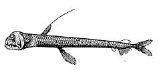
A
viperfish is a saltwater fish in the
genusIn biology, a genus is a low-level taxonomic rank used in the biological classification of living and fossil organisms, which is an example of definition by genus and differentia...
Chauliodus, with long, needle-like teeth and hinged lower jaws. They grow to lengths of 30 to 60 cm (12 - 24 inches). Viperfish stay near lower depths (250–5,000 feet) in the daytime and shallow at night. Viperfish mainly stay in tropical and temperate waters. It is one of the fiercest predators in the very deep part of the sea and is believed to attack its prey by luring the victim close to itself with a light producing organ. This organ is called a
photophoreA photophore is a light-emitting organ which appears as luminous spots on various marine animals, including fish and cephalopods. The organ can be simple, or as complex as the human eye; equipped with lenses, shutters, color filters and reflectors...
and is located on the end of its dorsal spine. It flashes this natural light on and off while at the same time moving the dorsal spine around like a fishing rod and hanging completely still in the water, and also uses the voluntary natural light producing organ to communicate to its potential mates and rivals. Viperfish vary in color between green, silver and black. It uses its fang-like teeth to immobilize its prey, and would not be able to close its mouth because of their length if it were not able to curve them behind its head. The first vertebra behind the head of the viperfish is known to absorb the shock of its attacks, which are mainly targeted against dragonfish and other small creatures. They are able to undergo long periods with scarcely any food.
Discussion
Ask a question about 'Viperfish'
Start a new discussion about 'Viperfish'
Answer questions from other users
|
A
viperfish is a saltwater fish in the
genusIn biology, a genus is a low-level taxonomic rank used in the biological classification of living and fossil organisms, which is an example of definition by genus and differentia...
Chauliodus, with long, needle-like teeth and hinged lower jaws. They grow to lengths of 30 to 60 cm (12 - 24 inches). Viperfish stay near lower depths (250–5,000 feet) in the daytime and shallow at night. Viperfish mainly stay in tropical and temperate waters. It is one of the fiercest predators in the very deep part of the sea and is believed to attack its prey by luring the victim close to itself with a light producing organ. This organ is called a
photophoreA photophore is a light-emitting organ which appears as luminous spots on various marine animals, including fish and cephalopods. The organ can be simple, or as complex as the human eye; equipped with lenses, shutters, color filters and reflectors...
and is located on the end of its dorsal spine. It flashes this natural light on and off while at the same time moving the dorsal spine around like a fishing rod and hanging completely still in the water, and also uses the voluntary natural light producing organ to communicate to its potential mates and rivals. Viperfish vary in color between green, silver and black. It uses its fang-like teeth to immobilize its prey, and would not be able to close its mouth because of their length if it were not able to curve them behind its head. The first vertebra behind the head of the viperfish is known to absorb the shock of its attacks, which are mainly targeted against dragonfish and other small creatures. They are able to undergo long periods with scarcely any food.
Viperfish are believed to live up to 30 years to 40 years but in captivity rarely live more than a few hours. Some species of dolphins and sharks are known to prey upon viperfish. Scientists believe that a viperfish can swim at a speed of two body lengths per second but that is not yet the official speed.
Species
There are 27 species:
- Chauliodus barbatus (Lowe, 1843).
- Dana viperfish, Chauliodus danae
Chauliodus danae, or dana viperfish, is a species of viperfish in the family Stomiidae. The Dana Viperfish is mostly found in the Bathyal zone....
Regan & Trewavas, 1929.
- Chauliodus dentatus Garman, 1899.
- Pacific viperfish
The Pacific viperfish, Chauliodus macouni, is a predatory fish that lives in the abyssal depths of the deep sea. In daytime it can be found from 200–5000 m below the ocean surface. At night it swims up into shallower depths of less than 200m where food is more plentiful. Pacific viperfish...
, Chauliodus macouni BeanTarleton Hoffman Bean was an American ichthyologist, born at Bainbridge, Pennsylvania on 8 October 1846. He died in Albany, New York on 28 December 1916.-FAMILY AND EDUCATION :...
, 1890.
- Chauliodus minimus Parin & Novikova, 1974.
- Chauliodus pammelas Alcock
Alfred William Alcock was a British physician naturalist and carcinologist.Alcock was the son of a sea-captain, John Alcock in Bombay, India who retired to live in Blackheath...
, 1892.
- Chauliodus schmidti (Regan & Trewavas, 1929).
- Sloane's viperfish
Sloane's viperfish, Chauliodus sloani, is a dragonfish of the genus Chauliodus, found in all tropical and subtropical oceans, at depths down to 2,500 m. Their length is between 20 and 35 cm....
, Chauliodus sloani BlochMarcus Elieser Bloch was a German medical doctor and naturalist. He is generally considered one of the most important ichthyologists of the 18th century.- Life :...
& SchneiderJohann Gottlob Theaenus Schneider was a German classicist and naturalist.-Biography:Schneider was born at Collm in Saxony...
, 1801.
- Chauliodus vasnetzovi
Chauliodus vasnetzovi is a deepwater species of the viperfish in the family Stomiidae, first discovered in 1972. It is generally found in the Bathypelagic zone in the Southeast Pacific near Chile and can grow to be up to 32.5cm in length....
Novikova, 1972.