


Vilna Ghetto

Encyclopedia
Nazi Germany
Nazi Germany , also known as the Third Reich , but officially called German Reich from 1933 to 1943 and Greater German Reich from 26 June 1943 onward, is the name commonly used to refer to the state of Germany from 1933 to 1945, when it was a totalitarian dictatorship ruled by...
in the city of Vilnius
Vilnius
Vilnius is the capital of Lithuania, and its largest city, with a population of 560,190 as of 2010. It is the seat of the Vilnius city municipality and of the Vilnius district municipality. It is also the capital of Vilnius County...
in the occupied Lithuanian Soviet Socialist Republic (now Vilnius
Vilnius
Vilnius is the capital of Lithuania, and its largest city, with a population of 560,190 as of 2010. It is the seat of the Vilnius city municipality and of the Vilnius district municipality. It is also the capital of Vilnius County...
, Lithuania
Lithuania
Lithuania , officially the Republic of Lithuania is a country in Northern Europe, the biggest of the three Baltic states. It is situated along the southeastern shore of the Baltic Sea, whereby to the west lie Sweden and Denmark...
), during the Holocaust
The Holocaust
The Holocaust , also known as the Shoah , was the genocide of approximately six million European Jews and millions of others during World War II, a programme of systematic state-sponsored murder by Nazi...
in World War II
World War II
World War II, or the Second World War , was a global conflict lasting from 1939 to 1945, involving most of the world's nations—including all of the great powers—eventually forming two opposing military alliances: the Allies and the Axis...
. During roughly two years of its existence, starvation
Starvation
Starvation is a severe deficiency in caloric energy, nutrient and vitamin intake. It is the most extreme form of malnutrition. In humans, prolonged starvation can cause permanent organ damage and eventually, death...
, disease
Disease
A disease is an abnormal condition affecting the body of an organism. It is often construed to be a medical condition associated with specific symptoms and signs. It may be caused by external factors, such as infectious disease, or it may be caused by internal dysfunctions, such as autoimmune...
, street executions, maltreatment and deportations to concentration camps and extermination camps reduced the population of the ghetto from an estimated 40,000 to zero. Only several hundred people managed to survive, mostly by hiding in the forests surrounding the town, joining the Soviet partisans
Soviet partisans
The Soviet partisans were members of a resistance movement which fought a guerrilla war against the Axis occupation of the Soviet Union during World War II....
, or finding shelter among sympathetic locals.
Background
Wehrmacht
The Wehrmacht – from , to defend and , the might/power) were the unified armed forces of Nazi Germany from 1935 to 1945. It consisted of the Heer , the Kriegsmarine and the Luftwaffe .-Origin and use of the term:...
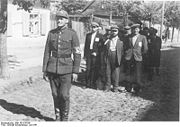
entered Vilnius on 26 June 1941, followed by units of the Einsatzgruppe A death squads. Over the course of the summer, German troops and Lithuania
Lithuania
Lithuania , officially the Republic of Lithuania is a country in Northern Europe, the biggest of the three Baltic states. It is situated along the southeastern shore of the Baltic Sea, whereby to the west lie Sweden and Denmark...
n civilians and Lithuanian police killed more than 21,000 Jews living in Vilnius, in a mass extermination program. Vilna or Vilnius was a predominantly Polish
Poles
thumb|right|180px|The state flag of [[Poland]] as used by Polish government and diplomatic authoritiesThe Polish people, or Poles , are a nation indigenous to Poland. They are united by the Polish language, which belongs to the historical Lechitic subgroup of West Slavic languages of Central Europe...
and Jewish city before World War II. After invading Poland
Soviet invasion of Poland
Soviet invasion of Poland can refer to:* the second phase of the Polish-Soviet War of 1920 when Soviet armies marched on Warsaw, Poland* Soviet invasion of Poland of 1939 when Soviet Union allied with Nazi Germany attacked Second Polish Republic...
, Joseph Stalin
Joseph Stalin
Joseph Vissarionovich Stalin was the Premier of the Soviet Union from 6 May 1941 to 5 March 1953. He was among the Bolshevik revolutionaries who brought about the October Revolution and had held the position of first General Secretary of the Communist Party of the Soviet Union's Central Committee...
gave it back to Lithuania in October 1939 according to the Soviet–Lithuanian Mutual Assistance Treaty
Soviet–Lithuanian Mutual Assistance Treaty
The Soviet–Lithuanian Mutual Assistance Treaty was a bilateral treaty signed between the Soviet Union and Lithuania on October 10, 1939. According to provisions outlined in the treaty, Lithuania would acquire about one fifth of the Vilnius Region, including Lithuania's historical capital, Vilnius,...
. The Republic of Lithuania had claimed it as its capital and the dispute between Poland
Poland
Poland , officially the Republic of Poland , is a country in Central Europe bordered by Germany to the west; the Czech Republic and Slovakia to the south; Ukraine, Belarus and Lithuania to the east; and the Baltic Sea and Kaliningrad Oblast, a Russian exclave, to the north...
and Lithuania was a long-standing one at the League of Nations
League of Nations
The League of Nations was an intergovernmental organization founded as a result of the Paris Peace Conference that ended the First World War. It was the first permanent international organization whose principal mission was to maintain world peace...
. The Republic of Lithuania, operating out of the provisional capital
Temporary capital of Lithuania
The temporary capital of Lithuania was the official designation of the city of Kaunas in Lithuania during the interwar period. It was in contrast to the declared capital in Vilnius , which was under Polish control from 1920 until 1939...
Kaunas
Kaunas
Kaunas is the second-largest city in Lithuania and has historically been a leading centre of Lithuanian economic, academic, and cultural life. Kaunas was the biggest city and the center of a powiat in Trakai Voivodeship of the Grand Duchy of Lithuania since 1413. During Russian Empire occupation...
, sent in the Lithuanian Army to reclaim the city and embarked on a project to Lithuanianize the city.
The Jewish population of Vilnius on the eve of the Holocaust was probably more than 60,000, including refugees from the German-occupied Poland, and subtracting the small number who managed to flee onward to the Soviet Union. The kidnapping and mass murder of Jews in the city commenced before the ghetto was set up by the advancing German forces, resulting in an execution of approximately 21,000 victims prior to September 6, 1941. The Lithuanian kidnappers were known in Yiddish
Yiddish language
Yiddish is a High German language of Ashkenazi Jewish origin, spoken throughout the world. It developed as a fusion of German dialects with Hebrew, Aramaic, Slavic languages and traces of Romance languages...
as hapunes, meaning grabbers or snatchers. In the months that followed Poles were also targeted by the German sponsored Lithuanian authorities collaborating with the Nazis in the extermination of Jews.
Establishment
The Great Provocation refers to the incident the Nazis staged as a pretext for clearing the predominantly poorer Jewish quarter in the Vilnius Old TownVilnius Old Town
The Old Town of Vilnius , one of the largest surviving medieval old towns in Northern Europe, has an area of 3.59 square kilometres . It encompasses 74 quarters, with 70 streets and lanes numbering 1487 buildings with a total floor area of 1,497,000 square meters...
in order to force the rest of the predominantly more affluent Jewish residents into the Nazi German-created ghetto. Specifically, the Great Provocation of 31 August 1941, was led by SS Einsatzkommando 9
Einsatzkommando
During World War II, the Nazi German Einsatzkommandos were a sub-group of five Einsatzgruppen mobile killing squads—up to 3,000 men each—usually composed of 500-1,000 functionaries of the SS and Gestapo, whose mission was to kill Jews, Romani, communists and the NKVD collaborators in the captured...
Oberscharführer
Oberscharführer
Oberscharführer was a Nazi Party paramilitary rank that existed between the years of 1932 and 1945. Translated as “Senior Squad Leader”, Oberscharführer was first used as a rank of the Sturmabteilung and was created due to an expansion of the enlisted positions required by growing SA membership...
Horst Schweinberger under orders from Gebietskommissar of the Vilnius municipality Hans Christian Hingst and Franz Murer
Franz Murer
Franz Murer , also known as the "Butcher from Vilnius", was an Austrian SS officer, who set up, organized, and ruled Vilna Ghetto.He joined the NSDAP in 1938. Murer was trained with Hitler Youth in Nuremberg. He was then transferred to Vilnius and was from 1941 to 1943 responsible for Jewish...
, Hingst’s deputy for Jewish affairs, under “provisional directives” of Reichskommissar
Reichskommissar
Reichskommissar , in German history, was an official gubernatorial title used for various public offices during the period of the German Empire and the Nazi Third Reich....
Hinrich Lohse
Hinrich Lohse
Hinrich Lohse was a Nazi German politician, best known for his World War II rule of the Baltic states.-Early life:...
. Murer, Hingst and Vilnius Lithuanian mayor Karolis Dabulevičius selected the site for the future ghetto and staged a sniping at German soldiers in front of a cinema from a window on the corner Stiklių (Glezer, also known as Szklana in Polish) and Didžioji (Wielka, meaning in Polish Great Street, hence the name for the event) streets by two Lithuanians in civilian clothes who had broken into an apartment belonging to Jews. The Lithuanians fled the apartment, then returned with waiting German soldiers, seized two Jews, accused them of firing on the German soldiers, beat them and then shot them on the spot. Stiklių and Mėsinių (Jatkowa) streets were ransacked by the local militia
Militia
The term militia is commonly used today to refer to a military force composed of ordinary citizens to provide defense, emergency law enforcement, or paramilitary service, in times of emergency without being paid a regular salary or committed to a fixed term of service. It is a polyseme with...
, and Jews were beaten up. At night, in “retaliation,” all Jews were driven out of the neighbourhood the Nazis had selected as the future ghetto territory, street by street, and the next day the women and children on remaining streets were seized while the men were at work. Men at workplaces were also seized. Jews were taken to Lukiškės Prison
Lukiškes Prison
Lukiškės Prison is a prison in the center of Vilnius, Lithuania, near the Lukiškės Square. As of 2007, it houses approximately 1,000 prisoners and employs around 250 prison guards...
, then to Paneriai, also known as Ponar or Ponary, where they were murdered between 1 September and 3 September. Five to ten thousand people were murdered, including ten members of the Judenrat
Judenrat
Judenräte were administrative bodies during the Second World War that the Germans required Jews to form in the German occupied territory of Poland, and later in the occupied territories of the Soviet Union It is the overall term for the enforcement bodies established by the Nazi occupiers to...
. The objective was to clear a territory for the establishment of a ghetto to imprison all the Jews of Vilnius and suburbs.
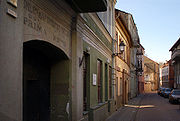
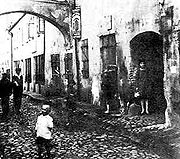
The area designated for the ghetto was the old Jewish quarter in the centre of the city. While Vilna never had a ghetto per se except for some very limited restrictions on the movement and settlement of Jews during the Middle Ages, the area chosen by the Nazis for their ghetto was predominantly and historically inhabited by Jews. The Nazis split the area into two ghettos with a non-ghetto corridor running down Deutschegasse (Niemiecka or Vokiečių Street). This made it easier for the Nazis to control what the victims knew of their fate beforehand, facilitating the Nazis' goal of total extermination. Like the other Jewish ghettos Nazi Germany set up during World War II, the Vilnius Ghetto was created both to dehumanize the people and to exploit its inmates as slave labour
Forced labor in Germany during World War II
The use of forced labour in Nazi Germany and throughout German-occupied Europe during World War II took place on an unprecedented scale. It was a vital part of the German economic exploitation of conquered territories. It also contributed to the mass extermination of populations in German-occupied...
. Conditions were intended to be extremely poor and crowded, subjecting victims to unsanitary conditions, disease and daily death.
Health Care
Jewish Vilna was also known for its distinguished medical tradition, which inmates of the Ghetto managed to maintain to some degree during the Holocaust. As in front of most Ghettos established by the Germans, a sign was put right outside the Ghetto stating: "Achtung! Seuchengefahr", that is "Attention! Danger of Infection". Mortality rates did, indeed, increase in the Vilna Ghetto as compared with pre-war demographics. However, due largely to the efforts of the Ghetto Health Department, the Vilna Ghetto had no major epidemics despite malnourishment, cold and overcrowding. According to Dr. Lazar Epstein, the head of Sanitary-Epidemiological Section of the ghetto Health Department, the inmates of the Ghetto could, left to their own devices, have lived a very long time, certainly to the end of the war despite the numerous privations.Liquidation
Estonia
Estonia , officially the Republic of Estonia , is a state in the Baltic region of Northern Europe. It is bordered to the north by the Gulf of Finland, to the west by the Baltic Sea, to the south by Latvia , and to the east by Lake Peipsi and the Russian Federation . Across the Baltic Sea lies...
by order of Heinrich Himmler
Heinrich Himmler
Heinrich Luitpold Himmler was Reichsführer of the SS, a military commander, and a leading member of the Nazi Party. As Chief of the German Police and the Minister of the Interior from 1943, Himmler oversaw all internal and external police and security forces, including the Gestapo...
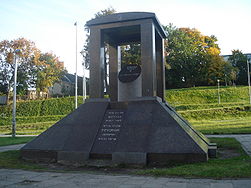
. Under the supervision of Oberscharführer Bruno Kittel, the ghetto was "liquidated" between 23 and 24 September 1943, and the majority of the Jewish population were sent to the Vaivara concentration camp in Estonia, killed in the forest of Paneriai, or sent to the death camps in German-occupied Poland.
A small remnant of Jews remained after the liquidation of the Vilnius Ghetto, primarily at the Kailis slave labour camp and at the HKP slave labour camp
HKP 562 Slave Labor Camp
HKP 562, located on Subocz Street in Vilnius, Lithuania, was the site of an unusual labor camp during the Holocaust. The camp was officially owned and administered by the SS, but run on a day to day basis by a Wehrmacht engineering unit, HKP 562 stationed in Vilna...
. The HKP camp (short for Heereskraftpark and an outfit involved in repairing German military automobiles) was commanded by Wehrmacht Major
Major
Major is a rank of commissioned officer, with corresponding ranks existing in almost every military in the world.When used unhyphenated, in conjunction with no other indicator of rank, the term refers to the rank just senior to that of an Army captain and just below the rank of lieutenant colonel. ...
Karl Plagge
Karl Plagge
Major Karl Plagge was a German officer and Nazi Party member who during World War II used his position as a staff officer in the Heer to employ and protect some 1,240 Jews — 500 men, the others women and children, in order to give them a better chance to survive the nearly total annihilation of...
, who, with the help of some of his men, managed to shield many of his workers from the murderous goal of the SS. Two-hundred and fifty Jews at HKP survived the war. They represent the single largest group of Jewish survivors of the Holocaust in Vilnius.
Resistance
The Fareynikte Partizaner Organizatsye (United Partisan Organization) was formed on 21 January 1942 in the Vilna Ghetto. It took for its motto "We will not go like sheep to the slaughter," a phrase resurrected by Abba KovnerAbba Kovner
Abba Kovner was a Lithuanian Jewish Hebrew poet, writer, and partisan leader. He became one of the great poets of modern Israel. He was a cousin of the Israeli Communist Party leader Meir Vilner.-Biography:...
. This was one of the first resistance organizations established in the Nazi ghettos during World War II. Unlike in other ghettos, the resistance movement in the Vilna Ghetto was not run by ghetto officials. Jacob Gens, appointed head of the ghetto by the Nazis but originally chief of police, ostensibly cooperated with German officials in stopping armed struggle. The FPO represented the full spectrum of political persuasions and parties in Jewish life. It was headed by Yitzhak Wittenberg
Yitzhak Wittenberg
Yitzhak Wittenberg was a Jewish resistance fighter in Vilna during World War II. He became famous as the leader of the Fareynikte Partizaner Organizatsye, a resistance group in the Vilna Ghetto. When the Germans learned about the existence of the group, they requested from the head of the Jewish...
, Josef Glazman, and Abba Kovner. The goals of the FPO were to establish a means for the self-defence of the ghetto population, to sabotage German industrial and military activities and to join the partisan and Red Army’s fight against the Nazis. Poet Hirsh Glick
Hirsh Glick
Hirsch Glick was a Jewish poet and partisan.Glick was born in Vilna in 1922. He began to write Yiddish poetry in his teens and became co-founder of Yungvald , a group of young Jewish poets...
, a Vilna ghetto inmate who later died after having been deported to Estonia, penned the words for what became the famous Partisan Hymn, Zog nit keynmol, az du geyst dem letstn veg.
Judenrat
Judenräte were administrative bodies during the Second World War that the Germans required Jews to form in the German occupied territory of Poland, and later in the occupied territories of the Soviet Union It is the overall term for the enforcement bodies established by the Nazi occupiers to...
, in response to German threats, tried to turn Yitzhak Wittenberg, the head of the FPO, over to the Gestapo
Gestapo
The Gestapo was the official secret police of Nazi Germany. Beginning on 20 April 1934, it was under the administration of the SS leader Heinrich Himmler in his position as Chief of German Police...
. The FPO was able to rescue him after he was seized in the apartment of Jacob Gens in a fight with Jewish ghetto police. Gens brought in heavies, the leaders of the work brigades, and effectively turned the majority of the population against the resistance members, claiming they were provoking the Nazis and asking rhetorically whether it was worth sacrificing tens of thousands for the sake of one man. Ghetto prisoners assembled and demanded the FPO give Wittenberg up. Ultimately Wittenberg himself made the decision to submit to the Nazi demands. He was taken to Gestapo headquarters in Vilnius and was reportedly found dead in his cell the next morning. Most people believed he had committed suicide. The rumour had it that Gens had slipped him a cyanide pill
Cyanide poisoning
Cyanide poisoning occurs when a living organism is exposed to a compound that produces cyanide ions when dissolved in water. Common poisonous cyanide compounds include hydrogen cyanide gas and the crystalline solids potassium cyanide and sodium cyanide...
in their final meeting.
The FPO was thoroughly demoralized by the chain of events and began to pursue a policy of sending young people out to the forest to join the Jewish partisans
Jewish partisans
Jewish partisans were fighters in irregular military groups participating in the Jewish resistance movement against Nazi Germany and its collaborators during World War II....
. This was controversial as well because the Nazis attempted to kill all family members of people who had joined the partisans. In the Vilna ghetto a "family" often included non-relations who registered as a member of a family in order to receive housing and a pitiful food ration.
When the Nazis came to liquidate the ghetto in 1943, members of the FPO went on alert. Gens took control of the liquidation in order to keep the Nazi forces out of the ghetto and away from a partisan ambush, but helped fill the quota of Jews with those who could fight but were not necessarily part of the resistance. The FPO fled to the forest and fought with the partisans.
Cultural life
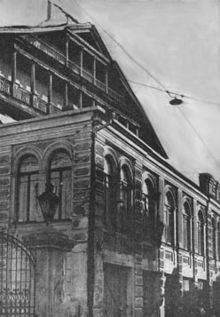
Yitskhok Rudashevski
Yitskhok Rudashevski was a young Jewish teenager who lived in the Vilna Ghetto in Lithuania during the 1940s. He wrote a diary from June 1941 to April 1943 which detailed his life and struggles living in the ghetto. He was shot to death in the Ponary massacre during the liquidation of September...
(1927–1943), a young teen who wrote a diary of his life in the ghetto during 1941 to 1943, mentions a number of these events and his participation in them. He was murdered in the liquidation of 1943, probably at Paneriai
Paneriai
Paneriai is a neighborhood of Vilnius, situated about 10 kilometres away from the city center. It is the largest elderate in the Vilnius city municipality. It is located on low forested hills, on the Vilnius-Warsaw road...
. His diary was discovered in 1944 by his cousin.
The Vilna Ghetto was well-known for its theatrical productions during World War II. Jacob Gens, the head of Jewish police and the ruler/dictator of the Vilna ghetto, was given the responsibility for the starting of this theatre. Performances included poetry by Jewish Authors, dramatizations of short stories, and new work by the young ghetto people.
The Ghetto Theatre was a great source of revenue and had a calming effect on the public. A total of 111 performances had been given by January 10th, 1943 and a total of 34,804 tickets were sold. The theatre was renovated to accommodate a bigger audience and create a better-looking theatre for the public eye. This theatre permitted the non-Aryan race to display their power through plays and songs; for instance, one of the songs that was sung was called "Endurance."
The last theatrical production, Der mabl meaning The Flood, was produced by the Swedish dramatist Henning Berger and opened in the summer of 1943, in the last week of this Ghetto’s existence. This play, set in an American saloon during a flood, featured a group of people who banded together during a time of danger and need.
Joseph Sobol's play Ghetto recounts the last days of the Vilna Ghetto theatre company.
See also
- Karl PlaggeKarl PlaggeMajor Karl Plagge was a German officer and Nazi Party member who during World War II used his position as a staff officer in the Heer to employ and protect some 1,240 Jews — 500 men, the others women and children, in order to give them a better chance to survive the nearly total annihilation of...
- HKP 562 Slave Labor CampHKP 562 Slave Labor CampHKP 562, located on Subocz Street in Vilnius, Lithuania, was the site of an unusual labor camp during the Holocaust. The camp was officially owned and administered by the SS, but run on a day to day basis by a Wehrmacht engineering unit, HKP 562 stationed in Vilna...
- Lithuanian collaboration with Nazi Germany
- Jewish response to The Forty Days of Musa DaghJewish response to The Forty Days of Musa DaghThe Forty Days of Musa Dagh was a 1933 novel by the Austrian-Jewish author Franz Werfel. Based on the events at Musa Dagh in 1915 during the Armenian Genocide in the Ottoman Empire, the book played a role in organizing the Jewish resistance under Nazi rule...
External links
- http://www.jewishvirtuallibrary.org/jsource/Holocaust/Gens3.html - Gens in response to resistance
- http://www.jewishvirtuallibrary.org/jsource/Holocaust/Gens2.html - Gens in response to the concert
- http://www.jewishvirtuallibrary.org/jsource/Holocaust/Vilna3.html - partisans on their program
- Chronicles of the Vilnius Ghetto
- About the Holocaust
- Jewish Partisan Group Near Vilnius
- Kurzbiographien
- Partisans in Vilnius
- Rozka Korczak & Abba Kovner with members of the United Partisan Organization (FPO)
- Vilnius Partisans
- Holocaust In The Baltics Information and updates on the ongoing debate, edited by Dovid KatzDovid KatzDovid Katz is an American-born, Vilnius-based Judaic studies professor, Yiddish specialist, and political activist, currently living in Lithuania.-Biography:...