

Viking biological experiments

Encyclopedia
Viking program
The Viking program consisted of a pair of American space probes sent to Mars, Viking 1 and Viking 2. Each spacecraft was composed of two main parts, an orbiter designed to photograph the surface of Mars from orbit, and a lander designed to study the planet from the surface...
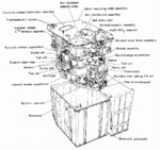
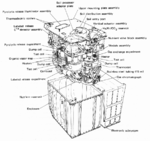
each carried four types of biological experiment
Experiment
An experiment is a methodical procedure carried out with the goal of verifying, falsifying, or establishing the validity of a hypothesis. Experiments vary greatly in their goal and scale, but always rely on repeatable procedure and logical analysis of the results...
s to the surface of Mars
Mars
Mars is the fourth planet from the Sun in the Solar System. The planet is named after the Roman god of war, Mars. It is often described as the "Red Planet", as the iron oxide prevalent on its surface gives it a reddish appearance...
in the late 1970s. These were the first Mars landers to carry out experiments to look for biosignature
Biosignature
A biosignature is any substance -such as an element, isotope, or molecule - or phenomenon that provides scientific evidence of past or present life. Measurable attributes of life include its complex physical and chemical structures and also its utilization of free energy and the production of...
s of life on Mars
Life on Mars
Scientists have long speculated about the possibility of life on Mars owing to the planet's proximity and similarity to Earth. Fictional Martians have been a recurring feature of popular entertainment of the 20th and 21st centuries, but it remains an open question whether life currently exists on...
. The landers used a robotic arm to put soil samples into sealed test containers on the craft. The two landers were identical, so the same tests were carried out at two places on Mars' surface, Viking 1
Viking 1
Viking 1 was the first of two spacecraft sent to Mars as part of NASA's Viking program. It was the first spacecraft to successfully land on Mars and perform its mission, and until May 19, 2010 held the record for the second longest Mars surface mission of 6 years and 116 days .- Mission :Following...
near the equator and Viking 2
Viking 2
The Viking 2 mission was part of the American Viking program to Mars, and consisted of an orbiter and a lander essentially identical to that of the Viking 1 mission. The Viking 2 lander operated on the surface for 1,281 Mars days and was turned off on 11 April 1980 when its batteries failed...
far enough north to see frost in winter.
The experiments
The mission looked for microorganisms, rather than larger creatures, because it is known that the favorable conditions for the evolution of multicellular organisms ceased some four billion years ago on Mars. The four experiments are presented here in the order in which they were carried out by the two Viking landers.Gas Chromatograph — Mass Spectrometer
(PI: Klaus Biemann, MIT) The Gas Chromatograph — Mass Spectrometer (GCMS) is a device that separates vapor components chemically via a gas chromatograph and then feeds the result into a mass spectrometer, which measures the molecular weight of each chemical. As a result, it can separate, identify, and quantify a large number of different chemicals. The GCMS was used to analyze the components of untreated Martian soil, and particularly those components that are released as the soil is heated to different temperatures. It could measure molecules present at a level of only a few parts per billion.However, the GCMS measured no significant amount of organic molecules in the Martian soil. In fact, Martian soils were found to contain less carbon than lifeless lunar soils returned by the Apollo program. It was previously believed that the strongest organic concentrations it measured were minute trace contaminants brought from Earth, left over from the assembly and cleaning of the sample chambers and instruments. This result was difficult to explain if Martian bacterial metabolism was responsible for the positive results seen by the Labeled Release experiment (see below). The Phoenix mission provided the missing information to explain Viking's results. Perchlorate ions were found in the Martian soil which, when heated, act as a strong oxidant that can destroy organic molecules, and produce the organic molecules chloromethane and dichloromethane, which can be easily mistaken for cleaning products. If there were organic molecules in the Martian soil, the Viking's method of testing, which involved heating the sample, could have destroyed those organics.
Gas Exchange
(PI: Vance Oyama, NASA Ames) The Gas Exchange (GEX) experiment looked for gases given off by an incubated soil sample by first replacing the Martian atmosphere with the inert gas HeliumHelium
Helium is the chemical element with atomic number 2 and an atomic weight of 4.002602, which is represented by the symbol He. It is a colorless, odorless, tasteless, non-toxic, inert, monatomic gas that heads the noble gas group in the periodic table...
. It applied a liquid complex of organic and inorganic nutrients and supplements to a soil sample, first with just nutrients added, then with water added too. Periodically, the instrument sampled the atmosphere of the incubation chamber and used a gas chromatograph to measure the concentrations of several gases, including oxygen
Oxygen
Oxygen is the element with atomic number 8 and represented by the symbol O. Its name derives from the Greek roots ὀξύς and -γενής , because at the time of naming, it was mistakenly thought that all acids required oxygen in their composition...
, CO2, nitrogen
Nitrogen
Nitrogen is a chemical element that has the symbol N, atomic number of 7 and atomic mass 14.00674 u. Elemental nitrogen is a colorless, odorless, tasteless, and mostly inert diatomic gas at standard conditions, constituting 78.08% by volume of Earth's atmosphere...
, hydrogen
Hydrogen
Hydrogen is the chemical element with atomic number 1. It is represented by the symbol H. With an average atomic weight of , hydrogen is the lightest and most abundant chemical element, constituting roughly 75% of the Universe's chemical elemental mass. Stars in the main sequence are mainly...
, and methane
Methane
Methane is a chemical compound with the chemical formula . It is the simplest alkane, the principal component of natural gas, and probably the most abundant organic compound on earth. The relative abundance of methane makes it an attractive fuel...
. The scientists hypothesized that metabolizing organisms would either consume or release at least one of the gases being measured. The result was negative.
Labeled Release
(PI: Gilbert Levin, Biospherics Inc.) The Labeled Release (LR) experiment is the one that gave the most promise for the exobiologists.In the LR experiment, a sample of Martian soil was inoculated with a drop of very dilute aqueous nutrient solution. The nutrients (7 molecules that were Miller-Urey products) were tagged with radioactive 14C. The air above the soil was monitored for the evolution of radioactive 14CO2 gas as evidence that microorganisms in the soil had metabolized
Metabolism
Metabolism is the set of chemical reactions that happen in the cells of living organisms to sustain life. These processes allow organisms to grow and reproduce, maintain their structures, and respond to their environments. Metabolism is usually divided into two categories...
one or more of the nutrients. Such a result was to be followed with the control part of the experiment as described for the PR below. The result was quite a surprise following the negative results of the first two tests, with a steady stream of radioactive gases being given off by the soil immediately following the first injection. The experiment was done by both Viking probes the first using a sample from the surface exposed to sunlight and the second probe taking the sample from underneath a rock both initial injections came back positive. Subsequent injections a week later did not, however, elicit the same reaction, and the result remains inconclusive.
Pyrolytic Release
(PI: Norman Horowitz, Caltech) Light, water, and a carbon-containing atmosphereAtmosphere of Mars
The atmosphere of Mars is relatively thin and is composed mostly of carbon dioxide . There has been interest in studying its composition since the detection of trace amounts of methane, which may indicate the presence of life on Mars, but may also be produced by a geochemical process, volcanic or...
of carbon monoxide
Carbon monoxide
Carbon monoxide , also called carbonous oxide, is a colorless, odorless, and tasteless gas that is slightly lighter than air. It is highly toxic to humans and animals in higher quantities, although it is also produced in normal animal metabolism in low quantities, and is thought to have some normal...
(CO) and carbon dioxide
Carbon dioxide
Carbon dioxide is a naturally occurring chemical compound composed of two oxygen atoms covalently bonded to a single carbon atom...
(CO2), simulating that on Mars. The carbon-bearing gases were made with carbon-14
Carbon-14
Carbon-14, 14C, or radiocarbon, is a radioactive isotope of carbon with a nucleus containing 6 protons and 8 neutrons. Its presence in organic materials is the basis of the radiocarbon dating method pioneered by Willard Libby and colleagues , to date archaeological, geological, and hydrogeological...
(14C), a heavy, radioactive isotope
Isotope
Isotopes are variants of atoms of a particular chemical element, which have differing numbers of neutrons. Atoms of a particular element by definition must contain the same number of protons but may have a distinct number of neutrons which differs from atom to atom, without changing the designation...
of carbon. If there were photosynthetic
Photosynthesis
Photosynthesis is a chemical process that converts carbon dioxide into organic compounds, especially sugars, using the energy from sunlight. Photosynthesis occurs in plants, algae, and many species of bacteria, but not in archaea. Photosynthetic organisms are called photoautotrophs, since they can...
organisms present, it was believed that they would incorporate some of the carbon as biomass
Biomass
Biomass, as a renewable energy source, is biological material from living, or recently living organisms. As an energy source, biomass can either be used directly, or converted into other energy products such as biofuel....
through the process of carbon fixation
Carbon fixation
In biology, carbon fixation is the reduction of carbon dioxide to organic compounds by living organisms. The obvious example is photosynthesis. Carbon fixation requires both a source of energy such as sunlight, and an electron donor such as water. All life depends on fixed carbon. Organisms that...
, just as plants and cyanobacteria on earth do. After several days of incubation, the experiment removed the gases, baked the remaining soil at 650 °C (1200 °F), and collected the products in a device which counted radioactivity. If any of the 14C had been converted to biomass, it would be vaporized during heating and the radioactivity counter would detect it as evidence for life. Should a positive response be obtained, a duplicate sample of the same soil would be heated to "sterilize" it. It would then be tested as a control and should it still show activity similar to the first response, that was evidence that the activity was chemical in nature. However, a nil, or greatly diminished response, was evidence for biology. This same control was to be used for any of the three life detection experiments that showed a positive initial result.
Scientific conclusions
Organic compounds seem to be common, for example, on asteroids, meteorites, comets and the icy bodies orbiting the Sun, so detecting no trace of any organic compound on the surface of Mars came as a surprise. The GC-MS was definitely working, because the controls were fine and it was able to detect traces of the cleaning solvents that had been used to sterilize it prior to launch. At the time, the total absence of organic material on the surface made the results of the biology experiments moot, since metabolismMetabolism
Metabolism is the set of chemical reactions that happen in the cells of living organisms to sustain life. These processes allow organisms to grow and reproduce, maintain their structures, and respond to their environments. Metabolism is usually divided into two categories...
involving organic compounds were what those experiments were designed to detect. However, the general scientific community surmise that the Viking's biological tests remain inconclusive.
Most researchers surmise that the results of the Viking biology experiments can be explained by purely chemical processes that do not require the presence of life, and the GC-MS results rule out life.
Despite the positive result from the Labeled Release experiment, a general assessment is that the results seen in the four experiments are best explained by oxidative chemical reactions with the Martian soil. One of the current conclusions is that the Martian soil, being continuously exposed to UV light
Ultraviolet
Ultraviolet light is electromagnetic radiation with a wavelength shorter than that of visible light, but longer than X-rays, in the range 10 nm to 400 nm, and energies from 3 eV to 124 eV...
from the Sun (Mars has no protective ozone layer
Ozone layer
The ozone layer is a layer in Earth's atmosphere which contains relatively high concentrations of ozone . This layer absorbs 97–99% of the Sun's high frequency ultraviolet light, which is potentially damaging to the life forms on Earth...
), has built up a thin layer of a very strong oxidant. A sufficiently strong oxidizing molecule would react with the added water to produce oxygen and hydrogen, and with the nutrients to produce carbon dioxide
Carbon dioxide
Carbon dioxide is a naturally occurring chemical compound composed of two oxygen atoms covalently bonded to a single carbon atom...
(CO2).
On August 2008, the Phoenix lander
Phoenix (spacecraft)
Phoenix was a robotic spacecraft on a space exploration mission on Mars under the Mars Scout Program. The Phoenix lander descended on Mars on May 25, 2008...
detected perchlorate
Perchlorate
Perchlorates are the salts derived from perchloric acid . They occur both naturally and through manufacturing. They have been used as a medicine for more than 50 years to treat thyroid gland disorders. They are used extensively within the pyrotechnics industry, and ammonium perchlorate is also a...
, a strong oxidizer when heated above 200°C. This was initially thought to be the cause of a false positive LR result.
However, results of experiments published in December 2010 propose that organic compounds "could have been present" in the soil analyzed by both Viking 1 and 2, since NASA's Phoenix lander in 2008 detected perchlorate, which can break down organic compounds. The study's authors found that perchlorate can destroy organics when heated and produce chloromethane
Chloromethane
Chloromethane, also called methyl chloride, R-40 or HCC 40, is a chemical compound of the group of organic compounds called haloalkanes. It was once widely used as a refrigerant. It is a colorless extremely flammable gas with a minorly sweet odor, which is, however, detected at possibly toxic levels...
and dichloromethane
Dichloromethane
Dichloromethane is an organic compound with the formula CH2Cl2. This colorless, volatile liquid with a moderately sweet aroma is widely used as a solvent. Although it is not miscible with water, it is miscible with many organic solvents...
as byproduct, the identical chlorine compounds discovered by both Viking landers when they performed the same tests on Mars. Because perchlorate would have broken down any Martian organics, the question of whether or not Viking found organic compounds is still wide open.
Controversy
Before the discovery of the oxidizer perchloratePerchlorate
Perchlorates are the salts derived from perchloric acid . They occur both naturally and through manufacturing. They have been used as a medicine for more than 50 years to treat thyroid gland disorders. They are used extensively within the pyrotechnics industry, and ammonium perchlorate is also a...
on Mars in 2008, some theories remained opposed to the general scientific conclusion. An investigator suggested that the biological explanation of the lack of detected organics by GC-MS could be that the oxidizing inventory of the H2O2-H2O solvent well exceeded the reducing power of the organic compounds of the organisms.
It has also been argued that the Labeled Release (LR) experiment detected so few metabolising organisms in the Martian soil, that it would have been impossible for the gas chromatograph to detect them. This view has been put forward by one of the designers of the LR experiment, Gilbert Levin
Gilbert Levin
Gilbert Levin is an American engineer, the founder of Spherix and famous for experiments on Mars soil by the Viking program and the development of tagatose.Levin is a member of the "International Committee Against Mars Sample Return" ....
, who believes the positive LR results are enough diagnostic for life on Mars. He and others have conducted ongoing experiments attempting to reproduce the Viking data, either with biological or non-biological materials on Earth. While no experiment has ever precisely duplicated the Mars LR test and control results, experiments with hydrogen peroxide
Hydrogen peroxide
Hydrogen peroxide is the simplest peroxide and an oxidizer. Hydrogen peroxide is a clear liquid, slightly more viscous than water. In dilute solution, it appears colorless. With its oxidizing properties, hydrogen peroxide is often used as a bleach or cleaning agent...
-saturated titanium dioxide
Titanium dioxide
Titanium dioxide, also known as titanium oxide or titania, is the naturally occurring oxide of titanium, chemical formula . When used as a pigment, it is called titanium white, Pigment White 6, or CI 77891. Generally it comes in two different forms, rutile and anatase. It has a wide range of...
have produced similar results.
While the majority of astrobiologists still conclude that the Viking biological experiments were inconclusive or negative, Gilbert Levin
Gilbert Levin
Gilbert Levin is an American engineer, the founder of Spherix and famous for experiments on Mars soil by the Viking program and the development of tagatose.Levin is a member of the "International Committee Against Mars Sample Return" ....
is not alone in believing otherwise. The current claim for life on Mars is grounded on old evidence reinterpreted in the light of recent developments. On 2006, Mario Crocco went as far as proposing the creation of a new nomenclatural rank
Taxonomy
Taxonomy is the science of identifying and naming species, and arranging them into a classification. The field of taxonomy, sometimes referred to as "biological taxonomy", revolves around the description and use of taxonomic units, known as taxa...
that classified some Viking results as 'metabolic
Metabolism
Metabolism is the set of chemical reactions that happen in the cells of living organisms to sustain life. These processes allow organisms to grow and reproduce, maintain their structures, and respond to their environments. Metabolism is usually divided into two categories...
' and therefore representative of a new form of life. The taxonomy proposed by Crocco has not been accepted by the scientific community, and the validity of Crocco's interpretation hinged entirely on the absence of an oxidative agent in the Martian soil.
On a paper published in December 2010, the scientists suggest that if organics were present, they would not have been detected because when the soil is heated to check for organics, perchlorate destroys them rapidly producing chloromethane and dichloromethane, which is what the Viking landers found. This team also notes that this is not a proof of life but it could make a difference in how scientists look for organic biomarkers in the future. It is expected that the results from the upcoming ExoMars
ExoMars
ExoMars is a European-led robotic mission to Mars currently under development by the European Space Agency with collaboration by NASA...
and Mars Science Laboratory
Mars Science Laboratory
The Mars Science Laboratory is a National Aeronautics and Space Administration mission with the aim to land and operate a rover named Curiosity on the surface of Mars. The MSL was launched November 26, 2011, at 10:02 EST and is scheduled to land on Mars at Gale Crater between August 6 and 20, 2012...
missions will help settle this controversy.
Criticism
James LovelockJames Lovelock
James Lovelock, CH, CBE, FRS is an independent scientist, environmentalist and futurologist who lives in Devon, England. He is best known for proposing the Gaia hypothesis, which postulates that the biosphere is a self-regulating entity with the capacity to keep our planet healthy by controlling...
argued that the Viking mission would have done better to examine the Martian atmosphere than look at the soil. He theorised that all life tends to expel waste gases into the atmosphere, and as such it would be possible to theorise the existence of life on a planet by detecting an atmosphere that was not in chemical equilibrium. He concluded that there was enough information about Mars' atmosphere at that time to discount the possibility of life there. Since then, methane has been discovered in Mars' atmosphere at 10ppb, thus reopening this debate.
A press commentary argued that, if there was life at the Viking lander sites, it may have been killed by the exhaust from the landing rockets. That is not a problem for missions which land via an airbag
Airbag
An Airbag is a vehicle safety device. It is an occupant restraint consisting of a flexible envelope designed to inflate rapidly during an automobile collision, to prevent occupants from striking interior objects such as the steering wheel or a window...
-protected capsule, slowed by parachutes and retrorockets, and dropped from a height that allows rocket exhaust to avoid the surface. Mars Pathfinder
Mars Pathfinder
Mars Pathfinder was an American spacecraft that landed a base station with roving probe on Mars in 1997. It consisted of a lander, renamed the Carl Sagan Memorial Station, and a lightweight wheeled robotic rover named Sojourner.Launched on December 4, 1996 by NASA aboard a Delta II booster a...
's Sojourner rover and the Mars Exploration Rover
Mars Exploration Rover
NASA's Mars Exploration Rover Mission is an ongoing robotic space mission involving two rovers, Spirit and Opportunity, exploring the planet Mars...
s each used this landing technique successfully. The Phoenix Scout
Phoenix (spacecraft)
Phoenix was a robotic spacecraft on a space exploration mission on Mars under the Mars Scout Program. The Phoenix lander descended on Mars on May 25, 2008...
lander descended to the surface with retro-rockets, however, their fuel was hydrazine
Hydrazine
Hydrazine is an inorganic compound with the formula N2H4. It is a colourless flammable liquid with an ammonia-like odor. Hydrazine is highly toxic and dangerously unstable unless handled in solution. Approximately 260,000 tons are manufactured annually...
, and the end products of the plume (water, nitrogen, and ammonia) were not found to have affected the soils at the landing site.
Future missions
The question of life on MarsLife on Mars
Scientists have long speculated about the possibility of life on Mars owing to the planet's proximity and similarity to Earth. Fictional Martians have been a recurring feature of popular entertainment of the 20th and 21st centuries, but it remains an open question whether life currently exists on...
will probably not be resolved entirely until future missions to Mars either conclusively demonstrate the presence of life on the planet, identify the chemical(s) responsible for the Viking results, or both. About thirty three years after the Viking program
Viking program
The Viking program consisted of a pair of American space probes sent to Mars, Viking 1 and Viking 2. Each spacecraft was composed of two main parts, an orbiter designed to photograph the surface of Mars from orbit, and a lander designed to study the planet from the surface...
, the Beagle 2
Beagle 2
Beagle 2 was an unsuccessful British landing spacecraft that formed part of the European Space Agency's 2003 Mars Express mission. All contact with it was lost upon its separation from the Mars Express six days before its scheduled entry into the atmosphere...
, a British
United Kingdom
The United Kingdom of Great Britain and Northern IrelandIn the United Kingdom and Dependencies, other languages have been officially recognised as legitimate autochthonous languages under the European Charter for Regional or Minority Languages...
robotic lander spacecraft, was sent to Mars in 2003 to specifically assess possible chemical biosignature
Biosignature
A biosignature is any substance -such as an element, isotope, or molecule - or phenomenon that provides scientific evidence of past or present life. Measurable attributes of life include its complex physical and chemical structures and also its utilization of free energy and the production of...
s of life, but the spacecraft was destroyed on landing. The Mars Science Laboratory
Mars Science Laboratory
The Mars Science Laboratory is a National Aeronautics and Space Administration mission with the aim to land and operate a rover named Curiosity on the surface of Mars. The MSL was launched November 26, 2011, at 10:02 EST and is scheduled to land on Mars at Gale Crater between August 6 and 20, 2012...
rover is scheduled to launch in 2011 and will determine the nature and inventory of organic carbon compounds in the soil and atmosphere of Mars. Astrobiology research on Mars will continue with the Mars Trace Gas Mission orbiter in 2016 and ExoMars
ExoMars
ExoMars is a European-led robotic mission to Mars currently under development by the European Space Agency with collaboration by NASA...
and MAX-C rovers in 2018.
See also
- AstrobiologyAstrobiologyAstrobiology is the study of the origin, evolution, distribution, and future of life in the universe. This interdisciplinary field encompasses the search for habitable environments in our Solar System and habitable planets outside our Solar System, the search for evidence of prebiotic chemistry,...
- BiosignatureBiosignatureA biosignature is any substance -such as an element, isotope, or molecule - or phenomenon that provides scientific evidence of past or present life. Measurable attributes of life include its complex physical and chemical structures and also its utilization of free energy and the production of...
- ExoMarsExoMarsExoMars is a European-led robotic mission to Mars currently under development by the European Space Agency with collaboration by NASA...
- Exploration of MarsExploration of MarsThe exploration of Mars has been an important part of the space exploration programs of the Soviet Union, the United States, Europe, and Japan. Dozens of robotic spacecraft, including orbiters, landers, and rovers, have been launched toward Mars since the 1960s...
- Life on MarsLife on MarsScientists have long speculated about the possibility of life on Mars owing to the planet's proximity and similarity to Earth. Fictional Martians have been a recurring feature of popular entertainment of the 20th and 21st centuries, but it remains an open question whether life currently exists on...
- Viking programViking programThe Viking program consisted of a pair of American space probes sent to Mars, Viking 1 and Viking 2. Each spacecraft was composed of two main parts, an orbiter designed to photograph the surface of Mars from orbit, and a lander designed to study the planet from the surface...
- Viking 1Viking 1Viking 1 was the first of two spacecraft sent to Mars as part of NASA's Viking program. It was the first spacecraft to successfully land on Mars and perform its mission, and until May 19, 2010 held the record for the second longest Mars surface mission of 6 years and 116 days .- Mission :Following...
- Viking 2Viking 2The Viking 2 mission was part of the American Viking program to Mars, and consisted of an orbiter and a lander essentially identical to that of the Viking 1 mission. The Viking 2 lander operated on the surface for 1,281 Mars days and was turned off on 11 April 1980 when its batteries failed...
External links
- Viking Lander LR Data Set from NASA
- Viking Biology from the NASA NSSDC Master Catalog of Experiments
- 2001 Space.com article about the debate over the LR results
- Life on Mars: Viking and the Biology Experiments
- Circadian rhythms Speculation Study
- Mars: The Living Planet. Barry E. DiGregorio, with additional contributions by Gilbert V. Levin and Patricia Ann Straat. North Atlantic Books, Berkeley, CA, 365 pages, 1997.
- The Viking GC/MS and the search for organics on Mars from the October 1, 2007 issue of Analytical Chemistry
- The Viking Mission Labeled Release Experiment and the Search for Martian Life: Part I