


Vianden

Encyclopedia
Vianden is a commune
with city status in the Oesling
, north-eastern Luxembourg
, with over 1,500 inhabitants. It is the capital of the canton of Vianden
, which is part of the district of Diekirch
. Vianden lies on the Our
river, near the border between Luxembourg and Germany
.
, the town of Vianden, which lies in the east of the commune, has a population of 1,511. It is known for its impressive castle and beautiful location in the Our valley.
on the site of the present castle
. The original name of Vianden was Viennensis. The first historical reference to Vianden was in 698 when there is a record of a gift in the form of a vineyard in Monte Viennense made by Saint Irmina to the Abbey of Echternach
. Vianden possesses one of the oldest charters in Europe, granted in 1308 by Philip II, count of Vianden, from whom the family of Nassau
-Vianden sprang, and who was consequently the ancestor of William of Orange
.
In the Middle Ages, Vianden's craftsmen were recognised for their skills as tanners, drapers, weavers, barrelmakers, masons, locksmiths and goldsmiths. In 1490, they created guilds for their various trades. Over the years leathermaking became the major industry with the establishment of two tanneries at the end of the 19th century which finally closed in the mid 1950s.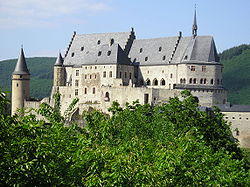 The castle was built between the 11th and 14th centuries and became the seat of the counts of Vianden
. It was further developed until the 18th century but with the departure of the Counts of Luxembourg to the Netherlands combined with the effects of fire and an earthquake, it slowly deteriorated. The final blow came in 1820 when William I of the Netherlands
sold it to a local merchant who in turn sold off its contents and masonry piecemeal, reducing it to a ruin. There were several attempts at restoration but these were hampered by problems of ownership. Victor Hugo lived in the castle for three months in 1871. Not until 1977, when Grand Duke Jean
ceded the castle to the State, was it possible to undertake large-scale work, most of which has now been completed.
Vianden is also remembered as the last place in Luxembourg to be freed from the Germans in World War II
in February 1945 when the Americans completed Luxembourg's liberation.(See also the Battle of Vianden
). A memorial to the west of the town, overlooking the castle, commemorates this final battle.
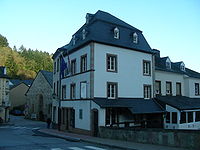 Many royal families and heads of state have associations with Vianden or have at least visited it. However, several other figures are worthy of note:
 Vianden is one of Luxembourg's main tourist centres with large numbers of holidaymakers and local visitors at all times of the year. In particular, the recently restored castle set spectactularly on the rocks above the town has become a museum which traces its history and its links with the royal families of Europe back to the middle ages
. Then there are links with Victor Hugo
who visited Luxembourg in 1862 and 1865 and spent a longer period in Vianden in 1871. His sketches and letters can be seen in the museum located in the house where he stayed next to the bridge over the Our
. There is also a museum of arts and crafts (Musée d'Art rustique) and a doll and toy museum (Musée de la Poupée et du Jouet).
But many people just visit Vianden to wander through its hilly, historic streets or as a centre for walking, camping or cycling in the north of Luxembourg. There is a pleasant cycle route up the Sauer and Our valleys to Vianden and there are many signposted walks in the area.
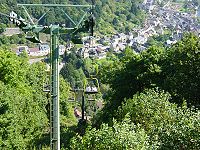
During the summer months, a chairlift operates from the banks of the river in the lower part of the town taking you high above the castle with magnificent views over the landscape.
Vianden also has a number of annual events and celebrations. The most famous of these is the nut market in October when the local walnuts are on sale together with walnut cakes, walnut confectionary, walnut brandy and walnut liqueurs.
Finally, there is an interesting attraction a few kilometers to the north of Vianden, Europe's biggest hydro-electric pumping station which provides pumped-storage hydroelectricity
storage and generation systems to benefit from the surplus electric power at night, and provide extra energy during peak hours.
s who take advantage of its restaurants, cafés, souvenir shops and sports facilities. The economy is however not without problems. While the hydro-electric pumping plant continues directly and indirectly to provide employment for the local population, the closure of the Electrolux plant a couple of years ago has resulted in a considerable loss of jobs. The commune is now planning to encourage the establishment of skilled craft industries in the area by making land available for development.
or Clervaux
which have rail connections to Luxembourg city. There are also buses to Bitburg
in Germany.
Many visitors arrive by bicycle taking the signposted cycle tracks from the south along the Our valley.
The summer evenings are particularly pleasant, often with temperatures of around 25°C until 11 pm. Very occasionally there are short periods of drought but the vegetation seldom loses its rich green for very long.
Daylight extends from about 5 am to 10.30 pm in June and from 8 am to 4.30 pm in December.
Communes of Luxembourg
The communes of Luxembourg are the lowest nation-wide administrative division in Luxembourg. They conform to LAU level 2.Within the hierarchy of administrative subdivisions, communes come directly below cantons, which are directly below districts. Communes are often re-arranged, being merged or...
with city status in the Oesling
Oesling
The Oesling or Ösling is a region covering the northern part of the Grand Duchy of Luxembourg, within the greater Ardennes area that also covers parts of Belgium and France...
, north-eastern Luxembourg
Luxembourg
Luxembourg , officially the Grand Duchy of Luxembourg , is a landlocked country in western Europe, bordered by Belgium, France, and Germany. It has two principal regions: the Oesling in the North as part of the Ardennes massif, and the Gutland in the south...
, with over 1,500 inhabitants. It is the capital of the canton of Vianden
Vianden (canton)
Vianden is a canton in the north of Luxembourg, in the Diekirch District. The capital is Vianden.The canton consists of the following 3 communes:*Putscheid*Tandel*ViandenThe canton's land area is currently 78.52 km²...
, which is part of the district of Diekirch
Diekirch (district)
The District of Diekirch is one of three districts of the Grand Duchy of Luxembourg. It contains 5 cantons divided into 43 communes:#Clervaux#*Clervaux#*Consthum#*Heinerscheid#*Hosingen#*Munshausen#*Troisvierges#*Weiswampach#*Wincrange#Diekirch...
. Vianden lies on the Our
Our River
The Our is a river of Belgium, Luxembourg and Germany. It is a left tributary to the river Sauer/Sûre. Its total length is 78 km....
river, near the border between Luxembourg and Germany
Germany
Germany , officially the Federal Republic of Germany , is a federal parliamentary republic in Europe. The country consists of 16 states while the capital and largest city is Berlin. Germany covers an area of 357,021 km2 and has a largely temperate seasonal climate...
.
, the town of Vianden, which lies in the east of the commune, has a population of 1,511. It is known for its impressive castle and beautiful location in the Our valley.
History
The origins of Vianden date back to the Gallo-Roman age when there was a castellumCastellum
A castellum is a small Roman detached fort or fortlet used as a watch tower or signal station. The Latin word castellum is a diminutive of castra , which in turn is the plural of castrum ; it is the source of the English word "castle".The term castellum was also used to refer to a settling or...
on the site of the present castle
Vianden Castle
Vianden Castle , located in Vianden in the north of Luxembourg, is one of the largest fortified castles west of the Rhine. With origins dating from the 10th century, the castle was built in the Romanesque style from the 11th to 14th centuries. Gothic transformations and trimmings were added at the...
. The original name of Vianden was Viennensis. The first historical reference to Vianden was in 698 when there is a record of a gift in the form of a vineyard in Monte Viennense made by Saint Irmina to the Abbey of Echternach
Abbey of Echternach
The Abbey of Echternach is a Benedictine monastery in the town of Echternach, in eastern Luxembourg. The Abbey was founded by St Willibrord, the patron saint of Luxembourg, in the seventh century...
. Vianden possesses one of the oldest charters in Europe, granted in 1308 by Philip II, count of Vianden, from whom the family of Nassau
House of Orange-Nassau
The House of Orange-Nassau , a branch of the European House of Nassau, has played a central role in the political life of the Netherlands — and at times in Europe — since William I of Orange organized the Dutch revolt against Spanish rule, which after the Eighty Years' War...
-Vianden sprang, and who was consequently the ancestor of William of Orange
William the Silent
William I, Prince of Orange , also widely known as William the Silent , or simply William of Orange , was the main leader of the Dutch revolt against the Spanish that set off the Eighty Years' War and resulted in the formal independence of the United Provinces in 1648. He was born in the House of...
.
In the Middle Ages, Vianden's craftsmen were recognised for their skills as tanners, drapers, weavers, barrelmakers, masons, locksmiths and goldsmiths. In 1490, they created guilds for their various trades. Over the years leathermaking became the major industry with the establishment of two tanneries at the end of the 19th century which finally closed in the mid 1950s.
Counts of Vianden
The Counts of Vianden, ancestors of the House of Orange-Nassau, were associated with the castle of Vianden .-House of Sponheim:* Bertolph count of Vianden * Frederic I of Vianden...
. It was further developed until the 18th century but with the departure of the Counts of Luxembourg to the Netherlands combined with the effects of fire and an earthquake, it slowly deteriorated. The final blow came in 1820 when William I of the Netherlands
William I of the Netherlands
William I Frederick, born Willem Frederik Prins van Oranje-Nassau , was a Prince of Orange and the first King of the Netherlands and Grand Duke of Luxembourg....
sold it to a local merchant who in turn sold off its contents and masonry piecemeal, reducing it to a ruin. There were several attempts at restoration but these were hampered by problems of ownership. Victor Hugo lived in the castle for three months in 1871. Not until 1977, when Grand Duke Jean
Jean, Grand Duke of Luxembourg
Grand Duke Jean of Luxembourg ruled Luxembourg from 1964 to 2000. He is the father of the current ruler, Grand Duke Henri, and the son of Grand Duchess Charlotte and Prince Felix of Bourbon-Parma...
ceded the castle to the State, was it possible to undertake large-scale work, most of which has now been completed.
Vianden is also remembered as the last place in Luxembourg to be freed from the Germans in World War II
World War II
World War II, or the Second World War , was a global conflict lasting from 1939 to 1945, involving most of the world's nations—including all of the great powers—eventually forming two opposing military alliances: the Allies and the Axis...
in February 1945 when the Americans completed Luxembourg's liberation.(See also the Battle of Vianden
Battle of Vianden
The Battle of Vianden took place November 19, 1944 in the small town of Vianden in northern Luxembourg, and was one of the most important battles of the Luxembourgish resistance against Nazi Germany during World War II...
). A memorial to the west of the town, overlooking the castle, commemorates this final battle.
Historic monuments
In addition to the castle, Vianden has a number of interesting historic monuments.- The Hockelstur or belltower (1603) on a rock close to the castle was originally part of the fortifications.
- The ramparts which have been partly restored.
- The Church of the Trinitarians (1248) built in the Gothic style with two parallel naves and the adjacent cloister. It was built by Count Henry I in thanks to the Trinitarians who arranged for the release of his father, Count Frederic II, who had been captured during a crusade.
- The Cross of Justice close to the Church of the Trinitarians recalling the chartering of Vianden by Philip II in 1308.
- The towered castle houses built for the nobility including the City Hall (1579) and the house where the pharmacy is now situated (1475).
- The Church of St Nicholas (13th century) partly destroyed by fire in 1723 and rebuilt the following year.
Coat of arms
The arms of Vianden (see top right-hand box) have not changed since 1288 when Godefroid I adopted the arms of Louvain-Perwez. The city was granted the right to use the same arms sometime during the 14th century. The arms were registered in the armorial général de France in 1696 by order of the King of France.Famous people
- Yolande or Yolanda of ViandenYolanda of ViandenMother Yolanda of Vianden, O.P., was the youngest daughter of Count Henry I of Vianden and Margaret, Marchioness of Namur. She joined the Dominican monastery in Marienthal, Luxembourg, against the wishes of her parents when she was very young...
, (1231–83), youngest daughter of Count Henry I, who joined the Convent of Marienthal against the wishes of her parents when she was very young and later became its devout prioress now a legend in Luxembourg's history. - Victor HugoVictor HugoVictor-Marie Hugo was a Frenchpoet, playwright, novelist, essayist, visual artist, statesman, human rights activist and exponent of the Romantic movement in France....
(1802–85), the famous French author, who stayed in Vianden on several occasions between 1862 and 1871, recording its beauty and setting in prose, poetry and sketches. Hugo did much to promote the attractions of Vianden to the outside world. - Edmond de la Fontaine (1823–91) otherwise known as DicksDicksEdmond de la Fontaine , better known by his pen name of Dicks, was a Luxembourgian jurist, poet, and lyricist, known for his work in the Luxembourgish language. He is considered the national poet of Luxembourg, and, along with Michel Lentz and Michel Rodange, one of the most important figures in...
, Luxembourg's national poet, who also wrote Vianden's first travel guide. - René Engelmann (1880–1915), a linguist and novelist, who established the basic grammar of the Luxembourgish dialect, later to become a national language.
Attractions
Middle Ages
The Middle Ages is a periodization of European history from the 5th century to the 15th century. The Middle Ages follows the fall of the Western Roman Empire in 476 and precedes the Early Modern Era. It is the middle period of a three-period division of Western history: Classic, Medieval and Modern...
. Then there are links with Victor Hugo
Victor Hugo
Victor-Marie Hugo was a Frenchpoet, playwright, novelist, essayist, visual artist, statesman, human rights activist and exponent of the Romantic movement in France....
who visited Luxembourg in 1862 and 1865 and spent a longer period in Vianden in 1871. His sketches and letters can be seen in the museum located in the house where he stayed next to the bridge over the Our
Our River
The Our is a river of Belgium, Luxembourg and Germany. It is a left tributary to the river Sauer/Sûre. Its total length is 78 km....
. There is also a museum of arts and crafts (Musée d'Art rustique) and a doll and toy museum (Musée de la Poupée et du Jouet).
But many people just visit Vianden to wander through its hilly, historic streets or as a centre for walking, camping or cycling in the north of Luxembourg. There is a pleasant cycle route up the Sauer and Our valleys to Vianden and there are many signposted walks in the area.
During the summer months, a chairlift operates from the banks of the river in the lower part of the town taking you high above the castle with magnificent views over the landscape.
Vianden also has a number of annual events and celebrations. The most famous of these is the nut market in October when the local walnuts are on sale together with walnut cakes, walnut confectionary, walnut brandy and walnut liqueurs.
Finally, there is an interesting attraction a few kilometers to the north of Vianden, Europe's biggest hydro-electric pumping station which provides pumped-storage hydroelectricity
Pumped-storage hydroelectricity
Pumped-storage hydroelectricity is a type of hydroelectric power generation used by some power plants for load balancing. The method stores energy in the form of water, pumped from a lower elevation reservoir to a higher elevation. Low-cost off-peak electric power is used to run the pumps...
storage and generation systems to benefit from the surplus electric power at night, and provide extra energy during peak hours.
Local economy
The fairytale atmosphere and various local attractions have made Vianden the jewel of Luxembourg's tourist industry with many tens of thousands of visitors every year, especially from the Netherlands, Belgium and Germany. With its 14 hotels, four campsites and youth hostel, there is a wide selection of accommodation. In addition, Vianden benefits from the large numbers of day-tripperDay-tripper
A day-tripper is a person who visits a tourist destination or visitor attraction from his/her home and returns home on the same day.- Definition :In other words, this excursion does not involve a night away from home such as experienced on a holiday...
s who take advantage of its restaurants, cafés, souvenir shops and sports facilities. The economy is however not without problems. While the hydro-electric pumping plant continues directly and indirectly to provide employment for the local population, the closure of the Electrolux plant a couple of years ago has resulted in a considerable loss of jobs. The commune is now planning to encourage the establishment of skilled craft industries in the area by making land available for development.
Access
Vianden is a 47 km drive from Luxembourg city. It can also be reached by bus from DiekirchDiekirch
Diekirch is a commune with city status in north-eastern Luxembourg, capital city of the canton Diekirch and the district of Diekirch. The city is situated on the banks of the Sauer river....
or Clervaux
Clervaux
Clervaux is a commune and town in northern Luxembourg, administrative capital of the canton of Clervaux.-History:The city was the site of heavy fighting during World War II, in the December 1944 .-Population:...
which have rail connections to Luxembourg city. There are also buses to Bitburg
Bitburg
Bitburg It is situated approx. 25 km north-west of Trier, and 50 km north-east of Luxembourg . One American airbase, Spangdahlem Air Base, is located nearby.-History:...
in Germany.
Many visitors arrive by bicycle taking the signposted cycle tracks from the south along the Our valley.
Climate
Like Luxembourg City, Vianden (altitude ca. 200 m) has a temperate climate with warm summers (average day temperature around 24°C, on occasion as high as 35°C) and chilly winters (daytime average 5°C but sometimes as low as –15°C at night). Rainfall is moderate, but on average it rains less than 10 days per month. The prevailing wind is south-westerly.The summer evenings are particularly pleasant, often with temperatures of around 25°C until 11 pm. Very occasionally there are short periods of drought but the vegetation seldom loses its rich green for very long.
Daylight extends from about 5 am to 10.30 pm in June and from 8 am to 4.30 pm in December.