

Vi

Encyclopedia
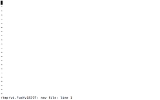
vi is a screen-oriented text editor
originally created for the Unix
operating system. The portable subset of the behavior of vi and programs based on it, and the ex
editor language supported within these programs, is described by (and thus standardized by) the Single Unix Specification
and POSIX
.
The original code for vi was written by Bill Joy
in 1976, as the visual mode for a line editor
called ex that Joy had written with Chuck Haley. Bill Joy's ex 1.1 was released as part of the first BSD
Unix
release in March, 1978. It was not until version 2.0 of ex, released as part of Second Berkeley Software Distribution in May, 1979 that the editor was installed under the name vi (which took users straight into ex's visual mode), and the name by which it is known today. Some current implementations of vi can trace their source code ancestry to Bill Joy; others are completely new, largely compatible reimplementations.
The name vi is derived from the shortest unambiguous abbreviation for the command visual in ex; the command in question switches the line editor
ex to visual
mode. The name vi is pronounced ˈ (as in the discrete English letters v and i), or, much less commonly, ˈ, but never "six" as in the Roman numeral VI.
In addition to various non-free software
implementations of vi distributed with proprietary implementations of Unix, several free and open source software
implementations of vi exist. A 2009 survey of Linux Journal
readers found that vi was the most widely used text editor among respondents, beating gedit
, the second most widely used editor by nearly a factor of two (36% to 19%).
, which was a line editor designed to work well on teletypes, rather than display terminals. Within AT&T
, where ed originated, people seemed to be happy with an editor as basic and unfriendly as ed, George Coulouris
recalls:
Coulouris considered the cryptic commands of ed to be only suitable for "immortals", and thus in February, 1976, he enhanced ed (using Ken Thompson's ed source as a starting point) to make em (the "editor for mortals") while acting as a lecturer at Queen Mary College
. The em editor was designed for display terminals and was a single-line-at-a-time visual editor. It was one of the first programs on Unix to make heavy use of "raw terminal input mode", in which the running program, rather than the terminal device driver, handled all keystrokes. When Coulouris visited UC Berkeley
in the summer of 1976, he brought a DECtape
containing em, and showed the editor to various people. Some people considered this new kind of editor to be a potential resource hog, but others, including Bill Joy
were impressed.
Inspired by em, and by their own tweaks to ed, Bill Joy
and Chuck Haley, both graduate students at UC Berkeley
, took code from em to make en, and then "extended" en to create ex version 0.1. After Haley's departure, Bruce Englar encouraged Joy to redesign the editor, which he did June through October 1977 adding a full-screen visual mode to ex.
Many of the ideas in ex's visual mode (a.k.a. vi) were taken from other software that existed at the time. According to Bill Joy, inspiration for vi's visual mode came from the Bravo
editor, which was a bimodal editor. In an interview about vi's origins, Joy said:
 Joy used a Lear Siegler ADM3A terminal. On this terminal, the Escape key was at the location now occupied by the Tab key on the widely-used IBM PC keyboard
(on the left side of the alphabetic part of the keyboard, one row above the middle row). This made it a convenient choice for switching vi modes. Also, the keys h,j,k,l served double duty as cursor movement keys and were inscribed with arrows, which is why vi uses them in that way. The ADM3A had no other cursor keys. Joy explained that the terse, single character commands and the ability to type ahead of the display were a result of the slow 300 baud modem he used when developing the software and that he wanted to be productive when the screen was painting slower than he could think.
. From that release of BSD Unix
onwards, the only editors that came with the Unix system were ed and ex. In a 1984 interview, Joy attributed much of the success of vi to the fact that it was bundled for free, whereas other editors, such as Emacs
could cost hundreds of dollars.
Eventually it was observed that most ex users were spending all their time in visual mode, and thus in ex 2.0 (released as part of Second Berkeley Software Distribution in May, 1979), Joy created vi as a hard link
to ex, such that when invoked as vi, ex would automatically start up in its visual mode. Thus, vi is not the evolution of ex, vi is ex.
Joy described ex 2.0 (vi) as a very large program, barely able to fit in the memory of a PDP-11/70, thus although vi may be regarded as a small, lightweight, program today, it was not seen that way early in its history. By version 3.1, shipped with 3BSD in December 1979, the full version of vi was no longer able to fit in the memory of a PDP-11.
Joy continued to be lead developer for vi until version 2.7 in June, 1979, and made occasional contributions to vi's development until at least version 3.5 in August, 1980. In discussing the origins of vi and why he discontinued development, Joy said:
In 1979, Mark Horton took on responsibility for vi. Horton added support for arrow and function keys, macros, and improved performance by replacing termcap with terminfo.
, and AT&T's UNIX System V
(January, 1983) adopting vi, changes to the vi codebase happened more slowly and in a more dispersed and mutually incompatible ways. At UC Berkeley, changes were made but the version number was never updated beyond 3.7. Commercial Unix vendors, such as Sun, HP, DEC, and IBM each received copies of the vi source, and their operating systems, Solaris, HP-UX, Tru64, and AIX, today continue to maintain versions of vi directly descended from the 3.7 release, but with added features, such as adjustable key mappings, encryption, and wide character support.
While commercial vendors could work with Bill Joy's codebase (and continue to use it today), many people could not. Because Joy had begun with Ken Thompson
's ed
editor, ex and vi were derivative works and could not be distributed except to people who had an AT&T source license. People looking for a free Unix-style editor would have to look elsewhere. By 1985, a version of Emacs
(MicroEMACS
) was available for a variety of platforms, but it was not until June, 1987 that Stevie (ST editor for VI enthusiasts), a limited vi clone appeared. In early January, 1990, Steve Kirkendall posted a new clone of vi, Elvis
, to the Usenet
newsgroup comp.os.minix, aiming for a more complete and more faithful clone of vi than Stevie. It quickly attracted considerable interest in a number of enthusiast communities. Andrew Tanenbaum
quickly asked the community to decide one of these two editors to be the vi clone in Minix
; Elvis was chosen, and remains the vi clone for Minix today.
In 1989 Lynne Jolitz and William Jolitz began porting BSD Unix to run on 386 class processors, but to create a free distribution they needed to avoid any AT&T-contaminated code, including Joy's vi. To fill the void left by removing vi, their 1992 386BSD
distribution adopted Elvis as its vi replacement. 386BSD's descendants, FreeBSD
and NetBSD
followed suit. But at UC Berkeley, Keith Bostic wanted a "bug for bug compatible" replacement for Joy's vi for BSD 4.4 Lite. Using Kirkendall's Elvis (version 1.8) as a starting point, Bostic created nvi
, releasing it in Spring of 1994. When FreeBSD and NetBSD resynchronized the 4.4-Lite2 codebase, they too switched over to Bostic's nvi, which they continue to use today.
Despite the existence of vi clones with enhanced featuresets, sometime before June, 2000, Gunnar Ritter ported Joy's vi codebase (taken from 2.11BSD, February, 1992) to modern Unix-based operating systems, such as Linux and FreeBSD. Initially, his work was technically illegal to distribute without an AT&T source license, but, in January, 2002, those licensing rules were relaxed, allowing legal distribution as an open-source project. Ritter continued to make small enhancements to the vi codebase similar to those done by commercial Unix vendors still using Joy's codebase, including changes required by the POSIX.2 standard for vi. His work is available as Traditional Vi, and runs today on a variety of systems.
But although Joy's vi was now once again available for BSD Unix, it arrived after the various BSD flavors had committed themselves to nvi, which provides a number of enhancements over traditional vi, and drops some of its legacy features (such as open mode for editing one line at a time). It is in some sense, a strange inversion that BSD Unix, where Joy's vi codebase began, no longer uses it, and the AT&T-derived Unixes, which in the early days lacked Joy's editor, are the ones that now use and maintain modified versions of his code.
standard Unix
editor and a nearly undisputed hacker favorite outside of MIT
until the rise of Emacs
after about 1984. The Single UNIX Specification
specifies vi, so every conforming system must have it.
vi is still widely used by users of the Unix family of operating systems. About half the respondents in a 1991 USENET
poll preferred vi. In 1999, Tim O'Reilly
, founder of the eponymous computer book publishing company, stated that his company sold more copies of its vi book than its emacs book.
editor: it operates in either insert mode (where typed text becomes part of the document) or normal mode (where keystrokes are interpreted as commands that control the edit session). For example, typing while in normal mode switches the editor to insert mode, but typing again at this point places an "i" character in the document. From insert mode, pressing the escape key switches the editor back to normal mode. A perceived advantage of vi's separation of text entry and command modes is that both text editing and command operations can be performed without requiring the removal of the user's hands from the home row. As non-modal editors usually have to reserve all keys with letters and symbols for the printing of characters, any special commands for actions other than adding text to the buffer must be assigned to keys which do not produce characters, such as function keys, or combinations of modifier keys such as , and with regular keys. Vi has the advantage that most ordinary keys are connected to some kind of command for positioning, altering text, searching and so forth, either singly or in key combinations. Many commands can be touch typed without the use of , or . Other types of editors generally require the user to move their hands from the home row when touch typing
:
For instance, replacing a word is replacement text which is a combination of two independent commands (change and word-motion) together with a transition into and out of insert mode. Text between the cursor position and the end of the word is overwritten by the replacement text. The operation can be repeated at some other location by typing , the effect being that the word starting that location will be replaced with the same replacement text.
Text editor
A text editor is a type of program used for editing plain text files.Text editors are often provided with operating systems or software development packages, and can be used to change configuration files and programming language source code....
originally created for the Unix
Unix
Unix is a multitasking, multi-user computer operating system originally developed in 1969 by a group of AT&T employees at Bell Labs, including Ken Thompson, Dennis Ritchie, Brian Kernighan, Douglas McIlroy, and Joe Ossanna...
operating system. The portable subset of the behavior of vi and programs based on it, and the ex
Ex (text editor)
ex, short for EXtended, is a line editor for Unix systems.The original ex was an advanced version of the standard Unix editor ed, included in the Berkeley Software Distribution...
editor language supported within these programs, is described by (and thus standardized by) the Single Unix Specification
Single UNIX Specification
The Single UNIX Specification is the collective name of a family of standards for computer operating systems to qualify for the name "Unix"...
and POSIX
POSIX
POSIX , an acronym for "Portable Operating System Interface", is a family of standards specified by the IEEE for maintaining compatibility between operating systems...
.
The original code for vi was written by Bill Joy
Bill Joy
William Nelson Joy , commonly known as Bill Joy, is an American computer scientist. Joy co-founded Sun Microsystems in 1982 along with Vinod Khosla, Scott McNealy and Andy Bechtolsheim, and served as chief scientist at the company until 2003...
in 1976, as the visual mode for a line editor
Line editor
A line editor is a text editor computer program that manipulates text primarily by the display, modification, and movement of lines. Line editors precede screen-based text editors and originated in an era when a computer operator typically interacted with a teleprinter , with no video display, and...
called ex that Joy had written with Chuck Haley. Bill Joy's ex 1.1 was released as part of the first BSD
Berkeley Software Distribution
Berkeley Software Distribution is a Unix operating system derivative developed and distributed by the Computer Systems Research Group of the University of California, Berkeley, from 1977 to 1995...
Unix
Unix
Unix is a multitasking, multi-user computer operating system originally developed in 1969 by a group of AT&T employees at Bell Labs, including Ken Thompson, Dennis Ritchie, Brian Kernighan, Douglas McIlroy, and Joe Ossanna...
release in March, 1978. It was not until version 2.0 of ex, released as part of Second Berkeley Software Distribution in May, 1979 that the editor was installed under the name vi (which took users straight into ex's visual mode), and the name by which it is known today. Some current implementations of vi can trace their source code ancestry to Bill Joy; others are completely new, largely compatible reimplementations.
The name vi is derived from the shortest unambiguous abbreviation for the command visual in ex; the command in question switches the line editor
Line editor
A line editor is a text editor computer program that manipulates text primarily by the display, modification, and movement of lines. Line editors precede screen-based text editors and originated in an era when a computer operator typically interacted with a teleprinter , with no video display, and...
ex to visual
Visual editor
Visual editors or full screen editors are editing programs which display the text being edited on the screen as it is being edited, as opposed to line-oriented editors ....
mode. The name vi is pronounced ˈ (as in the discrete English letters v and i), or, much less commonly, ˈ, but never "six" as in the Roman numeral VI.
In addition to various non-free software
Free software
Free software, software libre or libre software is software that can be used, studied, and modified without restriction, and which can be copied and redistributed in modified or unmodified form either without restriction, or with restrictions that only ensure that further recipients can also do...
implementations of vi distributed with proprietary implementations of Unix, several free and open source software
Free and open source software
Free and open-source software or free/libre/open-source software is software that is liberally licensed to grant users the right to use, study, change, and improve its design through the availability of its source code...
implementations of vi exist. A 2009 survey of Linux Journal
Linux Journal
Linux Journal is a monthly technology magazine published by Belltown Media, Inc. of Houston, Texas. The magazine focuses specifically on Linux, allowing the content to be a highly specialized source of information for open source enthusiasts.-History:...
readers found that vi was the most widely used text editor among respondents, beating gedit
Gedit
gedit is a text editor for the GNOME desktop environment, Mac OS X and Microsoft Windows. Designed as a general purpose text editor, gedit emphasizes simplicity and ease of use...
, the second most widely used editor by nearly a factor of two (36% to 19%).
Creation
vi was derived from a sequence of UNIX command line editors, starting with edEd (text editor)
ed is a line editor for the Unix operating system. It was one of the first end-user programs hosted on the system and has been standard in Unix-based systems ever since. ed was originally written in PDP-11/20 assembler by Ken Thompson in 1971...
, which was a line editor designed to work well on teletypes, rather than display terminals. Within AT&T
AT&T
AT&T Inc. is an American multinational telecommunications corporation headquartered in Whitacre Tower, Dallas, Texas, United States. It is the largest provider of mobile telephony and fixed telephony in the United States, and is also a provider of broadband and subscription television services...
, where ed originated, people seemed to be happy with an editor as basic and unfriendly as ed, George Coulouris
George Coulouris (computer scientist)
George Coulouris is a British computer scientist and the son of actor George Coulouris. He is an emeritus professor of Queen Mary, University of London and is currently Visiting Professor in Residence at University of Cambridge Computer Laboratory and co-author of a...
recalls:
[...] for many years, they had no suitable terminals. They carried on with TTYs and other printing terminals for a long time, and when they did buy screens for everyone, they got Tektronix 4014Tektronix 4014The Tektronix 4000 series was a family of text and graphics computer terminals based on the company's storage tube technology. No additional electronics were needed to maintain the display, so the 4000 series were less expensive than earlier graphics terminals and became widely used in the CAD...
s. These were large storage tubeDVBSTDirect-View Bistable Storage Tubes was an acronym used by Tektronix to describe their line of storage tubes. These were cathode ray tubes that stored information written to them using an analog technique inherent in the CRT and based upon the secondary emission of electrons from the phosphor...
displays. You can't run a screen editor on a storage-tube display as the picture can't be updated. Thus it had to fall to someone else to pioneer screen editing for Unix, and that was us initially, and we continued to do so for many years.
Coulouris considered the cryptic commands of ed to be only suitable for "immortals", and thus in February, 1976, he enhanced ed (using Ken Thompson's ed source as a starting point) to make em (the "editor for mortals") while acting as a lecturer at Queen Mary College
Queen Mary, University of London
Queen Mary, University of London is a public research university located in London, United Kingdom and a constituent college of the federal University of London...
. The em editor was designed for display terminals and was a single-line-at-a-time visual editor. It was one of the first programs on Unix to make heavy use of "raw terminal input mode", in which the running program, rather than the terminal device driver, handled all keystrokes. When Coulouris visited UC Berkeley
University of California, Berkeley
The University of California, Berkeley , is a teaching and research university established in 1868 and located in Berkeley, California, USA...
in the summer of 1976, he brought a DECtape
DECtape
DECtape, originally called "Microtape", was a magnetic tape data storage medium used with many Digital Equipment Corporation computers, including the PDP-6, PDP-8, LINC-8, PDP-10, PDP-11, PDP-12, and the PDP-15. On DEC's 32-bit systems, VAX/VMS support for it was implemented but did not become an...
containing em, and showed the editor to various people. Some people considered this new kind of editor to be a potential resource hog, but others, including Bill Joy
Bill Joy
William Nelson Joy , commonly known as Bill Joy, is an American computer scientist. Joy co-founded Sun Microsystems in 1982 along with Vinod Khosla, Scott McNealy and Andy Bechtolsheim, and served as chief scientist at the company until 2003...
were impressed.
Inspired by em, and by their own tweaks to ed, Bill Joy
Bill Joy
William Nelson Joy , commonly known as Bill Joy, is an American computer scientist. Joy co-founded Sun Microsystems in 1982 along with Vinod Khosla, Scott McNealy and Andy Bechtolsheim, and served as chief scientist at the company until 2003...
and Chuck Haley, both graduate students at UC Berkeley
University of California, Berkeley
The University of California, Berkeley , is a teaching and research university established in 1868 and located in Berkeley, California, USA...
, took code from em to make en, and then "extended" en to create ex version 0.1. After Haley's departure, Bruce Englar encouraged Joy to redesign the editor, which he did June through October 1977 adding a full-screen visual mode to ex.
Many of the ideas in ex's visual mode (a.k.a. vi) were taken from other software that existed at the time. According to Bill Joy, inspiration for vi's visual mode came from the Bravo
Bravo (software)
Bravo was the first WYSIWYG document preparation program. It provided multi-font capability using the bitmap displays on the Xerox Alto personal computer...
editor, which was a bimodal editor. In an interview about vi's origins, Joy said:
A lot of the ideas for the screen editing mode were stolen from a Bravo manual I surreptitiously looked at and copied. Dot is really the double-escape from Bravo, the redo command. Most of the stuff was stolen. There were some things stolen from edEd (text editor)ed is a line editor for the Unix operating system. It was one of the first end-user programs hosted on the system and has been standard in Unix-based systems ever since. ed was originally written in PDP-11/20 assembler by Ken Thompson in 1971...
—we got a manual page for the Toronto version of ed, which I think Rob Pike had something to do with. We took some of the regular expression extensions out of that.
IBM PC keyboard
The keyboards for IBM PC compatible computers are standardized. However, during the 3-plus decades of PC architecture being constantly updated, multiple types of keyboard layout variations have been developed....
(on the left side of the alphabetic part of the keyboard, one row above the middle row). This made it a convenient choice for switching vi modes. Also, the keys h,j,k,l served double duty as cursor movement keys and were inscribed with arrows, which is why vi uses them in that way. The ADM3A had no other cursor keys. Joy explained that the terse, single character commands and the ability to type ahead of the display were a result of the slow 300 baud modem he used when developing the software and that he wanted to be productive when the screen was painting slower than he could think.
Distribution
Joy was responsible for creating the first BSD Unix release in March, 1978, and included ex 1.1 (dated February 1, 1978) in the distribution, thereby exposing his editor to an audience beyond UC BerkeleyUniversity of California, Berkeley
The University of California, Berkeley , is a teaching and research university established in 1868 and located in Berkeley, California, USA...
. From that release of BSD Unix
Berkeley Software Distribution
Berkeley Software Distribution is a Unix operating system derivative developed and distributed by the Computer Systems Research Group of the University of California, Berkeley, from 1977 to 1995...
onwards, the only editors that came with the Unix system were ed and ex. In a 1984 interview, Joy attributed much of the success of vi to the fact that it was bundled for free, whereas other editors, such as Emacs
Emacs
Emacs is a class of text editors, usually characterized by their extensibility. GNU Emacs has over 1,000 commands. It also allows the user to combine these commands into macros to automate work.Development began in the mid-1970s and continues actively...
could cost hundreds of dollars.
Eventually it was observed that most ex users were spending all their time in visual mode, and thus in ex 2.0 (released as part of Second Berkeley Software Distribution in May, 1979), Joy created vi as a hard link
Hard link
In computing, a hard link is a directory entry that associates a name with a file on a file system. . The term is used in file systems which allow multiple hard links to be created for the same file. This has the effect of creating multiple names for the same file, causing an aliasing effect: e.g...
to ex, such that when invoked as vi, ex would automatically start up in its visual mode. Thus, vi is not the evolution of ex, vi is ex.
Joy described ex 2.0 (vi) as a very large program, barely able to fit in the memory of a PDP-11/70, thus although vi may be regarded as a small, lightweight, program today, it was not seen that way early in its history. By version 3.1, shipped with 3BSD in December 1979, the full version of vi was no longer able to fit in the memory of a PDP-11.
Joy continued to be lead developer for vi until version 2.7 in June, 1979, and made occasional contributions to vi's development until at least version 3.5 in August, 1980. In discussing the origins of vi and why he discontinued development, Joy said:
I wish we hadn't used all the keys on the keyboard. I think one of the interesting things is that vi is really a mode-based editor. I think as mode-based editors go, it's pretty good. One of the good things about EMACSEmacsEmacs is a class of text editors, usually characterized by their extensibility. GNU Emacs has over 1,000 commands. It also allows the user to combine these commands into macros to automate work.Development began in the mid-1970s and continues actively...
, though, is its programmability and the modelessness. Those are two ideas which never occurred to me. I also wasn't very good at optimizing code when I wrote vi. I think the redisplay module of the editor is almost intractable. It does a really good job for what it does, but when you're writing programs as you're learning... That's why I stopped working on it.
What actually happened was that I was in the process of adding multiwindows to vi when we installed our VAX, which would have been in December of '78. We didn't have any backups and the tape drive broke. I continued to work even without being able to do backups. And then the source code got scrunched and I didn't have a complete listing. I had almost rewritten all of the display code for windows, and that was when I gave up. After that, I went back to the previous version and just documented the code, finished the manual and closed it off. If that scrunch had not happened, vi would have multiple windows, and I might have put in some programmability—but I don't know.
The fundamental problem with vi is that it doesn't have a mouse and therefore you've got all these commands. In some sense, its backwards from the kind of thing you'd get from a mouse-oriented thing. I think multiple levels of undo would be wonderful, too. But fundamentally, vi is still ed inside. You can't really fool it.
Its like one of those pinatas—things that have candy inside but has layer after layer of paper mache on top. It doesn't really have a unified concept. I think if I were going to go back—I wouldn't go back, but start over again.
In 1979, Mark Horton took on responsibility for vi. Horton added support for arrow and function keys, macros, and improved performance by replacing termcap with terminfo.
Ports and clones
Up to version 3.7 of vi, created in October, 1981, UC Berkeley was the development home for vi, but with Bill Joy's departure in early 1982, to join Sun MicrosystemsSun Microsystems
Sun Microsystems, Inc. was a company that sold :computers, computer components, :computer software, and :information technology services. Sun was founded on February 24, 1982...
, and AT&T's UNIX System V
UNIX System V
Unix System V, commonly abbreviated SysV , is one of the first commercial versions of the Unix operating system. It was originally developed by American Telephone & Telegraph and first released in 1983. Four major versions of System V were released, termed Releases 1, 2, 3 and 4...
(January, 1983) adopting vi, changes to the vi codebase happened more slowly and in a more dispersed and mutually incompatible ways. At UC Berkeley, changes were made but the version number was never updated beyond 3.7. Commercial Unix vendors, such as Sun, HP, DEC, and IBM each received copies of the vi source, and their operating systems, Solaris, HP-UX, Tru64, and AIX, today continue to maintain versions of vi directly descended from the 3.7 release, but with added features, such as adjustable key mappings, encryption, and wide character support.
While commercial vendors could work with Bill Joy's codebase (and continue to use it today), many people could not. Because Joy had begun with Ken Thompson
Ken Thompson
Kenneth Lane Thompson , commonly referred to as ken in hacker circles, is an American pioneer of computer science...
's ed
Ed (text editor)
ed is a line editor for the Unix operating system. It was one of the first end-user programs hosted on the system and has been standard in Unix-based systems ever since. ed was originally written in PDP-11/20 assembler by Ken Thompson in 1971...
editor, ex and vi were derivative works and could not be distributed except to people who had an AT&T source license. People looking for a free Unix-style editor would have to look elsewhere. By 1985, a version of Emacs
Emacs
Emacs is a class of text editors, usually characterized by their extensibility. GNU Emacs has over 1,000 commands. It also allows the user to combine these commands into macros to automate work.Development began in the mid-1970s and continues actively...
(MicroEMACS
MicroEMACS
MicroEMACS is a small, portable Emacs-like text editor originally written by Dave Conroy in 1985, and further developed and maintained by Daniel M. Lawrence...
) was available for a variety of platforms, but it was not until June, 1987 that Stevie (ST editor for VI enthusiasts), a limited vi clone appeared. In early January, 1990, Steve Kirkendall posted a new clone of vi, Elvis
Elvis (text editor)
Elvis is a powerful vi/ex clone, i.e. it resembles the Unix text editor "vi" very much but adds quite a few commands and features. Elvis is written by Steve Kirkendall and is distributed under the Clarified Artistic License which is used by Perl....
, to the Usenet
Usenet
Usenet is a worldwide distributed Internet discussion system. It developed from the general purpose UUCP architecture of the same name.Duke University graduate students Tom Truscott and Jim Ellis conceived the idea in 1979 and it was established in 1980...
newsgroup comp.os.minix, aiming for a more complete and more faithful clone of vi than Stevie. It quickly attracted considerable interest in a number of enthusiast communities. Andrew Tanenbaum
Andrew S. Tanenbaum
Andrew Stuart "Andy" Tanenbaum is a professor of computer science at the Vrije Universiteit, Amsterdam in the Netherlands. He is best known as the author of MINIX, a free Unix-like operating system for teaching purposes, and for his computer science textbooks, regarded as standard texts in the...
quickly asked the community to decide one of these two editors to be the vi clone in Minix
Minix
MINIX is a Unix-like computer operating system based on a microkernel architecture created by Andrew S. Tanenbaum for educational purposes; MINIX also inspired the creation of the Linux kernel....
; Elvis was chosen, and remains the vi clone for Minix today.
In 1989 Lynne Jolitz and William Jolitz began porting BSD Unix to run on 386 class processors, but to create a free distribution they needed to avoid any AT&T-contaminated code, including Joy's vi. To fill the void left by removing vi, their 1992 386BSD
386BSD
386BSD, sometimes called "Jolix", was a free Unix-like operating system based on BSD, first released in 1992. It ran on PC compatible computer systems based on the Intel 80386 microprocessor...
distribution adopted Elvis as its vi replacement. 386BSD's descendants, FreeBSD
FreeBSD
FreeBSD is a free Unix-like operating system descended from AT&T UNIX via BSD UNIX. Although for legal reasons FreeBSD cannot be called “UNIX”, as the direct descendant of BSD UNIX , FreeBSD’s internals and system APIs are UNIX-compliant...
and NetBSD
NetBSD
NetBSD is a freely available open source version of the Berkeley Software Distribution Unix operating system. It was the second open source BSD descendant to be formally released, after 386BSD, and continues to be actively developed. The NetBSD project is primarily focused on high quality design,...
followed suit. But at UC Berkeley, Keith Bostic wanted a "bug for bug compatible" replacement for Joy's vi for BSD 4.4 Lite. Using Kirkendall's Elvis (version 1.8) as a starting point, Bostic created nvi
Nvi
nvi is a re-implementation of the classic Berkeley text editor, ex/vi, traditionally distributed with BSD, and later, Unix systems. It was originally distributed as part of the Fourth Berkeley Software Distribution ....
, releasing it in Spring of 1994. When FreeBSD and NetBSD resynchronized the 4.4-Lite2 codebase, they too switched over to Bostic's nvi, which they continue to use today.
Despite the existence of vi clones with enhanced featuresets, sometime before June, 2000, Gunnar Ritter ported Joy's vi codebase (taken from 2.11BSD, February, 1992) to modern Unix-based operating systems, such as Linux and FreeBSD. Initially, his work was technically illegal to distribute without an AT&T source license, but, in January, 2002, those licensing rules were relaxed, allowing legal distribution as an open-source project. Ritter continued to make small enhancements to the vi codebase similar to those done by commercial Unix vendors still using Joy's codebase, including changes required by the POSIX.2 standard for vi. His work is available as Traditional Vi, and runs today on a variety of systems.
But although Joy's vi was now once again available for BSD Unix, it arrived after the various BSD flavors had committed themselves to nvi, which provides a number of enhancements over traditional vi, and drops some of its legacy features (such as open mode for editing one line at a time). It is in some sense, a strange inversion that BSD Unix, where Joy's vi codebase began, no longer uses it, and the AT&T-derived Unixes, which in the early days lacked Joy's editor, are the ones that now use and maintain modified versions of his code.
Impact
Over the years since its creation, vi became the de factoDe facto
De facto is a Latin expression that means "concerning fact." In law, it often means "in practice but not necessarily ordained by law" or "in practice or actuality, but not officially established." It is commonly used in contrast to de jure when referring to matters of law, governance, or...
standard Unix
Unix
Unix is a multitasking, multi-user computer operating system originally developed in 1969 by a group of AT&T employees at Bell Labs, including Ken Thompson, Dennis Ritchie, Brian Kernighan, Douglas McIlroy, and Joe Ossanna...
editor and a nearly undisputed hacker favorite outside of MIT
Massachusetts Institute of Technology
The Massachusetts Institute of Technology is a private research university located in Cambridge, Massachusetts. MIT has five schools and one college, containing a total of 32 academic departments, with a strong emphasis on scientific and technological education and research.Founded in 1861 in...
until the rise of Emacs
Emacs
Emacs is a class of text editors, usually characterized by their extensibility. GNU Emacs has over 1,000 commands. It also allows the user to combine these commands into macros to automate work.Development began in the mid-1970s and continues actively...
after about 1984. The Single UNIX Specification
Single UNIX Specification
The Single UNIX Specification is the collective name of a family of standards for computer operating systems to qualify for the name "Unix"...
specifies vi, so every conforming system must have it.
vi is still widely used by users of the Unix family of operating systems. About half the respondents in a 1991 USENET
Usenet
Usenet is a worldwide distributed Internet discussion system. It developed from the general purpose UUCP architecture of the same name.Duke University graduate students Tom Truscott and Jim Ellis conceived the idea in 1979 and it was established in 1980...
poll preferred vi. In 1999, Tim O'Reilly
Tim O'Reilly
Tim O'Reilly is the founder of O'Reilly Media and a supporter of the free software and open source movements.-Life and career:...
, founder of the eponymous computer book publishing company, stated that his company sold more copies of its vi book than its emacs book.
Interface
vi is a modalMode (computer interface)
In user interface design, a mode is a distinct setting within a computer program or any physical machine interface, in which the same user input will produce perceived different results than it would in other settings....
editor: it operates in either insert mode (where typed text becomes part of the document) or normal mode (where keystrokes are interpreted as commands that control the edit session). For example, typing while in normal mode switches the editor to insert mode, but typing again at this point places an "i" character in the document. From insert mode, pressing the escape key switches the editor back to normal mode. A perceived advantage of vi's separation of text entry and command modes is that both text editing and command operations can be performed without requiring the removal of the user's hands from the home row. As non-modal editors usually have to reserve all keys with letters and symbols for the printing of characters, any special commands for actions other than adding text to the buffer must be assigned to keys which do not produce characters, such as function keys, or combinations of modifier keys such as , and with regular keys. Vi has the advantage that most ordinary keys are connected to some kind of command for positioning, altering text, searching and so forth, either singly or in key combinations. Many commands can be touch typed without the use of , or . Other types of editors generally require the user to move their hands from the home row when touch typing
Touch typing
Touch typing is typing without using the sense of sight to find the keys. Specifically, a touch typist will know their location on the keyboard through muscle memory. Touch typing typically involves placing the eight fingers in a horizontal row along the middle of the keyboard and having them...
:
- To use a mouse to select text, commands, or menu items in a GUIGuiGui or guee is a generic term to refer to grilled dishes in Korean cuisine. These most commonly have meat or fish as their primary ingredient, but may in some cases also comprise grilled vegetables or other vegetarian ingredients. The term derives from the verb, "gupda" in Korean, which literally...
editor. - To the arrow keys or editing functions (Home / End or Function Keys).
- To invoke commands using modifier keysKeyboard (computing)In computing, a keyboard is a typewriter-style keyboard, which uses an arrangement of buttons or keys, to act as mechanical levers or electronic switches...
in conjunction with the standard typewriter keys.
For instance, replacing a word is replacement text which is a combination of two independent commands (change and word-motion) together with a transition into and out of insert mode. Text between the cursor position and the end of the word is overwritten by the replacement text. The operation can be repeated at some other location by typing , the effect being that the word starting that location will be replaced with the same replacement text.
Contemporary derivatives and clones
- Traditional Vi is a port of the original vi to modern Unix systems by Gunnar Ritter. Minor enhancements include 8-bit input, support for multi-byte character encodings like UTF-8, and features demanded by POSIX.2. It contains few additions beyond these, so it is of interest for those who look for a small but well-defined vi implementation close to that of most commercial Unix systems. It also has some features to cope with primitive terminals or slow connections. It is available as part of the FreeBSD ports collection, MacPorts, and an RPM is available for Linux from the OpenPKG project. Ritter makes the following claims for Traditional Vi:
Compared to most of its many clones, the original vi is
a rather small program (~120 KB code on i386) just with its extremely
powerful editing interface, but lacking fancy features like multiple
undo, multiple screens or syntax highlighting. In other words, it is a
typical Unix program that does exactly what it should and nothing more.
- VimVim (text editor)Vim is a text editor written by Bram Moolenaar and first released publicly in 1991. Based on the vi editor common to Unix-like systems, Vim is designed for use both from a command line interface and as a standalone application in a graphical user interface...
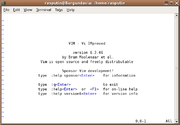
"Vi IMproved" has yet more features than vi, including (scriptable) syntax highlightingSyntax highlightingSyntax highlighting is a feature of some text editors that display text—especially source code—in different colors and fonts according to the category of terms. This feature eases writing in a structured language such as a programming language or a markup language as both structures and...
, mouse support, graphical versions, visual mode, many new editing commands and a large amount of extension in the area of ex commands. Vim is included with almost every Linux distribution (and is also shipped with every copy of Apple Mac OS XMac OS XMac OS X is a series of Unix-based operating systems and graphical user interfaces developed, marketed, and sold by Apple Inc. Since 2002, has been included with all new Macintosh computer systems...
). Vim also has a vi compatibility mode, in which Vim is more compatible with vi than it would be otherwise, although some vi features, such as open mode, are missing in Vim, even in compatibility mode. This mode is controlled by the:set compatibleoption. This mode is automatically turned on by Vim when it is started in a situation which looks as if the software might be expected to be vi compatible. Vim then changes some of its behaviors such that they are compatible with the vi standard. Vim features which do not conflict with vi compatibility are always available, regardless of the setting. - ElvisElvis (text editor)Elvis is a powerful vi/ex clone, i.e. it resembles the Unix text editor "vi" very much but adds quite a few commands and features. Elvis is written by Steve Kirkendall and is distributed under the Clarified Artistic License which is used by Perl....
is a free vi clone for Unix and other operating systems written by Steve Kirkendall. Elvis introduced a number of features now present in other vi clones, including allowing the cursor keys to work in input mode. It was the first to provide color syntax highlighting (and to generalize syntax highlighting to multiple filetypes). Elvis 1.x was used as the starting point for nviNvinvi is a re-implementation of the classic Berkeley text editor, ex/vi, traditionally distributed with BSD, and later, Unix systems. It was originally distributed as part of the Fourth Berkeley Software Distribution ....
, but Elvis 2.0 added numerous features, including multiple buffers, windows, display modes, and file access schemes. Elvis is the standard version of vi shipped on Slackware Linux, Kate OSKate OSKateOS is a Linux distribution originally based on Slackware. It is designed for intermediate users. Its package management system uses so called TGZex packages, which unlike Slackware packages support dependency tracking , internationalized descriptions, and are much easier to update...
and MINIXMinixMINIX is a Unix-like computer operating system based on a microkernel architecture created by Andrew S. Tanenbaum for educational purposes; MINIX also inspired the creation of the Linux kernel....
. The most recent version of Elvis is 2.2, released in October 2003. - nviNvinvi is a re-implementation of the classic Berkeley text editor, ex/vi, traditionally distributed with BSD, and later, Unix systems. It was originally distributed as part of the Fourth Berkeley Software Distribution ....
is an implementation of the ex/vi text editor originally distributed as part of the final official Berkeley Software Distribution (4.4 BSD-Lite). This is the version of vi that is shipped with all BSD-based open source distributions. It adds command history and editing, filename completions, multiple edit buffers, multi-windowing (including multiple windows on the same edit buffer). Beyond 1.79, from October, 1996, which is the recommended stable version, there have been "development releases" of nvi, the most recent of which is 1.81.6, from November, 2007. - vile was initially derived from an early version of MicroemacsMicroEMACSMicroEMACS is a small, portable Emacs-like text editor originally written by Dave Conroy in 1985, and further developed and maintained by Daniel M. Lawrence...
in an attempt to bring the EmacsEmacsEmacs is a class of text editors, usually characterized by their extensibility. GNU Emacs has over 1,000 commands. It also allows the user to combine these commands into macros to automate work.Development began in the mid-1970s and continues actively...
multi-window/multi-buffer editing paradigm to vi users. - BusyBoxBusyBoxBusyBox provides several stripped-down Unix tools in a single executable. It runs in a variety of POSIX environments such as Linux, Android, FreeBSD and others, such as proprietary kernels, although many of the tools it provides are designed to work with interfaces provided by the Linux kernel. It...
, a set of standard Linux utilities in a single executable, includes a tiny vi clone.
See also
- List of text editors
- Comparison of text editorsComparison of text editorsThis article provides basic comparisons for common text editors. More feature details for text editors are available from the Category of text editor features and from the individual products' articles...
- visudo
- List of Unix programs