


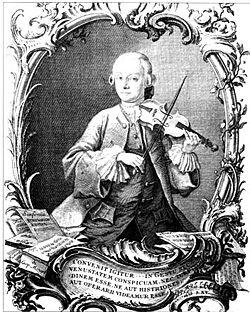
Versuch einer gründlichen Violinschule

Encyclopedia
Violin
The violin is a string instrument, usually with four strings tuned in perfect fifths. It is the smallest, highest-pitched member of the violin family of string instruments, which includes the viola and cello....
, published by Leopold Mozart
Leopold Mozart
Johann Georg Leopold Mozart was a German composer, conductor, teacher, and violinist. Mozart is best known today as the father and teacher of Wolfgang Amadeus Mozart, and for his violin textbook Versuch einer gründlichen Violinschule.-Childhood and student years:He was born in Augsburg, son of...
in 1756. The work was influential in its day, and continues to serve as a scholarly source concerning 18th century performance practice
Historically informed performance
Historically informed performance is an approach in the performance of music and theater. Within this approach, the performance adheres to state-of-the-art knowledge of the aesthetic criteria of the period in which the music or theatre work was conceived...
.
Background and publication
Leopold Mozart's primary job was as a court musician, working for the Prince-Archbishop of Salzburg. He began with an unpaid post in the violin section and gradually worked his way up the ranks in the court musical establishment, though he never was promoted to the top position of KapellmeisterKapellmeister
Kapellmeister is a German word designating a person in charge of music-making. The word is a compound, consisting of the roots Kapelle and Meister . The words Kapelle and Meister derive from the Latin: capella and magister...
. Salaries at Salzburg were low, and Leopold supplemented his income by giving violin lessons. There is indirect evidence that Leopold was a highly skilled teacher, in that both of his children, taught exclusively by him, became extraordinary musicians: Maria Anna Mozart
Maria Anna Mozart
Maria Anna Walburga Ignatia Mozart , nicknamed "Nannerl", was a musician, the older sister of Wolfgang Amadeus Mozart and daughter of Leopold and Anna Maria Mozart.-Childhood:...
(called "Nannerl") and Wolfgang Amadeus Mozart
Wolfgang Amadeus Mozart
Wolfgang Amadeus Mozart , baptismal name Johannes Chrysostomus Wolfgangus Theophilus Mozart , was a prolific and influential composer of the Classical era. He composed over 600 works, many acknowledged as pinnacles of symphonic, concertante, chamber, piano, operatic, and choral music...
.
Leopold wrote his textbook during the year 1755, when he was 36 years old. He took on the work of publication himself, assigning the task of printing to Johann Jakob Lotter, a printer in Leopold's home town of Augsburg
Augsburg
Augsburg is a city in the south-west of Bavaria, Germany. It is a university town and home of the Regierungsbezirk Schwaben and the Bezirk Schwaben. Augsburg is an urban district and home to the institutions of the Landkreis Augsburg. It is, as of 2008, the third-largest city in Bavaria with a...
. Leopold shipped copies of his book far and wide and received his share of the profits when they were sold. His mode of business can be seen in a letter (7 January 1770) he wrote to his wife Anna Maria
Anna Maria Mozart
Anna Maria Walburga Mozart was the mother of Wolfgang Amadeus Mozart and Maria Anna Mozart.-Biography:...
, who had to take over the operation while Leopold and Wolfgang were traveling in Italy:
- Put together 12 copies of the Violinschule, and send them to Joseph Wolf's bookshop, in Insprugg ... You need to enclose a short letter, something like this: You receive here 12 copies of the Violinschule, which my husband, from Verona, has told me to send you. You may keep them on commission, according to the arrangement, and sell each one at 2fl[orins] 14kr[eutzer] tyroleanCounty of TyrolThe County of Tyrol, Princely County from 1504, was a State of the Holy Roman Empire, from 1814 a province of the Austrian Empire and from 1867 a Cisleithanian crown land of Austria-Hungary...
coinage, and reimburse my husband at 1 fl. 45 kr. in the same coinage for the ones sold; you may put this in the paper and charge the costs to my husband in this case.
The Violinschule was successful in its day and went through two further German editions (1769, 1787), as well as being translated into Dutch (1766) and French (1770).
The work
Ruth Halliwell reviews the core of the work thus: "At the level of practical comments on improving aspects of violin technique, Leopold showed himself to be full of common sense, and to be capable of expressing his explanations in robust and clear language ... The work, together with [Leopold's] correspondence about it [with printer Lotter], shows that Leopold knew exactly what he wanted to do, that he had strong opinions on how pupils should be taught to play the violin, that he had thought out how to present his material in the clearest possible way, that he wanted even impoverished pupils to be able to afford his book, and that he was prepared to put in all the necessary work to get the details just right."Halliwell goes on to note Leopold's view that mere technical instruction would not produce fine violinists. For instance, concerning a particular aspect of bowing, Leopold insisted "that the performer pay attention to the Affekt
Doctrine of the affections
The doctrine of the affections, also known as the doctrine of affects, doctrine of the passions, theory of the affects, or by the German term Affektenlehre was a theory in musical aesthetics popular in the Baroque era...
(approximately, emotion) intended by the composer, so that the most appropriate bowing could be chosen. Leopold envisaged that the performer should be capable of studying a piece for clues about the intended Affekt... One element [necessary to this] was an education broad enough to encompass the study of literature and especially poetry, for a cantabile
Cantabile
Cantabile is a musical term meaning literally "singable" or "songlike" . It has several meanings in different contexts. In instrumental music, it indicates a particular style of playing designed to imitate the human voice. For 18th century composers, the term is often used synonymously with...
style should be the aim of every instrumentalist, and poetry was the key to good phrasing in music."
(Leopold Mozart was himself highly cultivated, with strong interests in poetry and many other areas.)