

Vere Gordon Childe

Encyclopedia
Vere Gordon Childe better known as V. Gordon Childe, was an Australian
archaeologist
and philologist who specialised in the study of European prehistory. A vocal socialist
, Childe accepted the socio-economic theory of Marxism
and was an early proponent of Marxist archaeology
. Childe worked for most of his life as an academic in the United Kingdom, initially at the University of Edinburgh
, and later at the Institute of Archaeology
, London. He also wrote a number of groundbreaking books on the subject of archaeology and prehistory, most notably Man Makes Himself (1936) and What Happened in History (1942).
Born in Sydney
, New South Wales
into a middle class family of English descent, Childe studied at the University of Sydney
before moving to England where he studied at the University of Oxford
. Upon returning to Australia he was prevented from working in academia because of his political views and so took up employment working for the Australian Labor Party
before he once more returned to England, settling down in London. Here he proceeded through a variety of jobs, all the time continuing his research into European prehistory by making various journeys across the continent, and eventually publishing his findings in academic papers and books.
From 1927 through to 1946 he was employed as the Abercromby Professor of Archaeology at the University of Edinburgh, and at that time was responsible for the excavation of the unique Neolithic
settlement of Skara Brae
and the chambered tomb of Maeshowe
, both in Orkney, northern Scotland. Becoming a co-founder and president of the Prehistoric Society, it was also at this time that he came to embrace Marxism and became a noted sympathiser with the Soviet Union, particularly during the Second World War. In 1947 he was offered the post of director at the Institute of Archaeology, something that he took up until 1957, when he retired. That year he committed suicide by jumping off of a cliff in the Australian Blue Mountains near to where he was born.
He has been described as being "the most eminent and influential scholar of European prehistory in the twentieth century". He was noted for synthesizing archaeological data from a variety of sources, thereby developing an understanding of wider European prehistory as a whole. Childe is also remembered for his emphasis on revolutionary developments on human society, such as the Neolithic Revolution
and the Urban Revolution
, in this manner being influenced by Marxist ideas of societal development.
, New South Wales
. He was the only surviving child of the Reverend Stephen Henry and Harriet Eliza Childe, a middle class couple of English descent. Stephen Childe (1807–1923) had been the son of William Childe, a stern English priest and teacher, and had followed in his father's footsteps by being ordained into the Church of England
in 1867 after gaining a BA from the University of Cambridge
. In 1871 he had married a woman named Mary Ellen Latchford, with whom he would have five children, and he went on to earn employment working as a teacher at various schools across Britain. Deciding to emigrate, the couple and their children moved to Australia's New South Wales in 1878, but it was here that Mary died after a few years, and so in 1886 Stephen remarried, this time to Harriet Eliza Gordon (1853–1910), an Englishwoman from a wealthy background who had moved to Australia when still a child. Harriet gave birth to Vere Gordon Childe in 1892, and he was raised along with his five older half-siblings at his father's palatial country house, the Chalet Fontenelle, which was located at Wentworth Falls
in the Blue Mountains west of Sydney. In Australia, the Reverend Childe worked as the minister for St. Thomas' Parish, but proved unpopular, getting into many arguments with other members of the community and often taking unscheduled holidays into the countryside when he was supposed to be overseeing religious services.
Being a sickly child, Gordon Childe was home schooled for a number of years, before being sent to gain an education at a private school in North Sydney
. In 1907, he began attending the Sydney Church of England Grammar School
, where he gained his Junior Matriculation in 1909, and then his Senior Matriculation the following year. At the school he studied ancient history, French, Greek, Latin, geometry, algebra and trigonometry, achieving good marks in all subjects, but was bullied because of his strange appearance and unathletic body. In July 1910 his mother, Harriet Childe, died, and his father took a woman named Monica Gardiner to be his third wife soon after. Gordon Childe's relationship with his father was strained, particularly following his mother's death, and they disagreed heavily on the subject of religion and politics, with the Reverend being a devout Christian and a conservative
whilst Gordon Childe was an atheist
and a socialist
.
at the University of Sydney
in 1911, where although he focused on the study of written sources, he first came across classical archaeology
through the works of prominent archaeologists like Heinrich Schliemann
and Sir Arthur Evans. At the University, he became an active member of the Debating Society, at one point arguing in favour of the proposition that "socialism is desirable". He had become increasingly interested in socialism and Marxism
, reading the works of the prominent Marxist theoreticians Karl Marx
and Friedrich Engels
, as well as the works of philosopher G.W.F. Hegel
, whose ideas on dialectical materialism
had been hugely influential on Marxist theory. Ending his studies in 1913, Childe graduated the following year with various honours and prizes, including Professor Francis Anderson
's prize for Philosophy.
Wishing to continue his education, he gained £200 from the Cooper Graduate Scholarship in Classics, allowing him to afford the tuition fees at Queen's College
, a part of the University of Oxford
, England. He set sail for Britain in August 1914, shortly after the outbreak of World War I
in which Britain, then allied with France and Russia, went to war with Germany, Austria-Hungary and the Ottoman Empire. At Queen's, Childe was entered for a diploma in classical archaeology followed by a Bachelor of Literature degree, but did not complete the requirements for the former. It was here that he studied under such archaeologists as John Beazley
and Arthur Evans
, the latter of whom acted as his supervisor. In 1915, he published his first academic paper, 'On the Date and Origin of Minyan Ware', which appeared in the Journal of Hellenic Studies
, and the following year produced his B.Litt. thesis, 'The Influence of Indo-Europeans in Prehistoric Greece', which displayed his interest in combining philological and archaeological evidence.
At Oxford he became actively involved with the local socialist movement, something which antagonised the conservative, rightist university authorities. He rose to become a noted member of the Oxford University Fabian Society, then at the height of its power and membership, and was there when, in 1915, it changed its name to the Oxford University Socialist Society following a split from the main Fabian Society
. His best friend and flatmate at the time was Rajani Palme Dutt
, a British citizen born to an Indian father and a Swedish mother who was also a fervent socialist and Marxist. The two would often get drunk and test each other's knowledge about classical history late at night. With Britain being in the midst of World War I, many socialists refused to fight for the British Army despite the government imposed conscription. They believed that the war was merely being waged in the interests of the ruling classes of the European imperialist
nations at the expense of the working classes, and that class war
was the only conflict that they should be concerned with. Dutt was imprisoned for refusing to fight, and Childe campaigned for both his release and the release of other socialists and pacifist conscientious objectors. Childe himself was never required to enlist in the army, most likely because his poor health and poor eyesight would have prevented him from being an effective soldier.
, and moving to the city he got involved in the socialist and anti-conscription movement that was centred there. In Easter 1918 he was one of the speakers at the Third Inter-State Peace Conference, an event organised by the Australian Union of Democratic Control for the Avoidance of War, a group that was deeply opposed to the plans by Prime Minister Billy Hughes
(then the leader of the centre-right Nationalist Party of Australia
) to introduce conscription for Australian males. The conference had a prominent socialist emphasis, with Peter Simonoff, the Soviet Consul-General for Australia, being present, and its report argued that the best hope for the end to international war was the "abolition of the Capitalist System". News of Childe's participation reached the Principal of St Andrew's College, Dr Harper, who, under pressure from the university authorities, forced Childe to resign from his job because of his political beliefs. With his good academic reputation however, several other members of staff at the University agreed to provide him with a job as a tutor in Ancient History in the Department of Tutorial Classes, but ultimately he was prevented from doing so by the Chancellor of the University, Chief Justice Sir William Cullen
, who feared that Childe would propagate his socialist ideas to students.
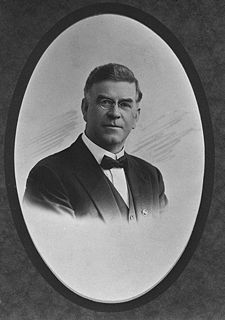 Realising that an academic career would be barred from him by the right wing university authorities in Australia, Childe then turned to getting a job within the actual leftist movement itself. In August 1919, he became Private Secretary and speech writer to the politician John Storey
, a prominent member of the centre-left Australian Labor Party
that was then in opposition to the Nationalist government in the state of New South Wales
. A member of the New South Wales Legislative Council
, where he represented the Sydney suburb of Balmain
, Storey became the state Premier
in 1920 when Labor achieved an electoral victory there. Working for such a senior figure in the Labor Party allowed Childe to gain an "unrivalled grasp of its structure and history", eventually enabling him to write a book on the subject, How Labour Governs (1923). However, the further involved that he got, the more Childe became critical of Labor, believing that they betrayed their socialist ideals once they gained political power and moderated to a more centrist, pro-capitalist stance.
Instead he became involved in the Australian branch of an international revolutionary socialist group called the Industrial Workers of the World
that advocated a specifically Marxist worldview. Although the group had been illegalised by the Australian government who considered it a political threat, it continued to operate with the support of figures like Childe, whose political views were increasingly moving further to the left. Meanwhile, Storey became anxious that the British press be kept updated with accurate news about New South Wales, and so in 1921 he sent Childe to London in order to act in this capacity. In December of that year however, Storey died, and a few days later the New South Wales elections led to the restoration of a Nationalist government under the premiership of George Fuller
. Fuller and his party members did not agree that Childe's job was necessary, and in early 1922 his employment was terminated.
, an area of central London, he initially found it hard to gain work, but spent much time studying at the nearby British Museum
and the library of the Royal Anthropological Institute. He also became an active member of the London socialist movement, associating with other leftists at the 1917 Club in Gerrard Street, Soho
, which was also frequented by such notables as Ramsay MacDonald
, Aldous Huxley
, H.G. Wells, H.N. Brailsford, Elsa Lanchester
and Rose Macauley. Although a socialist, he had not at this time adopted the Marxist views that he would be known for in later life, and for this reason did not join the Communist Party of Great Britain
, of which many of his friends were members.
Meanwhile, Childe had earned himself a reputation as a "prehistorian of exceptional promise", and he began to be invited to travel to other parts of Europe in order to study prehistoric artefacts. In 1922 he travelled to Vienna in Austria where he examined unpublished material about the painted Neolithic
pottery from Schipenitz, Bukowina
that was held in the Prehistoric Department of the Natural History Museum
. He soon published his findings from this visit in the 1923 Journal of the Royal Anthropological Institute. Childe also used this excursion as an opportunity to visit a number of museums in Czechoslovakia and Hungary, bringing them to the attention of British archaeologists in a 1922 article published in Man
. Returning to London, Childe became a private secretary again in 1922, this time for three British Members of Parliament
, including John Hope Simpson
and Frank Gray
, both of whom were members of the centre-left Liberal Party
. To supplement this income, Childe, who had mastered a variety of European languages, also worked as a translator for the publishers Kegan Paul, Trench, Trübner & Co
and occasionally lectured in prehistory at the London School of Economics
.
In 1923 his first book, How Labour Governs, was published by the London Labour Company. The work offered an examination of the Australian Labor Party and its wider connection with the Australian labour movement
, reflecting Childe's increasing dissolutionment with the party, believing that whilst it contained socialist members, the politicians that it managed to get elected had abandoned their socialist ideals in favour of personal comfort. His later biographer Sally Green (1981) noted that How Labour Governs was of particular significance at the time because it was published just as the British Labour Party
was emerging as a major player in British politics, threatening the former two-party dominance of the Conservatives
and Liberals. Indeed in 1924, the year after the book's publication, Labour, under the leadership of Ramsay MacDonald, was elected into power in the U.K. for the very first time in history.
In May 1923 he visited continental Europe once more, journeying to the museums in Lausanne, Berne and Zürich in order to study their collections of prehistoric artefacts, and that same year became a member of the Royal Anthropological Institute. In 1925, the Institute offered him "one of the very few archaeological jobs in Britain", and he became their librarian, and in doing so he helped to cement connections with scholars working in other parts of Europe. This job meant that he came into contact with many of Britain's archaeologists, of whom there were relatively few during the 1920s, and he developed a great friendship with O.G.S. Crawford, the noted Archaeological Officer to the Ordnance Survey
who was himself a devout Marxist.
In 1925, the company Kegan Paul, Trench, Trübner & Co published Childe's second book, The Dawn of European Civilisation, in which he synthesised the varied data about European prehistory that he had been exploring for many years. The work was of "outstanding importance", being released at a time when the few archaeologists across Europe were amateur and were focused purely on studying the archaeology of their locality; The Dawn was a rare example of a book that looked at the larger picture across an entire continent. Describing this groundbreaking book many years later, Childe would state that it "aimed at distilling from archaeological remains a preliterate substitute for the conventional politico-military history with cultures, instead of statesmen, as actors, and migrations in place of battles." In 1926 he brought out a successor work, The Aryans: A Study of Indo-European Origins, in which he looked at the theory that civilisation diffused northward and westward from the Near East to the rest of Europe via a linguistic group known as the Aryans. In these works, Childe accepted a moderate diffusionism, believing that although most cultural traits spread from one society to another, it was possible for the same traits to develop independently in different places. Such a theory was at odds with the hyper-diffusionism purported by Sir Grafton Elliot Smith which argued that all the cultural traits associated with civilisation must have originated from a single source.
in Scotland, so named after the Scottish prehistorian Lord John Abercromby, who had established it by deed in his bequest to the university. Although Childe recognised that accepting the post would take him away from London, where all of his friends and socialist activities were centred, he decided to take up the prestigious position, moving to Edinburgh in September 1927. At the age of 35, Childe became the "only academic prehistorian in a teaching post in Scotland", and was disliked by many Scottish archaeologists, who viewed him as an outsider who wasn't even a specialist in Scottish prehistory. This hostility reached such a point that he wrote to one of his friends, telling them that "I live here in an atmosphere of hatred and envy." Despite this, he made a number of friends and allies in Edinburgh, including Sir W. Lindsay Scott, Alexander Curle, J.G. Callender, Walter Grant and Charles G. Darwin. Darwin, who was the grandson of the renowned biologist Charles Darwin
, became a particularly good friend of Childe, and asked him to be the godfather of his youngest son, Edward.
At Edinburgh University, Childe spent much of his time focusing on his own research, and although he was reportedly very kind towards his students, never interacted much with them, to whom he remained largely distant. He had difficulty speaking to large audiences, and organised the BSc
degree course so that it began with studying the Iron Age
, and then progressed chronologically backward, through the Bronze Age
, Neolithic
, Mesolithic
and Palaeolithic, something many students found confusing. He also founded an archaeological society known as the Edinburgh League of Prehistorians, through which he took his more enthusiastic students on excavations and invited guest lecturers to visit them. He would often involve his students in experimental archaeology
, something that he was an early proponent of, for instance knapping flint lithics
in the midst of some of his lectures. Other experiments that he undertook had a clearer purpose, for instance in 1937 he performed experiments to understand the vitrification
process that had occurred at several Iron Age forts in northern Britain.
In Edinburgh, he initially lodged at Liberton
, although later moved into a semi-residential hotel, the Hotel de Vere, which was located in Eglington Crescent. He travelled down to London on a regular basis, where he would associate with his friends in both the socialist and archaeological communities. In the latter group, one notable friend of Childe's was Stuart Piggott
, another influential British archaeologist who would succeed Childe in his post as Abercromby Professor at Edinburgh. The duo, along with Grahame Clark, got themselves elected on to the committee of the Prehistoric Society of East Anglia, and then proceeded to use their influence over it to convert it into a nationwide organisation, the Prehistoric Society, in 1934–35, to which Childe was soon elected president.
Childe also regularly attended conferences across Europe, becoming fluent in a range of European languages, and in 1935 first visited the Soviet Union
, where he spent 12 days in Leningrad and Moscow. He was impressed with the socialist state that had been created there, and was particularly interested in the role that archaeology was playing within it. Upon his return to Britain he became a vocal Soviet sympathiser who avidly read the Daily Worker (the publication of the Communist Party of Great Britain), although was heavily critical of some of the Soviet government's policies, in particular the Molotov–Ribbentrop Pact that they made with Nazi Germany
. His socialist convictions led to his early denunciation of the fascist
movement in Europe, and he was particularly outraged by the Nazi co-opting of prehistoric archaeology to glorify their own conceptions of an Aryan racial heritage. He was supportive of the British government's decision to fight the fascist powers in the Second World War and had made the decision to commit suicide should the Nazis conquer Britain, recognising that he would be one of the first that they would exterminate because of his political beliefs. Despite his opposition to the fascist powers of Germany and Italy however, he was also critical of the imperialist
, capitalist
governments in control of the United Kingdom and United States: regarding the latter, he would often describe it as being full of "loathsome fascist hyenas".
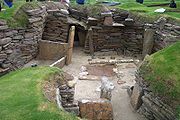 His university position meant that he was obliged to undertake archaeological excavations, something which he loathed and believed that he did poorly. Several of his students recognised that he took little interest in excavation, and was not good at much of it, but instead had a "genius for interpreting evidence". Unlike many of his contemporaries, he was scrupulous with writing up and publishing his findings, producing almost annual reports for the Proceedings of the Society of Antiquaries of Scotland, and also ensured that he acknowledged the help of all of his diggers.
His best known excavation was that undertaken from 1927 through to 1930 at the site of Skara Brae
in the Orkney Islands
. Here, he uncovered a Neolithic village in a good state of preservation that had partially been revealed when heavy storms hit the islands. In 1931, he published the results of his excavation in a book, entitled simply Skara Brae. He got on particularly well with the local populace who lived near the Skara Brae site, and is reported that to them "he was every inch the professor" because of his eccentric appearance and habits.
In 1932, Childe, collaborating with anthropologist C. Daryll Forde, excavated two Iron Age hillforts at Earn's Hugh on the Berwickshire
coast, whilst in June 1935 he excavated a promontory fort at Larriban near to Knocksoghey in Northern Ireland. Together with Wallace Thorneycroft, another Fellow of the Society of Antiquaries of Scotland, Childe excavated two vitrified Iron Age forts in Scotland, that at Finavon, Angus
(1933–34) and that at Rahoy, Argyllshire (1936–37).
river, recognising it as the natural boundary dividing the Near East from Europe, and subsequently he believed that it was via the Danube that various new technologies travelled westward in antiquity. In The Danube in Prehistory, Childe introduced the concept of an archaeological culture
(which up until then had been largely restrained purely to German academics), to his British counterparts. This concept would revolutionise the way in which archaeologists understood the past, and would come to be widely accepted in future decades.
Childe's next work, The Bronze Age (1930), dealt with the titular Bronze Age
in Europe, and displayed his increasing acceptance of Marxist theory in understanding how society functioned and changed. He believed that metal was the first indispensable article of commerce, and that metal-smiths were therefore full-time professionals who lived off the social surplus. Within a matter of years he had followed this up with a string of further works: The Forest Cultures of Northern Europe: A Study in Evolution and Diffusion (1931), The Continental Affinities of British Neolithic Pottery (1932) and Neolithic Settlement in the West of Scotland (1934).
In 1933, Childe travelled to Asia, visiting Iraq, a place he thought was "great fun", and then India, which he conversely felt was "detestable" because of the hot weather and the extreme poverty faced by the majority of Indians. During this holiday he toured a number of archaeological sites in the two countries, coming to the opinion that much of what he had written in The Most Ancient Near East was outdated, and so he went on to produce a new book on the subject, New Light on the Most Ancient Near East (1935), in which he applied his Marxist-influenced ideas about the economy to his conclusions.
After another publication dealing with Scottish archaeology, Prehistory of Scotland (1935), Childe produced one of the defining books of his career, Man Makes Himself (1936). Influenced by the Marxist view of history, Childe used the work to argue that the usual distinction between (pre-literate) prehistory and (literate) history was a false dichotomy and that human society has progressed through a series of technological, economic and social revolutions. These included the Neolithic Revolution
, when hunter-gatherers began settling down in permanent communities and began farming, through to the Urban Revolution
, when society progressed from a series of small towns through to the first cities, and right up to more recent times, when the Industrial Revolution
drastically changed the nature of production. With the outbreak of the Second World War, Childe was unable to travel across continental Europe, and so focused on producing a book about the prehistoric archaeology of Britain: the result was Prehistoric Communities of the British Isles (1940).
Childe's pessimism surrounding the outcome of the war led to him adopting the belief that "European Civilization – Capitalist and Stalinist
alike – was irrevocably headed for a Dark Age." It was in this state of mind that he produced what he saw as a sequal to Man Makes Himself entitled What Happened in History (1942), a synthesis of human history from the Palaeolithic through to the fall of the Roman Empire
. Although Oxford University Press
offered to publish the work, he instead chose to release the book through Penguin Books
because they would sell it at a cheaper price, something he believed was pivotal to providing his knowledge to "the masses." This was followed by two short works, Progress and Archaeology (1944) and then The Story of Tools (1944), the latter of which was explicitly Marxist and had been written for the Young Communist League
.
in London. He was anxious to return to the capital, where most of his friends and interests were centred, and as such had kept silent over his disapproval of government policies so that he would not be prevented from getting the job as had happened in Australia. The Institute had been founded in 1937, largely by noted archaeologist Mortimer Wheeler
and his wife Tessa, but until 1946 relied primarily upon volunteer lecturers. When Childe worked there, it was located in St John's Lodge, a building in the Inner Circle of Regent's Park
, although would be moved to Gordon Square in Bloomsbury in 1956. At the Institute, Childe worked alongside Wheeler, a figure who was widely known to the general public in Britain through his frequent television appearances and dominant personality. Wheeler had made a name for himself excavating the Indus Valley civilisation sites of Harappa
and Mohenjo-Daro
and unlike Childe was recognised as a particularly good field archaeologist. The duo did not get on particularly well; Wheeler was conservative and right-wing in his political views whilst also being intolerant of the shortcomings of others, something that Childe made an effort never to be. Whilst working at the Institute, Childe took up residence at Lawn Road Flats near to Hampstead
, an apartment block perhaps recommended to him by the popular crime fiction author Agatha Christie
(the wife of his colleague Max Mallowan
), who had lived there during the Second World War.
Students who studied under Childe often remarked that he was a kindly eccentric, but had a great deal of fondness for him, leading them to commission a bust of him from Marjorie Maitland-Howard. He was not however thought of as a particularly good lecturer, often mumbling his words or walking into an adjacent room to find something whilst continuing to give his talk. He was also known to refer to the socialist states in eastern Europe by their full official titles (for instance using "German Democratic Republic" over "East Germany" and "Socialist Federal Republic of Yugoslavia
" over "Yugoslavia"), and also referred to east European towns with their Slavonic rather than Germanic names, further confusing his students who were familiar with the latter. He was widely seen as being better at giving tutorials and seminars, where he could devote more time to interacting with his students individually.
 Whereas he had been required to undertake much fieldwork and excavation whilst at Edinburgh, at the Institute his position as Director meant that this was not necessary, although he did undertake one excavation at Maes Howe, a Neolithic burial tomb plundered by Early Medieaval Norse raiders, during 1954–55. Meanwhile, in 1949 Childe and his friend O.G.S. Crawford resigned their positions as Fellows of the Society of Antiquaries
in protest at the election of James Mann
to the Presidency following the retirement of Cyril Fox
. They believed that Mann, who was the Keeper of the Tower's Armouries at the Tower of London
, was a poor choice and that Mortimer Wheeler, being an actual prehistorian, should have won the election.
In 1952 a group of British Marxist historians began publishing the periodical Past and Present
, with Childe soon joining the editorial board. Similarly, he became a member of the board for The Modern Quarterly (later The Marxist Quarterly) during the early 1950s, working alongside his old friend Rajani Palme Dutt, who held the position of chairman of the board. He also wrote occasional articles for Palme Dutt's socialist journal, the Labour Monthly, but disagreed with him on the issue of the Hungarian Revolution of 1956. Palme Dutt had defended the Soviet Union's decision to quash the revolution using military force, but Childe, like many western socialists and Marxists at the time, strongly disagreed that this was an appropriate measure to take. The actions of the Soviet government alienated Childe, who lost his formerly firm faith in Joseph Stalin
's administration, but not his belief in socialism and Marxist theory. Despite the events of 1956, Childe retained a love of the Soviet Union, having visited it on a number of occasions prior, and was involved with the Society for Cultural Relations with the USSR, a satellite body of the Communist Party of Great Britain. He was also the president of the Society's National History and Archaeology Section from the early 1950s until his death. In April 1956, he had been awarded the Gold Medal of the Society of Antiquaries for his services to archaeology.
Whilst working at the Institute, Childe continued writing and publishing books dealing with archaeology and prehistory. History (1947) continued his belief that prehistory and literate history must be viewed together, and adopted a Marxist view of history, whilst Prehistoric Migrations (1950) displayed his views on moderate diffusionism. In 1946 he had also published a paper in the Southwestern Journal of Anthropology, entitled "Archaeology and Anthropology" which argued that the two disciplines must be used in tandem, something that would be widely accepted in the decades following his death.
In England he sorted out his affairs, donating most of his personal library, and all of his estate, to the Institute of Archaeology. After a holiday then spent visiting archaeological sites in Gibraltar and Spain in February 1957, he sailed to Australia, reaching Sydney on his 65th birthday. Here, the University of Sydney, which had once barred him from working there, now awarded him an honourary degree. He proceeded to travel around the country for the next six months, visiting various surviving family members and old friends. However he was unimpressed by what he saw of Australian society, coming to the opinion that the nation's society had not progressed in any way since the 1920s, having simply become reactionary, increasingly suburban and un-educated. Meanwhile, he also began to look into the prehistory of Australia, coming to the opinion that there was much for archaeologists to study in this field, and he gave several lectures to various archaeological and leftist groups on this and other topics. In the final week of his life he even gave a talk on Australian radio in which he argued against the racist and dismissive attitude of many Australian academics towards the Indigenous Australian
peoples of the continent.
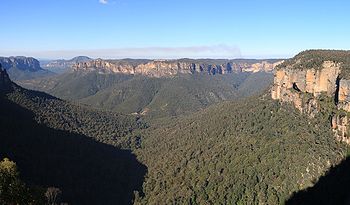 Shortly before his death he wrote letters to many of his friends that dealt with particularly personal topics. He also wrote a letter to W.F. Grimes, requesting that it not be opened until 1968. In it, he described how he feared old age, and stated his intention to take his own life, remarking that "Life ends best when one is happy and strong." On the morning of 19 October 1957, Childe went walking around the area of the Bridal Veil Falls in the Blue Mountains where he had grown up. He had left his hat, spectacles, compass, pipe and Mackintosh atop Govett's Leap at Blackheath
, before falling 1000 feet to his death. His death certificate issued by the coroner claimed that he had died from an accidental fall whilst studying rock formations, and it would only be in the 1980s, with the publication of his letter to Grimes, that his death became recognised as a suicide.
Later archaeologist Neil Faulkner
believed that part of the reason why Childe decided to take his own life was that his "political illusions had been shattered" after he had begun to lose faith in the direction being taken by the world's foremost socialist state, the Soviet Union. This, Faulkner believed, had been brought about by Soviet Premier Nikita Khrushchev
's denouncement of Joseph Stalin
and the Soviet Union's violent crushing of the Hungarian Revolution of 1956. Faulkner theorised that without contact with members of the New Left
or the Trotskyists
, the two main Marxist currents in Britain that were critical of the Soviet Union at the time, Childe felt alone in his conflicting feelings about the country, and despaired for the future of humanity.
, which had originally been formulated by the 19th century German philosophers and sociologists Karl Marx
and Friedrich Engels
. They put forward their ideas in a series of books, most notably the political pamphlet widely called The Communist Manifesto
(1848) and Marx's several-volume study, Capital
(1867–1894). Taking the ideas of fellow German philosopher G.W.F. Hegel
as a basis, Marx and Engels argued that all of human society rests upon class war
, the concept that different socio-economic classes struggle against one another for their own benefit, with the ruling class inevitably being overthrown through revolution, to be replaced with a new ruling class. This constant struggle, they argued, was the force through which society progressed, and was the reason that human society has developed since the Palaeolithic. Marx and Engels both used historical examples to try and back up their theory. They argued that in early hunter-gatherer
societies, humans lived in "primitive communism
", with no class system being evident. Eventually, as populations grew, slave-based societies emerged having the distinction between slave owners and slaves as their basis. Slave society was, in turn, replaced by feudalism
, in which kings and aristocrats became the ruling class. In turn, these feudal systems were overturned by capitalism
, a system in which the bourgeoisie
, or upper middle class, gained political control.
Childe's approach to understanding the past has been typically associated with Marxist archaeology
. This form of archaeological theory
was first developed in the Soviet Union in 1929, when a young archaeologist named Vladislav I. Ravdonikas (1894–1976) published a report entitled "For a Soviet history of material culture". Within this work, the very discipline of archaeology was criticised as being inherently bourgeoisie
and therefore anti-socialist, and so, as a part of the academic reforms instituted in the Soviet Union under the administration of Premier Joseph Stalin
, a great emphasis was placed on the adoption of Marxist archaeology throughout the country.
The extent to which Childe's interpretation of the past fits the Marxist conception of history has however been called into question. His biographer Sally Green noted that "his beliefs were never dogmatic, always idiosyncretic, and were continually changing throughout his life" but that "Marxist views on a model of the past were largely accepted by Childe offering as they do a structural analysis of culture in terms of economy, sociology and ideology, and a principle for cultural change through economy." She went on to note however that "Childe's Marxism frequently differed from contemporary 'orthodox' Marxism; partly because he had studied Hegel, Marx and Engels as far back as 1913 and still referred to the original texts rather than later interpretations, and partly because he was selective in his acceptance of their writings." Childe's Marxism was further critiqued by later Marxist archaeologist Neil Faulkner
, who argued that although Childe "was a deeply committed socialist heavily influenced by Marxism", he did not appear to accept the existence of class struggle
as an instrument of social change, something which was a core tenet of Marxist thought.
Faulkner instead believed that Childe's approach to archaeological interpretation was not that of a Marxist archaeologist, but was instead a precursor to the processual archaeological
approach that would be widely adopted in the discipline during the 1960s. This contrasted with the claims of the archaeologist Peter Ucko
, who was one of Childe's successors as director of the Institute of Archaeology. Ucko highlighted that in his writings, Childe accepted the subjectivity
of archaeological interpretation, something which was in stark contrast to the processualists' insistence that archaeological interpretation could be objective. In this manner Childe's approach would have had more in common with that put forward by the post-processual archaeologists
who emerged in the late 1970s and 1980s.
Childe himself was an atheist, and remained highly critical of religion, something he saw as being based in superstition, a viewpoint shared by orthodox Marxists. In History (1947) he discussed religion and magic, commenting that "Magic is a way of making people believe they are going to get what they want, whereas religion is a system for persuading them that they ought to want what they get."
Childe was fond of cars and driving them, writing a letter in 1931 in which he stated that "I love driving (when I'm the chaffeur) passionately; one has such a feeling of power." He was fond of telling people a story about how he had raced at a high speed down Piccadilly
in London at three o'clock in the morning for the sheer enjoyment of it, only to be pulled over by a policeman for such illegal and potentially dangerous activity. He was also known for his love of practical jokes, and he allegedly used to keep a halfpenny in his pocket in order to trick pickpockets. On another occasion he played a joke on the assembled delegates at a Prehistoric Society conference by lecturing them on a theory that the Neolithic monument of Woodhenge
had been constructed as an imitation of Stonehenge
by a nouveau riche chieftain. Several members of his audience failed to realise that he was being tongue in cheek.
Childe's other hobbies included going for walks in the British hillsides, attending classical music concerts and playing the card game contract bridge
. He was fond of poetry, with his favourite poet being John Keats
, although his favourite poems were William Wordsworth
's "Ode to Duty
" and Robert Browning
's "A Grammarian's Funeral". He was not particularly interested in reading novels but his favourite was D.H. Lawrence's Kangaroo
(1923), a book set in Australia that echoed many of Childe's own feelings about his homeland. He was also a fan of good quality food and drink, and frequented a number of restaurants.
Childe always wore his wide-brimmed black hat, which he had purchased from a hatter in Jermyn Street
, central London, as well as a tie, which was usually red, a colour chosen to symbolise his socialist beliefs. He also regularly wore a shiny black Mackintosh
raincoat, often carrying it over his arm or draped over his shoulders like a cape. In summer he instead frequently wore particularly short shorts, with socks, sock suspenders and large boots.
that had been presented as revolutions by Sir John Lubbock and others in the late 19th century. Such concepts as the "Neolithic Revolution
" and "Urban Revolution
" did not begin with him but he welded them into a new synthesis of economic periods based on what could be known from the artifacts, rather than from a supposed ethnology
of an unknown past. Thanks to his presentations and influence this synthesis is now accepted as vital in prehistoric studies. Childe traveled throughout Greece, Central Europe and the Balkans studying the archaeological literature. Harris said of him:
Childe placed considerable importance on human culture as a social construct rather than a product of environmental or technological contexts. Basically, he rejected Herbert Spencer's theory of parallel cultural evolution in favor of his own theory which was divergence with modifications of convergence.
Childe is referenced in the American blockbuster film Indiana Jones and the Kingdom of the Crystal Skull (2008). Directed by Steven Spielberg
and George Lucas
, the motion picture was the fourth film in the Indiana Jones
series that dealt with the eponymous fictional archaeologist and university professor. In the film, Jones is heard advising one of his students that to understand the concept of diffusion they must read the words of Childe.
Vere Gordon Childe (14 April 1892 – 19 October 1957), better known as V. Gordon Childe, was an Australian
archaeologist
and philologist who specialised in the study of European prehistory. A vocal socialist
, Childe accepted the socio-economic theory of Marxism
and was an early proponent of Marxist archaeology
. Childe worked for most of his life as an academic in the United Kingdom, initially at the University of Edinburgh
, and later at the Institute of Archaeology
, London. He also wrote a number of groundbreaking books on the subject of archaeology and prehistory, most notably Man Makes Himself (1936) and What Happened in History (1942).
Born in Sydney
, New South Wales
into a middle class family of English descent, Childe studied at the University of Sydney
before moving to England where he studied at the University of Oxford
. Upon returning to Australia he was prevented from working in academia because of his political views and so took up employment working for the Australian Labor Party
before he once more returned to England, settling down in London. Here he proceeded through a variety of jobs, all the time continuing his research into European prehistory by making various journeys across the continent, and eventually publishing his findings in academic papers and books.
From 1927 through to 1946 he was employed as the Abercromby Professor of Archaeology at the University of Edinburgh, and at that time was responsible for the excavation of the unique Neolithic
settlement of Skara Brae
and the chambered tomb of Maeshowe
, both in Orkney, northern Scotland. Becoming a co-founder and president of the Prehistoric Society, it was also at this time that he came to embrace Marxism and became a noted sympathiser with the Soviet Union, particularly during the Second World War. In 1947 he was offered the post of director at the Institute of Archaeology, something that he took up until 1957, when he retired. That year he committed suicide by jumping off of a cliff in the Australian Blue Mountains near to where he was born.
He has been described as being "the most eminent and influential scholar of European prehistory in the twentieth century". He was noted for synthesizing archaeological data from a variety of sources, thereby developing an understanding of wider European prehistory as a whole. Childe is also remembered for his emphasis on revolutionary developments on human society, such as the Neolithic Revolution
and the Urban Revolution
, in this manner being influenced by Marxist ideas of societal development.
, New South Wales
. He was the only surviving child of the Reverend Stephen Henry and Harriet Eliza Childe, a middle class couple of English descent. Stephen Childe (1807–1923) had been the son of William Childe, a stern English priest and teacher, and had followed in his father's footsteps by being ordained into the Church of England
in 1867 after gaining a BA from the University of Cambridge
. In 1871 he had married a woman named Mary Ellen Latchford, with whom he would have five children, and he went on to earn employment working as a teacher at various schools across Britain. Deciding to emigrate, the couple and their children moved to Australia's New South Wales in 1878, but it was here that Mary died after a few years, and so in 1886 Stephen remarried, this time to Harriet Eliza Gordon (1853–1910), an Englishwoman from a wealthy background who had moved to Australia when still a child. Harriet gave birth to Vere Gordon Childe in 1892, and he was raised along with his five older half-siblings at his father's palatial country house, the Chalet Fontenelle, which was located at Wentworth Falls
in the Blue Mountains west of Sydney. In Australia, the Reverend Childe worked as the minister for St. Thomas' Parish, but proved unpopular, getting into many arguments with other members of the community and often taking unscheduled holidays into the countryside when he was supposed to be overseeing religious services.
Being a sickly child, Gordon Childe was home schooled for a number of years, before being sent to gain an education at a private school in North Sydney
. In 1907, he began attending the Sydney Church of England Grammar School
, where he gained his Junior Matriculation in 1909, and then his Senior Matriculation the following year. At the school he studied ancient history, French, Greek, Latin, geometry, algebra and trigonometry, achieving good marks in all subjects, but was bullied because of his strange appearance and unathletic body. In July 1910 his mother, Harriet Childe, died, and his father took a woman named Monica Gardiner to be his third wife soon after. Gordon Childe's relationship with his father was strained, particularly following his mother's death, and they disagreed heavily on the subject of religion and politics, with the Reverend being a devout Christian and a conservative
whilst Gordon Childe was an atheist
and a socialist
.
at the University of Sydney
in 1911, where although he focused on the study of written sources, he first came across classical archaeology
through the works of prominent archaeologists like Heinrich Schliemann
and Sir Arthur Evans. At the University, he became an active member of the Debating Society, at one point arguing in favour of the proposition that "socialism is desirable". He had become increasingly interested in socialism and Marxism
, reading the works of the prominent Marxist theoreticians Karl Marx
and Friedrich Engels
, as well as the works of philosopher G.W.F. Hegel
, whose ideas on dialectical materialism
had been hugely influential on Marxist theory. Ending his studies in 1913, Childe graduated the following year with various honours and prizes, including Professor Francis Anderson
's prize for Philosophy.
Wishing to continue his education, he gained £200 from the Cooper Graduate Scholarship in Classics, allowing him to afford the tuition fees at Queen's College
, a part of the University of Oxford
, England. He set sail for Britain in August 1914, shortly after the outbreak of World War I
in which Britain, then allied with France and Russia, went to war with Germany, Austria-Hungary and the Ottoman Empire. At Queen's, Childe was entered for a diploma in classical archaeology followed by a Bachelor of Literature degree, but did not complete the requirements for the former. It was here that he studied under such archaeologists as John Beazley
and Arthur Evans
, the latter of whom acted as his supervisor. In 1915, he published his first academic paper, 'On the Date and Origin of Minyan Ware', which appeared in the Journal of Hellenic Studies
, and the following year produced his B.Litt. thesis, 'The Influence of Indo-Europeans in Prehistoric Greece', which displayed his interest in combining philological and archaeological evidence.
At Oxford he became actively involved with the local socialist movement, something which antagonised the conservative, rightist university authorities. He rose to become a noted member of the Oxford University Fabian Society, then at the height of its power and membership, and was there when, in 1915, it changed its name to the Oxford University Socialist Society following a split from the main Fabian Society
. His best friend and flatmate at the time was Rajani Palme Dutt
, a British citizen born to an Indian father and a Swedish mother who was also a fervent socialist and Marxist. The two would often get drunk and test each other's knowledge about classical history late at night. With Britain being in the midst of World War I, many socialists refused to fight for the British Army despite the government imposed conscription. They believed that the war was merely being waged in the interests of the ruling classes of the European imperialist
nations at the expense of the working classes, and that class war
was the only conflict that they should be concerned with. Dutt was imprisoned for refusing to fight, and Childe campaigned for both his release and the release of other socialists and pacifist conscientious objectors. Childe himself was never required to enlist in the army, most likely because his poor health and poor eyesight would have prevented him from being an effective soldier.
, and moving to the city he got involved in the socialist and anti-conscription movement that was centred there. In Easter 1918 he was one of the speakers at the Third Inter-State Peace Conference, an event organised by the Australian Union of Democratic Control for the Avoidance of War, a group that was deeply opposed to the plans by Prime Minister Billy Hughes
(then the leader of the centre-right Nationalist Party of Australia
) to introduce conscription for Australian males. The conference had a prominent socialist emphasis, with Peter Simonoff, the Soviet Consul-General for Australia, being present, and its report argued that the best hope for the end to international war was the "abolition of the Capitalist System". News of Childe's participation reached the Principal of St Andrew's College, Dr Harper, who, under pressure from the university authorities, forced Childe to resign from his job because of his political beliefs. With his good academic reputation however, several other members of staff at the University agreed to provide him with a job as a tutor in Ancient History in the Department of Tutorial Classes, but ultimately he was prevented from doing so by the Chancellor of the University, Chief Justice Sir William Cullen
, who feared that Childe would propagate his socialist ideas to students.
Realising that an academic career would be barred from him by the right wing university authorities in Australia, Childe then turned to getting a job within the actual leftist movement itself. In August 1919, he became Private Secretary and speech writer to the politician John Storey
, a prominent member of the centre-left Australian Labor Party
that was then in opposition to the Nationalist government in the state of New South Wales
. A member of the New South Wales Legislative Council
, where he represented the Sydney suburb of Balmain
, Storey became the state Premier
in 1920 when Labor achieved an electoral victory there. Working for such a senior figure in the Labor Party allowed Childe to gain an "unrivalled grasp of its structure and history", eventually enabling him to write a book on the subject, How Labour Governs (1923). However, the further involved that he got, the more Childe became critical of Labor, believing that they betrayed their socialist ideals once they gained political power and moderated to a more centrist, pro-capitalist stance.
Instead he became involved in the Australian branch of an international revolutionary socialist group called the Industrial Workers of the World
that advocated a specifically Marxist worldview. Although the group had been illegalised by the Australian government who considered it a political threat, it continued to operate with the support of figures like Childe, whose political views were increasingly moving further to the left. Meanwhile, Storey became anxious that the British press be kept updated with accurate news about New South Wales, and so in 1921 he sent Childe to London in order to act in this capacity. In December of that year however, Storey died, and a few days later the New South Wales elections led to the restoration of a Nationalist government under the premiership of George Fuller
. Fuller and his party members did not agree that Childe's job was necessary, and in early 1922 his employment was terminated.
, an area of central London, he initially found it hard to gain work, but spent much time studying at the nearby British Museum
and the library of the Royal Anthropological Institute. He also became an active member of the London socialist movement, associating with other leftists at the 1917 Club in Gerrard Street, Soho
, which was also frequented by such notables as Ramsay MacDonald
, Aldous Huxley
, H.G. Wells, H.N. Brailsford, Elsa Lanchester
and Rose Macauley. Although a socialist, he had not at this time adopted the Marxist views that he would be known for in later life, and for this reason did not join the Communist Party of Great Britain
, of which many of his friends were members.
Meanwhile, Childe had earned himself a reputation as a "prehistorian of exceptional promise", and he began to be invited to travel to other parts of Europe in order to study prehistoric artefacts. In 1922 he travelled to Vienna in Austria where he examined unpublished material about the painted Neolithic
pottery from Schipenitz, Bukowina
that was held in the Prehistoric Department of the Natural History Museum
. He soon published his findings from this visit in the 1923 Journal of the Royal Anthropological Institute. Childe also used this excursion as an opportunity to visit a number of museums in Czechoslovakia and Hungary, bringing them to the attention of British archaeologists in a 1922 article published in Man
. Returning to London, Childe became a private secretary again in 1922, this time for three British Members of Parliament
, including John Hope Simpson
and Frank Gray
, both of whom were members of the centre-left Liberal Party
. To supplement this income, Childe, who had mastered a variety of European languages, also worked as a translator for the publishers Kegan Paul, Trench, Trübner & Co
and occasionally lectured in prehistory at the London School of Economics
.
In 1923 his first book, How Labour Governs, was published by the London Labour Company. The work offered an examination of the Australian Labor Party and its wider connection with the Australian labour movement
, reflecting Childe's increasing dissolutionment with the party, believing that whilst it contained socialist members, the politicians that it managed to get elected had abandoned their socialist ideals in favour of personal comfort. His later biographer Sally Green (1981) noted that How Labour Governs was of particular significance at the time because it was published just as the British Labour Party
was emerging as a major player in British politics, threatening the former two-party dominance of the Conservatives
and Liberals. Indeed in 1924, the year after the book's publication, Labour, under the leadership of Ramsay MacDonald, was elected into power in the U.K. for the very first time in history.
In May 1923 he visited continental Europe once more, journeying to the museums in Lausanne, Berne and Zürich in order to study their collections of prehistoric artefacts, and that same year became a member of the Royal Anthropological Institute. In 1925, the Institute offered him "one of the very few archaeological jobs in Britain", and he became their librarian, and in doing so he helped to cement connections with scholars working in other parts of Europe. This job meant that he came into contact with many of Britain's archaeologists, of whom there were relatively few during the 1920s, and he developed a great friendship with O.G.S. Crawford, the noted Archaeological Officer to the Ordnance Survey
who was himself a devout Marxist.
In 1925, the company Kegan Paul, Trench, Trübner & Co published Childe's second book, The Dawn of European Civilisation, in which he synthesised the varied data about European prehistory that he had been exploring for many years. The work was of "outstanding importance", being released at a time when the few archaeologists across Europe were amateur and were focused purely on studying the archaeology of their locality; The Dawn was a rare example of a book that looked at the larger picture across an entire continent. Describing this groundbreaking book many years later, Childe would state that it "aimed at distilling from archaeological remains a preliterate substitute for the conventional politico-military history with cultures, instead of statesmen, as actors, and migrations in place of battles." In 1926 he brought out a successor work, The Aryans: A Study of Indo-European Origins, in which he looked at the theory that civilisation diffused northward and westward from the Near East to the rest of Europe via a linguistic group known as the Aryans. In these works, Childe accepted a moderate diffusionism, believing that although most cultural traits spread from one society to another, it was possible for the same traits to develop independently in different places. Such a theory was at odds with the hyper-diffusionism purported by Sir Grafton Elliot Smith which argued that all the cultural traits associated with civilisation must have originated from a single source.
in Scotland, so named after the Scottish prehistorian Lord John Abercromby, who had established it by deed in his bequest to the university. Although Childe recognised that accepting the post would take him away from London, where all of his friends and socialist activities were centred, he decided to take up the prestigious position, moving to Edinburgh in September 1927. At the age of 35, Childe became the "only academic prehistorian in a teaching post in Scotland", and was disliked by many Scottish archaeologists, who viewed him as an outsider who wasn't even a specialist in Scottish prehistory. This hostility reached such a point that he wrote to one of his friends, telling them that "I live here in an atmosphere of hatred and envy." Despite this, he made a number of friends and allies in Edinburgh, including Sir W. Lindsay Scott, Alexander Curle, J.G. Callender, Walter Grant and Charles G. Darwin. Darwin, who was the grandson of the renowned biologist Charles Darwin
, became a particularly good friend of Childe, and asked him to be the godfather of his youngest son, Edward.
At Edinburgh University, Childe spent much of his time focusing on his own research, and although he was reportedly very kind towards his students, never interacted much with them, to whom he remained largely distant. He had difficulty speaking to large audiences, and organised the BSc
degree course so that it began with studying the Iron Age
, and then progressed chronologically backward, through the Bronze Age
, Neolithic
, Mesolithic
and Palaeolithic, something many students found confusing. He also founded an archaeological society known as the Edinburgh League of Prehistorians, through which he took his more enthusiastic students on excavations and invited guest lecturers to visit them. He would often involve his students in experimental archaeology
, something that he was an early proponent of, for instance knapping flint lithics
in the midst of some of his lectures. Other experiments that he undertook had a clearer purpose, for instance in 1937 he performed experiments to understand the vitrification
process that had occurred at several Iron Age forts in northern Britain.
In Edinburgh, he initially lodged at Liberton
, although later moved into a semi-residential hotel, the Hotel de Vere, which was located in Eglington Crescent. He travelled down to London on a regular basis, where he would associate with his friends in both the socialist and archaeological communities. In the latter group, one notable friend of Childe's was Stuart Piggott
, another influential British archaeologist who would succeed Childe in his post as Abercromby Professor at Edinburgh. The duo, along with Grahame Clark, got themselves elected on to the committee of the Prehistoric Society of East Anglia, and then proceeded to use their influence over it to convert it into a nationwide organisation, the Prehistoric Society, in 1934–35, to which Childe was soon elected president.
Childe also regularly attended conferences across Europe, becoming fluent in a range of European languages, and in 1935 first visited the Soviet Union
, where he spent 12 days in Leningrad and Moscow. He was impressed with the socialist state that had been created there, and was particularly interested in the role that archaeology was playing within it. Upon his return to Britain he became a vocal Soviet sympathiser who avidly read the Daily Worker (the publication of the Communist Party of Great Britain), although was heavily critical of some of the Soviet government's policies, in particular the Molotov–Ribbentrop Pact that they made with Nazi Germany
. His socialist convictions led to his early denunciation of the fascist
movement in Europe, and he was particularly outraged by the Nazi co-opting of prehistoric archaeology to glorify their own conceptions of an Aryan racial heritage. He was supportive of the British government's decision to fight the fascist powers in the Second World War and had made the decision to commit suicide should the Nazis conquer Britain, recognising that he would be one of the first that they would exterminate because of his political beliefs. Despite his opposition to the fascist powers of Germany and Italy however, he was also critical of the imperialist
, capitalist
governments in control of the United Kingdom and United States: regarding the latter, he would often describe it as being full of "loathsome fascist hyenas".
His university position meant that he was obliged to undertake archaeological excavations, something which he loathed and believed that he did poorly. Several of his students recognised that he took little interest in excavation, and was not good at much of it, but instead had a "genius for interpreting evidence". Unlike many of his contemporaries, he was scrupulous with writing up and publishing his findings, producing almost annual reports for the Proceedings of the Society of Antiquaries of Scotland, and also ensured that he acknowledged the help of all of his diggers.
His best known excavation was that undertaken from 1927 through to 1930 at the site of Skara Brae
in the Orkney Islands
. Here, he uncovered a Neolithic village in a good state of preservation that had partially been revealed when heavy storms hit the islands. In 1931, he published the results of his excavation in a book, entitled simply Skara Brae. He got on particularly well with the local populace who lived near the Skara Brae site, and is reported that to them "he was every inch the professor" because of his eccentric appearance and habits.
In 1932, Childe, collaborating with anthropologist C. Daryll Forde, excavated two Iron Age hillforts at Earn's Hugh on the Berwickshire
coast, whilst in June 1935 he excavated a promontory fort at Larriban near to Knocksoghey in Northern Ireland. Together with Wallace Thorneycroft, another Fellow of the Society of Antiquaries of Scotland, Childe excavated two vitrified Iron Age forts in Scotland, that at Finavon, Angus
(1933–34) and that at Rahoy, Argyllshire (1936–37).
river, recognising it as the natural boundary dividing the Near East from Europe, and subsequently he believed that it was via the Danube that various new technologies travelled westward in antiquity. In The Danube in Prehistory, Childe introduced the concept of an archaeological culture
(which up until then had been largely restrained purely to German academics), to his British counterparts. This concept would revolutionise the way in which archaeologists understood the past, and would come to be widely accepted in future decades.
Childe's next work, The Bronze Age (1930), dealt with the titular Bronze Age
in Europe, and displayed his increasing acceptance of Marxist theory in understanding how society functioned and changed. He believed that metal was the first indispensable article of commerce, and that metal-smiths were therefore full-time professionals who lived off the social surplus. Within a matter of years he had followed this up with a string of further works: The Forest Cultures of Northern Europe: A Study in Evolution and Diffusion (1931), The Continental Affinities of British Neolithic Pottery (1932) and Neolithic Settlement in the West of Scotland (1934).
In 1933, Childe travelled to Asia, visiting Iraq, a place he thought was "great fun", and then India, which he conversely felt was "detestable" because of the hot weather and the extreme poverty faced by the majority of Indians. During this holiday he toured a number of archaeological sites in the two countries, coming to the opinion that much of what he had written in The Most Ancient Near East was outdated, and so he went on to produce a new book on the subject, New Light on the Most Ancient Near East (1935), in which he applied his Marxist-influenced ideas about the economy to his conclusions.
After another publication dealing with Scottish archaeology, Prehistory of Scotland (1935), Childe produced one of the defining books of his career, Man Makes Himself (1936). Influenced by the Marxist view of history, Childe used the work to argue that the usual distinction between (pre-literate) prehistory and (literate) history was a false dichotomy and that human society has progressed through a series of technological, economic and social revolutions. These included the Neolithic Revolution
, when hunter-gatherers began settling down in permanent communities and began farming, through to the Urban Revolution
, when society progressed from a series of small towns through to the first cities, and right up to more recent times, when the Industrial Revolution
drastically changed the nature of production. With the outbreak of the Second World War, Childe was unable to travel across continental Europe, and so focused on producing a book about the prehistoric archaeology of Britain: the result was Prehistoric Communities of the British Isles (1940).
Childe's pessimism surrounding the outcome of the war led to him adopting the belief that "European Civilization – Capitalist and Stalinist
alike – was irrevocably headed for a Dark Age." It was in this state of mind that he produced what he saw as a sequal to Man Makes Himself entitled What Happened in History (1942), a synthesis of human history from the Palaeolithic through to the fall of the Roman Empire
. Although Oxford University Press
offered to publish the work, he instead chose to release the book through Penguin Books
because they would sell it at a cheaper price, something he believed was pivotal to providing his knowledge to "the masses." This was followed by two short works, Progress and Archaeology (1944) and then The Story of Tools (1944), the latter of which was explicitly Marxist and had been written for the Young Communist League
.
in London. He was anxious to return to the capital, where most of his friends and interests were centred, and as such had kept silent over his disapproval of government policies so that he would not be prevented from getting the job as had happened in Australia. The Institute had been founded in 1937, largely by noted archaeologist Mortimer Wheeler
and his wife Tessa, but until 1946 relied primarily upon volunteer lecturers. When Childe worked there, it was located in St John's Lodge, a building in the Inner Circle of Regent's Park
, although would be moved to Gordon Square in Bloomsbury in 1956. At the Institute, Childe worked alongside Wheeler, a figure who was widely known to the general public in Britain through his frequent television appearances and dominant personality. Wheeler had made a name for himself excavating the Indus Valley civilisation sites of Harappa
and Mohenjo-Daro
and unlike Childe was recognised as a particularly good field archaeologist. The duo did not get on particularly well; Wheeler was conservative and right-wing in his political views whilst also being intolerant of the shortcomings of others, something that Childe made an effort never to be. Whilst working at the Institute, Childe took up residence at Lawn Road Flats near to Hampstead
, an apartment block perhaps recommended to him by the popular crime fiction author Agatha Christie
(the wife of his colleague Max Mallowan
), who had lived there during the Second World War.
Students who studied under Childe often remarked that he was a kindly eccentric, but had a great deal of fondness for him, leading them to commission a bust of him from Marjorie Maitland-Howard. He was not however thought of as a particularly good lecturer, often mumbling his words or walking into an adjacent room to find something whilst continuing to give his talk. He was also known to refer to the socialist states in eastern Europe by their full official titles (for instance using "German Democratic Republic" over "East Germany" and "Socialist Federal Republic of Yugoslavia
" over "Yugoslavia"), and also referred to east European towns with their Slavonic rather than Germanic names, further confusing his students who were familiar with the latter. He was widely seen as being better at giving tutorials and seminars, where he could devote more time to interacting with his students individually.
Whereas he had been required to undertake much fieldwork and excavation whilst at Edinburgh, at the Institute his position as Director meant that this was not necessary, although he did undertake one excavation at Maes Howe, a Neolithic burial tomb plundered by Early Medieaval Norse raiders, during 1954–55. Meanwhile, in 1949 Childe and his friend O.G.S. Crawford resigned their positions as Fellows of the Society of Antiquaries
in protest at the election of James Mann
to the Presidency following the retirement of Cyril Fox
. They believed that Mann, who was the Keeper of the Tower's Armouries at the Tower of London
, was a poor choice and that Mortimer Wheeler, being an actual prehistorian, should have won the election.
In 1952 a group of British Marxist historians began publishing the periodical Past and Present
, with Childe soon joining the editorial board. Similarly, he became a member of the board for The Modern Quarterly (later The Marxist Quarterly) during the early 1950s, working alongside his old friend Rajani Palme Dutt, who held the position of chairman of the board. He also wrote occasional articles for Palme Dutt's socialist journal, the Labour Monthly, but disagreed with him on the issue of the Hungarian Revolution of 1956. Palme Dutt had defended the Soviet Union's decision to quash the revolution using military force, but Childe, like many western socialists and Marxists at the time, strongly disagreed that this was an appropriate measure to take. The actions of the Soviet government alienated Childe, who lost his formerly firm faith in Joseph Stalin
's administration, but not his belief in socialism and Marxist theory. Despite the events of 1956, Childe retained a love of the Soviet Union, having visited it on a number of occasions prior, and was involved with the Society for Cultural Relations with the USSR, a satellite body of the Communist Party of Great Britain. He was also the president of the Society's National History and Archaeology Section from the early 1950s until his death. In April 1956, he had been awarded the Gold Medal of the Society of Antiquaries for his services to archaeology.
Whilst working at the Institute, Childe continued writing and publishing books dealing with archaeology and prehistory. History (1947) continued his belief that prehistory and literate history must be viewed together, and adopted a Marxist view of history, whilst Prehistoric Migrations (1950) displayed his views on moderate diffusionism. In 1946 he had also published a paper in the Southwestern Journal of Anthropology, entitled "Archaeology and Anthropology" which argued that the two disciplines must be used in tandem, something that would be widely accepted in the decades following his death.
In England he sorted out his affairs, donating most of his personal library, and all of his estate, to the Institute of Archaeology. After a holiday then spent visiting archaeological sites in Gibraltar and Spain in February 1957, he sailed to Australia, reaching Sydney on his 65th birthday. Here, the University of Sydney, which had once barred him from working there, now awarded him an honourary degree. He proceeded to travel around the country for the next six months, visiting various surviving family members and old friends. However he was unimpressed by what he saw of Australian society, coming to the opinion that the nation's society had not progressed in any way since the 1920s, having simply become reactionary, increasingly suburban and un-educated. Meanwhile, he also began to look into the prehistory of Australia, coming to the opinion that there was much for archaeologists to study in this field, and he gave several lectures to various archaeological and leftist groups on this and other topics. In the final week of his life he even gave a talk on Australian radio in which he argued against the racist and dismissive attitude of many Australian academics towards the Indigenous Australian
peoples of the continent.
Shortly before his death he wrote letters to many of his friends that dealt with particularly personal topics. He also wrote a letter to W.F. Grimes, requesting that it not be opened until 1968. In it, he described how he feared old age, and stated his intention to take his own life, remarking that "Life ends best when one is happy and strong." On the morning of 19 October 1957, Childe went walking around the area of the Bridal Veil Falls in the Blue Mountains where he had grown up. He had left his hat, spectacles, compass, pipe and Mackintosh atop Govett's Leap at Blackheath
, before falling 1000 feet to his death. His death certificate issued by the coroner claimed that he had died from an accidental fall whilst studying rock formations, and it would only be in the 1980s, with the publication of his letter to Grimes, that his death became recognised as a suicide.
Later archaeologist Neil Faulkner
believed that part of the reason why Childe decided to take his own life was that his "political illusions had been shattered" after he had begun to lose faith in the direction being taken by the world's foremost socialist state, the Soviet Union. This, Faulkner believed, had been brought about by Soviet Premier Nikita Khrushchev
's denouncement of Joseph Stalin
and the Soviet Union's violent crushing of the Hungarian Revolution of 1956. Faulkner theorised that without contact with members of the New Left
or the Trotskyists
, the two main Marxist currents in Britain that were critical of the Soviet Union at the time, Childe felt alone in his conflicting feelings about the country, and despaired for the future of humanity.
, which had originally been formulated by the 19th century German philosophers and sociologists Karl Marx
and Friedrich Engels
. They put forward their ideas in a series of books, most notably the political pamphlet widely called The Communist Manifesto
(1848) and Marx's several-volume study, Capital
(1867–1894). Taking the ideas of fellow German philosopher G.W.F. Hegel
as a basis, Marx and Engels argued that all of human society rests upon class war
, the concept that different socio-economic classes struggle against one another for their own benefit, with the ruling class inevitably being overthrown through revolution, to be replaced with a new ruling class. This constant struggle, they argued, was the force through which society progressed, and was the reason that human society has developed since the Palaeolithic. Marx and Engels both used historical examples to try and back up their theory. They argued that in early hunter-gatherer
societies, humans lived in "primitive communism
", with no class system being evident. Eventually, as populations grew, slave-based societies emerged having the distinction between slave owners and slaves as their basis. Slave society was, in turn, replaced by feudalism
, in which kings and aristocrats became the ruling class. In turn, these feudal systems were overturned by capitalism
, a system in which the bourgeoisie
, or upper middle class, gained political control.
Childe's approach to understanding the past has been typically associated with Marxist archaeology
. This form of archaeological theory
was first developed in the Soviet Union in 1929, when a young archaeologist named Vladislav I. Ravdonikas (1894–1976) published a report entitled "For a Soviet history of material culture". Within this work, the very discipline of archaeology was criticised as being inherently bourgeoisie
and therefore anti-socialist, and so, as a part of the academic reforms instituted in the Soviet Union under the administration of Premier Joseph Stalin
, a great emphasis was placed on the adoption of Marxist archaeology throughout the country.
The extent to which Childe's interpretation of the past fits the Marxist conception of history has however been called into question. His biographer Sally Green noted that "his beliefs were never dogmatic, always idiosyncretic, and were continually changing throughout his life" but that "Marxist views on a model of the past were largely accepted by Childe offering as they do a structural analysis of culture in terms of economy, sociology and ideology, and a principle for cultural change through economy." She went on to note however that "Childe's Marxism frequently differed from contemporary 'orthodox' Marxism; partly because he had studied Hegel, Marx and Engels as far back as 1913 and still referred to the original texts rather than later interpretations, and partly because he was selective in his acceptance of their writings." Childe's Marxism was further critiqued by later Marxist archaeologist Neil Faulkner
, who argued that although Childe "was a deeply committed socialist heavily influenced by Marxism", he did not appear to accept the existence of class struggle
as an instrument of social change, something which was a core tenet of Marxist thought.
Faulkner instead believed that Childe's approach to archaeological interpretation was not that of a Marxist archaeologist, but was instead a precursor to the processual archaeological
approach that would be widely adopted in the discipline during the 1960s. This contrasted with the claims of the archaeologist Peter Ucko
, who was one of Childe's successors as director of the Institute of Archaeology. Ucko highlighted that in his writings, Childe accepted the subjectivity
of archaeological interpretation, something which was in stark contrast to the processualists' insistence that archaeological interpretation could be objective. In this manner Childe's approach would have had more in common with that put forward by the post-processual archaeologists
who emerged in the late 1970s and 1980s.
Childe himself was an atheist, and remained highly critical of religion, something he saw as being based in superstition, a viewpoint shared by orthodox Marxists. In History (1947) he discussed religion and magic, commenting that "Magic is a way of making people believe they are going to get what they want, whereas religion is a system for persuading them that they ought to want what they get."
Childe was fond of cars and driving them, writing a letter in 1931 in which he stated that "I love driving (when I'm the chaffeur) passionately; one has such a feeling of power." He was fond of telling people a story about how he had raced at a high speed down Piccadilly
in London at three o'clock in the morning for the sheer enjoyment of it, only to be pulled over by a policeman for such illegal and potentially dangerous activity. He was also known for his love of practical jokes, and he allegedly used to keep a halfpenny in his pocket in order to trick pickpockets. On another occasion he played a joke on the assembled delegates at a Prehistoric Society conference by lecturing them on a theory that the Neolithic monument of Woodhenge
had been constructed as an imitation of Stonehenge
by a nouveau riche chieftain. Several members of his audience failed to realise that he was being tongue in cheek.
Childe's other hobbies included going for walks in the British hillsides, attending classical music concerts and playing the card game contract bridge
. He was fond of poetry, with his favourite poet being John Keats
, although his favourite poems were William Wordsworth
's "Ode to Duty
" and Robert Browning
's "A Grammarian's Funeral". He was not particularly interested in reading novels but his favourite was D.H. Lawrence's Kangaroo
(1923), a book set in Australia that echoed many of Childe's own feelings about his homeland. He was also a fan of good quality food and drink, and frequented a number of restaurants.
Childe always wore his wide-brimmed black hat, which he had purchased from a hatter in Jermyn Street
, central London, as well as a tie, which was usually red, a colour chosen to symbolise his socialist beliefs. He also regularly wore a shiny black Mackintosh
raincoat, often carrying it over his arm or draped over his shoulders like a cape. In summer he instead frequently wore particularly short shorts, with socks, sock suspenders and large boots.
that had been presented as revolutions by Sir John Lubbock and others in the late 19th century. Such concepts as the "Neolithic Revolution
" and "Urban Revolution
" did not begin with him but he welded them into a new synthesis of economic periods based on what could be known from the artifacts, rather than from a supposed ethnology
of an unknown past. Thanks to his presentations and influence this synthesis is now accepted as vital in prehistoric studies. Childe traveled throughout Greece, Central Europe and the Balkans studying the archaeological literature. Harris said of him:
Childe placed considerable importance on human culture as a social construct rather than a product of environmental or technological contexts. Basically, he rejected Herbert Spencer's theory of parallel cultural evolution in favor of his own theory which was divergence with modifications of convergence.
Childe is referenced in the American blockbuster film Indiana Jones and the Kingdom of the Crystal Skull (2008). Directed by Steven Spielberg
and George Lucas
, the motion picture was the fourth film in the Indiana Jones
series that dealt with the eponymous fictional archaeologist and university professor. In the film, Jones is heard advising one of his students that to understand the concept of diffusion they must read the words of Childe.
Vere Gordon Childe (14 April 1892 – 19 October 1957), better known as V. Gordon Childe, was an Australian
archaeologist
and philologist who specialised in the study of European prehistory. A vocal socialist
, Childe accepted the socio-economic theory of Marxism
and was an early proponent of Marxist archaeology
. Childe worked for most of his life as an academic in the United Kingdom, initially at the University of Edinburgh
, and later at the Institute of Archaeology
, London. He also wrote a number of groundbreaking books on the subject of archaeology and prehistory, most notably Man Makes Himself (1936) and What Happened in History (1942).
Born in Sydney
, New South Wales
into a middle class family of English descent, Childe studied at the University of Sydney
before moving to England where he studied at the University of Oxford
. Upon returning to Australia he was prevented from working in academia because of his political views and so took up employment working for the Australian Labor Party
before he once more returned to England, settling down in London. Here he proceeded through a variety of jobs, all the time continuing his research into European prehistory by making various journeys across the continent, and eventually publishing his findings in academic papers and books.
From 1927 through to 1946 he was employed as the Abercromby Professor of Archaeology at the University of Edinburgh, and at that time was responsible for the excavation of the unique Neolithic
settlement of Skara Brae
and the chambered tomb of Maeshowe
, both in Orkney, northern Scotland. Becoming a co-founder and president of the Prehistoric Society, it was also at this time that he came to embrace Marxism and became a noted sympathiser with the Soviet Union, particularly during the Second World War. In 1947 he was offered the post of director at the Institute of Archaeology, something that he took up until 1957, when he retired. That year he committed suicide by jumping off of a cliff in the Australian Blue Mountains near to where he was born.
He has been described as being "the most eminent and influential scholar of European prehistory in the twentieth century". He was noted for synthesizing archaeological data from a variety of sources, thereby developing an understanding of wider European prehistory as a whole. Childe is also remembered for his emphasis on revolutionary developments on human society, such as the Neolithic Revolution
and the Urban Revolution
, in this manner being influenced by Marxist ideas of societal development.
, New South Wales
. He was the only surviving child of the Reverend Stephen Henry and Harriet Eliza Childe, a middle class couple of English descent. Stephen Childe (1807–1923) had been the son of William Childe, a stern English priest and teacher, and had followed in his father's footsteps by being ordained into the Church of England
in 1867 after gaining a BA from the University of Cambridge
. In 1871 he had married a woman named Mary Ellen Latchford, with whom he would have five children, and he went on to earn employment working as a teacher at various schools across Britain. Deciding to emigrate, the couple and their children moved to Australia's New South Wales in 1878, but it was here that Mary died after a few years, and so in 1886 Stephen remarried, this time to Harriet Eliza Gordon (1853–1910), an Englishwoman from a wealthy background who had moved to Australia when still a child. Harriet gave birth to Vere Gordon Childe in 1892, and he was raised along with his five older half-siblings at his father's palatial country house, the Chalet Fontenelle, which was located at Wentworth Falls
in the Blue Mountains west of Sydney. In Australia, the Reverend Childe worked as the minister for St. Thomas' Parish, but proved unpopular, getting into many arguments with other members of the community and often taking unscheduled holidays into the countryside when he was supposed to be overseeing religious services.
Being a sickly child, Gordon Childe was home schooled for a number of years, before being sent to gain an education at a private school in North Sydney
. In 1907, he began attending the Sydney Church of England Grammar School
, where he gained his Junior Matriculation in 1909, and then his Senior Matriculation the following year. At the school he studied ancient history, French, Greek, Latin, geometry, algebra and trigonometry, achieving good marks in all subjects, but was bullied because of his strange appearance and unathletic body. In July 1910 his mother, Harriet Childe, died, and his father took a woman named Monica Gardiner to be his third wife soon after. Gordon Childe's relationship with his father was strained, particularly following his mother's death, and they disagreed heavily on the subject of religion and politics, with the Reverend being a devout Christian and a conservative
whilst Gordon Childe was an atheist
and a socialist
.
at the University of Sydney
in 1911, where although he focused on the study of written sources, he first came across classical archaeology
through the works of prominent archaeologists like Heinrich Schliemann
and Sir Arthur Evans. At the University, he became an active member of the Debating Society, at one point arguing in favour of the proposition that "socialism is desirable". He had become increasingly interested in socialism and Marxism
, reading the works of the prominent Marxist theoreticians Karl Marx
and Friedrich Engels
, as well as the works of philosopher G.W.F. Hegel
, whose ideas on dialectical materialism
had been hugely influential on Marxist theory. Ending his studies in 1913, Childe graduated the following year with various honours and prizes, including Professor Francis Anderson
's prize for Philosophy.
Wishing to continue his education, he gained £200 from the Cooper Graduate Scholarship in Classics, allowing him to afford the tuition fees at Queen's College
, a part of the University of Oxford
, England. He set sail for Britain in August 1914, shortly after the outbreak of World War I
in which Britain, then allied with France and Russia, went to war with Germany, Austria-Hungary and the Ottoman Empire. At Queen's, Childe was entered for a diploma in classical archaeology followed by a Bachelor of Literature degree, but did not complete the requirements for the former. It was here that he studied under such archaeologists as John Beazley
and Arthur Evans
, the latter of whom acted as his supervisor. In 1915, he published his first academic paper, 'On the Date and Origin of Minyan Ware', which appeared in the Journal of Hellenic Studies
, and the following year produced his B.Litt. thesis, 'The Influence of Indo-Europeans in Prehistoric Greece', which displayed his interest in combining philological and archaeological evidence.
At Oxford he became actively involved with the local socialist movement, something which antagonised the conservative, rightist university authorities. He rose to become a noted member of the Oxford University Fabian Society, then at the height of its power and membership, and was there when, in 1915, it changed its name to the Oxford University Socialist Society following a split from the main Fabian Society
. His best friend and flatmate at the time was Rajani Palme Dutt
, a British citizen born to an Indian father and a Swedish mother who was also a fervent socialist and Marxist. The two would often get drunk and test each other's knowledge about classical history late at night. With Britain being in the midst of World War I, many socialists refused to fight for the British Army despite the government imposed conscription. They believed that the war was merely being waged in the interests of the ruling classes of the European imperialist
nations at the expense of the working classes, and that class war
was the only conflict that they should be concerned with. Dutt was imprisoned for refusing to fight, and Childe campaigned for both his release and the release of other socialists and pacifist conscientious objectors. Childe himself was never required to enlist in the army, most likely because his poor health and poor eyesight would have prevented him from being an effective soldier.
, and moving to the city he got involved in the socialist and anti-conscription movement that was centred there. In Easter 1918 he was one of the speakers at the Third Inter-State Peace Conference, an event organised by the Australian Union of Democratic Control for the Avoidance of War, a group that was deeply opposed to the plans by Prime Minister Billy Hughes
(then the leader of the centre-right Nationalist Party of Australia
) to introduce conscription for Australian males. The conference had a prominent socialist emphasis, with Peter Simonoff, the Soviet Consul-General for Australia, being present, and its report argued that the best hope for the end to international war was the "abolition of the Capitalist System". News of Childe's participation reached the Principal of St Andrew's College, Dr Harper, who, under pressure from the university authorities, forced Childe to resign from his job because of his political beliefs. With his good academic reputation however, several other members of staff at the University agreed to provide him with a job as a tutor in Ancient History in the Department of Tutorial Classes, but ultimately he was prevented from doing so by the Chancellor of the University, Chief Justice Sir William Cullen
, who feared that Childe would propagate his socialist ideas to students.
Realising that an academic career would be barred from him by the right wing university authorities in Australia, Childe then turned to getting a job within the actual leftist movement itself. In August 1919, he became Private Secretary and speech writer to the politician John Storey
, a prominent member of the centre-left Australian Labor Party
that was then in opposition to the Nationalist government in the state of New South Wales
. A member of the New South Wales Legislative Council
, where he represented the Sydney suburb of Balmain
, Storey became the state Premier
in 1920 when Labor achieved an electoral victory there. Working for such a senior figure in the Labor Party allowed Childe to gain an "unrivalled grasp of its structure and history", eventually enabling him to write a book on the subject, How Labour Governs (1923). However, the further involved that he got, the more Childe became critical of Labor, believing that they betrayed their socialist ideals once they gained political power and moderated to a more centrist, pro-capitalist stance.
Instead he became involved in the Australian branch of an international revolutionary socialist group called the Industrial Workers of the World
that advocated a specifically Marxist worldview. Although the group had been illegalised by the Australian government who considered it a political threat, it continued to operate with the support of figures like Childe, whose political views were increasingly moving further to the left. Meanwhile, Storey became anxious that the British press be kept updated with accurate news about New South Wales, and so in 1921 he sent Childe to London in order to act in this capacity. In December of that year however, Storey died, and a few days later the New South Wales elections led to the restoration of a Nationalist government under the premiership of George Fuller
. Fuller and his party members did not agree that Childe's job was necessary, and in early 1922 his employment was terminated.
, an area of central London, he initially found it hard to gain work, but spent much time studying at the nearby British Museum
and the library of the Royal Anthropological Institute. He also became an active member of the London socialist movement, associating with other leftists at the 1917 Club in Gerrard Street, Soho
, which was also frequented by such notables as Ramsay MacDonald
, Aldous Huxley
, H.G. Wells, H.N. Brailsford, Elsa Lanchester
and Rose Macauley. Although a socialist, he had not at this time adopted the Marxist views that he would be known for in later life, and for this reason did not join the Communist Party of Great Britain
, of which many of his friends were members.
Meanwhile, Childe had earned himself a reputation as a "prehistorian of exceptional promise", and he began to be invited to travel to other parts of Europe in order to study prehistoric artefacts. In 1922 he travelled to Vienna in Austria where he examined unpublished material about the painted Neolithic
pottery from Schipenitz, Bukowina
that was held in the Prehistoric Department of the Natural History Museum
. He soon published his findings from this visit in the 1923 Journal of the Royal Anthropological Institute. Childe also used this excursion as an opportunity to visit a number of museums in Czechoslovakia and Hungary, bringing them to the attention of British archaeologists in a 1922 article published in Man
. Returning to London, Childe became a private secretary again in 1922, this time for three British Members of Parliament
, including John Hope Simpson
and Frank Gray
, both of whom were members of the centre-left Liberal Party
. To supplement this income, Childe, who had mastered a variety of European languages, also worked as a translator for the publishers Kegan Paul, Trench, Trübner & Co
and occasionally lectured in prehistory at the London School of Economics
.
In 1923 his first book, How Labour Governs, was published by the London Labour Company. The work offered an examination of the Australian Labor Party and its wider connection with the Australian labour movement
, reflecting Childe's increasing dissolutionment with the party, believing that whilst it contained socialist members, the politicians that it managed to get elected had abandoned their socialist ideals in favour of personal comfort. His later biographer Sally Green (1981) noted that How Labour Governs was of particular significance at the time because it was published just as the British Labour Party
was emerging as a major player in British politics, threatening the former two-party dominance of the Conservatives
and Liberals. Indeed in 1924, the year after the book's publication, Labour, under the leadership of Ramsay MacDonald, was elected into power in the U.K. for the very first time in history.
In May 1923 he visited continental Europe once more, journeying to the museums in Lausanne, Berne and Zürich in order to study their collections of prehistoric artefacts, and that same year became a member of the Royal Anthropological Institute. In 1925, the Institute offered him "one of the very few archaeological jobs in Britain", and he became their librarian, and in doing so he helped to cement connections with scholars working in other parts of Europe. This job meant that he came into contact with many of Britain's archaeologists, of whom there were relatively few during the 1920s, and he developed a great friendship with O.G.S. Crawford, the noted Archaeological Officer to the Ordnance Survey
who was himself a devout Marxist.
In 1925, the company Kegan Paul, Trench, Trübner & Co published Childe's second book, The Dawn of European Civilisation, in which he synthesised the varied data about European prehistory that he had been exploring for many years. The work was of "outstanding importance", being released at a time when the few archaeologists across Europe were amateur and were focused purely on studying the archaeology of their locality; The Dawn was a rare example of a book that looked at the larger picture across an entire continent. Describing this groundbreaking book many years later, Childe would state that it "aimed at distilling from archaeological remains a preliterate substitute for the conventional politico-military history with cultures, instead of statesmen, as actors, and migrations in place of battles." In 1926 he brought out a successor work, The Aryans: A Study of Indo-European Origins, in which he looked at the theory that civilisation diffused northward and westward from the Near East to the rest of Europe via a linguistic group known as the Aryans. In these works, Childe accepted a moderate diffusionism, believing that although most cultural traits spread from one society to another, it was possible for the same traits to develop independently in different places. Such a theory was at odds with the hyper-diffusionism purported by Sir Grafton Elliot Smith which argued that all the cultural traits associated with civilisation must have originated from a single source.
in Scotland, so named after the Scottish prehistorian Lord John Abercromby, who had established it by deed in his bequest to the university. Although Childe recognised that accepting the post would take him away from London, where all of his friends and socialist activities were centred, he decided to take up the prestigious position, moving to Edinburgh in September 1927. At the age of 35, Childe became the "only academic prehistorian in a teaching post in Scotland", and was disliked by many Scottish archaeologists, who viewed him as an outsider who wasn't even a specialist in Scottish prehistory. This hostility reached such a point that he wrote to one of his friends, telling them that "I live here in an atmosphere of hatred and envy." Despite this, he made a number of friends and allies in Edinburgh, including Sir W. Lindsay Scott, Alexander Curle, J.G. Callender, Walter Grant and Charles G. Darwin. Darwin, who was the grandson of the renowned biologist Charles Darwin
, became a particularly good friend of Childe, and asked him to be the godfather of his youngest son, Edward.
At Edinburgh University, Childe spent much of his time focusing on his own research, and although he was reportedly very kind towards his students, never interacted much with them, to whom he remained largely distant. He had difficulty speaking to large audiences, and organised the BSc
degree course so that it began with studying the Iron Age
, and then progressed chronologically backward, through the Bronze Age
, Neolithic
, Mesolithic
and Palaeolithic, something many students found confusing. He also founded an archaeological society known as the Edinburgh League of Prehistorians, through which he took his more enthusiastic students on excavations and invited guest lecturers to visit them. He would often involve his students in experimental archaeology
, something that he was an early proponent of, for instance knapping flint lithics
in the midst of some of his lectures. Other experiments that he undertook had a clearer purpose, for instance in 1937 he performed experiments to understand the vitrification
process that had occurred at several Iron Age forts in northern Britain.
In Edinburgh, he initially lodged at Liberton
, although later moved into a semi-residential hotel, the Hotel de Vere, which was located in Eglington Crescent. He travelled down to London on a regular basis, where he would associate with his friends in both the socialist and archaeological communities. In the latter group, one notable friend of Childe's was Stuart Piggott
, another influential British archaeologist who would succeed Childe in his post as Abercromby Professor at Edinburgh. The duo, along with Grahame Clark, got themselves elected on to the committee of the Prehistoric Society of East Anglia, and then proceeded to use their influence over it to convert it into a nationwide organisation, the Prehistoric Society, in 1934–35, to which Childe was soon elected president.
Childe also regularly attended conferences across Europe, becoming fluent in a range of European languages, and in 1935 first visited the Soviet Union
, where he spent 12 days in Leningrad and Moscow. He was impressed with the socialist state that had been created there, and was particularly interested in the role that archaeology was playing within it. Upon his return to Britain he became a vocal Soviet sympathiser who avidly read the Daily Worker (the publication of the Communist Party of Great Britain), although was heavily critical of some of the Soviet government's policies, in particular the Molotov–Ribbentrop Pact that they made with Nazi Germany
. His socialist convictions led to his early denunciation of the fascist
movement in Europe, and he was particularly outraged by the Nazi co-opting of prehistoric archaeology to glorify their own conceptions of an Aryan racial heritage. He was supportive of the British government's decision to fight the fascist powers in the Second World War and had made the decision to commit suicide should the Nazis conquer Britain, recognising that he would be one of the first that they would exterminate because of his political beliefs. Despite his opposition to the fascist powers of Germany and Italy however, he was also critical of the imperialist
, capitalist
governments in control of the United Kingdom and United States: regarding the latter, he would often describe it as being full of "loathsome fascist hyenas".
His university position meant that he was obliged to undertake archaeological excavations, something which he loathed and believed that he did poorly. Several of his students recognised that he took little interest in excavation, and was not good at much of it, but instead had a "genius for interpreting evidence". Unlike many of his contemporaries, he was scrupulous with writing up and publishing his findings, producing almost annual reports for the Proceedings of the Society of Antiquaries of Scotland, and also ensured that he acknowledged the help of all of his diggers.
His best known excavation was that undertaken from 1927 through to 1930 at the site of Skara Brae
in the Orkney Islands
. Here, he uncovered a Neolithic village in a good state of preservation that had partially been revealed when heavy storms hit the islands. In 1931, he published the results of his excavation in a book, entitled simply Skara Brae. He got on particularly well with the local populace who lived near the Skara Brae site, and is reported that to them "he was every inch the professor" because of his eccentric appearance and habits.
In 1932, Childe, collaborating with anthropologist C. Daryll Forde, excavated two Iron Age hillforts at Earn's Hugh on the Berwickshire
coast, whilst in June 1935 he excavated a promontory fort at Larriban near to Knocksoghey in Northern Ireland. Together with Wallace Thorneycroft, another Fellow of the Society of Antiquaries of Scotland, Childe excavated two vitrified Iron Age forts in Scotland, that at Finavon, Angus
(1933–34) and that at Rahoy, Argyllshire (1936–37).
river, recognising it as the natural boundary dividing the Near East from Europe, and subsequently he believed that it was via the Danube that various new technologies travelled westward in antiquity. In The Danube in Prehistory, Childe introduced the concept of an archaeological culture
(which up until then had been largely restrained purely to German academics), to his British counterparts. This concept would revolutionise the way in which archaeologists understood the past, and would come to be widely accepted in future decades.
Childe's next work, The Bronze Age (1930), dealt with the titular Bronze Age
in Europe, and displayed his increasing acceptance of Marxist theory in understanding how society functioned and changed. He believed that metal was the first indispensable article of commerce, and that metal-smiths were therefore full-time professionals who lived off the social surplus. Within a matter of years he had followed this up with a string of further works: The Forest Cultures of Northern Europe: A Study in Evolution and Diffusion (1931), The Continental Affinities of British Neolithic Pottery (1932) and Neolithic Settlement in the West of Scotland (1934).
In 1933, Childe travelled to Asia, visiting Iraq, a place he thought was "great fun", and then India, which he conversely felt was "detestable" because of the hot weather and the extreme poverty faced by the majority of Indians. During this holiday he toured a number of archaeological sites in the two countries, coming to the opinion that much of what he had written in The Most Ancient Near East was outdated, and so he went on to produce a new book on the subject, New Light on the Most Ancient Near East (1935), in which he applied his Marxist-influenced ideas about the economy to his conclusions.
After another publication dealing with Scottish archaeology, Prehistory of Scotland (1935), Childe produced one of the defining books of his career, Man Makes Himself (1936). Influenced by the Marxist view of history, Childe used the work to argue that the usual distinction between (pre-literate) prehistory and (literate) history was a false dichotomy and that human society has progressed through a series of technological, economic and social revolutions. These included the Neolithic Revolution
, when hunter-gatherers began settling down in permanent communities and began farming, through to the Urban Revolution
, when society progressed from a series of small towns through to the first cities, and right up to more recent times, when the Industrial Revolution
drastically changed the nature of production. With the outbreak of the Second World War, Childe was unable to travel across continental Europe, and so focused on producing a book about the prehistoric archaeology of Britain: the result was Prehistoric Communities of the British Isles (1940).
Childe's pessimism surrounding the outcome of the war led to him adopting the belief that "European Civilization – Capitalist and Stalinist
alike – was irrevocably headed for a Dark Age." It was in this state of mind that he produced what he saw as a sequal to Man Makes Himself entitled What Happened in History (1942), a synthesis of human history from the Palaeolithic through to the fall of the Roman Empire
. Although Oxford University Press
offered to publish the work, he instead chose to release the book through Penguin Books
because they would sell it at a cheaper price, something he believed was pivotal to providing his knowledge to "the masses." This was followed by two short works, Progress and Archaeology (1944) and then The Story of Tools (1944), the latter of which was explicitly Marxist and had been written for the Young Communist League
.
in London. He was anxious to return to the capital, where most of his friends and interests were centred, and as such had kept silent over his disapproval of government policies so that he would not be prevented from getting the job as had happened in Australia. The Institute had been founded in 1937, largely by noted archaeologist Mortimer Wheeler
and his wife Tessa, but until 1946 relied primarily upon volunteer lecturers. When Childe worked there, it was located in St John's Lodge, a building in the Inner Circle of Regent's Park
, although would be moved to Gordon Square in Bloomsbury in 1956. At the Institute, Childe worked alongside Wheeler, a figure who was widely known to the general public in Britain through his frequent television appearances and dominant personality. Wheeler had made a name for himself excavating the Indus Valley civilisation sites of Harappa
and Mohenjo-Daro
and unlike Childe was recognised as a particularly good field archaeologist. The duo did not get on particularly well; Wheeler was conservative and right-wing in his political views whilst also being intolerant of the shortcomings of others, something that Childe made an effort never to be. Whilst working at the Institute, Childe took up residence at Lawn Road Flats near to Hampstead
, an apartment block perhaps recommended to him by the popular crime fiction author Agatha Christie
(the wife of his colleague Max Mallowan
), who had lived there during the Second World War.
Students who studied under Childe often remarked that he was a kindly eccentric, but had a great deal of fondness for him, leading them to commission a bust of him from Marjorie Maitland-Howard. He was not however thought of as a particularly good lecturer, often mumbling his words or walking into an adjacent room to find something whilst continuing to give his talk. He was also known to refer to the socialist states in eastern Europe by their full official titles (for instance using "German Democratic Republic" over "East Germany" and "Socialist Federal Republic of Yugoslavia
" over "Yugoslavia"), and also referred to east European towns with their Slavonic rather than Germanic names, further confusing his students who were familiar with the latter. He was widely seen as being better at giving tutorials and seminars, where he could devote more time to interacting with his students individually.
Whereas he had been required to undertake much fieldwork and excavation whilst at Edinburgh, at the Institute his position as Director meant that this was not necessary, although he did undertake one excavation at Maes Howe, a Neolithic burial tomb plundered by Early Medieaval Norse raiders, during 1954–55. Meanwhile, in 1949 Childe and his friend O.G.S. Crawford resigned their positions as Fellows of the Society of Antiquaries
in protest at the election of James Mann
to the Presidency following the retirement of Cyril Fox
. They believed that Mann, who was the Keeper of the Tower's Armouries at the Tower of London
, was a poor choice and that Mortimer Wheeler, being an actual prehistorian, should have won the election.
In 1952 a group of British Marxist historians began publishing the periodical Past and Present
, with Childe soon joining the editorial board. Similarly, he became a member of the board for The Modern Quarterly (later The Marxist Quarterly) during the early 1950s, working alongside his old friend Rajani Palme Dutt, who held the position of chairman of the board. He also wrote occasional articles for Palme Dutt's socialist journal, the Labour Monthly, but disagreed with him on the issue of the Hungarian Revolution of 1956. Palme Dutt had defended the Soviet Union's decision to quash the revolution using military force, but Childe, like many western socialists and Marxists at the time, strongly disagreed that this was an appropriate measure to take. The actions of the Soviet government alienated Childe, who lost his formerly firm faith in Joseph Stalin
's administration, but not his belief in socialism and Marxist theory. Despite the events of 1956, Childe retained a love of the Soviet Union, having visited it on a number of occasions prior, and was involved with the Society for Cultural Relations with the USSR, a satellite body of the Communist Party of Great Britain. He was also the president of the Society's National History and Archaeology Section from the early 1950s until his death. In April 1956, he had been awarded the Gold Medal of the Society of Antiquaries for his services to archaeology.
Whilst working at the Institute, Childe continued writing and publishing books dealing with archaeology and prehistory. History (1947) continued his belief that prehistory and literate history must be viewed together, and adopted a Marxist view of history, whilst Prehistoric Migrations (1950) displayed his views on moderate diffusionism. In 1946 he had also published a paper in the Southwestern Journal of Anthropology, entitled "Archaeology and Anthropology" which argued that the two disciplines must be used in tandem, something that would be widely accepted in the decades following his death.
In England he sorted out his affairs, donating most of his personal library, and all of his estate, to the Institute of Archaeology. After a holiday then spent visiting archaeological sites in Gibraltar and Spain in February 1957, he sailed to Australia, reaching Sydney on his 65th birthday. Here, the University of Sydney, which had once barred him from working there, now awarded him an honourary degree. He proceeded to travel around the country for the next six months, visiting various surviving family members and old friends. However he was unimpressed by what he saw of Australian society, coming to the opinion that the nation's society had not progressed in any way since the 1920s, having simply become reactionary, increasingly suburban and un-educated. Meanwhile, he also began to look into the prehistory of Australia, coming to the opinion that there was much for archaeologists to study in this field, and he gave several lectures to various archaeological and leftist groups on this and other topics. In the final week of his life he even gave a talk on Australian radio in which he argued against the racist and dismissive attitude of many Australian academics towards the Indigenous Australian
peoples of the continent.
Shortly before his death he wrote letters to many of his friends that dealt with particularly personal topics. He also wrote a letter to W.F. Grimes, requesting that it not be opened until 1968. In it, he described how he feared old age, and stated his intention to take his own life, remarking that "Life ends best when one is happy and strong." On the morning of 19 October 1957, Childe went walking around the area of the Bridal Veil Falls in the Blue Mountains where he had grown up. He had left his hat, spectacles, compass, pipe and Mackintosh atop Govett's Leap at Blackheath
, before falling 1000 feet to his death. His death certificate issued by the coroner claimed that he had died from an accidental fall whilst studying rock formations, and it would only be in the 1980s, with the publication of his letter to Grimes, that his death became recognised as a suicide.
Later archaeologist Neil Faulkner
believed that part of the reason why Childe decided to take his own life was that his "political illusions had been shattered" after he had begun to lose faith in the direction being taken by the world's foremost socialist state, the Soviet Union. This, Faulkner believed, had been brought about by Soviet Premier Nikita Khrushchev
's denouncement of Joseph Stalin
and the Soviet Union's violent crushing of the Hungarian Revolution of 1956. Faulkner theorised that without contact with members of the New Left
or the Trotskyists
, the two main Marxist currents in Britain that were critical of the Soviet Union at the time, Childe felt alone in his conflicting feelings about the country, and despaired for the future of humanity.
, which had originally been formulated by the 19th century German philosophers and sociologists Karl Marx
and Friedrich Engels
. They put forward their ideas in a series of books, most notably the political pamphlet widely called The Communist Manifesto
(1848) and Marx's several-volume study, Capital
(1867–1894). Taking the ideas of fellow German philosopher G.W.F. Hegel
as a basis, Marx and Engels argued that all of human society rests upon class war
, the concept that different socio-economic classes struggle against one another for their own benefit, with the ruling class inevitably being overthrown through revolution, to be replaced with a new ruling class. This constant struggle, they argued, was the force through which society progressed, and was the reason that human society has developed since the Palaeolithic. Marx and Engels both used historical examples to try and back up their theory. They argued that in early hunter-gatherer
societies, humans lived in "primitive communism
", with no class system being evident. Eventually, as populations grew, slave-based societies emerged having the distinction between slave owners and slaves as their basis. Slave society was, in turn, replaced by feudalism
, in which kings and aristocrats became the ruling class. In turn, these feudal systems were overturned by capitalism
, a system in which the bourgeoisie
, or upper middle class, gained political control.
Childe's approach to understanding the past has been typically associated with Marxist archaeology
. This form of archaeological theory
was first developed in the Soviet Union in 1929, when a young archaeologist named Vladislav I. Ravdonikas (1894–1976) published a report entitled "For a Soviet history of material culture". Within this work, the very discipline of archaeology was criticised as being inherently bourgeoisie
and therefore anti-socialist, and so, as a part of the academic reforms instituted in the Soviet Union under the administration of Premier Joseph Stalin
, a great emphasis was placed on the adoption of Marxist archaeology throughout the country.
The extent to which Childe's interpretation of the past fits the Marxist conception of history has however been called into question. His biographer Sally Green noted that "his beliefs were never dogmatic, always idiosyncretic, and were continually changing throughout his life" but that "Marxist views on a model of the past were largely accepted by Childe offering as they do a structural analysis of culture in terms of economy, sociology and ideology, and a principle for cultural change through economy." She went on to note however that "Childe's Marxism frequently differed from contemporary 'orthodox' Marxism; partly because he had studied Hegel, Marx and Engels as far back as 1913 and still referred to the original texts rather than later interpretations, and partly because he was selective in his acceptance of their writings." Childe's Marxism was further critiqued by later Marxist archaeologist Neil Faulkner
, who argued that although Childe "was a deeply committed socialist heavily influenced by Marxism", he did not appear to accept the existence of class struggle
as an instrument of social change, something which was a core tenet of Marxist thought.
Faulkner instead believed that Childe's approach to archaeological interpretation was not that of a Marxist archaeologist, but was instead a precursor to the processual archaeological
approach that would be widely adopted in the discipline during the 1960s. This contrasted with the claims of the archaeologist Peter Ucko
, who was one of Childe's successors as director of the Institute of Archaeology. Ucko highlighted that in his writings, Childe accepted the subjectivity
of archaeological interpretation, something which was in stark contrast to the processualists' insistence that archaeological interpretation could be objective. In this manner Childe's approach would have had more in common with that put forward by the post-processual archaeologists
who emerged in the late 1970s and 1980s.
Childe himself was an atheist, and remained highly critical of religion, something he saw as being based in superstition, a viewpoint shared by orthodox Marxists. In History (1947) he discussed religion and magic, commenting that "Magic is a way of making people believe they are going to get what they want, whereas religion is a system for persuading them that they ought to want what they get."
Childe was fond of cars and driving them, writing a letter in 1931 in which he stated that "I love driving (when I'm the chaffeur) passionately; one has such a feeling of power." He was fond of telling people a story about how he had raced at a high speed down Piccadilly
in London at three o'clock in the morning for the sheer enjoyment of it, only to be pulled over by a policeman for such illegal and potentially dangerous activity. He was also known for his love of practical jokes, and he allegedly used to keep a halfpenny in his pocket in order to trick pickpockets. On another occasion he played a joke on the assembled delegates at a Prehistoric Society conference by lecturing them on a theory that the Neolithic monument of Woodhenge
had been constructed as an imitation of Stonehenge
by a nouveau riche chieftain. Several members of his audience failed to realise that he was being tongue in cheek.
Childe's other hobbies included going for walks in the British hillsides, attending classical music concerts and playing the card game contract bridge
. He was fond of poetry, with his favourite poet being John Keats
, although his favourite poems were William Wordsworth
's "Ode to Duty
" and Robert Browning
's "A Grammarian's Funeral". He was not particularly interested in reading novels but his favourite was D.H. Lawrence's Kangaroo
(1923), a book set in Australia that echoed many of Childe's own feelings about his homeland. He was also a fan of good quality food and drink, and frequented a number of restaurants.
Childe always wore his wide-brimmed black hat, which he had purchased from a hatter in Jermyn Street
, central London, as well as a tie, which was usually red, a colour chosen to symbolise his socialist beliefs. He also regularly wore a shiny black Mackintosh
raincoat, often carrying it over his arm or draped over his shoulders like a cape. In summer he instead frequently wore particularly short shorts, with socks, sock suspenders and large boots.
that had been presented as revolutions by Sir John Lubbock and others in the late 19th century. Such concepts as the "Neolithic Revolution
" and "Urban Revolution
" did not begin with him but he welded them into a new synthesis of economic periods based on what could be known from the artifacts, rather than from a supposed ethnology
of an unknown past. Thanks to his presentations and influence this synthesis is now accepted as vital in prehistoric studies. Childe traveled throughout Greece, Central Europe and the Balkans studying the archaeological literature. Harris said of him:
Childe placed considerable importance on human culture as a social construct rather than a product of environmental or technological contexts. Basically, he rejected Herbert Spencer's theory of parallel cultural evolution in favor of his own theory which was divergence with modifications of convergence.
Childe is referenced in the American blockbuster film Indiana Jones and the Kingdom of the Crystal Skull (2008). Directed by Steven Spielberg
and George Lucas
, the motion picture was the fourth film in the Indiana Jones
series that dealt with the eponymous fictional archaeologist and university professor. In the film, Jones is heard advising one of his students that to understand the concept of diffusion they must read the words of Childe.
|publisher=The Antiquity Trust |volume=74 |pages=769–770 |ref=Bar00}} |url=http://www.jstor.org/pss/2843571 |year= 1923 |journal=The Journal of the Royal Anthropological Institute of Great Britain and Ireland |publisher=Royal Anthropological Institute |volume=53 |pages=263–288 |ref=Chi23}} |url=http://antiquity.ac.uk/ant/032/Ant0320069.htm |year= 1958 |journal=Antiquity
|publisher=The Antiquity Trust |volume=32 |pages=69–74 |ref=Chi58}} |url= |year= 1979 [1949] |journal=Antiquity
|publisher=The Antiquity Trust |volume=53 |pages=93–95 |ref=Chi79}} |url=http://www.isj.org.uk/index.php4?id=367&issue=116 |year= Autumn 2007 |journal= International Socialism |publisher=Socialist Worker's Party |location=London |volume=116 |pages=81–106 |ref=Fau07}} |url=http://www.jstor.org/pss/124074?searchUrl=%2Faction%2FdoBasicSearch%3FQuery%3D%2527Patterns%2Bin%2BPrehistory%2527%253A%2BAn%2BExamination%2Bof%2Bthe%2BLater%2BThinking%2Bof%2BV.%2BGordon%2BChilde%26gw%3Djtx%26prq%3Dhugo%2Bchavez%26Search%3DSearch%26hp%3D25%26wc%3Don&Search=yes |journal=World Archaeology
|publisher=Routledge |location=London |volume=3 (2) |year=October 1971 |pages=225–232 |ref=Gat71}} |url=http://www.jstor.org/pss/650864?searchUrl=%2Faction%2FdoBasicSearch%3FQuery%3Dretrospective%2BV.%2BGordon%2BChilde%26gw%3Djtx%26prq%3D%2527Patterns%2Bin%2BPrehistory%2527%2B%2BAn%2BExamination%2Bof%2Bthe%2BLater%2BThinking%2Bof%2BV.%2BGordon%2BChilde%26Search%3DSearch%26hp%3D25%26wc%3Don&Search=yes |year=November 1989 |journal=Past & Present
|publisher=Oxford University Press |location=Oxford |volume=125 |pages=151–185 |ref=She89}} |journal=Journal of Field Archaeology |publisher=Maney Publishing |location= |volume=10 (1) |year=Spring 1983 |pages=85–100 |ref=Tri83}} |year= 1990 |journal= The Politics of the Past (Eds: P. Gathercole and D. Lowenthal) |pages=ix–xxi |ref=Uck90}}
Australian people
Australian people, or simply Australians, are the citizens of Australia. Australia is a multi-ethnic nation, and therefore the term "Australian" is not a racial identifier. Aside from the Indigenous Australian population, nearly all Australians or their ancestors immigrated within the past 230 years...
archaeologist
Archaeology
Archaeology, or archeology , is the study of human society, primarily through the recovery and analysis of the material culture and environmental data that they have left behind, which includes artifacts, architecture, biofacts and cultural landscapes...
and philologist who specialised in the study of European prehistory. A vocal socialist
Socialism
Socialism is an economic system characterized by social ownership of the means of production and cooperative management of the economy; or a political philosophy advocating such a system. "Social ownership" may refer to any one of, or a combination of, the following: cooperative enterprises,...
, Childe accepted the socio-economic theory of Marxism
Marxism
Marxism is an economic and sociopolitical worldview and method of socioeconomic inquiry that centers upon a materialist interpretation of history, a dialectical view of social change, and an analysis and critique of the development of capitalism. Marxism was pioneered in the early to mid 19th...
and was an early proponent of Marxist archaeology
Marxist archaeology
Marxist archaeology is an archaeological theory that interprets archaeological information within the framework of Marxism. Whilst neither Karl Marx nor Freidrich Engels described how archaeology could be understood in a Marxist conception of history, it was developed by archaeologists in the...
. Childe worked for most of his life as an academic in the United Kingdom, initially at the University of Edinburgh
University of Edinburgh
The University of Edinburgh, founded in 1583, is a public research university located in Edinburgh, the capital of Scotland, and a UNESCO World Heritage Site. The university is deeply embedded in the fabric of the city, with many of the buildings in the historic Old Town belonging to the university...
, and later at the Institute of Archaeology
Institute of Archaeology
The UCL Institute of Archaeology is an academic department of the Social & Historical Sciences Faculty of University College London , England. It is one of the largest departments of archaeology in the world, with over 80 members of academic staff and 500 students...
, London. He also wrote a number of groundbreaking books on the subject of archaeology and prehistory, most notably Man Makes Himself (1936) and What Happened in History (1942).
Born in Sydney
Sydney
Sydney is the most populous city in Australia and the state capital of New South Wales. Sydney is located on Australia's south-east coast of the Tasman Sea. As of June 2010, the greater metropolitan area had an approximate population of 4.6 million people...
, New South Wales
New South Wales
New South Wales is a state of :Australia, located in the east of the country. It is bordered by Queensland, Victoria and South Australia to the north, south and west respectively. To the east, the state is bordered by the Tasman Sea, which forms part of the Pacific Ocean. New South Wales...
into a middle class family of English descent, Childe studied at the University of Sydney
University of Sydney
The University of Sydney is a public university located in Sydney, New South Wales. The main campus spreads across the suburbs of Camperdown and Darlington on the southwestern outskirts of the Sydney CBD. Founded in 1850, it is the oldest university in Australia and Oceania...
before moving to England where he studied at the University of Oxford
University of Oxford
The University of Oxford is a university located in Oxford, United Kingdom. It is the second-oldest surviving university in the world and the oldest in the English-speaking world. Although its exact date of foundation is unclear, there is evidence of teaching as far back as 1096...
. Upon returning to Australia he was prevented from working in academia because of his political views and so took up employment working for the Australian Labor Party
Australian Labor Party
The Australian Labor Party is an Australian political party. It has been the governing party of the Commonwealth of Australia since the 2007 federal election. Julia Gillard is the party's federal parliamentary leader and Prime Minister of Australia...
before he once more returned to England, settling down in London. Here he proceeded through a variety of jobs, all the time continuing his research into European prehistory by making various journeys across the continent, and eventually publishing his findings in academic papers and books.
From 1927 through to 1946 he was employed as the Abercromby Professor of Archaeology at the University of Edinburgh, and at that time was responsible for the excavation of the unique Neolithic
Neolithic
The Neolithic Age, Era, or Period, or New Stone Age, was a period in the development of human technology, beginning about 9500 BC in some parts of the Middle East, and later in other parts of the world. It is traditionally considered as the last part of the Stone Age...
settlement of Skara Brae
Skara Brae
Skara Brae is a large stone-built Neolithic settlement, located on the Bay of Skaill on the west coast of Mainland, Orkney, Scotland. It consists of ten clustered houses, and was occupied from roughly 3180 BCE–2500 BCE...
and the chambered tomb of Maeshowe
Maeshowe
Maeshowe is a Neolithic chambered cairn and passage grave situated on Mainland, Orkney, Scotland. The monuments around Maeshowe, including Skara Brae, were designated a UNESCO World Heritage Site in 1999. It gives its name to the Maeshowe type of chambered cairn, which is limited to Orkney...
, both in Orkney, northern Scotland. Becoming a co-founder and president of the Prehistoric Society, it was also at this time that he came to embrace Marxism and became a noted sympathiser with the Soviet Union, particularly during the Second World War. In 1947 he was offered the post of director at the Institute of Archaeology, something that he took up until 1957, when he retired. That year he committed suicide by jumping off of a cliff in the Australian Blue Mountains near to where he was born.
He has been described as being "the most eminent and influential scholar of European prehistory in the twentieth century". He was noted for synthesizing archaeological data from a variety of sources, thereby developing an understanding of wider European prehistory as a whole. Childe is also remembered for his emphasis on revolutionary developments on human society, such as the Neolithic Revolution
Neolithic Revolution
The Neolithic Revolution was the first agricultural revolution. It was the transition from hunting and gathering to agriculture and settlement. Archaeological data indicates that various forms of plants and animal domestication evolved independently in 6 separate locations worldwide circa...
and the Urban Revolution
Urban revolution
In anthropology and archaeology, the Urban Revolution is the process by which small, kin-based, nonliterate agricultural villages were transformed into large, socially complex, urban societies....
, in this manner being influenced by Marxist ideas of societal development.
Early years: 1892–1910
Gordon Childe was born on 14 April 1892 in SydneySydney
Sydney is the most populous city in Australia and the state capital of New South Wales. Sydney is located on Australia's south-east coast of the Tasman Sea. As of June 2010, the greater metropolitan area had an approximate population of 4.6 million people...
, New South Wales
New South Wales
New South Wales is a state of :Australia, located in the east of the country. It is bordered by Queensland, Victoria and South Australia to the north, south and west respectively. To the east, the state is bordered by the Tasman Sea, which forms part of the Pacific Ocean. New South Wales...
. He was the only surviving child of the Reverend Stephen Henry and Harriet Eliza Childe, a middle class couple of English descent. Stephen Childe (1807–1923) had been the son of William Childe, a stern English priest and teacher, and had followed in his father's footsteps by being ordained into the Church of England
Church of England
The Church of England is the officially established Christian church in England and the Mother Church of the worldwide Anglican Communion. The church considers itself within the tradition of Western Christianity and dates its formal establishment principally to the mission to England by St...
in 1867 after gaining a BA from the University of Cambridge
University of Cambridge
The University of Cambridge is a public research university located in Cambridge, United Kingdom. It is the second-oldest university in both the United Kingdom and the English-speaking world , and the seventh-oldest globally...
. In 1871 he had married a woman named Mary Ellen Latchford, with whom he would have five children, and he went on to earn employment working as a teacher at various schools across Britain. Deciding to emigrate, the couple and their children moved to Australia's New South Wales in 1878, but it was here that Mary died after a few years, and so in 1886 Stephen remarried, this time to Harriet Eliza Gordon (1853–1910), an Englishwoman from a wealthy background who had moved to Australia when still a child. Harriet gave birth to Vere Gordon Childe in 1892, and he was raised along with his five older half-siblings at his father's palatial country house, the Chalet Fontenelle, which was located at Wentworth Falls
Wentworth Falls (waterfall)
Wentworth Falls is a three-tiered seasonal waterfall fed by the Kedumba Creek, near the Blue Mountains town of Wentworth Falls in New South Wales, Australia. The falls are accessible via the National Pass and the Overcliff/Undercliff Walk...
in the Blue Mountains west of Sydney. In Australia, the Reverend Childe worked as the minister for St. Thomas' Parish, but proved unpopular, getting into many arguments with other members of the community and often taking unscheduled holidays into the countryside when he was supposed to be overseeing religious services.
Being a sickly child, Gordon Childe was home schooled for a number of years, before being sent to gain an education at a private school in North Sydney
North Sydney, New South Wales
North Sydney is a suburb and commercial district on the Lower North Shore of Sydney, in the state of New South Wales, Australia. North Sydney is located 3 kilometres north of the Sydney central business district and is the administrative centre for the local government area of North Sydney...
. In 1907, he began attending the Sydney Church of England Grammar School
Sydney Church of England Grammar School
Sydney Church of England Grammar School is an independent, Anglican, day and boarding school for boys, located in North Sydney, New South Wales, Australia....
, where he gained his Junior Matriculation in 1909, and then his Senior Matriculation the following year. At the school he studied ancient history, French, Greek, Latin, geometry, algebra and trigonometry, achieving good marks in all subjects, but was bullied because of his strange appearance and unathletic body. In July 1910 his mother, Harriet Childe, died, and his father took a woman named Monica Gardiner to be his third wife soon after. Gordon Childe's relationship with his father was strained, particularly following his mother's death, and they disagreed heavily on the subject of religion and politics, with the Reverend being a devout Christian and a conservative
Social conservatism
Social Conservatism is primarily a political, and usually morally influenced, ideology that focuses on the preservation of what are seen as traditional values. Social conservatism is a form of authoritarianism often associated with the position that the federal government should have a greater role...
whilst Gordon Childe was an atheist
Atheism
Atheism is, in a broad sense, the rejection of belief in the existence of deities. In a narrower sense, atheism is specifically the position that there are no deities...
and a socialist
Socialism
Socialism is an economic system characterized by social ownership of the means of production and cooperative management of the economy; or a political philosophy advocating such a system. "Social ownership" may refer to any one of, or a combination of, the following: cooperative enterprises,...
.
University in Sydney and Oxford: 1911–1917
Childe went on to study for a degree in ClassicsClassics
Classics is the branch of the Humanities comprising the languages, literature, philosophy, history, art, archaeology and other culture of the ancient Mediterranean world ; especially Ancient Greece and Ancient Rome during Classical Antiquity Classics (sometimes encompassing Classical Studies or...
at the University of Sydney
University of Sydney
The University of Sydney is a public university located in Sydney, New South Wales. The main campus spreads across the suburbs of Camperdown and Darlington on the southwestern outskirts of the Sydney CBD. Founded in 1850, it is the oldest university in Australia and Oceania...
in 1911, where although he focused on the study of written sources, he first came across classical archaeology
Classical archaeology
Classical archaeology is the archaeological investigation of the great Mediterranean civilizations of Ancient Greece and Ancient Rome. Nineteenth century archaeologists such as Heinrich Schliemann were drawn to study the societies they had read about in Latin and Greek texts...
through the works of prominent archaeologists like Heinrich Schliemann
Heinrich Schliemann
Heinrich Schliemann was a German businessman and amateur archaeologist, and an advocate of the historical reality of places mentioned in the works of Homer. Schliemann was an archaeological excavator of Troy, along with the Mycenaean sites Mycenae and Tiryns...
and Sir Arthur Evans. At the University, he became an active member of the Debating Society, at one point arguing in favour of the proposition that "socialism is desirable". He had become increasingly interested in socialism and Marxism
Marxism
Marxism is an economic and sociopolitical worldview and method of socioeconomic inquiry that centers upon a materialist interpretation of history, a dialectical view of social change, and an analysis and critique of the development of capitalism. Marxism was pioneered in the early to mid 19th...
, reading the works of the prominent Marxist theoreticians Karl Marx
Karl Marx
Karl Heinrich Marx was a German philosopher, economist, sociologist, historian, journalist, and revolutionary socialist. His ideas played a significant role in the development of social science and the socialist political movement...
and Friedrich Engels
Friedrich Engels
Friedrich Engels was a German industrialist, social scientist, author, political theorist, philosopher, and father of Marxist theory, alongside Karl Marx. In 1845 he published The Condition of the Working Class in England, based on personal observations and research...
, as well as the works of philosopher G.W.F. Hegel
Georg Wilhelm Friedrich Hegel
Georg Wilhelm Friedrich Hegel was a German philosopher, one of the creators of German Idealism. His historicist and idealist account of reality as a whole revolutionized European philosophy and was an important precursor to Continental philosophy and Marxism.Hegel developed a comprehensive...
, whose ideas on dialectical materialism
Dialectical materialism
Dialectical materialism is a strand of Marxism synthesizing Hegel's dialectics. The idea was originally invented by Moses Hess and it was later developed by Karl Marx and Friedrich Engels...
had been hugely influential on Marxist theory. Ending his studies in 1913, Childe graduated the following year with various honours and prizes, including Professor Francis Anderson
Francis Anderson
Sir Francis Anderson was an Australian philosopher and educationist.-Early life:Francis Anderson was born in Glasgow, the son of Francis Anderson, manufacturer, and his wife Elizabeth Anna Lockart, née Ellison. Anderson was educated at Old Wynd and Oatlands public schools and became a...
's prize for Philosophy.
Wishing to continue his education, he gained £200 from the Cooper Graduate Scholarship in Classics, allowing him to afford the tuition fees at Queen's College
The Queen's College, Oxford
The Queen's College, founded 1341, is one of the constituent colleges of the University of Oxford in England. Queen's is centrally situated on the High Street, and is renowned for its 18th-century architecture...
, a part of the University of Oxford
University of Oxford
The University of Oxford is a university located in Oxford, United Kingdom. It is the second-oldest surviving university in the world and the oldest in the English-speaking world. Although its exact date of foundation is unclear, there is evidence of teaching as far back as 1096...
, England. He set sail for Britain in August 1914, shortly after the outbreak of World War I
World War I
World War I , which was predominantly called the World War or the Great War from its occurrence until 1939, and the First World War or World War I thereafter, was a major war centred in Europe that began on 28 July 1914 and lasted until 11 November 1918...
in which Britain, then allied with France and Russia, went to war with Germany, Austria-Hungary and the Ottoman Empire. At Queen's, Childe was entered for a diploma in classical archaeology followed by a Bachelor of Literature degree, but did not complete the requirements for the former. It was here that he studied under such archaeologists as John Beazley
John Beazley
Sir John Davidson Beazley was an English classical scholar.Born in Glasgow, Scotland, Beazley attended Balliol College, Oxford, where he was a close friend of the poet James Elroy Flecker. After graduating in 1907, Beazley was a student and tutor in Classics at Christ Church, and in 1925 he...
and Arthur Evans
Arthur Evans
Sir Arthur John Evans FRS was a British archaeologist most famous for unearthing the palace of Knossos on the Greek island of Crete and for developing the concept of Minoan civilization from the structures and artifacts found there and elsewhere throughout eastern Mediterranean...
, the latter of whom acted as his supervisor. In 1915, he published his first academic paper, 'On the Date and Origin of Minyan Ware', which appeared in the Journal of Hellenic Studies
Journal of Hellenic Studies
The Journal of Hellenic Studies is a peer-reviewed academic journal which contains articles that pertain to Hellenic studies, i.e. the language, literature, history, and archaeology of the ancient Greek world, and reviews of recent books of importance to Hellenic studies. It is published annually...
, and the following year produced his B.Litt. thesis, 'The Influence of Indo-Europeans in Prehistoric Greece', which displayed his interest in combining philological and archaeological evidence.
At Oxford he became actively involved with the local socialist movement, something which antagonised the conservative, rightist university authorities. He rose to become a noted member of the Oxford University Fabian Society, then at the height of its power and membership, and was there when, in 1915, it changed its name to the Oxford University Socialist Society following a split from the main Fabian Society
Fabian Society
The Fabian Society is a British socialist movement, whose purpose is to advance the principles of democratic socialism via gradualist and reformist, rather than revolutionary, means. It is best known for its initial ground-breaking work beginning late in the 19th century and continuing up to World...
. His best friend and flatmate at the time was Rajani Palme Dutt
Rajani Palme Dutt
Rajani Palme Dutt , best known as R. Palme Dutt, was a leading journalist and theoretician in the Communist Party of Great Britain.-Early years:...
, a British citizen born to an Indian father and a Swedish mother who was also a fervent socialist and Marxist. The two would often get drunk and test each other's knowledge about classical history late at night. With Britain being in the midst of World War I, many socialists refused to fight for the British Army despite the government imposed conscription. They believed that the war was merely being waged in the interests of the ruling classes of the European imperialist
Imperialism
Imperialism, as defined by Dictionary of Human Geography, is "the creation and/or maintenance of an unequal economic, cultural, and territorial relationships, usually between states and often in the form of an empire, based on domination and subordination." The imperialism of the last 500 years,...
nations at the expense of the working classes, and that class war
Class conflict
Class conflict is the tension or antagonism which exists in society due to competing socioeconomic interests between people of different classes....
was the only conflict that they should be concerned with. Dutt was imprisoned for refusing to fight, and Childe campaigned for both his release and the release of other socialists and pacifist conscientious objectors. Childe himself was never required to enlist in the army, most likely because his poor health and poor eyesight would have prevented him from being an effective soldier.
Early career in Australia: 1918–1921
After three years studying in Britain, Childe returned to Australia in 1917. Here he took up employment teaching Latin at the Maryborough Grammar School in Queensland, but left at the end of the school year after suffering abuse from disobedient pupils. The following year he took up the post of Senior Resident Tutor at St Andrew's College, Sydney UniversitySt Andrew's College, Sydney
St Andrew's College is a Protestant co-residential college within the University of Sydney, in the suburb of Camperdown.-History:St Andrew's College was incorporated by Act of Parliament and received Royal Assent from Queen Victoria on 12 December 1867. The St Andrew's College Act 1998 replaced the...
, and moving to the city he got involved in the socialist and anti-conscription movement that was centred there. In Easter 1918 he was one of the speakers at the Third Inter-State Peace Conference, an event organised by the Australian Union of Democratic Control for the Avoidance of War, a group that was deeply opposed to the plans by Prime Minister Billy Hughes
Billy Hughes
William Morris "Billy" Hughes, CH, KC, MHR , Australian politician, was the seventh Prime Minister of Australia from 1915 to 1923....
(then the leader of the centre-right Nationalist Party of Australia
Nationalist Party of Australia
The Nationalist Party of Australia was an Australian political party. It was formed on 17 February 1917 from a merger between the conservative Commonwealth Liberal Party and the National Labor Party, the name given to the pro-conscription defectors from the Australian Labor Party led by Prime...
) to introduce conscription for Australian males. The conference had a prominent socialist emphasis, with Peter Simonoff, the Soviet Consul-General for Australia, being present, and its report argued that the best hope for the end to international war was the "abolition of the Capitalist System". News of Childe's participation reached the Principal of St Andrew's College, Dr Harper, who, under pressure from the university authorities, forced Childe to resign from his job because of his political beliefs. With his good academic reputation however, several other members of staff at the University agreed to provide him with a job as a tutor in Ancient History in the Department of Tutorial Classes, but ultimately he was prevented from doing so by the Chancellor of the University, Chief Justice Sir William Cullen
William Portus Cullen
Sir William Portus Cullen KCMG was Chief Justice of New South Wales, Australia.-Early life:Cullen was born at Mount Johnston, near Jamberoo, New South Wales, the seventh son of John and Rebecca Cullen. A brother, Joseph Cullen, was a Member of Parliament for both New South Wales and Western...
, who feared that Childe would propagate his socialist ideas to students.
John Storey (politician)
John Storey was an Australian politician who was Premier of New South Wales from 12 April 1920 until his sudden death in Sydney...
, a prominent member of the centre-left Australian Labor Party
Australian Labor Party
The Australian Labor Party is an Australian political party. It has been the governing party of the Commonwealth of Australia since the 2007 federal election. Julia Gillard is the party's federal parliamentary leader and Prime Minister of Australia...
that was then in opposition to the Nationalist government in the state of New South Wales
New South Wales
New South Wales is a state of :Australia, located in the east of the country. It is bordered by Queensland, Victoria and South Australia to the north, south and west respectively. To the east, the state is bordered by the Tasman Sea, which forms part of the Pacific Ocean. New South Wales...
. A member of the New South Wales Legislative Council
New South Wales Legislative Council
The New South Wales Legislative Council, or upper house, is one of the two chambers of the parliament of New South Wales in Australia. The other is the Legislative Assembly. Both sit at Parliament House in the state capital, Sydney. The Assembly is referred to as the lower house and the Council as...
, where he represented the Sydney suburb of Balmain
Balmain, New South Wales
Balmain is a suburb in the inner-west of Sydney, in the state of New South Wales, Australia. Balmain is located slightly west of the Sydney central business district, in the local government area of the Municipality of Leichhardt....
, Storey became the state Premier
Premiers of the Australian states
The Premiers of the Australian states are the de facto heads of the executive governments in the six states of the Commonwealth of Australia. They perform the same function at the state level as the Prime Minister of Australia performs at the national level. The territory equivalents to the...
in 1920 when Labor achieved an electoral victory there. Working for such a senior figure in the Labor Party allowed Childe to gain an "unrivalled grasp of its structure and history", eventually enabling him to write a book on the subject, How Labour Governs (1923). However, the further involved that he got, the more Childe became critical of Labor, believing that they betrayed their socialist ideals once they gained political power and moderated to a more centrist, pro-capitalist stance.
Instead he became involved in the Australian branch of an international revolutionary socialist group called the Industrial Workers of the World
Industrial Workers of the World
The Industrial Workers of the World is an international union. At its peak in 1923, the organization claimed some 100,000 members in good standing, and could marshal the support of perhaps 300,000 workers. Its membership declined dramatically after a 1924 split brought on by internal conflict...
that advocated a specifically Marxist worldview. Although the group had been illegalised by the Australian government who considered it a political threat, it continued to operate with the support of figures like Childe, whose political views were increasingly moving further to the left. Meanwhile, Storey became anxious that the British press be kept updated with accurate news about New South Wales, and so in 1921 he sent Childe to London in order to act in this capacity. In December of that year however, Storey died, and a few days later the New South Wales elections led to the restoration of a Nationalist government under the premiership of George Fuller
George Fuller (Australian politician)
Sir George Warburton Fuller KCMG was Premier of New South Wales, Australia on two occasions during the 1920s. His first term of office lasted less than one day ; his second lasted from 13 April 1922 to 17 June 1925.-Early life:Fuller was born in Kiama, New South Wales and was educated at Kiama...
. Fuller and his party members did not agree that Childe's job was necessary, and in early 1922 his employment was terminated.
London and early books: 1922–1926
Realising that he would be unable to find an academic job in Australia, Childe decided to remain in Britain and look for one there instead. Renting a room in BloomsburyBloomsbury
-Places:* Bloomsbury is an area in central London.* Bloomsbury , related local government unit* Bloomsbury, New Jersey, New Jersey, USA* Bloomsbury , listed on the NRHP in Maryland...
, an area of central London, he initially found it hard to gain work, but spent much time studying at the nearby British Museum
British Museum
The British Museum is a museum of human history and culture in London. Its collections, which number more than seven million objects, are amongst the largest and most comprehensive in the world and originate from all continents, illustrating and documenting the story of human culture from its...
and the library of the Royal Anthropological Institute. He also became an active member of the London socialist movement, associating with other leftists at the 1917 Club in Gerrard Street, Soho
Soho
Soho is an area of the City of Westminster and part of the West End of London. Long established as an entertainment district, for much of the 20th century Soho had a reputation for sex shops as well as night life and film industry. Since the early 1980s, the area has undergone considerable...
, which was also frequented by such notables as Ramsay MacDonald
Ramsay MacDonald
James Ramsay MacDonald, PC, FRS was a British politician who was the first ever Labour Prime Minister, leading a minority government for two terms....
, Aldous Huxley
Aldous Huxley
Aldous Leonard Huxley was an English writer and one of the most prominent members of the famous Huxley family. Best known for his novels including Brave New World and a wide-ranging output of essays, Huxley also edited the magazine Oxford Poetry, and published short stories, poetry, travel...
, H.G. Wells, H.N. Brailsford, Elsa Lanchester
Elsa Lanchester
Elsa Sullivan Lanchester was an English-American character actress with a long career in theatre, film and television....
and Rose Macauley. Although a socialist, he had not at this time adopted the Marxist views that he would be known for in later life, and for this reason did not join the Communist Party of Great Britain
Communist Party of Great Britain
The Communist Party of Great Britain was the largest communist party in Great Britain, although it never became a mass party like those in France and Italy. It existed from 1920 to 1991.-Formation:...
, of which many of his friends were members.
Meanwhile, Childe had earned himself a reputation as a "prehistorian of exceptional promise", and he began to be invited to travel to other parts of Europe in order to study prehistoric artefacts. In 1922 he travelled to Vienna in Austria where he examined unpublished material about the painted Neolithic
Neolithic
The Neolithic Age, Era, or Period, or New Stone Age, was a period in the development of human technology, beginning about 9500 BC in some parts of the Middle East, and later in other parts of the world. It is traditionally considered as the last part of the Stone Age...
pottery from Schipenitz, Bukowina
Bukowina
Bukowina may refer to:*Bukowina, Lower Silesian Voivodeship *Bukowina, Biłgoraj County in Lublin Voivodeship *Bukowina, Piotrków County in Łódź Voivodeship...
that was held in the Prehistoric Department of the Natural History Museum
Naturhistorisches Museum
The Naturhistorisches Museum Wien or NHMW is a large museum located in Vienna, Austria.The collections displayed cover , and the museum has a website providing an overview as a video virtual tour....
. He soon published his findings from this visit in the 1923 Journal of the Royal Anthropological Institute. Childe also used this excursion as an opportunity to visit a number of museums in Czechoslovakia and Hungary, bringing them to the attention of British archaeologists in a 1922 article published in Man
Man (journal)
Man was a journal of anthropological research, published in London between 1901–1994 by the Royal Anthropological Institute of Great Britain and Ireland. For first sixty-three volumes from its inception in 1901 up to 1963 it was issued on a monthly basis, moving to bi-monthly issue for the...
. Returning to London, Childe became a private secretary again in 1922, this time for three British Members of Parliament
Member of Parliament
A Member of Parliament is a representative of the voters to a :parliament. In many countries with bicameral parliaments, the term applies specifically to members of the lower house, as upper houses often have a different title, such as senate, and thus also have different titles for its members,...
, including John Hope Simpson
John Hope Simpson
Sir John Hope Simpson was a British Liberal politician who served as a Member of Parliament and later in the Government of Newfoundland....
and Frank Gray
Frank Gray
Francis Tierney 'Frank' Gray is a Scottish football manager and former footballer.Gray has previously managed Darlington, Farnborough Town, Grays Athletic and Woking....
, both of whom were members of the centre-left Liberal Party
Liberal Party (UK)
The Liberal Party was one of the two major political parties of the United Kingdom during the 19th and early 20th centuries. It was a third party of negligible importance throughout the latter half of the 20th Century, before merging with the Social Democratic Party in 1988 to form the present day...
. To supplement this income, Childe, who had mastered a variety of European languages, also worked as a translator for the publishers Kegan Paul, Trench, Trübner & Co
Routledge
Routledge is a British publishing house which has operated under a succession of company names and latterly as an academic imprint. Its origins may be traced back to the 19th-century London bookseller George Routledge...
and occasionally lectured in prehistory at the London School of Economics
London School of Economics
The London School of Economics and Political Science is a public research university specialised in the social sciences located in London, United Kingdom, and a constituent college of the federal University of London...
.
In 1923 his first book, How Labour Governs, was published by the London Labour Company. The work offered an examination of the Australian Labor Party and its wider connection with the Australian labour movement
Australian labour movement
The Australian labour movement has its origins in the early 19th century and includes both trade unions and political activity. At its broadest, the movement can be defined as encompassing the industrial wing, the unions in Australia, and the political wing, the Australian Labor Party and minor...
, reflecting Childe's increasing dissolutionment with the party, believing that whilst it contained socialist members, the politicians that it managed to get elected had abandoned their socialist ideals in favour of personal comfort. His later biographer Sally Green (1981) noted that How Labour Governs was of particular significance at the time because it was published just as the British Labour Party
Labour Party (UK)
The Labour Party is a centre-left democratic socialist party in the United Kingdom. It surpassed the Liberal Party in general elections during the early 1920s, forming minority governments under Ramsay MacDonald in 1924 and 1929-1931. The party was in a wartime coalition from 1940 to 1945, after...
was emerging as a major player in British politics, threatening the former two-party dominance of the Conservatives
Conservative Party (UK)
The Conservative Party, formally the Conservative and Unionist Party, is a centre-right political party in the United Kingdom that adheres to the philosophies of conservatism and British unionism. It is the largest political party in the UK, and is currently the largest single party in the House...
and Liberals. Indeed in 1924, the year after the book's publication, Labour, under the leadership of Ramsay MacDonald, was elected into power in the U.K. for the very first time in history.
In May 1923 he visited continental Europe once more, journeying to the museums in Lausanne, Berne and Zürich in order to study their collections of prehistoric artefacts, and that same year became a member of the Royal Anthropological Institute. In 1925, the Institute offered him "one of the very few archaeological jobs in Britain", and he became their librarian, and in doing so he helped to cement connections with scholars working in other parts of Europe. This job meant that he came into contact with many of Britain's archaeologists, of whom there were relatively few during the 1920s, and he developed a great friendship with O.G.S. Crawford, the noted Archaeological Officer to the Ordnance Survey
Ordnance Survey
Ordnance Survey , an executive agency and non-ministerial government department of the Government of the United Kingdom, is the national mapping agency for Great Britain, producing maps of Great Britain , and one of the world's largest producers of maps.The name reflects its creation together with...
who was himself a devout Marxist.
In 1925, the company Kegan Paul, Trench, Trübner & Co published Childe's second book, The Dawn of European Civilisation, in which he synthesised the varied data about European prehistory that he had been exploring for many years. The work was of "outstanding importance", being released at a time when the few archaeologists across Europe were amateur and were focused purely on studying the archaeology of their locality; The Dawn was a rare example of a book that looked at the larger picture across an entire continent. Describing this groundbreaking book many years later, Childe would state that it "aimed at distilling from archaeological remains a preliterate substitute for the conventional politico-military history with cultures, instead of statesmen, as actors, and migrations in place of battles." In 1926 he brought out a successor work, The Aryans: A Study of Indo-European Origins, in which he looked at the theory that civilisation diffused northward and westward from the Near East to the rest of Europe via a linguistic group known as the Aryans. In these works, Childe accepted a moderate diffusionism, believing that although most cultural traits spread from one society to another, it was possible for the same traits to develop independently in different places. Such a theory was at odds with the hyper-diffusionism purported by Sir Grafton Elliot Smith which argued that all the cultural traits associated with civilisation must have originated from a single source.
Abercromby Professor of Archaeology: 1927–1946
In 1927, Childe was offered the newly created post of Abercromby Professor of Archaeology at the University of EdinburghUniversity of Edinburgh
The University of Edinburgh, founded in 1583, is a public research university located in Edinburgh, the capital of Scotland, and a UNESCO World Heritage Site. The university is deeply embedded in the fabric of the city, with many of the buildings in the historic Old Town belonging to the university...
in Scotland, so named after the Scottish prehistorian Lord John Abercromby, who had established it by deed in his bequest to the university. Although Childe recognised that accepting the post would take him away from London, where all of his friends and socialist activities were centred, he decided to take up the prestigious position, moving to Edinburgh in September 1927. At the age of 35, Childe became the "only academic prehistorian in a teaching post in Scotland", and was disliked by many Scottish archaeologists, who viewed him as an outsider who wasn't even a specialist in Scottish prehistory. This hostility reached such a point that he wrote to one of his friends, telling them that "I live here in an atmosphere of hatred and envy." Despite this, he made a number of friends and allies in Edinburgh, including Sir W. Lindsay Scott, Alexander Curle, J.G. Callender, Walter Grant and Charles G. Darwin. Darwin, who was the grandson of the renowned biologist Charles Darwin
Charles Darwin
Charles Robert Darwin FRS was an English naturalist. He established that all species of life have descended over time from common ancestry, and proposed the scientific theory that this branching pattern of evolution resulted from a process that he called natural selection.He published his theory...
, became a particularly good friend of Childe, and asked him to be the godfather of his youngest son, Edward.
At Edinburgh University, Childe spent much of his time focusing on his own research, and although he was reportedly very kind towards his students, never interacted much with them, to whom he remained largely distant. He had difficulty speaking to large audiences, and organised the BSc
BSC
BSC is a three-letter abbreviation that may refer to:Science and technology* Bachelor of Science , an undergraduate degree* Base Station Controller, part of a mobile phone network; see: Base Station subsystem...
degree course so that it began with studying the Iron Age
Iron Age
The Iron Age is the archaeological period generally occurring after the Bronze Age, marked by the prevalent use of iron. The early period of the age is characterized by the widespread use of iron or steel. The adoption of such material coincided with other changes in society, including differing...
, and then progressed chronologically backward, through the Bronze Age
Bronze Age
The Bronze Age is a period characterized by the use of copper and its alloy bronze as the chief hard materials in the manufacture of some implements and weapons. Chronologically, it stands between the Stone Age and Iron Age...
, Neolithic
Neolithic
The Neolithic Age, Era, or Period, or New Stone Age, was a period in the development of human technology, beginning about 9500 BC in some parts of the Middle East, and later in other parts of the world. It is traditionally considered as the last part of the Stone Age...
, Mesolithic
Mesolithic
The Mesolithic is an archaeological concept used to refer to certain groups of archaeological cultures defined as falling between the Paleolithic and the Neolithic....
and Palaeolithic, something many students found confusing. He also founded an archaeological society known as the Edinburgh League of Prehistorians, through which he took his more enthusiastic students on excavations and invited guest lecturers to visit them. He would often involve his students in experimental archaeology
Experimental archaeology
Experimental archaeology employs a number of different methods, techniques, analyses, and approaches in order to generate and test hypotheses, based upon archaeological source material, like ancient structures or artifacts. It should not be confused with primitive technology which is not concerned...
, something that he was an early proponent of, for instance knapping flint lithics
Stone tool
A stone tool is, in the most general sense, any tool made either partially or entirely out of stone. Although stone tool-dependent societies and cultures still exist today, most stone tools are associated with prehistoric, particularly Stone Age cultures that have become extinct...
in the midst of some of his lectures. Other experiments that he undertook had a clearer purpose, for instance in 1937 he performed experiments to understand the vitrification
Vitrification
Vitrification is the transformation of a substance into a glass. Usually, it is achieved by rapidly cooling a liquid through the glass transition. Certain chemical reactions also result in glasses...
process that had occurred at several Iron Age forts in northern Britain.
In Edinburgh, he initially lodged at Liberton
Liberton
Liberton is a suburb of Edinburgh, the capital of Scotland. It is in the south of the city, south-east of the King's Buildings campus of the University of Edinburgh....
, although later moved into a semi-residential hotel, the Hotel de Vere, which was located in Eglington Crescent. He travelled down to London on a regular basis, where he would associate with his friends in both the socialist and archaeological communities. In the latter group, one notable friend of Childe's was Stuart Piggott
Stuart Piggott
Stuart Ernest Piggott CBE was a British archaeologist best known for his work on prehistoric Wessex.Born in Petersfield, Hampshire, Piggott was educated at Churcher's College and on leaving school in 1927 took up a post as assistant at Reading Museum where he developed an expertise in Neolithic...
, another influential British archaeologist who would succeed Childe in his post as Abercromby Professor at Edinburgh. The duo, along with Grahame Clark, got themselves elected on to the committee of the Prehistoric Society of East Anglia, and then proceeded to use their influence over it to convert it into a nationwide organisation, the Prehistoric Society, in 1934–35, to which Childe was soon elected president.
Childe also regularly attended conferences across Europe, becoming fluent in a range of European languages, and in 1935 first visited the Soviet Union
Soviet Union
The Soviet Union , officially the Union of Soviet Socialist Republics , was a constitutionally socialist state that existed in Eurasia between 1922 and 1991....
, where he spent 12 days in Leningrad and Moscow. He was impressed with the socialist state that had been created there, and was particularly interested in the role that archaeology was playing within it. Upon his return to Britain he became a vocal Soviet sympathiser who avidly read the Daily Worker (the publication of the Communist Party of Great Britain), although was heavily critical of some of the Soviet government's policies, in particular the Molotov–Ribbentrop Pact that they made with Nazi Germany
Nazi Germany
Nazi Germany , also known as the Third Reich , but officially called German Reich from 1933 to 1943 and Greater German Reich from 26 June 1943 onward, is the name commonly used to refer to the state of Germany from 1933 to 1945, when it was a totalitarian dictatorship ruled by...
. His socialist convictions led to his early denunciation of the fascist
Fascism
Fascism is a radical authoritarian nationalist political ideology. Fascists seek to rejuvenate their nation based on commitment to the national community as an organic entity, in which individuals are bound together in national identity by suprapersonal connections of ancestry, culture, and blood...
movement in Europe, and he was particularly outraged by the Nazi co-opting of prehistoric archaeology to glorify their own conceptions of an Aryan racial heritage. He was supportive of the British government's decision to fight the fascist powers in the Second World War and had made the decision to commit suicide should the Nazis conquer Britain, recognising that he would be one of the first that they would exterminate because of his political beliefs. Despite his opposition to the fascist powers of Germany and Italy however, he was also critical of the imperialist
Imperialism
Imperialism, as defined by Dictionary of Human Geography, is "the creation and/or maintenance of an unequal economic, cultural, and territorial relationships, usually between states and often in the form of an empire, based on domination and subordination." The imperialism of the last 500 years,...
, capitalist
Capitalism
Capitalism is an economic system that became dominant in the Western world following the demise of feudalism. There is no consensus on the precise definition nor on how the term should be used as a historical category...
governments in control of the United Kingdom and United States: regarding the latter, he would often describe it as being full of "loathsome fascist hyenas".
Excavations
His best known excavation was that undertaken from 1927 through to 1930 at the site of Skara Brae
Skara Brae
Skara Brae is a large stone-built Neolithic settlement, located on the Bay of Skaill on the west coast of Mainland, Orkney, Scotland. It consists of ten clustered houses, and was occupied from roughly 3180 BCE–2500 BCE...
in the Orkney Islands
Orkney Islands
Orkney also known as the Orkney Islands , is an archipelago in northern Scotland, situated north of the coast of Caithness...
. Here, he uncovered a Neolithic village in a good state of preservation that had partially been revealed when heavy storms hit the islands. In 1931, he published the results of his excavation in a book, entitled simply Skara Brae. He got on particularly well with the local populace who lived near the Skara Brae site, and is reported that to them "he was every inch the professor" because of his eccentric appearance and habits.
In 1932, Childe, collaborating with anthropologist C. Daryll Forde, excavated two Iron Age hillforts at Earn's Hugh on the Berwickshire
Berwickshire
Berwickshire or the County of Berwick is a registration county, a committee area of the Scottish Borders Council, and a lieutenancy area of Scotland, on the border with England. The town after which it is named—Berwick-upon-Tweed—was lost by Scotland to England in 1482...
coast, whilst in June 1935 he excavated a promontory fort at Larriban near to Knocksoghey in Northern Ireland. Together with Wallace Thorneycroft, another Fellow of the Society of Antiquaries of Scotland, Childe excavated two vitrified Iron Age forts in Scotland, that at Finavon, Angus
Angus
Angus is one of the 32 local government council areas of Scotland, a registration county and a lieutenancy area. The council area borders Aberdeenshire, Perth and Kinross and Dundee City...
(1933–34) and that at Rahoy, Argyllshire (1936–37).
Publications
Whilst at Edinburgh University, Childe continued writing and publishing books on archaeology, beginning with a series of works that followed on from The Dawn of European Civilisation and The Aryans by compiling and synthesising data from across Europe. First of these was The Most Ancient Near East (1928), in which he assembled information from across Mesopotamia and India and helped to set a background from which the spread of farming and other technologies into Europe could be understood. This was followed by The Danube in Prehistory (1929), in which Childe examined the archaeology along the DanubeDanube
The Danube is a river in the Central Europe and the Europe's second longest river after the Volga. It is classified as an international waterway....
river, recognising it as the natural boundary dividing the Near East from Europe, and subsequently he believed that it was via the Danube that various new technologies travelled westward in antiquity. In The Danube in Prehistory, Childe introduced the concept of an archaeological culture
Archaeological culture
An archaeological culture is a recurring assemblage of artifacts from a specific time and place, which are thought to constitute the material culture remains of a particular past human society. The connection between the artifacts is based on archaeologists' understanding and interpretation and...
(which up until then had been largely restrained purely to German academics), to his British counterparts. This concept would revolutionise the way in which archaeologists understood the past, and would come to be widely accepted in future decades.
Childe's next work, The Bronze Age (1930), dealt with the titular Bronze Age
Bronze Age
The Bronze Age is a period characterized by the use of copper and its alloy bronze as the chief hard materials in the manufacture of some implements and weapons. Chronologically, it stands between the Stone Age and Iron Age...
in Europe, and displayed his increasing acceptance of Marxist theory in understanding how society functioned and changed. He believed that metal was the first indispensable article of commerce, and that metal-smiths were therefore full-time professionals who lived off the social surplus. Within a matter of years he had followed this up with a string of further works: The Forest Cultures of Northern Europe: A Study in Evolution and Diffusion (1931), The Continental Affinities of British Neolithic Pottery (1932) and Neolithic Settlement in the West of Scotland (1934).
In 1933, Childe travelled to Asia, visiting Iraq, a place he thought was "great fun", and then India, which he conversely felt was "detestable" because of the hot weather and the extreme poverty faced by the majority of Indians. During this holiday he toured a number of archaeological sites in the two countries, coming to the opinion that much of what he had written in The Most Ancient Near East was outdated, and so he went on to produce a new book on the subject, New Light on the Most Ancient Near East (1935), in which he applied his Marxist-influenced ideas about the economy to his conclusions.
After another publication dealing with Scottish archaeology, Prehistory of Scotland (1935), Childe produced one of the defining books of his career, Man Makes Himself (1936). Influenced by the Marxist view of history, Childe used the work to argue that the usual distinction between (pre-literate) prehistory and (literate) history was a false dichotomy and that human society has progressed through a series of technological, economic and social revolutions. These included the Neolithic Revolution
Neolithic Revolution
The Neolithic Revolution was the first agricultural revolution. It was the transition from hunting and gathering to agriculture and settlement. Archaeological data indicates that various forms of plants and animal domestication evolved independently in 6 separate locations worldwide circa...
, when hunter-gatherers began settling down in permanent communities and began farming, through to the Urban Revolution
Urban revolution
In anthropology and archaeology, the Urban Revolution is the process by which small, kin-based, nonliterate agricultural villages were transformed into large, socially complex, urban societies....
, when society progressed from a series of small towns through to the first cities, and right up to more recent times, when the Industrial Revolution
Industrial Revolution
The Industrial Revolution was a period from the 18th to the 19th century where major changes in agriculture, manufacturing, mining, transportation, and technology had a profound effect on the social, economic and cultural conditions of the times...
drastically changed the nature of production. With the outbreak of the Second World War, Childe was unable to travel across continental Europe, and so focused on producing a book about the prehistoric archaeology of Britain: the result was Prehistoric Communities of the British Isles (1940).
Childe's pessimism surrounding the outcome of the war led to him adopting the belief that "European Civilization – Capitalist and Stalinist
Stalinism
Stalinism refers to the ideology that Joseph Stalin conceived and implemented in the Soviet Union, and is generally considered a branch of Marxist–Leninist ideology but considered by some historians to be a significant deviation from this philosophy...
alike – was irrevocably headed for a Dark Age." It was in this state of mind that he produced what he saw as a sequal to Man Makes Himself entitled What Happened in History (1942), a synthesis of human history from the Palaeolithic through to the fall of the Roman Empire
Roman Empire
The Roman Empire was the post-Republican period of the ancient Roman civilization, characterised by an autocratic form of government and large territorial holdings in Europe and around the Mediterranean....
. Although Oxford University Press
Oxford University Press
Oxford University Press is the largest university press in the world. It is a department of the University of Oxford and is governed by a group of 15 academics appointed by the Vice-Chancellor known as the Delegates of the Press. They are headed by the Secretary to the Delegates, who serves as...
offered to publish the work, he instead chose to release the book through Penguin Books
Penguin Books
Penguin Books is a publisher founded in 1935 by Sir Allen Lane and V.K. Krishna Menon. Penguin revolutionised publishing in the 1930s through its high quality, inexpensive paperbacks, sold through Woolworths and other high street stores for sixpence. Penguin's success demonstrated that large...
because they would sell it at a cheaper price, something he believed was pivotal to providing his knowledge to "the masses." This was followed by two short works, Progress and Archaeology (1944) and then The Story of Tools (1944), the latter of which was explicitly Marxist and had been written for the Young Communist League
Young Communist League
The Young Communist League was or is the name used by the youth wing of various Communist parties around the world. The name YCL of XXX was generally taken by all sections of the Communist Youth International.Examples of YCLs:...
.
Institute of Archaeology, London: 1946–1956
In 1946, Childe left his post at Edinburgh University in order to take up the job a both Director and Professor of European Prehistory at the Institute of ArchaeologyInstitute of Archaeology
The UCL Institute of Archaeology is an academic department of the Social & Historical Sciences Faculty of University College London , England. It is one of the largest departments of archaeology in the world, with over 80 members of academic staff and 500 students...
in London. He was anxious to return to the capital, where most of his friends and interests were centred, and as such had kept silent over his disapproval of government policies so that he would not be prevented from getting the job as had happened in Australia. The Institute had been founded in 1937, largely by noted archaeologist Mortimer Wheeler
Mortimer Wheeler
Brigadier Sir Robert Eric Mortimer Wheeler CH, CIE, MC, FBA, FSA , was one of the best-known British archaeologists of the twentieth century.-Education and career:...
and his wife Tessa, but until 1946 relied primarily upon volunteer lecturers. When Childe worked there, it was located in St John's Lodge, a building in the Inner Circle of Regent's Park
Regent's Park
Regent's Park is one of the Royal Parks of London. It is in the north-western part of central London, partly in the City of Westminster and partly in the London Borough of Camden...
, although would be moved to Gordon Square in Bloomsbury in 1956. At the Institute, Childe worked alongside Wheeler, a figure who was widely known to the general public in Britain through his frequent television appearances and dominant personality. Wheeler had made a name for himself excavating the Indus Valley civilisation sites of Harappa
Harappa
Harappa is an archaeological site in Punjab, northeast Pakistan, about west of Sahiwal. The site takes its name from a modern village located near the former course of the Ravi River. The current village of Harappa is from the ancient site. Although modern Harappa has a train station left from...
and Mohenjo-Daro
Mohenjo-daro
Mohenjo-daro is an archeological site situated in what is now the province of Sindh, Pakistan. Built around 2600 BC, it was one of the largest settlements of the ancient Indus Valley Civilization, and one of the world's earliest major urban settlements, existing at the same time as the...
and unlike Childe was recognised as a particularly good field archaeologist. The duo did not get on particularly well; Wheeler was conservative and right-wing in his political views whilst also being intolerant of the shortcomings of others, something that Childe made an effort never to be. Whilst working at the Institute, Childe took up residence at Lawn Road Flats near to Hampstead
Hampstead
Hampstead is an area of London, England, north-west of Charing Cross. Part of the London Borough of Camden in Inner London, it is known for its intellectual, liberal, artistic, musical and literary associations and for Hampstead Heath, a large, hilly expanse of parkland...
, an apartment block perhaps recommended to him by the popular crime fiction author Agatha Christie
Agatha Christie
Dame Agatha Christie DBE was a British crime writer of novels, short stories, and plays. She also wrote romances under the name Mary Westmacott, but she is best remembered for her 66 detective novels and 14 short story collections , and her successful West End plays.According to...
(the wife of his colleague Max Mallowan
Max Mallowan
Sir Max Edgar Lucien Mallowan, CBE was a prominent British archaeologist, specialising in ancient Middle Eastern history, and the second husband of Dame Agatha Christie.-Life and work:...
), who had lived there during the Second World War.
Students who studied under Childe often remarked that he was a kindly eccentric, but had a great deal of fondness for him, leading them to commission a bust of him from Marjorie Maitland-Howard. He was not however thought of as a particularly good lecturer, often mumbling his words or walking into an adjacent room to find something whilst continuing to give his talk. He was also known to refer to the socialist states in eastern Europe by their full official titles (for instance using "German Democratic Republic" over "East Germany" and "Socialist Federal Republic of Yugoslavia
Socialist Federal Republic of Yugoslavia
The Socialist Federal Republic of Yugoslavia was the Yugoslav state that existed from the abolition of the Yugoslav monarchy until it was dissolved in 1992 amid the Yugoslav Wars. It was a socialist state and a federation made up of six socialist republics: Bosnia and Herzegovina, Croatia,...
" over "Yugoslavia"), and also referred to east European towns with their Slavonic rather than Germanic names, further confusing his students who were familiar with the latter. He was widely seen as being better at giving tutorials and seminars, where he could devote more time to interacting with his students individually.
Society of Antiquaries
Society of Antiquaries can refer to:*Society of Antiquaries of London*Society of Antiquaries of Scotland*Society of Antiquaries of Newcastle upon Tyne*Royal Society of Antiquaries of Ireland...
in protest at the election of James Mann
James Mann
James Mann is an American journalist, and senior writer-in-residence at the Paul H. Nitze School of Advanced International Studies.-Life:He graduated from Harvard University with a B.A...
to the Presidency following the retirement of Cyril Fox
Cyril Fox
Sir Cyril Fred Fox , born, Chippenham, Wiltshire, was an English archaeologist.Cyril Fox became keeper of archaeology at the National Museum of Wales...
. They believed that Mann, who was the Keeper of the Tower's Armouries at the Tower of London
Tower of London
Her Majesty's Royal Palace and Fortress, more commonly known as the Tower of London, is a historic castle on the north bank of the River Thames in central London, England. It lies within the London Borough of Tower Hamlets, separated from the eastern edge of the City of London by the open space...
, was a poor choice and that Mortimer Wheeler, being an actual prehistorian, should have won the election.
In 1952 a group of British Marxist historians began publishing the periodical Past and Present
Past and Present
Past and Present may refer to:* Past and Present , a 1843 book by Thomas Carlyle* Past & Present, a historical journal* Past and Present , an episode of the science fiction television series Stargate SG-1...
, with Childe soon joining the editorial board. Similarly, he became a member of the board for The Modern Quarterly (later The Marxist Quarterly) during the early 1950s, working alongside his old friend Rajani Palme Dutt, who held the position of chairman of the board. He also wrote occasional articles for Palme Dutt's socialist journal, the Labour Monthly, but disagreed with him on the issue of the Hungarian Revolution of 1956. Palme Dutt had defended the Soviet Union's decision to quash the revolution using military force, but Childe, like many western socialists and Marxists at the time, strongly disagreed that this was an appropriate measure to take. The actions of the Soviet government alienated Childe, who lost his formerly firm faith in Joseph Stalin
Joseph Stalin
Joseph Vissarionovich Stalin was the Premier of the Soviet Union from 6 May 1941 to 5 March 1953. He was among the Bolshevik revolutionaries who brought about the October Revolution and had held the position of first General Secretary of the Communist Party of the Soviet Union's Central Committee...
's administration, but not his belief in socialism and Marxist theory. Despite the events of 1956, Childe retained a love of the Soviet Union, having visited it on a number of occasions prior, and was involved with the Society for Cultural Relations with the USSR, a satellite body of the Communist Party of Great Britain. He was also the president of the Society's National History and Archaeology Section from the early 1950s until his death. In April 1956, he had been awarded the Gold Medal of the Society of Antiquaries for his services to archaeology.
Whilst working at the Institute, Childe continued writing and publishing books dealing with archaeology and prehistory. History (1947) continued his belief that prehistory and literate history must be viewed together, and adopted a Marxist view of history, whilst Prehistoric Migrations (1950) displayed his views on moderate diffusionism. In 1946 he had also published a paper in the Southwestern Journal of Anthropology, entitled "Archaeology and Anthropology" which argued that the two disciplines must be used in tandem, something that would be widely accepted in the decades following his death.
Retirement and death: 1957
In the summer of 1956, Childe decided to retire from his position as Director at the Institute of Archaeology a year prematurely, and gave the impression to one good friend of his that he felt that his academic career should come to an end. The archaeological discipline had rapidly expanded across Europe during the 1950s, leading to increasing specialisation of different areas and making the synthesising that Childe was known for increasingly difficult. That year, the Institute was moving to a new building in Gordon Square, Bloomsbury, and Childe wanted to give his successor, W.F. Grimes, a fresh start as Director in the new surroundings. To commemorate his achievements, the Proceedings of the Prehistoric Society published a Festschrift edition on the last day of his Directorship that contained contributions from friends and colleagues from all over the world, something that touched Childe deeply. Upon his retirement, he told many of his friends that he planned to return to Australia, visit his relatives, and then jump off a cliff, committing suicide. The reason that he gave for this was that he was terrified of becoming old, senile, and a burden on society. He had already noticed his body functions deteriorating, and suspected that he had cancer.In England he sorted out his affairs, donating most of his personal library, and all of his estate, to the Institute of Archaeology. After a holiday then spent visiting archaeological sites in Gibraltar and Spain in February 1957, he sailed to Australia, reaching Sydney on his 65th birthday. Here, the University of Sydney, which had once barred him from working there, now awarded him an honourary degree. He proceeded to travel around the country for the next six months, visiting various surviving family members and old friends. However he was unimpressed by what he saw of Australian society, coming to the opinion that the nation's society had not progressed in any way since the 1920s, having simply become reactionary, increasingly suburban and un-educated. Meanwhile, he also began to look into the prehistory of Australia, coming to the opinion that there was much for archaeologists to study in this field, and he gave several lectures to various archaeological and leftist groups on this and other topics. In the final week of his life he even gave a talk on Australian radio in which he argued against the racist and dismissive attitude of many Australian academics towards the Indigenous Australian
Indigenous Australians
Indigenous Australians are the original inhabitants of the Australian continent and nearby islands. The Aboriginal Indigenous Australians migrated from the Indian continent around 75,000 to 100,000 years ago....
peoples of the continent.
Blackheath, New South Wales
Blackheath is a small town located near the top of the Blue Mountains in New South Wales, Australia, 120 kilometres west north west of Sydney and 11 kilometres northwest of Katoomba. In 2006, Blackheath had a population of 4,177 people...
, before falling 1000 feet to his death. His death certificate issued by the coroner claimed that he had died from an accidental fall whilst studying rock formations, and it would only be in the 1980s, with the publication of his letter to Grimes, that his death became recognised as a suicide.
Later archaeologist Neil Faulkner
Neil Faulkner (archaeologist)
Dr. Neil Faulkner is an archaeologist, historian, Editor of Military Times, Features Editor of the magazine Current Archaeology, a tour guide and a lecturer.- Biography :...
believed that part of the reason why Childe decided to take his own life was that his "political illusions had been shattered" after he had begun to lose faith in the direction being taken by the world's foremost socialist state, the Soviet Union. This, Faulkner believed, had been brought about by Soviet Premier Nikita Khrushchev
Nikita Khrushchev
Nikita Sergeyevich Khrushchev led the Soviet Union during part of the Cold War. He served as First Secretary of the Communist Party of the Soviet Union from 1953 to 1964, and as Chairman of the Council of Ministers, or Premier, from 1958 to 1964...
's denouncement of Joseph Stalin
On the Personality Cult and its Consequences
On the Personality Cult and its Consequences was a report, critical of Joseph Stalin, made to the Twentieth Party Congress on February 25, 1956 by Soviet leader Nikita Khrushchev. It is more commonly known as the Secret Speech or the Khrushchev Report...
and the Soviet Union's violent crushing of the Hungarian Revolution of 1956. Faulkner theorised that without contact with members of the New Left
New Left
The New Left was a term used mainly in the United Kingdom and United States in reference to activists, educators, agitators and others in the 1960s and 1970s who sought to implement a broad range of reforms, in contrast to earlier leftist or Marxist movements that had taken a more vanguardist...
or the Trotskyists
Trotskyism
Trotskyism is the theory of Marxism as advocated by Leon Trotsky. Trotsky considered himself an orthodox Marxist and Bolshevik-Leninist, arguing for the establishment of a vanguard party of the working-class...
, the two main Marxist currents in Britain that were critical of the Soviet Union at the time, Childe felt alone in his conflicting feelings about the country, and despaired for the future of humanity.
Marxist archaeology
Childe was a believer in the socio-economic theory of MarxismMarxism
Marxism is an economic and sociopolitical worldview and method of socioeconomic inquiry that centers upon a materialist interpretation of history, a dialectical view of social change, and an analysis and critique of the development of capitalism. Marxism was pioneered in the early to mid 19th...
, which had originally been formulated by the 19th century German philosophers and sociologists Karl Marx
Karl Marx
Karl Heinrich Marx was a German philosopher, economist, sociologist, historian, journalist, and revolutionary socialist. His ideas played a significant role in the development of social science and the socialist political movement...
and Friedrich Engels
Friedrich Engels
Friedrich Engels was a German industrialist, social scientist, author, political theorist, philosopher, and father of Marxist theory, alongside Karl Marx. In 1845 he published The Condition of the Working Class in England, based on personal observations and research...
. They put forward their ideas in a series of books, most notably the political pamphlet widely called The Communist Manifesto
The Communist Manifesto
The Communist Manifesto, originally titled Manifesto of the Communist Party is a short 1848 publication written by the German Marxist political theorists Karl Marx and Friedrich Engels. It has since been recognized as one of the world's most influential political manuscripts. Commissioned by the...
(1848) and Marx's several-volume study, Capital
Das Kapital
Das Kapital, Kritik der politischen Ökonomie , by Karl Marx, is a critical analysis of capitalism as political economy, meant to reveal the economic laws of the capitalist mode of production, and how it was the precursor of the socialist mode of production.- Themes :In Capital: Critique of...
(1867–1894). Taking the ideas of fellow German philosopher G.W.F. Hegel
Georg Wilhelm Friedrich Hegel
Georg Wilhelm Friedrich Hegel was a German philosopher, one of the creators of German Idealism. His historicist and idealist account of reality as a whole revolutionized European philosophy and was an important precursor to Continental philosophy and Marxism.Hegel developed a comprehensive...
as a basis, Marx and Engels argued that all of human society rests upon class war
Class conflict
Class conflict is the tension or antagonism which exists in society due to competing socioeconomic interests between people of different classes....
, the concept that different socio-economic classes struggle against one another for their own benefit, with the ruling class inevitably being overthrown through revolution, to be replaced with a new ruling class. This constant struggle, they argued, was the force through which society progressed, and was the reason that human society has developed since the Palaeolithic. Marx and Engels both used historical examples to try and back up their theory. They argued that in early hunter-gatherer
Hunter-gatherer
A hunter-gatherer or forage society is one in which most or all food is obtained from wild plants and animals, in contrast to agricultural societies which rely mainly on domesticated species. Hunting and gathering was the ancestral subsistence mode of Homo, and all modern humans were...
societies, humans lived in "primitive communism
Primitive communism
Primitive communism is a term used by Karl Marx and Friedrich Engels to describe what they interpreted as early forms of communism: As a model, primitive communism is usually used to describe early hunter-gatherer societies, that had no hierarchical social class structures or capital accumulation...
", with no class system being evident. Eventually, as populations grew, slave-based societies emerged having the distinction between slave owners and slaves as their basis. Slave society was, in turn, replaced by feudalism
Feudalism
Feudalism was a set of legal and military customs in medieval Europe that flourished between the 9th and 15th centuries, which, broadly defined, was a system for ordering society around relationships derived from the holding of land in exchange for service or labour.Although derived from the...
, in which kings and aristocrats became the ruling class. In turn, these feudal systems were overturned by capitalism
Capitalism
Capitalism is an economic system that became dominant in the Western world following the demise of feudalism. There is no consensus on the precise definition nor on how the term should be used as a historical category...
, a system in which the bourgeoisie
Bourgeoisie
In sociology and political science, bourgeoisie describes a range of groups across history. In the Western world, between the late 18th century and the present day, the bourgeoisie is a social class "characterized by their ownership of capital and their related culture." A member of the...
, or upper middle class, gained political control.
Childe's approach to understanding the past has been typically associated with Marxist archaeology
Marxist archaeology
Marxist archaeology is an archaeological theory that interprets archaeological information within the framework of Marxism. Whilst neither Karl Marx nor Freidrich Engels described how archaeology could be understood in a Marxist conception of history, it was developed by archaeologists in the...
. This form of archaeological theory
Archaeological theory
Archaeological theory refers to the various intellectual frameworks through which archaeologists interpret archaeological data. There is no one singular theory of archaeology, but many, with different archaeologists believing that information should be interpreted in different ways...
was first developed in the Soviet Union in 1929, when a young archaeologist named Vladislav I. Ravdonikas (1894–1976) published a report entitled "For a Soviet history of material culture". Within this work, the very discipline of archaeology was criticised as being inherently bourgeoisie
Bourgeoisie
In sociology and political science, bourgeoisie describes a range of groups across history. In the Western world, between the late 18th century and the present day, the bourgeoisie is a social class "characterized by their ownership of capital and their related culture." A member of the...
and therefore anti-socialist, and so, as a part of the academic reforms instituted in the Soviet Union under the administration of Premier Joseph Stalin
Joseph Stalin
Joseph Vissarionovich Stalin was the Premier of the Soviet Union from 6 May 1941 to 5 March 1953. He was among the Bolshevik revolutionaries who brought about the October Revolution and had held the position of first General Secretary of the Communist Party of the Soviet Union's Central Committee...
, a great emphasis was placed on the adoption of Marxist archaeology throughout the country.
The extent to which Childe's interpretation of the past fits the Marxist conception of history has however been called into question. His biographer Sally Green noted that "his beliefs were never dogmatic, always idiosyncretic, and were continually changing throughout his life" but that "Marxist views on a model of the past were largely accepted by Childe offering as they do a structural analysis of culture in terms of economy, sociology and ideology, and a principle for cultural change through economy." She went on to note however that "Childe's Marxism frequently differed from contemporary 'orthodox' Marxism; partly because he had studied Hegel, Marx and Engels as far back as 1913 and still referred to the original texts rather than later interpretations, and partly because he was selective in his acceptance of their writings." Childe's Marxism was further critiqued by later Marxist archaeologist Neil Faulkner
Neil Faulkner (archaeologist)
Dr. Neil Faulkner is an archaeologist, historian, Editor of Military Times, Features Editor of the magazine Current Archaeology, a tour guide and a lecturer.- Biography :...
, who argued that although Childe "was a deeply committed socialist heavily influenced by Marxism", he did not appear to accept the existence of class struggle
Class struggle
Class struggle is the active expression of a class conflict looked at from any kind of socialist perspective. Karl Marx and Friedrich Engels wrote "The [written] history of all hitherto existing society is the history of class struggle"....
as an instrument of social change, something which was a core tenet of Marxist thought.
Faulkner instead believed that Childe's approach to archaeological interpretation was not that of a Marxist archaeologist, but was instead a precursor to the processual archaeological
Processual archaeology
Processual archaeology is a form of archaeological theory that had its genesis in 1958 with Willey and Phillips' work Method and Theory in American Archeology, in which the pair stated that "American archaeology is anthropology or it is nothing" , a rephrasing of Frederic William Maitland's...
approach that would be widely adopted in the discipline during the 1960s. This contrasted with the claims of the archaeologist Peter Ucko
Peter Ucko
Peter John Ucko FRAI FSA was an influential English archaeologist, noted for being the Professor Emeritus of Comparative Archaeology and also the former Executive Director of University College London's Institute of Archaeology. He was also noted for his organisation of the first World...
, who was one of Childe's successors as director of the Institute of Archaeology. Ucko highlighted that in his writings, Childe accepted the subjectivity
Subjectivity
Subjectivity refers to the subject and his or her perspective, feelings, beliefs, and desires. In philosophy, the term is usually contrasted with objectivity.-Qualia:...
of archaeological interpretation, something which was in stark contrast to the processualists' insistence that archaeological interpretation could be objective. In this manner Childe's approach would have had more in common with that put forward by the post-processual archaeologists
Post-processual archaeology
Post-processual archaeology, which is sometimes alternately referred to as the interpretative archaeologies by its adherents, is a movement in archaeological theory that emphasizes the subjectivity of archaeological interpretations...
who emerged in the late 1970s and 1980s.
Childe himself was an atheist, and remained highly critical of religion, something he saw as being based in superstition, a viewpoint shared by orthodox Marxists. In History (1947) he discussed religion and magic, commenting that "Magic is a way of making people believe they are going to get what they want, whereas religion is a system for persuading them that they ought to want what they get."
Personal life
Childe was never married, and his biographer Sally Green found no evidence that he had ever had a serious relationship with a woman. Nonetheless, she believed that he was likely heterosexual because she could find "no suggestion of any homosexual tendency." He had many friends throughout his life, both male and female, although he remained "rather awkward and uncouth, without any social graces". He enjoyed interacting and socialising with his students, particularly at the Institute of Archaeology, and would often invite them to dine with him or visit his apartment. Despite this, he always found it difficult to relate to his students and to other humans generally. He could speak a number of European languages, having taught himself in early life when he was travelling across much of the continent.Childe was fond of cars and driving them, writing a letter in 1931 in which he stated that "I love driving (when I'm the chaffeur) passionately; one has such a feeling of power." He was fond of telling people a story about how he had raced at a high speed down Piccadilly
Piccadilly
Piccadilly is a major street in central London, running from Hyde Park Corner in the west to Piccadilly Circus in the east. It is completely within the city of Westminster. The street is part of the A4 road, London's second most important western artery. St...
in London at three o'clock in the morning for the sheer enjoyment of it, only to be pulled over by a policeman for such illegal and potentially dangerous activity. He was also known for his love of practical jokes, and he allegedly used to keep a halfpenny in his pocket in order to trick pickpockets. On another occasion he played a joke on the assembled delegates at a Prehistoric Society conference by lecturing them on a theory that the Neolithic monument of Woodhenge
Woodhenge
Woodhenge is a Neolithic Class I henge and timber circle monument located in the Stonehenge World Heritage Site in Wiltshire, England. It is north-east of Stonehenge in the parish of Durrington, just north of Amesbury.-Discovery:...
had been constructed as an imitation of Stonehenge
Stonehenge
Stonehenge is a prehistoric monument located in the English county of Wiltshire, about west of Amesbury and north of Salisbury. One of the most famous sites in the world, Stonehenge is composed of a circular setting of large standing stones set within earthworks...
by a nouveau riche chieftain. Several members of his audience failed to realise that he was being tongue in cheek.
Childe's other hobbies included going for walks in the British hillsides, attending classical music concerts and playing the card game contract bridge
Contract bridge
Contract bridge, usually known simply as bridge, is a trick-taking card game using a standard deck of 52 playing cards played by four players in two competing partnerships with partners sitting opposite each other around a small table...
. He was fond of poetry, with his favourite poet being John Keats
John Keats
John Keats was an English Romantic poet. Along with Lord Byron and Percy Bysshe Shelley, he was one of the key figures in the second generation of the Romantic movement, despite the fact that his work had been in publication for only four years before his death.Although his poems were not...
, although his favourite poems were William Wordsworth
William Wordsworth
William Wordsworth was a major English Romantic poet who, with Samuel Taylor Coleridge, helped to launch the Romantic Age in English literature with the 1798 joint publication Lyrical Ballads....
's "Ode to Duty
Ode to Duty
Ode to Duty is a poem written by William Wordsworth.-Description:“Ode to Duty” is an appeal to the principle of morality for guidance and support...
" and Robert Browning
Robert Browning
Robert Browning was an English poet and playwright whose mastery of dramatic verse, especially dramatic monologues, made him one of the foremost Victorian poets.-Early years:...
's "A Grammarian's Funeral". He was not particularly interested in reading novels but his favourite was D.H. Lawrence's Kangaroo
Kangaroo (novel)
Kangaroo is a novel by D. H. Lawrence, first published in 1923. It is set in Australia.-Description:Kangaroo is an account of a visit to New South Wales by an English writer named Richard Lovat Somers, and his German wife Harriet, in the early 1920s...
(1923), a book set in Australia that echoed many of Childe's own feelings about his homeland. He was also a fan of good quality food and drink, and frequented a number of restaurants.
Childe always wore his wide-brimmed black hat, which he had purchased from a hatter in Jermyn Street
Jermyn Street
Jermyn Street is a street in the City of Westminster, central London, to the south, parallel and adjacent to Piccadilly.It is well known as a street where the shops are almost exclusively aimed at the Gentleman's market and is famous for its resident shirtmakers Jermyn Street is a street in the...
, central London, as well as a tie, which was usually red, a colour chosen to symbolise his socialist beliefs. He also regularly wore a shiny black Mackintosh
Mackintosh
The Mackintosh or Macintosh is a form of waterproof raincoat, first sold in 1824, made out of rubberised fabric...
raincoat, often carrying it over his arm or draped over his shoulders like a cape. In summer he instead frequently wore particularly short shorts, with socks, sock suspenders and large boots.
Influence
Childe was one of the first to explore developments of the three-age systemThree-age system
The three-age system in archaeology and physical anthropology is the periodization of human prehistory into three consecutive time periods, named for their respective tool-making technologies:* The Stone Age* The Bronze Age* The Iron Age-Origin:...
that had been presented as revolutions by Sir John Lubbock and others in the late 19th century. Such concepts as the "Neolithic Revolution
Neolithic Revolution
The Neolithic Revolution was the first agricultural revolution. It was the transition from hunting and gathering to agriculture and settlement. Archaeological data indicates that various forms of plants and animal domestication evolved independently in 6 separate locations worldwide circa...
" and "Urban Revolution
Urban revolution
In anthropology and archaeology, the Urban Revolution is the process by which small, kin-based, nonliterate agricultural villages were transformed into large, socially complex, urban societies....
" did not begin with him but he welded them into a new synthesis of economic periods based on what could be known from the artifacts, rather than from a supposed ethnology
Ethnology
Ethnology is the branch of anthropology that compares and analyzes the origins, distribution, technology, religion, language, and social structure of the ethnic, racial, and/or national divisions of humanity.-Scientific discipline:Compared to ethnography, the study of single groups through direct...
of an unknown past. Thanks to his presentations and influence this synthesis is now accepted as vital in prehistoric studies. Childe traveled throughout Greece, Central Europe and the Balkans studying the archaeological literature. Harris said of him:
"At a time when European archaeologists were preoccupied with regional sites and sequences, it was he who had the vision, the knowledge and the skill to construct the first prehistory of the whole continent (1925) and the first ordered and comprehensive account of the ancient Near East (1928)."
Childe placed considerable importance on human culture as a social construct rather than a product of environmental or technological contexts. Basically, he rejected Herbert Spencer's theory of parallel cultural evolution in favor of his own theory which was divergence with modifications of convergence.
Childe is referenced in the American blockbuster film Indiana Jones and the Kingdom of the Crystal Skull (2008). Directed by Steven Spielberg
Steven Spielberg
Steven Allan Spielberg KBE is an American film director, screenwriter, producer, video game designer, and studio entrepreneur. In a career of more than four decades, Spielberg's films have covered many themes and genres. Spielberg's early science-fiction and adventure films were seen as an...
and George Lucas
George Lucas
George Walton Lucas, Jr. is an American film producer, screenwriter, and director, and entrepreneur. He is the founder, chairman and chief executive of Lucasfilm. He is best known as the creator of the space opera franchise Star Wars and the archaeologist-adventurer character Indiana Jones...
, the motion picture was the fourth film in the Indiana Jones
Indiana Jones
Colonel Henry Walton "Indiana" Jones, Jr., Ph.D. is a fictional character and the protagonist of the Indiana Jones franchise. George Lucas and Steven Spielberg created the character in homage to the action heroes of 1930s film serials...
series that dealt with the eponymous fictional archaeologist and university professor. In the film, Jones is heard advising one of his students that to understand the concept of diffusion they must read the words of Childe.
Books
| Title | Year | Publisher |
|---|---|---|
| How Labour Governs | 1923 | |
| The Dawn of European Civilization | 1925 | |
| The Aryans: A Study of Indo-European Origins | 1926 | |
| The Most Ancient East | 1929 | |
| The Danube in Prehistory | 1929 | |
| The Bronze Age | 1930 | |
| The Forest Cultures of Northern Europe: A Study in Evolution and Diffusion | 1931 | |
| The Continental Affinities of British Neolithic Pottery | 1932 | |
| Neolithic Settlement in the West of Scotland | 1934 | |
| New Light on the Most Ancient East | 1935 | |
| Prehistory of Scotland | 1935 | |
| Man Makes Himself | 1936, slightly revised 1941, 1951 | |
| Prehistoric Communities of the British Isles | 1940, second edition 1947 | |
| What Happened in History | 1942 | |
| The Story of Tools | 1944 | |
| Progress and Archaeology | 1944 | |
| History | 1947 | |
| Social Worlds of Knowledge | 1949 | |
| Prehistoric Migrations | 1950 | |
| Social Evolution | 1951 | |
| Illustrated Guide to Ancient Monuments: Vol. VI Scotland | 1952 | |
| The Constitution of Archaeology as a Science | 1953 | |
| Society and Knowledge | 1956 | |
| Piecing Together the Past: The Interpretation of Archeological Data | 1956 | |
| The Prehistory of European Society | 1958 | |
Vere Gordon Childe (14 April 1892 – 19 October 1957), better known as V. Gordon Childe, was an Australian
Australian people
Australian people, or simply Australians, are the citizens of Australia. Australia is a multi-ethnic nation, and therefore the term "Australian" is not a racial identifier. Aside from the Indigenous Australian population, nearly all Australians or their ancestors immigrated within the past 230 years...
archaeologist
Archaeology
Archaeology, or archeology , is the study of human society, primarily through the recovery and analysis of the material culture and environmental data that they have left behind, which includes artifacts, architecture, biofacts and cultural landscapes...
and philologist who specialised in the study of European prehistory. A vocal socialist
Socialism
Socialism is an economic system characterized by social ownership of the means of production and cooperative management of the economy; or a political philosophy advocating such a system. "Social ownership" may refer to any one of, or a combination of, the following: cooperative enterprises,...
, Childe accepted the socio-economic theory of Marxism
Marxism
Marxism is an economic and sociopolitical worldview and method of socioeconomic inquiry that centers upon a materialist interpretation of history, a dialectical view of social change, and an analysis and critique of the development of capitalism. Marxism was pioneered in the early to mid 19th...
and was an early proponent of Marxist archaeology
Marxist archaeology
Marxist archaeology is an archaeological theory that interprets archaeological information within the framework of Marxism. Whilst neither Karl Marx nor Freidrich Engels described how archaeology could be understood in a Marxist conception of history, it was developed by archaeologists in the...
. Childe worked for most of his life as an academic in the United Kingdom, initially at the University of Edinburgh
University of Edinburgh
The University of Edinburgh, founded in 1583, is a public research university located in Edinburgh, the capital of Scotland, and a UNESCO World Heritage Site. The university is deeply embedded in the fabric of the city, with many of the buildings in the historic Old Town belonging to the university...
, and later at the Institute of Archaeology
Institute of Archaeology
The UCL Institute of Archaeology is an academic department of the Social & Historical Sciences Faculty of University College London , England. It is one of the largest departments of archaeology in the world, with over 80 members of academic staff and 500 students...
, London. He also wrote a number of groundbreaking books on the subject of archaeology and prehistory, most notably Man Makes Himself (1936) and What Happened in History (1942).
Born in Sydney
Sydney
Sydney is the most populous city in Australia and the state capital of New South Wales. Sydney is located on Australia's south-east coast of the Tasman Sea. As of June 2010, the greater metropolitan area had an approximate population of 4.6 million people...
, New South Wales
New South Wales
New South Wales is a state of :Australia, located in the east of the country. It is bordered by Queensland, Victoria and South Australia to the north, south and west respectively. To the east, the state is bordered by the Tasman Sea, which forms part of the Pacific Ocean. New South Wales...
into a middle class family of English descent, Childe studied at the University of Sydney
University of Sydney
The University of Sydney is a public university located in Sydney, New South Wales. The main campus spreads across the suburbs of Camperdown and Darlington on the southwestern outskirts of the Sydney CBD. Founded in 1850, it is the oldest university in Australia and Oceania...
before moving to England where he studied at the University of Oxford
University of Oxford
The University of Oxford is a university located in Oxford, United Kingdom. It is the second-oldest surviving university in the world and the oldest in the English-speaking world. Although its exact date of foundation is unclear, there is evidence of teaching as far back as 1096...
. Upon returning to Australia he was prevented from working in academia because of his political views and so took up employment working for the Australian Labor Party
Australian Labor Party
The Australian Labor Party is an Australian political party. It has been the governing party of the Commonwealth of Australia since the 2007 federal election. Julia Gillard is the party's federal parliamentary leader and Prime Minister of Australia...
before he once more returned to England, settling down in London. Here he proceeded through a variety of jobs, all the time continuing his research into European prehistory by making various journeys across the continent, and eventually publishing his findings in academic papers and books.
From 1927 through to 1946 he was employed as the Abercromby Professor of Archaeology at the University of Edinburgh, and at that time was responsible for the excavation of the unique Neolithic
Neolithic
The Neolithic Age, Era, or Period, or New Stone Age, was a period in the development of human technology, beginning about 9500 BC in some parts of the Middle East, and later in other parts of the world. It is traditionally considered as the last part of the Stone Age...
settlement of Skara Brae
Skara Brae
Skara Brae is a large stone-built Neolithic settlement, located on the Bay of Skaill on the west coast of Mainland, Orkney, Scotland. It consists of ten clustered houses, and was occupied from roughly 3180 BCE–2500 BCE...
and the chambered tomb of Maeshowe
Maeshowe
Maeshowe is a Neolithic chambered cairn and passage grave situated on Mainland, Orkney, Scotland. The monuments around Maeshowe, including Skara Brae, were designated a UNESCO World Heritage Site in 1999. It gives its name to the Maeshowe type of chambered cairn, which is limited to Orkney...
, both in Orkney, northern Scotland. Becoming a co-founder and president of the Prehistoric Society, it was also at this time that he came to embrace Marxism and became a noted sympathiser with the Soviet Union, particularly during the Second World War. In 1947 he was offered the post of director at the Institute of Archaeology, something that he took up until 1957, when he retired. That year he committed suicide by jumping off of a cliff in the Australian Blue Mountains near to where he was born.
He has been described as being "the most eminent and influential scholar of European prehistory in the twentieth century". He was noted for synthesizing archaeological data from a variety of sources, thereby developing an understanding of wider European prehistory as a whole. Childe is also remembered for his emphasis on revolutionary developments on human society, such as the Neolithic Revolution
Neolithic Revolution
The Neolithic Revolution was the first agricultural revolution. It was the transition from hunting and gathering to agriculture and settlement. Archaeological data indicates that various forms of plants and animal domestication evolved independently in 6 separate locations worldwide circa...
and the Urban Revolution
Urban revolution
In anthropology and archaeology, the Urban Revolution is the process by which small, kin-based, nonliterate agricultural villages were transformed into large, socially complex, urban societies....
, in this manner being influenced by Marxist ideas of societal development.
Early years: 1892–1910
Gordon Childe was born on 14 April 1892 in SydneySydney
Sydney is the most populous city in Australia and the state capital of New South Wales. Sydney is located on Australia's south-east coast of the Tasman Sea. As of June 2010, the greater metropolitan area had an approximate population of 4.6 million people...
, New South Wales
New South Wales
New South Wales is a state of :Australia, located in the east of the country. It is bordered by Queensland, Victoria and South Australia to the north, south and west respectively. To the east, the state is bordered by the Tasman Sea, which forms part of the Pacific Ocean. New South Wales...
. He was the only surviving child of the Reverend Stephen Henry and Harriet Eliza Childe, a middle class couple of English descent. Stephen Childe (1807–1923) had been the son of William Childe, a stern English priest and teacher, and had followed in his father's footsteps by being ordained into the Church of England
Church of England
The Church of England is the officially established Christian church in England and the Mother Church of the worldwide Anglican Communion. The church considers itself within the tradition of Western Christianity and dates its formal establishment principally to the mission to England by St...
in 1867 after gaining a BA from the University of Cambridge
University of Cambridge
The University of Cambridge is a public research university located in Cambridge, United Kingdom. It is the second-oldest university in both the United Kingdom and the English-speaking world , and the seventh-oldest globally...
. In 1871 he had married a woman named Mary Ellen Latchford, with whom he would have five children, and he went on to earn employment working as a teacher at various schools across Britain. Deciding to emigrate, the couple and their children moved to Australia's New South Wales in 1878, but it was here that Mary died after a few years, and so in 1886 Stephen remarried, this time to Harriet Eliza Gordon (1853–1910), an Englishwoman from a wealthy background who had moved to Australia when still a child. Harriet gave birth to Vere Gordon Childe in 1892, and he was raised along with his five older half-siblings at his father's palatial country house, the Chalet Fontenelle, which was located at Wentworth Falls
Wentworth Falls (waterfall)
Wentworth Falls is a three-tiered seasonal waterfall fed by the Kedumba Creek, near the Blue Mountains town of Wentworth Falls in New South Wales, Australia. The falls are accessible via the National Pass and the Overcliff/Undercliff Walk...
in the Blue Mountains west of Sydney. In Australia, the Reverend Childe worked as the minister for St. Thomas' Parish, but proved unpopular, getting into many arguments with other members of the community and often taking unscheduled holidays into the countryside when he was supposed to be overseeing religious services.
Being a sickly child, Gordon Childe was home schooled for a number of years, before being sent to gain an education at a private school in North Sydney
North Sydney, New South Wales
North Sydney is a suburb and commercial district on the Lower North Shore of Sydney, in the state of New South Wales, Australia. North Sydney is located 3 kilometres north of the Sydney central business district and is the administrative centre for the local government area of North Sydney...
. In 1907, he began attending the Sydney Church of England Grammar School
Sydney Church of England Grammar School
Sydney Church of England Grammar School is an independent, Anglican, day and boarding school for boys, located in North Sydney, New South Wales, Australia....
, where he gained his Junior Matriculation in 1909, and then his Senior Matriculation the following year. At the school he studied ancient history, French, Greek, Latin, geometry, algebra and trigonometry, achieving good marks in all subjects, but was bullied because of his strange appearance and unathletic body. In July 1910 his mother, Harriet Childe, died, and his father took a woman named Monica Gardiner to be his third wife soon after. Gordon Childe's relationship with his father was strained, particularly following his mother's death, and they disagreed heavily on the subject of religion and politics, with the Reverend being a devout Christian and a conservative
Social conservatism
Social Conservatism is primarily a political, and usually morally influenced, ideology that focuses on the preservation of what are seen as traditional values. Social conservatism is a form of authoritarianism often associated with the position that the federal government should have a greater role...
whilst Gordon Childe was an atheist
Atheism
Atheism is, in a broad sense, the rejection of belief in the existence of deities. In a narrower sense, atheism is specifically the position that there are no deities...
and a socialist
Socialism
Socialism is an economic system characterized by social ownership of the means of production and cooperative management of the economy; or a political philosophy advocating such a system. "Social ownership" may refer to any one of, or a combination of, the following: cooperative enterprises,...
.
University in Sydney and Oxford: 1911–1917
Childe went on to study for a degree in ClassicsClassics
Classics is the branch of the Humanities comprising the languages, literature, philosophy, history, art, archaeology and other culture of the ancient Mediterranean world ; especially Ancient Greece and Ancient Rome during Classical Antiquity Classics (sometimes encompassing Classical Studies or...
at the University of Sydney
University of Sydney
The University of Sydney is a public university located in Sydney, New South Wales. The main campus spreads across the suburbs of Camperdown and Darlington on the southwestern outskirts of the Sydney CBD. Founded in 1850, it is the oldest university in Australia and Oceania...
in 1911, where although he focused on the study of written sources, he first came across classical archaeology
Classical archaeology
Classical archaeology is the archaeological investigation of the great Mediterranean civilizations of Ancient Greece and Ancient Rome. Nineteenth century archaeologists such as Heinrich Schliemann were drawn to study the societies they had read about in Latin and Greek texts...
through the works of prominent archaeologists like Heinrich Schliemann
Heinrich Schliemann
Heinrich Schliemann was a German businessman and amateur archaeologist, and an advocate of the historical reality of places mentioned in the works of Homer. Schliemann was an archaeological excavator of Troy, along with the Mycenaean sites Mycenae and Tiryns...
and Sir Arthur Evans. At the University, he became an active member of the Debating Society, at one point arguing in favour of the proposition that "socialism is desirable". He had become increasingly interested in socialism and Marxism
Marxism
Marxism is an economic and sociopolitical worldview and method of socioeconomic inquiry that centers upon a materialist interpretation of history, a dialectical view of social change, and an analysis and critique of the development of capitalism. Marxism was pioneered in the early to mid 19th...
, reading the works of the prominent Marxist theoreticians Karl Marx
Karl Marx
Karl Heinrich Marx was a German philosopher, economist, sociologist, historian, journalist, and revolutionary socialist. His ideas played a significant role in the development of social science and the socialist political movement...
and Friedrich Engels
Friedrich Engels
Friedrich Engels was a German industrialist, social scientist, author, political theorist, philosopher, and father of Marxist theory, alongside Karl Marx. In 1845 he published The Condition of the Working Class in England, based on personal observations and research...
, as well as the works of philosopher G.W.F. Hegel
Georg Wilhelm Friedrich Hegel
Georg Wilhelm Friedrich Hegel was a German philosopher, one of the creators of German Idealism. His historicist and idealist account of reality as a whole revolutionized European philosophy and was an important precursor to Continental philosophy and Marxism.Hegel developed a comprehensive...
, whose ideas on dialectical materialism
Dialectical materialism
Dialectical materialism is a strand of Marxism synthesizing Hegel's dialectics. The idea was originally invented by Moses Hess and it was later developed by Karl Marx and Friedrich Engels...
had been hugely influential on Marxist theory. Ending his studies in 1913, Childe graduated the following year with various honours and prizes, including Professor Francis Anderson
Francis Anderson
Sir Francis Anderson was an Australian philosopher and educationist.-Early life:Francis Anderson was born in Glasgow, the son of Francis Anderson, manufacturer, and his wife Elizabeth Anna Lockart, née Ellison. Anderson was educated at Old Wynd and Oatlands public schools and became a...
's prize for Philosophy.
Wishing to continue his education, he gained £200 from the Cooper Graduate Scholarship in Classics, allowing him to afford the tuition fees at Queen's College
The Queen's College, Oxford
The Queen's College, founded 1341, is one of the constituent colleges of the University of Oxford in England. Queen's is centrally situated on the High Street, and is renowned for its 18th-century architecture...
, a part of the University of Oxford
University of Oxford
The University of Oxford is a university located in Oxford, United Kingdom. It is the second-oldest surviving university in the world and the oldest in the English-speaking world. Although its exact date of foundation is unclear, there is evidence of teaching as far back as 1096...
, England. He set sail for Britain in August 1914, shortly after the outbreak of World War I
World War I
World War I , which was predominantly called the World War or the Great War from its occurrence until 1939, and the First World War or World War I thereafter, was a major war centred in Europe that began on 28 July 1914 and lasted until 11 November 1918...
in which Britain, then allied with France and Russia, went to war with Germany, Austria-Hungary and the Ottoman Empire. At Queen's, Childe was entered for a diploma in classical archaeology followed by a Bachelor of Literature degree, but did not complete the requirements for the former. It was here that he studied under such archaeologists as John Beazley
John Beazley
Sir John Davidson Beazley was an English classical scholar.Born in Glasgow, Scotland, Beazley attended Balliol College, Oxford, where he was a close friend of the poet James Elroy Flecker. After graduating in 1907, Beazley was a student and tutor in Classics at Christ Church, and in 1925 he...
and Arthur Evans
Arthur Evans
Sir Arthur John Evans FRS was a British archaeologist most famous for unearthing the palace of Knossos on the Greek island of Crete and for developing the concept of Minoan civilization from the structures and artifacts found there and elsewhere throughout eastern Mediterranean...
, the latter of whom acted as his supervisor. In 1915, he published his first academic paper, 'On the Date and Origin of Minyan Ware', which appeared in the Journal of Hellenic Studies
Journal of Hellenic Studies
The Journal of Hellenic Studies is a peer-reviewed academic journal which contains articles that pertain to Hellenic studies, i.e. the language, literature, history, and archaeology of the ancient Greek world, and reviews of recent books of importance to Hellenic studies. It is published annually...
, and the following year produced his B.Litt. thesis, 'The Influence of Indo-Europeans in Prehistoric Greece', which displayed his interest in combining philological and archaeological evidence.
At Oxford he became actively involved with the local socialist movement, something which antagonised the conservative, rightist university authorities. He rose to become a noted member of the Oxford University Fabian Society, then at the height of its power and membership, and was there when, in 1915, it changed its name to the Oxford University Socialist Society following a split from the main Fabian Society
Fabian Society
The Fabian Society is a British socialist movement, whose purpose is to advance the principles of democratic socialism via gradualist and reformist, rather than revolutionary, means. It is best known for its initial ground-breaking work beginning late in the 19th century and continuing up to World...
. His best friend and flatmate at the time was Rajani Palme Dutt
Rajani Palme Dutt
Rajani Palme Dutt , best known as R. Palme Dutt, was a leading journalist and theoretician in the Communist Party of Great Britain.-Early years:...
, a British citizen born to an Indian father and a Swedish mother who was also a fervent socialist and Marxist. The two would often get drunk and test each other's knowledge about classical history late at night. With Britain being in the midst of World War I, many socialists refused to fight for the British Army despite the government imposed conscription. They believed that the war was merely being waged in the interests of the ruling classes of the European imperialist
Imperialism
Imperialism, as defined by Dictionary of Human Geography, is "the creation and/or maintenance of an unequal economic, cultural, and territorial relationships, usually between states and often in the form of an empire, based on domination and subordination." The imperialism of the last 500 years,...
nations at the expense of the working classes, and that class war
Class conflict
Class conflict is the tension or antagonism which exists in society due to competing socioeconomic interests between people of different classes....
was the only conflict that they should be concerned with. Dutt was imprisoned for refusing to fight, and Childe campaigned for both his release and the release of other socialists and pacifist conscientious objectors. Childe himself was never required to enlist in the army, most likely because his poor health and poor eyesight would have prevented him from being an effective soldier.
Early career in Australia: 1918–1921
After three years studying in Britain, Childe returned to Australia in 1917. Here he took up employment teaching Latin at the Maryborough Grammar School in Queensland, but left at the end of the school year after suffering abuse from disobedient pupils. The following year he took up the post of Senior Resident Tutor at St Andrew's College, Sydney UniversitySt Andrew's College, Sydney
St Andrew's College is a Protestant co-residential college within the University of Sydney, in the suburb of Camperdown.-History:St Andrew's College was incorporated by Act of Parliament and received Royal Assent from Queen Victoria on 12 December 1867. The St Andrew's College Act 1998 replaced the...
, and moving to the city he got involved in the socialist and anti-conscription movement that was centred there. In Easter 1918 he was one of the speakers at the Third Inter-State Peace Conference, an event organised by the Australian Union of Democratic Control for the Avoidance of War, a group that was deeply opposed to the plans by Prime Minister Billy Hughes
Billy Hughes
William Morris "Billy" Hughes, CH, KC, MHR , Australian politician, was the seventh Prime Minister of Australia from 1915 to 1923....
(then the leader of the centre-right Nationalist Party of Australia
Nationalist Party of Australia
The Nationalist Party of Australia was an Australian political party. It was formed on 17 February 1917 from a merger between the conservative Commonwealth Liberal Party and the National Labor Party, the name given to the pro-conscription defectors from the Australian Labor Party led by Prime...
) to introduce conscription for Australian males. The conference had a prominent socialist emphasis, with Peter Simonoff, the Soviet Consul-General for Australia, being present, and its report argued that the best hope for the end to international war was the "abolition of the Capitalist System". News of Childe's participation reached the Principal of St Andrew's College, Dr Harper, who, under pressure from the university authorities, forced Childe to resign from his job because of his political beliefs. With his good academic reputation however, several other members of staff at the University agreed to provide him with a job as a tutor in Ancient History in the Department of Tutorial Classes, but ultimately he was prevented from doing so by the Chancellor of the University, Chief Justice Sir William Cullen
William Portus Cullen
Sir William Portus Cullen KCMG was Chief Justice of New South Wales, Australia.-Early life:Cullen was born at Mount Johnston, near Jamberoo, New South Wales, the seventh son of John and Rebecca Cullen. A brother, Joseph Cullen, was a Member of Parliament for both New South Wales and Western...
, who feared that Childe would propagate his socialist ideas to students.
John Storey (politician)
John Storey was an Australian politician who was Premier of New South Wales from 12 April 1920 until his sudden death in Sydney...
, a prominent member of the centre-left Australian Labor Party
Australian Labor Party
The Australian Labor Party is an Australian political party. It has been the governing party of the Commonwealth of Australia since the 2007 federal election. Julia Gillard is the party's federal parliamentary leader and Prime Minister of Australia...
that was then in opposition to the Nationalist government in the state of New South Wales
New South Wales
New South Wales is a state of :Australia, located in the east of the country. It is bordered by Queensland, Victoria and South Australia to the north, south and west respectively. To the east, the state is bordered by the Tasman Sea, which forms part of the Pacific Ocean. New South Wales...
. A member of the New South Wales Legislative Council
New South Wales Legislative Council
The New South Wales Legislative Council, or upper house, is one of the two chambers of the parliament of New South Wales in Australia. The other is the Legislative Assembly. Both sit at Parliament House in the state capital, Sydney. The Assembly is referred to as the lower house and the Council as...
, where he represented the Sydney suburb of Balmain
Balmain, New South Wales
Balmain is a suburb in the inner-west of Sydney, in the state of New South Wales, Australia. Balmain is located slightly west of the Sydney central business district, in the local government area of the Municipality of Leichhardt....
, Storey became the state Premier
Premiers of the Australian states
The Premiers of the Australian states are the de facto heads of the executive governments in the six states of the Commonwealth of Australia. They perform the same function at the state level as the Prime Minister of Australia performs at the national level. The territory equivalents to the...
in 1920 when Labor achieved an electoral victory there. Working for such a senior figure in the Labor Party allowed Childe to gain an "unrivalled grasp of its structure and history", eventually enabling him to write a book on the subject, How Labour Governs (1923). However, the further involved that he got, the more Childe became critical of Labor, believing that they betrayed their socialist ideals once they gained political power and moderated to a more centrist, pro-capitalist stance.
Instead he became involved in the Australian branch of an international revolutionary socialist group called the Industrial Workers of the World
Industrial Workers of the World
The Industrial Workers of the World is an international union. At its peak in 1923, the organization claimed some 100,000 members in good standing, and could marshal the support of perhaps 300,000 workers. Its membership declined dramatically after a 1924 split brought on by internal conflict...
that advocated a specifically Marxist worldview. Although the group had been illegalised by the Australian government who considered it a political threat, it continued to operate with the support of figures like Childe, whose political views were increasingly moving further to the left. Meanwhile, Storey became anxious that the British press be kept updated with accurate news about New South Wales, and so in 1921 he sent Childe to London in order to act in this capacity. In December of that year however, Storey died, and a few days later the New South Wales elections led to the restoration of a Nationalist government under the premiership of George Fuller
George Fuller (Australian politician)
Sir George Warburton Fuller KCMG was Premier of New South Wales, Australia on two occasions during the 1920s. His first term of office lasted less than one day ; his second lasted from 13 April 1922 to 17 June 1925.-Early life:Fuller was born in Kiama, New South Wales and was educated at Kiama...
. Fuller and his party members did not agree that Childe's job was necessary, and in early 1922 his employment was terminated.
London and early books: 1922–1926
Realising that he would be unable to find an academic job in Australia, Childe decided to remain in Britain and look for one there instead. Renting a room in BloomsburyBloomsbury
-Places:* Bloomsbury is an area in central London.* Bloomsbury , related local government unit* Bloomsbury, New Jersey, New Jersey, USA* Bloomsbury , listed on the NRHP in Maryland...
, an area of central London, he initially found it hard to gain work, but spent much time studying at the nearby British Museum
British Museum
The British Museum is a museum of human history and culture in London. Its collections, which number more than seven million objects, are amongst the largest and most comprehensive in the world and originate from all continents, illustrating and documenting the story of human culture from its...
and the library of the Royal Anthropological Institute. He also became an active member of the London socialist movement, associating with other leftists at the 1917 Club in Gerrard Street, Soho
Soho
Soho is an area of the City of Westminster and part of the West End of London. Long established as an entertainment district, for much of the 20th century Soho had a reputation for sex shops as well as night life and film industry. Since the early 1980s, the area has undergone considerable...
, which was also frequented by such notables as Ramsay MacDonald
Ramsay MacDonald
James Ramsay MacDonald, PC, FRS was a British politician who was the first ever Labour Prime Minister, leading a minority government for two terms....
, Aldous Huxley
Aldous Huxley
Aldous Leonard Huxley was an English writer and one of the most prominent members of the famous Huxley family. Best known for his novels including Brave New World and a wide-ranging output of essays, Huxley also edited the magazine Oxford Poetry, and published short stories, poetry, travel...
, H.G. Wells, H.N. Brailsford, Elsa Lanchester
Elsa Lanchester
Elsa Sullivan Lanchester was an English-American character actress with a long career in theatre, film and television....
and Rose Macauley. Although a socialist, he had not at this time adopted the Marxist views that he would be known for in later life, and for this reason did not join the Communist Party of Great Britain
Communist Party of Great Britain
The Communist Party of Great Britain was the largest communist party in Great Britain, although it never became a mass party like those in France and Italy. It existed from 1920 to 1991.-Formation:...
, of which many of his friends were members.
Meanwhile, Childe had earned himself a reputation as a "prehistorian of exceptional promise", and he began to be invited to travel to other parts of Europe in order to study prehistoric artefacts. In 1922 he travelled to Vienna in Austria where he examined unpublished material about the painted Neolithic
Neolithic
The Neolithic Age, Era, or Period, or New Stone Age, was a period in the development of human technology, beginning about 9500 BC in some parts of the Middle East, and later in other parts of the world. It is traditionally considered as the last part of the Stone Age...
pottery from Schipenitz, Bukowina
Bukowina
Bukowina may refer to:*Bukowina, Lower Silesian Voivodeship *Bukowina, Biłgoraj County in Lublin Voivodeship *Bukowina, Piotrków County in Łódź Voivodeship...
that was held in the Prehistoric Department of the Natural History Museum
Naturhistorisches Museum
The Naturhistorisches Museum Wien or NHMW is a large museum located in Vienna, Austria.The collections displayed cover , and the museum has a website providing an overview as a video virtual tour....
. He soon published his findings from this visit in the 1923 Journal of the Royal Anthropological Institute. Childe also used this excursion as an opportunity to visit a number of museums in Czechoslovakia and Hungary, bringing them to the attention of British archaeologists in a 1922 article published in Man
Man (journal)
Man was a journal of anthropological research, published in London between 1901–1994 by the Royal Anthropological Institute of Great Britain and Ireland. For first sixty-three volumes from its inception in 1901 up to 1963 it was issued on a monthly basis, moving to bi-monthly issue for the...
. Returning to London, Childe became a private secretary again in 1922, this time for three British Members of Parliament
Member of Parliament
A Member of Parliament is a representative of the voters to a :parliament. In many countries with bicameral parliaments, the term applies specifically to members of the lower house, as upper houses often have a different title, such as senate, and thus also have different titles for its members,...
, including John Hope Simpson
John Hope Simpson
Sir John Hope Simpson was a British Liberal politician who served as a Member of Parliament and later in the Government of Newfoundland....
and Frank Gray
Frank Gray
Francis Tierney 'Frank' Gray is a Scottish football manager and former footballer.Gray has previously managed Darlington, Farnborough Town, Grays Athletic and Woking....
, both of whom were members of the centre-left Liberal Party
Liberal Party (UK)
The Liberal Party was one of the two major political parties of the United Kingdom during the 19th and early 20th centuries. It was a third party of negligible importance throughout the latter half of the 20th Century, before merging with the Social Democratic Party in 1988 to form the present day...
. To supplement this income, Childe, who had mastered a variety of European languages, also worked as a translator for the publishers Kegan Paul, Trench, Trübner & Co
Routledge
Routledge is a British publishing house which has operated under a succession of company names and latterly as an academic imprint. Its origins may be traced back to the 19th-century London bookseller George Routledge...
and occasionally lectured in prehistory at the London School of Economics
London School of Economics
The London School of Economics and Political Science is a public research university specialised in the social sciences located in London, United Kingdom, and a constituent college of the federal University of London...
.
In 1923 his first book, How Labour Governs, was published by the London Labour Company. The work offered an examination of the Australian Labor Party and its wider connection with the Australian labour movement
Australian labour movement
The Australian labour movement has its origins in the early 19th century and includes both trade unions and political activity. At its broadest, the movement can be defined as encompassing the industrial wing, the unions in Australia, and the political wing, the Australian Labor Party and minor...
, reflecting Childe's increasing dissolutionment with the party, believing that whilst it contained socialist members, the politicians that it managed to get elected had abandoned their socialist ideals in favour of personal comfort. His later biographer Sally Green (1981) noted that How Labour Governs was of particular significance at the time because it was published just as the British Labour Party
Labour Party (UK)
The Labour Party is a centre-left democratic socialist party in the United Kingdom. It surpassed the Liberal Party in general elections during the early 1920s, forming minority governments under Ramsay MacDonald in 1924 and 1929-1931. The party was in a wartime coalition from 1940 to 1945, after...
was emerging as a major player in British politics, threatening the former two-party dominance of the Conservatives
Conservative Party (UK)
The Conservative Party, formally the Conservative and Unionist Party, is a centre-right political party in the United Kingdom that adheres to the philosophies of conservatism and British unionism. It is the largest political party in the UK, and is currently the largest single party in the House...
and Liberals. Indeed in 1924, the year after the book's publication, Labour, under the leadership of Ramsay MacDonald, was elected into power in the U.K. for the very first time in history.
In May 1923 he visited continental Europe once more, journeying to the museums in Lausanne, Berne and Zürich in order to study their collections of prehistoric artefacts, and that same year became a member of the Royal Anthropological Institute. In 1925, the Institute offered him "one of the very few archaeological jobs in Britain", and he became their librarian, and in doing so he helped to cement connections with scholars working in other parts of Europe. This job meant that he came into contact with many of Britain's archaeologists, of whom there were relatively few during the 1920s, and he developed a great friendship with O.G.S. Crawford, the noted Archaeological Officer to the Ordnance Survey
Ordnance Survey
Ordnance Survey , an executive agency and non-ministerial government department of the Government of the United Kingdom, is the national mapping agency for Great Britain, producing maps of Great Britain , and one of the world's largest producers of maps.The name reflects its creation together with...
who was himself a devout Marxist.
In 1925, the company Kegan Paul, Trench, Trübner & Co published Childe's second book, The Dawn of European Civilisation, in which he synthesised the varied data about European prehistory that he had been exploring for many years. The work was of "outstanding importance", being released at a time when the few archaeologists across Europe were amateur and were focused purely on studying the archaeology of their locality; The Dawn was a rare example of a book that looked at the larger picture across an entire continent. Describing this groundbreaking book many years later, Childe would state that it "aimed at distilling from archaeological remains a preliterate substitute for the conventional politico-military history with cultures, instead of statesmen, as actors, and migrations in place of battles." In 1926 he brought out a successor work, The Aryans: A Study of Indo-European Origins, in which he looked at the theory that civilisation diffused northward and westward from the Near East to the rest of Europe via a linguistic group known as the Aryans. In these works, Childe accepted a moderate diffusionism, believing that although most cultural traits spread from one society to another, it was possible for the same traits to develop independently in different places. Such a theory was at odds with the hyper-diffusionism purported by Sir Grafton Elliot Smith which argued that all the cultural traits associated with civilisation must have originated from a single source.
Abercromby Professor of Archaeology: 1927–1946
In 1927, Childe was offered the newly created post of Abercromby Professor of Archaeology at the University of EdinburghUniversity of Edinburgh
The University of Edinburgh, founded in 1583, is a public research university located in Edinburgh, the capital of Scotland, and a UNESCO World Heritage Site. The university is deeply embedded in the fabric of the city, with many of the buildings in the historic Old Town belonging to the university...
in Scotland, so named after the Scottish prehistorian Lord John Abercromby, who had established it by deed in his bequest to the university. Although Childe recognised that accepting the post would take him away from London, where all of his friends and socialist activities were centred, he decided to take up the prestigious position, moving to Edinburgh in September 1927. At the age of 35, Childe became the "only academic prehistorian in a teaching post in Scotland", and was disliked by many Scottish archaeologists, who viewed him as an outsider who wasn't even a specialist in Scottish prehistory. This hostility reached such a point that he wrote to one of his friends, telling them that "I live here in an atmosphere of hatred and envy." Despite this, he made a number of friends and allies in Edinburgh, including Sir W. Lindsay Scott, Alexander Curle, J.G. Callender, Walter Grant and Charles G. Darwin. Darwin, who was the grandson of the renowned biologist Charles Darwin
Charles Darwin
Charles Robert Darwin FRS was an English naturalist. He established that all species of life have descended over time from common ancestry, and proposed the scientific theory that this branching pattern of evolution resulted from a process that he called natural selection.He published his theory...
, became a particularly good friend of Childe, and asked him to be the godfather of his youngest son, Edward.
At Edinburgh University, Childe spent much of his time focusing on his own research, and although he was reportedly very kind towards his students, never interacted much with them, to whom he remained largely distant. He had difficulty speaking to large audiences, and organised the BSc
BSC
BSC is a three-letter abbreviation that may refer to:Science and technology* Bachelor of Science , an undergraduate degree* Base Station Controller, part of a mobile phone network; see: Base Station subsystem...
degree course so that it began with studying the Iron Age
Iron Age
The Iron Age is the archaeological period generally occurring after the Bronze Age, marked by the prevalent use of iron. The early period of the age is characterized by the widespread use of iron or steel. The adoption of such material coincided with other changes in society, including differing...
, and then progressed chronologically backward, through the Bronze Age
Bronze Age
The Bronze Age is a period characterized by the use of copper and its alloy bronze as the chief hard materials in the manufacture of some implements and weapons. Chronologically, it stands between the Stone Age and Iron Age...
, Neolithic
Neolithic
The Neolithic Age, Era, or Period, or New Stone Age, was a period in the development of human technology, beginning about 9500 BC in some parts of the Middle East, and later in other parts of the world. It is traditionally considered as the last part of the Stone Age...
, Mesolithic
Mesolithic
The Mesolithic is an archaeological concept used to refer to certain groups of archaeological cultures defined as falling between the Paleolithic and the Neolithic....
and Palaeolithic, something many students found confusing. He also founded an archaeological society known as the Edinburgh League of Prehistorians, through which he took his more enthusiastic students on excavations and invited guest lecturers to visit them. He would often involve his students in experimental archaeology
Experimental archaeology
Experimental archaeology employs a number of different methods, techniques, analyses, and approaches in order to generate and test hypotheses, based upon archaeological source material, like ancient structures or artifacts. It should not be confused with primitive technology which is not concerned...
, something that he was an early proponent of, for instance knapping flint lithics
Stone tool
A stone tool is, in the most general sense, any tool made either partially or entirely out of stone. Although stone tool-dependent societies and cultures still exist today, most stone tools are associated with prehistoric, particularly Stone Age cultures that have become extinct...
in the midst of some of his lectures. Other experiments that he undertook had a clearer purpose, for instance in 1937 he performed experiments to understand the vitrification
Vitrification
Vitrification is the transformation of a substance into a glass. Usually, it is achieved by rapidly cooling a liquid through the glass transition. Certain chemical reactions also result in glasses...
process that had occurred at several Iron Age forts in northern Britain.
In Edinburgh, he initially lodged at Liberton
Liberton
Liberton is a suburb of Edinburgh, the capital of Scotland. It is in the south of the city, south-east of the King's Buildings campus of the University of Edinburgh....
, although later moved into a semi-residential hotel, the Hotel de Vere, which was located in Eglington Crescent. He travelled down to London on a regular basis, where he would associate with his friends in both the socialist and archaeological communities. In the latter group, one notable friend of Childe's was Stuart Piggott
Stuart Piggott
Stuart Ernest Piggott CBE was a British archaeologist best known for his work on prehistoric Wessex.Born in Petersfield, Hampshire, Piggott was educated at Churcher's College and on leaving school in 1927 took up a post as assistant at Reading Museum where he developed an expertise in Neolithic...
, another influential British archaeologist who would succeed Childe in his post as Abercromby Professor at Edinburgh. The duo, along with Grahame Clark, got themselves elected on to the committee of the Prehistoric Society of East Anglia, and then proceeded to use their influence over it to convert it into a nationwide organisation, the Prehistoric Society, in 1934–35, to which Childe was soon elected president.
Childe also regularly attended conferences across Europe, becoming fluent in a range of European languages, and in 1935 first visited the Soviet Union
Soviet Union
The Soviet Union , officially the Union of Soviet Socialist Republics , was a constitutionally socialist state that existed in Eurasia between 1922 and 1991....
, where he spent 12 days in Leningrad and Moscow. He was impressed with the socialist state that had been created there, and was particularly interested in the role that archaeology was playing within it. Upon his return to Britain he became a vocal Soviet sympathiser who avidly read the Daily Worker (the publication of the Communist Party of Great Britain), although was heavily critical of some of the Soviet government's policies, in particular the Molotov–Ribbentrop Pact that they made with Nazi Germany
Nazi Germany
Nazi Germany , also known as the Third Reich , but officially called German Reich from 1933 to 1943 and Greater German Reich from 26 June 1943 onward, is the name commonly used to refer to the state of Germany from 1933 to 1945, when it was a totalitarian dictatorship ruled by...
. His socialist convictions led to his early denunciation of the fascist
Fascism
Fascism is a radical authoritarian nationalist political ideology. Fascists seek to rejuvenate their nation based on commitment to the national community as an organic entity, in which individuals are bound together in national identity by suprapersonal connections of ancestry, culture, and blood...
movement in Europe, and he was particularly outraged by the Nazi co-opting of prehistoric archaeology to glorify their own conceptions of an Aryan racial heritage. He was supportive of the British government's decision to fight the fascist powers in the Second World War and had made the decision to commit suicide should the Nazis conquer Britain, recognising that he would be one of the first that they would exterminate because of his political beliefs. Despite his opposition to the fascist powers of Germany and Italy however, he was also critical of the imperialist
Imperialism
Imperialism, as defined by Dictionary of Human Geography, is "the creation and/or maintenance of an unequal economic, cultural, and territorial relationships, usually between states and often in the form of an empire, based on domination and subordination." The imperialism of the last 500 years,...
, capitalist
Capitalism
Capitalism is an economic system that became dominant in the Western world following the demise of feudalism. There is no consensus on the precise definition nor on how the term should be used as a historical category...
governments in control of the United Kingdom and United States: regarding the latter, he would often describe it as being full of "loathsome fascist hyenas".
Excavations
His best known excavation was that undertaken from 1927 through to 1930 at the site of Skara Brae
Skara Brae
Skara Brae is a large stone-built Neolithic settlement, located on the Bay of Skaill on the west coast of Mainland, Orkney, Scotland. It consists of ten clustered houses, and was occupied from roughly 3180 BCE–2500 BCE...
in the Orkney Islands
Orkney Islands
Orkney also known as the Orkney Islands , is an archipelago in northern Scotland, situated north of the coast of Caithness...
. Here, he uncovered a Neolithic village in a good state of preservation that had partially been revealed when heavy storms hit the islands. In 1931, he published the results of his excavation in a book, entitled simply Skara Brae. He got on particularly well with the local populace who lived near the Skara Brae site, and is reported that to them "he was every inch the professor" because of his eccentric appearance and habits.
In 1932, Childe, collaborating with anthropologist C. Daryll Forde, excavated two Iron Age hillforts at Earn's Hugh on the Berwickshire
Berwickshire
Berwickshire or the County of Berwick is a registration county, a committee area of the Scottish Borders Council, and a lieutenancy area of Scotland, on the border with England. The town after which it is named—Berwick-upon-Tweed—was lost by Scotland to England in 1482...
coast, whilst in June 1935 he excavated a promontory fort at Larriban near to Knocksoghey in Northern Ireland. Together with Wallace Thorneycroft, another Fellow of the Society of Antiquaries of Scotland, Childe excavated two vitrified Iron Age forts in Scotland, that at Finavon, Angus
Angus
Angus is one of the 32 local government council areas of Scotland, a registration county and a lieutenancy area. The council area borders Aberdeenshire, Perth and Kinross and Dundee City...
(1933–34) and that at Rahoy, Argyllshire (1936–37).
Publications
Whilst at Edinburgh University, Childe continued writing and publishing books on archaeology, beginning with a series of works that followed on from The Dawn of European Civilisation and The Aryans by compiling and synthesising data from across Europe. First of these was The Most Ancient Near East (1928), in which he assembled information from across Mesopotamia and India and helped to set a background from which the spread of farming and other technologies into Europe could be understood. This was followed by The Danube in Prehistory (1929), in which Childe examined the archaeology along the DanubeDanube
The Danube is a river in the Central Europe and the Europe's second longest river after the Volga. It is classified as an international waterway....
river, recognising it as the natural boundary dividing the Near East from Europe, and subsequently he believed that it was via the Danube that various new technologies travelled westward in antiquity. In The Danube in Prehistory, Childe introduced the concept of an archaeological culture
Archaeological culture
An archaeological culture is a recurring assemblage of artifacts from a specific time and place, which are thought to constitute the material culture remains of a particular past human society. The connection between the artifacts is based on archaeologists' understanding and interpretation and...
(which up until then had been largely restrained purely to German academics), to his British counterparts. This concept would revolutionise the way in which archaeologists understood the past, and would come to be widely accepted in future decades.
Childe's next work, The Bronze Age (1930), dealt with the titular Bronze Age
Bronze Age
The Bronze Age is a period characterized by the use of copper and its alloy bronze as the chief hard materials in the manufacture of some implements and weapons. Chronologically, it stands between the Stone Age and Iron Age...
in Europe, and displayed his increasing acceptance of Marxist theory in understanding how society functioned and changed. He believed that metal was the first indispensable article of commerce, and that metal-smiths were therefore full-time professionals who lived off the social surplus. Within a matter of years he had followed this up with a string of further works: The Forest Cultures of Northern Europe: A Study in Evolution and Diffusion (1931), The Continental Affinities of British Neolithic Pottery (1932) and Neolithic Settlement in the West of Scotland (1934).
In 1933, Childe travelled to Asia, visiting Iraq, a place he thought was "great fun", and then India, which he conversely felt was "detestable" because of the hot weather and the extreme poverty faced by the majority of Indians. During this holiday he toured a number of archaeological sites in the two countries, coming to the opinion that much of what he had written in The Most Ancient Near East was outdated, and so he went on to produce a new book on the subject, New Light on the Most Ancient Near East (1935), in which he applied his Marxist-influenced ideas about the economy to his conclusions.
After another publication dealing with Scottish archaeology, Prehistory of Scotland (1935), Childe produced one of the defining books of his career, Man Makes Himself (1936). Influenced by the Marxist view of history, Childe used the work to argue that the usual distinction between (pre-literate) prehistory and (literate) history was a false dichotomy and that human society has progressed through a series of technological, economic and social revolutions. These included the Neolithic Revolution
Neolithic Revolution
The Neolithic Revolution was the first agricultural revolution. It was the transition from hunting and gathering to agriculture and settlement. Archaeological data indicates that various forms of plants and animal domestication evolved independently in 6 separate locations worldwide circa...
, when hunter-gatherers began settling down in permanent communities and began farming, through to the Urban Revolution
Urban revolution
In anthropology and archaeology, the Urban Revolution is the process by which small, kin-based, nonliterate agricultural villages were transformed into large, socially complex, urban societies....
, when society progressed from a series of small towns through to the first cities, and right up to more recent times, when the Industrial Revolution
Industrial Revolution
The Industrial Revolution was a period from the 18th to the 19th century where major changes in agriculture, manufacturing, mining, transportation, and technology had a profound effect on the social, economic and cultural conditions of the times...
drastically changed the nature of production. With the outbreak of the Second World War, Childe was unable to travel across continental Europe, and so focused on producing a book about the prehistoric archaeology of Britain: the result was Prehistoric Communities of the British Isles (1940).
Childe's pessimism surrounding the outcome of the war led to him adopting the belief that "European Civilization – Capitalist and Stalinist
Stalinism
Stalinism refers to the ideology that Joseph Stalin conceived and implemented in the Soviet Union, and is generally considered a branch of Marxist–Leninist ideology but considered by some historians to be a significant deviation from this philosophy...
alike – was irrevocably headed for a Dark Age." It was in this state of mind that he produced what he saw as a sequal to Man Makes Himself entitled What Happened in History (1942), a synthesis of human history from the Palaeolithic through to the fall of the Roman Empire
Roman Empire
The Roman Empire was the post-Republican period of the ancient Roman civilization, characterised by an autocratic form of government and large territorial holdings in Europe and around the Mediterranean....
. Although Oxford University Press
Oxford University Press
Oxford University Press is the largest university press in the world. It is a department of the University of Oxford and is governed by a group of 15 academics appointed by the Vice-Chancellor known as the Delegates of the Press. They are headed by the Secretary to the Delegates, who serves as...
offered to publish the work, he instead chose to release the book through Penguin Books
Penguin Books
Penguin Books is a publisher founded in 1935 by Sir Allen Lane and V.K. Krishna Menon. Penguin revolutionised publishing in the 1930s through its high quality, inexpensive paperbacks, sold through Woolworths and other high street stores for sixpence. Penguin's success demonstrated that large...
because they would sell it at a cheaper price, something he believed was pivotal to providing his knowledge to "the masses." This was followed by two short works, Progress and Archaeology (1944) and then The Story of Tools (1944), the latter of which was explicitly Marxist and had been written for the Young Communist League
Young Communist League
The Young Communist League was or is the name used by the youth wing of various Communist parties around the world. The name YCL of XXX was generally taken by all sections of the Communist Youth International.Examples of YCLs:...
.
Institute of Archaeology, London: 1946–1956
In 1946, Childe left his post at Edinburgh University in order to take up the job a both Director and Professor of European Prehistory at the Institute of ArchaeologyInstitute of Archaeology
The UCL Institute of Archaeology is an academic department of the Social & Historical Sciences Faculty of University College London , England. It is one of the largest departments of archaeology in the world, with over 80 members of academic staff and 500 students...
in London. He was anxious to return to the capital, where most of his friends and interests were centred, and as such had kept silent over his disapproval of government policies so that he would not be prevented from getting the job as had happened in Australia. The Institute had been founded in 1937, largely by noted archaeologist Mortimer Wheeler
Mortimer Wheeler
Brigadier Sir Robert Eric Mortimer Wheeler CH, CIE, MC, FBA, FSA , was one of the best-known British archaeologists of the twentieth century.-Education and career:...
and his wife Tessa, but until 1946 relied primarily upon volunteer lecturers. When Childe worked there, it was located in St John's Lodge, a building in the Inner Circle of Regent's Park
Regent's Park
Regent's Park is one of the Royal Parks of London. It is in the north-western part of central London, partly in the City of Westminster and partly in the London Borough of Camden...
, although would be moved to Gordon Square in Bloomsbury in 1956. At the Institute, Childe worked alongside Wheeler, a figure who was widely known to the general public in Britain through his frequent television appearances and dominant personality. Wheeler had made a name for himself excavating the Indus Valley civilisation sites of Harappa
Harappa
Harappa is an archaeological site in Punjab, northeast Pakistan, about west of Sahiwal. The site takes its name from a modern village located near the former course of the Ravi River. The current village of Harappa is from the ancient site. Although modern Harappa has a train station left from...
and Mohenjo-Daro
Mohenjo-daro
Mohenjo-daro is an archeological site situated in what is now the province of Sindh, Pakistan. Built around 2600 BC, it was one of the largest settlements of the ancient Indus Valley Civilization, and one of the world's earliest major urban settlements, existing at the same time as the...
and unlike Childe was recognised as a particularly good field archaeologist. The duo did not get on particularly well; Wheeler was conservative and right-wing in his political views whilst also being intolerant of the shortcomings of others, something that Childe made an effort never to be. Whilst working at the Institute, Childe took up residence at Lawn Road Flats near to Hampstead
Hampstead
Hampstead is an area of London, England, north-west of Charing Cross. Part of the London Borough of Camden in Inner London, it is known for its intellectual, liberal, artistic, musical and literary associations and for Hampstead Heath, a large, hilly expanse of parkland...
, an apartment block perhaps recommended to him by the popular crime fiction author Agatha Christie
Agatha Christie
Dame Agatha Christie DBE was a British crime writer of novels, short stories, and plays. She also wrote romances under the name Mary Westmacott, but she is best remembered for her 66 detective novels and 14 short story collections , and her successful West End plays.According to...
(the wife of his colleague Max Mallowan
Max Mallowan
Sir Max Edgar Lucien Mallowan, CBE was a prominent British archaeologist, specialising in ancient Middle Eastern history, and the second husband of Dame Agatha Christie.-Life and work:...
), who had lived there during the Second World War.
Students who studied under Childe often remarked that he was a kindly eccentric, but had a great deal of fondness for him, leading them to commission a bust of him from Marjorie Maitland-Howard. He was not however thought of as a particularly good lecturer, often mumbling his words or walking into an adjacent room to find something whilst continuing to give his talk. He was also known to refer to the socialist states in eastern Europe by their full official titles (for instance using "German Democratic Republic" over "East Germany" and "Socialist Federal Republic of Yugoslavia
Socialist Federal Republic of Yugoslavia
The Socialist Federal Republic of Yugoslavia was the Yugoslav state that existed from the abolition of the Yugoslav monarchy until it was dissolved in 1992 amid the Yugoslav Wars. It was a socialist state and a federation made up of six socialist republics: Bosnia and Herzegovina, Croatia,...
" over "Yugoslavia"), and also referred to east European towns with their Slavonic rather than Germanic names, further confusing his students who were familiar with the latter. He was widely seen as being better at giving tutorials and seminars, where he could devote more time to interacting with his students individually.
Society of Antiquaries
Society of Antiquaries can refer to:*Society of Antiquaries of London*Society of Antiquaries of Scotland*Society of Antiquaries of Newcastle upon Tyne*Royal Society of Antiquaries of Ireland...
in protest at the election of James Mann
James Mann
James Mann is an American journalist, and senior writer-in-residence at the Paul H. Nitze School of Advanced International Studies.-Life:He graduated from Harvard University with a B.A...
to the Presidency following the retirement of Cyril Fox
Cyril Fox
Sir Cyril Fred Fox , born, Chippenham, Wiltshire, was an English archaeologist.Cyril Fox became keeper of archaeology at the National Museum of Wales...
. They believed that Mann, who was the Keeper of the Tower's Armouries at the Tower of London
Tower of London
Her Majesty's Royal Palace and Fortress, more commonly known as the Tower of London, is a historic castle on the north bank of the River Thames in central London, England. It lies within the London Borough of Tower Hamlets, separated from the eastern edge of the City of London by the open space...
, was a poor choice and that Mortimer Wheeler, being an actual prehistorian, should have won the election.
In 1952 a group of British Marxist historians began publishing the periodical Past and Present
Past and Present
Past and Present may refer to:* Past and Present , a 1843 book by Thomas Carlyle* Past & Present, a historical journal* Past and Present , an episode of the science fiction television series Stargate SG-1...
, with Childe soon joining the editorial board. Similarly, he became a member of the board for The Modern Quarterly (later The Marxist Quarterly) during the early 1950s, working alongside his old friend Rajani Palme Dutt, who held the position of chairman of the board. He also wrote occasional articles for Palme Dutt's socialist journal, the Labour Monthly, but disagreed with him on the issue of the Hungarian Revolution of 1956. Palme Dutt had defended the Soviet Union's decision to quash the revolution using military force, but Childe, like many western socialists and Marxists at the time, strongly disagreed that this was an appropriate measure to take. The actions of the Soviet government alienated Childe, who lost his formerly firm faith in Joseph Stalin
Joseph Stalin
Joseph Vissarionovich Stalin was the Premier of the Soviet Union from 6 May 1941 to 5 March 1953. He was among the Bolshevik revolutionaries who brought about the October Revolution and had held the position of first General Secretary of the Communist Party of the Soviet Union's Central Committee...
's administration, but not his belief in socialism and Marxist theory. Despite the events of 1956, Childe retained a love of the Soviet Union, having visited it on a number of occasions prior, and was involved with the Society for Cultural Relations with the USSR, a satellite body of the Communist Party of Great Britain. He was also the president of the Society's National History and Archaeology Section from the early 1950s until his death. In April 1956, he had been awarded the Gold Medal of the Society of Antiquaries for his services to archaeology.
Whilst working at the Institute, Childe continued writing and publishing books dealing with archaeology and prehistory. History (1947) continued his belief that prehistory and literate history must be viewed together, and adopted a Marxist view of history, whilst Prehistoric Migrations (1950) displayed his views on moderate diffusionism. In 1946 he had also published a paper in the Southwestern Journal of Anthropology, entitled "Archaeology and Anthropology" which argued that the two disciplines must be used in tandem, something that would be widely accepted in the decades following his death.
Retirement and death: 1957
In the summer of 1956, Childe decided to retire from his position as Director at the Institute of Archaeology a year prematurely, and gave the impression to one good friend of his that he felt that his academic career should come to an end. The archaeological discipline had rapidly expanded across Europe during the 1950s, leading to increasing specialisation of different areas and making the synthesising that Childe was known for increasingly difficult. That year, the Institute was moving to a new building in Gordon Square, Bloomsbury, and Childe wanted to give his successor, W.F. Grimes, a fresh start as Director in the new surroundings. To commemorate his achievements, the Proceedings of the Prehistoric Society published a Festschrift edition on the last day of his Directorship that contained contributions from friends and colleagues from all over the world, something that touched Childe deeply. Upon his retirement, he told many of his friends that he planned to return to Australia, visit his relatives, and then jump off a cliff, committing suicide. The reason that he gave for this was that he was terrified of becoming old, senile, and a burden on society. He had already noticed his body functions deteriorating, and suspected that he had cancer.In England he sorted out his affairs, donating most of his personal library, and all of his estate, to the Institute of Archaeology. After a holiday then spent visiting archaeological sites in Gibraltar and Spain in February 1957, he sailed to Australia, reaching Sydney on his 65th birthday. Here, the University of Sydney, which had once barred him from working there, now awarded him an honourary degree. He proceeded to travel around the country for the next six months, visiting various surviving family members and old friends. However he was unimpressed by what he saw of Australian society, coming to the opinion that the nation's society had not progressed in any way since the 1920s, having simply become reactionary, increasingly suburban and un-educated. Meanwhile, he also began to look into the prehistory of Australia, coming to the opinion that there was much for archaeologists to study in this field, and he gave several lectures to various archaeological and leftist groups on this and other topics. In the final week of his life he even gave a talk on Australian radio in which he argued against the racist and dismissive attitude of many Australian academics towards the Indigenous Australian
Indigenous Australians
Indigenous Australians are the original inhabitants of the Australian continent and nearby islands. The Aboriginal Indigenous Australians migrated from the Indian continent around 75,000 to 100,000 years ago....
peoples of the continent.
Blackheath, New South Wales
Blackheath is a small town located near the top of the Blue Mountains in New South Wales, Australia, 120 kilometres west north west of Sydney and 11 kilometres northwest of Katoomba. In 2006, Blackheath had a population of 4,177 people...
, before falling 1000 feet to his death. His death certificate issued by the coroner claimed that he had died from an accidental fall whilst studying rock formations, and it would only be in the 1980s, with the publication of his letter to Grimes, that his death became recognised as a suicide.
Later archaeologist Neil Faulkner
Neil Faulkner (archaeologist)
Dr. Neil Faulkner is an archaeologist, historian, Editor of Military Times, Features Editor of the magazine Current Archaeology, a tour guide and a lecturer.- Biography :...
believed that part of the reason why Childe decided to take his own life was that his "political illusions had been shattered" after he had begun to lose faith in the direction being taken by the world's foremost socialist state, the Soviet Union. This, Faulkner believed, had been brought about by Soviet Premier Nikita Khrushchev
Nikita Khrushchev
Nikita Sergeyevich Khrushchev led the Soviet Union during part of the Cold War. He served as First Secretary of the Communist Party of the Soviet Union from 1953 to 1964, and as Chairman of the Council of Ministers, or Premier, from 1958 to 1964...
's denouncement of Joseph Stalin
On the Personality Cult and its Consequences
On the Personality Cult and its Consequences was a report, critical of Joseph Stalin, made to the Twentieth Party Congress on February 25, 1956 by Soviet leader Nikita Khrushchev. It is more commonly known as the Secret Speech or the Khrushchev Report...
and the Soviet Union's violent crushing of the Hungarian Revolution of 1956. Faulkner theorised that without contact with members of the New Left
New Left
The New Left was a term used mainly in the United Kingdom and United States in reference to activists, educators, agitators and others in the 1960s and 1970s who sought to implement a broad range of reforms, in contrast to earlier leftist or Marxist movements that had taken a more vanguardist...
or the Trotskyists
Trotskyism
Trotskyism is the theory of Marxism as advocated by Leon Trotsky. Trotsky considered himself an orthodox Marxist and Bolshevik-Leninist, arguing for the establishment of a vanguard party of the working-class...
, the two main Marxist currents in Britain that were critical of the Soviet Union at the time, Childe felt alone in his conflicting feelings about the country, and despaired for the future of humanity.
Marxist archaeology
Childe was a believer in the socio-economic theory of MarxismMarxism
Marxism is an economic and sociopolitical worldview and method of socioeconomic inquiry that centers upon a materialist interpretation of history, a dialectical view of social change, and an analysis and critique of the development of capitalism. Marxism was pioneered in the early to mid 19th...
, which had originally been formulated by the 19th century German philosophers and sociologists Karl Marx
Karl Marx
Karl Heinrich Marx was a German philosopher, economist, sociologist, historian, journalist, and revolutionary socialist. His ideas played a significant role in the development of social science and the socialist political movement...
and Friedrich Engels
Friedrich Engels
Friedrich Engels was a German industrialist, social scientist, author, political theorist, philosopher, and father of Marxist theory, alongside Karl Marx. In 1845 he published The Condition of the Working Class in England, based on personal observations and research...
. They put forward their ideas in a series of books, most notably the political pamphlet widely called The Communist Manifesto
The Communist Manifesto
The Communist Manifesto, originally titled Manifesto of the Communist Party is a short 1848 publication written by the German Marxist political theorists Karl Marx and Friedrich Engels. It has since been recognized as one of the world's most influential political manuscripts. Commissioned by the...
(1848) and Marx's several-volume study, Capital
Das Kapital
Das Kapital, Kritik der politischen Ökonomie , by Karl Marx, is a critical analysis of capitalism as political economy, meant to reveal the economic laws of the capitalist mode of production, and how it was the precursor of the socialist mode of production.- Themes :In Capital: Critique of...
(1867–1894). Taking the ideas of fellow German philosopher G.W.F. Hegel
Georg Wilhelm Friedrich Hegel
Georg Wilhelm Friedrich Hegel was a German philosopher, one of the creators of German Idealism. His historicist and idealist account of reality as a whole revolutionized European philosophy and was an important precursor to Continental philosophy and Marxism.Hegel developed a comprehensive...
as a basis, Marx and Engels argued that all of human society rests upon class war
Class conflict
Class conflict is the tension or antagonism which exists in society due to competing socioeconomic interests between people of different classes....
, the concept that different socio-economic classes struggle against one another for their own benefit, with the ruling class inevitably being overthrown through revolution, to be replaced with a new ruling class. This constant struggle, they argued, was the force through which society progressed, and was the reason that human society has developed since the Palaeolithic. Marx and Engels both used historical examples to try and back up their theory. They argued that in early hunter-gatherer
Hunter-gatherer
A hunter-gatherer or forage society is one in which most or all food is obtained from wild plants and animals, in contrast to agricultural societies which rely mainly on domesticated species. Hunting and gathering was the ancestral subsistence mode of Homo, and all modern humans were...
societies, humans lived in "primitive communism
Primitive communism
Primitive communism is a term used by Karl Marx and Friedrich Engels to describe what they interpreted as early forms of communism: As a model, primitive communism is usually used to describe early hunter-gatherer societies, that had no hierarchical social class structures or capital accumulation...
", with no class system being evident. Eventually, as populations grew, slave-based societies emerged having the distinction between slave owners and slaves as their basis. Slave society was, in turn, replaced by feudalism
Feudalism
Feudalism was a set of legal and military customs in medieval Europe that flourished between the 9th and 15th centuries, which, broadly defined, was a system for ordering society around relationships derived from the holding of land in exchange for service or labour.Although derived from the...
, in which kings and aristocrats became the ruling class. In turn, these feudal systems were overturned by capitalism
Capitalism
Capitalism is an economic system that became dominant in the Western world following the demise of feudalism. There is no consensus on the precise definition nor on how the term should be used as a historical category...
, a system in which the bourgeoisie
Bourgeoisie
In sociology and political science, bourgeoisie describes a range of groups across history. In the Western world, between the late 18th century and the present day, the bourgeoisie is a social class "characterized by their ownership of capital and their related culture." A member of the...
, or upper middle class, gained political control.
Childe's approach to understanding the past has been typically associated with Marxist archaeology
Marxist archaeology
Marxist archaeology is an archaeological theory that interprets archaeological information within the framework of Marxism. Whilst neither Karl Marx nor Freidrich Engels described how archaeology could be understood in a Marxist conception of history, it was developed by archaeologists in the...
. This form of archaeological theory
Archaeological theory
Archaeological theory refers to the various intellectual frameworks through which archaeologists interpret archaeological data. There is no one singular theory of archaeology, but many, with different archaeologists believing that information should be interpreted in different ways...
was first developed in the Soviet Union in 1929, when a young archaeologist named Vladislav I. Ravdonikas (1894–1976) published a report entitled "For a Soviet history of material culture". Within this work, the very discipline of archaeology was criticised as being inherently bourgeoisie
Bourgeoisie
In sociology and political science, bourgeoisie describes a range of groups across history. In the Western world, between the late 18th century and the present day, the bourgeoisie is a social class "characterized by their ownership of capital and their related culture." A member of the...
and therefore anti-socialist, and so, as a part of the academic reforms instituted in the Soviet Union under the administration of Premier Joseph Stalin
Joseph Stalin
Joseph Vissarionovich Stalin was the Premier of the Soviet Union from 6 May 1941 to 5 March 1953. He was among the Bolshevik revolutionaries who brought about the October Revolution and had held the position of first General Secretary of the Communist Party of the Soviet Union's Central Committee...
, a great emphasis was placed on the adoption of Marxist archaeology throughout the country.
The extent to which Childe's interpretation of the past fits the Marxist conception of history has however been called into question. His biographer Sally Green noted that "his beliefs were never dogmatic, always idiosyncretic, and were continually changing throughout his life" but that "Marxist views on a model of the past were largely accepted by Childe offering as they do a structural analysis of culture in terms of economy, sociology and ideology, and a principle for cultural change through economy." She went on to note however that "Childe's Marxism frequently differed from contemporary 'orthodox' Marxism; partly because he had studied Hegel, Marx and Engels as far back as 1913 and still referred to the original texts rather than later interpretations, and partly because he was selective in his acceptance of their writings." Childe's Marxism was further critiqued by later Marxist archaeologist Neil Faulkner
Neil Faulkner (archaeologist)
Dr. Neil Faulkner is an archaeologist, historian, Editor of Military Times, Features Editor of the magazine Current Archaeology, a tour guide and a lecturer.- Biography :...
, who argued that although Childe "was a deeply committed socialist heavily influenced by Marxism", he did not appear to accept the existence of class struggle
Class struggle
Class struggle is the active expression of a class conflict looked at from any kind of socialist perspective. Karl Marx and Friedrich Engels wrote "The [written] history of all hitherto existing society is the history of class struggle"....
as an instrument of social change, something which was a core tenet of Marxist thought.
Faulkner instead believed that Childe's approach to archaeological interpretation was not that of a Marxist archaeologist, but was instead a precursor to the processual archaeological
Processual archaeology
Processual archaeology is a form of archaeological theory that had its genesis in 1958 with Willey and Phillips' work Method and Theory in American Archeology, in which the pair stated that "American archaeology is anthropology or it is nothing" , a rephrasing of Frederic William Maitland's...
approach that would be widely adopted in the discipline during the 1960s. This contrasted with the claims of the archaeologist Peter Ucko
Peter Ucko
Peter John Ucko FRAI FSA was an influential English archaeologist, noted for being the Professor Emeritus of Comparative Archaeology and also the former Executive Director of University College London's Institute of Archaeology. He was also noted for his organisation of the first World...
, who was one of Childe's successors as director of the Institute of Archaeology. Ucko highlighted that in his writings, Childe accepted the subjectivity
Subjectivity
Subjectivity refers to the subject and his or her perspective, feelings, beliefs, and desires. In philosophy, the term is usually contrasted with objectivity.-Qualia:...
of archaeological interpretation, something which was in stark contrast to the processualists' insistence that archaeological interpretation could be objective. In this manner Childe's approach would have had more in common with that put forward by the post-processual archaeologists
Post-processual archaeology
Post-processual archaeology, which is sometimes alternately referred to as the interpretative archaeologies by its adherents, is a movement in archaeological theory that emphasizes the subjectivity of archaeological interpretations...
who emerged in the late 1970s and 1980s.
Childe himself was an atheist, and remained highly critical of religion, something he saw as being based in superstition, a viewpoint shared by orthodox Marxists. In History (1947) he discussed religion and magic, commenting that "Magic is a way of making people believe they are going to get what they want, whereas religion is a system for persuading them that they ought to want what they get."
Personal life
Childe was never married, and his biographer Sally Green found no evidence that he had ever had a serious relationship with a woman. Nonetheless, she believed that he was likely heterosexual because she could find "no suggestion of any homosexual tendency." He had many friends throughout his life, both male and female, although he remained "rather awkward and uncouth, without any social graces". He enjoyed interacting and socialising with his students, particularly at the Institute of Archaeology, and would often invite them to dine with him or visit his apartment. Despite this, he always found it difficult to relate to his students and to other humans generally. He could speak a number of European languages, having taught himself in early life when he was travelling across much of the continent.Childe was fond of cars and driving them, writing a letter in 1931 in which he stated that "I love driving (when I'm the chaffeur) passionately; one has such a feeling of power." He was fond of telling people a story about how he had raced at a high speed down Piccadilly
Piccadilly
Piccadilly is a major street in central London, running from Hyde Park Corner in the west to Piccadilly Circus in the east. It is completely within the city of Westminster. The street is part of the A4 road, London's second most important western artery. St...
in London at three o'clock in the morning for the sheer enjoyment of it, only to be pulled over by a policeman for such illegal and potentially dangerous activity. He was also known for his love of practical jokes, and he allegedly used to keep a halfpenny in his pocket in order to trick pickpockets. On another occasion he played a joke on the assembled delegates at a Prehistoric Society conference by lecturing them on a theory that the Neolithic monument of Woodhenge
Woodhenge
Woodhenge is a Neolithic Class I henge and timber circle monument located in the Stonehenge World Heritage Site in Wiltshire, England. It is north-east of Stonehenge in the parish of Durrington, just north of Amesbury.-Discovery:...
had been constructed as an imitation of Stonehenge
Stonehenge
Stonehenge is a prehistoric monument located in the English county of Wiltshire, about west of Amesbury and north of Salisbury. One of the most famous sites in the world, Stonehenge is composed of a circular setting of large standing stones set within earthworks...
by a nouveau riche chieftain. Several members of his audience failed to realise that he was being tongue in cheek.
Childe's other hobbies included going for walks in the British hillsides, attending classical music concerts and playing the card game contract bridge
Contract bridge
Contract bridge, usually known simply as bridge, is a trick-taking card game using a standard deck of 52 playing cards played by four players in two competing partnerships with partners sitting opposite each other around a small table...
. He was fond of poetry, with his favourite poet being John Keats
John Keats
John Keats was an English Romantic poet. Along with Lord Byron and Percy Bysshe Shelley, he was one of the key figures in the second generation of the Romantic movement, despite the fact that his work had been in publication for only four years before his death.Although his poems were not...
, although his favourite poems were William Wordsworth
William Wordsworth
William Wordsworth was a major English Romantic poet who, with Samuel Taylor Coleridge, helped to launch the Romantic Age in English literature with the 1798 joint publication Lyrical Ballads....
's "Ode to Duty
Ode to Duty
Ode to Duty is a poem written by William Wordsworth.-Description:“Ode to Duty” is an appeal to the principle of morality for guidance and support...
" and Robert Browning
Robert Browning
Robert Browning was an English poet and playwright whose mastery of dramatic verse, especially dramatic monologues, made him one of the foremost Victorian poets.-Early years:...
's "A Grammarian's Funeral". He was not particularly interested in reading novels but his favourite was D.H. Lawrence's Kangaroo
Kangaroo (novel)
Kangaroo is a novel by D. H. Lawrence, first published in 1923. It is set in Australia.-Description:Kangaroo is an account of a visit to New South Wales by an English writer named Richard Lovat Somers, and his German wife Harriet, in the early 1920s...
(1923), a book set in Australia that echoed many of Childe's own feelings about his homeland. He was also a fan of good quality food and drink, and frequented a number of restaurants.
Childe always wore his wide-brimmed black hat, which he had purchased from a hatter in Jermyn Street
Jermyn Street
Jermyn Street is a street in the City of Westminster, central London, to the south, parallel and adjacent to Piccadilly.It is well known as a street where the shops are almost exclusively aimed at the Gentleman's market and is famous for its resident shirtmakers Jermyn Street is a street in the...
, central London, as well as a tie, which was usually red, a colour chosen to symbolise his socialist beliefs. He also regularly wore a shiny black Mackintosh
Mackintosh
The Mackintosh or Macintosh is a form of waterproof raincoat, first sold in 1824, made out of rubberised fabric...
raincoat, often carrying it over his arm or draped over his shoulders like a cape. In summer he instead frequently wore particularly short shorts, with socks, sock suspenders and large boots.
Influence
Childe was one of the first to explore developments of the three-age systemThree-age system
The three-age system in archaeology and physical anthropology is the periodization of human prehistory into three consecutive time periods, named for their respective tool-making technologies:* The Stone Age* The Bronze Age* The Iron Age-Origin:...
that had been presented as revolutions by Sir John Lubbock and others in the late 19th century. Such concepts as the "Neolithic Revolution
Neolithic Revolution
The Neolithic Revolution was the first agricultural revolution. It was the transition from hunting and gathering to agriculture and settlement. Archaeological data indicates that various forms of plants and animal domestication evolved independently in 6 separate locations worldwide circa...
" and "Urban Revolution
Urban revolution
In anthropology and archaeology, the Urban Revolution is the process by which small, kin-based, nonliterate agricultural villages were transformed into large, socially complex, urban societies....
" did not begin with him but he welded them into a new synthesis of economic periods based on what could be known from the artifacts, rather than from a supposed ethnology
Ethnology
Ethnology is the branch of anthropology that compares and analyzes the origins, distribution, technology, religion, language, and social structure of the ethnic, racial, and/or national divisions of humanity.-Scientific discipline:Compared to ethnography, the study of single groups through direct...
of an unknown past. Thanks to his presentations and influence this synthesis is now accepted as vital in prehistoric studies. Childe traveled throughout Greece, Central Europe and the Balkans studying the archaeological literature. Harris said of him:
"At a time when European archaeologists were preoccupied with regional sites and sequences, it was he who had the vision, the knowledge and the skill to construct the first prehistory of the whole continent (1925) and the first ordered and comprehensive account of the ancient Near East (1928)."
Childe placed considerable importance on human culture as a social construct rather than a product of environmental or technological contexts. Basically, he rejected Herbert Spencer's theory of parallel cultural evolution in favor of his own theory which was divergence with modifications of convergence.
Childe is referenced in the American blockbuster film Indiana Jones and the Kingdom of the Crystal Skull (2008). Directed by Steven Spielberg
Steven Spielberg
Steven Allan Spielberg KBE is an American film director, screenwriter, producer, video game designer, and studio entrepreneur. In a career of more than four decades, Spielberg's films have covered many themes and genres. Spielberg's early science-fiction and adventure films were seen as an...
and George Lucas
George Lucas
George Walton Lucas, Jr. is an American film producer, screenwriter, and director, and entrepreneur. He is the founder, chairman and chief executive of Lucasfilm. He is best known as the creator of the space opera franchise Star Wars and the archaeologist-adventurer character Indiana Jones...
, the motion picture was the fourth film in the Indiana Jones
Indiana Jones
Colonel Henry Walton "Indiana" Jones, Jr., Ph.D. is a fictional character and the protagonist of the Indiana Jones franchise. George Lucas and Steven Spielberg created the character in homage to the action heroes of 1930s film serials...
series that dealt with the eponymous fictional archaeologist and university professor. In the film, Jones is heard advising one of his students that to understand the concept of diffusion they must read the words of Childe.
Books
| Title | Year | Publisher |
|---|---|---|
| How Labour Governs | 1923 | |
| The Dawn of European Civilization | 1925 | |
| The Aryans: A Study of Indo-European Origins | 1926 | |
| The Most Ancient East | 1929 | |
| The Danube in Prehistory | 1929 | |
| The Bronze Age | 1930 | |
| The Forest Cultures of Northern Europe: A Study in Evolution and Diffusion | 1931 | |
| The Continental Affinities of British Neolithic Pottery | 1932 | |
| Neolithic Settlement in the West of Scotland | 1934 | |
| New Light on the Most Ancient East | 1935 | |
| Prehistory of Scotland | 1935 | |
| Man Makes Himself | 1936, slightly revised 1941, 1951 | |
| Prehistoric Communities of the British Isles | 1940, second edition 1947 | |
| What Happened in History | 1942 | |
| The Story of Tools | 1944 | |
| Progress and Archaeology | 1944 | |
| History | 1947 | |
| Social Worlds of Knowledge | 1949 | |
| Prehistoric Migrations | 1950 | |
| Social Evolution | 1951 | |
| Illustrated Guide to Ancient Monuments: Vol. VI Scotland | 1952 | |
| The Constitution of Archaeology as a Science | 1953 | |
| Society and Knowledge | 1956 | |
| Piecing Together the Past: The Interpretation of Archeological Data | 1956 | |
| The Prehistory of European Society | 1958 | |
Vere Gordon Childe (14 April 1892 – 19 October 1957), better known as V. Gordon Childe, was an Australian
Australian people
Australian people, or simply Australians, are the citizens of Australia. Australia is a multi-ethnic nation, and therefore the term "Australian" is not a racial identifier. Aside from the Indigenous Australian population, nearly all Australians or their ancestors immigrated within the past 230 years...
archaeologist
Archaeology
Archaeology, or archeology , is the study of human society, primarily through the recovery and analysis of the material culture and environmental data that they have left behind, which includes artifacts, architecture, biofacts and cultural landscapes...
and philologist who specialised in the study of European prehistory. A vocal socialist
Socialism
Socialism is an economic system characterized by social ownership of the means of production and cooperative management of the economy; or a political philosophy advocating such a system. "Social ownership" may refer to any one of, or a combination of, the following: cooperative enterprises,...
, Childe accepted the socio-economic theory of Marxism
Marxism
Marxism is an economic and sociopolitical worldview and method of socioeconomic inquiry that centers upon a materialist interpretation of history, a dialectical view of social change, and an analysis and critique of the development of capitalism. Marxism was pioneered in the early to mid 19th...
and was an early proponent of Marxist archaeology
Marxist archaeology
Marxist archaeology is an archaeological theory that interprets archaeological information within the framework of Marxism. Whilst neither Karl Marx nor Freidrich Engels described how archaeology could be understood in a Marxist conception of history, it was developed by archaeologists in the...
. Childe worked for most of his life as an academic in the United Kingdom, initially at the University of Edinburgh
University of Edinburgh
The University of Edinburgh, founded in 1583, is a public research university located in Edinburgh, the capital of Scotland, and a UNESCO World Heritage Site. The university is deeply embedded in the fabric of the city, with many of the buildings in the historic Old Town belonging to the university...
, and later at the Institute of Archaeology
Institute of Archaeology
The UCL Institute of Archaeology is an academic department of the Social & Historical Sciences Faculty of University College London , England. It is one of the largest departments of archaeology in the world, with over 80 members of academic staff and 500 students...
, London. He also wrote a number of groundbreaking books on the subject of archaeology and prehistory, most notably Man Makes Himself (1936) and What Happened in History (1942).
Born in Sydney
Sydney
Sydney is the most populous city in Australia and the state capital of New South Wales. Sydney is located on Australia's south-east coast of the Tasman Sea. As of June 2010, the greater metropolitan area had an approximate population of 4.6 million people...
, New South Wales
New South Wales
New South Wales is a state of :Australia, located in the east of the country. It is bordered by Queensland, Victoria and South Australia to the north, south and west respectively. To the east, the state is bordered by the Tasman Sea, which forms part of the Pacific Ocean. New South Wales...
into a middle class family of English descent, Childe studied at the University of Sydney
University of Sydney
The University of Sydney is a public university located in Sydney, New South Wales. The main campus spreads across the suburbs of Camperdown and Darlington on the southwestern outskirts of the Sydney CBD. Founded in 1850, it is the oldest university in Australia and Oceania...
before moving to England where he studied at the University of Oxford
University of Oxford
The University of Oxford is a university located in Oxford, United Kingdom. It is the second-oldest surviving university in the world and the oldest in the English-speaking world. Although its exact date of foundation is unclear, there is evidence of teaching as far back as 1096...
. Upon returning to Australia he was prevented from working in academia because of his political views and so took up employment working for the Australian Labor Party
Australian Labor Party
The Australian Labor Party is an Australian political party. It has been the governing party of the Commonwealth of Australia since the 2007 federal election. Julia Gillard is the party's federal parliamentary leader and Prime Minister of Australia...
before he once more returned to England, settling down in London. Here he proceeded through a variety of jobs, all the time continuing his research into European prehistory by making various journeys across the continent, and eventually publishing his findings in academic papers and books.
From 1927 through to 1946 he was employed as the Abercromby Professor of Archaeology at the University of Edinburgh, and at that time was responsible for the excavation of the unique Neolithic
Neolithic
The Neolithic Age, Era, or Period, or New Stone Age, was a period in the development of human technology, beginning about 9500 BC in some parts of the Middle East, and later in other parts of the world. It is traditionally considered as the last part of the Stone Age...
settlement of Skara Brae
Skara Brae
Skara Brae is a large stone-built Neolithic settlement, located on the Bay of Skaill on the west coast of Mainland, Orkney, Scotland. It consists of ten clustered houses, and was occupied from roughly 3180 BCE–2500 BCE...
and the chambered tomb of Maeshowe
Maeshowe
Maeshowe is a Neolithic chambered cairn and passage grave situated on Mainland, Orkney, Scotland. The monuments around Maeshowe, including Skara Brae, were designated a UNESCO World Heritage Site in 1999. It gives its name to the Maeshowe type of chambered cairn, which is limited to Orkney...
, both in Orkney, northern Scotland. Becoming a co-founder and president of the Prehistoric Society, it was also at this time that he came to embrace Marxism and became a noted sympathiser with the Soviet Union, particularly during the Second World War. In 1947 he was offered the post of director at the Institute of Archaeology, something that he took up until 1957, when he retired. That year he committed suicide by jumping off of a cliff in the Australian Blue Mountains near to where he was born.
He has been described as being "the most eminent and influential scholar of European prehistory in the twentieth century". He was noted for synthesizing archaeological data from a variety of sources, thereby developing an understanding of wider European prehistory as a whole. Childe is also remembered for his emphasis on revolutionary developments on human society, such as the Neolithic Revolution
Neolithic Revolution
The Neolithic Revolution was the first agricultural revolution. It was the transition from hunting and gathering to agriculture and settlement. Archaeological data indicates that various forms of plants and animal domestication evolved independently in 6 separate locations worldwide circa...
and the Urban Revolution
Urban revolution
In anthropology and archaeology, the Urban Revolution is the process by which small, kin-based, nonliterate agricultural villages were transformed into large, socially complex, urban societies....
, in this manner being influenced by Marxist ideas of societal development.
Early years: 1892–1910
Gordon Childe was born on 14 April 1892 in SydneySydney
Sydney is the most populous city in Australia and the state capital of New South Wales. Sydney is located on Australia's south-east coast of the Tasman Sea. As of June 2010, the greater metropolitan area had an approximate population of 4.6 million people...
, New South Wales
New South Wales
New South Wales is a state of :Australia, located in the east of the country. It is bordered by Queensland, Victoria and South Australia to the north, south and west respectively. To the east, the state is bordered by the Tasman Sea, which forms part of the Pacific Ocean. New South Wales...
. He was the only surviving child of the Reverend Stephen Henry and Harriet Eliza Childe, a middle class couple of English descent. Stephen Childe (1807–1923) had been the son of William Childe, a stern English priest and teacher, and had followed in his father's footsteps by being ordained into the Church of England
Church of England
The Church of England is the officially established Christian church in England and the Mother Church of the worldwide Anglican Communion. The church considers itself within the tradition of Western Christianity and dates its formal establishment principally to the mission to England by St...
in 1867 after gaining a BA from the University of Cambridge
University of Cambridge
The University of Cambridge is a public research university located in Cambridge, United Kingdom. It is the second-oldest university in both the United Kingdom and the English-speaking world , and the seventh-oldest globally...
. In 1871 he had married a woman named Mary Ellen Latchford, with whom he would have five children, and he went on to earn employment working as a teacher at various schools across Britain. Deciding to emigrate, the couple and their children moved to Australia's New South Wales in 1878, but it was here that Mary died after a few years, and so in 1886 Stephen remarried, this time to Harriet Eliza Gordon (1853–1910), an Englishwoman from a wealthy background who had moved to Australia when still a child. Harriet gave birth to Vere Gordon Childe in 1892, and he was raised along with his five older half-siblings at his father's palatial country house, the Chalet Fontenelle, which was located at Wentworth Falls
Wentworth Falls (waterfall)
Wentworth Falls is a three-tiered seasonal waterfall fed by the Kedumba Creek, near the Blue Mountains town of Wentworth Falls in New South Wales, Australia. The falls are accessible via the National Pass and the Overcliff/Undercliff Walk...
in the Blue Mountains west of Sydney. In Australia, the Reverend Childe worked as the minister for St. Thomas' Parish, but proved unpopular, getting into many arguments with other members of the community and often taking unscheduled holidays into the countryside when he was supposed to be overseeing religious services.
Being a sickly child, Gordon Childe was home schooled for a number of years, before being sent to gain an education at a private school in North Sydney
North Sydney, New South Wales
North Sydney is a suburb and commercial district on the Lower North Shore of Sydney, in the state of New South Wales, Australia. North Sydney is located 3 kilometres north of the Sydney central business district and is the administrative centre for the local government area of North Sydney...
. In 1907, he began attending the Sydney Church of England Grammar School
Sydney Church of England Grammar School
Sydney Church of England Grammar School is an independent, Anglican, day and boarding school for boys, located in North Sydney, New South Wales, Australia....
, where he gained his Junior Matriculation in 1909, and then his Senior Matriculation the following year. At the school he studied ancient history, French, Greek, Latin, geometry, algebra and trigonometry, achieving good marks in all subjects, but was bullied because of his strange appearance and unathletic body. In July 1910 his mother, Harriet Childe, died, and his father took a woman named Monica Gardiner to be his third wife soon after. Gordon Childe's relationship with his father was strained, particularly following his mother's death, and they disagreed heavily on the subject of religion and politics, with the Reverend being a devout Christian and a conservative
Social conservatism
Social Conservatism is primarily a political, and usually morally influenced, ideology that focuses on the preservation of what are seen as traditional values. Social conservatism is a form of authoritarianism often associated with the position that the federal government should have a greater role...
whilst Gordon Childe was an atheist
Atheism
Atheism is, in a broad sense, the rejection of belief in the existence of deities. In a narrower sense, atheism is specifically the position that there are no deities...
and a socialist
Socialism
Socialism is an economic system characterized by social ownership of the means of production and cooperative management of the economy; or a political philosophy advocating such a system. "Social ownership" may refer to any one of, or a combination of, the following: cooperative enterprises,...
.
University in Sydney and Oxford: 1911–1917
Childe went on to study for a degree in ClassicsClassics
Classics is the branch of the Humanities comprising the languages, literature, philosophy, history, art, archaeology and other culture of the ancient Mediterranean world ; especially Ancient Greece and Ancient Rome during Classical Antiquity Classics (sometimes encompassing Classical Studies or...
at the University of Sydney
University of Sydney
The University of Sydney is a public university located in Sydney, New South Wales. The main campus spreads across the suburbs of Camperdown and Darlington on the southwestern outskirts of the Sydney CBD. Founded in 1850, it is the oldest university in Australia and Oceania...
in 1911, where although he focused on the study of written sources, he first came across classical archaeology
Classical archaeology
Classical archaeology is the archaeological investigation of the great Mediterranean civilizations of Ancient Greece and Ancient Rome. Nineteenth century archaeologists such as Heinrich Schliemann were drawn to study the societies they had read about in Latin and Greek texts...
through the works of prominent archaeologists like Heinrich Schliemann
Heinrich Schliemann
Heinrich Schliemann was a German businessman and amateur archaeologist, and an advocate of the historical reality of places mentioned in the works of Homer. Schliemann was an archaeological excavator of Troy, along with the Mycenaean sites Mycenae and Tiryns...
and Sir Arthur Evans. At the University, he became an active member of the Debating Society, at one point arguing in favour of the proposition that "socialism is desirable". He had become increasingly interested in socialism and Marxism
Marxism
Marxism is an economic and sociopolitical worldview and method of socioeconomic inquiry that centers upon a materialist interpretation of history, a dialectical view of social change, and an analysis and critique of the development of capitalism. Marxism was pioneered in the early to mid 19th...
, reading the works of the prominent Marxist theoreticians Karl Marx
Karl Marx
Karl Heinrich Marx was a German philosopher, economist, sociologist, historian, journalist, and revolutionary socialist. His ideas played a significant role in the development of social science and the socialist political movement...
and Friedrich Engels
Friedrich Engels
Friedrich Engels was a German industrialist, social scientist, author, political theorist, philosopher, and father of Marxist theory, alongside Karl Marx. In 1845 he published The Condition of the Working Class in England, based on personal observations and research...
, as well as the works of philosopher G.W.F. Hegel
Georg Wilhelm Friedrich Hegel
Georg Wilhelm Friedrich Hegel was a German philosopher, one of the creators of German Idealism. His historicist and idealist account of reality as a whole revolutionized European philosophy and was an important precursor to Continental philosophy and Marxism.Hegel developed a comprehensive...
, whose ideas on dialectical materialism
Dialectical materialism
Dialectical materialism is a strand of Marxism synthesizing Hegel's dialectics. The idea was originally invented by Moses Hess and it was later developed by Karl Marx and Friedrich Engels...
had been hugely influential on Marxist theory. Ending his studies in 1913, Childe graduated the following year with various honours and prizes, including Professor Francis Anderson
Francis Anderson
Sir Francis Anderson was an Australian philosopher and educationist.-Early life:Francis Anderson was born in Glasgow, the son of Francis Anderson, manufacturer, and his wife Elizabeth Anna Lockart, née Ellison. Anderson was educated at Old Wynd and Oatlands public schools and became a...
's prize for Philosophy.
Wishing to continue his education, he gained £200 from the Cooper Graduate Scholarship in Classics, allowing him to afford the tuition fees at Queen's College
The Queen's College, Oxford
The Queen's College, founded 1341, is one of the constituent colleges of the University of Oxford in England. Queen's is centrally situated on the High Street, and is renowned for its 18th-century architecture...
, a part of the University of Oxford
University of Oxford
The University of Oxford is a university located in Oxford, United Kingdom. It is the second-oldest surviving university in the world and the oldest in the English-speaking world. Although its exact date of foundation is unclear, there is evidence of teaching as far back as 1096...
, England. He set sail for Britain in August 1914, shortly after the outbreak of World War I
World War I
World War I , which was predominantly called the World War or the Great War from its occurrence until 1939, and the First World War or World War I thereafter, was a major war centred in Europe that began on 28 July 1914 and lasted until 11 November 1918...
in which Britain, then allied with France and Russia, went to war with Germany, Austria-Hungary and the Ottoman Empire. At Queen's, Childe was entered for a diploma in classical archaeology followed by a Bachelor of Literature degree, but did not complete the requirements for the former. It was here that he studied under such archaeologists as John Beazley
John Beazley
Sir John Davidson Beazley was an English classical scholar.Born in Glasgow, Scotland, Beazley attended Balliol College, Oxford, where he was a close friend of the poet James Elroy Flecker. After graduating in 1907, Beazley was a student and tutor in Classics at Christ Church, and in 1925 he...
and Arthur Evans
Arthur Evans
Sir Arthur John Evans FRS was a British archaeologist most famous for unearthing the palace of Knossos on the Greek island of Crete and for developing the concept of Minoan civilization from the structures and artifacts found there and elsewhere throughout eastern Mediterranean...
, the latter of whom acted as his supervisor. In 1915, he published his first academic paper, 'On the Date and Origin of Minyan Ware', which appeared in the Journal of Hellenic Studies
Journal of Hellenic Studies
The Journal of Hellenic Studies is a peer-reviewed academic journal which contains articles that pertain to Hellenic studies, i.e. the language, literature, history, and archaeology of the ancient Greek world, and reviews of recent books of importance to Hellenic studies. It is published annually...
, and the following year produced his B.Litt. thesis, 'The Influence of Indo-Europeans in Prehistoric Greece', which displayed his interest in combining philological and archaeological evidence.
At Oxford he became actively involved with the local socialist movement, something which antagonised the conservative, rightist university authorities. He rose to become a noted member of the Oxford University Fabian Society, then at the height of its power and membership, and was there when, in 1915, it changed its name to the Oxford University Socialist Society following a split from the main Fabian Society
Fabian Society
The Fabian Society is a British socialist movement, whose purpose is to advance the principles of democratic socialism via gradualist and reformist, rather than revolutionary, means. It is best known for its initial ground-breaking work beginning late in the 19th century and continuing up to World...
. His best friend and flatmate at the time was Rajani Palme Dutt
Rajani Palme Dutt
Rajani Palme Dutt , best known as R. Palme Dutt, was a leading journalist and theoretician in the Communist Party of Great Britain.-Early years:...
, a British citizen born to an Indian father and a Swedish mother who was also a fervent socialist and Marxist. The two would often get drunk and test each other's knowledge about classical history late at night. With Britain being in the midst of World War I, many socialists refused to fight for the British Army despite the government imposed conscription. They believed that the war was merely being waged in the interests of the ruling classes of the European imperialist
Imperialism
Imperialism, as defined by Dictionary of Human Geography, is "the creation and/or maintenance of an unequal economic, cultural, and territorial relationships, usually between states and often in the form of an empire, based on domination and subordination." The imperialism of the last 500 years,...
nations at the expense of the working classes, and that class war
Class conflict
Class conflict is the tension or antagonism which exists in society due to competing socioeconomic interests between people of different classes....
was the only conflict that they should be concerned with. Dutt was imprisoned for refusing to fight, and Childe campaigned for both his release and the release of other socialists and pacifist conscientious objectors. Childe himself was never required to enlist in the army, most likely because his poor health and poor eyesight would have prevented him from being an effective soldier.
Early career in Australia: 1918–1921
After three years studying in Britain, Childe returned to Australia in 1917. Here he took up employment teaching Latin at the Maryborough Grammar School in Queensland, but left at the end of the school year after suffering abuse from disobedient pupils. The following year he took up the post of Senior Resident Tutor at St Andrew's College, Sydney UniversitySt Andrew's College, Sydney
St Andrew's College is a Protestant co-residential college within the University of Sydney, in the suburb of Camperdown.-History:St Andrew's College was incorporated by Act of Parliament and received Royal Assent from Queen Victoria on 12 December 1867. The St Andrew's College Act 1998 replaced the...
, and moving to the city he got involved in the socialist and anti-conscription movement that was centred there. In Easter 1918 he was one of the speakers at the Third Inter-State Peace Conference, an event organised by the Australian Union of Democratic Control for the Avoidance of War, a group that was deeply opposed to the plans by Prime Minister Billy Hughes
Billy Hughes
William Morris "Billy" Hughes, CH, KC, MHR , Australian politician, was the seventh Prime Minister of Australia from 1915 to 1923....
(then the leader of the centre-right Nationalist Party of Australia
Nationalist Party of Australia
The Nationalist Party of Australia was an Australian political party. It was formed on 17 February 1917 from a merger between the conservative Commonwealth Liberal Party and the National Labor Party, the name given to the pro-conscription defectors from the Australian Labor Party led by Prime...
) to introduce conscription for Australian males. The conference had a prominent socialist emphasis, with Peter Simonoff, the Soviet Consul-General for Australia, being present, and its report argued that the best hope for the end to international war was the "abolition of the Capitalist System". News of Childe's participation reached the Principal of St Andrew's College, Dr Harper, who, under pressure from the university authorities, forced Childe to resign from his job because of his political beliefs. With his good academic reputation however, several other members of staff at the University agreed to provide him with a job as a tutor in Ancient History in the Department of Tutorial Classes, but ultimately he was prevented from doing so by the Chancellor of the University, Chief Justice Sir William Cullen
William Portus Cullen
Sir William Portus Cullen KCMG was Chief Justice of New South Wales, Australia.-Early life:Cullen was born at Mount Johnston, near Jamberoo, New South Wales, the seventh son of John and Rebecca Cullen. A brother, Joseph Cullen, was a Member of Parliament for both New South Wales and Western...
, who feared that Childe would propagate his socialist ideas to students.
John Storey (politician)
John Storey was an Australian politician who was Premier of New South Wales from 12 April 1920 until his sudden death in Sydney...
, a prominent member of the centre-left Australian Labor Party
Australian Labor Party
The Australian Labor Party is an Australian political party. It has been the governing party of the Commonwealth of Australia since the 2007 federal election. Julia Gillard is the party's federal parliamentary leader and Prime Minister of Australia...
that was then in opposition to the Nationalist government in the state of New South Wales
New South Wales
New South Wales is a state of :Australia, located in the east of the country. It is bordered by Queensland, Victoria and South Australia to the north, south and west respectively. To the east, the state is bordered by the Tasman Sea, which forms part of the Pacific Ocean. New South Wales...
. A member of the New South Wales Legislative Council
New South Wales Legislative Council
The New South Wales Legislative Council, or upper house, is one of the two chambers of the parliament of New South Wales in Australia. The other is the Legislative Assembly. Both sit at Parliament House in the state capital, Sydney. The Assembly is referred to as the lower house and the Council as...
, where he represented the Sydney suburb of Balmain
Balmain, New South Wales
Balmain is a suburb in the inner-west of Sydney, in the state of New South Wales, Australia. Balmain is located slightly west of the Sydney central business district, in the local government area of the Municipality of Leichhardt....
, Storey became the state Premier
Premiers of the Australian states
The Premiers of the Australian states are the de facto heads of the executive governments in the six states of the Commonwealth of Australia. They perform the same function at the state level as the Prime Minister of Australia performs at the national level. The territory equivalents to the...
in 1920 when Labor achieved an electoral victory there. Working for such a senior figure in the Labor Party allowed Childe to gain an "unrivalled grasp of its structure and history", eventually enabling him to write a book on the subject, How Labour Governs (1923). However, the further involved that he got, the more Childe became critical of Labor, believing that they betrayed their socialist ideals once they gained political power and moderated to a more centrist, pro-capitalist stance.
Instead he became involved in the Australian branch of an international revolutionary socialist group called the Industrial Workers of the World
Industrial Workers of the World
The Industrial Workers of the World is an international union. At its peak in 1923, the organization claimed some 100,000 members in good standing, and could marshal the support of perhaps 300,000 workers. Its membership declined dramatically after a 1924 split brought on by internal conflict...
that advocated a specifically Marxist worldview. Although the group had been illegalised by the Australian government who considered it a political threat, it continued to operate with the support of figures like Childe, whose political views were increasingly moving further to the left. Meanwhile, Storey became anxious that the British press be kept updated with accurate news about New South Wales, and so in 1921 he sent Childe to London in order to act in this capacity. In December of that year however, Storey died, and a few days later the New South Wales elections led to the restoration of a Nationalist government under the premiership of George Fuller
George Fuller (Australian politician)
Sir George Warburton Fuller KCMG was Premier of New South Wales, Australia on two occasions during the 1920s. His first term of office lasted less than one day ; his second lasted from 13 April 1922 to 17 June 1925.-Early life:Fuller was born in Kiama, New South Wales and was educated at Kiama...
. Fuller and his party members did not agree that Childe's job was necessary, and in early 1922 his employment was terminated.
London and early books: 1922–1926
Realising that he would be unable to find an academic job in Australia, Childe decided to remain in Britain and look for one there instead. Renting a room in BloomsburyBloomsbury
-Places:* Bloomsbury is an area in central London.* Bloomsbury , related local government unit* Bloomsbury, New Jersey, New Jersey, USA* Bloomsbury , listed on the NRHP in Maryland...
, an area of central London, he initially found it hard to gain work, but spent much time studying at the nearby British Museum
British Museum
The British Museum is a museum of human history and culture in London. Its collections, which number more than seven million objects, are amongst the largest and most comprehensive in the world and originate from all continents, illustrating and documenting the story of human culture from its...
and the library of the Royal Anthropological Institute. He also became an active member of the London socialist movement, associating with other leftists at the 1917 Club in Gerrard Street, Soho
Soho
Soho is an area of the City of Westminster and part of the West End of London. Long established as an entertainment district, for much of the 20th century Soho had a reputation for sex shops as well as night life and film industry. Since the early 1980s, the area has undergone considerable...
, which was also frequented by such notables as Ramsay MacDonald
Ramsay MacDonald
James Ramsay MacDonald, PC, FRS was a British politician who was the first ever Labour Prime Minister, leading a minority government for two terms....
, Aldous Huxley
Aldous Huxley
Aldous Leonard Huxley was an English writer and one of the most prominent members of the famous Huxley family. Best known for his novels including Brave New World and a wide-ranging output of essays, Huxley also edited the magazine Oxford Poetry, and published short stories, poetry, travel...
, H.G. Wells, H.N. Brailsford, Elsa Lanchester
Elsa Lanchester
Elsa Sullivan Lanchester was an English-American character actress with a long career in theatre, film and television....
and Rose Macauley. Although a socialist, he had not at this time adopted the Marxist views that he would be known for in later life, and for this reason did not join the Communist Party of Great Britain
Communist Party of Great Britain
The Communist Party of Great Britain was the largest communist party in Great Britain, although it never became a mass party like those in France and Italy. It existed from 1920 to 1991.-Formation:...
, of which many of his friends were members.
Meanwhile, Childe had earned himself a reputation as a "prehistorian of exceptional promise", and he began to be invited to travel to other parts of Europe in order to study prehistoric artefacts. In 1922 he travelled to Vienna in Austria where he examined unpublished material about the painted Neolithic
Neolithic
The Neolithic Age, Era, or Period, or New Stone Age, was a period in the development of human technology, beginning about 9500 BC in some parts of the Middle East, and later in other parts of the world. It is traditionally considered as the last part of the Stone Age...
pottery from Schipenitz, Bukowina
Bukowina
Bukowina may refer to:*Bukowina, Lower Silesian Voivodeship *Bukowina, Biłgoraj County in Lublin Voivodeship *Bukowina, Piotrków County in Łódź Voivodeship...
that was held in the Prehistoric Department of the Natural History Museum
Naturhistorisches Museum
The Naturhistorisches Museum Wien or NHMW is a large museum located in Vienna, Austria.The collections displayed cover , and the museum has a website providing an overview as a video virtual tour....
. He soon published his findings from this visit in the 1923 Journal of the Royal Anthropological Institute. Childe also used this excursion as an opportunity to visit a number of museums in Czechoslovakia and Hungary, bringing them to the attention of British archaeologists in a 1922 article published in Man
Man (journal)
Man was a journal of anthropological research, published in London between 1901–1994 by the Royal Anthropological Institute of Great Britain and Ireland. For first sixty-three volumes from its inception in 1901 up to 1963 it was issued on a monthly basis, moving to bi-monthly issue for the...
. Returning to London, Childe became a private secretary again in 1922, this time for three British Members of Parliament
Member of Parliament
A Member of Parliament is a representative of the voters to a :parliament. In many countries with bicameral parliaments, the term applies specifically to members of the lower house, as upper houses often have a different title, such as senate, and thus also have different titles for its members,...
, including John Hope Simpson
John Hope Simpson
Sir John Hope Simpson was a British Liberal politician who served as a Member of Parliament and later in the Government of Newfoundland....
and Frank Gray
Frank Gray
Francis Tierney 'Frank' Gray is a Scottish football manager and former footballer.Gray has previously managed Darlington, Farnborough Town, Grays Athletic and Woking....
, both of whom were members of the centre-left Liberal Party
Liberal Party (UK)
The Liberal Party was one of the two major political parties of the United Kingdom during the 19th and early 20th centuries. It was a third party of negligible importance throughout the latter half of the 20th Century, before merging with the Social Democratic Party in 1988 to form the present day...
. To supplement this income, Childe, who had mastered a variety of European languages, also worked as a translator for the publishers Kegan Paul, Trench, Trübner & Co
Routledge
Routledge is a British publishing house which has operated under a succession of company names and latterly as an academic imprint. Its origins may be traced back to the 19th-century London bookseller George Routledge...
and occasionally lectured in prehistory at the London School of Economics
London School of Economics
The London School of Economics and Political Science is a public research university specialised in the social sciences located in London, United Kingdom, and a constituent college of the federal University of London...
.
In 1923 his first book, How Labour Governs, was published by the London Labour Company. The work offered an examination of the Australian Labor Party and its wider connection with the Australian labour movement
Australian labour movement
The Australian labour movement has its origins in the early 19th century and includes both trade unions and political activity. At its broadest, the movement can be defined as encompassing the industrial wing, the unions in Australia, and the political wing, the Australian Labor Party and minor...
, reflecting Childe's increasing dissolutionment with the party, believing that whilst it contained socialist members, the politicians that it managed to get elected had abandoned their socialist ideals in favour of personal comfort. His later biographer Sally Green (1981) noted that How Labour Governs was of particular significance at the time because it was published just as the British Labour Party
Labour Party (UK)
The Labour Party is a centre-left democratic socialist party in the United Kingdom. It surpassed the Liberal Party in general elections during the early 1920s, forming minority governments under Ramsay MacDonald in 1924 and 1929-1931. The party was in a wartime coalition from 1940 to 1945, after...
was emerging as a major player in British politics, threatening the former two-party dominance of the Conservatives
Conservative Party (UK)
The Conservative Party, formally the Conservative and Unionist Party, is a centre-right political party in the United Kingdom that adheres to the philosophies of conservatism and British unionism. It is the largest political party in the UK, and is currently the largest single party in the House...
and Liberals. Indeed in 1924, the year after the book's publication, Labour, under the leadership of Ramsay MacDonald, was elected into power in the U.K. for the very first time in history.
In May 1923 he visited continental Europe once more, journeying to the museums in Lausanne, Berne and Zürich in order to study their collections of prehistoric artefacts, and that same year became a member of the Royal Anthropological Institute. In 1925, the Institute offered him "one of the very few archaeological jobs in Britain", and he became their librarian, and in doing so he helped to cement connections with scholars working in other parts of Europe. This job meant that he came into contact with many of Britain's archaeologists, of whom there were relatively few during the 1920s, and he developed a great friendship with O.G.S. Crawford, the noted Archaeological Officer to the Ordnance Survey
Ordnance Survey
Ordnance Survey , an executive agency and non-ministerial government department of the Government of the United Kingdom, is the national mapping agency for Great Britain, producing maps of Great Britain , and one of the world's largest producers of maps.The name reflects its creation together with...
who was himself a devout Marxist.
In 1925, the company Kegan Paul, Trench, Trübner & Co published Childe's second book, The Dawn of European Civilisation, in which he synthesised the varied data about European prehistory that he had been exploring for many years. The work was of "outstanding importance", being released at a time when the few archaeologists across Europe were amateur and were focused purely on studying the archaeology of their locality; The Dawn was a rare example of a book that looked at the larger picture across an entire continent. Describing this groundbreaking book many years later, Childe would state that it "aimed at distilling from archaeological remains a preliterate substitute for the conventional politico-military history with cultures, instead of statesmen, as actors, and migrations in place of battles." In 1926 he brought out a successor work, The Aryans: A Study of Indo-European Origins, in which he looked at the theory that civilisation diffused northward and westward from the Near East to the rest of Europe via a linguistic group known as the Aryans. In these works, Childe accepted a moderate diffusionism, believing that although most cultural traits spread from one society to another, it was possible for the same traits to develop independently in different places. Such a theory was at odds with the hyper-diffusionism purported by Sir Grafton Elliot Smith which argued that all the cultural traits associated with civilisation must have originated from a single source.
Abercromby Professor of Archaeology: 1927–1946
In 1927, Childe was offered the newly created post of Abercromby Professor of Archaeology at the University of EdinburghUniversity of Edinburgh
The University of Edinburgh, founded in 1583, is a public research university located in Edinburgh, the capital of Scotland, and a UNESCO World Heritage Site. The university is deeply embedded in the fabric of the city, with many of the buildings in the historic Old Town belonging to the university...
in Scotland, so named after the Scottish prehistorian Lord John Abercromby, who had established it by deed in his bequest to the university. Although Childe recognised that accepting the post would take him away from London, where all of his friends and socialist activities were centred, he decided to take up the prestigious position, moving to Edinburgh in September 1927. At the age of 35, Childe became the "only academic prehistorian in a teaching post in Scotland", and was disliked by many Scottish archaeologists, who viewed him as an outsider who wasn't even a specialist in Scottish prehistory. This hostility reached such a point that he wrote to one of his friends, telling them that "I live here in an atmosphere of hatred and envy." Despite this, he made a number of friends and allies in Edinburgh, including Sir W. Lindsay Scott, Alexander Curle, J.G. Callender, Walter Grant and Charles G. Darwin. Darwin, who was the grandson of the renowned biologist Charles Darwin
Charles Darwin
Charles Robert Darwin FRS was an English naturalist. He established that all species of life have descended over time from common ancestry, and proposed the scientific theory that this branching pattern of evolution resulted from a process that he called natural selection.He published his theory...
, became a particularly good friend of Childe, and asked him to be the godfather of his youngest son, Edward.
At Edinburgh University, Childe spent much of his time focusing on his own research, and although he was reportedly very kind towards his students, never interacted much with them, to whom he remained largely distant. He had difficulty speaking to large audiences, and organised the BSc
BSC
BSC is a three-letter abbreviation that may refer to:Science and technology* Bachelor of Science , an undergraduate degree* Base Station Controller, part of a mobile phone network; see: Base Station subsystem...
degree course so that it began with studying the Iron Age
Iron Age
The Iron Age is the archaeological period generally occurring after the Bronze Age, marked by the prevalent use of iron. The early period of the age is characterized by the widespread use of iron or steel. The adoption of such material coincided with other changes in society, including differing...
, and then progressed chronologically backward, through the Bronze Age
Bronze Age
The Bronze Age is a period characterized by the use of copper and its alloy bronze as the chief hard materials in the manufacture of some implements and weapons. Chronologically, it stands between the Stone Age and Iron Age...
, Neolithic
Neolithic
The Neolithic Age, Era, or Period, or New Stone Age, was a period in the development of human technology, beginning about 9500 BC in some parts of the Middle East, and later in other parts of the world. It is traditionally considered as the last part of the Stone Age...
, Mesolithic
Mesolithic
The Mesolithic is an archaeological concept used to refer to certain groups of archaeological cultures defined as falling between the Paleolithic and the Neolithic....
and Palaeolithic, something many students found confusing. He also founded an archaeological society known as the Edinburgh League of Prehistorians, through which he took his more enthusiastic students on excavations and invited guest lecturers to visit them. He would often involve his students in experimental archaeology
Experimental archaeology
Experimental archaeology employs a number of different methods, techniques, analyses, and approaches in order to generate and test hypotheses, based upon archaeological source material, like ancient structures or artifacts. It should not be confused with primitive technology which is not concerned...
, something that he was an early proponent of, for instance knapping flint lithics
Stone tool
A stone tool is, in the most general sense, any tool made either partially or entirely out of stone. Although stone tool-dependent societies and cultures still exist today, most stone tools are associated with prehistoric, particularly Stone Age cultures that have become extinct...
in the midst of some of his lectures. Other experiments that he undertook had a clearer purpose, for instance in 1937 he performed experiments to understand the vitrification
Vitrification
Vitrification is the transformation of a substance into a glass. Usually, it is achieved by rapidly cooling a liquid through the glass transition. Certain chemical reactions also result in glasses...
process that had occurred at several Iron Age forts in northern Britain.
In Edinburgh, he initially lodged at Liberton
Liberton
Liberton is a suburb of Edinburgh, the capital of Scotland. It is in the south of the city, south-east of the King's Buildings campus of the University of Edinburgh....
, although later moved into a semi-residential hotel, the Hotel de Vere, which was located in Eglington Crescent. He travelled down to London on a regular basis, where he would associate with his friends in both the socialist and archaeological communities. In the latter group, one notable friend of Childe's was Stuart Piggott
Stuart Piggott
Stuart Ernest Piggott CBE was a British archaeologist best known for his work on prehistoric Wessex.Born in Petersfield, Hampshire, Piggott was educated at Churcher's College and on leaving school in 1927 took up a post as assistant at Reading Museum where he developed an expertise in Neolithic...
, another influential British archaeologist who would succeed Childe in his post as Abercromby Professor at Edinburgh. The duo, along with Grahame Clark, got themselves elected on to the committee of the Prehistoric Society of East Anglia, and then proceeded to use their influence over it to convert it into a nationwide organisation, the Prehistoric Society, in 1934–35, to which Childe was soon elected president.
Childe also regularly attended conferences across Europe, becoming fluent in a range of European languages, and in 1935 first visited the Soviet Union
Soviet Union
The Soviet Union , officially the Union of Soviet Socialist Republics , was a constitutionally socialist state that existed in Eurasia between 1922 and 1991....
, where he spent 12 days in Leningrad and Moscow. He was impressed with the socialist state that had been created there, and was particularly interested in the role that archaeology was playing within it. Upon his return to Britain he became a vocal Soviet sympathiser who avidly read the Daily Worker (the publication of the Communist Party of Great Britain), although was heavily critical of some of the Soviet government's policies, in particular the Molotov–Ribbentrop Pact that they made with Nazi Germany
Nazi Germany
Nazi Germany , also known as the Third Reich , but officially called German Reich from 1933 to 1943 and Greater German Reich from 26 June 1943 onward, is the name commonly used to refer to the state of Germany from 1933 to 1945, when it was a totalitarian dictatorship ruled by...
. His socialist convictions led to his early denunciation of the fascist
Fascism
Fascism is a radical authoritarian nationalist political ideology. Fascists seek to rejuvenate their nation based on commitment to the national community as an organic entity, in which individuals are bound together in national identity by suprapersonal connections of ancestry, culture, and blood...
movement in Europe, and he was particularly outraged by the Nazi co-opting of prehistoric archaeology to glorify their own conceptions of an Aryan racial heritage. He was supportive of the British government's decision to fight the fascist powers in the Second World War and had made the decision to commit suicide should the Nazis conquer Britain, recognising that he would be one of the first that they would exterminate because of his political beliefs. Despite his opposition to the fascist powers of Germany and Italy however, he was also critical of the imperialist
Imperialism
Imperialism, as defined by Dictionary of Human Geography, is "the creation and/or maintenance of an unequal economic, cultural, and territorial relationships, usually between states and often in the form of an empire, based on domination and subordination." The imperialism of the last 500 years,...
, capitalist
Capitalism
Capitalism is an economic system that became dominant in the Western world following the demise of feudalism. There is no consensus on the precise definition nor on how the term should be used as a historical category...
governments in control of the United Kingdom and United States: regarding the latter, he would often describe it as being full of "loathsome fascist hyenas".
Excavations
His best known excavation was that undertaken from 1927 through to 1930 at the site of Skara Brae
Skara Brae
Skara Brae is a large stone-built Neolithic settlement, located on the Bay of Skaill on the west coast of Mainland, Orkney, Scotland. It consists of ten clustered houses, and was occupied from roughly 3180 BCE–2500 BCE...
in the Orkney Islands
Orkney Islands
Orkney also known as the Orkney Islands , is an archipelago in northern Scotland, situated north of the coast of Caithness...
. Here, he uncovered a Neolithic village in a good state of preservation that had partially been revealed when heavy storms hit the islands. In 1931, he published the results of his excavation in a book, entitled simply Skara Brae. He got on particularly well with the local populace who lived near the Skara Brae site, and is reported that to them "he was every inch the professor" because of his eccentric appearance and habits.
In 1932, Childe, collaborating with anthropologist C. Daryll Forde, excavated two Iron Age hillforts at Earn's Hugh on the Berwickshire
Berwickshire
Berwickshire or the County of Berwick is a registration county, a committee area of the Scottish Borders Council, and a lieutenancy area of Scotland, on the border with England. The town after which it is named—Berwick-upon-Tweed—was lost by Scotland to England in 1482...
coast, whilst in June 1935 he excavated a promontory fort at Larriban near to Knocksoghey in Northern Ireland. Together with Wallace Thorneycroft, another Fellow of the Society of Antiquaries of Scotland, Childe excavated two vitrified Iron Age forts in Scotland, that at Finavon, Angus
Angus
Angus is one of the 32 local government council areas of Scotland, a registration county and a lieutenancy area. The council area borders Aberdeenshire, Perth and Kinross and Dundee City...
(1933–34) and that at Rahoy, Argyllshire (1936–37).
Publications
Whilst at Edinburgh University, Childe continued writing and publishing books on archaeology, beginning with a series of works that followed on from The Dawn of European Civilisation and The Aryans by compiling and synthesising data from across Europe. First of these was The Most Ancient Near East (1928), in which he assembled information from across Mesopotamia and India and helped to set a background from which the spread of farming and other technologies into Europe could be understood. This was followed by The Danube in Prehistory (1929), in which Childe examined the archaeology along the DanubeDanube
The Danube is a river in the Central Europe and the Europe's second longest river after the Volga. It is classified as an international waterway....
river, recognising it as the natural boundary dividing the Near East from Europe, and subsequently he believed that it was via the Danube that various new technologies travelled westward in antiquity. In The Danube in Prehistory, Childe introduced the concept of an archaeological culture
Archaeological culture
An archaeological culture is a recurring assemblage of artifacts from a specific time and place, which are thought to constitute the material culture remains of a particular past human society. The connection between the artifacts is based on archaeologists' understanding and interpretation and...
(which up until then had been largely restrained purely to German academics), to his British counterparts. This concept would revolutionise the way in which archaeologists understood the past, and would come to be widely accepted in future decades.
Childe's next work, The Bronze Age (1930), dealt with the titular Bronze Age
Bronze Age
The Bronze Age is a period characterized by the use of copper and its alloy bronze as the chief hard materials in the manufacture of some implements and weapons. Chronologically, it stands between the Stone Age and Iron Age...
in Europe, and displayed his increasing acceptance of Marxist theory in understanding how society functioned and changed. He believed that metal was the first indispensable article of commerce, and that metal-smiths were therefore full-time professionals who lived off the social surplus. Within a matter of years he had followed this up with a string of further works: The Forest Cultures of Northern Europe: A Study in Evolution and Diffusion (1931), The Continental Affinities of British Neolithic Pottery (1932) and Neolithic Settlement in the West of Scotland (1934).
In 1933, Childe travelled to Asia, visiting Iraq, a place he thought was "great fun", and then India, which he conversely felt was "detestable" because of the hot weather and the extreme poverty faced by the majority of Indians. During this holiday he toured a number of archaeological sites in the two countries, coming to the opinion that much of what he had written in The Most Ancient Near East was outdated, and so he went on to produce a new book on the subject, New Light on the Most Ancient Near East (1935), in which he applied his Marxist-influenced ideas about the economy to his conclusions.
After another publication dealing with Scottish archaeology, Prehistory of Scotland (1935), Childe produced one of the defining books of his career, Man Makes Himself (1936). Influenced by the Marxist view of history, Childe used the work to argue that the usual distinction between (pre-literate) prehistory and (literate) history was a false dichotomy and that human society has progressed through a series of technological, economic and social revolutions. These included the Neolithic Revolution
Neolithic Revolution
The Neolithic Revolution was the first agricultural revolution. It was the transition from hunting and gathering to agriculture and settlement. Archaeological data indicates that various forms of plants and animal domestication evolved independently in 6 separate locations worldwide circa...
, when hunter-gatherers began settling down in permanent communities and began farming, through to the Urban Revolution
Urban revolution
In anthropology and archaeology, the Urban Revolution is the process by which small, kin-based, nonliterate agricultural villages were transformed into large, socially complex, urban societies....
, when society progressed from a series of small towns through to the first cities, and right up to more recent times, when the Industrial Revolution
Industrial Revolution
The Industrial Revolution was a period from the 18th to the 19th century where major changes in agriculture, manufacturing, mining, transportation, and technology had a profound effect on the social, economic and cultural conditions of the times...
drastically changed the nature of production. With the outbreak of the Second World War, Childe was unable to travel across continental Europe, and so focused on producing a book about the prehistoric archaeology of Britain: the result was Prehistoric Communities of the British Isles (1940).
Childe's pessimism surrounding the outcome of the war led to him adopting the belief that "European Civilization – Capitalist and Stalinist
Stalinism
Stalinism refers to the ideology that Joseph Stalin conceived and implemented in the Soviet Union, and is generally considered a branch of Marxist–Leninist ideology but considered by some historians to be a significant deviation from this philosophy...
alike – was irrevocably headed for a Dark Age." It was in this state of mind that he produced what he saw as a sequal to Man Makes Himself entitled What Happened in History (1942), a synthesis of human history from the Palaeolithic through to the fall of the Roman Empire
Roman Empire
The Roman Empire was the post-Republican period of the ancient Roman civilization, characterised by an autocratic form of government and large territorial holdings in Europe and around the Mediterranean....
. Although Oxford University Press
Oxford University Press
Oxford University Press is the largest university press in the world. It is a department of the University of Oxford and is governed by a group of 15 academics appointed by the Vice-Chancellor known as the Delegates of the Press. They are headed by the Secretary to the Delegates, who serves as...
offered to publish the work, he instead chose to release the book through Penguin Books
Penguin Books
Penguin Books is a publisher founded in 1935 by Sir Allen Lane and V.K. Krishna Menon. Penguin revolutionised publishing in the 1930s through its high quality, inexpensive paperbacks, sold through Woolworths and other high street stores for sixpence. Penguin's success demonstrated that large...
because they would sell it at a cheaper price, something he believed was pivotal to providing his knowledge to "the masses." This was followed by two short works, Progress and Archaeology (1944) and then The Story of Tools (1944), the latter of which was explicitly Marxist and had been written for the Young Communist League
Young Communist League
The Young Communist League was or is the name used by the youth wing of various Communist parties around the world. The name YCL of XXX was generally taken by all sections of the Communist Youth International.Examples of YCLs:...
.
Institute of Archaeology, London: 1946–1956
In 1946, Childe left his post at Edinburgh University in order to take up the job a both Director and Professor of European Prehistory at the Institute of ArchaeologyInstitute of Archaeology
The UCL Institute of Archaeology is an academic department of the Social & Historical Sciences Faculty of University College London , England. It is one of the largest departments of archaeology in the world, with over 80 members of academic staff and 500 students...
in London. He was anxious to return to the capital, where most of his friends and interests were centred, and as such had kept silent over his disapproval of government policies so that he would not be prevented from getting the job as had happened in Australia. The Institute had been founded in 1937, largely by noted archaeologist Mortimer Wheeler
Mortimer Wheeler
Brigadier Sir Robert Eric Mortimer Wheeler CH, CIE, MC, FBA, FSA , was one of the best-known British archaeologists of the twentieth century.-Education and career:...
and his wife Tessa, but until 1946 relied primarily upon volunteer lecturers. When Childe worked there, it was located in St John's Lodge, a building in the Inner Circle of Regent's Park
Regent's Park
Regent's Park is one of the Royal Parks of London. It is in the north-western part of central London, partly in the City of Westminster and partly in the London Borough of Camden...
, although would be moved to Gordon Square in Bloomsbury in 1956. At the Institute, Childe worked alongside Wheeler, a figure who was widely known to the general public in Britain through his frequent television appearances and dominant personality. Wheeler had made a name for himself excavating the Indus Valley civilisation sites of Harappa
Harappa
Harappa is an archaeological site in Punjab, northeast Pakistan, about west of Sahiwal. The site takes its name from a modern village located near the former course of the Ravi River. The current village of Harappa is from the ancient site. Although modern Harappa has a train station left from...
and Mohenjo-Daro
Mohenjo-daro
Mohenjo-daro is an archeological site situated in what is now the province of Sindh, Pakistan. Built around 2600 BC, it was one of the largest settlements of the ancient Indus Valley Civilization, and one of the world's earliest major urban settlements, existing at the same time as the...
and unlike Childe was recognised as a particularly good field archaeologist. The duo did not get on particularly well; Wheeler was conservative and right-wing in his political views whilst also being intolerant of the shortcomings of others, something that Childe made an effort never to be. Whilst working at the Institute, Childe took up residence at Lawn Road Flats near to Hampstead
Hampstead
Hampstead is an area of London, England, north-west of Charing Cross. Part of the London Borough of Camden in Inner London, it is known for its intellectual, liberal, artistic, musical and literary associations and for Hampstead Heath, a large, hilly expanse of parkland...
, an apartment block perhaps recommended to him by the popular crime fiction author Agatha Christie
Agatha Christie
Dame Agatha Christie DBE was a British crime writer of novels, short stories, and plays. She also wrote romances under the name Mary Westmacott, but she is best remembered for her 66 detective novels and 14 short story collections , and her successful West End plays.According to...
(the wife of his colleague Max Mallowan
Max Mallowan
Sir Max Edgar Lucien Mallowan, CBE was a prominent British archaeologist, specialising in ancient Middle Eastern history, and the second husband of Dame Agatha Christie.-Life and work:...
), who had lived there during the Second World War.
Students who studied under Childe often remarked that he was a kindly eccentric, but had a great deal of fondness for him, leading them to commission a bust of him from Marjorie Maitland-Howard. He was not however thought of as a particularly good lecturer, often mumbling his words or walking into an adjacent room to find something whilst continuing to give his talk. He was also known to refer to the socialist states in eastern Europe by their full official titles (for instance using "German Democratic Republic" over "East Germany" and "Socialist Federal Republic of Yugoslavia
Socialist Federal Republic of Yugoslavia
The Socialist Federal Republic of Yugoslavia was the Yugoslav state that existed from the abolition of the Yugoslav monarchy until it was dissolved in 1992 amid the Yugoslav Wars. It was a socialist state and a federation made up of six socialist republics: Bosnia and Herzegovina, Croatia,...
" over "Yugoslavia"), and also referred to east European towns with their Slavonic rather than Germanic names, further confusing his students who were familiar with the latter. He was widely seen as being better at giving tutorials and seminars, where he could devote more time to interacting with his students individually.
Society of Antiquaries
Society of Antiquaries can refer to:*Society of Antiquaries of London*Society of Antiquaries of Scotland*Society of Antiquaries of Newcastle upon Tyne*Royal Society of Antiquaries of Ireland...
in protest at the election of James Mann
James Mann
James Mann is an American journalist, and senior writer-in-residence at the Paul H. Nitze School of Advanced International Studies.-Life:He graduated from Harvard University with a B.A...
to the Presidency following the retirement of Cyril Fox
Cyril Fox
Sir Cyril Fred Fox , born, Chippenham, Wiltshire, was an English archaeologist.Cyril Fox became keeper of archaeology at the National Museum of Wales...
. They believed that Mann, who was the Keeper of the Tower's Armouries at the Tower of London
Tower of London
Her Majesty's Royal Palace and Fortress, more commonly known as the Tower of London, is a historic castle on the north bank of the River Thames in central London, England. It lies within the London Borough of Tower Hamlets, separated from the eastern edge of the City of London by the open space...
, was a poor choice and that Mortimer Wheeler, being an actual prehistorian, should have won the election.
In 1952 a group of British Marxist historians began publishing the periodical Past and Present
Past and Present
Past and Present may refer to:* Past and Present , a 1843 book by Thomas Carlyle* Past & Present, a historical journal* Past and Present , an episode of the science fiction television series Stargate SG-1...
, with Childe soon joining the editorial board. Similarly, he became a member of the board for The Modern Quarterly (later The Marxist Quarterly) during the early 1950s, working alongside his old friend Rajani Palme Dutt, who held the position of chairman of the board. He also wrote occasional articles for Palme Dutt's socialist journal, the Labour Monthly, but disagreed with him on the issue of the Hungarian Revolution of 1956. Palme Dutt had defended the Soviet Union's decision to quash the revolution using military force, but Childe, like many western socialists and Marxists at the time, strongly disagreed that this was an appropriate measure to take. The actions of the Soviet government alienated Childe, who lost his formerly firm faith in Joseph Stalin
Joseph Stalin
Joseph Vissarionovich Stalin was the Premier of the Soviet Union from 6 May 1941 to 5 March 1953. He was among the Bolshevik revolutionaries who brought about the October Revolution and had held the position of first General Secretary of the Communist Party of the Soviet Union's Central Committee...
's administration, but not his belief in socialism and Marxist theory. Despite the events of 1956, Childe retained a love of the Soviet Union, having visited it on a number of occasions prior, and was involved with the Society for Cultural Relations with the USSR, a satellite body of the Communist Party of Great Britain. He was also the president of the Society's National History and Archaeology Section from the early 1950s until his death. In April 1956, he had been awarded the Gold Medal of the Society of Antiquaries for his services to archaeology.
Whilst working at the Institute, Childe continued writing and publishing books dealing with archaeology and prehistory. History (1947) continued his belief that prehistory and literate history must be viewed together, and adopted a Marxist view of history, whilst Prehistoric Migrations (1950) displayed his views on moderate diffusionism. In 1946 he had also published a paper in the Southwestern Journal of Anthropology, entitled "Archaeology and Anthropology" which argued that the two disciplines must be used in tandem, something that would be widely accepted in the decades following his death.
Retirement and death: 1957
In the summer of 1956, Childe decided to retire from his position as Director at the Institute of Archaeology a year prematurely, and gave the impression to one good friend of his that he felt that his academic career should come to an end. The archaeological discipline had rapidly expanded across Europe during the 1950s, leading to increasing specialisation of different areas and making the synthesising that Childe was known for increasingly difficult. That year, the Institute was moving to a new building in Gordon Square, Bloomsbury, and Childe wanted to give his successor, W.F. Grimes, a fresh start as Director in the new surroundings. To commemorate his achievements, the Proceedings of the Prehistoric Society published a Festschrift edition on the last day of his Directorship that contained contributions from friends and colleagues from all over the world, something that touched Childe deeply. Upon his retirement, he told many of his friends that he planned to return to Australia, visit his relatives, and then jump off a cliff, committing suicide. The reason that he gave for this was that he was terrified of becoming old, senile, and a burden on society. He had already noticed his body functions deteriorating, and suspected that he had cancer.In England he sorted out his affairs, donating most of his personal library, and all of his estate, to the Institute of Archaeology. After a holiday then spent visiting archaeological sites in Gibraltar and Spain in February 1957, he sailed to Australia, reaching Sydney on his 65th birthday. Here, the University of Sydney, which had once barred him from working there, now awarded him an honourary degree. He proceeded to travel around the country for the next six months, visiting various surviving family members and old friends. However he was unimpressed by what he saw of Australian society, coming to the opinion that the nation's society had not progressed in any way since the 1920s, having simply become reactionary, increasingly suburban and un-educated. Meanwhile, he also began to look into the prehistory of Australia, coming to the opinion that there was much for archaeologists to study in this field, and he gave several lectures to various archaeological and leftist groups on this and other topics. In the final week of his life he even gave a talk on Australian radio in which he argued against the racist and dismissive attitude of many Australian academics towards the Indigenous Australian
Indigenous Australians
Indigenous Australians are the original inhabitants of the Australian continent and nearby islands. The Aboriginal Indigenous Australians migrated from the Indian continent around 75,000 to 100,000 years ago....
peoples of the continent.
Blackheath, New South Wales
Blackheath is a small town located near the top of the Blue Mountains in New South Wales, Australia, 120 kilometres west north west of Sydney and 11 kilometres northwest of Katoomba. In 2006, Blackheath had a population of 4,177 people...
, before falling 1000 feet to his death. His death certificate issued by the coroner claimed that he had died from an accidental fall whilst studying rock formations, and it would only be in the 1980s, with the publication of his letter to Grimes, that his death became recognised as a suicide.
Later archaeologist Neil Faulkner
Neil Faulkner (archaeologist)
Dr. Neil Faulkner is an archaeologist, historian, Editor of Military Times, Features Editor of the magazine Current Archaeology, a tour guide and a lecturer.- Biography :...
believed that part of the reason why Childe decided to take his own life was that his "political illusions had been shattered" after he had begun to lose faith in the direction being taken by the world's foremost socialist state, the Soviet Union. This, Faulkner believed, had been brought about by Soviet Premier Nikita Khrushchev
Nikita Khrushchev
Nikita Sergeyevich Khrushchev led the Soviet Union during part of the Cold War. He served as First Secretary of the Communist Party of the Soviet Union from 1953 to 1964, and as Chairman of the Council of Ministers, or Premier, from 1958 to 1964...
's denouncement of Joseph Stalin
On the Personality Cult and its Consequences
On the Personality Cult and its Consequences was a report, critical of Joseph Stalin, made to the Twentieth Party Congress on February 25, 1956 by Soviet leader Nikita Khrushchev. It is more commonly known as the Secret Speech or the Khrushchev Report...
and the Soviet Union's violent crushing of the Hungarian Revolution of 1956. Faulkner theorised that without contact with members of the New Left
New Left
The New Left was a term used mainly in the United Kingdom and United States in reference to activists, educators, agitators and others in the 1960s and 1970s who sought to implement a broad range of reforms, in contrast to earlier leftist or Marxist movements that had taken a more vanguardist...
or the Trotskyists
Trotskyism
Trotskyism is the theory of Marxism as advocated by Leon Trotsky. Trotsky considered himself an orthodox Marxist and Bolshevik-Leninist, arguing for the establishment of a vanguard party of the working-class...
, the two main Marxist currents in Britain that were critical of the Soviet Union at the time, Childe felt alone in his conflicting feelings about the country, and despaired for the future of humanity.
Marxist archaeology
Childe was a believer in the socio-economic theory of MarxismMarxism
Marxism is an economic and sociopolitical worldview and method of socioeconomic inquiry that centers upon a materialist interpretation of history, a dialectical view of social change, and an analysis and critique of the development of capitalism. Marxism was pioneered in the early to mid 19th...
, which had originally been formulated by the 19th century German philosophers and sociologists Karl Marx
Karl Marx
Karl Heinrich Marx was a German philosopher, economist, sociologist, historian, journalist, and revolutionary socialist. His ideas played a significant role in the development of social science and the socialist political movement...
and Friedrich Engels
Friedrich Engels
Friedrich Engels was a German industrialist, social scientist, author, political theorist, philosopher, and father of Marxist theory, alongside Karl Marx. In 1845 he published The Condition of the Working Class in England, based on personal observations and research...
. They put forward their ideas in a series of books, most notably the political pamphlet widely called The Communist Manifesto
The Communist Manifesto
The Communist Manifesto, originally titled Manifesto of the Communist Party is a short 1848 publication written by the German Marxist political theorists Karl Marx and Friedrich Engels. It has since been recognized as one of the world's most influential political manuscripts. Commissioned by the...
(1848) and Marx's several-volume study, Capital
Das Kapital
Das Kapital, Kritik der politischen Ökonomie , by Karl Marx, is a critical analysis of capitalism as political economy, meant to reveal the economic laws of the capitalist mode of production, and how it was the precursor of the socialist mode of production.- Themes :In Capital: Critique of...
(1867–1894). Taking the ideas of fellow German philosopher G.W.F. Hegel
Georg Wilhelm Friedrich Hegel
Georg Wilhelm Friedrich Hegel was a German philosopher, one of the creators of German Idealism. His historicist and idealist account of reality as a whole revolutionized European philosophy and was an important precursor to Continental philosophy and Marxism.Hegel developed a comprehensive...
as a basis, Marx and Engels argued that all of human society rests upon class war
Class conflict
Class conflict is the tension or antagonism which exists in society due to competing socioeconomic interests between people of different classes....
, the concept that different socio-economic classes struggle against one another for their own benefit, with the ruling class inevitably being overthrown through revolution, to be replaced with a new ruling class. This constant struggle, they argued, was the force through which society progressed, and was the reason that human society has developed since the Palaeolithic. Marx and Engels both used historical examples to try and back up their theory. They argued that in early hunter-gatherer
Hunter-gatherer
A hunter-gatherer or forage society is one in which most or all food is obtained from wild plants and animals, in contrast to agricultural societies which rely mainly on domesticated species. Hunting and gathering was the ancestral subsistence mode of Homo, and all modern humans were...
societies, humans lived in "primitive communism
Primitive communism
Primitive communism is a term used by Karl Marx and Friedrich Engels to describe what they interpreted as early forms of communism: As a model, primitive communism is usually used to describe early hunter-gatherer societies, that had no hierarchical social class structures or capital accumulation...
", with no class system being evident. Eventually, as populations grew, slave-based societies emerged having the distinction between slave owners and slaves as their basis. Slave society was, in turn, replaced by feudalism
Feudalism
Feudalism was a set of legal and military customs in medieval Europe that flourished between the 9th and 15th centuries, which, broadly defined, was a system for ordering society around relationships derived from the holding of land in exchange for service or labour.Although derived from the...
, in which kings and aristocrats became the ruling class. In turn, these feudal systems were overturned by capitalism
Capitalism
Capitalism is an economic system that became dominant in the Western world following the demise of feudalism. There is no consensus on the precise definition nor on how the term should be used as a historical category...
, a system in which the bourgeoisie
Bourgeoisie
In sociology and political science, bourgeoisie describes a range of groups across history. In the Western world, between the late 18th century and the present day, the bourgeoisie is a social class "characterized by their ownership of capital and their related culture." A member of the...
, or upper middle class, gained political control.
Childe's approach to understanding the past has been typically associated with Marxist archaeology
Marxist archaeology
Marxist archaeology is an archaeological theory that interprets archaeological information within the framework of Marxism. Whilst neither Karl Marx nor Freidrich Engels described how archaeology could be understood in a Marxist conception of history, it was developed by archaeologists in the...
. This form of archaeological theory
Archaeological theory
Archaeological theory refers to the various intellectual frameworks through which archaeologists interpret archaeological data. There is no one singular theory of archaeology, but many, with different archaeologists believing that information should be interpreted in different ways...
was first developed in the Soviet Union in 1929, when a young archaeologist named Vladislav I. Ravdonikas (1894–1976) published a report entitled "For a Soviet history of material culture". Within this work, the very discipline of archaeology was criticised as being inherently bourgeoisie
Bourgeoisie
In sociology and political science, bourgeoisie describes a range of groups across history. In the Western world, between the late 18th century and the present day, the bourgeoisie is a social class "characterized by their ownership of capital and their related culture." A member of the...
and therefore anti-socialist, and so, as a part of the academic reforms instituted in the Soviet Union under the administration of Premier Joseph Stalin
Joseph Stalin
Joseph Vissarionovich Stalin was the Premier of the Soviet Union from 6 May 1941 to 5 March 1953. He was among the Bolshevik revolutionaries who brought about the October Revolution and had held the position of first General Secretary of the Communist Party of the Soviet Union's Central Committee...
, a great emphasis was placed on the adoption of Marxist archaeology throughout the country.
The extent to which Childe's interpretation of the past fits the Marxist conception of history has however been called into question. His biographer Sally Green noted that "his beliefs were never dogmatic, always idiosyncretic, and were continually changing throughout his life" but that "Marxist views on a model of the past were largely accepted by Childe offering as they do a structural analysis of culture in terms of economy, sociology and ideology, and a principle for cultural change through economy." She went on to note however that "Childe's Marxism frequently differed from contemporary 'orthodox' Marxism; partly because he had studied Hegel, Marx and Engels as far back as 1913 and still referred to the original texts rather than later interpretations, and partly because he was selective in his acceptance of their writings." Childe's Marxism was further critiqued by later Marxist archaeologist Neil Faulkner
Neil Faulkner (archaeologist)
Dr. Neil Faulkner is an archaeologist, historian, Editor of Military Times, Features Editor of the magazine Current Archaeology, a tour guide and a lecturer.- Biography :...
, who argued that although Childe "was a deeply committed socialist heavily influenced by Marxism", he did not appear to accept the existence of class struggle
Class struggle
Class struggle is the active expression of a class conflict looked at from any kind of socialist perspective. Karl Marx and Friedrich Engels wrote "The [written] history of all hitherto existing society is the history of class struggle"....
as an instrument of social change, something which was a core tenet of Marxist thought.
Faulkner instead believed that Childe's approach to archaeological interpretation was not that of a Marxist archaeologist, but was instead a precursor to the processual archaeological
Processual archaeology
Processual archaeology is a form of archaeological theory that had its genesis in 1958 with Willey and Phillips' work Method and Theory in American Archeology, in which the pair stated that "American archaeology is anthropology or it is nothing" , a rephrasing of Frederic William Maitland's...
approach that would be widely adopted in the discipline during the 1960s. This contrasted with the claims of the archaeologist Peter Ucko
Peter Ucko
Peter John Ucko FRAI FSA was an influential English archaeologist, noted for being the Professor Emeritus of Comparative Archaeology and also the former Executive Director of University College London's Institute of Archaeology. He was also noted for his organisation of the first World...
, who was one of Childe's successors as director of the Institute of Archaeology. Ucko highlighted that in his writings, Childe accepted the subjectivity
Subjectivity
Subjectivity refers to the subject and his or her perspective, feelings, beliefs, and desires. In philosophy, the term is usually contrasted with objectivity.-Qualia:...
of archaeological interpretation, something which was in stark contrast to the processualists' insistence that archaeological interpretation could be objective. In this manner Childe's approach would have had more in common with that put forward by the post-processual archaeologists
Post-processual archaeology
Post-processual archaeology, which is sometimes alternately referred to as the interpretative archaeologies by its adherents, is a movement in archaeological theory that emphasizes the subjectivity of archaeological interpretations...
who emerged in the late 1970s and 1980s.
Childe himself was an atheist, and remained highly critical of religion, something he saw as being based in superstition, a viewpoint shared by orthodox Marxists. In History (1947) he discussed religion and magic, commenting that "Magic is a way of making people believe they are going to get what they want, whereas religion is a system for persuading them that they ought to want what they get."
Personal life
Childe was never married, and his biographer Sally Green found no evidence that he had ever had a serious relationship with a woman. Nonetheless, she believed that he was likely heterosexual because she could find "no suggestion of any homosexual tendency." He had many friends throughout his life, both male and female, although he remained "rather awkward and uncouth, without any social graces". He enjoyed interacting and socialising with his students, particularly at the Institute of Archaeology, and would often invite them to dine with him or visit his apartment. Despite this, he always found it difficult to relate to his students and to other humans generally. He could speak a number of European languages, having taught himself in early life when he was travelling across much of the continent.Childe was fond of cars and driving them, writing a letter in 1931 in which he stated that "I love driving (when I'm the chaffeur) passionately; one has such a feeling of power." He was fond of telling people a story about how he had raced at a high speed down Piccadilly
Piccadilly
Piccadilly is a major street in central London, running from Hyde Park Corner in the west to Piccadilly Circus in the east. It is completely within the city of Westminster. The street is part of the A4 road, London's second most important western artery. St...
in London at three o'clock in the morning for the sheer enjoyment of it, only to be pulled over by a policeman for such illegal and potentially dangerous activity. He was also known for his love of practical jokes, and he allegedly used to keep a halfpenny in his pocket in order to trick pickpockets. On another occasion he played a joke on the assembled delegates at a Prehistoric Society conference by lecturing them on a theory that the Neolithic monument of Woodhenge
Woodhenge
Woodhenge is a Neolithic Class I henge and timber circle monument located in the Stonehenge World Heritage Site in Wiltshire, England. It is north-east of Stonehenge in the parish of Durrington, just north of Amesbury.-Discovery:...
had been constructed as an imitation of Stonehenge
Stonehenge
Stonehenge is a prehistoric monument located in the English county of Wiltshire, about west of Amesbury and north of Salisbury. One of the most famous sites in the world, Stonehenge is composed of a circular setting of large standing stones set within earthworks...
by a nouveau riche chieftain. Several members of his audience failed to realise that he was being tongue in cheek.
Childe's other hobbies included going for walks in the British hillsides, attending classical music concerts and playing the card game contract bridge
Contract bridge
Contract bridge, usually known simply as bridge, is a trick-taking card game using a standard deck of 52 playing cards played by four players in two competing partnerships with partners sitting opposite each other around a small table...
. He was fond of poetry, with his favourite poet being John Keats
John Keats
John Keats was an English Romantic poet. Along with Lord Byron and Percy Bysshe Shelley, he was one of the key figures in the second generation of the Romantic movement, despite the fact that his work had been in publication for only four years before his death.Although his poems were not...
, although his favourite poems were William Wordsworth
William Wordsworth
William Wordsworth was a major English Romantic poet who, with Samuel Taylor Coleridge, helped to launch the Romantic Age in English literature with the 1798 joint publication Lyrical Ballads....
's "Ode to Duty
Ode to Duty
Ode to Duty is a poem written by William Wordsworth.-Description:“Ode to Duty” is an appeal to the principle of morality for guidance and support...
" and Robert Browning
Robert Browning
Robert Browning was an English poet and playwright whose mastery of dramatic verse, especially dramatic monologues, made him one of the foremost Victorian poets.-Early years:...
's "A Grammarian's Funeral". He was not particularly interested in reading novels but his favourite was D.H. Lawrence's Kangaroo
Kangaroo (novel)
Kangaroo is a novel by D. H. Lawrence, first published in 1923. It is set in Australia.-Description:Kangaroo is an account of a visit to New South Wales by an English writer named Richard Lovat Somers, and his German wife Harriet, in the early 1920s...
(1923), a book set in Australia that echoed many of Childe's own feelings about his homeland. He was also a fan of good quality food and drink, and frequented a number of restaurants.
Childe always wore his wide-brimmed black hat, which he had purchased from a hatter in Jermyn Street
Jermyn Street
Jermyn Street is a street in the City of Westminster, central London, to the south, parallel and adjacent to Piccadilly.It is well known as a street where the shops are almost exclusively aimed at the Gentleman's market and is famous for its resident shirtmakers Jermyn Street is a street in the...
, central London, as well as a tie, which was usually red, a colour chosen to symbolise his socialist beliefs. He also regularly wore a shiny black Mackintosh
Mackintosh
The Mackintosh or Macintosh is a form of waterproof raincoat, first sold in 1824, made out of rubberised fabric...
raincoat, often carrying it over his arm or draped over his shoulders like a cape. In summer he instead frequently wore particularly short shorts, with socks, sock suspenders and large boots.
Influence
Childe was one of the first to explore developments of the three-age systemThree-age system
The three-age system in archaeology and physical anthropology is the periodization of human prehistory into three consecutive time periods, named for their respective tool-making technologies:* The Stone Age* The Bronze Age* The Iron Age-Origin:...
that had been presented as revolutions by Sir John Lubbock and others in the late 19th century. Such concepts as the "Neolithic Revolution
Neolithic Revolution
The Neolithic Revolution was the first agricultural revolution. It was the transition from hunting and gathering to agriculture and settlement. Archaeological data indicates that various forms of plants and animal domestication evolved independently in 6 separate locations worldwide circa...
" and "Urban Revolution
Urban revolution
In anthropology and archaeology, the Urban Revolution is the process by which small, kin-based, nonliterate agricultural villages were transformed into large, socially complex, urban societies....
" did not begin with him but he welded them into a new synthesis of economic periods based on what could be known from the artifacts, rather than from a supposed ethnology
Ethnology
Ethnology is the branch of anthropology that compares and analyzes the origins, distribution, technology, religion, language, and social structure of the ethnic, racial, and/or national divisions of humanity.-Scientific discipline:Compared to ethnography, the study of single groups through direct...
of an unknown past. Thanks to his presentations and influence this synthesis is now accepted as vital in prehistoric studies. Childe traveled throughout Greece, Central Europe and the Balkans studying the archaeological literature. Harris said of him:
"At a time when European archaeologists were preoccupied with regional sites and sequences, it was he who had the vision, the knowledge and the skill to construct the first prehistory of the whole continent (1925) and the first ordered and comprehensive account of the ancient Near East (1928)."
Childe placed considerable importance on human culture as a social construct rather than a product of environmental or technological contexts. Basically, he rejected Herbert Spencer's theory of parallel cultural evolution in favor of his own theory which was divergence with modifications of convergence.
Childe is referenced in the American blockbuster film Indiana Jones and the Kingdom of the Crystal Skull (2008). Directed by Steven Spielberg
Steven Spielberg
Steven Allan Spielberg KBE is an American film director, screenwriter, producer, video game designer, and studio entrepreneur. In a career of more than four decades, Spielberg's films have covered many themes and genres. Spielberg's early science-fiction and adventure films were seen as an...
and George Lucas
George Lucas
George Walton Lucas, Jr. is an American film producer, screenwriter, and director, and entrepreneur. He is the founder, chairman and chief executive of Lucasfilm. He is best known as the creator of the space opera franchise Star Wars and the archaeologist-adventurer character Indiana Jones...
, the motion picture was the fourth film in the Indiana Jones
Indiana Jones
Colonel Henry Walton "Indiana" Jones, Jr., Ph.D. is a fictional character and the protagonist of the Indiana Jones franchise. George Lucas and Steven Spielberg created the character in homage to the action heroes of 1930s film serials...
series that dealt with the eponymous fictional archaeologist and university professor. In the film, Jones is heard advising one of his students that to understand the concept of diffusion they must read the words of Childe.
Books
| Title | Year | Publisher |
|---|---|---|
| How Labour Governs | 1923 | |
| The Dawn of European Civilization | 1925 | |
| The Aryans: A Study of Indo-European Origins | 1926 | |
| The Most Ancient East | 1929 | |
| The Danube in Prehistory | 1929 | |
| The Bronze Age | 1930 | |
| The Forest Cultures of Northern Europe: A Study in Evolution and Diffusion | 1931 | |
| The Continental Affinities of British Neolithic Pottery | 1932 | |
| Neolithic Settlement in the West of Scotland | 1934 | |
| New Light on the Most Ancient East | 1935 | |
| Prehistory of Scotland | 1935 | |
| Man Makes Himself | 1936, slightly revised 1941, 1951 | |
| Prehistoric Communities of the British Isles | 1940, second edition 1947 | |
| What Happened in History | 1942 | |
| The Story of Tools | 1944 | |
| Progress and Archaeology | 1944 | |
| History | 1947 | |
| Social Worlds of Knowledge | 1949 | |
| Prehistoric Migrations | 1950 | |
| Social Evolution | 1951 | |
| Illustrated Guide to Ancient Monuments: Vol. VI Scotland | 1952 | |
| The Constitution of Archaeology as a Science | 1953 | |
| Society and Knowledge | 1956 | |
| Piecing Together the Past: The Interpretation of Archeological Data | 1956 | |
| The Prehistory of European Society | 1958 | |
Books
|year= 1929 |publisher=Clarendon Press |location=Oxford |isbn= |nopp=|ref=Chi29}} |year= 1942 |publisher=Penguin Books Ltd. |location=Harmondsworth and New York |isbn= |nopp=|ref=Chi42}} |year= 1964 [1923] |publisher=Melbourne University Press |location=Melbourne |isbn= |nopp=|ref=Chi64}} |year= 1981 |publisher=Moonraker Press |location=Bradford-on-Avon, Wiltshire |isbn=0-239002067 |nopp=|ref=Gre81}} |year= 1980 |publisher=Edinburgh University |location= |isbn= |nopp=|ref=McN80}} |year= 2004 |publisher= Thames and Hudson |location= London |isbn=9780500284414 |nopp=|ref=Ren04}} |year= 1980 |publisher=Thames & Hudson |location= London |isbn= |nopp=|ref=Tri80}} |year= 2007|publisher= Cambridge University Press |location= New York |isbn=9780521600491 |nopp=|ref=Tri07}} |year=1989 |publisher= Thames and Hudson |location= London |isbn= |nopp=|ref=Dan89}}- Gathercole, P, Irving, T.H and Melleuish, G, Childe and Australia: Archaeology, Politics and Ideas, (University of Queensland Press, 1995)
- Harris, David R. (ed.) The Archaeology of V. Gordon Childe: Contemporary Perspectives. Carlton, Vic.: Melbourne University Press, 1994 (hardcover, ISBN 0-522-84622-X).
Journal and Anthology Articles
|url=http://antiquity.ac.uk/ant/074/Ant0740769.htm |year= 2000 |journal=AntiquityAntiquity (journal)
Antiquity is an academic journal dedicated to the subject of archaeology. It publishes four editions a year, covering topics worldwide from all periods. Its current editor is Martin Carver, Emeritus Professor of Archaeology at the University of York....
|publisher=The Antiquity Trust |volume=74 |pages=769–770 |ref=Bar00}} |url=http://www.jstor.org/pss/2843571 |year= 1923 |journal=The Journal of the Royal Anthropological Institute of Great Britain and Ireland |publisher=Royal Anthropological Institute |volume=53 |pages=263–288 |ref=Chi23}} |url=http://antiquity.ac.uk/ant/032/Ant0320069.htm |year= 1958 |journal=Antiquity
Antiquity (journal)
Antiquity is an academic journal dedicated to the subject of archaeology. It publishes four editions a year, covering topics worldwide from all periods. Its current editor is Martin Carver, Emeritus Professor of Archaeology at the University of York....
|publisher=The Antiquity Trust |volume=32 |pages=69–74 |ref=Chi58}} |url= |year= 1979 [1949] |journal=Antiquity
Antiquity (journal)
Antiquity is an academic journal dedicated to the subject of archaeology. It publishes four editions a year, covering topics worldwide from all periods. Its current editor is Martin Carver, Emeritus Professor of Archaeology at the University of York....
|publisher=The Antiquity Trust |volume=53 |pages=93–95 |ref=Chi79}} |url=http://www.isj.org.uk/index.php4?id=367&issue=116 |year= Autumn 2007 |journal= International Socialism |publisher=Socialist Worker's Party |location=London |volume=116 |pages=81–106 |ref=Fau07}} |url=http://www.jstor.org/pss/124074?searchUrl=%2Faction%2FdoBasicSearch%3FQuery%3D%2527Patterns%2Bin%2BPrehistory%2527%253A%2BAn%2BExamination%2Bof%2Bthe%2BLater%2BThinking%2Bof%2BV.%2BGordon%2BChilde%26gw%3Djtx%26prq%3Dhugo%2Bchavez%26Search%3DSearch%26hp%3D25%26wc%3Don&Search=yes |journal=World Archaeology
World Archaeology
World Archaeology is a peer reviewed academic journal in the field of archaeology. The journal examines current issues in archaeology and anthropology from all around the globe, and also publishes research findings and archaeological survey results across a broad spectrum of historical and...
|publisher=Routledge |location=London |volume=3 (2) |year=October 1971 |pages=225–232 |ref=Gat71}} |url=http://www.jstor.org/pss/650864?searchUrl=%2Faction%2FdoBasicSearch%3FQuery%3Dretrospective%2BV.%2BGordon%2BChilde%26gw%3Djtx%26prq%3D%2527Patterns%2Bin%2BPrehistory%2527%2B%2BAn%2BExamination%2Bof%2Bthe%2BLater%2BThinking%2Bof%2BV.%2BGordon%2BChilde%26Search%3DSearch%26hp%3D25%26wc%3Don&Search=yes |year=November 1989 |journal=Past & Present
Past & Present
Past & Present is a British historical academic journal, which was a leading force in the development of social history. It was founded in 1952 by a combination of Marxist and non-Marxist historians. The Marxist historians included members of the Communist Party Historians Group, including E. P...
|publisher=Oxford University Press |location=Oxford |volume=125 |pages=151–185 |ref=She89}} |journal=Journal of Field Archaeology |publisher=Maney Publishing |location= |volume=10 (1) |year=Spring 1983 |pages=85–100 |ref=Tri83}} |year= 1990 |journal= The Politics of the Past (Eds: P. Gathercole and D. Lowenthal) |pages=ix–xxi |ref=Uck90}}
Web articles
|publisher=Archaeology Magazine |date=20 May 2008|ref=Ros08}}Further reading
- Braidwood, Robert J. "Vere Gordon Childe, 1892–1957: [Obituary]", American Anthropologist, New Series, Vol. 60, No. 4. (Aug. 1958), pp. 733–736.
- Childe, V. Gordon. Foundations of Social Archaeology: Selected Writings of V. Gordon Childe, edited by Thomas C. Patterson and Charles E. Orser, Jr.. Oxford: Berg Publishers, 2005 (hardback, ISBN 1-84520-272-4; paperback, ISBN 1-84520-273-2).
- Díaz-Andreu, Margarita (ed.). "Childe 50 years after". European Journal of Archaeology 12, pp. 1–250, 2009. (ISSN 1461-9571)
- Rouse, Irving. "Vere Gordon Childe, 1892–1957: [Obituary]", American Antiquity, Vol. 24, No. 1. (Jul. 1958), pp. 82–84.
- Smith, Michael E. "V. Gordon Childe and the Urban Revolution: An Historical Perspective on a Revolution in Urban Studies," Town Planning Review, No. 80. (2009) pp. 3–29.
- Trigger, Bruce G. Gordon Childe: Revolutions in Archaeology. London: Thames and Hudson, 1980 (hardcover, ISBN 0-500-05034-1); New York: Columbia University Press, 1980 (hardcover, ISBN 0-231-05038-0).
