


Vehicle inspection

Encyclopedia
Car safety
Automobile safety is the study and practice of vehicle design, construction, and equipment to minimize the occurrence and consequences of automobile accidents. Automobile safety is the study and practice of vehicle design, construction, and equipment to minimize the occurrence and consequences of...
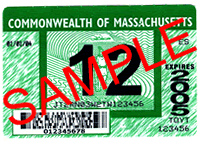
, emissions, or both. Inspection can be required at various times, e.g., periodically or on transfer of title to a vehicle. If required periodically, it is often termed periodic motor vehicle inspection; typical intervals are every two years and every year. The stickers that are on car's winshields are called inspection decals or inspection stickers.
In some jurisdictions, proof of inspection is required before a vehicle licence
Vehicle licence
A valid vehicle licence is required by law in some countries to be displayed on any registered motor vehicle if it is to be used or kept on a public road.-Worldwide:...
or license plate
US and Canadian license plates
In the United States, license plates are issued by an agency of the state or territorial government, and in the case of the District of Columbia the District government. Some Native American tribes also issue plates. The U.S. federal government issues plates only for its own vehicle fleet and for...
can be issued or renewed. In others, once a vehicle passes inspection, a decal is attached to the windshield, and police can enforce the inspection law by seeing whether the vehicle displays an up-to-date decal. In the case of a vehicle lacking a windshield (e.g., a trailer
Trailer (vehicle)
A trailer is generally an unpowered vehicle pulled by a powered vehicle. Commonly, the term trailer refers to such vehicles used for transport of goods and materials....
or motorcycle
Motorcycle
A motorcycle is a single-track, two-wheeled motor vehicle. Motorcycles vary considerably depending on the task for which they are designed, such as long distance travel, navigating congested urban traffic, cruising, sport and racing, or off-road conditions.Motorcycles are one of the most...
), the decal is typically attached to the vehicle body or license plate.
There is some controversy over whether periodically inspecting motor vehicles is a cost-effective
Cost-effectiveness
Cost-effectiveness analysis is a form of economic analysis that compares the relative costs and outcomes of two or more courses of action. Cost-effectiveness analysis is distinct from cost-benefit analysis, which assigns a monetary value to the measure of effect...
way to improve road-traffic safety
Road-traffic safety
The term road traffic safety is about the risk of a person being killed or seriously injured while using the road network as a pedestrian, cyclist, motorist or user of on road public transport...
.
Brazil
In Brazil inspections are performed by private companies designated by the cities.Annual inspection is mandatory for all diesel vehicles; all natural gas, gasoline and alcohol vehicles except for new vehicles registered in the current year;
all motorcycles and motorbikes, independent of year of fabrication (two-stroke engines are exempt).
Vehicles are tested for noise level and emissions levels;
After passing inspection the driver is issued an electronic stamp ('selo eletrônico') associated to the license
plate of the vehicle. In São Paulo, traffic cameras identify vehicles that did not get
their annual inspection and issue tickets.
Inspection costs around U$70 for the first time and around $40 in later years.
Canada
AirCare
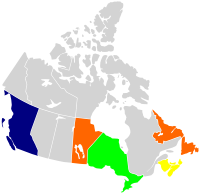
AirCare is a vehicle emissions testing program in place in the Lower Mainland including the Greater Vancouver Regional District and the Fraser Valley Regional District of British Columbia. Drivers in these areas are required to demonstrate that their vehicle has recently passed an emissions test...
in the Lower Mainland only of British Columbia
British Columbia
British Columbia is the westernmost of Canada's provinces and is known for its natural beauty, as reflected in its Latin motto, Splendor sine occasu . Its name was chosen by Queen Victoria in 1858...
and Ontario's Drive Clean
Ontario's Drive Clean
Ontario's Drive Clean is an automobile emissions control program in Ontario, Canada. It applies only to vehicles in the program coverage areas, which are largely the lower half of Ontario, from Windsor in Southwestern Ontario to Ottawa in Eastern Ontario. It is unlikely it will be expanded to...
in Southern Ontario
Ontario
Ontario is a province of Canada, located in east-central Canada. It is Canada's most populous province and second largest in total area. It is home to the nation's most populous city, Toronto, and the nation's capital, Ottawa....
only.
Safety testing regulations vary through the different provinces. In Manitoba
Manitoba
Manitoba is a Canadian prairie province with an area of . The province has over 110,000 lakes and has a largely continental climate because of its flat topography. Agriculture, mostly concentrated in the fertile southern and western parts of the province, is vital to the province's economy; other...
for example, upon buying a car (new or used), a valid safety check must be done before it can be registered. Dealerships are required to provide the buyer with a new safety, while private sellers are not (if a private seller so chooses, they may pay for, and issue a new safety in order to make it more appealing to buy). In either case, If the vehicle bought has not had a safety test within the last year, the buyer must safety the vehicle before it can be registered with autopac. From the point the car is registered, no safety test is required as long as the car remains with the current owner (however, if something goes wrong, automechanics and dealerships have the right to refuse to let the client drive out with an unsafe car).
The provinces of New Brunswick
New Brunswick
New Brunswick is one of Canada's three Maritime provinces and is the only province in the federation that is constitutionally bilingual . The provincial capital is Fredericton and Saint John is the most populous city. Greater Moncton is the largest Census Metropolitan Area...
and Prince Edward Island
Prince Edward Island
Prince Edward Island is a Canadian province consisting of an island of the same name, as well as other islands. The maritime province is the smallest in the nation in both land area and population...
require annual safety inspections, in Nova Scotia
Nova Scotia
Nova Scotia is one of Canada's three Maritime provinces and is the most populous province in Atlantic Canada. The name of the province is Latin for "New Scotland," but "Nova Scotia" is the recognized, English-language name of the province. The provincial capital is Halifax. Nova Scotia is the...
, a safety inspection is required every two years. Ontario
Ontario
Ontario is a province of Canada, located in east-central Canada. It is Canada's most populous province and second largest in total area. It is home to the nation's most populous city, Toronto, and the nation's capital, Ottawa....
and British Columbia
British Columbia
British Columbia is the westernmost of Canada's provinces and is known for its natural beauty, as reflected in its Latin motto, Splendor sine occasu . Its name was chosen by Queen Victoria in 1858...
require bi-annual emission testing, although only the Lower Mainland of BC, which includes the city of Vancouver, and the southern part of Ontario, require any testing. The rest of the province is without such legislation.
Mar 2008 "CAA-Quebec is recommending that the government implement mandatory inspections for motor vehicles more than eight years old, because this would result in significantly fewer emissions being produced by Quebec's automobiles."
United States

In the United States, each state
U.S. state
A U.S. state is any one of the 50 federated states of the United States of America that share sovereignty with the federal government. Because of this shared sovereignty, an American is a citizen both of the federal entity and of his or her state of domicile. Four states use the official title of...
government is free to decide whether to require vehicle safety inspection, as well as the specifics of the inspection program. 18 states have a periodic (annual or biannual) safety inspection program, while Maryland requires an inspection prior to registration or transfer of ownership only.
Under the Clean Air Act (1990), states are required to implement vehicle emission inspection programs in metropolitan areas whose air quality does not meet federal standards. The specifics of those programs vary from state to state. Some states, including Florida, Kentucky and Minnesota, have discontinued their testing programs in recent years with approval from the federal government.
In most states, such inspections are done at state-operated garages, usually near the local DMV
Department of Motor Vehicles
In the United States of America, a Department of Motor Vehicles is a state-level government agency that administers vehicle registration and driver licensing. Similar departments exist in Canada...
office. Massachusetts
Massachusetts
The Commonwealth of Massachusetts is a state in the New England region of the northeastern United States of America. It is bordered by Rhode Island and Connecticut to the south, New York to the west, and Vermont and New Hampshire to the north; at its east lies the Atlantic Ocean. As of the 2010...
, Pennsylvania
Pennsylvania
The Commonwealth of Pennsylvania is a U.S. state that is located in the Northeastern and Mid-Atlantic regions of the United States. The state borders Delaware and Maryland to the south, West Virginia to the southwest, Ohio to the west, New York and Ontario, Canada, to the north, and New Jersey to...
, New York
New York
New York is a state in the Northeastern region of the United States. It is the nation's third most populous state. New York is bordered by New Jersey and Pennsylvania to the south, and by Connecticut, Massachusetts and Vermont to the east...
, Texas
Texas
Texas is the second largest U.S. state by both area and population, and the largest state by area in the contiguous United States.The name, based on the Caddo word "Tejas" meaning "friends" or "allies", was applied by the Spanish to the Caddo themselves and to the region of their settlement in...
, North Carolina
North Carolina
North Carolina is a state located in the southeastern United States. The state borders South Carolina and Georgia to the south, Tennessee to the west and Virginia to the north. North Carolina contains 100 counties. Its capital is Raleigh, and its largest city is Charlotte...
, New Hampshire
New Hampshire
New Hampshire is a state in the New England region of the northeastern United States of America. The state was named after the southern English county of Hampshire. It is bordered by Massachusetts to the south, Vermont to the west, Maine and the Atlantic Ocean to the east, and the Canadian...
, and Virginia
Virginia
The Commonwealth of Virginia , is a U.S. state on the Atlantic Coast of the Southern United States. Virginia is nicknamed the "Old Dominion" and sometimes the "Mother of Presidents" after the eight U.S. presidents born there...
are notable exceptions, instead opting to have privately-owned garages doing inspections with approval from the state DOT.
On August 1, 2010, New Jersey
New Jersey
New Jersey is a state in the Northeastern and Middle Atlantic regions of the United States. , its population was 8,791,894. It is bordered on the north and east by the state of New York, on the southeast and south by the Atlantic Ocean, on the west by Pennsylvania and on the southwest by Delaware...
became the 30th state that does not inspect vehicles for safety. They continue to emission-test all vehicles over 5 years old.
Japan
Under the Japanese shaken (車検) program, personal cars and 2 wheeled motorcycles have the first shaken last 3 years with every 2 years requiring a new shaken.China
Chinese Rural Vehicle (CRV) operators can be fined by the police if their vehicle emits visible smoke. Regulations are established and enforced by province/economic region/city as appropriate. New vehicles must pass regulations (Euro spec) in effect on the day of manufacture.Singapore
Cars are required to obtain a safety and emissions inspection every other year starting in the third model year, and annually after 10 model years. Motorcycles and mopeds must be inspected annually starting in the third model year. Buses, taxicabs, commercial vehicles, and trailers must be inspected every year or six months depending on the vehicle's age. An up to date inspection (if required) is needed to renew a vehicle's road taxRoad tax
Road tax, known by various names around the world, is a tax which has to be paid on a motor vehicle before using it on a public road.-Australia:...
.
Turkey
Until 2008 the vehicle inspection was limited to administrative checks (whether all taxes have been paid) and a visual check if the car matches the documents. In August 2005 the Turkish government decided to introduce a vehicle inspection scheme following the directive 96/96/EC of the European Union. Since there was no technical equipment available for real roadworthiness tests a contract was laid out with the German TÜV SÜDTÜV SÜD
TÜV SÜD is an international service corporation focusing on consulting, testing, certification and training. At over 600 locations, primarily in Europe, North America, Asia Pacific, TÜV SÜD Group employs approximately 16,000 staff. In 2010, sales revenues totalled EUR 1.55 billion, roughly 30 per...
that was presenting itself for the task in syndication with two Turkish corporations. The TÜV Türk trust is given a monopoly on car inspection for 20 years. Beginning with 2009 the TÜV test is mandatory for all cars with the inspection scheme to follow the German inspection scheme - however there is a transition period up to 2013 where established TÜV regulations are not followed as strictly as in mainland Europe. The shift in vehicle inspection policies is nevertheless rather sharp - since the old vehicle inspection service was strickened with corruption no staff members were taken over to the TÜV Süd, the internal inspection protocol is stricter than in Germany as to prevent any corruption. The introduction of the TÜV was accompanied with a strong propaganda program to agitate the requirement for a modern inspection scheme (e.g. the number of fatal road accidents was three times as high as in mainland Europe despite most of the country to be very rural). Additionally, it is expected that the connection with the German Turks
German Turks
Turks in Germany are people of Turkish ethnicity living in Germany who form the largest ethnic group after Germans...
allows for most citizens to have some knowledge how to cope with the TÜV inspection scheme.
European Union
The Council directive 96/96/EC of 20 December 1996 mandates all member states to carry out periodic safety and emission inspections for most types of motor vehicles. It also sets minimum requirements for those inspections and their intervals - for light commercial vehicles (up to 3.5 t) and private cars (up to 8 seats) the first inspection shall occur no later than 4 years and at a frequency of up to 2 years thereafter. All other types of vehicles shall be subject to yearly inspection (busses, vans, trucks, trailers, taxis, ambulances, coaches). Vehicles from the military and fire departments are exempted from the directive.Austria

Decal
A decal or transfer is a plastic, cloth, paper or ceramic substrate that has printed on it a pattern or image that can be moved to another surface upon contact, usually with the aid of heat or water. The word is short for decalcomania...
is placed on the vehicle's windscreen (usually the upper left-hand corner as seen from outside the vehicle), hence the inspection itself is colloquially referred to as "Pickerl" (literally: sticker). The color of the decal is white for vehicles with a catalytic converter
Catalytic converter
A catalytic converter is a device used to convert toxic exhaust emissions from an internal combustion engine into non-toxic substances. Inside a catalytic converter, a catalyst stimulates a chemical reaction in which noxious byproducts of combustion are converted to less toxic substances by dint...
, and green for vehicles without one. Punch holes indicate the month and year that the next inspection is due. The actual inspection can be carried out one month in advance of that date and up to four months after the date indicated on the decal; the vehicle remains roadworthy during that time. Unless the inspection is overdue in the sense just described, the roadworthiness certificate is transferable, meaning a potential new owner will get a new decal with the same date, but the corrected license plate number upon registration of her vehicle. However, the latest official inspection report has to be presented for this purpose to the authority issuing the new registration documents and license plates.
The first inspection on new passenger cars is required after three years, another one two years on, while thereafter passenger cars must pass the official inspection each and every year to remain roadworthy. Heavy trucks and motorcycles must undergo annual inspections from the very first year. Inspections are carried out by specially licensed garages and by Austria's two major automotive clubs. The Austrian motor vehicle inspection covers both aspects of vehicle safety and emissions standards.
Bulgaria
All cars over 3 years old must undergo an annual test. This test is conducted at accredited garages and at KAT police stations. This test is rather basic with only the brakes being tested.Finland
Finland has a long tradition of vehicle inspection, dating back to year 1917. Vehicle inspection was initially carried by cities and provincial inspectors but starting from year 1968 the inspection moved to national governing body of road vehicle administration known as Autorekisterikeskus. In 1994 the vehicle inspection was opened for competition and in 1996 Autorekisterikeskus was split as administrative body Ajoneuvohallintokeskus (AKE) and inspection company Suomen Autokatsastus Oy. Nowadays, Liikenteen Turvallisuusvirasto TraFi, the successor of Ajoneuvohallintokeskus since beginning of the 2010, governs the inspection companies and keeps track of inspection quality and the inspections are carried by private companies. During the years, the inspection procedures and facilities have improved greatly and nowadays the quality of inspection is on such level that mechanical failures as immediate cause for fatal crashes in whole country are minimal.In Finland, the "Määräaikaiskatsastus" (periodic inspection) is required for all passenger cars, vans, trucks, ATVs and for trailers with maximum structural weight of more than 750 kilograms. Inspection interval depends on vehicle class and usage. For privately-used passenger car, inspection must be carried after three and five years counting from the specified date of first deployment and every year after fifth year. For privately-used van, the first inspection must be carried after three years and every year after third year. If there is no specified date of first deployment (for instance 00.00.1987) the time of inspection is determined by the last number of license plate. The inspection period also varies depending on vehicle class and usage but for privately-used passenger cars and vans the length of the period is four months preceding the date specified in date of first deployment or four months preceding the last date of inspection specified by the license plate number.
The periodic inspection includes verification of vehicle register information (VIN, taxes, insurance), a test drive, brake testing, inspection of lights and compulsory equipment, superficial inspection for visibility and handling hindrances and bodywork, undercarriage inspection for suspension parts and corrosion and emission measurements (requirements vary depending on propellant and date of first deployment). The emission measurement can be taken on a registered repair shop prior to the inspection. If done so, a proper measurement certificate must be shown at inspection. Upon passed inspection, a new "Part one" of registration certificate is printed and handed to customer among with inspection report. If inspection fails, the faults found during the inspection must be repaired and the vehicle needs to be shown at the same inspection station for "Jälkitarkastus" (recheck) within one month of the inspection.
France
Vehicle testing has been mandatory in France since 1992. The first inspection (Contrôle Technique) is carried out after four years then subsequently every two years. A blue and white CT sticker affixed inside the windscreen indicates when the next test is due.A less than 6 month valid CT is required prior to transfer of ownership.
Germany
German car number plates
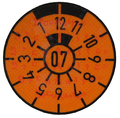
German car number plates show the place where the car carrying them is registered. Whenever German citizens change their main place of residence in Germany, they are required to buy new number plates. Number plates can be bought which are valid all year round or between 2 to 11 months within any...
; the emission inspection decal was placed on the front license plate until it was phased out in 2010 and integrated into the safety inspection).
Ireland
In Ireland, the National Car Test (NCT) is required for cars four or more years of age to be inspected for various items, such as brakes, lighting, bodywork condition, emissions, etc. A disc which must be displayed on the windscreen is issued to cars that pass the test. The disc is valid for two years, after which the car must then be retested.A Certificate of Roadworthiness is required for goods vehicles, or vehicles carrying more than eight passengers (buses). This is commonly referred to as a "DOE" cert and the test is carried out in approved garages.
Norway
In Norway, the vehicle inspection is called "Periodisk Kjøretøykontroll", which translates to "Periodic vehicle inspection", although it is commonly referred to as "EU kontroll", for its origin from the European Union.When a car is 4 years old it must undergo its first inspection. After this, inspections will be required every second year.
Buses, taxicabs and ambulances are inspected every year.
The inspection focuses on safety and emission. After the inspection is completed, you will be given a check list with errors that must be repaired before the vehicle can pass. If the car only have errors marked with 1, or none errors at all, the car will pass immediately. The errors are rated depending on how dangerous they are, with the grades of 1, 2 and 3. Errors marked with 1 will not require a re-inspection. Errors marked with 2 will require a re-inspection, but the owner can use the car until the inspection deadline. Errors marked with 3 are very rare, and prohibits the user from using the car until those errors are repaired.
The inspection cost is usually between 75-130 US dollars (400-700 Norwegian Kroner). You can have your vehicle inspected at garages approved by the NPRA
Norwegian Public Roads Administration
The Norwegian Public Roads Administration is a Norwegian government agency responsible for the state and county public roads in the country. This includes planning, construction and operation of the state and county road networks, driver training and licensing, vehicle inspection and subsidies to...
. Without a passed inspection, the license plates will be withdrawn and the car will no longer be street legal. The police and the NPRA are checking license plates at a regular interval to check if the car has passed the inspection, if the road tax is paid and the car is insured.
Poland
In Poland there's an annual inspection requirement for most vehicles. New passenger car vehicles (of age 4 or less) have to be inspected every two years. Inspections are performed by accredited garages. The inspection includes checking of main car systems like brakes, suspension, lights and steering, as well as emission and presence of mandatory equipment. An additional, separate inspection is required for cars that are running on autogasAutogas
Autogas is the common name for liquefied petroleum gas when it is used as a fuel in internal combustion engines in vehicles as well as in stationary applications such as generators. It is a mixture of propane and butane....
. Pass of inspection is confirmed in registration certificate. When car does not pass the inspection, owner is requested to remove the cause and then pass subsequent inspection. Registration certificate may be also revoked in case the vehicle is in fatal technical condition.
Driving a car without valid inspection is subject to a fine.
Spain
Spanish vehicles are required to undergo an Inspección Técnica de Vehículos, better known as the ITV.Sweden
The road worthiness of cars is tested once every year for modern cars, every second year for cars classified as veteran/classic carsAntique vehicle registration
Antique vehicle registration is a special form of motor vehicle registration for vehicles that are considered antique, classic, vintage, or historic...
(currently occurring when the car reaches age 30). Since July 2010 the inspection can be performed by any vehicle inspection body accredited by SWEDAC
SWEDAC
Swedish Board for Accreditation and Conformity Assessment is the national accreditation body, assessing the competence of laboratories, certification and inspection bodies in Sweden....
.
Before 1 January 2010, when a vehicle had passed inspection and road tax and insurance had been paid, the owner would receive an adhesive sticker to attach to the rear license plate, thus making it easy for the police to see if a vehicle is roadworthy. This sticker is no longer in use.
The Netherlands
In The Netherlands the "Algemene Periodieke Keuring" (APK) or General Periodical Inspection is mandatory for vehicles aging 3 – 50 years. The inspection of vehicles up to 30 years old is annual, bi-annual for vehicles from 30–50 years old, older vehicles are exempt. The inspection includes conforming to safety and emission standards in force in the year of first introduction of the car. Registration is all digital and public, there are no longer visible stickers or decalDecal
A decal or transfer is a plastic, cloth, paper or ceramic substrate that has printed on it a pattern or image that can be moved to another surface upon contact, usually with the aid of heat or water. The word is short for decalcomania...
s on the vehicle, and since July 2008 the paper inspection report does not need to be carried in the car anymore.
United Kingdom
The Department Of Transport (formerly the Ministry of Transport, hence it being usually referred to as the MOT) test is a mandatory annual test of safety, roadworthiness and exhaust emissions for vehicles over three years old.Australia
Vehicle inspection in Australia is done on a state basis. Each state or territory has the authority to set its own laws pertaining to vehicle inspections, all (with the exception of the self governing territory of Norfolk IslandNorfolk Island
Norfolk Island is a small island in the Pacific Ocean located between Australia, New Zealand and New Caledonia. The island is part of the Commonwealth of Australia, but it enjoys a large degree of self-governance...
) have some form of inspection, either periodically or before a transfer of ownership.
New Zealand
The New Zealand Transport AgencyNew Zealand Transport Agency
The New Zealand Transport Agency is a New Zealand Crown entity tasked with promoting safe and functional transport by land, including the responsibility for driver and vehicle licensing and investigating rail accidents. It was created on 1 August 2008 by the Land Transport Management Amendment...
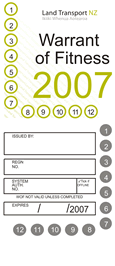
requires most vehicles to maintain a Warrant of Fitness through periodic inspections from licensed inspectors. Cars and light vehicles newer than six years old must be inspected at least once every twelve months; older cars require six-monthly inspections. Heavy vehicles and some classes of light vehicles (such as rental cars) must instead maintain a Certificate of Fitness, which requires a six-monthly inspection regardless of the age of the vehicle.
External links
- ROAD CHECK MOBILE PRE-PURCHASE AND CAR WARRANTY INSPECTIONS in Sydney, New South Wales
- CHECK-IT AUSTRALIA- Prepurchase Vehicle Inspection.org
- CITA-Vehicle Inspection.org
- Vehicle Inspections in the UK
- NRMA
- Vehicle Inspection ( Araç Muayene) Turkey TUVTURK
- http://www.autospections.com.au Autospections
- AUTOSPECTOR Florida Pre-Purchase Vehicle Inspections
- Workshop Vehicle Inspection, MOT & Warranty