


Vegetarianism and religion

Encyclopedia
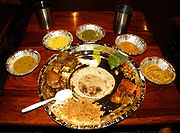
Hinduism
Hinduism is the predominant and indigenous religious tradition of the Indian Subcontinent. Hinduism is known to its followers as , amongst many other expressions...
, Jainism
Jainism
Jainism is an Indian religion that prescribes a path of non-violence towards all living beings. Its philosophy and practice emphasize the necessity of self-effort to move the soul towards divine consciousness and liberation. Any soul that has conquered its own inner enemies and achieved the state...
and Buddhism
Buddhism
Buddhism is a religion and philosophy encompassing a variety of traditions, beliefs and practices, largely based on teachings attributed to Siddhartha Gautama, commonly known as the Buddha . The Buddha lived and taught in the northeastern Indian subcontinent some time between the 6th and 4th...
). In Jainism, vegetarianism
Vegetarianism
Vegetarianism encompasses the practice of following plant-based diets , with or without the inclusion of dairy products or eggs, and with the exclusion of meat...
is mandatory for everyone; in Hinduism and Mahayana Buddhism
Mahayana
Mahāyāna is one of the two main existing branches of Buddhism and a term for classification of Buddhist philosophies and practice...
, it is advocated by some influential scriptures and religious authorities. Comparatively, in the Abrahamic religions
Abrahamic religions
Abrahamic religions are the monotheistic faiths emphasizing and tracing their common origin to Abraham or recognizing a spiritual tradition identified with him...
(Judaism
Judaism
Judaism ) is the "religion, philosophy, and way of life" of the Jewish people...
, Christianity
Christianity
Christianity is a monotheistic religion based on the life and teachings of Jesus as presented in canonical gospels and other New Testament writings...
and Islam
Islam
Islam . The most common are and . : Arabic pronunciation varies regionally. The first vowel ranges from ~~. The second vowel ranges from ~~~...
) and in Sikhism
Sikhism
Sikhism is a monotheistic religion founded during the 15th century in the Punjab region, by Guru Nanak Dev and continued to progress with ten successive Sikh Gurus . It is the fifth-largest organized religion in the world and one of the fastest-growing...
, vegetarianism is not promoted by mainstream authorities. In Christianity and Sikhism, however, there are groups promoting vegetarianism on religious grounds.
Indian religions
Most Indian religions have philosophical schools that forbid consumption of meat and Jainism institutes an outright ban on the same. Consequently, IndiaIndia
India , officially the Republic of India , is a country in South Asia. It is the seventh-largest country by geographical area, the second-most populous country with over 1.2 billion people, and the most populous democracy in the world...
is home to more vegetarians than any other country. About 30% of India's 1.2 billion population practices lacto vegetarianism, with overall meat consumption increasing.
Jainism
Vegetarianism in JainismJainism
Jainism is an Indian religion that prescribes a path of non-violence towards all living beings. Its philosophy and practice emphasize the necessity of self-effort to move the soul towards divine consciousness and liberation. Any soul that has conquered its own inner enemies and achieved the state...
is based on the principle of nonviolence (ahimsa) like in Hinduism, but it is stricter than in the main Hindu traditions and are considered mandatory for everyone. Jains are either lacto-vegetarians or vegans
Veganism
Veganism is the practice of eliminating the use of animal products. Ethical vegans reject the commodity status of animals and the use of animal products for any purpose, while dietary vegans or strict vegetarians eliminate them from their diet only...
. No use or consumption of products obtained from dead animals is allowed. Moreover Jains try to avoid unnecessary injury to plants and suksma jiva (Sanskrit for subtle life forms; minuscule organisms). The goal is to cause as little violence to living things as possible, hence they avoid eating roots, tubers and anything that involves uprooting (and thus eventually killing) a plant to obtain food.
Every act by which a person directly or indirectly supports killing or injury is seen as violence (himsa), which creates harmful karma. The aim of ahimsa is to prevent the accumulation of such karma. Jains consider nonviolence to be the most essential religious duty for everyone (ahinsā paramo dharmaḥ, a statement often inscribed on Jain temples). Their scrupulous and thorough way of applying nonviolence to everyday activities, and especially to food, shapes their entire lives and is the most significant hallmark of Jain identity. A side effect of this strict discipline is the exercise of asceticism, which is strongly encouraged in Jainism for lay people as well as for monks and nuns.
Jains do not believe in animal sacrifice as they consider all sentient beings to be equal.
Hinduism
Vegetarianism is an integral part of most schools of Hinduism although there are a wide variety of practices and beliefs that have changed over time. An estimated 20 to 30% of all Hindus are vegetarians. Some sects of Hindus do not observe vegetarianism.Nonviolence
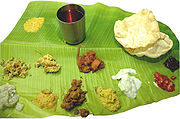
Nonviolence
Nonviolence has two meanings. It can refer, first, to a general philosophy of abstention from violence because of moral or religious principle It can refer to the behaviour of people using nonviolent action Nonviolence has two (closely related) meanings. (1) It can refer, first, to a general...
(Ahimsa
Ahimsa
Ahimsa is a term meaning to do no harm . The word is derived from the Sanskrit root hims – to strike; himsa is injury or harm, a-himsa is the opposite of this, i.e. non harming or nonviolence. It is an important tenet of the Indian religions...
) applied to animals is connected with the intention to avoid negative karmic
Karma
Karma in Indian religions is the concept of "action" or "deed", understood as that which causes the entire cycle of cause and effect originating in ancient India and treated in Hindu, Jain, Buddhist and Sikh philosophies....
influences which result from violence. The suffering of all beings is believed to arise from craving and desire, conditioned by the karmic effects of both animal and human action. The violence of slaughtering animals for food, and its source in craving, reveal flesh eating as one mode in which humans enslave themselves to suffering. Hinduism holds that such influences affect he who permits the slaughter of an animal, he who cuts it up, he who kills it, he who buys or sells meat, he who cooks it, he who serves it up, and he who eats it. They must all be considered the slayers of the animal. The question of religious duties towards the animals and of negative Karma incurred from violence (himsa) against them is discussed in detail in Hindu scriptures and religious law books.
Hindu scriptures belong or refer to the Vedic period
Vedic period
The Vedic period was a period in history during which the Vedas, the oldest scriptures of Hinduism, were composed. The time span of the period is uncertain. Philological and linguistic evidence indicates that the Rigveda, the oldest of the Vedas, was composed roughly between 1700–1100 BCE, also...
which lasted till about 500 BCE according to the chronological division by modern historians. In the historical Vedic religion
Historical Vedic religion
The religion of the Vedic period is a historical predecessor of Hinduism. Its liturgy is reflected in the mantra portion of the four Vedas, which are compiled in Sanskrit. The religious practices centered on a clergy administering rites...
, the predecessor of Hinduism, meat eating was not banned in principle, but was restricted by specific rules. Several highly authoritative scriptures bar violence against domestic animals except in the case of ritual sacrifice. This view is clearly expressed in the Mahabharata
Mahabharata
The Mahabharata is one of the two major Sanskrit epics of ancient India and Nepal, the other being the Ramayana. The epic is part of itihasa....
(3.199.11-12; 13.115; 13.116.26; 13.148.17), the Bhagavata Purana
Bhagavata purana
The Bhāgavata Purāṇa is one of the "Maha" Puranic texts of Hindu literature, with its primary focus on bhakti to the incarnations of Vishnu, particularly Krishna...
(11.5.13-14), and the Chandogya Upanishad
Chandogya Upanishad
The Chandogya Upanishad is one of the "primary" Upanishads. Together with the Jaiminiya Upanishad Brahmana and the Brihadaranyaka Upanishad it ranks among the oldest Upanishads, dating to the Vedic Brahmana period....
(8.15.1). For instance, many Hindus point to the Mahabharata
Mahabharata
The Mahabharata is one of the two major Sanskrit epics of ancient India and Nepal, the other being the Ramayana. The epic is part of itihasa....
's maxim that "Nonviolence is the highest duty and the highest teaching," as advocating a vegetarian diet. It is also reflected in the Manu Smriti
Manu Smriti
' , also known as Mānava-Dharmaśāstra , is the most important and earliest metrical work of the Dharmaśāstra textual tradition of Hinduism...
(5.27-44), a particularly renowned traditional Hindu law book (Dharmaśāstra
Dharmasastra
Dharmaśāstra is a genre of Sanskrit texts and refers to the śāstra, or Indic branch of learning, pertaining to Hindu dharma, religious and legal duty. The voluminous textual corpus of Dharmaśāstra is primarily a product of the Brahmanical tradition in India and represents the elaborate scholastic...
). These texts strongly condemn the slaughter of animals and meat eating.
The Mahabharata (12.260; 13.115-116; 14.28) and the Manu Smriti (5.27-55) contain lengthy discussions about the legitimacy of ritual slaughter and subsequent consumption of the meat. In the Mahabharata both meat eaters and vegetarians present various arguments to substantiate their viewpoints. Apart from the debates about domestic animals, there is also a long discourse by a hunter in defence of hunting and meat eating. These texts show that both ritual slaughter and hunting were challenged by advocates of universal non-violence and their acceptability was doubtful and a matter of dispute.
Spiritual aspects
In some traditions, especially within VaishnavismVaishnavism
Vaishnavism is a tradition of Hinduism, distinguished from other schools by its worship of Vishnu, or his associated Avatars such as Rama and Krishna, as the original and supreme God....
, it is essential that devotees offer all their food to their chosen deity
Deity
A deity is a recognized preternatural or supernatural immortal being, who may be thought of as holy, divine, or sacred, held in high regard, and respected by believers....
before eating it as prasad
Prasad
Prasād is a mental condition of generosity, as well as a material substance that is first offered to a deity and then consumed...
. This rule is strictly observed by the disciples of the schools of Bhakti Yoga
Bhakti yoga
Bhakti yoga is one of the types of yoga mentioned in Hindu philosophies which denotes the spiritual practice of fostering loving devotion to a personal form of God....
, especially the Gaudiya Vaishnavas
Gaudiya Vaishnavism
Gaudiya Vaishnavism is a Vaishnava religious movement founded by Chaitanya Mahaprabhu in India in the 16th century. "Gaudiya" refers to the Gauḍa region with Vaishnavism meaning "the worship of Vishnu"...
. They worship Vishnu
Vishnu
Vishnu is the Supreme god in the Vaishnavite tradition of Hinduism. Smarta followers of Adi Shankara, among others, venerate Vishnu as one of the five primary forms of God....
or Krishna
Krishna
Krishna is a central figure of Hinduism and is traditionally attributed the authorship of the Bhagavad Gita. He is the supreme Being and considered in some monotheistic traditions as an Avatar of Vishnu...
, and according to the scriptural injunctions they obey, only vegetarian food is acceptable as prasad.
Vegetarianism is also mandatory for the practitioners of Hatha Yoga
Hatha yoga
Hatha yoga , also called hatha vidya , is a system of yoga introduced by Yogi Swatmarama, a Hindu sage of 15th century India, and compiler of the Hatha Yoga Pradipika....
. They follow the advice of scriptures such as the Bhagavad Gita
Bhagavad Gita
The ' , also more simply known as Gita, is a 700-verse Hindu scripture that is part of the ancient Sanskrit epic, the Mahabharata, but is frequently treated as a freestanding text, and in particular, as an Upanishad in its own right, one of the several books that constitute general Vedic tradition...
to eat only high-quality food, because they are convinced that food shapes the personality, mood and mind. Meat is said to promote sloth and ignorance and an undesirable mental state known as tamas
Tamas (philosophy)
In the Samkhya school of philosophy, tamas is one of the three gunas , the other two being rajas and sattva or purity). Tamas is the template for inertia or resistance to action...
, while a vegetarian diet is considered to promote the desirable sattvic
Sattvic diet
A sattvic diet, also referred to as a yoga diet or sentient diet, is a diet based on foods which, according to Ayurveda, Yoga, and Jainism, are strong in the sattva guna, and lead to clarity and equanimity of mind while also being beneficial to the body.Such foods include water, cereal grains, mung...
qualities essential for spiritual progress.
Essential scriptural evidence
"What need there be said of those innocent and healthy creatures endued with love of life, when they are sought to be slain by sinful wretches subsisting by slaughter? For this reason, O monarch, know that the discarding of meat is the highest refuge of religion, of heaven, and of happiness. Abstention from injury is the highest religion. It is, again, the highest penance. It is also the highest truths from which all duty proceeds. Flesh cannot be had from grass or wood or stone. Unless a living creature is slain, it cannot be had. Hence is the fault in eating flesh... That man who abstains from meat, is never put in fear, O king, by any creature. All creatures seek his protection. He never causes any anxiety in others, and himself has never to become anxious. If there were nobody who ate flesh there would then be nobody to kill living creatures. The man who kills living creatures kill them for the sake of the person who eats flesh. If flesh were regarded as inedible, there would then be no slaughter of living creatures. It is for the sake of the eater that the slaughter of living creatures goes on in the world. Since, O thou of great splendour, the period of life is shortened of persons who slaughter living creatures or cause them to be slaughtered, it is clear that the person who wishes his own good should give up meat entirely... The purchaser of flesh performs himsa [violence] by his wealth; he who eats flesh does so by enjoying its taste; the killer does himsa by actually tying and killing the animal. Thus, there are three forms of killing. He who brings flesh or sends for it, he who cuts off the limbs of an animal, and he who purchases, sells, or cooks flesh and eats it—all of these are to be considered meat-eaters." (MahabharataMahabharataThe Mahabharata is one of the two major Sanskrit epics of ancient India and Nepal, the other being the Ramayana. The epic is part of itihasa....
13.115)
"Those sinful persons who are ignorant of actual religious principles, yet consider themselves to be completely pious, without compunction commit violence against innocent animals who are fully trusting in them. In their next lives, such sinful persons will be eaten by the same creatures they have killed in this world." (Bhagavata PuranaBhagavata puranaThe Bhāgavata Purāṇa is one of the "Maha" Puranic texts of Hindu literature, with its primary focus on bhakti to the incarnations of Vishnu, particularly Krishna...
11.5.14)
"A person fully aware of religious principles should never offer anything like meat, eggs or fish in the SraddhaŚrāddhaŚrāddha or Shraaddha is a Sanskrit word which literally means anything or any act that is performed with all sincerity and faith . In the Hindu religion, it is the ritual that one performs to pay homage to one’s 'ancestors' , especially to one’s dead parents...
ceremony, and even if one is a KshatriyaKshatriya*For the Bollywood film of the same name see Kshatriya Kshatriya or Kashtriya, meaning warrior, is one of the four varnas in Hinduism...
(warrior), he himself should not eat such things." (Bhagavata Purana 7.15.7)
Current situation
In modern India the food habits of Hindus vary according to their community or caste and according to regional traditions. Hindu vegetarians usually eschew eggs but consume milk and dairy productDairy product
Dairy products are generally defined as foods produced from cow's or domestic buffalo's milk. They are usually high-energy-yielding food products. A production plant for such processing is called a dairy or a dairy factory. Raw milk for processing comes mainly from cows, and, to a lesser extent,...
s, so they are lacto-vegetarians
Lacto vegetarianism
A lacto vegetarian diet is a vegetarian diet that includes dairy products such as milk, cheese, yogurt, butter, cream, and kefir, but excludes eggs. Lacto-vegetarians also abstain from cheeses that include animal rennet and yogurts that contain gelatin...
.
According to a survey of 2006, vegetarianism is weak in coastal states and strong in landlocked northern and western states and among Brahmin
Brahmin
Brahmin Brahman, Brahma and Brahmin.Brahman, Brahmin and Brahma have different meanings. Brahman refers to the Supreme Self...
s in general, 55 percent of whom are vegetarians. Many coastal inhabitants are fish eaters. In particular Bengali
Bengali people
The Bengali people are an ethnic community native to the historic region of Bengal in South Asia. They speak Bengali , which is an Indo-Aryan language of the eastern Indian subcontinent, evolved from the Magadhi Prakrit and Sanskrit languages. In their native language, they are referred to as বাঙালী...
Hindus have romanticized fishermen and the consumption of fish through poetry, literature and music.
Hindus who eat meat
Meat
Meat is animal flesh that is used as food. Most often, this means the skeletal muscle and associated fat and other tissues, but it may also describe other edible tissues such as organs and offal...
are encouraged to eat Jhatka
Jhatka
Jhatka or Chatka meat is meat from an animal which has been killed by a single strike of a sword or axe to sever the head, as opposed to Jewish slaughter or Islamic slaughter in which the animal is killed by ritually slicing the throat.-Jhatka meat and Sikhs:Jhatka for Sikhs is the...
meat.
Bali sacrifice
Bali Sacrifice (sometimes known as Jhatka Bali) is the ritual killing of an animal in HinduismHinduism
Hinduism is the predominant and indigenous religious tradition of the Indian Subcontinent. Hinduism is known to its followers as , amongst many other expressions...
.
The ritual sacrifice normally forms part of a festival to honour a Hindu god. For example, in Nepal the Hindu goddess Gadhimai, is honoured every 5 years with the slaughter of 250,000 animals. Bali sacrifice today is common at the Sakta shrines of the Goddess Kali.
Buddhism
The first lay precept in BuddhismBuddhism
Buddhism is a religion and philosophy encompassing a variety of traditions, beliefs and practices, largely based on teachings attributed to Siddhartha Gautama, commonly known as the Buddha . The Buddha lived and taught in the northeastern Indian subcontinent some time between the 6th and 4th...
prohibits killing. Unlike the Biblical commandment ("Thou shalt not kill
You shall not murder
You shall not murder or You shall not kill, KJV Thou shalt not kill , is a moral imperative included as one of the Ten Commandments in the Torah, specificallyExodus 20:13 and Deuteronomy 5:17....
"), which Jewish and Christian authorities have typically applied only to human beings, the First Precept has always been held to apply to animals as well as humans. Many see this as implying that Buddhists should not eat the meat of animals. There are however differing points of view. The Buddha made distinction between killing an animal and consumption of meat, stressing that it is immoral conduct that makes one impure, not the food one eats. At one point the Buddha specifically refused to institute vegetarianism. There were, however, rules prohibiting certain types of meat, such as human, leopard
Leopard
The leopard , Panthera pardus, is a member of the Felidae family and the smallest of the four "big cats" in the genus Panthera, the other three being the tiger, lion, and jaguar. The leopard was once distributed across eastern and southern Asia and Africa, from Siberia to South Africa, but its...
or elephant
Elephant
Elephants are large land mammals in two extant genera of the family Elephantidae: Elephas and Loxodonta, with the third genus Mammuthus extinct...
. Monks are also prohibited from consuming meat if they witnessed the animal's death or know it was killed specifically for them.
On the other hand, the Buddha in certain Mahayana sutras
Mahayana sutras
Mahāyāna sutras are a broad genre of Buddhist scriptures that are accepted as canonical by the various traditions of Mahāyāna Buddhism. These are largely preserved in the Chinese Buddhist canon, the Tibetan Buddhist canon, and in extant Sanskrit manuscripts...
strongly denounces the eating of meat. In the Mahayana Mahaparinirvana Sutra
Mahayana Mahaparinirvana Sutra
The Nirvana Sutra or ' ; ; ).) is one of the major sutras of Mahayana Buddhism. It shares its title with another well-known Buddhist scripture, the Mahaparinibbana Sutta of the Pali Canon but is quite different in form and content...
, the Buddha states that "the eating of meat extinguishes the seed of great compassion", adding that all and every kind of meat and fish consumption (even of animals already found dead) is prohibited by him. The Buddha goes on to emphasize that meat-eating cannot coexist with the great compassion and calls for not just a vegetarian, but a vegan lifestyle. The Buddha also predicts in this sutra that later monks will "hold spurious writings to be the authentic Dharma" and will concoct their own sutras and mendaciously claim that the Buddha allows the eating of meat, whereas in fact (he says) he does not. The Lankavatara Sutra (a Mahayana scripture), in particular, devotes an entire chapter to the Buddha's response to the request of a disciple named Mahamati to "teach us as to the merit and vice of meat-eating." A long passage in the Lankavatara Sutra
Lankavatara Sutra
The Laṅkāvatāra Sūtra is a sutra of Mahāyāna Buddhism. The sūtra recounts a teaching primarily between the Buddha and a bodhisattva named Mahāmati...
shows the Buddha weighing strongly in favor of vegetarianism, since the eating of the flesh of fellow sentient beings is said by him to be incompatible with the compassion a Bodhisattva
Bodhisattva
In Buddhism, a bodhisattva is either an enlightened existence or an enlightenment-being or, given the variant Sanskrit spelling satva rather than sattva, "heroic-minded one for enlightenment ." The Pali term has sometimes been translated as "wisdom-being," although in modern publications, and...
should strive to cultivate. Several other Mahayana sutras also emphatically prohibit the consumption of meat.
A solution to this problem arose when monks from the Indian sphere of influence migrated to China
China
Chinese civilization may refer to:* China for more general discussion of the country.* Chinese culture* Greater China, the transnational community of ethnic Chinese.* History of China* Sinosphere, the area historically affected by Chinese culture...
, as of the year 65 CE. There they met followers who provided them with money instead of food. From those days onwards Chinese monastics, and others who came to inhabit northern countries, cultivated their own vegetable plots and bought everything else they needed in terms of food in the market.
In the modern Buddhist world, attitudes toward vegetarianism vary by location. In China and Vietnam
Vietnam
Vietnam – sometimes spelled Viet Nam , officially the Socialist Republic of Vietnam – is the easternmost country on the Indochina Peninsula in Southeast Asia. It is bordered by China to the north, Laos to the northwest, Cambodia to the southwest, and the South China Sea –...
, monks typically eat no meat (and with other restrictions as well—see Buddhist cuisine
Buddhist cuisine
Buddhist cuisine is an East Asian cuisine which is followed by some believers of Buddhism. It is primarily vegetarian, in order to keep with the general Buddhist precept of ahimsa...
). In Japan
Japan
Japan is an island nation in East Asia. Located in the Pacific Ocean, it lies to the east of the Sea of Japan, China, North Korea, South Korea and Russia, stretching from the Sea of Okhotsk in the north to the East China Sea and Taiwan in the south...
or Korea
Korea
Korea ) is an East Asian geographic region that is currently divided into two separate sovereign states — North Korea and South Korea. Located on the Korean Peninsula, Korea is bordered by the People's Republic of China to the northwest, Russia to the northeast, and is separated from Japan to the...
some schools do not eat meat, while most do. Theravadins in Sri Lanka
Sri Lanka
Sri Lanka, officially the Democratic Socialist Republic of Sri Lanka is a country off the southern coast of the Indian subcontinent. Known until 1972 as Ceylon , Sri Lanka is an island surrounded by the Indian Ocean, the Gulf of Mannar and the Palk Strait, and lies in the vicinity of India and the...
and South-east Asia do not practice vegetarianism. All Buddhists however, including monks, are allowed to practice vegetarianism if they wish to do so. Experts have estimated that worldwide about half of all Buddhists are vegetarian.
Sikhism
Followers of Sikhism do not have a preference for meat or vegetarian consumption. There are two views on initiated or "Amritdhari Sikhs" and meat consumption. "Amritdhari" Sikhs (i.e. those that follow the Sikh Rehat Maryada - the Official Sikh Code of Conduct)) can eat meat (provided it is not Kutha meatKutha meat
Kutha meat is defined as "meat of animal or fowl slaughtered slowly as prescribed by Islamic law.". It has been more broadly defined as "killing an animal with a prayer" or "a sacrifice to God" or meat prepared through "unnecessary ritualism"....
)."Amritdharis" that belong to some Sikh sects (e.g. Akhand Kirtani Jatha
Akhand Kirtani Jatha
The Akhand Kirtani Jatha is a jatha of Sikhs....
, Damdami Taksal
Damdami Taksal
The Damdami Taksal is a 300 years old educational organization said to have been founded by the tenth Sikh Master, Guru Gobind Singh. According to the Damdami Taksal, it was entrusted with the responsibility of teaching the reading , analysis and recitation of the Sikh scriptures by Guru Gobind...
, Namdhari
Namdhari
Namdhari are a sect of Sikhism. The main difference between Namdhari Sikhs and mainstream Sikhs is their belief in Jagjit Singh as their living Guru...
, Rarionwalay, etc.) are vehemently against the consumption of meat and eggs.
In the case of meat, the Sikh Gurus
Sikh Gurus
The Sikh Gurus established Sikhism from over the centuries beginning in the year 1469. Sikhism was founded by the first guru, Guru Nanak, and subsequently, all in order were referred to as "Nanak", and as "Lights", making their teachings in the holy scriptures, equivalent...
have indicated their preference for a simple diet, which could include meat or be vegetarian. Passages from the Guru Granth Sahib
Guru Granth Sahib
Sri Guru Granth Sahib , or Adi Granth, is the religious text of Sikhism. It is the final and eternal guru of the Sikhs. It is a voluminous text of 1430 angs, compiled and composed during the period of Sikh gurus, from 1469 to 1708...
(the holy book of Sikhs, also known as the Adi Granth) say that fools argue over this issue. Guru Nanak said that overconsumption of food (Lobh
Lobh
Lobh is a Gurmukhi word which translates in English to greed; it is a strong desire for worldly possessions and a constant focus on possessing material items, especially the urge to possess what rightfully belongs to others. According to Sikhism, it makes an individual selfish and self-centred. It...
, Greed) involves a drain on the Earth's resources and thus on life. The tenth guru, Guru Gobind Singh
Guru Gobind Singh
Guru Gobind Singh is the tenth and last Sikh guru in a sacred lineage of ten Sikh gurus. Born in Patna, Bihar in India, he was also a warrior, poet and philosopher. He succeeded his father Guru Tegh Bahadur as the leader of Sikhs at a young age of nine...
, prohibited the Sikhs from the consumption of halal
Halal
Halal is a term designating any object or an action which is permissible to use or engage in, according to Islamic law. The term is used to designate food seen as permissible according to Islamic law...
or Kutha
Kutha meat
Kutha meat is defined as "meat of animal or fowl slaughtered slowly as prescribed by Islamic law.". It has been more broadly defined as "killing an animal with a prayer" or "a sacrifice to God" or meat prepared through "unnecessary ritualism"....
(any ritually slaughtered meat) meat because of the Sikh belief that sacrificing an animal in the name of God is mere ritualism (something to be avoided).
On the views that eating vegetation would be eating flesh, first Sikh Guru Nanak states:
On Vegetation, the Guru described it as living and experiencing pain:
Page 143 of the Sri Guru Granth Sahib Ji
- Page 143 Sri Guru Granth Sahib Ji
Sikhs who eat meat, eat Jhatka
Jhatka
Jhatka or Chatka meat is meat from an animal which has been killed by a single strike of a sword or axe to sever the head, as opposed to Jewish slaughter or Islamic slaughter in which the animal is killed by ritually slicing the throat.-Jhatka meat and Sikhs:Jhatka for Sikhs is the...
meat.
Abrahamic religions
Judaic, ChristianChristian
A Christian is a person who adheres to Christianity, an Abrahamic, monotheistic religion based on the life and teachings of Jesus of Nazareth as recorded in the Canonical gospels and the letters of the New Testament...
, and Muslim
Muslim
A Muslim, also spelled Moslem, is an adherent of Islam, a monotheistic, Abrahamic religion based on the Quran, which Muslims consider the verbatim word of God as revealed to prophet Muhammad. "Muslim" is the Arabic term for "submitter" .Muslims believe that God is one and incomparable...
traditions (Abrahamic religions) all have strong connections to the Biblical ideal of the Garden of Eden
Garden of Eden
The Garden of Eden is in the Bible's Book of Genesis as being the place where the first man, Adam, and his wife, Eve, lived after they were created by God. Literally, the Bible speaks about a garden in Eden...
, which includes references to a herbivore diet.[, ] However, only minorities within those populations actually practice and advocate such diets, since the same book of the Bible
Bible
The Bible refers to any one of the collections of the primary religious texts of Judaism and Christianity. There is no common version of the Bible, as the individual books , their contents and their order vary among denominations...
, Genesis, later allegedly gives permission to Noah
Noah
Noah was, according to the Hebrew Bible, the tenth and last of the antediluvian Patriarchs. The biblical story of Noah is contained in chapters 6–9 of the book of Genesis, where he saves his family and representatives of all animals from the flood by constructing an ark...
(and presumably his descendants) to consume animal flesh due to a supposed emergency lack of food.
Judaism
RabbiRabbi
In Judaism, a rabbi is a teacher of Torah. This title derives from the Hebrew word רבי , meaning "My Master" , which is the way a student would address a master of Torah...
nical Judaism
Judaism
Judaism ) is the "religion, philosophy, and way of life" of the Jewish people...
discourages ascetic practices in general, and encourages one to enjoy the bounty of this world in a proper fashion. With respect to food, this teaching may be summarized by the Talmud
Talmud
The Talmud is a central text of mainstream Judaism. It takes the form of a record of rabbinic discussions pertaining to Jewish law, ethics, philosophy, customs and history....
ic statement, "Man will have to account for everything he saw but did not eat." (This refers to permissible or kosher
Kashrut
Kashrut is the set of Jewish dietary laws. Food in accord with halakha is termed kosher in English, from the Ashkenazi pronunciation of the Hebrew term kashér , meaning "fit" Kashrut (also kashruth or kashrus) is the set of Jewish dietary laws. Food in accord with halakha (Jewish law) is termed...
foods only, not to forbidden animal species such as pork
Pork
Pork is the culinary name for meat from the domestic pig , which is eaten in many countries. It is one of the most commonly consumed meats worldwide, with evidence of pig husbandry dating back to 5000 BC....
.) On the other hand, the Talmud discourages indulgence and states that it is preferable that one's diet consist mostly of non-meat products. To Jewish vegetarians wishing to remain consistent with this teaching, vegetarianism is not a form of self-deprivation, because the vegetarian does not desire to eat meat and believes it is healthier not to eat meat.
Several passages in the Old Testament encourages eating animal flesh such as Genesis 9:3 which states "Every moving thing that liveth shall be meat for you."
Genesis 1:29 states "And God said: Behold, I have given you every herb yielding seed which is upon the face of all the earth, and every tree that has seed-yielding fruit—to you it shall be for food." According to some classical Jewish Bible commentators this means that God's original plan was for mankind to be vegetarian, and that God only later gave permission for man to eat meat because of man's weak nature.· As the ideal images of the Torah are vegetarian, it is natural to similarly see the laws of kashrut as actually designed to wean us away from meat eating towards the vegetarian ideal. The rituals of kashrut remind us of the magnitude of what we do each time we kill a living being. Other commentators argue that people may eat animals because God gave Adam and Eve
Adam and Eve
Adam and Eve were, according to the Genesis creation narratives, the first human couple to inhabit Earth, created by YHWH, the God of the ancient Hebrews...
dominion over them.
Generally speaking, Judaism has not promoted vegetarianism. However, some prominent rabbis have promoted vegetarian lifestyle, among them David Cohen
David Cohen (rabbi)
David Cohen was a rabbi, talmudist, philosopher, and kabbalist. A noted Jewish ascetic, he took a Nazirite vow after making aliyah to Israel.-Biography:...
(known as "Ha-Nazir"), and Chief Rabbi of Israel Shlomo Goren
Shlomo Goren
Shlomo Goren , was an Orthodox Religious Zionist rabbi in Israel who founded and served as the first head of the Military Rabbinate of the Israel Defense Forces and subsequently as the third Ashkenazi Chief Rabbi of Israel from 1973 to 1983.He served in the Israel Defense Forces during three wars,...
. Rabbi Isaac ha-Levi Herzog said:
- "Jews will move increasingly to vegetarianism out of their own deepening knowledge of what their tradition commands... A whole galaxy of central rabbinic and spiritual leaders...has been affirming vegetarianism as the ultimate meaning of Jewish moral teaching."
- "Man ideally should not eat meat, for to eat meat a life must be taken, an animal must be put to death."
Rabbi Milgrom
Jacob Milgrom
Jacob Milgrom was a prominent American Jewish Bible scholar and Conservative rabbi, best known for his comprehensive Torah commentaries and work on the Dead Sea Scrolls.-Biography:...
regards the commandment against blood as a law that permits man to "indulge in his lust for meat and not be brutalized in the process."
Some Orthodox authorities have ruled that it is forbidden for an individual to become a vegetarian if they do so because they believe in animal rights; however, they have ruled that vegetarianism is allowed for pragmatic reasons (if kosher meat is expensive or hard to come by in their area), health concerns, or for reasons of personal taste (if someone finds meat unpalatable). Some believe that halakha
Halakha
Halakha — also transliterated Halocho , or Halacha — is the collective body of Jewish law, including biblical law and later talmudic and rabbinic law, as well as customs and traditions.Judaism classically draws no distinction in its laws between religious and ostensibly non-religious life; Jewish...
encourages the eating of meat at the Sabbath and Festival meals, thus some Orthodox Jews who are otherwise vegetarian will nevertheless consume meat at these meals.
There are several arguments from Judaism used by Jewish vegetarians.
For the Jewish vegetarian there are three main components which prove vegetarianism to be an ethical mitzvah: Tza'ar ba'alei hayyim, Pikuach nefesh
Pikuach Nefesh
The Hebrew term pikuakh nefesh describes the principle in Jewish law that the preservation of human life overrides virtually any other religious consideration...
and Bal tashkhit
Bal tashkhit
Bal tashkhit is a basic ethical principle in Jewish law.The principle is rooted in the Biblical law of Deuteronomy 20:19–20...
. Tza'ar ba'alei hayyim is the injunction not to cause ‘pain to living creatures’. Pikuach nefesh is not only the regard for human life which is in immediate danger. Bal Tashchit is the law which prohibits waste. Another argument is that, since Adam and Eve were not allowed to eat meat and that, according to some opinions, in the Messianic
Jewish Messiah
Messiah, ; mashiah, moshiah, mashiach, or moshiach, is a term used in the Hebrew Bible to describe priests and kings, who were traditionally anointed with holy anointing oil as described in Exodus 30:22-25...
era, the whole world will be vegetarian, not eating meat is something that brings the world closer to that ideal. In his booklet summarizing many of Rav Kook’s teachings, Joseph Green, a 20th-century South African Jewish vegetarian writer, concludes that Jewish religious ethical vegetarians are pioneers of the messianic era; they are leading lives that make the coming of the Messiah more likely. The Jewish tradition asserts that one way to speed the coming of the Messiah is to start practicing the ways that will prevail in the messianic time. A second one is that the laws of shechita
Shechita
Shechita is the ritual slaughter of mammals and birds according to Jewish dietary laws...
are meant to prevent the suffering of animals and today, with factory farming
Factory farming
Factory farming is a term referring to the process of raising livestock in confinement at high stocking density, where a farm operates as a factory — a practice typical in industrial farming by agribusinesses. The main products of this industry are meat, milk and eggs for human consumption...
and high-speed, mechanized slaughterhouse
Slaughterhouse
A slaughterhouse or abattoir is a facility where animals are killed for consumption as food products.Approximately 45-50% of the animal can be turned into edible products...
s, even kosher slaughterhouses are considered by some authorities not to fulfill enough of the requirements to render the meat kosher. A third one is that the Sages only mandated eating an olive's bulk of meat during festivals, but even then, this was because in Talmudic times, meat was considered essential for one's diet.
Sacrifices were used as an excuse to eat meat, and later denounced.
- HoseaHoseaHosea was the son of Beeri and a prophet in Israel in the 8th century BC. He is one of the Twelve Prophets of the Jewish Hebrew Bible, also known as the Minor Prophets of the Christian Old Testament. Hosea is often seen as a "prophet of doom", but underneath his message of destruction is a promise...
8:13
-
- They offer sacrifices to me because they are those who eat the meat, but Hashem does not accept their sacrifices, for He is mindful of their sin and remembers their wickedness
- Hosea 6:6
-
- For I desired mercy, and not sacrifice; and the knowledge of God more than burnt offerings.
- JeremiahBook of JeremiahThe Book of Jeremiah is the second of the Latter Prophets in the Hebrew Bible, following the book of Isaiah and preceding Ezekiel and the Book of the Twelve....
7:22-23
-
- 22 For when I brought your forefathers out of Egypt and spoke to them, I did not give them commands about burnt offerings and sacrifices, 23 but I gave them this command: Obey me, and I will be your God and you will be my people. Walk in all the ways I command you, that it may go well with you.
- Isaiah 66:3
-
- But whoever sacrifices a bull is like one who kills a man, and whoever offers a lamb, like one who breaks a dog's neck and whoever makes a grain offering is like one who presents pig's blood, and whoever burns memorial incense, like one who worships an idol. They have chosen their own ways, and their souls delight in their abominations;
In Israel there is one vegetarian moshav
Moshav
Moshav is a type of Israeli town or settlement, in particular a type of cooperative agricultural community of individual farms pioneered by the Labour Zionists during the second aliyah...
(village), called Amirim
Amirim
Amirim is a moshav in the Galilee established by vegetarians. Today 150 families live on the moshav.Amirim is located 650 m. above sea level on a hill overlooking the Sea of Galilee. It is 15 km. from Safed.-History:...
. Its vegetarianism is based on general principles of health and ethics and not on the Jewish religion.
Christianity
Several Christian monasticMonasticism
Monasticism is a religious way of life characterized by the practice of renouncing worldly pursuits to fully devote one's self to spiritual work...
groups, including the Desert Fathers
Desert Fathers
The Desert Fathers were hermits, ascetics, monks, and nuns who lived mainly in the Scetes desert of Egypt beginning around the third century AD. The most well known was Anthony the Great, who moved to the desert in 270–271 and became known as both the father and founder of desert monasticism...
, Trappist
TRAPPIST
TRAPPIST is Belgian robotic telescope in Chile which came online in 2010, and is an acronym for TRAnsiting Planets and PlanetesImals Small Telescope, so named in homage to Trappist beer produced in the Belgian region. Situated high in the Chilean mountains at La Silla Observatory, it is actually...
s, Benedictine
Benedictine
Benedictine refers to the spirituality and consecrated life in accordance with the Rule of St Benedict, written by Benedict of Nursia in the sixth century for the cenobitic communities he founded in central Italy. The most notable of these is Monte Cassino, the first monastery founded by Benedict...
s and Carthusian
Carthusian
The Carthusian Order, also called the Order of St. Bruno, is a Roman Catholic religious order of enclosed monastics. The order was founded by Saint Bruno of Cologne in 1084 and includes both monks and nuns...
s, all of the Orthodox monks
Degrees of Eastern Orthodox monasticism
The degrees of Eastern Orthodox monasticism are the stages an Eastern Orthodox monk or nun passes through in their religious vocation.In the Eastern Orthodox Church, the process of becoming a monk or nun is intentionally slow, as the monastic vows taken are considered to entail a lifelong...
and also Christian esoteric
Esoteric Christianity
Esoteric Christianity is a term which refers to an ensemble of spiritual currents which regard Christianity as a mystery religion, and profess the existence and possession of certain esoteric doctrines or practices, hidden from the public but accessible only to a narrow circle of "enlightened",...
groups, such as the Rosicrucian Fellowship
Rosicrucian Fellowship
The Rosicrucian Fellowship – "An International Association of Christian Mystics" – was founded in 1909 by Max Heindel as herald of the Aquarian Age and with the aim of publicly promulgating "the true Philosophy" of the Rosicrucians....
, have encouraged vegetarianism. Some Christian groups, such as Seventh-Day Adventists
Seventh-day Adventist Church
The Seventh-day Adventist Church is a Protestant Christian denomination distinguished by its observance of Saturday, the original seventh day of the Judeo-Christian week, as the Sabbath, and by its emphasis on the imminent second coming of Jesus Christ...
, the Christian Vegetarian Association
Christian Vegetarian Association
The Christian Vegetarian Association is an international, non-denominational Christian ministry that promotes responsible stewardship of God's creation through plant-based eating...
and Christian anarchists
Christian anarchism
Christian anarchism is a movement in political theology that combines anarchism and Christianity. It is the belief that there is only one source of authority to which Christians are ultimately answerable, the authority of God as embodied in the teachings of Jesus...
, take a literal interpretation of the Biblical prophecies of universal veg(etari)anism[, , ] and encourage veg(etari)anism as a preferred lifestyle or as a tool to reject the commodity status of animals
Abolitionism (animal rights)
Abolitionism within the animal rights movement is the idea that focusing on animal welfare reform not only fails to challenge animal suffering, but may prolong it by making the exercise of property rights over animals appear acceptable. The abolitionists' objective is to secure a moral and legal...
and the use of animal products for any purpose, although some of them say it is not required. However, most evangelical groups claim to be unaware of the existence of any such prophecies, and point instead to allegedly explicit prophecies of temple sacrifices in the Messianic Kingdom, e.g. , where so-called peace offerings and so-called freewill offerings are said that will be offered, and where it states that such offerings are eaten, what may contradict the very purpose of Jesus' purportedly sufficient atonement. Some Christian vegetarians argue that Jesus himself was a vegetarian. There is one argument that Jesus was an Essene (vegetarian inhabitants of the Dead Sea community at Qumran). The present academic consensus is that Jesus was not an Essene. There is no historical record of Jesus’ precise attitudes to animals, but there is a strand in his ethical teaching about the primacy of mercy to the weak, the powerless and the oppressed, which Walters and Portmess argue can also refer to captive animals. St. Augustine
Augustine of Hippo
Augustine of Hippo , also known as Augustine, St. Augustine, St. Austin, St. Augoustinos, Blessed Augustine, or St. Augustine the Blessed, was Bishop of Hippo Regius . He was a Latin-speaking philosopher and theologian who lived in the Roman Africa Province...
and Saint David
Saint David
Saint David was a Welsh Bishop during the 6th century; he was later regarded as a saint and as the patron saint of Wales. David was a native of Wales, and a relatively large amount of information is known about his life. However, his birth date is still uncertain, as suggestions range from 462 to...
became vegetarians for ascetic reasons, not necessarily because of a religious edict to that effect. In the 19th century, members of the Bible Christian sect established the first vegetarian groups in England and United States.
On a more practical level, Eastern Christianity
Eastern Christianity
Eastern Christianity comprises the Christian traditions and churches that developed in the Balkans, Eastern Europe, Asia Minor, the Middle East, Northeastern Africa, India and parts of the Far East over several centuries of religious antiquity. The term is generally used in Western Christianity to...
generally recommends veganism. Naturally vegetarianism is practiced as part of fasting
Fasting
Fasting is primarily the act of willingly abstaining from some or all food, drink, or both, for a period of time. An absolute fast is normally defined as abstinence from all food and liquid for a defined period, usually a single day , or several days. Other fasts may be only partially restrictive,...
during the Great Lent
Great Lent
Great Lent, or the Great Fast, is the most important fasting season in the church year in Eastern Christianity, which prepares Christians for the greatest feast of the church year, Pascha . In many ways Great Lent is similar to Lent in Western Christianity...
(although shellfish and other non-vertebrate products are generally considered acceptable during some periods of this time); vegan fasting is particularly common in Eastern Orthodoxy the Oriental Orthodox Churches
Oriental Orthodoxy
Oriental Orthodoxy is the faith of those Eastern Christian Churches that recognize only three ecumenical councils — the First Council of Nicaea, the First Council of Constantinople and the First Council of Ephesus. They rejected the dogmatic definitions of the Council of Chalcedon...
, such as the Coptic Orthodox Church of Alexandria, which generally fasts 210 days out of the year.
Islam
IslamIslam
Islam . The most common are and . : Arabic pronunciation varies regionally. The first vowel ranges from ~~. The second vowel ranges from ~~~...
explicitly prohibits eating of some kinds of meat, especially pork. However, one of the most important Islamic celebrations, Eid ul-Adha, involves animal sacrifices. Muslims who can afford to do so sacrifice their best domestic animals (usually sheep, but also camels, cows, and goats). According to the Quran a large portion of the meat has to be given towards the poor and hungry, and every effort is to be made to see that no impoverished Muslim is left without sacrificial food during days of feast like Eid-ul-Adha. Since these practices are justified by Koran, advocacy of vegetarianism by implying that God ordained diet to be immoral could be seen as contrary to Islam. Certain Islamic orders are mainly vegetarian; many Sufis
Sufism
Sufism or ' is defined by its adherents as the inner, mystical dimension of Islam. A practitioner of this tradition is generally known as a '...
maintain a vegetarian diet.
Rastafari
RastafariansRastafari movement
The Rastafari movement or Rasta is a new religious movement that arose in the 1930s in Jamaica, which at the time was a country with a predominantly Christian culture where 98% of the people were the black descendants of slaves. Its adherents worship Haile Selassie I, Emperor of Ethiopia , as God...
generally follow a diet called "I-tal", which eschews the eating of food that has been artificially preserved, flavoured, or chemically altered in any way. Some Rastafarians consider it to also forbid the eating of meat but the majority will not eat pork.
Bahá'í Faith
While there are no dietary restrictions in the Bahá'í FaithBahá'í Faith
The Bahá'í Faith is a monotheistic religion founded by Bahá'u'lláh in 19th-century Persia, emphasizing the spiritual unity of all humankind. There are an estimated five to six million Bahá'ís around the world in more than 200 countries and territories....
, `Abdu'l-Bahá
`Abdu'l-Bahá
‘Abdu’l-Bahá , born ‘Abbás Effendí, was the eldest son of Bahá'u'lláh, the founder of the Bahá'í Faith. In 1892, `Abdu'l-Bahá was appointed in his father's will to be his successor and head of the Bahá'í Faith. `Abdu'l-Bahá was born in Tehran to an aristocratic family of the realm...
, the son of the founder of the religion, noted that a vegetarian diet consisting of fruits and grains was desirable, except for people with a weak constitution or those that are sick. He stated that there are no requirements that Bahá'ís become vegetarian, but that a future society would gradually become vegetarian. `Abdu'l-Bahá also stated that killing animals was somewhat contrary to compassion. While Shoghi Effendi
Shoghi Effendi
Shoghí Effendí Rabbání , better known as Shoghi Effendi, was the Guardian and appointed head of the Bahá'í Faith from 1921 until his death in 1957...
, the Guardian of the Bahá'í Faith stated that a purely vegetarian diet would be preferable since it avoided killing animals, both he and the Universal House of Justice
Universal House of Justice
The Universal House of Justice is the supreme governing institution of the Bahá'í Faith. It is a legislative institution with the authority to supplement and apply the laws of Bahá'u'lláh, the founder of the Bahá'í Faith, and exercises a judicial function as the highest appellate institution in the...
, the governing body of the Bahá'ís have stated that these teachings do not constitute a Bahá'í practice and that Bahá'ís can choose to eat whatever they wish, but to be respectful of others beliefs.
Taoism
In Chinese societies, "simple eating" (素食 Mandarin: sù shí) refers to a particular restricted diet associated with TaoistTaoism
Taoism refers to a philosophical or religious tradition in which the basic concept is to establish harmony with the Tao , which is the mechanism of everything that exists...
monks, and sometimes practiced by members of the general population during Taoist festivals. It is referred to by the English word "vegetarian"; however, though it rejects meat, eggs, and milk, this diet does include oyster
Oyster
The word oyster is used as a common name for a number of distinct groups of bivalve molluscs which live in marine or brackish habitats. The valves are highly calcified....
s and oyster products.
Zoroastrianism
One of the main precepts in ZoroastrianismZoroastrianism
Zoroastrianism is a religion and philosophy based on the teachings of prophet Zoroaster and was formerly among the world's largest religions. It was probably founded some time before the 6th century BCE in Greater Iran.In Zoroastrianism, the Creator Ahura Mazda is all good, and no evil...
is respect and kindness towards all living things, condemnation of cruelty against animals and the sacrifice of animals
Animal sacrifice
Animal sacrifice is the ritual killing of an animal as part of a religion. It is practised by many religions as a means of appeasing a god or gods or changing the course of nature...
.
Neopaganism
There is no set teaching on vegetarianism within the diverse neopagan communities, however many do follow a vegetarian diet often connected to ecological concerns as well as the welfare and rights of animals. Vegetarian practitioners of WiccaWicca
Wicca , is a modern Pagan religious movement. Developing in England in the first half of the 20th century, Wicca was popularised in the 1950s and early 1960s by a Wiccan High Priest named Gerald Gardner, who at the time called it the "witch cult" and "witchcraft," and its adherents "the Wica."...
will often see their standpoint as a natural extension of the Wiccan Rede
Wiccan Rede
The Wiccan Rede is a statement that provides the key moral system in the Neopagan religion of Wicca and other related Witchcraft-based faiths. A common form of the Rede is An it harm none, do what ye will....
and Odinists of Odinism
Odinism
Odinism is a type of Germanic Neopaganism.Odinism may also refer to:*Norse paganism** the cult of Odin- See also :*Odinist Fellowship*Odinic Rite*The Odin Brotherhood*Wotanism, a Völkisch / White Nationalist movement*Wodenism...
. Organizations like SERV refer to the historic figures of Porphyry
Porphyry (philosopher)
Porphyry of Tyre , Porphyrios, AD 234–c. 305) was a Neoplatonic philosopher who was born in Tyre. He edited and published the Enneads, the only collection of the work of his teacher Plotinus. He also wrote many works himself on a wide variety of topics...
, Pythagoras
Pythagoras
Pythagoras of Samos was an Ionian Greek philosopher, mathematician, and founder of the religious movement called Pythagoreanism. Most of the information about Pythagoras was written down centuries after he lived, so very little reliable information is known about him...
and Iamblichus as sources for the Pagan view of vegetarianism. During the 1970s the publication Earth Religion News, focused on articles related to neopaganism and vegetarianism, it was edited by the author Herman Slater
Herman Slater
Herman Slater was an American Wiccan high priest and occult-bookstore proprietor as well as an editor, publisher, and author. He died of AIDS in 1992. - Beginnings :...
.
Meher Baba's teachings
The spiritual teacher Meher BabaMeher Baba
Meher Baba , , born Merwan Sheriar Irani, was an Indian mystic and spiritual master who declared publicly in 1954 that he was the Avatar of the age....
recommended a vegetarian diet for his followers because he held that it helps one to avoid certain impurities: "Killing an animal for sport, pleasure or food means catching all its bad impressions, since the motive is selfish....Impressions are contagious. Eating meat is prohibited in many spiritual disciplines because therein the person catches the impressions of the animal, thus rendering himself more susceptible to lust and anger."
Shinto
In ShintoShinto
or Shintoism, also kami-no-michi, is the indigenous spirituality of Japan and the Japanese people. It is a set of practices, to be carried out diligently, to establish a connection between present day Japan and its ancient past. Shinto practices were first recorded and codified in the written...
it is completely unknown whether veg(tari)anism is a part of the faith or not.
See also
- Animal chaplainsAnimal chaplainsAnimal chaplains community, including pet loss grief support, animal memorial services, praying for animals who are sick or injured, comforting bereaved family members, holding hands with pet owners during surgery or animal euthanasia at a veterinary clinic or animal hospital, and performing...
- Environmental vegetarianismEnvironmental vegetarianismEnvironmental vegetarianism is the practice of vegetarianism or veganism based on the indications that animal production, particularly by intensive agriculture, is environmentally unsustainable...
- Ethics of vegetarianism
- FastingFastingFasting is primarily the act of willingly abstaining from some or all food, drink, or both, for a period of time. An absolute fast is normally defined as abstinence from all food and liquid for a defined period, usually a single day , or several days. Other fasts may be only partially restrictive,...
- History of vegetarianismHistory of vegetarianismVegetarianism is the theory and practice of the voluntarily non-consumption of the flesh of any animal with or without also eschewing other animal derivatives, such as dairy products or eggs...
- Vegetarian cuisineVegetarian cuisineVegetarian cuisine refers to food that meets vegetarian standards by not including meat and animal tissue products. For lacto-ovo vegetarianism , eggs and dairy products such as milk and cheese are permitted...
- Vegetarian nutritionVegetarian nutritionVegetarian nutrition is the set of health-related challenges and advantages of vegetarian diets.Well-planned vegetarian and vegan diets are nutritionally adequate and are appropriate for all stages of the life cycle, including during pregnancy, lactation, infancy, childhood, and adolescence...
Further reading
- Religious Vegetarianism: From Hesiod to the Dalai Lama (2001) edited by: Kerry Walters; Lisa Portmess
- Steven J. Rosen, Diet for Transcendence (formerly published as Food for the Spirit): Vegetarianism and the World Religions, foreword by Isaac Bashevis Singer (Badger, California: Torchlight Books, 1997)
- Steven J. Rosen, Holy Cow: The Hare Krishna Contribution to Vegetarianism and Animal Rights (New York: Lantern Books, 2004)
- Roberta Kalechofsky, Rabbis and Vegetarianism: An Evolving Tradition. (Micah Publications. Massachusetts, 1995. ISBN 0916288420.)
- Richard H. Schwartz, Judaism and Vegetarianism. (Lantern Books. New York, 2001. ISBN 1-930051-24-7.)
- Richard Alan Young, Is God a Vegetarian? (Carus Publishing Company. Chicago, 1999. ISBN 0-8126-9393-0.)
- Norm Phelps, The Great Compassion: Buddhism & Animal Rights. (Lantern Books. New York, 2004.ISBN 1-59056-069-8.)
External links
- Buddhist Resources on Vegetarianism and Animal Welfare
- Rennets and religion The use of rennet in Abrahamic religions
- Christian Vegetarian Association
- The Order of the Golden Age - historical Food Reform and the Churches
- The Fellowship of Life archive of British activism since the 1970s
- The Word of Wisdom: the Forgotten Verses A discussion of Latter-day Saint (LDS or Mormon) beliefs and vegetarian principles
- Jewish Encyclopedia: Vegetarianism
- The Vegetarian Mitzvah
- ShalomVeg
- What Gives Us the Right to Kill Animals? - A Jewish view on Vegetarianism chabad.org
- Islamic Concerns: Animals in Islam
- Fools Who Wrangle Over Flesh for a technical Sikh perspective
- Shabkar.org Vegetarianism and Buddhism
- Buddhist Vegetarian Tibetan Buddhism and vegetarian diet.
- Can Sikhs Eat Meat?
- Sikh History on Diet
- Sikh Scholar Views on Diet