

.gif)
Vault (architecture)

Encyclopedia
A Vault is an architectural
term for an arch
ed form used to provide a space with a ceiling or roof. The parts of a vault exert lateral thrust
that require a counter resistance
. When vaults are built underground, the ground gives all the resistance required. However, when the vault is built above ground, various replacements are employed to supply the needed resistance. An example is the thicker walls used in the case of barrel or continuous vaults
. Buttresses are used to supply resistance when intersecting vaults are employed.
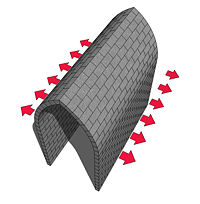
The simplest kind of vault is the barrel vault
(also called a wagon or tunnel vault) which is generally semicircular in shape. The barrel vault is a continuous arch, the length being greater than its diameter. As in building an arch
, a temporary support is needed while rings of voussoir
s are constructed and the rings placed in position. Until the topmost voussoir, the keystone
, is positioned the vault is not self-supporting. Where timber is easily obtained, this temporary support is provided by centering consisting of a framed truss
with a semicircular or segmental
head, which supports the voussoirs until the ring of the whole arch is completed. With a barrel vault, the centering can then be shifted on to support the next rings.
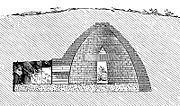 Amongst the earliest known examples of any form of vaulting is to be found in the neolithic
village of Khirokitia on Cyprus
. Dating from ca. 6000 BCE
, the circular buildings supported beehive shaped corbel
domed vaults of unfired mud-bricks and also represent the first evidence for settlements with an upper floor. Similar Beehive tomb
s, called tholoi, exist in Crete
and Northern Iraq
. Their construction differs from that at Khirokitia in that most appear partially buried and make provision for a dromos entry.
The inclusion of domes, however, represents a wider sense of the word vault. The distinction between the two is that a vault is essentially an arch which is extruded into the third dimension, whereas a dome is an arch revolved around its vertical axis.
The earliest known examples of barrel vault
s were built by the Sumer
ians, possibly under the ziggurat
at Nippur
in Babylonia
, which was built of fired brick
s cemented with clay
mortar
.
The earliest barrel vaults in Egypt
are thought to be those in the granaries built by Ramesses II
, the ruins of which are behind the Ramesseum
, at Thebes
. The span was 12 ft (3.6m). and the lower part of the arch was built in horizontal courses, up to about one-third of the height, and the rings above were inclined back at a slight angle, so that the bricks of each ring, laid flatwise, adhered till the ring was completed, no centering of any kind being required; the vault thus formed was elliptic in section, arising from the method of its construction. A similar system of construction was employed for the vault over the great hall at Ctesiphon
, where the' material employed was fired bricks or tiles of great dimensions, cemented with mortar; but the span was close upon 83 ft (25m), and the thickness of the vault was nearly 5 ft (1.5m) at the top, there being four rings of brickwork
.
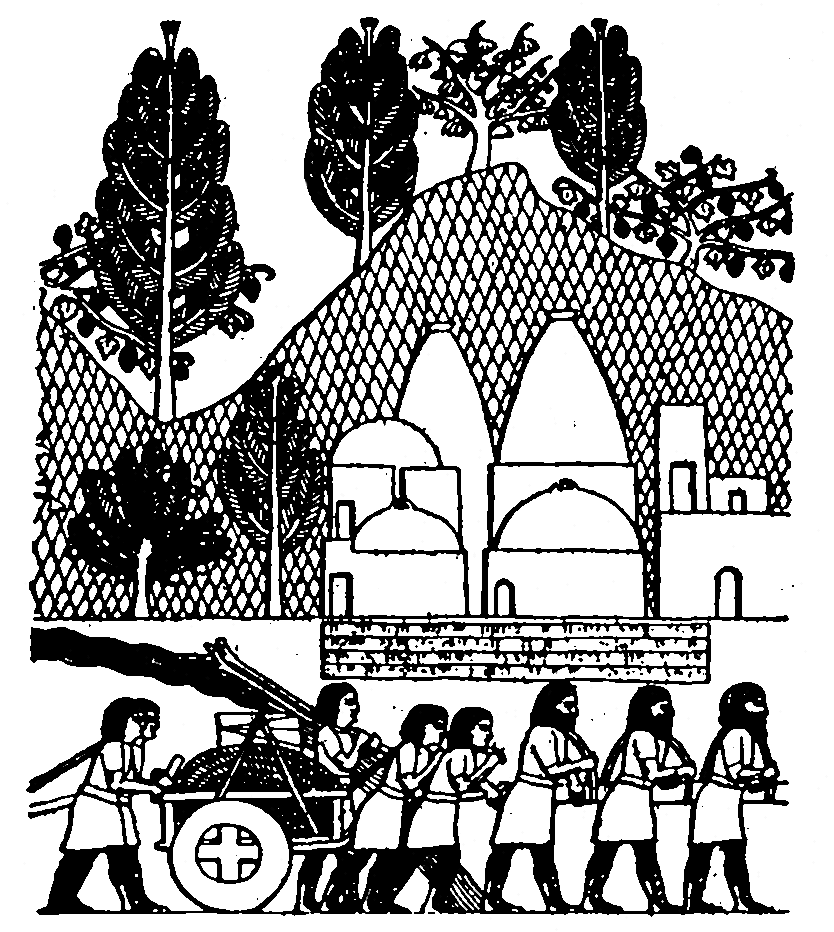 It is probable that the great vaults of the Assyria
n palaces were constructed in the same way, but with unburnt bricks dried only in the sun: one of the drains discovered by Sir Austen Henry Layard
at Nimrud
was built in rings sloping backwards. From the fact that each Assyrian monarch on his accession to the throne commenced his reign by the erection of a palace, it is probable that, owing to the ephemeral construction of these great vaults, half a century was the term of their existence. This may also account for the fact that no domed structures exist of the type shown in one of the bas-reliefs from Nimrud; the tradition of their erection, however, would seem to have been handed down to their successors in Mesopotamia
, viz. to the Sassanians, who in their palaces in Serbia
and Firouzabad
built domes of similar form to those shown in the Nimrud sculptures, the chief difference being that, constructed in rubble
stone and cemented with mortar, they still exist, though probably abandoned on the Islamic invasion in the 7th century.
 In all the instances above quoted in Sumer and Egypt the bricks, whether burnt or sun-dried, were of the description to which the term "tile
" would now be given; the dimensions varied from 18 or 20 in. to 10 in., being generally square and about 4 to 2 in. thick, and they were not shaped as voussoirs, the connecting medium being thicker at the top than at the bottom. The earliest Egyptian examples of regular voussoirs in stone belong to the XXVIth Dynasty
(ca. 650 B.C.) in the additions made then to the temple of Medinet Habu
, and here it is probable that centering of some kind was provided, as the vaults are built in rings, so that the same centering could be shifted on after the completion of each ring. The earliest example of regularly shaped voussoirs, and of about the same date, is found in the cloaca
at Graviscae in Etruria
, with a span of about 14 ft., the voussoirs of which are from 5 to 6 ft. long. The cloaca maxima in Rome, built by Lucius Tarquinius Priscus (603 B.C.) to drain the marshy ground between the Palatine
and the Capitoline Hills, was according to Commendatore Boni vaulted over in the 1st century B.C., the vault being over 800 ft. long, 10 ft. in span, with three concentric rings of voussoirs.
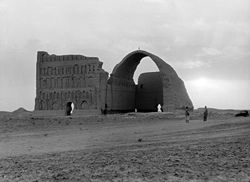 The enormous Eyvan-e Khosro at Ctesiphon
(near present-day Baghdad
) was built during the Persian Sasanian period as a throne room. The arch was about 37 meters high, 26 meters across and 50 meters long, entirely without centering and it was the largest vault ever constructed at the time.
So far, all the vaults mentioned have been barrel vaults, which, when not built underground, required continuous walls of great thickness to resist their thrust; the earliest example of the next variety, the intersecting barrel vault, is said to be over a small hall at Pergamum, in Asia Minor
, but its first employment over halls of great dimensions is due to the Romans
. When two semicircular barrel vaults of the same diameter cross one another their intersection (a true ellipse) is known as a groin
, down which the thrust of the vault is carried to the cross walls; if a series of two or more barrel vaults intersect one another, the weight is carried on to the piers at their intersection and the thrust is transmitted to the outer cross walls; thus in the Roman reservoir at Baiae
, known as the Piscina Mirabilis
, a series of five aisles with semicircular barrel vaults are intersected by twelve cross aisles, the vaults being carried on 48 piers and thick external walls. The width of these aisles being only about 13 ft. there was no great difficulty in the construction of these vaults, but in the Roman Baths of Caracalla
the tepidarium
had a span of 80 ft., more than twice that of an English cathedral
, so that its construction both from the statical and economical point of view was of the greatest importance.
The researches of M. Choisy (L'Art de bâtir chez les Romains), based on a minute examination of those portions of the vaults which still remain in situ, have shown that, on a comparatively slight centering, consisting of trusses placed about 10 ft. apart and covered with planks laid from truss to truss, were laid - to begin with - two layers of the Roman brick (measuring nearly 2 ft. square and 2 in. thick); on these and on the trusses transverse rings of brick were built with longitudinal ties at intervals; on the brick layers and embedding the rings and cross ties concrete
was thrown in horizontal layers, the haunches being filled in solid, and the surface sloped on either side and covered over with a tile roof of low pitch laid direct on the concrete. The rings relieved the centering from the weight imposed, and the two layers of bricks carried the concrete till it had set.
As the walls carrying these vaults were also built in concrete with occasional bond courses of brick, the whole structure was homogeneous. One of the important ingredients of the mortar was a volcanic deposit found near Rome, known as pozzolana
, which, when the concrete had set, not only made the concrete as solid as the rock itself, but to a certain extent neutralized the thrust of the vaults, which formed shells equivalent to that of a metal lid; the Romans, however, do not seem to have recognized the extraordinary value of this pozzolana mixture, for they otherwise provided amply for the counteracting of any thrust which might exist by the erection of cross walls and buttresses. In the tepidaria of the Thermae and in the basilica of Constantine
, in order to bring the thrust well within the walls, the main barrel vault of the hall was brought forward on each side and rested on detached columns, which constituted the principal architectural decoration. In cases where the cross vaults intersecting were not of the same span as those of the main vault, the arches were either stilted so that their soffits might be of the same height, or they formed smaller intersections in the lower part of the vault; in both of these cases, however, the intersections or groins were twisted, for which it was very difficult to form a centering, and, moreover, they were of disagreeable effect: though every attempt was made to mask
this in the decoration of the vault by panels and reliefs modelled in stucco
.
The widest hall vaulted by the Romans was that of the throne room in the palace of Diocletian
on the Palatine Hill
, and this had the enormous span of 1oo ft., its thrust being counteracted by other halls on either side with buttresses outside. In provincial towns and in other parts of the Roman Empire, where the material pozzolana was not procurable, the Romans had to trust to their mortar as a cementing medium, but this, though excellent of its kind, was not of sufficient cohesive strength to allow of the erection of vaults of more than about 40 ft. span, which were generally built in rubble masonry
. There still exist in Asia Minor and Syria
some vaulted halls, generally attached to thermae, which are carried on walls of great thickness. There were many varieties of the Roman vault, whether continuous or intersected, such as those employed over the corridors on the Colosseum
and the theatre of Marcellus
, but in these cases the springing of the vault was above the summit of the arches of the main front, so that there was no intersection; on the other hand, over the corridors were either elliptical or semicircular, or over the staircases rising vaults, all of which were more difficult to construct; there were also numerous solutions of vault over circular halls, of which that of the Pantheon
was the most important example, having a diameter of 142 ft., and over the hemicycles, which were sometimes of great size; that known as Canopus
in Hadrian's Villa
at Tivoli
had a diameter of 75 ft., and was vaulted over with a series of ribs, between which were alternating rampant flat and semicircular webs and cells; in the same villa and in Rome were octagonal halls with various other combinations of vault. Another type of vault not yet referred to is that of the Tabularium
arcade
where the Cloister vault was employed. Fig. 3 compared with fig. 2 will show the difference; in the former the angles of intersection are inset, and in the latter they are groins with projecting angles at the base, which die away at the summit.
.jpg)
 Reference has been made to the rib vault in Roman work, where the intersecting barrel vaults were not of the same diameter; their construction must at all times have been somewhat difficult, but where the barrel vaulting was carried round over the choir
aisle
and was intersected, as in St Bartholomew-the-Great
, Smithfield, London
by semicones, instead of cylinders, it became worse and the groins more complicated; this would seem to have led to a change of system, and to the introduction of a new feature, which completely revolutionized the construction of the vault. Hitherto the intersecting features were geometrical surfaces, of which the diagonal groins were the intersections, elliptical in form, generally weak in construction and often twisting. The medieval builder reversed the process, and set up the diagonal ribs first, which were utilized as permanent centres, and on these he carried his vault or web, which henceforward took its shape from the ribs. Instead of the elliptical curve which was given by the intersection of two semicircular barrel vaults, or cylinders, he employed the semicircular arch for the diagonal ribs; this, however, raised the centre of the square bay vaulted above the level of the transverse arches and of the wall ribs, and thus gave the appearance of a dome to the vault, such as may be seen in the nave of Sant' Ambrogio, Milan
. To meet this, at first the transverse and wall ribs were stilted, or the upper part of their arches was raised, as in the Abbaye-aux-Hommes
at Caen
, and the Abbey of Lessay, in Normandy
. The problem was ultimately solved by the introduction of the pointed arch for the transverse and wall ribs - the pointed arch had long been known and employed, on account of its much greater strength and of the less thrust it exerted on the walls. When employed for the ribs of a vault, however narrow the span might be, by adopting a pointed arch, its summit could be made to range in height with the diagonal rib; and, moreover, when utilized for the ribs of the annular vault, as in the aisle round the apsidal
termination of the choir, it was not necessary that the half ribs on the outer side should be in the same plane as those of the inner side; for when the opposite ribs met in the centre of the annular vault, the thrust was equally transmitted from one to the other, and being already a broken arch the change of its direction was not noticeable.
The first introduction of the pointed arch rib took place at Durham Cathedral
and pre-dated the abbey of St. Denis. Whilst the pointed rib-arch is often seen as an identifier for gothic architecture, Durham is a romanesque cathedral whose masons experimented with the possibility of rib-arches before it was widely adopted by western church architecture. It was in the church at Vezelay
(1140) that it was extended to the square bay of the porch
. Before entering into the question of the web or stone shell of the vault carried on the ribs, the earlier development of the great vaults which were thrown over the naves of a cathedral, or church, before the introduction of the pointed arch rib, shall here be noted. As has been pointed out, the aisles had already in the early Christian churches been covered over with groined vaults, the only advance made in the later developments being the introduction of transverse ribs' dividing the bays into square compartments; but when in the 12th century
the first attempts were made to vault over the naves, another difficulty presented itself, because the latter were twice the width of the aisles, so that it became necessary to include two bays of the aisles to form one square bay in the nave. This was an immense space to vault over, and moreover, it followed that every alternate pier
served no purpose, so far as the support of the nave vault was concerned, and this would seem to have suggested an alternative, viz. to provide a supplementary rib across the church and between the transverse ribs. This resulted in what is known as a sexpartite, or six-celled vault, of which one of the earliest examples is found in the Abbaye-aux-Hommes (S. Etienne) at Caen
. This church, built by William the Conqueror, was originally constructed to carry a timber roof only, but nearly a century later the upper part of the nave walls were partly rebuilt, in order that it might be covered with a vault. The immense size, however, of the square vault over the nave necessitated some additional support, so that an intermediate rib was thrown across the church, dividing the square compartment into six cells, and called the sexpartite vault
this was adopted in the cathedrals of Sens
(1170), Laon
(1195), Noyon
(1190), Paris (1223–35), and Bourges
(1250). The intermediate rib, however, had the disadvantage of partially obscuring one side of the clerestory
windows, and it threw unequal weights on the alternate piers, so that in the cathedral of Soissons
(1205) a quadripartite or four-celled vault was introduced, the width of each bay being half the span of the nave, and corresponding therefore with the aisle piers. To this there are some exceptions, in Sant' Ambrogio, Milan, and San Michele, Pavia
(the original vault), and in the cathedrals of Speyer
, Mainz
and Worms
, where the quadripartite vaults are nearly square, the intermediate piers of the aisles being of much smaller dimensions. In England sexpartite vaults exist at Canterbury
(1175) (set out by William of Sens
), Rochester
(1200),(1200), Lincoln
(1215),(1215), Durham
(east transept
), and St. Faith's chapel, Westminster Abbey
.
In the earlier stage of rib vaulting, the arched ribs consisted of independent or separate voussoir
s down to the springing; the difficulty, however, of working the ribs separately led to two other important changes: (1) the lower part of the transverse diagonal and wall ribs were all worked out of one stone; and (2) the lower horizontal, constituting what is known as the tas-de-charge
or solid springer
. Fig. 9 is a diagram made by Professor Willis taken from the south transept of Westminster Abbey. The horizontal courses rise to N. or about half the height of the vault, but the ribs are freed from one another from the point M. The tas-de-charge, or solid springer, had two advantages: (1) it enabled the stone courses to run straight through the wall, so as to bond the whole together much better; and (2) it lessened the span of the vault, which then required a centering of smaller dimensions. As soon as the ribs were completed, the web or stone shell of the vault was laid on them. In some English work, as may be seen in fig. 9, each course of stone was of uniform height from one side to the other; but, as the diagonal rib was longer than either the transverse or wall rib, the courses dipped towards the former, and at the apex
of the vault were cut to fit one another. In the early English Gothic period, in consequence of the great span of the vault and the very slight rise or curvature of the web, it was thought better to simplify the construction of the web by introducing intermediate ribs between the wall rib and the diagonal rib and between the diagonal and the transverse ribs; and in order to meet the thrust of these intermediate ribs a ridge rib was required, and the prolongation of this rib to the wall rib hid the junction of the web at the summit, which was not always very sightly, and constituted the ridge rib. In France, on the other hand, the web courses were always laid horizontally, and they are therefore of unequal height, increasing towards the diagonal rib. Each course also was given a slight rise in the centre, so as to increase its strength; this enabled the French masons to dispense with the intermediate rib, which was not introduced by them till the 15th century, and then more as a decorative than a constructive feature, as the domical form given to the French web rendered unnecessary the ridge rib, which, with some few exceptions, exists only in England. In both English and French vaulting centering was rarely required for the building of the web, a template (Fr. cerce) being employed to support the stones of each ring until it was complete. In Italy, Germany and Spain the French method of building the web was adopted, with horizontal courses and a domical form. Sometimes, in the case of comparatively narrow compartments, and more especially in clerestories
, the wall rib was stilted, and this caused a peculiar twisting of the web, where the springing of the wall rib is at K: to these twisted surfaces the term ploughshare vaulting is given.
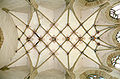 One of the earliest examples of the introduction of the intermediate rib is found in the nave of Lincoln Cathedral
, and there the ridge rib is not carried to the wall rib. It was soon found, however, that the construction of the web was much facilitated by additional ribs, and consequently there was a tendency to increase their number, so that in the nave of Exeter
Cathedral three intermediate ribs were provided between the wall rib and the diagonal rib. In order to mask the junction of the various ribs, their intersections were ornamented with richly carved bosses, and this practice increased on the introduction of another short rib, known as the lierne, a term in France given to the ridge rib. Lierne ribs
are short ribs crossing between the main ribs, and were employed chiefly as decorative features, as, for instance, in the Liebfrauenkirche (1482) of Mühlacker
, Germany. One of the best examples of Lierne ribs exists in the vault of the oriel window
of Crosby Hall, London. The tendency to increase the number of ribs led to singular results in some cases, as in the choir of Gloucester Cathedral
, where the ordinary diagonal ribs become mere ornamental mouldings
on the surface of an intersected pointed barrel vault, and again in the cloisters, where the introduction of the fan vault
, forming a concave-sided conoid
, returned to the principles of the Roman geometrical vault. This is further shown in the construction of these fan vaults, for although in the earliest examples each of the ribs above the tas-de-charge was an independent feature, eventually it was found easier to carve them and the web out of the solid stone, so that the rib and web were purely decorative and had no constructional or independent functions.
's chapel (see Plate II. fig. 19) and in the divinity school
s at Oxford
, where a new development presented itself. One of the defects of the fan vault at Gloucester is the appearance it gives of being half sunk in the wall; to remedy this, in the two buildings just quoted, the complete conoid is detached and treated as a pendant
.
 The vault of the Basilica of Maxentius
, completed by Constantine, was the last great work carried out in Rome before its fall, and two centuries pass before the next important development is found in the Church of the Holy Wisdom (Hagia Sophia) at Constantinople
. It is probable that the realization of the great advance in the science of vaulting shown in this church owed something to the eastern tradition of dome
vaulting seen in the Assyrian domes, which are known to us only by the representations in the bas-relief from Nimrud (fig. 1), because in the great water cisterns in Istanbul, known as the Yere Batan Serai (the underground palace) and Bin bir direk (cistern with a thousand and one columns), both built by Constantine, we find the intersecting groin vaults of the Romans already replaced by small cupolas or domes. These domes, however, are of small dimensions when compared with that projected and carried out by Justinian in the Hagia Sophia
. Previous to this the greatest dome was that of the Pantheon
at Rome, but this was carried on an immense wall 20 ft. thick, and with the exception of small niches or recesses in the thickness of the wall could not be extended, so that Justinian apparently instructed his architect to provide an immense hemicycle or apse
at the eastern end, a similar apse at the western end, and great arches on either side, the walls under which would be pierced with windows. Unlike the Pantheon dome, the upper portions of which were made of concrete, Byzantine domes were made of brick, which were lighter and thinner, but which more vulnerable to the forces exterted onto them.
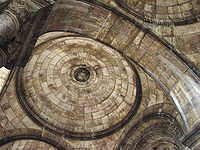 The diagram
(fig. 4) shows the outlines of the solution of the problem. If a hemispherical dome is cut by four vertical planes, the intersection gives four semicircular arches; if cut in addition by a horizontal plane tangent to the top of these arches, it describes a circle; that portion of the sphere which is below this circle and between the arches, forming a spherical spandril, is the pendentive
(fig. 5), and its radius
is equal to the diagonal
of the square on which the four arches rest. Having obtained a circle for the base of the dome, it is not necessary that the upper portion of the dome should spring from the same level as the arches, or that its domical surface should be a continuation of that of the pendentive. The first and second dome of the Hagia Sophia apparently fell down, so that Justinian determined to raise it, possibly to give greater lightness to the structure, but mainly in order to obtain increased light for the interior of the church. This was effected by piercing it with forty windows - the effect of which was of an extraordinary nature, as the light streaming through these windows gave to the dome the appearance of being suspended in the air. The pendentive which carried the dome rested on four great arches, the thrust of those crossing the church being counteracted by immense buttresses which traversed the aisles, and the other two partly by smaller arches in the apse, the thrust being carried to the outer walls, and to a certain extent by the side walls which were built under the arches. From the description given by Procopius
we gather that the centering employed for the great arches consisted of a wall erected to support them during their erection. The construction of the pendentives is not known, but it is surmised that to the top of the pendentives they were built in horizontal courses of brick, projecting one over the other, the projecting angles being cut off afterwards and covered with stucco in which the mosaics were embedded; this was the method employed in the erection of the Périgordian domes, to which we shall return; these, however, were of less diameter than those of the Hagia Sophia, being only about 40 to 60 ft. instead of 107 ft. The apotheosis of Byzantine architecture
, in fact, was reached in Hagia Sophia, for although it formed the model on which all subsequent Byzantine churches were based, so far as their plan was concerned, no domes approaching the former in dimensions were even attempted. The principal difference in some later examples is that which took place in the form of the pendentive on which the dome was carried. Instead of the spherical spandril of Hagia Sophia, large niches were formed in the angles, as in the Mosque of Damascus
, which was built by Byzantine workmen for the Al-Walid I in A.D. 705; these gave an octagonal base on which the hemispherical dome rested (fig. 6); or again, as in the Sassanian palaces of Serbia and Firouzabad of the 4th and 5th century, when a series of concentric arch rings, projecting one in front of the other, were built, giving also an octagonal base; each of these pendentives is known as a squinch
.
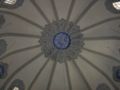 There is one other remarkable vault, also built by Justinian, in the Church of the Saints Sergius and Bacchus
in Constantinople. The central area of this church was octagonal on plan, and the dome is divided into sixteen compartments; of these eight consist of broad flat bands rising from the centre of each of the walls, and the alternate eight are concave cells over the angles of the octagon, which externally and internally give to the roof the appearance of an umbrella.
 Although the dome constitutes the principal characteristic of the Byzantine church, throughout Asia Minor are numerous examples in which the naves are vaulted with the semicircular barrel vault, and this is the type of vault found throughout the south of France in the 11th and 12th centuries, the only change being the occasional substitution of the pointed barrel vault, adopted not only on account of its exerting a less thrust, but because, as pointed out by Fergusson (vol. ii. p. 46), the roofing tiles were laid directly on the vault and a less amount of filling in at the top was required. The continuous thrust of the barrel vault in these cases was met either by semicircular or pointed barrel vaults on the aisles, which had only half the span of the nave
; of this there is an interesting example in the Chapel of Saint John
in the Tower of London
- and sometimes by half-barrel vaults. The great thickness of the walls, however, required in such constructions would seem to have led to another solution of the problem of roofing over churches with incombustible material, viz. that which is found throughout Périgord
and La Charente, where a series of domes carried on pendentives covered over the nave, the chief peculiarities of these domes being the fact that the arches carrying them form part of the pendentives, which are all built in horizontal courses.
The intersecting and groined vault of the Romans was employed in the early Christian churches in Rome, but only over the aisles, which were comparatively of small span, but in these there was a tendency to raise the centres of these vaults, which became slightly domical; in all these cases centering was employed.
, and here the complete conoid is displayed in its centre carried on a central column. This vault, not built until 1640, is an exceptional example of the long continuance of traditional workmanship, probably in Oxford transmitted in consequence of the late vaulting of the entrance gateways to the colleges. Fan vaulting is peculiar to England, the only example approaching it in France being the pendant of the Lady-chapel at Caudebec, in Normandy. In France, Germany and Spain the multiplication of ribs in the 15th century led to decorative vaults of various kinds, but with some singular modifications. Thus in Germany, recognizing that the rib was no longer a necessary constructive feature, they cut it off abruptly, leaving a stump only; in France, on the other hand, they gave still more importance to the rib, by making it of greater depth, piercing it with tracery
and hanging pendants from it, and the web became a horizontal stone paving laid on the top of these decorated vertical webs. This is the characteristic of the great Renaissance work in France and Spain; but it soon gave way to Italian influence, when the construction of vaults reverted to the geometrical surfaces of the Romans, without, however, always that economy in centering to which they had attached so much importance, and more especially in small structures. In large vaults, where it constituted an important expense, the chief boast of some of the most eminent architects has been that centering was dispensed with, as in the case of the dome of the Santa Maria del Fiore in Florence
, built by Filippo Brunelleschi
, and Ferguson cites as an example the great dome of the church at Mousta in Malta
, erected in the first half of the 19th century, which was built entirely without centering of any kind. Fig. 10 is a plan and section of the vault of Henry VII.'s chapel and fig. 11 a perspective
view, in which it will be seen that the transverse rib
thrown across the chapel carries the pendant, the weight of the latter probably preventing a rise in the haunches.
, and Byzantine
vaults, like that at Hagia Sophia
, were not protected from above (i.e. the vault from the inside was the same that one saw from the outside), the European architects of the Middle Ages, protected their vaults with wooden roofs. In other words, one will not see a Gothic vault from the outside. The reasons for this development are hypothetical, but the fact that the roofed basilica
form preceded the era when vaults begin to be made is certainly to be taken into consideration. In other words, the traditional image of a roof took precedent over the vault.
The separation between interior and exterior - and between structure and image - was to be developed very purposefully in the Renaissance
and beyond, especially once the dome
became reinstated in the Western tradition as a key element in church design. Michelangelo
's dome for St. Peter's Basilica
in Rome, as redesigned between 1585 and 1590 by Giacomo della Porta
, for example, consists of two domes of which, however, only the inner is structural. Baltasar Neumann, in his baroque
churches, perfected light-weight plaster vaults supported by wooden frames. These vaults, which exerted no lateral pressures, were perfectly suited for elaborate ceiling frescoes. In St Paul's Cathedral
in London there is a highly complex system of vaults and faux-vaults. The dome that one sees from the outside is not a vault, but a relatively light-weight wooden-framed structure resting on an invisible - and for its age highly original - catenary
vault of brick, below which is another dome, (the dome that one sees from the inside), but of plaster supported by a wood frame. From the inside, one can easily assume that that one is looking at the same vault that one sees from the outside.
(A.D. 1559), and the other is Gol Gumbaz
, the tomb of Muhammad Adil Shah II (A.D. 1626-1660) in the same town. The vault of the latter was constructed over a hall 135 ft. square, to carry a hemispherical dome. The ribs, instead of being carried across the angles only, thus giving an octagonal base for the dome, are carried across to the further pier of the octagon (fig. 12) and consequently intersect one another, reducing the central opening to 97 ft. in diameter, and, by the weight of the masonry they carry, serving as counterpoise to the thrust of the dome, which is set back so as to leave a passage about 12 ft. wide round the interior. The internal diameter of the dome is 124 ft., its height 175 ft. and the ribs struck from four centres have their springing 57 ft. from the floor of the hall. The Jumma Musjid dome was of smaller dimensions, on a square of 70 ft. with a diameter of 57 ft., and was carried on piers only instead of immensely thick walls as in the tomb; but any thrust which might exist was counteracted by its transmission across aisles to the outer wall.
 The 20th century saw great advances in reinforced concrete
design. The advent of shell construction
and the better mathematical understanding of hyperbolic paraboloids allowed very thin, strong vaults to be constructed with previously unseen shapes.
Architecture
Architecture is both the process and product of planning, designing and construction. Architectural works, in the material form of buildings, are often perceived as cultural and political symbols and as works of art...
term for an arch
Arch
An arch is a structure that spans a space and supports a load. Arches appeared as early as the 2nd millennium BC in Mesopotamian brick architecture and their systematic use started with the Ancient Romans who were the first to apply the technique to a wide range of structures.-Technical aspects:The...
ed form used to provide a space with a ceiling or roof. The parts of a vault exert lateral thrust
Thrust
Thrust is a reaction force described quantitatively by Newton's second and third laws. When a system expels or accelerates mass in one direction the accelerated mass will cause a force of equal magnitude but opposite direction on that system....
that require a counter resistance
Friction
Friction is the force resisting the relative motion of solid surfaces, fluid layers, and/or material elements sliding against each other. There are several types of friction:...
. When vaults are built underground, the ground gives all the resistance required. However, when the vault is built above ground, various replacements are employed to supply the needed resistance. An example is the thicker walls used in the case of barrel or continuous vaults
Barrel vault
A barrel vault, also known as a tunnel vault or a wagon vault, is an architectural element formed by the extrusion of a single curve along a given distance. The curves are typically circular in shape, lending a semi-cylindrical appearance to the total design...
. Buttresses are used to supply resistance when intersecting vaults are employed.
The simplest kind of vault is the barrel vault
Barrel vault
A barrel vault, also known as a tunnel vault or a wagon vault, is an architectural element formed by the extrusion of a single curve along a given distance. The curves are typically circular in shape, lending a semi-cylindrical appearance to the total design...
(also called a wagon or tunnel vault) which is generally semicircular in shape. The barrel vault is a continuous arch, the length being greater than its diameter. As in building an arch
Arch
An arch is a structure that spans a space and supports a load. Arches appeared as early as the 2nd millennium BC in Mesopotamian brick architecture and their systematic use started with the Ancient Romans who were the first to apply the technique to a wide range of structures.-Technical aspects:The...
, a temporary support is needed while rings of voussoir
Voussoir
A voussoir is a wedge-shaped element, typically a stone, used in building an arch or vault.Although each unit in an arch or vault is a voussoir, two units are of distinct functional importance: the keystone and the springer. The keystone is the center stone or masonry unit at the apex of an arch. A...
s are constructed and the rings placed in position. Until the topmost voussoir, the keystone
Keystone (architecture)
A keystone is the wedge-shaped stone piece at the apex of a masonry vault or arch, which is the final piece placed during construction and locks all the stones into position, allowing the arch to bear weight. This makes a keystone very important structurally...
, is positioned the vault is not self-supporting. Where timber is easily obtained, this temporary support is provided by centering consisting of a framed truss
Truss
In architecture and structural engineering, a truss is a structure comprising one or more triangular units constructed with straight members whose ends are connected at joints referred to as nodes. External forces and reactions to those forces are considered to act only at the nodes and result in...
with a semicircular or segmental
Circular segment
In geometry, a circular segment is an area of a circle informally defined as an area which is "cut off" from the rest of the circle by a secant or a chord. The circle segment constitutes the part between the secant and an arc, excluding the circle's center...
head, which supports the voussoirs until the ring of the whole arch is completed. With a barrel vault, the centering can then be shifted on to support the next rings.
Dome
Neolithic
The Neolithic Age, Era, or Period, or New Stone Age, was a period in the development of human technology, beginning about 9500 BC in some parts of the Middle East, and later in other parts of the world. It is traditionally considered as the last part of the Stone Age...
village of Khirokitia on Cyprus
Cyprus
Cyprus , officially the Republic of Cyprus , is a Eurasian island country, member of the European Union, in the Eastern Mediterranean, east of Greece, south of Turkey, west of Syria and north of Egypt. It is the third largest island in the Mediterranean Sea.The earliest known human activity on the...
. Dating from ca. 6000 BCE
Common Era
Common Era ,abbreviated as CE, is an alternative designation for the calendar era originally introduced by Dionysius Exiguus in the 6th century, traditionally identified with Anno Domini .Dates before the year 1 CE are indicated by the usage of BCE, short for Before the Common Era Common Era...
, the circular buildings supported beehive shaped corbel
Corbel
In architecture a corbel is a piece of stone jutting out of a wall to carry any superincumbent weight. A piece of timber projecting in the same way was called a "tassel" or a "bragger". The technique of corbelling, where rows of corbels deeply keyed inside a wall support a projecting wall or...
domed vaults of unfired mud-bricks and also represent the first evidence for settlements with an upper floor. Similar Beehive tomb
Beehive tomb
A beehive tomb, also known as a tholos tomb , is a burial structure characterized by its false dome created by the superposition of successively smaller rings of mudbricks or, more often, stones...
s, called tholoi, exist in Crete
Crete
Crete is the largest and most populous of the Greek islands, the fifth largest island in the Mediterranean Sea, and one of the thirteen administrative regions of Greece. It forms a significant part of the economy and cultural heritage of Greece while retaining its own local cultural traits...
and Northern Iraq
Iraq
Iraq ; officially the Republic of Iraq is a country in Western Asia spanning most of the northwestern end of the Zagros mountain range, the eastern part of the Syrian Desert and the northern part of the Arabian Desert....
. Their construction differs from that at Khirokitia in that most appear partially buried and make provision for a dromos entry.
The inclusion of domes, however, represents a wider sense of the word vault. The distinction between the two is that a vault is essentially an arch which is extruded into the third dimension, whereas a dome is an arch revolved around its vertical axis.
Barrel vault
A barrel vault is the simplest form of a vault and resembles a barrel or tunnel cut lengthwise in half. The effect is that of a structure composed of continuous semicircular or pointed sections.The earliest known examples of barrel vault
Barrel vault
A barrel vault, also known as a tunnel vault or a wagon vault, is an architectural element formed by the extrusion of a single curve along a given distance. The curves are typically circular in shape, lending a semi-cylindrical appearance to the total design...
s were built by the Sumer
Sumer
Sumer was a civilization and historical region in southern Mesopotamia, modern Iraq during the Chalcolithic and Early Bronze Age....
ians, possibly under the ziggurat
Ziggurat
Ziggurats were massive structures built in the ancient Mesopotamian valley and western Iranian plateau, having the form of a terraced step pyramid of successively receding stories or levels.Notable ziggurats include the Great Ziggurat of Ur near Nasiriyah, Iraq; the Ziggurat of Aqar Quf near...
at Nippur
Nippur
Nippur was one of the most ancient of all the Sumerian cities. It was the special seat of the worship of the Sumerian god Enlil, the "Lord Wind," ruler of the cosmos subject to An alone...
in Babylonia
Babylonia
Babylonia was an ancient cultural region in central-southern Mesopotamia , with Babylon as its capital. Babylonia emerged as a major power when Hammurabi Babylonia was an ancient cultural region in central-southern Mesopotamia (present-day Iraq), with Babylon as its capital. Babylonia emerged as...
, which was built of fired brick
Brick
A brick is a block of ceramic material used in masonry construction, usually laid using various kinds of mortar. It has been regarded as one of the longest lasting and strongest building materials used throughout history.-History:...
s cemented with clay
Clay
Clay is a general term including many combinations of one or more clay minerals with traces of metal oxides and organic matter. Geologic clay deposits are mostly composed of phyllosilicate minerals containing variable amounts of water trapped in the mineral structure.- Formation :Clay minerals...
mortar
Mortar (masonry)
Mortar is a workable paste used to bind construction blocks together and fill the gaps between them. The blocks may be stone, brick, cinder blocks, etc. Mortar becomes hard when it sets, resulting in a rigid aggregate structure. Modern mortars are typically made from a mixture of sand, a binder...
.
The earliest barrel vaults in Egypt
Egypt
Egypt , officially the Arab Republic of Egypt, Arabic: , is a country mainly in North Africa, with the Sinai Peninsula forming a land bridge in Southwest Asia. Egypt is thus a transcontinental country, and a major power in Africa, the Mediterranean Basin, the Middle East and the Muslim world...
are thought to be those in the granaries built by Ramesses II
Ramesses II
Ramesses II , referred to as Ramesses the Great, was the third Egyptian pharaoh of the Nineteenth dynasty. He is often regarded as the greatest, most celebrated, and most powerful pharaoh of the Egyptian Empire...
, the ruins of which are behind the Ramesseum
Ramesseum
The Ramesseum is the memorial temple of Pharaoh Ramesses II . It is located in the Theban necropolis in Upper Egypt, across the River Nile from the modern city of Luxor...
, at Thebes
Thebes, Egypt
Thebes is the Greek name for a city in Ancient Egypt located about 800 km south of the Mediterranean, on the east bank of the river Nile within the modern city of Luxor. The Theban Necropolis is situated nearby on the west bank of the Nile.-History:...
. The span was 12 ft (3.6m). and the lower part of the arch was built in horizontal courses, up to about one-third of the height, and the rings above were inclined back at a slight angle, so that the bricks of each ring, laid flatwise, adhered till the ring was completed, no centering of any kind being required; the vault thus formed was elliptic in section, arising from the method of its construction. A similar system of construction was employed for the vault over the great hall at Ctesiphon
Ctesiphon
Ctesiphon, the imperial capital of the Parthian Arsacids and of the Persian Sassanids, was one of the great cities of ancient Mesopotamia.The ruins of the city are located on the east bank of the Tigris, across the river from the Hellenistic city of Seleucia...
, where the' material employed was fired bricks or tiles of great dimensions, cemented with mortar; but the span was close upon 83 ft (25m), and the thickness of the vault was nearly 5 ft (1.5m) at the top, there being four rings of brickwork
Brickwork
Brickwork is masonry produced by a bricklayer, using bricks and mortar to build up brick structures such as walls. Brickwork is also used to finish corners, door, and window openings, etc...
.
Assyria
Assyria was a Semitic Akkadian kingdom, extant as a nation state from the mid–23rd century BC to 608 BC centred on the Upper Tigris river, in northern Mesopotamia , that came to rule regional empires a number of times through history. It was named for its original capital, the ancient city of Assur...
n palaces were constructed in the same way, but with unburnt bricks dried only in the sun: one of the drains discovered by Sir Austen Henry Layard
Austen Henry Layard
Sir Austen Henry Layard GCB, PC was a British traveller, archaeologist, cuneiformist, art historian, draughtsman, collector, author, politician and diplomat, best known as the excavator of Nimrud.-Family:...
at Nimrud
Nimrud
Nimrud is an ancient Assyrian city located south of Nineveh on the river Tigris in modern Ninawa Governorate Iraq. In ancient times the city was called Kalḫu. The Arabs called the city Nimrud after the Biblical Nimrod, a legendary hunting hero .The city covered an area of around . Ruins of the city...
was built in rings sloping backwards. From the fact that each Assyrian monarch on his accession to the throne commenced his reign by the erection of a palace, it is probable that, owing to the ephemeral construction of these great vaults, half a century was the term of their existence. This may also account for the fact that no domed structures exist of the type shown in one of the bas-reliefs from Nimrud; the tradition of their erection, however, would seem to have been handed down to their successors in Mesopotamia
Mesopotamia
Mesopotamia is a toponym for the area of the Tigris–Euphrates river system, largely corresponding to modern-day Iraq, northeastern Syria, southeastern Turkey and southwestern Iran.Widely considered to be the cradle of civilization, Bronze Age Mesopotamia included Sumer and the...
, viz. to the Sassanians, who in their palaces in Serbia
Serbia
Serbia , officially the Republic of Serbia , is a landlocked country located at the crossroads of Central and Southeast Europe, covering the southern part of the Carpathian basin and the central part of the Balkans...
and Firouzabad
Firouzabad
Firuzabad is a city in and the capital of Firuzabad County, Fars Province, Iran. At the 2006 census, its population was 58,210, in 12,888 families.Firuzabad is located south of Shiraz. The town is surrounded by a mud wall and ditch....
built domes of similar form to those shown in the Nimrud sculptures, the chief difference being that, constructed in rubble
Rubble
Rubble is broken stone, of irregular size, shape and texture. This word is closely connected in derivation with "rubbish", which was formerly also applied to what we now call "rubble". Rubble naturally found in the soil is known also as brash...
stone and cemented with mortar, they still exist, though probably abandoned on the Islamic invasion in the 7th century.
Tile
A tile is a manufactured piece of hard-wearing material such as ceramic, stone, metal, or even glass. Tiles are generally used for covering roofs, floors, walls, showers, or other objects such as tabletops...
" would now be given; the dimensions varied from 18 or 20 in. to 10 in., being generally square and about 4 to 2 in. thick, and they were not shaped as voussoirs, the connecting medium being thicker at the top than at the bottom. The earliest Egyptian examples of regular voussoirs in stone belong to the XXVIth Dynasty
Egyptian chronology
The creation of a reliable chronology of Ancient Egypt is a task fraught with problems. While the overwhelming majority of Egyptologists agree on the outline and many of the details of a common chronology, disagreements either individually or in groups have resulted in a variety of dates offered...
(ca. 650 B.C.) in the additions made then to the temple of Medinet Habu
Medinet Habu (temple)
Medinet Habu is the name commonly given to the Mortuary Temple of Ramesses III, an important New Kingdom period structure in the location of the same name on the West Bank of Luxor in Egypt...
, and here it is probable that centering of some kind was provided, as the vaults are built in rings, so that the same centering could be shifted on after the completion of each ring. The earliest example of regularly shaped voussoirs, and of about the same date, is found in the cloaca
Cloaca
In zoological anatomy, a cloaca is the posterior opening that serves as the only such opening for the intestinal, reproductive, and urinary tracts of certain animal species...
at Graviscae in Etruria
Etruria
Etruria—usually referred to in Greek and Latin source texts as Tyrrhenia—was a region of Central Italy, an area that covered part of what now are Tuscany, Latium, Emilia-Romagna, and Umbria. A particularly noteworthy work dealing with Etruscan locations is D. H...
, with a span of about 14 ft., the voussoirs of which are from 5 to 6 ft. long. The cloaca maxima in Rome, built by Lucius Tarquinius Priscus (603 B.C.) to drain the marshy ground between the Palatine
Palatine Hill
The Palatine Hill is the centermost of the Seven Hills of Rome and is one of the most ancient parts of the city...
and the Capitoline Hills, was according to Commendatore Boni vaulted over in the 1st century B.C., the vault being over 800 ft. long, 10 ft. in span, with three concentric rings of voussoirs.
Ctesiphon
Ctesiphon, the imperial capital of the Parthian Arsacids and of the Persian Sassanids, was one of the great cities of ancient Mesopotamia.The ruins of the city are located on the east bank of the Tigris, across the river from the Hellenistic city of Seleucia...
(near present-day Baghdad
Baghdad
Baghdad is the capital of Iraq, as well as the coterminous Baghdad Governorate. The population of Baghdad in 2011 is approximately 7,216,040...
) was built during the Persian Sasanian period as a throne room. The arch was about 37 meters high, 26 meters across and 50 meters long, entirely without centering and it was the largest vault ever constructed at the time.
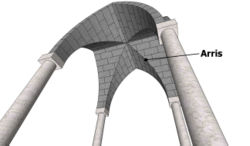
Groin vaults
 |
 |
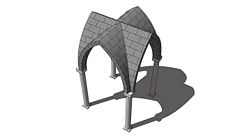 |
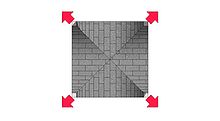
So far, all the vaults mentioned have been barrel vaults, which, when not built underground, required continuous walls of great thickness to resist their thrust; the earliest example of the next variety, the intersecting barrel vault, is said to be over a small hall at Pergamum, in Asia Minor
Asia Minor
Asia Minor is a geographical location at the westernmost protrusion of Asia, also called Anatolia, and corresponds to the western two thirds of the Asian part of Turkey...
, but its first employment over halls of great dimensions is due to the Romans
Ancient Rome
Ancient Rome was a thriving civilization that grew on the Italian Peninsula as early as the 8th century BC. Located along the Mediterranean Sea and centered on the city of Rome, it expanded to one of the largest empires in the ancient world....
. When two semicircular barrel vaults of the same diameter cross one another their intersection (a true ellipse) is known as a groin
Groin vault
A groin vault or groined vault is produced by the intersection at right angles of two barrel vaults. The word groin refers to the edge between the intersecting vaults; cf. ribbed vault. Sometimes the arches of groin vaults are pointed instead of round...
, down which the thrust of the vault is carried to the cross walls; if a series of two or more barrel vaults intersect one another, the weight is carried on to the piers at their intersection and the thrust is transmitted to the outer cross walls; thus in the Roman reservoir at Baiae
Baiae
Baiae , a frazione of the comune of Bacoli) in the Campania region of Italy was a Roman seaside resort on the Bay of Naples. It was said to have been named after Baius, who was supposedly buried there. Baiae was for several hundred years a fashionable resort, especially towards the end of the Roman...
, known as the Piscina Mirabilis
Piscina Mirabilis
The Piscina Mirabilis was a freshwater cistern on the Bacoli cliff at the western end of the Gulf of Naples, southern Italy. One of the largest freshwater cisterns built by the ancient Romans, it was situated there in order to provide the Roman western imperial fleet at Portus Julius with drinking...
, a series of five aisles with semicircular barrel vaults are intersected by twelve cross aisles, the vaults being carried on 48 piers and thick external walls. The width of these aisles being only about 13 ft. there was no great difficulty in the construction of these vaults, but in the Roman Baths of Caracalla
Baths of Caracalla
The Baths of Caracalla in Rome, Italy were Roman public baths, or thermae, built in Rome between AD 212 and 216, during the reign of the Emperor Caracalla.- History :...
the tepidarium
Tepidarium
The tepidarium was the warm bathroom of the Roman baths heated by a hypocaust or underfloor heating system.The specialty of a tepidarium is the pleasant feeling of constant radiant heat which directly affects the human body from the walls and floor.There is an interesting example at Pompeii; this...
had a span of 80 ft., more than twice that of an English cathedral
Cathedral
A cathedral is a Christian church that contains the seat of a bishop...
, so that its construction both from the statical and economical point of view was of the greatest importance.
The researches of M. Choisy (L'Art de bâtir chez les Romains), based on a minute examination of those portions of the vaults which still remain in situ, have shown that, on a comparatively slight centering, consisting of trusses placed about 10 ft. apart and covered with planks laid from truss to truss, were laid - to begin with - two layers of the Roman brick (measuring nearly 2 ft. square and 2 in. thick); on these and on the trusses transverse rings of brick were built with longitudinal ties at intervals; on the brick layers and embedding the rings and cross ties concrete
Concrete
Concrete is a composite construction material, composed of cement and other cementitious materials such as fly ash and slag cement, aggregate , water and chemical admixtures.The word concrete comes from the Latin word...
was thrown in horizontal layers, the haunches being filled in solid, and the surface sloped on either side and covered over with a tile roof of low pitch laid direct on the concrete. The rings relieved the centering from the weight imposed, and the two layers of bricks carried the concrete till it had set.
As the walls carrying these vaults were also built in concrete with occasional bond courses of brick, the whole structure was homogeneous. One of the important ingredients of the mortar was a volcanic deposit found near Rome, known as pozzolana
Pozzolana
Pozzolana, also known as pozzolanic ash , is a fine, sandy volcanic ash. Pozzolanic ash was first discovered and dug in Italy, at Pozzuoli. It was later discovered at a number of other sites as well...
, which, when the concrete had set, not only made the concrete as solid as the rock itself, but to a certain extent neutralized the thrust of the vaults, which formed shells equivalent to that of a metal lid; the Romans, however, do not seem to have recognized the extraordinary value of this pozzolana mixture, for they otherwise provided amply for the counteracting of any thrust which might exist by the erection of cross walls and buttresses. In the tepidaria of the Thermae and in the basilica of Constantine
Basilica of Constantine
Basilica of Constantine can refer to* Basilica of Maxentius and Constantine in Rome* Basilica of Constantine in Trier...
, in order to bring the thrust well within the walls, the main barrel vault of the hall was brought forward on each side and rested on detached columns, which constituted the principal architectural decoration. In cases where the cross vaults intersecting were not of the same span as those of the main vault, the arches were either stilted so that their soffits might be of the same height, or they formed smaller intersections in the lower part of the vault; in both of these cases, however, the intersections or groins were twisted, for which it was very difficult to form a centering, and, moreover, they were of disagreeable effect: though every attempt was made to mask
Mask
A mask is an article normally worn on the face, typically for protection, disguise, performance or entertainment. Masks have been used since antiquity for both ceremonial and practical purposes...
this in the decoration of the vault by panels and reliefs modelled in stucco
Stucco
Stucco or render is a material made of an aggregate, a binder, and water. Stucco is applied wet and hardens to a very dense solid. It is used as decorative coating for walls and ceilings and as a sculptural and artistic material in architecture...
.
The widest hall vaulted by the Romans was that of the throne room in the palace of Diocletian
Diocletian
Diocletian |latinized]] upon his accession to Diocletian . c. 22 December 244 – 3 December 311), was a Roman Emperor from 284 to 305....
on the Palatine Hill
Palatine Hill
The Palatine Hill is the centermost of the Seven Hills of Rome and is one of the most ancient parts of the city...
, and this had the enormous span of 1oo ft., its thrust being counteracted by other halls on either side with buttresses outside. In provincial towns and in other parts of the Roman Empire, where the material pozzolana was not procurable, the Romans had to trust to their mortar as a cementing medium, but this, though excellent of its kind, was not of sufficient cohesive strength to allow of the erection of vaults of more than about 40 ft. span, which were generally built in rubble masonry
Masonry
Masonry is the building of structures from individual units laid in and bound together by mortar; the term masonry can also refer to the units themselves. The common materials of masonry construction are brick, stone, marble, granite, travertine, limestone; concrete block, glass block, stucco, and...
. There still exist in Asia Minor and Syria
Syria
Syria , officially the Syrian Arab Republic , is a country in Western Asia, bordering Lebanon and the Mediterranean Sea to the West, Turkey to the north, Iraq to the east, Jordan to the south, and Israel to the southwest....
some vaulted halls, generally attached to thermae, which are carried on walls of great thickness. There were many varieties of the Roman vault, whether continuous or intersected, such as those employed over the corridors on the Colosseum
Colosseum
The Colosseum, or the Coliseum, originally the Flavian Amphitheatre , is an elliptical amphitheatre in the centre of the city of Rome, Italy, the largest ever built in the Roman Empire...
and the theatre of Marcellus
Theatre of Marcellus
The Theatre of Marcellus is an ancient open-air theatre in Rome, Italy, built in the closing years of the Roman Republic. At the theatre, locals and visitors alike were able to watch performances of drama and song. Today its ancient edifice in the rione of Sant'Angelo, Rome, once again provides...
, but in these cases the springing of the vault was above the summit of the arches of the main front, so that there was no intersection; on the other hand, over the corridors were either elliptical or semicircular, or over the staircases rising vaults, all of which were more difficult to construct; there were also numerous solutions of vault over circular halls, of which that of the Pantheon
Pantheon, Rome
The Pantheon ,Rarely Pantheum. This appears in Pliny's Natural History in describing this edifice: Agrippae Pantheum decoravit Diogenes Atheniensis; in columnis templi eius Caryatides probantur inter pauca operum, sicut in fastigio posita signa, sed propter altitudinem loci minus celebrata.from ,...
was the most important example, having a diameter of 142 ft., and over the hemicycles, which were sometimes of great size; that known as Canopus
Canopus
Canopus |Alpha]] Carinae) is the brightest star in the southern constellation of Carina and Argo Navis, and the second brightest star in the night-time sky, after Sirius. Canopus's visual magnitude is −0.72, and it has an absolute magnitude of −5.53.Canopus is a supergiant of spectral...
in Hadrian's Villa
Hadrian's Villa
The Hadrian's Villa is a large Roman archaeological complex at Tivoli, Italy.- History :The villa was constructed at Tibur as a retreat from Rome for Roman Emperor Hadrian during the second and third decades of the 2nd century AD...
at Tivoli
Tivoli, Italy
Tivoli , the classical Tibur, is an ancient Italian town in Lazio, about 30 km east-north-east of Rome, at the falls of the Aniene river where it issues from the Sabine hills...
had a diameter of 75 ft., and was vaulted over with a series of ribs, between which were alternating rampant flat and semicircular webs and cells; in the same villa and in Rome were octagonal halls with various other combinations of vault. Another type of vault not yet referred to is that of the Tabularium
Tabularium
The Tabularium was the official records office of ancient Rome, and also housed the offices of many city officials. Situated within the Roman Forum, it was on the front slope of the Capitoline Hill, below the Temple of Jupiter Optimus Maximus, to the southeast of the Arx and Tarpeian Rock.Within...
arcade
Arcade (architecture)
An arcade is a succession of arches, each counterthrusting the next, supported by columns or piers or a covered walk enclosed by a line of such arches on one or both sides. In warmer or wet climates, exterior arcades provide shelter for pedestrians....
where the Cloister vault was employed. Fig. 3 compared with fig. 2 will show the difference; in the former the angles of intersection are inset, and in the latter they are groins with projecting angles at the base, which die away at the summit.
Rib vault
Choir
A choir, chorale or chorus is a musical ensemble of singers. Choral music, in turn, is the music written specifically for such an ensemble to perform.A body of singers who perform together as a group is called a choir or chorus...
aisle
Aisle
An aisle is, in general, a space for walking with rows of seats on both sides or with rows of seats on one side and a wall on the other...
and was intersected, as in St Bartholomew-the-Great
St Bartholomew-the-Great
The Priory Church of St Bartholomew the Great is an Anglican church located at West Smithfield in the City of London, founded as an Augustinian priory in 1123 -History:...
, Smithfield, London
Smithfield, London
Smithfield is an area of the City of London, in the ward of Farringdon Without. It is located in the north-west part of the City, and is mostly known for its centuries-old meat market, today the last surviving historical wholesale market in Central London...
by semicones, instead of cylinders, it became worse and the groins more complicated; this would seem to have led to a change of system, and to the introduction of a new feature, which completely revolutionized the construction of the vault. Hitherto the intersecting features were geometrical surfaces, of which the diagonal groins were the intersections, elliptical in form, generally weak in construction and often twisting. The medieval builder reversed the process, and set up the diagonal ribs first, which were utilized as permanent centres, and on these he carried his vault or web, which henceforward took its shape from the ribs. Instead of the elliptical curve which was given by the intersection of two semicircular barrel vaults, or cylinders, he employed the semicircular arch for the diagonal ribs; this, however, raised the centre of the square bay vaulted above the level of the transverse arches and of the wall ribs, and thus gave the appearance of a dome to the vault, such as may be seen in the nave of Sant' Ambrogio, Milan
Milan
Milan is the second-largest city in Italy and the capital city of the region of Lombardy and of the province of Milan. The city proper has a population of about 1.3 million, while its urban area, roughly coinciding with its administrative province and the bordering Province of Monza and Brianza ,...
. To meet this, at first the transverse and wall ribs were stilted, or the upper part of their arches was raised, as in the Abbaye-aux-Hommes
Abbaye-aux-Hommes
The Abbaye aux Hommes is a former abbey church in the French city of Caen, Normandy. Dedicated to Saint Stephen , it is considered, along with the neighbouring Abbaye aux Dames , to be one of the most notable Romanesque buildings in Normandy. Like all the major abbeys in Normandy, it was Benedictine...
at Caen
Caen
Caen is a commune in northwestern France. It is the prefecture of the Calvados department and the capital of the Basse-Normandie region. It is located inland from the English Channel....
, and the Abbey of Lessay, in Normandy
Normandy
Normandy is a geographical region corresponding to the former Duchy of Normandy. It is in France.The continental territory covers 30,627 km² and forms the preponderant part of Normandy and roughly 5% of the territory of France. It is divided for administrative purposes into two régions:...
. The problem was ultimately solved by the introduction of the pointed arch for the transverse and wall ribs - the pointed arch had long been known and employed, on account of its much greater strength and of the less thrust it exerted on the walls. When employed for the ribs of a vault, however narrow the span might be, by adopting a pointed arch, its summit could be made to range in height with the diagonal rib; and, moreover, when utilized for the ribs of the annular vault, as in the aisle round the apsidal
Apse
In architecture, the apse is a semicircular recess covered with a hemispherical vault or semi-dome...
termination of the choir, it was not necessary that the half ribs on the outer side should be in the same plane as those of the inner side; for when the opposite ribs met in the centre of the annular vault, the thrust was equally transmitted from one to the other, and being already a broken arch the change of its direction was not noticeable.
The first introduction of the pointed arch rib took place at Durham Cathedral
Durham Cathedral
The Cathedral Church of Christ, Blessed Mary the Virgin and St Cuthbert of Durham is a cathedral in the city of Durham, England, the seat of the Anglican Bishop of Durham. The Bishopric dates from 995, with the present cathedral being founded in AD 1093...
and pre-dated the abbey of St. Denis. Whilst the pointed rib-arch is often seen as an identifier for gothic architecture, Durham is a romanesque cathedral whose masons experimented with the possibility of rib-arches before it was widely adopted by western church architecture. It was in the church at Vezelay
Vézelay
Vézelay is a commune in the Yonne department in Burgundy in north-central France. It is a defendable hill town famous for Vézelay Abbey. The town and the Basilica of St Magdelene are designated UNESCO World Heritage sites....
(1140) that it was extended to the square bay of the porch
Porch
A porch is external to the walls of the main building proper, but may be enclosed by screen, latticework, broad windows, or other light frame walls extending from the main structure.There are various styles of porches, all of which depend on the architectural tradition of its location...
. Before entering into the question of the web or stone shell of the vault carried on the ribs, the earlier development of the great vaults which were thrown over the naves of a cathedral, or church, before the introduction of the pointed arch rib, shall here be noted. As has been pointed out, the aisles had already in the early Christian churches been covered over with groined vaults, the only advance made in the later developments being the introduction of transverse ribs' dividing the bays into square compartments; but when in the 12th century
the first attempts were made to vault over the naves, another difficulty presented itself, because the latter were twice the width of the aisles, so that it became necessary to include two bays of the aisles to form one square bay in the nave. This was an immense space to vault over, and moreover, it followed that every alternate pier
Pier
A pier is a raised structure, including bridge and building supports and walkways, over water, typically supported by widely spread piles or pillars...
served no purpose, so far as the support of the nave vault was concerned, and this would seem to have suggested an alternative, viz. to provide a supplementary rib across the church and between the transverse ribs. This resulted in what is known as a sexpartite, or six-celled vault, of which one of the earliest examples is found in the Abbaye-aux-Hommes (S. Etienne) at Caen
Caen
Caen is a commune in northwestern France. It is the prefecture of the Calvados department and the capital of the Basse-Normandie region. It is located inland from the English Channel....
. This church, built by William the Conqueror, was originally constructed to carry a timber roof only, but nearly a century later the upper part of the nave walls were partly rebuilt, in order that it might be covered with a vault. The immense size, however, of the square vault over the nave necessitated some additional support, so that an intermediate rib was thrown across the church, dividing the square compartment into six cells, and called the sexpartite vault
Sexpartite vault
Sexpartite vault, in architecture, is a rib vault divided into six bays by two diagonal ribs and three transverse ribs.The principal examples are those in the Abbaye-aux-Hommes and Abbaye-aux-Dames at Caen , Notre Dame de Paris, and the cathedrals of Bourges, Laon, Noyon, Senlis and Sens; from...
this was adopted in the cathedrals of Sens
Sens
Sens is a commune in the Yonne department in Burgundy in north-central France.Sens is a sub-prefecture of the department. It is crossed by the Yonne and the Vanne, which empties into the Yonne here.-History:...
(1170), Laon
Laon
Laon is the capital city of the Aisne department in Picardy in northern France.-History:The hilly district of Laon, which rises a hundred metres above the otherwise flat Picardy plain, has always held strategic importance...
(1195), Noyon
Noyon
Noyon is a commune in the Oise department in northern France.It lies on the Oise Canal, 100 km north of Paris.-History:...
(1190), Paris (1223–35), and Bourges
Bourges
Bourges is a city in central France on the Yèvre river. It is the capital of the department of Cher and also was the capital of the former province of Berry.-History:...
(1250). The intermediate rib, however, had the disadvantage of partially obscuring one side of the clerestory
Clerestory
Clerestory is an architectural term that historically denoted an upper level of a Roman basilica or of the nave of a Romanesque or Gothic church, the walls of which rise above the rooflines of the lower aisles and are pierced with windows. In modern usage, clerestory refers to any high windows...
windows, and it threw unequal weights on the alternate piers, so that in the cathedral of Soissons
Soissons
Soissons is a commune in the Aisne department in Picardy in northern France, located on the Aisne River, about northeast of Paris. It is one of the most ancient towns of France, and is probably the ancient capital of the Suessiones...
(1205) a quadripartite or four-celled vault was introduced, the width of each bay being half the span of the nave, and corresponding therefore with the aisle piers. To this there are some exceptions, in Sant' Ambrogio, Milan, and San Michele, Pavia
Pavia
Pavia , the ancient Ticinum, is a town and comune of south-western Lombardy, northern Italy, 35 km south of Milan on the lower Ticino river near its confluence with the Po. It is the capital of the province of Pavia. It has a population of c. 71,000...
(the original vault), and in the cathedrals of Speyer
Speyer Cathedral
The Speyer Cathedral, officially the Imperial Cathedral Basilica of the Assumption and St Stephen, in Latin: Domus sanctae Mariae Spirae in Speyer, Germany, is the seat of the Roman Catholic Bishop of Speyer and is suffragan to the Archdiocese of Bamberg. The cathedral, which is dedicated to St...
, Mainz
Mainz Cathedral
Mainz Cathedral or St. Martin's Cathedral is located near the historical center and pedestrianized market square of the city of Mainz, Germany...
and Worms
Worms Cathedral
Cathedral of St Peter is a church in Worms, southern Germany. It was the seat of the Catholic Prince-Bishopric of Worms until its extinction in 1800.It is a basilica with four round towers, two large domes, and a choir at each end...
, where the quadripartite vaults are nearly square, the intermediate piers of the aisles being of much smaller dimensions. In England sexpartite vaults exist at Canterbury
Canterbury Cathedral
Canterbury Cathedral in Canterbury, Kent, is one of the oldest and most famous Christian structures in England and forms part of a World Heritage Site....
(1175) (set out by William of Sens
William of Sens
William of Sens was a 12th century French architect, supposed to have been born at Sens, France.He is referred to in September 1174 as having been the architect who undertook the task of rebuilding the choir of Canterbury cathedral, originally erected by Conrad, the prior of the monastery, and...
), Rochester
Rochester Cathedral
Rochester Cathedral, or the Cathedral Church of Christ and the Blessed Virgin Mary, is a Norman church in Rochester, Kent. The bishopric is second oldest in England after Canterbury...
(1200),(1200), Lincoln
Lincoln, Lincolnshire
Lincoln is a cathedral city and county town of Lincolnshire, England.The non-metropolitan district of Lincoln has a population of 85,595; the 2001 census gave the entire area of Lincoln a population of 120,779....
(1215),(1215), Durham
Durham Cathedral
The Cathedral Church of Christ, Blessed Mary the Virgin and St Cuthbert of Durham is a cathedral in the city of Durham, England, the seat of the Anglican Bishop of Durham. The Bishopric dates from 995, with the present cathedral being founded in AD 1093...
(east transept
Transept
For the periodical go to The Transept.A transept is a transverse section, of any building, which lies across the main body of the building. In Christian churches, a transept is an area set crosswise to the nave in a cruciform building in Romanesque and Gothic Christian church architecture...
), and St. Faith's chapel, Westminster Abbey
Westminster Abbey
The Collegiate Church of St Peter at Westminster, popularly known as Westminster Abbey, is a large, mainly Gothic church, in the City of Westminster, London, United Kingdom, located just to the west of the Palace of Westminster. It is the traditional place of coronation and burial site for English,...
.
In the earlier stage of rib vaulting, the arched ribs consisted of independent or separate voussoir
Voussoir
A voussoir is a wedge-shaped element, typically a stone, used in building an arch or vault.Although each unit in an arch or vault is a voussoir, two units are of distinct functional importance: the keystone and the springer. The keystone is the center stone or masonry unit at the apex of an arch. A...
s down to the springing; the difficulty, however, of working the ribs separately led to two other important changes: (1) the lower part of the transverse diagonal and wall ribs were all worked out of one stone; and (2) the lower horizontal, constituting what is known as the tas-de-charge
Tas-de-charge
Tas-de-charge is a French language term in architecture, for which there is no equivalent in English, given to the lower courses of ribs of a Gothic vault, which are laid in horizontal courses and bonded into the wall, forming a solid mass; this helps bond the ribs, vault and walls together...
or solid springer
Springer (architecture)
A springer is an architectural term for the lowest voussoir on each side of an arch. Since it is the bottom-most element of the arch, it is where the arch support terminates at the responds. It rests on the impost or pier of the arch, that is, the topmost part of the abutment, from which the arch...
. Fig. 9 is a diagram made by Professor Willis taken from the south transept of Westminster Abbey. The horizontal courses rise to N. or about half the height of the vault, but the ribs are freed from one another from the point M. The tas-de-charge, or solid springer, had two advantages: (1) it enabled the stone courses to run straight through the wall, so as to bond the whole together much better; and (2) it lessened the span of the vault, which then required a centering of smaller dimensions. As soon as the ribs were completed, the web or stone shell of the vault was laid on them. In some English work, as may be seen in fig. 9, each course of stone was of uniform height from one side to the other; but, as the diagonal rib was longer than either the transverse or wall rib, the courses dipped towards the former, and at the apex
Apex (geometry)
In geometry, an apex is the vertex which is in some sense the highest of the figure to which it belongs.*In an isosceles triangle, the apex is the vertex where the two sides of equal length meet, opposite the unequal third side....
of the vault were cut to fit one another. In the early English Gothic period, in consequence of the great span of the vault and the very slight rise or curvature of the web, it was thought better to simplify the construction of the web by introducing intermediate ribs between the wall rib and the diagonal rib and between the diagonal and the transverse ribs; and in order to meet the thrust of these intermediate ribs a ridge rib was required, and the prolongation of this rib to the wall rib hid the junction of the web at the summit, which was not always very sightly, and constituted the ridge rib. In France, on the other hand, the web courses were always laid horizontally, and they are therefore of unequal height, increasing towards the diagonal rib. Each course also was given a slight rise in the centre, so as to increase its strength; this enabled the French masons to dispense with the intermediate rib, which was not introduced by them till the 15th century, and then more as a decorative than a constructive feature, as the domical form given to the French web rendered unnecessary the ridge rib, which, with some few exceptions, exists only in England. In both English and French vaulting centering was rarely required for the building of the web, a template (Fr. cerce) being employed to support the stones of each ring until it was complete. In Italy, Germany and Spain the French method of building the web was adopted, with horizontal courses and a domical form. Sometimes, in the case of comparatively narrow compartments, and more especially in clerestories
Clerestory
Clerestory is an architectural term that historically denoted an upper level of a Roman basilica or of the nave of a Romanesque or Gothic church, the walls of which rise above the rooflines of the lower aisles and are pierced with windows. In modern usage, clerestory refers to any high windows...
, the wall rib was stilted, and this caused a peculiar twisting of the web, where the springing of the wall rib is at K: to these twisted surfaces the term ploughshare vaulting is given.
Lincoln Cathedral
Lincoln Cathedral is a historic Anglican cathedral in Lincoln in England and seat of the Bishop of Lincoln in the Church of England. It was reputedly the tallest building in the world for 249 years . The central spire collapsed in 1549 and was not rebuilt...
, and there the ridge rib is not carried to the wall rib. It was soon found, however, that the construction of the web was much facilitated by additional ribs, and consequently there was a tendency to increase their number, so that in the nave of Exeter
Exeter
Exeter is a historic city in Devon, England. It lies within the ceremonial county of Devon, of which it is the county town as well as the home of Devon County Council. Currently the administrative area has the status of a non-metropolitan district, and is therefore under the administration of the...
Cathedral three intermediate ribs were provided between the wall rib and the diagonal rib. In order to mask the junction of the various ribs, their intersections were ornamented with richly carved bosses, and this practice increased on the introduction of another short rib, known as the lierne, a term in France given to the ridge rib. Lierne ribs
Lierne (vault)
A Lierne in Gothic rib vaulting is an architectural term for a tertiary rib spanning between two other ribs, instead of from a springer, or to the central boss...
are short ribs crossing between the main ribs, and were employed chiefly as decorative features, as, for instance, in the Liebfrauenkirche (1482) of Mühlacker
Mühlacker
Mühlacker is a town in the eastern part of the Enz district in Baden-Württemberg in southern Germany. Mühlacker station has direct rail connections with Stuttgart, Karlsruhe, Heidelberg, Pforzheim and the Northern Black Forest....
, Germany. One of the best examples of Lierne ribs exists in the vault of the oriel window
Oriel window
Oriel windows are a form of bay window commonly found in Gothic architecture, which project from the main wall of the building but do not reach to the ground. Corbels or brackets are often used to support this kind of window. They are seen in combination with the Tudor arch. This type of window was...
of Crosby Hall, London. The tendency to increase the number of ribs led to singular results in some cases, as in the choir of Gloucester Cathedral
Gloucester Cathedral
Gloucester Cathedral, or the Cathedral Church of St Peter and the Holy and Indivisible Trinity, in Gloucester, England, stands in the north of the city near the river. It originated in 678 or 679 with the foundation of an abbey dedicated to Saint Peter .-Foundations:The foundations of the present...
, where the ordinary diagonal ribs become mere ornamental mouldings
Molding (decorative)
Molding or moulding is a strip of material with various profiles used to cover transitions between surfaces or for decoration. It is traditionally made from solid milled wood or plaster but may be made from plastic or reformed wood...
on the surface of an intersected pointed barrel vault, and again in the cloisters, where the introduction of the fan vault
Fan vault
thumb|right|250px|Fan vaulting over the nave at Bath Abbey, Bath, England. Made from local Bath stone, this is a [[Victorian restoration]] of the original roof of 1608....
, forming a concave-sided conoid
Conoid
In geometry, a conoid is a Catalan surface all of whose rulings intersect a fixed line, called the axis of the conoid. If all its rulings are perpendicular to its axis, then the conoid is called a right conoid....
, returned to the principles of the Roman geometrical vault. This is further shown in the construction of these fan vaults, for although in the earliest examples each of the ribs above the tas-de-charge was an independent feature, eventually it was found easier to carve them and the web out of the solid stone, so that the rib and web were purely decorative and had no constructional or independent functions.
Fan vault
The fan vault would seem to have owed its origin to the employment of centerings of one curve for all the ribs, instead of having separate centerings for the transverse, diagonal wall and intermediate ribs; it was facilitated also by the introduction of the four-centred arch, because the lower portion of the arch formed part of the fan, or conoid, and the upper part could be extended at pleasure with a greater radius across the vault. The simplest version is that found in the cloisters of Gloucester Cathedral, where the fans meet one another at the summit, so that there are only small compartments between the fans to be filled up. In later examples, as in King's College Chapel, Cambridge (see Plate II. fig. 18), on account of the great dimensions of the vault, it was found necessary to introduce transverse ribs, which were required to give greater strength. Similar transverse ribs are found in Henry VIIHenry VII of England
Henry VII was King of England and Lord of Ireland from his seizing the crown on 22 August 1485 until his death on 21 April 1509, as the first monarch of the House of Tudor....
's chapel (see Plate II. fig. 19) and in the divinity school
Divinity School
Divinity School may refer to:* The common noun, divinity school* When used as a proper noun, may be an abbreviated reference to one of the following:** Beeson Divinity School** Berkeley Divinity School** Brite Divinity School...
s at Oxford
Oxford
The city of Oxford is the county town of Oxfordshire, England. The city, made prominent by its medieval university, has a population of just under 165,000, with 153,900 living within the district boundary. It lies about 50 miles north-west of London. The rivers Cherwell and Thames run through...
, where a new development presented itself. One of the defects of the fan vault at Gloucester is the appearance it gives of being half sunk in the wall; to remedy this, in the two buildings just quoted, the complete conoid is detached and treated as a pendant
Pendant
A pendant is a loose-hanging piece of jewellery, generally attached by a small loop to a necklace, when the ensemble may be known as a "pendant necklace". A pendant earring is an earring with a piece hanging down. In modern French "pendant" is the gerund form of “hanging”...
.
Byzantine vaults and domes
Basilica of Maxentius
The Basilica of Maxentius and Constantine is an ancient building in the Roman Forum, Rome, Italy...
, completed by Constantine, was the last great work carried out in Rome before its fall, and two centuries pass before the next important development is found in the Church of the Holy Wisdom (Hagia Sophia) at Constantinople
Constantinople
Constantinople was the capital of the Roman, Eastern Roman, Byzantine, Latin, and Ottoman Empires. Throughout most of the Middle Ages, Constantinople was Europe's largest and wealthiest city.-Names:...
. It is probable that the realization of the great advance in the science of vaulting shown in this church owed something to the eastern tradition of dome
Dome
A dome is a structural element of architecture that resembles the hollow upper half of a sphere. Dome structures made of various materials have a long architectural lineage extending into prehistory....
vaulting seen in the Assyrian domes, which are known to us only by the representations in the bas-relief from Nimrud (fig. 1), because in the great water cisterns in Istanbul, known as the Yere Batan Serai (the underground palace) and Bin bir direk (cistern with a thousand and one columns), both built by Constantine, we find the intersecting groin vaults of the Romans already replaced by small cupolas or domes. These domes, however, are of small dimensions when compared with that projected and carried out by Justinian in the Hagia Sophia
Hagia Sophia
Hagia Sophia is a former Orthodox patriarchal basilica, later a mosque, and now a museum in Istanbul, Turkey...
. Previous to this the greatest dome was that of the Pantheon
Pantheon, Rome
The Pantheon ,Rarely Pantheum. This appears in Pliny's Natural History in describing this edifice: Agrippae Pantheum decoravit Diogenes Atheniensis; in columnis templi eius Caryatides probantur inter pauca operum, sicut in fastigio posita signa, sed propter altitudinem loci minus celebrata.from ,...
at Rome, but this was carried on an immense wall 20 ft. thick, and with the exception of small niches or recesses in the thickness of the wall could not be extended, so that Justinian apparently instructed his architect to provide an immense hemicycle or apse
Apse
In architecture, the apse is a semicircular recess covered with a hemispherical vault or semi-dome...
at the eastern end, a similar apse at the western end, and great arches on either side, the walls under which would be pierced with windows. Unlike the Pantheon dome, the upper portions of which were made of concrete, Byzantine domes were made of brick, which were lighter and thinner, but which more vulnerable to the forces exterted onto them.
Diagram
A diagram is a two-dimensional geometric symbolic representation of information according to some visualization technique. Sometimes, the technique uses a three-dimensional visualization which is then projected onto the two-dimensional surface...
(fig. 4) shows the outlines of the solution of the problem. If a hemispherical dome is cut by four vertical planes, the intersection gives four semicircular arches; if cut in addition by a horizontal plane tangent to the top of these arches, it describes a circle; that portion of the sphere which is below this circle and between the arches, forming a spherical spandril, is the pendentive
Pendentive
A pendentive is a constructive device permitting the placing of a circular dome over a square room or an elliptical dome over a rectangular room. The pendentives, which are triangular segments of a sphere, taper to points at the bottom and spread at the top to establish the continuous circular or...
(fig. 5), and its radius
Radius
In classical geometry, a radius of a circle or sphere is any line segment from its center to its perimeter. By extension, the radius of a circle or sphere is the length of any such segment, which is half the diameter. If the object does not have an obvious center, the term may refer to its...
is equal to the diagonal
Diagonal
A diagonal is a line joining two nonconsecutive vertices of a polygon or polyhedron. Informally, any sloping line is called diagonal. The word "diagonal" derives from the Greek διαγώνιος , from dia- and gonia ; it was used by both Strabo and Euclid to refer to a line connecting two vertices of a...
of the square on which the four arches rest. Having obtained a circle for the base of the dome, it is not necessary that the upper portion of the dome should spring from the same level as the arches, or that its domical surface should be a continuation of that of the pendentive. The first and second dome of the Hagia Sophia apparently fell down, so that Justinian determined to raise it, possibly to give greater lightness to the structure, but mainly in order to obtain increased light for the interior of the church. This was effected by piercing it with forty windows - the effect of which was of an extraordinary nature, as the light streaming through these windows gave to the dome the appearance of being suspended in the air. The pendentive which carried the dome rested on four great arches, the thrust of those crossing the church being counteracted by immense buttresses which traversed the aisles, and the other two partly by smaller arches in the apse, the thrust being carried to the outer walls, and to a certain extent by the side walls which were built under the arches. From the description given by Procopius
Procopius
Procopius of Caesarea was a prominent Byzantine scholar from Palestine. Accompanying the general Belisarius in the wars of the Emperor Justinian I, he became the principal historian of the 6th century, writing the Wars of Justinian, the Buildings of Justinian and the celebrated Secret History...
we gather that the centering employed for the great arches consisted of a wall erected to support them during their erection. The construction of the pendentives is not known, but it is surmised that to the top of the pendentives they were built in horizontal courses of brick, projecting one over the other, the projecting angles being cut off afterwards and covered with stucco in which the mosaics were embedded; this was the method employed in the erection of the Périgordian domes, to which we shall return; these, however, were of less diameter than those of the Hagia Sophia, being only about 40 to 60 ft. instead of 107 ft. The apotheosis of Byzantine architecture
Byzantine architecture
Byzantine architecture is the architecture of the Byzantine Empire. The empire gradually emerged as a distinct artistic and cultural entity from what is today referred to as the Roman Empire after AD 330, when the Roman Emperor Constantine moved the capital of the Roman Empire east from Rome to...
, in fact, was reached in Hagia Sophia, for although it formed the model on which all subsequent Byzantine churches were based, so far as their plan was concerned, no domes approaching the former in dimensions were even attempted. The principal difference in some later examples is that which took place in the form of the pendentive on which the dome was carried. Instead of the spherical spandril of Hagia Sophia, large niches were formed in the angles, as in the Mosque of Damascus
Umayyad Mosque
The Umayyad Mosque, also known as the Great Mosque of Damascus or formerly the Basilica of Saint John the Baptist , is located in the old city of Damascus, is one of the largest and oldest mosques in the world...
, which was built by Byzantine workmen for the Al-Walid I in A.D. 705; these gave an octagonal base on which the hemispherical dome rested (fig. 6); or again, as in the Sassanian palaces of Serbia and Firouzabad of the 4th and 5th century, when a series of concentric arch rings, projecting one in front of the other, were built, giving also an octagonal base; each of these pendentives is known as a squinch
Squinch
A squinch in architecture is a construction filling in the upper angles of a square room so as to form a base to receive an octagonal or spherical dome...
.
Little Hagia Sophia
Little Hagia Sophia , formerly the Church of the Saints Sergius and Bacchus , is a former Eastern Orthodox church dedicated to Saints Sergius and Bacchus in Constantinople, later converted into a mosque during the Ottoman Empire....
in Constantinople. The central area of this church was octagonal on plan, and the dome is divided into sixteen compartments; of these eight consist of broad flat bands rising from the centre of each of the walls, and the alternate eight are concave cells over the angles of the octagon, which externally and internally give to the roof the appearance of an umbrella.
Romanesque
Nave
In Romanesque and Gothic Christian abbey, cathedral basilica and church architecture, the nave is the central approach to the high altar, the main body of the church. "Nave" was probably suggested by the keel shape of its vaulting...
; of this there is an interesting example in the Chapel of Saint John
St John's Chapel, London
St. John's Chapel is located in the Tower of London. Dating from 1080, this complete 11th-century church is the oldest church in London.A Romanesque chapel, St. John's is on the second floor of the White Tower, which was built in 1077–97 as a keep or citadel, the oldest part of William the...
in the Tower of London
Tower of London
Her Majesty's Royal Palace and Fortress, more commonly known as the Tower of London, is a historic castle on the north bank of the River Thames in central London, England. It lies within the London Borough of Tower Hamlets, separated from the eastern edge of the City of London by the open space...
- and sometimes by half-barrel vaults. The great thickness of the walls, however, required in such constructions would seem to have led to another solution of the problem of roofing over churches with incombustible material, viz. that which is found throughout Périgord
Périgord
The Périgord is a former province of France, which corresponds roughly to the current Dordogne département, now forming the northern part of the Aquitaine région. It is divided into four regions, the Périgord Noir , the Périgord Blanc , the Périgord Vert and the Périgord Pourpre...
and La Charente, where a series of domes carried on pendentives covered over the nave, the chief peculiarities of these domes being the fact that the arches carrying them form part of the pendentives, which are all built in horizontal courses.
The intersecting and groined vault of the Romans was employed in the early Christian churches in Rome, but only over the aisles, which were comparatively of small span, but in these there was a tendency to raise the centres of these vaults, which became slightly domical; in all these cases centering was employed.
Gothic survival and the renaissance
One of the most interesting examples of the fan vault is that over the staircase leading to the hall of Christ Church, OxfordChrist Church, Oxford
Christ Church or house of Christ, and thus sometimes known as The House), is one of the largest constituent colleges of the University of Oxford in England...
, and here the complete conoid is displayed in its centre carried on a central column. This vault, not built until 1640, is an exceptional example of the long continuance of traditional workmanship, probably in Oxford transmitted in consequence of the late vaulting of the entrance gateways to the colleges. Fan vaulting is peculiar to England, the only example approaching it in France being the pendant of the Lady-chapel at Caudebec, in Normandy. In France, Germany and Spain the multiplication of ribs in the 15th century led to decorative vaults of various kinds, but with some singular modifications. Thus in Germany, recognizing that the rib was no longer a necessary constructive feature, they cut it off abruptly, leaving a stump only; in France, on the other hand, they gave still more importance to the rib, by making it of greater depth, piercing it with tracery
Tracery
In architecture, Tracery is the stonework elements that support the glass in a Gothic window. The term probably derives from the 'tracing floors' on which the complex patterns of late Gothic windows were laid out.-Plate tracery:...
and hanging pendants from it, and the web became a horizontal stone paving laid on the top of these decorated vertical webs. This is the characteristic of the great Renaissance work in France and Spain; but it soon gave way to Italian influence, when the construction of vaults reverted to the geometrical surfaces of the Romans, without, however, always that economy in centering to which they had attached so much importance, and more especially in small structures. In large vaults, where it constituted an important expense, the chief boast of some of the most eminent architects has been that centering was dispensed with, as in the case of the dome of the Santa Maria del Fiore in Florence
Florence
Florence is the capital city of the Italian region of Tuscany and of the province of Florence. It is the most populous city in Tuscany, with approximately 370,000 inhabitants, expanding to over 1.5 million in the metropolitan area....
, built by Filippo Brunelleschi
Filippo Brunelleschi
Filippo Brunelleschi was one of the foremost architects and engineers of the Italian Renaissance. He is perhaps most famous for inventing linear perspective and designing the dome of the Florence Cathedral, but his accomplishments also included bronze artwork, architecture , mathematics,...
, and Ferguson cites as an example the great dome of the church at Mousta in Malta
Malta
Malta , officially known as the Republic of Malta , is a Southern European country consisting of an archipelago situated in the centre of the Mediterranean, south of Sicily, east of Tunisia and north of Libya, with Gibraltar to the west and Alexandria to the east.Malta covers just over in...
, erected in the first half of the 19th century, which was built entirely without centering of any kind. Fig. 10 is a plan and section of the vault of Henry VII.'s chapel and fig. 11 a perspective
Perspective (graphical)
Perspective in the graphic arts, such as drawing, is an approximate representation, on a flat surface , of an image as it is seen by the eye...
view, in which it will be seen that the transverse rib
Transverse rib
A Transverse rib is the term in architecture given to the rib of a rib vault which is carried across the nave, dividing the same into bays. Although as a rule it was sunk in the barrel vault of the Thermae, it is found occasionally below it, as in the Piscina at Baiae and the so-called Baths of...
thrown across the chapel carries the pendant, the weight of the latter probably preventing a rise in the haunches.
Vaulting and Faux Vaulting in the Renaissance and after
It is important to note that whereas Roman vaults, like that of the PantheonPantheon, Rome
The Pantheon ,Rarely Pantheum. This appears in Pliny's Natural History in describing this edifice: Agrippae Pantheum decoravit Diogenes Atheniensis; in columnis templi eius Caryatides probantur inter pauca operum, sicut in fastigio posita signa, sed propter altitudinem loci minus celebrata.from ,...
, and Byzantine
Byzantine
Byzantine usually refers to the Roman Empire during the Middle Ages.Byzantine may also refer to:* A citizen of the Byzantine Empire, or native Greek during the Middle Ages...
vaults, like that at Hagia Sophia
Hagia Sophia
Hagia Sophia is a former Orthodox patriarchal basilica, later a mosque, and now a museum in Istanbul, Turkey...
, were not protected from above (i.e. the vault from the inside was the same that one saw from the outside), the European architects of the Middle Ages, protected their vaults with wooden roofs. In other words, one will not see a Gothic vault from the outside. The reasons for this development are hypothetical, but the fact that the roofed basilica
Basilica
The Latin word basilica , was originally used to describe a Roman public building, usually located in the forum of a Roman town. Public basilicas began to appear in Hellenistic cities in the 2nd century BC.The term was also applied to buildings used for religious purposes...
form preceded the era when vaults begin to be made is certainly to be taken into consideration. In other words, the traditional image of a roof took precedent over the vault.
The separation between interior and exterior - and between structure and image - was to be developed very purposefully in the Renaissance
Renaissance
The Renaissance was a cultural movement that spanned roughly the 14th to the 17th century, beginning in Italy in the Late Middle Ages and later spreading to the rest of Europe. The term is also used more loosely to refer to the historical era, but since the changes of the Renaissance were not...
and beyond, especially once the dome
Dome
A dome is a structural element of architecture that resembles the hollow upper half of a sphere. Dome structures made of various materials have a long architectural lineage extending into prehistory....
became reinstated in the Western tradition as a key element in church design. Michelangelo
Michelangelo
Michelangelo di Lodovico Buonarroti Simoni , commonly known as Michelangelo, was an Italian Renaissance painter, sculptor, architect, poet, and engineer who exerted an unparalleled influence on the development of Western art...
's dome for St. Peter's Basilica
St. Peter's Basilica
The Papal Basilica of Saint Peter , officially known in Italian as ' and commonly known as Saint Peter's Basilica, is a Late Renaissance church located within the Vatican City. Saint Peter's Basilica has the largest interior of any Christian church in the world...
in Rome, as redesigned between 1585 and 1590 by Giacomo della Porta
Giacomo della Porta
Giacomo della Porta was an Italian architect and sculptor, who worked on many important buildings in Rome, including St. Peter's Basilica. He was born at Porlezza, Lombardy and died in Rome.-Biography:...
, for example, consists of two domes of which, however, only the inner is structural. Baltasar Neumann, in his baroque
Baroque
The Baroque is a period and the style that used exaggerated motion and clear, easily interpreted detail to produce drama, tension, exuberance, and grandeur in sculpture, painting, literature, dance, and music...
churches, perfected light-weight plaster vaults supported by wooden frames. These vaults, which exerted no lateral pressures, were perfectly suited for elaborate ceiling frescoes. In St Paul's Cathedral
St Paul's Cathedral
St Paul's Cathedral, London, is a Church of England cathedral and seat of the Bishop of London. Its dedication to Paul the Apostle dates back to the original church on this site, founded in AD 604. St Paul's sits at the top of Ludgate Hill, the highest point in the City of London, and is the mother...
in London there is a highly complex system of vaults and faux-vaults. The dome that one sees from the outside is not a vault, but a relatively light-weight wooden-framed structure resting on an invisible - and for its age highly original - catenary
Catenary
In physics and geometry, the catenary is the curve that an idealised hanging chain or cable assumes when supported at its ends and acted on only by its own weight. The curve is the graph of the hyperbolic cosine function, and has a U-like shape, superficially similar in appearance to a parabola...
vault of brick, below which is another dome, (the dome that one sees from the inside), but of plaster supported by a wood frame. From the inside, one can easily assume that that one is looking at the same vault that one sees from the outside.
India
There are two distinctive "other ribbed vaults" (called "Karbandi" in persian) in India which form no part of the development of European vaults, but are too remarkable to be passed over; one carries the central dome of the Jumma Musjid at BijapurBijapur, Karnataka
Bijapur Urdu:بیجاپور city is the district headquarters of Bijapur District of Karnataka state. Bijapur city is well known for its historical monuments of architectural importance built during the rule of Adil Shahi dynasty...
(A.D. 1559), and the other is Gol Gumbaz
Gol Gumbaz
Gol Gumbaz is the mausoleum of Mohammed Adil Shah, Sultan of Bijapur. The tomb, located in Bijapur, Karnataka in southern India, was completed in 1656 by the architect Yaqut of Dabul...
, the tomb of Muhammad Adil Shah II (A.D. 1626-1660) in the same town. The vault of the latter was constructed over a hall 135 ft. square, to carry a hemispherical dome. The ribs, instead of being carried across the angles only, thus giving an octagonal base for the dome, are carried across to the further pier of the octagon (fig. 12) and consequently intersect one another, reducing the central opening to 97 ft. in diameter, and, by the weight of the masonry they carry, serving as counterpoise to the thrust of the dome, which is set back so as to leave a passage about 12 ft. wide round the interior. The internal diameter of the dome is 124 ft., its height 175 ft. and the ribs struck from four centres have their springing 57 ft. from the floor of the hall. The Jumma Musjid dome was of smaller dimensions, on a square of 70 ft. with a diameter of 57 ft., and was carried on piers only instead of immensely thick walls as in the tomb; but any thrust which might exist was counteracted by its transmission across aisles to the outer wall.
Hyperbolic paraboloids
Reinforced concrete
Reinforced concrete is concrete in which reinforcement bars , reinforcement grids, plates or fibers have been incorporated to strengthen the concrete in tension. It was invented by French gardener Joseph Monier in 1849 and patented in 1867. The term Ferro Concrete refers only to concrete that is...
design. The advent of shell construction
Thin-shell structure
Thin-shell structures are light weight constructions using shell elements. These elements are typically curved and are assembled to large structures...
and the better mathematical understanding of hyperbolic paraboloids allowed very thin, strong vaults to be constructed with previously unseen shapes.
- Hyperboloid structureHyperboloid structureHyperboloid structures are architectural structures designed with hyperboloid geometry. Often these are tall structures such as towers where the hyperboloid geometry's structural strength is used to support an object high off the ground, but hyperboloid geometry is also often used for decorative...
, Concrete shellConcrete shellA concrete shell, also commonly called thin shell concrete structure, is a structure composed of a relatively thin shell of concrete, usually with no interior columns or exterior buttresses. The shells are most commonly flat plates and domes, but may also take the form of ellipsoids or cylindrical...
, Tensile architecture, Tensile structureTensile structureA tensile structure is a construction of elements carrying only tension and no compression or bending. The term tensile should not be confused with tensegrity, which is a structural form with both tension and compression elements....
,
Further reading
- Block, Philippe, (2005) Equilibrium Systems, studies in masonry structure.
- Severy, Ching, Francis D. K. (1995). A Visual Dictionary of Architecture. Van Nostrand Reinhold Company. p. 262. ISBN 0-442-02462-2.