
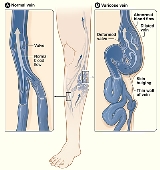
Varicose veins are veins that have become enlarged and tortuous. The term commonly refers to the veins on the leg, although varicose veins can occur
elsewhereVarices may refer to:In lower extremities* Varicose veins, large tortuous veins usually found on legsIn the digestive system* Sublingual varices* Esophageal varices, also known as Oesophageal varices* Gastric varices* Intestinal varices...
. Veins have leaflet valves to prevent blood from flowing backwards (retrograde). Leg muscles pump the veins to return blood to the heart, against the effects of gravity. When veins become varicose, the leaflets of the valves no longer meet properly, and the valves do not work. This allows blood to flow backwards and they enlarge even more. Varicose veins are most common in the superficial veins of the legs, which are subject to high pressure when standing. Besides cosmetic problems, varicose veins are often painful, especially when standing or walking. They often itch, and scratching them can cause ulcers. Serious complications are rare. Non-surgical treatments include
sclerotherapySclerotherapy is a procedure used to treat blood vessels or blood vessel malformations and also those of the lymphatic system. A medicine is injected into the vessels, which makes them shrink. It is used for children and young adults with vascular or lymphatic malformations...
, elastic stockings, elevating the legs, and exercise. The traditional surgical treatment has been
vein strippingVein stripping is a surgical procedure done under general or local anaesthetic to remove varicose veins. The surgery involves making one or more incisions upon the desired area followed by insertion of a special wire into the vein. The wire is tied to and advanced through the vein to a desired...
to remove the affected veins. Newer, less invasive treatments which seal the main leaking vein on the thigh are available. Alternative techniques, such as ultrasound-guided foam
sclerotherapySclerotherapy is a procedure used to treat blood vessels or blood vessel malformations and also those of the lymphatic system. A medicine is injected into the vessels, which makes them shrink. It is used for children and young adults with vascular or lymphatic malformations...
,
radiofrequency ablationRadio frequency ablation is a medical procedure where part of the electrical conduction system of the heart, tumor or other dysfunctional tissue is ablated using the heat generated from the high frequency alternating current to treat a medical disorder...
and
endovenous laser treatmentEndovenous laser treatment is a minimally invasive ultrasound-guided technique used for treating varicose veins using laser energy.-Methods:...
, are available as well. Because most of the blood in the legs is returned by the deep veins, the
superficial veinSuperficial vein is a term used to describe a vein that is close to the surface of the body. It is used to differentiate veins that are close to the surface from veins that are far from the surface, known as deep veins....
s, which return only about 10 per cent of the total blood of the legs, can usually be removed or ablated without serious harm. Varicose veins are distinguished from reticular veins (blue veins) and telangiectasias (spider veins), which also involve valvular insufficiency, by the size and location of the veins. Many patients who suffer with varicose veins seek out the assistance of physicians who specialize in vein care. These physicians are called
phlebologistA Phlebologist is a medical specialist in the diagnosis and treatment of disorders of venous origin. The specialty of Phlebology has developed to enable physicians sharing an interest in venous disease but with a variety of backgrounds such as dermatology, vascular surgery, haematology, or general...
s.
Signs and symptoms
- Aching, heavy legs
Heavy legs is an alleged medical condition, described as an "unpleasant sensation of pain and heaviness" in the lower limbs. It is recognised primarily in France, and to a lesser extent elsewhere....
(often worse at night and after exercise).
- Appearance of spider veins (telangiectasia
Telangiectasias /tɛ.læn.dʒiː'ɛk.teɪ.ʃi:ə/ are small dilated blood vessels near the surface of the skin or mucous membranes, measuring between 0.5 and 1 millimeter in diameter. They can develop anywhere on the body but are commonly seen on the face around the nose, cheeks, and chin...
) in the affected leg.
- Ankle swelling.
- A brownish-blue shiny skin discoloration near the affected veins.
- Redness, dryness, and itchiness of areas of skin, termed stasis dermatitis
Stasis dermatitis refers to the skin changes that occur in the leg as a result of "stasis" or blood pooling from insufficient venous return; the alternative name of varicose eczema comes from a common cause of this being varicose veins.Insufficient venous...
or venous eczemaEczema is a form of dermatitis, or inflammation of the epidermis . In England, an estimated 5.7 million or about one in every nine people have been diagnosed with the disease by a clinician at some point in their lives.The term eczema is broadly applied to a range of persistent skin conditions...
, because of waste products building up in the leg.
- Cramps may develop especially when making a sudden move as standing up.
- Minor injuries to the area may bleed more than normal and/or take a long time to heal.
- In some people the skin above the ankle may shrink (lipodermatosclerosis
Lipodermatosclerosis is a skin and connective tissue disease. It is a form of lower extremity panniculitis, an inflammation of the layer of fat under the epidermis.- Symptoms :Pain may be the first noticed symptom...
) because the fat underneath the skin becomes hard.
- Restless legs syndrome
Restless legs syndrome or Willis-Ekbom disease is a neurological disorder characterized by an irresistible urge to move one's body to stop uncomfortable or odd sensations. It most commonly affects the legs, but can affect the arms, torso, and even phantom limbs...
appears to be a common overlapping clinical syndrome in patients with varicose veins and other chronic venous insufficiencyChronic venous insufficiency or CVI is a medical condition where the veins cannot pump enough oxygen-poor blood back to the heart. It is sometimes referred to as an "impaired musculovenous pump", this is due to damaged or "incompetent" valves as may occur after deep vein thrombosis or phlebitis...
.
- Whitened, irregular scar-like patches can appear at the ankles. This is known as atrophie blanche
Livedo reticularis is a common cutaneous finding consisting of a mottled reticulated vascular pattern that appears like a lace-like purplish discoloration of the lower extremities. The discoloration is caused by swelling of the medium veins in the skin, which makes them more visible...
.
Complications
Most varicose veins are relatively benign, but severe varicosities can lead to major complications, due to the poor circulation through the affected limb.
- Pain, heaviness, inability to walk or stand for long hours, thus hindering work
- Skin conditions / Dermatitis
-Etymology:Dermatitis derives from Greek derma "skin" + -itis "inflammation" and genetic disorder.-Terminology:There are several different types of dermatitis. The different kinds usually have in common an allergic reaction to specific allergens. The term may describe eczema, which is also called...
which could predispose skin loss
- Skin ulcers especially near the ankle, usually referred to as venous ulcers.
- Development of carcinoma or sarcoma in longstanding venous ulcers. There have been over 100 reported cases of malignant transformation and the rate is reported as 0.4% to 1%.
- Severe bleeding from minor trauma, of particular concern in the elderly.
- Blood clotting within affected veins. Termed superficial thrombophlebitis. These are frequently isolated to the superficial veins, but can extend into deep veins becoming a more serious problem.
- Acute fat necrosis can occur, especially at the ankle of overweight patients with varicose veins. Females are more frequently affected than males.
- The afflicted person suffers tenderness in that region
Stages
- C0 no visible or palpable signs of venous disease
- C1 telangectasia or reticular veins
- C2 varicose veins
- C3 edema
- C4a skin changes due to venous disorders: pigmentation, eczema
Stasis dermatitis refers to the skin changes that occur in the leg as a result of "stasis" or blood pooling from insufficient venous return; the alternative name of varicose eczema comes from a common cause of this being varicose veins.Insufficient venous...
- C4b skin changes due to venous disorders: lipodermatosclerosis
Lipodermatosclerosis is a skin and connective tissue disease. It is a form of lower extremity panniculitis, an inflammation of the layer of fat under the epidermis.- Symptoms :Pain may be the first noticed symptom...
, atrophie blanche
- C5 as C4 but with healed ulcers
- C6 skin changes with active ulcers (venous insufficiency ulceration
Venous insufficiency ulceration, as well as stasis dermatitis, is a skin condition that results from increased pressure in the venous system of the lower leg.- See also :* Arterial insufficiency ulcer* List of cutaneous conditions* Venous ulcer...
)
Causes
Varicose veins are more common in women than in men, and are linked with
heredityHeredity is the passing of traits to offspring . This is the process by which an offspring cell or organism acquires or becomes predisposed to the characteristics of its parent cell or organism. Through heredity, variations exhibited by individuals can accumulate and cause some species to evolve...
. Other related factors are
pregnancyPregnancy refers to the fertilization and development of one or more offspring, known as a fetus or embryo, in a woman's uterus. In a pregnancy, there can be multiple gestations, as in the case of twins or triplets...
,
obesityObesity is a medical condition in which excess body fat has accumulated to the extent that it may have an adverse effect on health, leading to reduced life expectancy and/or increased health problems...
,
menopauseMenopause is a term used to describe the permanent cessation of the primary functions of the human ovaries: the ripening and release of ova and the release of hormones that cause both the creation of the uterine lining and the subsequent shedding of the uterine lining...
,
agingSenescence or biological aging is the change in the biology of an organism as it ages after its maturity. Such changes range from those affecting its cells and their function to those affecting the whole organism...
, prolonged standing, leg injury, abdominal straining, and crossing legs at the knees or ankles.
Less commonly, but not exceptionally, varicose veins can be due to other causes, as post phlebitic obstruction and/or incontinence, venous and arteriovenous malformations
See also for differential diagnosis- 1. Klippel-Trenaunay syndrome, 2. Parkes-Weber syndrome
Conservative
The symptoms of varicose veins can be controlled to an extent with the following:
- Elevating the legs often provides temporary symptomatic relief.
- "Advice about regular exercise sounds sensible but is not supported by any evidence."
- The wearing of graduated compression stockings
Compression stockings and socks are specialised hosiery items designed to increase blood circulation. Their main theraputic purpose is to provide graduated pressure on the lower leg and foot and, in some cases, the thigh, to alleviate circulatory problems such as edema, phlebitis and...
with variable pressure gradients (Class II or III) has been shown to correct the swelling, nutritional exchange, and improve the microcirculation in legs affected by varicose veins. They also often provide relief from the discomfort associated with this disease. Caution should be exercised in their use in patients with concurrent arterial disease.
- Diosmin
Diosmin is a semisynthetic phlebotropic drug , a member of the flavonoid family. It is an oral phlebotropic drug used in the treatment of venous disease, i.e., chronic venous insufficiency and hemorrhoidal disease , in acute or chronic hemorrhoids, in place of rubber-band ligation, in combination...
/Hesperidine and other flavonoidFlavonoids , are a class of plant secondary metabolites....
s.
- anti-inflammatory medication such as ibuprofen
Ibuprofen is a nonsteroidal anti-inflammatory drug used for relief of symptoms of arthritis, fever, as an analgesic , especially where there is an inflammatory component, and dysmenorrhea....
or aspirinAspirin , also known as acetylsalicylic acid , is a salicylate drug, often used as an analgesic to relieve minor aches and pains, as an antipyretic to reduce fever, and as an anti-inflammatory medication. It was discovered by Arthur Eichengrun, a chemist with the German company Bayer...
can be used as part of treatment for superficial thrombophlebitis along with graduated compression hosiery – but there is a risk of intestinal bleeding. In extensive superficial thrombophlebitis, consideration should be given to anti-coagulation, thrombectomy or sclerotherapy of the involved vein.
Active
Active medical intervention in varicose veins can be divided into surgical and non-surgical treatments. Some doctors favor traditional
open surgeryVein stripping is a surgical procedure done under general or local anaesthetic to remove varicose veins. The surgery involves making one or more incisions upon the desired area followed by insertion of a special wire into the vein. The wire is tied to and advanced through the vein to a desired...
, while others prefer the newer methods.
Newer methods for treating varicose veins such as Endovenous Thermal Ablation (
endovenous laser treatmentEndovenous laser treatment is a minimally invasive ultrasound-guided technique used for treating varicose veins using laser energy.-Methods:...
or
radiofrequency ablationRadio frequency ablation is a medical procedure where part of the electrical conduction system of the heart, tumor or other dysfunctional tissue is ablated using the heat generated from the high frequency alternating current to treat a medical disorder...
), and foam
sclerotherapySclerotherapy is a procedure used to treat blood vessels or blood vessel malformations and also those of the lymphatic system. A medicine is injected into the vessels, which makes them shrink. It is used for children and young adults with vascular or lymphatic malformations...
are not as well studied, especially in the longer term.
Surgical
Several techniques have been performed for over a century, from the more invasive saphenous stripping, to less invasive procedures like ambulatory phlebectomy and CHIVA.
Stripping
Stripping consists of removal of all or part the saphenous vein main trunk. The complications include
deep vein thrombosisDeep vein thrombosis is the formation of a blood clot in a deep vein. Deep vein thrombosis commonly affects the leg veins or the deep veins of the pelvis. Occasionally the veins of the arm are affected...
(5.3%),
pulmonary embolismPulmonary embolism is a blockage of the main artery of the lung or one of its branches by a substance that has travelled from elsewhere in the body through the bloodstream . Usually this is due to embolism of a thrombus from the deep veins in the legs, a process termed venous thromboembolism...
(0.06%), and wound complications including infection (2.2%). For traditional surgery, reported recurrence rates, which have been tracked for 10 years, range from 5-60%. In addition, since stripping removes the saphenous main trunks, they are no longer available for venous bypass in the future (coronary and/or leg artery vital disease)
- Othe
Other surgical treatments are:
- Ambulatory phlebectomy
Ambulatory phlebectomy is a treatment for superficial varicose veins. The procedure involves the removal of the varicose veins through small 2–3 mm incisions in the skin overlying the veins. The procedure may be performed in hospital or outpatient settings...
- Vein ligation
In surgery or medical procedure, a ligature consists of a piece of thread tied around an anatomical structure, usually a blood vessel or another hollow structure to shut it off. With a blood vessel the surgeon will clamp the vessel perpendicular to the axis of the artery or vein with a hemostat,...
- Cryosurgery- A cryoprobe is passed down the long saphenous vein following saphenofemoral ligation. Then the probe is cooled with NO2 or CO2 to a temperature of -850. The vein freezes to the probe and can be retrogradely stripped after 5 sec of freezing.It is a variant of Stripping. The only point of this technique is to avoid a distal incision to remove the stripper.
Non-surgical treatment
Sclerotherapy
A commonly performed non-surgical treatment for varicose and "spider" leg veins is
sclerotherapySclerotherapy is a procedure used to treat blood vessels or blood vessel malformations and also those of the lymphatic system. A medicine is injected into the vessels, which makes them shrink. It is used for children and young adults with vascular or lymphatic malformations...
in which medicine is injected into the veins to make them shrink. The medicines that are commonly used as sclerosants are polidocanol (POL), sodium tetradecyl sulphate (STS), Sclerodex (Canada), Hypertonic Saline, Glycerin and Chromated Glycerin. STS and Polidocanol(branded Asclera in the United States) liquids can be mixed with air or CO
2 or O
2 to create foams. Sclerotherapy has been used in the treatment of varicose veins for over 150 years. Sclerotherapy is often used for telangiectasias (spider veins) and varicose veins that persist or recur after vein stripping. Sclerotherapy can also be performed using foamed sclerosants under ultrasound guidance to treat larger varicose veins, including the great saphenous and small saphenous veins. A study by Kanter and Thibault in 1996 reported a 76% success rate at 24 months in treating saphenofemoral junction and great saphenous vein incompetence with STS 3% solution. A Cochrane Collaboration review concluded sclerotherapy was better than surgery in the short term (1 year) for its treatment success, complication rate and cost, but surgery was better after 5 years, although the research is weak.
A Health Technology Assessment found that sclerotherapy provided less benefit than surgery, but is likely to provide a small benefit in varicose veins without reflux. This Health Technology Assessment monograph includes reviews of the epidemiology, assessment, and treatment of varicose veins, as well as a study on clinical and cost effectiveness of surgery and sclerotherapy. Complications of sclerotherapy are rare but can include blood clots and ulceration.
AnaphylacticAnaphylaxis is defined as "a serious allergic reaction that is rapid in onset and may cause death". It typically results in a number of symptoms including throat swelling, an itchy rash, and low blood pressure...
reactions are "extraordinarily rare but can be life-threatening," and doctors should have resuscitation equipment ready. There has been one reported case of stroke after ultrasound guided sclerotherapy when an unusually large dose of sclerosant foam was injected.
Endovenous thermal ablation
The Australian Medical Services Advisory Committee (MSAC) in 2008 has determined that
endovenous laser treatmentEndovenous laser treatment is a minimally invasive ultrasound-guided technique used for treating varicose veins using laser energy.-Methods:...
/ablation (ELA) for varicose veins "appears to be more effective in the short term, and at least as effective overall, as the comparative procedure of junction ligation and vein stripping for the treatment of varicose veins." It also found in its assessment of available literature, that "occurrence rates of more severe complications such as DVT, nerve injury and paraesthesia, post-operative infections and haematomas, appears to be greater after ligation and stripping than after EVLT". Complications for ELA include minor skin burns (0.4%) and temporary paraesthesia (2.1%). The longest study of endovenous laser ablation is 39 months.
Two prospective randomized trials found speedier recovery and fewer complications after radiofrequency ablation (ERA) compared to open surgery. Myers wrote that open surgery for
small saphenous veinThe small saphenous vein , is a relatively large vein of the superficial posterior leg.-Path:Its origin is where the dorsal vein from the fifth digit merges with the dorsal venous arch of the foot, which attaches to the great saphenous vein...
reflux is obsolete. Myers said these veins should be treated with endovenous techniques, citing high recurrence rates after surgical management, and risk of nerve damage up to 15%. In comparison, ERA has been shown to control 80% of cases of small saphenous vein reflux at 4 years, said Myers. Complications for ERA include burns, paraesthesia, clinical phlebitis, and slightly higher rates of deep vein thrombosis (0.57%) and pulmonary embolism (0.17%).One 3-year study compared ERA, with a recurrence rate of 33%, to open surgery, which had a recurrence rate of 23%.
ELA and ERA require specialized training for doctors and expensive equipment. ELA is performed as an outpatient procedure and does not require the use of an operating theatre, nor does the patient need a general anaesthetic. Doctors must use high frequency ultrasound during the procedure to visualize the anatomical relationships between the saphenous structures. Some practitioners also perform phlebectomy or ultrasound guided sclerotherapy at the time of endovenous treatment. Follow-up treatment to smaller branch varicose veins is often needed in the weeks or months after the initial procedure.
External links