
All Topics  
Van de Graaff generator

 
Van De Graaff Generator

   Email Print
   Bookmark   Link


Van de Graaff generator


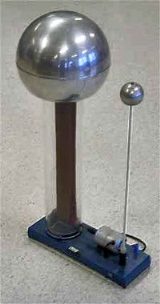
A Van de Graaff generator is an electrostatic machine
Electrostatic generator

An electrostatic generator, or electrostatic machine, is a mechanical device that produces static electricity, or electricity at high voltage and low continuous current....
 which uses a moving belt to accumulate very high electrostatically stable voltage
Voltage

Electrical tension is the potential difference between two points of an electrical or electronic circuit, expressed in volts. It is the measurement of the potential for an electric field to cause an electric current in an electrical conductor....
s on a hollow metal globe. The potential difference
Potential difference

In physics, the potential difference or p.d. between two points is the difference of the points' scalar potential, equivalent to the line integral of the field strength between the two points....
s achieved in modern Van de Graaff generators can reach 5 megavolts. The Van de Graaff generator can be thought of as a constant-current source connected in parallel with a capacitor
Capacitor

A capacitor or condenser is a Passive component electronic component consisting of a pair of electrical conductor separated by a dielectric....
 and a very large electrical resistance.

mple Van de Graaff generator consists of a belt of silk, or a similar flexible dielectric
Dielectric

A dielectric is a nonconducting substance, i.e. an Insulator . The term was coined by William Whewell in response to a request from Michael Faraday....
 material, running over two pulleys, one of which is surrounded by a hollow metal sphere.


Discussion
Ask a question about 'Van de Graaff generator'
Start a new discussion about 'Van de Graaff generator'
Answer questions from other users
Full Discussion Forum


Encyclopedia


A Van de Graaff generator is an electrostatic machine
Electrostatic generator

An electrostatic generator, or electrostatic machine, is a mechanical device that produces static electricity, or electricity at high voltage and low continuous current....
 which uses a moving belt to accumulate very high electrostatically stable voltage
Voltage

Electrical tension is the potential difference between two points of an electrical or electronic circuit, expressed in volts. It is the measurement of the potential for an electric field to cause an electric current in an electrical conductor....
s on a hollow metal globe. The potential difference
Potential difference

In physics, the potential difference or p.d. between two points is the difference of the points' scalar potential, equivalent to the line integral of the field strength between the two points....
s achieved in modern Van de Graaff generators can reach 5 megavolts. The Van de Graaff generator can be thought of as a constant-current source connected in parallel with a capacitor
Capacitor

A capacitor or condenser is a Passive component electronic component consisting of a pair of electrical conductor separated by a dielectric....
 and a very large electrical resistance.

Description

Van De Graaf Generator
A simple Van de Graaff generator consists of a belt of silk, or a similar flexible dielectric
Dielectric

A dielectric is a nonconducting substance, i.e. an Insulator . The term was coined by William Whewell in response to a request from Michael Faraday....
 material, running over two pulleys, one of which is surrounded by a hollow metal sphere. Two electrode
Electrode

An electrode is an electrical conductor used to make contact with a nonmetallic part of a Electronic circuit . The word was coined by the scientist Michael Faraday from the Greek language words elektron and hodos, a way....
s, (2) and (7), in the form of comb-shaped rows of sharp metal points, are positioned respectively near to the bottom of the pulley and inside the sphere. (2) is connected to the sphere, and a high DC potential (with respect to earth) is applied to (7); a positive potential in this example.

As the belt is pulled away from the upper roller, it pulls away some of the roller's electrons, leaving the roller with a positive charge, and the belt with a negative charge. This then causes electrons to concentrate at the tips of the lower brush (7), the longer the belt is turning, the higher the concentration of the electrons is. In the end this will cause the air around (7) to ionize, the electrons will then jump through the now conductive air towards the positively charged roller. But instead of hitting the roller, they meet the belt and are carried up to (2), the electrons are then pushed away from the negatively charged belt towards (2), (NOTE: the top roller must be made of an insulating material for this to work) where they are then led to the dome. As the belt continues to move, a constant charging current travels via the belt, and the sphere continues to accumulate negative charge until the rate that charge is being lost (through leakage and corona discharge
Corona discharge

In electricity, a corona discharge is an electrical discharge brought on by the ionization of a fluid surrounding a conductor , which occurs when the potential gradient exceeds a certain value, but conditions are insufficient to cause complete electrical breakdown or electric arc....
s) equals the charging current. The larger the sphere and the farther it is from ground, the higher will be its final potential.

The other method for building Van de Graaff generators is to use the triboelectric effect
Triboelectric effect

The triboelectric effect is a type of contact electrification in which certain materials become electric charge after they come into contact with another different material and are then separated ....
. The strong e-field
Electric field

In physics, the space surrounding an electric charge or in the presence of a time-varying magnetic field has a property called an electric field ....
 from the rollers then induces a corona discharge at the tip of the pointed electrodes. The electrodes then "spray" a charge onto the belt which is opposite in polarity to the charge on the rollers. The remaining operation is otherwise the same as the voltage-injecting version above. This type of generator is easier to build for science fair or homemade projects, since it doesn't require a potentially dangerous high voltage source. The trade-off is that it cannot build up as high a voltage as the other type, and operation may become difficult under humid conditions (which can severely reduce triboelectric effects).

Since a Van de Graaff generator can supply the same small current at almost any level of electrical potential, it is an example of a nearly ideal current source
Current source

A current source is an electrical or electronic device that delivers or absorbs electric current. A current source is the Duality of a voltage source....
. The maximum achievable potential is approximately equal to the sphere's radius multiplied by the e-field where corona discharges begin to form within the surrounding gas. For example, a polished spherical electrode 30 cm in diameter immersed in air at STP
Standard conditions for temperature and pressure

In physical sciences, standard conditions for temperature and pressure are standard sets of conditions for experimental measurements, to allow comparisons to be made between different sets of data....
 (which has a breakdown voltage
Breakdown voltage

The breakdown voltage of an nonconductor is the minimum voltage that causes a portion of an insulator to become electrically Conductor .The breakdown voltage of a diode is the minimum reverse voltage to make the diode conduct in reverse....
 of about 30 kV/cm) could be expected to develop a maximum voltage of about 450 kV.

History

Van Den Graaff Dsc09091
The fundamental idea for the friction machine as high-voltage supply, using electrostatic influence to charge rotating disk or belt can be traced back to the 17th century or even before (cf. Friction machines History
Electrostatic generator

An electrostatic generator, or electrostatic machine, is a mechanical device that produces static electricity, or electricity at high voltage and low continuous current....
)

The Van de Graaff generator was developed, starting in 1929, by physicist Robert J. Van de Graaff
Robert J. Van de Graaff

Robert Jemison Van de Graaff, was an United States physicist and instrument maker, and professor of physics at Princeton University....
 at Princeton University
Princeton University

Princeton University is a private university university located in Princeton, New Jersey, New Jersey, United States. The school is one of the eight universities of the Ivy League and has the largest per-student Financial endowment in the world....
. The first model was demonstrated in October 1929. The first machine used a silk ribbon bought at a five and dime store as the charge transport belt. In 1931 a version able to produce 1,000,000 volts was described in a patent disclosure. This version had two 60 cm diameter charge accumulation spheres mounted on Pyrex
Pyrex

Pyrex is a brand name for glassware, introduced by Corning Incorporated in 1915. Originally, Pyrex was made from thermal shock resistant borosilicate glass....
 glass columns 180 cm high; the apparatus cost only $90.

Van de Graaff applied for a patent in December 1931, which was assigned to MIT
Massachusetts Institute of Technology

The Massachusetts Institute of Technology is a private university research university located in Cambridge, Massachusetts, Massachusetts, United States....
 in exchange for a share of net income. The patent was later granted.

In 1933 Van de Graaff built a 40-foot (12 m) model at MIT's Round Hill
Round Hill, Massachusetts

Round Hill is a location in Dartmouth, Massachusetts of historical significance....
 facility, the use of which was donated by Colonel Green
Edward Howland Robinson Green

Colonel Edward Howland Robinson Green , aka Colonel Green, was the son of miser Hetty Green, and the heir to her fortune of $150 million....
.

A more recent development is the tandem Van de Graaff accelerator, containing one or more Van de Graaff generators, in which negatively charged ion
Ion

An ion is an atom or molecule which has lost or gained one or more electrons, giving it a positive or negative electrical charge. According to the Bohr_model this will be from or in the outer shield 'n'....
s are accelerated through one potential difference
Potential difference

In physics, the potential difference or p.d. between two points is the difference of the points' scalar potential, equivalent to the line integral of the field strength between the two points....
 before being stripped of two or more electrons, inside a high voltage terminal, and accelerated again.

One of Van de Graaff's accelerators used two charged domes of sufficient size that each of the domes had laboratories inside - one to provide the source of the accelerated beam, and the other to analyze the actual experiment. The power for the equipment inside the domes came from generators that ran off the belt, and several sessions came to a rather spectacular end when a pigeon would try to fly between the two domes - causing them to discharge (The accelerator was set up in an airplane hangar).

By the 1970s, up to 14 million volts could be achieved at the terminal of a tandem that used a tank of high pressure sulfur hexafluoride (SF6) gas to prevent sparking by trapping electrons. This allowed the generation of heavy ion beams of several tens of megaelectronvolts, sufficient to study light ion direct nuclear reactions. The highest potential sustained by a Van de Graaff accelerator is 25.5 MV, achieved by the tandem at the Holifield Radioactive Ion Beam Facility at Oak Ridge National Laboratory
Oak Ridge National Laboratory

Oak Ridge National Laboratory is a multiprogram science and technology national laboratory managed for the United States Department of Energy by UT-Battelle....
.

A further development is the pelletron
Pelletron

Pelletron is a type of Electrostatic generator particle accelerator similar to a Van de Graaff generator. Pelletrons have been built in many sizes, from small units producing voltages up to 500 kilovolts and beam energies up to 1 Electronvolt of kinetic energy, to the largest system, which has reached a DC voltage of over 25 megavolts and...
, where the rubber or fabric belt is replaced by a chain of short conductive rods connected by insulating links, and the air-ionizing electrodes are replaced by a grounded roller and inductive charging electrode. The chain can be operated at much higher velocity than a belt, and both the voltage and currents attainable are much higher than with a conventional Van de Graaff generator.

The Nuclear Structure Facility, or NSF at Daresbury Laboratory
Daresbury Laboratory

Daresbury Laboratory is a scientific research laboratory near Daresbury in Cheshire, England, which began operations in 1962 and was officially opened on 16 June 1967 as the Daresbury Nuclear Physics Laboratory by the then Prime Minister, Harold Wilson....
, was proposed in the 1970s, commissioned in 1981 and opened for experiments in 1983. It consisted of a tandem Van de Graaff operating routinely at 20 MV, housed in a distinctive building 70 metres high. During its lifetime it accelerated 80 different ion beams for experimental use, ranging from protons to uranium. A particular feature was the ability to accelerate rare isotopic and radioactive beams. Perhaps the most important discovery made on the NSF was that of super-deformed nuclei. These nuclei, when formed from the fusion of lighter elements, rotate very rapidly. The pattern of gamma-rays emitted as they slow down provided detailed information about the inner structure of the nucleus. Following financial cutbacks, the NSF closed in 1993.

Van de Graaff generators on display


One of the largest Van de Graaff generators in the world, built by Dr. Van de Graaff himself, is now on permanent display at Boston's Museum of Science
Museum of Science, Boston

The Museum of Science is a Boston, Massachusetts landmark, located in Science Park, a plot of land spanning the Charles River. Along with over 500 interactive exhibits, the Museum features a number of live presentations throughout the building everyday, along with shows at the Charles Hayden Planetarium and the Mugar Omni IMAX theater, the o...
. With two conjoined 4.5 metre (15 foot) aluminum spheres standing on columns many feet tall, this generator can often reach 2 million(2,000,000) volt
Volt

The volt is the SI SI derived unit of electric potential difference or electromotive force, commonly known as voltage. It is named in honor of the Lombard physicist Alessandro Volta , who invented the voltaic pile, possibly the first chemical battery ....
s. Shows using the Van de Graaff generator and several Tesla coil
Tesla coil

A Tesla coil is a type of Transformer#Resonant transformers circuit invented by Serbian-American scientist Nikola Tesla around 1891. It is generally used to generate very high voltage, low Electrical current, high frequency alternating current electricity....
s are conducted several times each day.

Comparison with other high voltage generators

Other classical electrostatic machines like a triplex Wimshurst Machine
Wimshurst machine

The Wimshurst machine is an electrostatic generator for generating high voltages developed between 1880 and 1883 by United Kingdom inventor James Wimshurst ....
 or a Bonetti machine can easily produce more current, but the less insulated structures result in smaller voltages.

Patents


See also


  • Kirlian photography
    Kirlian photography

    Kirlian photography refers to a form of photogram made with a high voltage. It is named after Semyon Kirlian, who in 1939 accidentally discovered that if an object on a photographic plate is connected to a source of high voltage, small corona discharges create an image on the photographic plate....
  • Los Alamos National Laboratory
    Los Alamos National Laboratory

    Los Alamos National Laboratory is a United States Department of Energy United States Department of Energy National Labs, managed and operated by Los Alamos National Security, LLC , located in Los Alamos, New Mexico....
  • Electrostatic induction
    Electrostatic induction

    Electrostatic induction is a redistribution of electrical charge in an object, caused by the influence of nearby charges. Induction was discovered by British scientist John Canton in 1753 and Swedish professor Johan Carl Wilcke in 1762....
  • Superconductivity
    Superconductivity

    Superconductivity is a phenomenon occurring in certain materials generally at very low temperatures, characterized by exactly zero electrical resistance and the exclusion of the interior magnetic field ....
  • Mad scientist
    Mad scientist

    A mad scientist is a stock character of Genre fiction, specifically science fiction. The mad scientist may be villainous, benign or neutral, and whether psychosis, eccentricity , or simply bumbling, mad scientists often work with fictional technology in order to forward their schemes, if they even have a coherent scheme....
  • Triboelectric effect
    Triboelectric effect

    The triboelectric effect is a type of contact electrification in which certain materials become electric charge after they come into contact with another different material and are then separated ....
  • Electrical generator
    Electrical generator

    In electricity generation, an electrical generator is a device that converts mechanical energy to electrical energy, generally using electromagnetic induction....
  • Robert J. Van de Graaff
    Robert J. Van de Graaff

    Robert Jemison Van de Graaff, was an United States physicist and instrument maker, and professor of physics at Princeton University....
  • Static electricity
    Static electricity

    Static electricity refers to the buildup of electric charge on the surface of objects. The static charges remains on an object until they either bleed off to ground or are quickly neutralized by a discharge....
  • High-voltage
    High voltage

    The term high voltage characterizes electrical circuits, in which the voltage used is the cause of particular safety concerns and insulation requirements....
  • Teleforce
    Teleforce

    Teleforce was Nikola Tesla's charged particle beam projector, first mentioned publicly in the New York Sun and New York Times on July 10, 1934....
  • 1929 in science
    1929 in science

    The year 1929 in science and technology involved some significant events, listed below....
  • Tesla coil
    Tesla coil

    A Tesla coil is a type of Transformer#Resonant transformers circuit invented by Serbian-American scientist Nikola Tesla around 1891. It is generally used to generate very high voltage, low Electrical current, high frequency alternating current electricity....
  • Oudin coil
    Oudin coil

    An Oudin coil, also called an Oudin oscillator or Oudin resonator, is a disruptive discharge coil, that is a transformer designed to produce high voltage Electrical arcs and Corona discharge, similar to a Tesla coil....
  • Wimshurst machine
    Wimshurst machine

    The Wimshurst machine is an electrostatic generator for generating high voltages developed between 1880 and 1883 by United Kingdom inventor James Wimshurst ....
Build your own VDG

External links

  • University of Virginia
  • National High Magnetic Field Laboratory
  • Vivitron 20MV+ generator
  • Nikola Tesla
    Nikola Tesla

    Nikola Tesla was an inventor and a mechanical engineer and electrical engineer. Tesla was born in the village of Smiljan near the town of Gospic, in Croatia ....
    , "". Scientific American, March, 1934. (.doc format)
  • Paolo Brenni , Bulletin of the Scientific Instrument Society No. 63 (1999)
  • Charrier Jacques "". Faculté des Sciences de Nantes.
  • Hellborg, Ragnar, ed. Electrostatic Accelerators: Fundamentals and Applications [N.Y., N.Y.: Springer, 2005]. Available on-line at: http://books.google.com/books?id=tc6CEuIV1jEC&pg=PA51&lpg=PA51&dq=electrostatic+accelerator+book&source=web&ots=Qa0DbmiZJt&sig=bLoYaz_VUpBr7-Wv4lk_fLBnUo4#PPP1,M1