
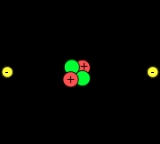
In chemistry,
valence electrons are the
electronThe electron is a subatomic particle with a negative elementary electric charge. It has no known components or substructure; in other words, it is generally thought to be an elementary particle. An electron has a mass that is approximately 1/1836 that of the proton...
s of an
atomThe atom is a basic unit of matter that consists of a dense central nucleus surrounded by a cloud of negatively charged electrons. The atomic nucleus contains a mix of positively charged protons and electrically neutral neutrons...
that can participate in the formation of
chemical bondA chemical bond is an attraction between atoms that allows the formation of chemical substances that contain two or more atoms. The bond is caused by the electromagnetic force attraction between opposite charges, either between electrons and nuclei, or as the result of a dipole attraction...
s with other atoms. Valence electrons are the "own" electrons, present in the free neutral atom, that combine with valence electrons of other atoms to form chemical bonds. In a single
covalent bondA covalent bond is a form of chemical bonding that is characterized by the sharing of pairs of electrons between atoms. The stable balance of attractive and repulsive forces between atoms when they share electrons is known as covalent bonding....
both atoms contribute one valence electron to form a
shared pairIn chemistry, a shared pair is a pair of electrons bonding two atoms together by being shared by the two atoms, because the positive nuclei are attracted to the negative electrons....
. For
main group elementIn chemistry and atomic physics, main group elements are elements in groups whose lightest members are represented by helium, lithium,...
s, only the outermost electrons are valence electrons. In
transition metalThe term transition metal has two possible meanings:*The IUPAC definition states that a transition metal is "an element whose atom has an incomplete d sub-shell, or which can give rise to cations with an incomplete d sub-shell." Group 12 elements are not transition metals in this definition.*Some...
s, some inner-shell electrons are also valence electrons.
Valence electrons are important in determining how the atom reacts chemically with other atoms. Atoms with a complete
(closed) shellIn the context of atomic orbitals, an open shell is a valence shell which is not completely filled with electrons or that has not given all of its valence electrons through chemical bonds with other atoms or molecules during a chemical reaction. Atoms generally reach a noble gas configuration in a...
of valence electrons (corresponding to an
electron configurationIn atomic physics and quantum chemistry, electron configuration is the arrangement of electrons of an atom, a molecule, or other physical structure...
s
2p
6) tend to be chemically inert. Atoms with one or two valence electrons more than a closed shell are highly reactive because the extra electrons are easily removed to form positive
ionAn ion is an atom or molecule in which the total number of electrons is not equal to the total number of protons, giving it a net positive or negative electrical charge. The name was given by physicist Michael Faraday for the substances that allow a current to pass between electrodes in a...
s. Atoms with one or two valence electrons fewer than a closed shell are also highly reactive because of a tendency either to gain the missing electrons and form negative ions, or to share electrons and form covalent bonds.
Valence electrons have the ability, like electrons in inner shells, to absorb or release energy in the form of
photonIn physics, a photon is an elementary particle, the quantum of the electromagnetic interaction and the basic unit of light and all other forms of electromagnetic radiation. It is also the force carrier for the electromagnetic force...
s. This gain or loss of energy can trigger an electron to move (jump) to another shell or even break free from the atom and its valence shell. When an electron absorbs energy in the form of one or more photons, then it moves to a more outer shell depending on the amount of energy gained. (See also : electrons in an excited state).
When an electron loses energy (photons), then it moves to a more inner shell.
The number of valence electrons
The number of valence electrons of an element is determined by its
periodic table groupIn chemistry, a group is a vertical column in the periodic table of the chemical elements. There are 18 groups in the standard periodic table, including the d-block elements, but excluding the f-block elements....
(vertical column) in which the element is categorized. With the exception of groups 3–12 (
transition metalThe term transition metal has two possible meanings:*The IUPAC definition states that a transition metal is "an element whose atom has an incomplete d sub-shell, or which can give rise to cations with an incomplete d sub-shell." Group 12 elements are not transition metals in this definition.*Some...
s), the number within the unit's place identifies how many valence electrons are contained within the elements listed under that particular column.

Periodic table groupIn chemistry, a group is a vertical column in the periodic table of the chemical elements. There are 18 groups in the standard periodic table, including the d-block elements, but excluding the f-block elements....
|
Valence electrons |
Group 1 (I) (alkali metalThe alkali metals are a series of chemical elements in the periodic table. In the modern IUPAC nomenclature, the alkali metals comprise the group 1 elements, along with hydrogen. The alkali metals are lithium , sodium , potassium , rubidium , caesium , and francium... s) |
1 |
Group 2 (II) (alkaline earth metalThe alkaline earth metals are a group in the periodic table. In the modern IUPAC nomenclature, the alkaline earth metals are called the group 2 elements. Previously, they were called the Group IIA elements . The alkaline earth metals contain beryllium , magnesium , calcium , strontium , barium and... s) |
2 |
Groups 3-12 (transition metalThe term transition metal has two possible meanings:*The IUPAC definition states that a transition metal is "an element whose atom has an incomplete d sub-shell, or which can give rise to cations with an incomplete d sub-shell." Group 12 elements are not transition metals in this definition.*Some... s) |
See note * |
| Group 13 (III) (boron group The boron group is the series of elements in group 13 of the periodic table, comprising boron , aluminium , gallium , indium , thallium , and ununtrium . The elements in the boron group are characterized by having three electrons in their outer energy levels... ) |
3 |
| Group 14 (IV) (carbon group The carbon group is a periodic table group consisting of carbon , silicon , germanium , tin , lead , and ununquadium .... ) |
4 |
| Group 15 (V) (nitrogen group The nitrogen group is a periodic table group consisting of nitrogen , phosphorus , arsenic , antimony , bismuth and ununpentium .... ) |
5 |
| Group 16 (VI) (chalcogen The chalcogens are the chemical elements in group 16 of the periodic table. This group is also known as the oxygen family... s) |
6 |
Group 17 (VII) (halogenThe halogens or halogen elements are a series of nonmetal elements from Group 17 IUPAC Style of the periodic table, comprising fluorine , chlorine , bromine , iodine , and astatine... s) |
7 |
| Group 18 (noble gases) |
8** |
- The general method for counting valence electrons is generally not useful for transition metals. Instead the modified d electron count
The d electron count is a chemistry formalism used to describe the electron configuration of the valence electrons of a transition metal center in a coordination complex. The d electron count is an effective way to understand the geometry and reactivity of transition metal complexes...
method is used.
-
- Except for helium
Helium is the chemical element with atomic number 2 and an atomic weight of 4.002602, which is represented by the symbol He. It is a colorless, odorless, tasteless, non-toxic, inert, monatomic gas that heads the noble gas group in the periodic table...
, which has only two valence electrons.
Valence electrons and electron configuration
For
main group elementIn chemistry and atomic physics, main group elements are elements in groups whose lightest members are represented by helium, lithium,...
s, the number of valence electrons depends on the
electron configurationIn atomic physics and quantum chemistry, electron configuration is the arrangement of electrons of an atom, a molecule, or other physical structure...
in a simple way, but for
transition metalThe term transition metal has two possible meanings:*The IUPAC definition states that a transition metal is "an element whose atom has an incomplete d sub-shell, or which can give rise to cations with an incomplete d sub-shell." Group 12 elements are not transition metals in this definition.*Some...
s the relationship is more complex.
For main group elements, valence electrons can be defined as those in the electronic shell of highest
principal quantum numberIn atomic physics, the principal quantum symbolized as n is the firstof a set of quantum numbers of an atomic orbital. The principal quantum number can only have positive integer values...
n. For example the electronic configuration of phosphorus (P) is 1s
2 2s
2 2p
6 3s
2 3p
3 so that there are 5 valence electrons (3s
2 3p
3), corresponding to a maximum valence for P of 5 as in the molecule PF
5. This configuration is normally abbreviated to (Ne) 3s
2 3p
3, where (Ne) signifies the core electrons whose configuration is identical to the
noble gasThe noble gases are a group of chemical elements with very similar properties: under standard conditions, they are all odorless, colorless, monatomic gases, with very low chemical reactivity...
neon.
However this simple method does not work for transition metals, which have incomplete nd (i.e. 3d, 4d or 5d) subshells whose energy is normally comparable with that of the (n+1)s electrons. The valence electrons are instead defined as those outside a noble-gas core. For example,
manganeseManganese is a chemical element, designated by the symbol Mn. It has the atomic number 25. It is found as a free element in nature , and in many minerals...
(Mn) has configuration 1s
2 2s
2 2p
6 3s
2 3p
6 4s
2 3d
5. This is abbreviated to (Ar) 4s
2 3d
5, where (Ar) denotes a core configuration identical to that of
argonArgon is a chemical element represented by the symbol Ar. Argon has atomic number 18 and is the third element in group 18 of the periodic table . Argon is the third most common gas in the Earth's atmosphere, at 0.93%, making it more common than carbon dioxide...
. In this atom, the 3d electrons have energies similar to those of the 4s electrons, and much higher than for the 3s and 3p electrons. In effect there are seven valence electrons (4s
2 3d
5) outside the argon-like core. This is consistent with the chemical fact that manganese can have
oxidation stateIn chemistry, the oxidation state is an indicator of the degree of oxidation of an atom in a chemical compound. The formal oxidation state is the hypothetical charge that an atom would have if all bonds to atoms of different elements were 100% ionic. Oxidation states are typically represented by...
s as high as +7 (in the
permanganateA permanganate is the general name for a chemical compound containing the manganate ion, . Because manganese is in the +7 oxidation state, the permanganate ion is a strong oxidizing agent. The ion has tetrahedral geometry...
ion MnO
4-).
Towards the right of each transition metal series, the d electrons descend to lower energies and have less valence electron character. Thus although
nickelNickel is a chemical element with the chemical symbol Ni and atomic number 28. It is a silvery-white lustrous metal with a slight golden tinge. Nickel belongs to the transition metals and is hard and ductile...
has in principle ten valence electrons (4s
2 3d
8), the oxidation state never exceeds four. For
zincZinc , or spelter , is a metallic chemical element; it has the symbol Zn and atomic number 30. It is the first element in group 12 of the periodic table. Zinc is, in some respects, chemically similar to magnesium, because its ion is of similar size and its only common oxidation state is +2...
and succeeding elements, the 3d subshell is complete and the 3d electrons are considered core electrons.
Since the number of valence electrons which actually participate in chemical reactions is difficult to predict, the concept of valence electrons is less useful for transition metals than for main group elements. As mentioned above, the
d electron countThe d electron count is a chemistry formalism used to describe the electron configuration of the valence electrons of a transition metal center in a coordination complex. The d electron count is an effective way to understand the geometry and reactivity of transition metal complexes...
provides a more useful tool for the understanding of the chemistry of these elements.
Valence electrons in chemical reactions
The number of electrons in an atom's outermost valence shell governs its
bondingA chemical bond is an attraction between atoms that allows the formation of chemical substances that contain two or more atoms. The bond is caused by the electromagnetic force attraction between opposite charges, either between electrons and nuclei, or as the result of a dipole attraction...
behavior. Therefore, elements with the same number of valence electrons are grouped together in the
periodic tableThe periodic table of the chemical elements is a tabular display of the 118 known chemical elements organized by selected properties of their atomic structures. Elements are presented by increasing atomic number, the number of protons in an atom's atomic nucleus...
of the elements. As a general rule, atoms of
main group elementIn chemistry and atomic physics, main group elements are elements in groups whose lightest members are represented by helium, lithium,...
s (except hydrogen and helium) tend to react to form a "closed" or complete shell, corresponding to an s
2p
6 electron configurationIn atomic physics and quantum chemistry, electron configuration is the arrangement of electrons of an atom, a molecule, or other physical structure...
. This tendency is called the
octet ruleThe octet rule is a chemical rule of thumb that states that atoms of low The octet rule is a chemical rule of thumb that states that atoms of low The octet rule is a chemical rule of thumb that states that atoms of low (The octet rule is a chemical rule of thumb that states that atoms of low (...
since the bonded atom has or shares eight valence electrons.
The most reactive metallic elements are the
alkali metalThe alkali metals are a series of chemical elements in the periodic table. In the modern IUPAC nomenclature, the alkali metals comprise the group 1 elements, along with hydrogen. The alkali metals are lithium , sodium , potassium , rubidium , caesium , and francium...
s of Group 1, for example
sodiumSodium is a chemical element with the symbol Na and atomic number 11. It is a soft, silvery-white, highly reactive metal and is a member of the alkali metals; its only stable isotope is 23Na. It is an abundant element that exists in numerous minerals, most commonly as sodium chloride...
(Na) and
potassiumPotassium is the chemical element with the symbol K and atomic number 19. Elemental potassium is a soft silvery-white alkali metal that oxidizes rapidly in air and is very reactive with water, generating sufficient heat to ignite the hydrogen emitted in the reaction.Potassium and sodium are...
(K) whose atoms each have a single valence electron. This is easily lost to form a positive
ionAn ion is an atom or molecule in which the total number of electrons is not equal to the total number of protons, giving it a net positive or negative electrical charge. The name was given by physicist Michael Faraday for the substances that allow a current to pass between electrodes in a...
(cation) with a closed shell (Na
+ or K
+), during the formation of an
ionic bondAn ionic bond is a type of chemical bond formed through an electrostatic attraction between two oppositely charged ions. Ionic bonds are formed between a cation, which is usually a metal, and an anion, which is usually a nonmetal. Pure ionic bonding cannot exist: all ionic compounds have some...
which provides the necessary
ionization energyThe ionization energy of a chemical species, i.e. an atom or molecule, is the energy required to remove an electron from the species to a practically infinite distance. Large atoms or molecules have a low ionization energy, while small molecules tend to have higher ionization energies.The property...
. The
alkaline earth metalThe alkaline earth metals are a group in the periodic table. In the modern IUPAC nomenclature, the alkaline earth metals are called the group 2 elements. Previously, they were called the Group IIA elements . The alkaline earth metals contain beryllium , magnesium , calcium , strontium , barium and...
s of Group 2, for example
magnesiumMagnesium is a chemical element with the symbol Mg, atomic number 12, and common oxidation number +2. It is an alkaline earth metal and the eighth most abundant element in the Earth's crust and ninth in the known universe as a whole...
, are somewhat less reactive since each atom must lose two valence electrons to form a positive ion with a closed shell such as Mg
2+.
NonmetalNonmetal, or non-metal, is a term used in chemistry when classifying the chemical elements. On the basis of their general physical and chemical properties, every element in the periodic table can be termed either a metal or a nonmetal...
atoms tend to attract additional valence electrons to attain a full valence shell. This can be achieved one of two ways: an atom can either share electrons with neighboring atoms, a
covalent bondA covalent bond is a form of chemical bonding that is characterized by the sharing of pairs of electrons between atoms. The stable balance of attractive and repulsive forces between atoms when they share electrons is known as covalent bonding....
, or it can remove electrons from other atoms, an
ionic bondAn ionic bond is a type of chemical bond formed through an electrostatic attraction between two oppositely charged ions. Ionic bonds are formed between a cation, which is usually a metal, and an anion, which is usually a nonmetal. Pure ionic bonding cannot exist: all ionic compounds have some...
. The most reactive non-metals are the
halogenThe halogens or halogen elements are a series of nonmetal elements from Group 17 IUPAC Style of the periodic table, comprising fluorine , chlorine , bromine , iodine , and astatine...
s such as
fluorineFluorine is the chemical element with atomic number 9, represented by the symbol F. It is the lightest element of the halogen column of the periodic table and has a single stable isotope, fluorine-19. At standard pressure and temperature, fluorine is a pale yellow gas composed of diatomic...
(F) and
chlorineChlorine is the chemical element with atomic number 17 and symbol Cl. It is the second lightest halogen, found in the periodic table in group 17. The element forms diatomic molecules under standard conditions, called dichlorine...
(Cl), which have electron configurations s
2p
5 and require only one additional valence electron for a closed shell. To form an ionic bond, a halogen atom can remove an electron from another atom to form an anion (F
-, Cl
-, etc.). To form a covalent bond, one electron from the halogen and one electron from another atom form a shared pair. For example in the molecule H-F, the line represents a shared pair of valence electrons, one from H and one from F.
In these simple cases where the octet rule is obeyed, the
valenceIn chemistry, valence, also known as valency or valence number, is a measure of the number of bonds formed by an atom of a given element. "Valence" can be defined as the number of valence bonds...
of an atom equals the number of electrons gained, lost or shared to form the stable octet. However there are also many molecules which are exceptions, and for which the valence is less clearly defined.
Valence electrons and electrical conductivity
The valence electrons are also responsible for the electrical conductivity of elements, which may be divided into
metalA metal , is an element, compound, or alloy that is a good conductor of both electricity and heat. Metals are usually malleable and shiny, that is they reflect most of incident light...
s, nonmetals, and
semiconductorA semiconductor is a material with electrical conductivity due to electron flow intermediate in magnitude between that of a conductor and an insulator. This means a conductivity roughly in the range of 103 to 10−8 siemens per centimeter...
s or
metalloidMetalloid is a term used in chemistry when classifying the chemical elements. On the basis of their general physical and chemical properties, each element can usually be classified as a metal or a nonmetal. However, some elements with intermediate or mixed properties can be harder to characterize...
s.
Metals or metallic elements are elements with high electrical conductivity in the
solidSolid is one of the three classical states of matter . It is characterized by structural rigidity and resistance to changes of shape or volume. Unlike a liquid, a solid object does not flow to take on the shape of its container, nor does it expand to fill the entire volume available to it like a...
state. In each row of the
periodic table the metals occur to the left of the nonmetals and thus have fewer valence electrons. The valence electrons which are present have small
ionization energiesThe ionization energy of a chemical species, i.e. an atom or molecule, is the energy required to remove an electron from the species to a practically infinite distance. Large atoms or molecules have a low ionization energy, while small molecules tend to have higher ionization energies.The property...
, and in the solid state they are relatively free to leave one atom and move to its neighbour. These “free electrons” can move under the influence of an
electric fieldIn physics, an electric field surrounds electrically charged particles and time-varying magnetic fields. The electric field depicts the force exerted on other electrically charged objects by the electrically charged particle the field is surrounding...
and their motion constitutes an
electric currentElectric current is a flow of electric charge through a medium.This charge is typically carried by moving electrons in a conductor such as wire...
. They are therefore responsible for the electrical conductivity of the metal.
CopperCopper is a chemical element with the symbol Cu and atomic number 29. It is a ductile metal with very high thermal and electrical conductivity. Pure copper is soft and malleable; an exposed surface has a reddish-orange tarnish...
,
aluminiumAluminium or aluminum is a silvery white member of the boron group of chemical elements. It has the symbol Al, and its atomic number is 13. It is not soluble in water under normal circumstances....
,
silverSilver is a metallic chemical element with the chemical symbol Ag and atomic number 47. A soft, white, lustrous transition metal, it has the highest electrical conductivity of any element and the highest thermal conductivity of any metal...
and
goldGold is a chemical element with the symbol Au and an atomic number of 79. Gold is a dense, soft, shiny, malleable and ductile metal. Pure gold has a bright yellow color and luster traditionally considered attractive, which it maintains without oxidizing in air or water. Chemically, gold is a...
are examples of good conductors used widely in industry.
NonmetalNonmetal, or non-metal, is a term used in chemistry when classifying the chemical elements. On the basis of their general physical and chemical properties, every element in the periodic table can be termed either a metal or a nonmetal...
lic elements have low electrical conductivity and act as insulators. They are found to the right of the periodic table with valence shells which are at least half full (except for
boronBoron is the chemical element with atomic number 5 and the chemical symbol B. Boron is a metalloid. Because boron is not produced by stellar nucleosynthesis, it is a low-abundance element in both the solar system and the Earth's crust. However, boron is concentrated on Earth by the...
). Their ionization energies are large so that electrons cannot leave an atom easily when an electric field is applied, and they conduct only very small electric currents. Examples of solid elemental insulators are
diamondIn mineralogy, diamond is an allotrope of carbon, where the carbon atoms are arranged in a variation of the face-centered cubic crystal structure called a diamond lattice. Diamond is less stable than graphite, but the conversion rate from diamond to graphite is negligible at ambient conditions...
(an allotrope of
carbonCarbon is the chemical element with symbol C and atomic number 6. As a member of group 14 on the periodic table, it is nonmetallic and tetravalent—making four electrons available to form covalent chemical bonds...
) and
sulfurSulfur or sulphur is the chemical element with atomic number 16. In the periodic table it is represented by the symbol S. It is an abundant, multivalent non-metal. Under normal conditions, sulfur atoms form cyclic octatomic molecules with chemical formula S8. Elemental sulfur is a bright yellow...
.
Solid compounds containing metals can also be insulators if the valence electrons of the metal atoms are used to form
ionic bondAn ionic bond is a type of chemical bond formed through an electrostatic attraction between two oppositely charged ions. Ionic bonds are formed between a cation, which is usually a metal, and an anion, which is usually a nonmetal. Pure ionic bonding cannot exist: all ionic compounds have some...
s. For example, although elemental
sodiumSodium is a chemical element with the symbol Na and atomic number 11. It is a soft, silvery-white, highly reactive metal and is a member of the alkali metals; its only stable isotope is 23Na. It is an abundant element that exists in numerous minerals, most commonly as sodium chloride...
is a metal, solid
sodium chlorideSodium chloride, also known as salt, common salt, table salt or halite, is an inorganic compound with the formula NaCl. Sodium chloride is the salt most responsible for the salinity of the ocean and of the extracellular fluid of many multicellular organisms...
is an insulator because the valence electron of sodium is transferred to chlorine to form an ionic bond and cannot move easily in an electric field.
Semiconductors have an electrical conductivity intermediate between metals and nonmetals, and also differ from metals in that their conductivity increases with
temperatureTemperature is a physical property of matter that quantitatively expresses the common notions of hot and cold. Objects of low temperature are cold, while various degrees of higher temperatures are referred to as warm or hot...
. The typical elemental semiconductors are
siliconSilicon is a chemical element with the symbol Si and atomic number 14. A tetravalent metalloid, it is less reactive than its chemical analog carbon, the nonmetal directly above it in the periodic table, but more reactive than germanium, the metalloid directly below it in the table...
and
germaniumGermanium is a chemical element with the symbol Ge and atomic number 32. It is a lustrous, hard, grayish-white metalloid in the carbon group, chemically similar to its group neighbors tin and silicon. The isolated element is a semiconductor, with an appearance most similar to elemental silicon....
with four valence electrons each. Their properties are best explained using band theory, as a consequence of a small energy gap between a
valence bandIn solids, the valence band is the highest range of electron energies in which electrons are normally present at absolute zero temperature....
which contains the valence electrons at absolute zero, and a
conduction bandIn the solid-state physics field of semiconductors and insulators, the conduction band is the range of electron energies, higher than that of the valence band, sufficient to free an electron from binding with its individual atom and allow it to move freely within the atomic lattice of the material...
to which valence electrons are excited by thermal energy.
External links
- Francis, Eden. Valence Electrons.