


Vacuum distillation

Encyclopedia
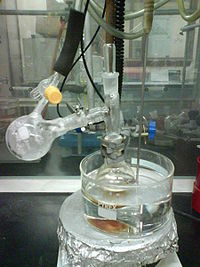
Distillation
Distillation is a method of separating mixtures based on differences in volatilities of components in a boiling liquid mixture. Distillation is a unit operation, or a physical separation process, and not a chemical reaction....
whereby the pressure above the liquid mixture to be distilled is reduced to less than its vapor pressure
Vapor pressure
Vapor pressure or equilibrium vapor pressure is the pressure of a vapor in thermodynamic equilibrium with its condensed phases in a closed system. All liquids have a tendency to evaporate, and some solids can sublimate into a gaseous form...
(usually less than atmospheric pressure
Atmospheric pressure
Atmospheric pressure is the force per unit area exerted into a surface by the weight of air above that surface in the atmosphere of Earth . In most circumstances atmospheric pressure is closely approximated by the hydrostatic pressure caused by the weight of air above the measurement point...
) causing evaporation of the most volatile
Volatility (chemistry)
In chemistry and physics, volatility is the tendency of a substance to vaporize. Volatility is directly related to a substance's vapor pressure. At a given temperature, a substance with higher vapor pressure vaporizes more readily than a substance with a lower vapor pressure.The term is primarily...
liquid(s) (those with the lowest boiling point
Boiling point
The boiling point of an element or a substance is the temperature at which the vapor pressure of the liquid equals the environmental pressure surrounding the liquid....
s). This distillation method works on the principle that boiling occurs when the vapor pressure of a liquid exceeds the ambient pressure. Vacuum distillation is used with or without heating the mixture.
Laboratory-scale applications
Laboratory-scale vacuum distillation is used when liquids to be distilled have high atmospheric boiling points or chemically changeChemical change
Chemical changes occur when a substance combines with another to form a new substance or, alternatively, decomposes into two or more different substances. These processes are called chemical reactions and , in general, are not reversible except by further chemical reactions...
at temperatures near their atmospheric boiling points. Temperature sensitive materials (such as beta carotene) also require vacuum distillation to remove solvent
Solvent
A solvent is a liquid, solid, or gas that dissolves another solid, liquid, or gaseous solute, resulting in a solution that is soluble in a certain volume of solvent at a specified temperature...
s from the mixture without damaging the product. Another reason vacuum distillation is used is that compared to steam distillation
Steam distillation
Steam distillation is a special type of distillation for temperature sensitive materials like natural aromatic compounds....
there is a lower level of residue build up. This is important in commercial applications where temperature transfer is produced using heat exchanger
Heat exchanger
A heat exchanger is a piece of equipment built for efficient heat transfer from one medium to another. The media may be separated by a solid wall, so that they never mix, or they may be in direct contact...
s.
Vacuum distillation is sometimes referred to as low temperature distillation.
There are many laboratory applications for vacuum distillation as well as many types of distillation set-ups and apparatuses.
Safety is an important consideration when using glassware as part of the set-up. All of the glass components should be carefully examined for scratches and cracks which could result in implosions when the vacuum is applied. Wrapping as much of the glassware with tape as is practical helps to prevent dangerous scattering of glass shards in the event of an implosion.
Rotary evaporation
Rotary evaporation is a type of vacuum distillation apparatus used to remove bulk solventSolvent
A solvent is a liquid, solid, or gas that dissolves another solid, liquid, or gaseous solute, resulting in a solution that is soluble in a certain volume of solvent at a specified temperature...
s from the liquid being distilled. It is also used by environmental regulatory agencies for determining the amount of solvents in paint, coatings and inks.
Rotary evaporation set-ups include an apparatus referred to as a Rotovap which rotates the distillation flask (sometimes called the still pot) to enhance the distillation. Rotating the flask throws up liquid on the walls of the flask and thus increases the surface area for evaporation.
Heat is often applied to the rotating distillation flask by partially immersing it in a heated bath of water or oil. Typically, the vacuum in such systems is generated by a water aspirator
Aspirator
An aspirator, also called an eductor-jet pump or filter pump, is a device that produces vacuum by means of the Venturi effect. In an aspirator, fluid flows through a tube which then narrows. When the tube narrows, the fluid's speed increases, and because of the Venturi effect, its pressure...
or a vacuum pump
Vacuum pump
A vacuum pump is a device that removes gas molecules from a sealed volume in order to leave behind a partial vacuum. The first vacuum pump was invented in 1650 by Otto von Guericke.- Types :Pumps can be broadly categorized according to three techniques:...
of some type.
Distillation of high-boiling and/or air sensitive materials
Some compounds have high boiling point temperatures as well as being air sensitive. A simple laboratory vacuum distillation glassware set-up can be used, in which the vacuum can be replaced with an inert gasGas
Gas is one of the three classical states of matter . Near absolute zero, a substance exists as a solid. As heat is added to this substance it melts into a liquid at its melting point , boils into a gas at its boiling point, and if heated high enough would enter a plasma state in which the electrons...
after the distillation is complete.
However, this is not a completely satisfactory system if it is desired to collect fractions under a reduced pressure.
For better results or for very air sensitive compounds, either a Perkin triangle distillation set-up or a short-path distillation set-up can be used.
Perkin triangle distillation set-up
The Perkin-trianglePerkin triangle
A Perkin triangle is a specialized apparatus for the distillation of air-sensitive materials. It is named after William Henry Perkin Jr., whose design was approximately triangular in shape. The image opposite shows a more modern version in which the glass taps have been replaced with more air-tight...
set-up (Image 5) uses a series of Teflon valves to allow the distilled fractions to be isolated from the distillation flask without the main body of the distillation set-up being removed from either the vacuum or the heat source, and thus can remain in a state of reflux.
To do this, the distillate receiver vessel is first isolated from the vacuum by means of the Teflon valves.
The vacuum over the sample is then replaced with an inert gas (such as nitrogen
Nitrogen
Nitrogen is a chemical element that has the symbol N, atomic number of 7 and atomic mass 14.00674 u. Elemental nitrogen is a colorless, odorless, tasteless, and mostly inert diatomic gas at standard conditions, constituting 78.08% by volume of Earth's atmosphere...
or argon
Argon
Argon is a chemical element represented by the symbol Ar. Argon has atomic number 18 and is the third element in group 18 of the periodic table . Argon is the third most common gas in the Earth's atmosphere, at 0.93%, making it more common than carbon dioxide...
) and the distillate receiver can then be stoppered and removed from the system.
Vacuum distillation set-up using a short-path head
Vacuum distillation of moderately air/water-sensitive liquid can be done using standard Schlenk-line techniques (Image 6).When assembling the set-up apparatus, all of the connecting lines are clamped so that they cannot pop off.
Once the apparatus is assembled, and the liquid to be distilled is in the still pot, the desired vacuum is established in the system by using the vacuum connection on the short-path distillation head. Care is taken to prevent potential "bumping" as the liquid in the still pot degases.
While establishing the vacuum, the flow of coolant is started through the short-path distillation head. Once the desired vacuum is established, heat is applied to the still pot.
If needed, the first portion of distillate can be discarded by purging with inert gas and changing out the distillate receiver.
When the distillation is complete: the heat is removed, the vacuum connection is closed, and inert gas is purged through the distillation head and the distillate receiver. While under the inert gas purge, remove the distillate receiver and cap it with an air-tight cap. The distillate receiver can be stored under vacuum or under inert gas by using the side-arm on the distillation flask.
Industrial-scale applications

Heat pump
A heat pump is a machine or device that effectively "moves" thermal energy from one location called the "source," which is at a lower temperature, to another location called the "sink" or "heat sink", which is at a higher temperature. An air conditioner is a particular type of heat pump, but the...
cycle to maximize efficiency. This type of distillation is in use in the oil industry where common ASTM standards are D1160, D2892, D5236. These standards describe typical applications of vacuum distillation at pressures of about 1-100 mbar. Pilot plants up to 60 L
Litér
- External links :*...
can be built in accordance with these standards.
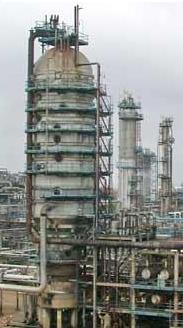
Industrial-scale vacuum distillation has several advantages. Close boiling mixtures may require many equilibrium stages to separate the key components. One tool to reduce the number of stages needed is to utilize vacuum distillation. Vacuum distillation columns (as depicted in the drawing to the right) typically used in oil refineries have diameters ranging up to about 14 metres (46 feet), heights ranging up to about 50 metres (164 feet), and feed rates ranging up to about 25,400 cubic metres per day (160,000 barrels per day).
Vacuum distillation increases the relative volatility
Relative volatility
Relative volatility is a measure comparing the vapor pressures of the components in a liquid mixture of chemicals. This quantity is widely used in designing large industrial distillation processes. In effect, it indicates the ease or difficulty of using distillation to separate the more volatile...
of the key components in many applications. The higher the relative volatility, the more separable are the two components; this connotes fewer stages in a distillation column in order to effect the same separation between the overhead and bottoms products. Lower pressures increase relative volatilities in most systems.
A second advantage of vacuum distillation is the reduced temperature requirement at lower pressures. For many systems, the products degrade or polymerize at elevated temperatures.
Vacuum distillation can improve a separation by:
- Prevention of product degradation or polymer formation because of reduced pressure leading to lower tower bottoms temperatures,
- Reduction of product degradation or polymer formation because of reduced mean residence time especially in columns using packing rather than trays.
- Increasing capacity, yield, and purity.
Another advantage of vacuum distillation is the reduced capital cost, at the expense of slightly more operating cost. Utilizing vacuum distillation can reduce the height and diameter, and thus the capital cost of a distillation column.
Vacuum distillation in petroleum refining
PetroleumPetroleum
Petroleum or crude oil is a naturally occurring, flammable liquid consisting of a complex mixture of hydrocarbons of various molecular weights and other liquid organic compounds, that are found in geologic formations beneath the Earth's surface. Petroleum is recovered mostly through oil drilling...
crude oil is a complex mixture of hundreds of different hydrocarbon
Hydrocarbon
In organic chemistry, a hydrocarbon is an organic compound consisting entirely of hydrogen and carbon. Hydrocarbons from which one hydrogen atom has been removed are functional groups, called hydrocarbyls....
compounds generally having from 3 to 60 carbon
Carbon
Carbon is the chemical element with symbol C and atomic number 6. As a member of group 14 on the periodic table, it is nonmetallic and tetravalent—making four electrons available to form covalent chemical bonds...
atom
Atom
The atom is a basic unit of matter that consists of a dense central nucleus surrounded by a cloud of negatively charged electrons. The atomic nucleus contains a mix of positively charged protons and electrically neutral neutrons...
s per molecule
Molecule
A molecule is an electrically neutral group of at least two atoms held together by covalent chemical bonds. Molecules are distinguished from ions by their electrical charge...
, although there may be small amounts of hydrocarbons outside that range. The refining of crude oil begins with distilling the incoming crude oil in a so-called atmospheric distillation column operating at pressures slightly above atmospheric pressure.
In distilling the crude oil, it is important not to subject the crude oil to temperatures above 370 to 380 °C because the high molecular weight components in the crude oil will undergo thermal cracking and form petroleum coke
Petroleum coke
Petroleum coke is a carbonaceous solid derived from oil refinery coker units or other cracking processes. Other coke has traditionally been derived from coal....
at temperatures above that. Formation of coke would result in plugging the tubes in the furnace
Furnace
A furnace is a device used for heating. The name derives from Latin fornax, oven.In American English and Canadian English, the term furnace on its own is generally used to describe household heating systems based on a central furnace , and sometimes as a synonym for kiln, a device used in the...
that heats the feed stream to the crude oil distillation column. Plugging would also occur in the piping
Piping
Within industry, piping is a system of pipes used to convey fluids from one location to another. The engineering discipline of piping design studies the efficient transport of fluid....
from the furnace to the distillation column as well as in the column itself.
The constraint imposed by limiting the column inlet crude oil to a temperature of more than 370 to 380 °C yields a residual oil from the bottom of the atmospheric distillation column consisting entirely of hydrocarbons that boil above 370 to 380 °C.
To further distill the residual oil from the atmospheric distillation column, the distillation must be performed at absolute pressures as low as 10 to 40 mmHg (also referred to as Torr
Torr
The torr is a non-SI unit of pressure with the ratio of 760 to 1 standard atmosphere, chosen to be roughly equal to the fluid pressure exerted by a millimetre of mercury, i.e., a pressure of 1 torr is approximately equal to 1 mmHg...
) so as to limit the operating temperature to less than 370 to 380 °C.
Image 1 is a photograph of a large vacuum distillation column in a petroleum refinery and Image 2 is a process diagram of a petroleum refinery vacuum distillation column that depicts the internals of the column.
The 10 to 40 mmHg absolute pressure in a vacuum distillation column increases the volume of vapor formed per volume of liquid distilled. The result is that such columns have very large diameters.
Distillation columns such those in Images 1 and 2, may have diameters of 15 meters or more, heights ranging up to about 50 meters, and feed rates ranging up to about 25,400 cubic meters per day (160,000 barrels per day).
The vacuum distillation column internals must provide good vapor-liquid contacting while, at the same time, maintaining a very low pressure increase from the top of the column top to the bottom. Therefore, the vacuum column uses distillation tray
Theoretical plate
A theoretical plate in many separation processes is a hypothetical zone or stage in which two phases, such as the liquid and vapor phases of a substance, establish an equilibrium with each other. Such equilibrium stages may also be referred to as an equilibrium stage, ideal stage or a theoretical...
s only where withdrawing products from the side of the column (referred to as side draws). Most of the column uses packing material
Packed bed
In chemical processing, a packed bed is a hollow tube, pipe, or other vessel that is filled with a packing material. The packing can be randomly filled with small objects like Raschig rings or else it can be a specifically designed structured packing...
for the vapor-liquid contacting because such packing has a lower pressure drop than distillation trays. This packing material can be either structured sheet metal
Packed bed
In chemical processing, a packed bed is a hollow tube, pipe, or other vessel that is filled with a packing material. The packing can be randomly filled with small objects like Raschig rings or else it can be a specifically designed structured packing...
or randomly dumped packing such as Raschig rings
Packed bed
In chemical processing, a packed bed is a hollow tube, pipe, or other vessel that is filled with a packing material. The packing can be randomly filled with small objects like Raschig rings or else it can be a specifically designed structured packing...
.
The absolute pressure of 10 to 40 mmHg in the vacuum column is most often achieved by using multiple stages of steam jet ejectors.
Many industries, other than the petroleum refining industry, use vacuum distillation on a much a smaller scale.
Molecular distillation
Molecular distillation is vacuum distillation below the pressure of 0.01 torr. 0.01 torr is one order of magnitude above high vacuum, where fluids are in the free molecular flowFree molecular flow
Free molecular flow describes the fluid dynamics of gas where the mean free path of the molecules is larger than the size of the chamber or of the object under test. For tubes/objects of the size of several cm, these means pressures well below 10-3 torr. This is also called the regime of high...
regime, i.e. the mean free path
Mean free path
In physics, the mean free path is the average distance covered by a moving particle between successive impacts which modify its direction or energy or other particle properties.-Derivation:...
of molecules is comparable to the size of the equipment. The gaseous phase no longer exerts significant pressure on the substance to be evaporated, and consequently, rate of evaporation no longer depends on pressure. That is, because the continuum assumptions of fluid dynamics no longer apply, mass transport is governed by molecular dynamics rather than fluid dynamics. Thus, a short path between the hot surface and the cold surface is necessary, typically by suspending a hot plate covered with a film of feed next to a cold plate with a line of sight in between. Molecular distillation is used industrially for purification of oils.
See also
- Continuous distillationContinuous distillationContinuous distillation, a form of distillation, is an ongoing separation in which a mixture is continuously fed into the process and separated fractions are removed continuously as output streams. A distillation is the separation or partial separation of a liquid feed mixture into components or...
- Fractionating columnFractionating columnA fractionating column or fractionation column is an essential item used in the distillation of liquid mixtures so as to separate the mixture into its component parts, or fractions, based on the differences in their volatilities...
- Fractional distillationFractional distillationFractional distillation is the separation of a mixture into its component parts, or fractions, such as in separating chemical compounds by their boiling point by heating them to a temperature at which several fractions of the compound will evaporate. It is a special type of distillation...
- KugelrohrKugelrohrA Kugelrohr is a short-path vacuum distillation apparatus typically used to distill relatively small amounts of compounds with high boiling points under greatly reduced pressure.-Design:...