

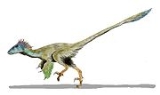
Utahraptor

Encyclopedia
Utahraptor is a genus
of theropod dinosaur
s, including the largest known members of the family Dromaeosauridae
. Fossil specimens date to the upper Barremian
stage
of the early Cretaceous
period (in rock strata dated to 126 ± 2.5 million years ago). It contains a single species, Utahraptor ostrommaysorum.
 The holotype
specimen of Utahraptor is fragmentary, consisting of skull fragments, a tibia, claws and some caudal (tail) vertebra. These few elements suggest an animal about twice the size of Deinonychus
. Like other dromaeosaurids, Utahraptor had large curved claws on their second toes. One claw specimen is preserved at 22 centimetres (8.7 in) in length and is thought to reach 24 centimetres (9.4 in) restored.
The largest described U. ostrommaysorum specimens are estimated to have reached up to 7 m (23 ft) long and somewhat less than 500 kg (1,102.3 lb) in weight, comparable to a grizzly bear
in size. Some undescribed specimens in the BYU
collections may have reached up to 11 m (36.1 ft) long, though these await more detailed study.
It is thought that Utahraptor may be closely related to the smaller Dromaeosaurus
and the giant Mongolia
n dromaeosaurid genus Achillobator
.
Although feathers have never been found in association with Utahraptor specimens, there is strong phylogenetic evidence suggesting that all dromaeosaurids possessed them. This evidence comes from phylogenetic bracketing
, which allows paleontologists to infer traits that exist in a clade based on the existence of that trait in a more basal
form. The genus Microraptor
is one of the oldest known dromaeosaurids, and is phylogenetically more primitive than Utahraptor. Since Microraptor possessed feathers, it is reasonable to assume that this trait was present in all of Dromaeosauridae. Feathers were very unlikely to have evolved more than once in dromaeosaurids, so assuming that Utahraptor lacked feathers would require positive evidence that they did not have them. So far, there is nothing to suggest that feathers were lost in larger, more derived species of dromaeosaurs.
In a 2001 study conducted by Bruce Rothschild and other paleontologists, 2 foot bones referred to Utahraptor were examined for signs of stress fracture
, but none were found.
in the Dalton Wells Quarry in east-central Utah, near the town of Moab
, but did not receive much attention. After a find of a large foot-claw by Carl Limoni in October 1991
James Kirkland, Robert Gaston, and Donald Burge uncovered further remains of Utahraptor in 1991 in the Gaston Quarry in Grand County
, Utah
, within the Yellow Cat and Poison Strip members of the Cedar Mountain Formation
. Radiometric dating has shown that these parts of the Cedar Mountain Formation were deposited about 124 million years ago. The type specimen, CEU 184v.86, is currently housed at the College of Eastern Utah Prehistoric Museum
, although Brigham Young University
, the depository of Jensen's finds, currently houses the largest collection of Utahraptor fossils.
The type species (and only known species of Utahraptor), Utahraptor ostrommaysorum, was named by Kirkland, Gaston and Burge in 1993 for the American
paleontologist John Ostrom
, from Yale University's Peabody Museum of Natural History, and Chris Mays, of Dinamation
International. Originally in the specific name the singular genitive ostrommaysi was used but this was in 2000 emended by George Olshevsky
to the plural. Earlier it had been intended to name the species "Utahraptor spielbergi" after film director
Steven Spielberg
, in exchange for funding palaeontological research, but no agreement could be reached on the amount of financial assistance. Sculptor Raymond Persinger
was included in James Kirkland's original abstract referencing Mr. Persinger's concepts regarding the claw structure.
television series Walking with Dinosaurs
. The program portrayed Utahraptor with several anatomical inaccuracies including pronated
hands, and depicted them living in Europe when the only fossils of Utahraptor have been found in western North America. A much more scientifically accurate reconstruction of Utahraptor appeared in the 2011 Discovery Channel series Dinosaur Revolution
.
Ryan North's award-winning "Dinosaur Comics
" online comic strip prominently features a Utahraptor. The Utahraptor character is meant to serve as a "questioning and interrogative" interlocutor in the comic's sometimes bizarre discussions of life and philosophy.
Genus
In biology, a genus is a low-level taxonomic rank used in the biological classification of living and fossil organisms, which is an example of definition by genus and differentia...
of theropod dinosaur
Dinosaur
Dinosaurs are a diverse group of animals of the clade and superorder Dinosauria. They were the dominant terrestrial vertebrates for over 160 million years, from the late Triassic period until the end of the Cretaceous , when the Cretaceous–Paleogene extinction event led to the extinction of...
s, including the largest known members of the family Dromaeosauridae
Dromaeosauridae
Dromaeosauridae is a family of bird-like theropod dinosaurs. They were small- to medium-sized feathered carnivores that flourished in the Cretaceous Period. The name Dromaeosauridae means 'running lizards', from Greek dromeus meaning 'runner' and sauros meaning 'lizard'...
. Fossil specimens date to the upper Barremian
Barremian
The Barremian is an age in the geologic timescale between 130.0 ± 1.5 Ma and 125.0 ± 1.0 Ma). It is a subdivision of the Early Cretaceous epoch...
stage
Faunal stage
In chronostratigraphy, a stage is a succession of rock strata laid down in a single age on the geologic timescale, which usually represents millions of years of deposition. A given stage of rock and the corresponding age of time will by convention have the same name, and the same boundaries.Rock...
of the early Cretaceous
Cretaceous
The Cretaceous , derived from the Latin "creta" , usually abbreviated K for its German translation Kreide , is a geologic period and system from circa to million years ago. In the geologic timescale, the Cretaceous follows the Jurassic period and is followed by the Paleogene period of the...
period (in rock strata dated to 126 ± 2.5 million years ago). It contains a single species, Utahraptor ostrommaysorum.
Description
Holotype
A holotype is a single physical example of an organism, known to have been used when the species was formally described. It is either the single such physical example or one of several such, but explicitly designated as the holotype...
specimen of Utahraptor is fragmentary, consisting of skull fragments, a tibia, claws and some caudal (tail) vertebra. These few elements suggest an animal about twice the size of Deinonychus
Deinonychus
Deinonychus was a genus of carnivorous dromaeosaurid dinosaur. There is one described species, Deinonychus antirrhopus. This 3.4 meter long dinosaur lived during the early Cretaceous Period, about 115–108 million years ago . Fossils have been recovered from the U.S...
. Like other dromaeosaurids, Utahraptor had large curved claws on their second toes. One claw specimen is preserved at 22 centimetres (8.7 in) in length and is thought to reach 24 centimetres (9.4 in) restored.
The largest described U. ostrommaysorum specimens are estimated to have reached up to 7 m (23 ft) long and somewhat less than 500 kg (1,102.3 lb) in weight, comparable to a grizzly bear
Grizzly Bear
The grizzly bear , also known as the silvertip bear, the grizzly, or the North American brown bear, is a subspecies of brown bear that generally lives in the uplands of western North America...
in size. Some undescribed specimens in the BYU
BYU
-Education:* Brigham Young University, a university located in Provo, Utah, USA administered by The Church of Jesus Christ of Latter-day Saints.**BYU Salt Lake Center, a satellite center in Salt Lake City, Utah, USA...
collections may have reached up to 11 m (36.1 ft) long, though these await more detailed study.
It is thought that Utahraptor may be closely related to the smaller Dromaeosaurus
Dromaeosaurus
Dromaeosaurus was a genus of theropod dinosaur which lived during the Late Cretaceous period , sometime between 76.5 and 74.8 million years ago, in the western United States and Alberta, Canada. The name means 'running lizard'....
and the giant Mongolia
Mongolia
Mongolia is a landlocked country in East and Central Asia. It is bordered by Russia to the north and China to the south, east and west. Although Mongolia does not share a border with Kazakhstan, its western-most point is only from Kazakhstan's eastern tip. Ulan Bator, the capital and largest...
n dromaeosaurid genus Achillobator
Achillobator
Achillobator is a genus of dromaeosaurid theropod dinosaur from the late Cretaceous Period of what is now Mongolia, about 90 million years ago. It was probably an active bipedal predator, hunting with the large sickle-shaped claw on the second toe of each hind foot...
.
Although feathers have never been found in association with Utahraptor specimens, there is strong phylogenetic evidence suggesting that all dromaeosaurids possessed them. This evidence comes from phylogenetic bracketing
Phylogenetic bracketing
Phylogenetic bracketing is a method of inference used in biological sciences. It is to infer the likelihood of unknown traits in organisms based on their position in a phylogenetic tree. One of the main applications of phylogenetic bracketing is on extinct animals, known only from fossils...
, which allows paleontologists to infer traits that exist in a clade based on the existence of that trait in a more basal
Basal (phylogenetics)
In phylogenetics, a basal clade is the earliest clade to branch in a larger clade; it appears at the base of a cladogram.A basal group forms an outgroup to the rest of the clade, such as in the following example:...
form. The genus Microraptor
Microraptor
Microraptor is a genus of small, four-winged dromaeosaurid dinosaurs. Numerous well-preserved fossil specimens have been recovered from Liaoning, China...
is one of the oldest known dromaeosaurids, and is phylogenetically more primitive than Utahraptor. Since Microraptor possessed feathers, it is reasonable to assume that this trait was present in all of Dromaeosauridae. Feathers were very unlikely to have evolved more than once in dromaeosaurids, so assuming that Utahraptor lacked feathers would require positive evidence that they did not have them. So far, there is nothing to suggest that feathers were lost in larger, more derived species of dromaeosaurs.
In a 2001 study conducted by Bruce Rothschild and other paleontologists, 2 foot bones referred to Utahraptor were examined for signs of stress fracture
Stress fracture
A stress fracture is one type of incomplete fracture in bones. It is caused by "unusual or repeated stress" and also heavy continuous weight on the ankle or leg...
, but none were found.
Discovery
The first specimens of Utahraptor were found in 1975 by Jim JensenJames A. Jensen
James A. Jensen , was an American paleontologist. His extensive collecting program at BYU in the Utah-Colorado region which spanned 23 years was comparable in terms of the number of specimens collected to that of Barnum Brown during the early 20th century. He was given the name "Dinosaur Jim"...
in the Dalton Wells Quarry in east-central Utah, near the town of Moab
Moab, Utah
Moab is a city in Grand County, in eastern Utah, in the western United States. The population was 4,779 at the 2000 census. It is the county seat and largest city in Grand County. Moab hosts a large number of tourists every year, mostly visitors to the nearby Arches and Canyonlands National Parks...
, but did not receive much attention. After a find of a large foot-claw by Carl Limoni in October 1991
James Kirkland, Robert Gaston, and Donald Burge uncovered further remains of Utahraptor in 1991 in the Gaston Quarry in Grand County
Grand County, Utah
Grand County is a county located in the U.S. state of Utah. As of 2000 the population was 8,485, and by 2005 had been estimated at 8,743. It was named for the Colorado River, which at the time of statehood was known as the Grand River. Its county seat and largest city is Moab.-Geography:According...
, Utah
Utah
Utah is a state in the Western United States. It was the 45th state to join the Union, on January 4, 1896. Approximately 80% of Utah's 2,763,885 people live along the Wasatch Front, centering on Salt Lake City. This leaves vast expanses of the state nearly uninhabited, making the population the...
, within the Yellow Cat and Poison Strip members of the Cedar Mountain Formation
Cedar Mountain Formation
The Cedar Mountain Formation is the name given to distinctive sedimentary rocks in eastern Utah that occur between the underlying Morrison Formation and overlying Naturita Formation . It is composed of non-marine sediments, that is, sediments deposited in rivers, lakes and on flood plains...
. Radiometric dating has shown that these parts of the Cedar Mountain Formation were deposited about 124 million years ago. The type specimen, CEU 184v.86, is currently housed at the College of Eastern Utah Prehistoric Museum
College of Eastern Utah Prehistoric Museum
The USU Eastern Prehistoric Museum, formerly known as the College of Eastern Utah Prehistoric Museum, is a museum accredited by the American Association of Museums located in Price, Utah. The museum seeks to promote public understanding of prehistory through interpretive exhibits, educational...
, although Brigham Young University
Brigham Young University
Brigham Young University is a private university located in Provo, Utah. It is owned and operated by The Church of Jesus Christ of Latter-day Saints , and is the United States' largest religious university and third-largest private university.Approximately 98% of the university's 34,000 students...
, the depository of Jensen's finds, currently houses the largest collection of Utahraptor fossils.
The type species (and only known species of Utahraptor), Utahraptor ostrommaysorum, was named by Kirkland, Gaston and Burge in 1993 for the American
United States
The United States of America is a federal constitutional republic comprising fifty states and a federal district...
paleontologist John Ostrom
John Ostrom
John H. Ostrom was an American paleontologist who revolutionized modern understanding of dinosaurs in the 1960s, when he demonstrated that dinosaurs are more like big non-flying birds than they are like lizards , an idea first proposed by Thomas Henry Huxley in the 1860s, but which had garnered...
, from Yale University's Peabody Museum of Natural History, and Chris Mays, of Dinamation
Dinamation
Dinamation International Corporation was a robotics effects company based in San Juan Capistrano, Santa Ana, and Tustin, California, USA. It was founded in 1986 by former airline pilot Chris Mays and some neighbors and dropped in March 2001...
International. Originally in the specific name the singular genitive ostrommaysi was used but this was in 2000 emended by George Olshevsky
George Olshevsky
George Olshevsky is a freelance editor, writer, publisher, amateur paleontologist, and mathematician living in San Diego, California.Olshevsky maintains the comprehensive online Dinosaur Genera List...
to the plural. Earlier it had been intended to name the species "Utahraptor spielbergi" after film director
Film director
A film director is a person who directs the actors and film crew in filmmaking. They control a film's artistic and dramatic nathan roach, while guiding the technical crew and actors.-Responsibilities:...
Steven Spielberg
Steven Spielberg
Steven Allan Spielberg KBE is an American film director, screenwriter, producer, video game designer, and studio entrepreneur. In a career of more than four decades, Spielberg's films have covered many themes and genres. Spielberg's early science-fiction and adventure films were seen as an...
, in exchange for funding palaeontological research, but no agreement could be reached on the amount of financial assistance. Sculptor Raymond Persinger
Raymond Persinger
Artist Raymond Persinger has created sculptures for many public and private collections including the City of Brea, California, Chapman University and the National Geographic Museum. His work has been selected by prominent curators such as Dr...
was included in James Kirkland's original abstract referencing Mr. Persinger's concepts regarding the claw structure.
In popular culture
A speculative reconstruction of Utahraptor lifestyles and behavior was presented in the 1999 BBCBBC
The British Broadcasting Corporation is a British public service broadcaster. Its headquarters is at Broadcasting House in the City of Westminster, London. It is the largest broadcaster in the world, with about 23,000 staff...
television series Walking with Dinosaurs
Walking with Dinosaurs
Walking with Dinosaurs is a six-part documentary television miniseries that was produced by BBC, narrated by Kenneth Branagh, and first aired in the United Kingdom, in 1999. The series was subsequently aired in North America on the Discovery Channel in 2000, with Branagh's voice replaced with that...
. The program portrayed Utahraptor with several anatomical inaccuracies including pronated
Pronation
In anatomy, pronation is a rotational movement of the forearm at the radioulnar joint, or of the foot at the subtalar and talocalcaneonavicular joints. For the forearm, when standing in the anatomical position, pronation will move the palm of the hand from an anterior-facing position to a...
hands, and depicted them living in Europe when the only fossils of Utahraptor have been found in western North America. A much more scientifically accurate reconstruction of Utahraptor appeared in the 2011 Discovery Channel series Dinosaur Revolution
Dinosaur Revolution
Dinosaur Revolution is a four-part American nature documentary produced by Creative Differences, although it was believed to be a Pixar project when it was first revealed to the public due to a press release saying so. The first two episodes aired on Discovery Channel on September 4, 2011. The...
.
Ryan North's award-winning "Dinosaur Comics
Dinosaur Comics
Dinosaur Comics is a constrained webcomic by Canadian writer Ryan North. It is also known as "Qwantz", after the site's domain name, "qwantz.com". The first comic was posted on 1 February 2003, though there were earlier prototypes. Dinosaur Comics has also been printed in two collections and in a...
" online comic strip prominently features a Utahraptor. The Utahraptor character is meant to serve as a "questioning and interrogative" interlocutor in the comic's sometimes bizarre discussions of life and philosophy.