
Home      Discussion      Topics      Dictionary      Almanac
Signup       Login
Utah Beach

Utah Beach

Overview
Utah Beach was the code name
Code name
A code name or cryptonym is a word or name used clandestinely to refer to another name or word. Code names are often used for military purposes, or in espionage...

 for the right flank, or westernmost, of the Allied
Allies of World War II
The Allies of World War II were the countries that opposed the Axis powers during the Second World War . Former Axis states contributing to the Allied victory are not considered Allied states...

 landing beaches during the D-Day
D-Day
D-Day is a term often used in military parlance to denote the day on which a combat attack or operation is to be initiated. "D-Day" often represents a variable, designating the day upon which some significant event will occur or has occurred; see Military designation of days and hours for similar...

 invasion of Normandy, as part of Operation Overlord
Operation Overlord
Operation Overlord was the code name for the Battle of Normandy, the operation that launched the invasion of German-occupied western Europe during World War II by Allied forces. The operation commenced on 6 June 1944 with the Normandy landings...

 on 6 June 1944. Utah was added to the invasion plan toward the end of the planning stages, when more landing craft
Landing craft
Landing craft are boats and seagoing vessels used to convey a landing force from the sea to the shore during an amphibious assault. Most renowned are those used to storm the beaches of Normandy, the Mediterranean, and many Pacific islands during WWII...

 became available.
Discussion
Ask a question about 'Utah Beach'
Start a new discussion about 'Utah Beach'
Answer questions from other users
Full Discussion Forum
 
Recent Discussions
Encyclopedia
Utah Beach was the code name
Code name
A code name or cryptonym is a word or name used clandestinely to refer to another name or word. Code names are often used for military purposes, or in espionage...

 for the right flank, or westernmost, of the Allied
Allies of World War II
The Allies of World War II were the countries that opposed the Axis powers during the Second World War . Former Axis states contributing to the Allied victory are not considered Allied states...

 landing beaches during the D-Day
D-Day
D-Day is a term often used in military parlance to denote the day on which a combat attack or operation is to be initiated. "D-Day" often represents a variable, designating the day upon which some significant event will occur or has occurred; see Military designation of days and hours for similar...

 invasion of Normandy, as part of Operation Overlord
Operation Overlord
Operation Overlord was the code name for the Battle of Normandy, the operation that launched the invasion of German-occupied western Europe during World War II by Allied forces. The operation commenced on 6 June 1944 with the Normandy landings...

 on 6 June 1944. Utah was added to the invasion plan toward the end of the planning stages, when more landing craft
Landing craft
Landing craft are boats and seagoing vessels used to convey a landing force from the sea to the shore during an amphibious assault. Most renowned are those used to storm the beaches of Normandy, the Mediterranean, and many Pacific islands during WWII...

 became available.

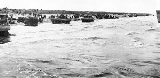
Utah Beach, about 3 miles (5 km) long, was the westernmost of the five landing beaches, located between Pouppeville and the village of La Madeleine
La Madeleine, Manche
La Madeleine is a hamlet of Sainte-Marie-du-Mont village in North-western France which was one anchor point of the Utah Beach landings on the Dday invasion of Hitler's Fortress Europa, 6 June 1944...

, which became the right flank anchor of the allied offensive along the left bank (western bank) of the Douve River estuary
Estuary
An estuary is a partly enclosed coastal body of water with one or more rivers or streams flowing into it, and with a free connection to the open sea....

. The German sector code was W5.

Despite being substantially off course, the US 4th Infantry Division (part of VII corps) landed with relatively little resistance, in stark contrast to Omaha Beach
Omaha Beach
Omaha Beach is the code name for one of the five sectors of the Allied invasion of German-occupied France in the Normandy landings on 6 June 1944, during World War II...

, where the fighting was fierce.

Plan of attack


The landing was planned in four waves. The first consisted of 20 Higgins boats or LCVPs, each carrying a 30-man assault team from the 8th Infantry Regiment. The 10 craft on the right were to land on Tare Green Beach, opposite the strong-point at les Dunes de Varreville. The 10 craft on the left were intended for Uncle Red Beach, 1,000 yards (900 m) farther south. The entire operation was timed against the touchdown of this first assault wave, which was scheduled to take place at 06:30 am. Eight LCT
Landing craft tank
The Landing Craft, Tank was an amphibious assault ship for landing tanks on beachheads. They were initially developed by the British Royal Navy and later by the United States Navy during World War II in a series of versions. Initially known as the "Tank Landing Craft" by the British, they later...

s (Landing Craft, Tanks), each carrying four amphibious DD Tank
DD tank
DD tanks , were a type of amphibious swimming tank developed by the British during the Second World War...

s, were scheduled to land at the same time or as soon thereafter as possible.

The second wave consisted of another 32 Higgins boats with additional troops of the two assault battalions, some combat engineers, and also eight naval demolition teams that were to clear the beach of underwater obstacles.

The third wave, timed for H plus 15 minutes, contained eight more Higgins boats with DD tanks.

It was followed within 2 minutes by the fourth wave, mainly detachments of the 237th and 299th Combat Engineer Battalions, to clear the beaches between high- and low-water marks.

D-Day


Two hours before the main invasion force, a raiding party swam ashore from Landing Craft Assault
Landing Craft Assault
The Landing Craft Assault was a British landing craft used extensively in World War II. Its primary purpose was to ferry troops from transport ships to attack enemy-held shores. The craft derived from a prototype designed by John I. Thornycroft Ltd. During the war it was manufactured throughout...

 at Îles Saint-Marcouf
Îles Saint-Marcouf
Îles Saint-Marcouf are a group of two small uninhabited islands off the coast of Normandy, France. They lie in the Baie de la Seine region of the English Channel and are 6.5 kilometres east of the coast of the Cotentin peninsula at Ravenoville and 13 kilometres from the island of Tatihou...

, thought to be a German
Nazi Germany
Nazi Germany , also known as the Third Reich , but officially called German Reich from 1933 to 1943 and Greater German Reich from 26 June 1943 onward, is the name commonly used to refer to the state of Germany from 1933 to 1945, when it was a totalitarian dictatorship ruled by...

 observation post. It was unoccupied.

The first wave arrived at the line of departure on time and all 20 craft were dispatched abreast. Support craft to the rear were firing machine guns, possibly with the hope of exploding mines. When the LCVPs were 300–400 yards (270–360 metres) from the beach, the assault company commanders fired special smoke projectors to signal the lifting of naval support craft fire. Almost exactly at H Hour the assault craft lowered their ramps and 600 men waded through waist-deep water for the last 100 or more yards to the beach. The actual touchdown on the beach was therefore a few minutes late, but the delay was negligible and had no effect on the phasing of the succeeding waves. Enemy artillery
Artillery
Originally applied to any group of infantry primarily armed with projectile weapons, artillery has over time become limited in meaning to refer only to those engines of war that operate by projection of munitions far beyond the range of effect of personal weapons...

 had fired a few air bursts at sea, but otherwise there was no opposition at H Hour.

The first troops to reach shore were from the 2nd Battalion, 8th Infantry. Captain Leonard T. Schroeder
Leonard T. Schroeder
Leonard T. "Max" Schroeder Jr. was a colonel in the United States Army, who served on active duty from 1941 to 1971. As a captain during World War II, he commanded Company F of the 2nd Battalion, 8th Infantry Regiment, 4th Infantry Division in the Normandy Landings on June 6, 1944, landing on Utah...

, leading Company F, was the first man from a landing craft to reach the beach. The 1st Battalion landed a few minutes later. Both came ashore considerably south of the designated beaches. The 2nd Battalion should have hit Uncle Red Beach opposite Exit 3. The 1st Battalion was supposed to land directly opposite the strong-point at les Dunes de Varreville. The landings, however, were made astride Exit 2 about 2,000 yards (1,800 metres) south.

This error was potentially very serious, for it could have caused great confusion. But it did not. The original plans, in which each assault section had a specific mission, could not be carried out in detail, of course.

Brigadier General Theodore Roosevelt, Jr.
Theodore Roosevelt, Jr.
Theodore D. Roosevelt, Jr. , was an American political and business leader, a Medal of Honor recipient who fought in both of the 20th century's world wars. He was the eldest son of President Theodore Roosevelt from his second wife Edith Roosevelt...

, assistant commander of the 4th Division, had requested several times, against his commander's best judgement, to go in the first wave and personally lead the initial attack on the beach strong points. His written request was finally approved by General Barton, 4th Division Commander.

Roosevelt was the only general to land with the initial seaborne assault wave on D-Day, coming ashore in Schroeder's LCVP. At age 56, he was the oldest soldier to land. When Roosevelt realized the landing craft had drifted south with the current and smoke more than a mile from their objective—and that the first wave was a mile off course—he personally made a reconnaissance of the area immediately to the rear of the beach to locate the causeways which were to be used for the advance inland.

He then returned to the point of landing, contacted the commanders of the two battalions (Lieutenant Colonels Conrad C. Simmons and Carlton O. MacNeely), and coordinated the attack. Roosevelt's famous quote was, "We’ll start the war from here!" These impromptu plans worked successfully and with little confusion. With artillery landing close by, each followup regiment was personally welcomed on the beach by a cool, calm and collected Roosevelt, who inspired all by humor and confidence. He pointed almost every regiment to its changed objectives. For his actions on Utah Beach, Roosevelt was later awarded the Medal of Honor
Medal of Honor
The Medal of Honor is the highest military decoration awarded by the United States government. It is bestowed by the President, in the name of Congress, upon members of the United States Armed Forces who distinguish themselves through "conspicuous gallantry and intrepidity at the risk of his or her...

.

The German forces responsible for the defense of the beach were elements of the 709th Infantry Division, commanded by Generalleutnant Karl-Wilhelm von Schlieben
Karl-Wilhelm von Schlieben
Karl-Wilhelm von Schlieben was a German officer in World War I and World War II.- World War I career :Karl-Wilhelm von Schlieben joined the Prussian Army in August 1914 as a Fahnenjunker . He was assigned to the training and replacement Battalion of the 3rd Foot Guards...

, and the 352nd Infantry Division, commanded by Generalleutnant Dietrich Kraiss
Dietrich Kraiss
Dietrich Kraiss was a German Generalleutnant during World War II, awarded the German Cross in Gold and the Knight's Cross of the Iron Cross with Oak Leaves.Kraiss was born in Stuttgart...

.

Success


By the end of D-Day, some 23,250 troops had safely landed on the beach, along with 1,700 vehicles. Only about 200 casualties were recorded during the landings. Several factors contributed to the success at Utah compared to the bloody battle at nearby Omaha:
  • Fewer German fortifications: The defense of the area was largely based on flooding the coastal plain behind the beaches, and there were fewer bunkers.
  • Effective pre-invasion bombardment: Many of the known large bunkers, such as the coastal battery near Saint-Martin-de-Varreville
    Saint-Martin-de-Varreville
    Saint-Martin-de-Varreville is a commune in the Manche department in Normandy in north-western France.-References:*...

    , were destroyed from the air prior to D-Day. B-26 Marauder
    B-26 Marauder
    The Martin B-26 Marauder was a World War II twin-engine medium bomber built by the Glenn L. Martin Company. First used in the Pacific Theater in early 1942, it was also used in the Mediterranean Theater and in Western Europe....

     medium bomber
    Medium bomber
    A medium bomber is a bomber aircraft designed to operate with medium bombloads over medium distances; the name serves to distinguish them from the larger heavy bombers and smaller light bombers...

    s of the US Ninth Air Force
    Ninth Air Force
    The Ninth Air Force is a numbered air force of the United States Air Force's Air Combat Command . It is headquartered at Shaw Air Force Base, South Carolina....

    , flying below 5,000 feet (1,500 m), provided close air support
    Close air support
    In military tactics, close air support is defined as air action by fixed or rotary winged aircraft against hostile targets that are close to friendly forces, and which requires detailed integration of each air mission with fire and movement of these forces.The determining factor for CAS is...

     for the assaulting forces.
  • DD tank
    DD tank
    DD tanks , were a type of amphibious swimming tank developed by the British during the Second World War...

    s: Nearly all of these swimming tanks made the beach, because they were launched half as far out as at Omaha and were able to steer into the current more effectively to avoid swamping in the rough seas.
  • Mis-landings: Because most of the invasion force landed opposite Exit 2, this one was the most used; other exits were more heavily fortified.
  • Paratroopers: The most significant difference was the 13,000 men from the 101st Airborne Division
    101st Airborne Division
    The 101st Airborne Division—the "Screaming Eagles"—is a U.S. Army modular light infantry division trained for air assault operations. During World War II, it was renowned for its role in Operation Overlord, the D-Day landings on 6 June 1944, in Normandy, France, Operation Market Garden, the...

     and the 82nd Airborne Division
    U.S. 82nd Airborne Division
    The 82nd Airborne Division is an active airborne infantry division of the United States Army specializing in parachute landing operations. Based at Fort Bragg, North Carolina, the 82nd Airborne Division is the primary fighting arm of the XVIII Airborne Corps....

     already fighting inland. For five hours before the first Utah landings, the paratroopers (and glider forces) had been fighting their way toward the beach, clearing the enemy from positions along the exits. The paratroopers also greatly confused the enemy and prevented any significant counterattack to the landing area.


The true cost of Utah Beach is reflected in the heavy airborne casualties: The 101st alone lost about 40% of its forces on D-Day. Also, the 1,000 casualties during Exercise Tiger
Exercise Tiger
Exercise Tiger, or Operation Tiger, were the code names for a full-scale rehearsal in 1944 for the D-Day invasion of Normandy. During the exercise, an Allied convoy was attacked, resulting in the deaths of 946 American servicemen....

, a practice run for the Utah assault, could also be considered part of the price for D-Day.

Notable people on Utah Beach

  • Philip Hart
    Philip Hart
    Philip Aloysius Hart was a Democratic United States Senator from Michigan from 1959 until 1976. He was nicknamed the Conscience of the Senate.-Early years:...

     – U.S. senator
  • Elliot Richardson
    Elliot Richardson
    Elliot Lee Richardson was an American lawyer and politician who was a member of the cabinet of Presidents Richard Nixon and Gerald Ford. As U.S...

     – Nixon-era
    Richard Nixon
    Richard Milhous Nixon was the 37th President of the United States, serving from 1969 to 1974. The only president to resign the office, Nixon had previously served as a US representative and senator from California and as the 36th Vice President of the United States from 1953 to 1961 under...

     politician, medical officer in the 4th wave ashore
  • Theodore Roosevelt, Jr.
    Theodore Roosevelt, Jr.
    Theodore D. Roosevelt, Jr. , was an American political and business leader, a Medal of Honor recipient who fought in both of the 20th century's world wars. He was the eldest son of President Theodore Roosevelt from his second wife Edith Roosevelt...

     – 4th ID general, landed in the 1st wave
  • J. D. Salinger
    J. D. Salinger
    Jerome David Salinger was an American author, best known for his 1951 novel The Catcher in the Rye, as well as his reclusive nature. His last original published work was in 1965; he gave his last interview in 1980....

     – U.S. author
  • James Van Fleet
    James Van Fleet
    James Alward Van Fleet was a U.S. Army officer during World War I, World War II and the Korean War. Van Fleet was a native of New Jersey, who was raised in Florida and graduated from the U.S. Military Academy. He served as a regimental, divisional and corps commander during World War II and as...

     – 4th ID colonel
  • Hugh Nibley
    Hugh Nibley
    Hugh Winder Nibley was an American author, Mormon apologist, and professor at Brigham Young University...

     – Celebrated Mormon scholar
  • Stu Clarkson
    Stu Clarkson
    Stu Clarkson was a linebacker for the Chicago Bears from 1942 to 1951. He was the last pick in the 1942 NFL Draft.Clarkson was a two-time Little All-American at Texas A&I University , 1938 and 1939...

     – Chicago Bears football player
  • Walter Ohmsen
    Walter Ohmsen
    Walter Ohmsen was a highly decorated Oberleutnant zur See in the Kriegsmarine during World War II. On 6 June 1944 the Western Allies launched Operation Overlord, the amphibious invasion of Normandy, France. Ohmsen was the first German defender of Fortress Europe to sight the invasion force...

     – German commanding officer of the Crisbecq Battery
    Crisbecq Battery
    The Crisbecq battery, also called Marcouf Battery, was a World War II artillery battery constructed by the Todt Organization near the French village of Saint-Marcouf in the department of Manche in the north-east of Cotentin peninsula in Normandy...


See also


  • Exercise Tiger
    Exercise Tiger
    Exercise Tiger, or Operation Tiger, were the code names for a full-scale rehearsal in 1944 for the D-Day invasion of Normandy. During the exercise, an Allied convoy was attacked, resulting in the deaths of 946 American servicemen....

  • Omaha Beach
    Omaha Beach
    Omaha Beach is the code name for one of the five sectors of the Allied invasion of German-occupied France in the Normandy landings on 6 June 1944, during World War II...

  • Sword Beach
    Sword Beach
    Sword, commonly known as Sword Beach, was the code name given to one of the five main landing areas along the Normandy coast during the initial assault phase, Operation Neptune, of Operation Overlord; the Allied invasion of German-occupied France that commenced on 6 June 1944...

  • Juno Beach
    Juno Beach
    Juno or Juno Beach was one of five sectors of the Allied invasion of German-occupied France in the Normandy landings on 6 June 1944, during the Second World War. The sector spanned from Saint-Aubin, a village just east of the British Gold sector, to Courseulles, just west of the British Sword sector...

  • Gold Beach
    Gold Beach
    Gold Beach was the code name of one of the D-Day landing beaches that Allied forces used to invade German-occupied France on 6 June 1944, during World War II....

  • Brécourt Manor Assault
    Brécourt Manor Assault
    The Brécourt Manor Assault during the U.S. parachute assault of the Normandy Invasion of World War II is often cited as a classic example of small-unit tactics and leadership in overcoming a larger enemy force.-Objective:...


External links