

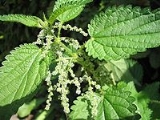
Urticaceae

Encyclopedia
Urticaceae, or the nettle family, is a family
of flowering plant
s. The family name comes from the genus Urtica (nettle
s). Urticaceae includes a number of well-known and useful plants, including the aforementioned nettles, Ramie
(Boehmeria nivea), māmaki (Pipturus albidus
), and ajlai (Debregeasia saeneb).
The family includes approximately 2600 species, grouped into 54 to 79 genera according to the database of the Royal Botanic Gardens, Kew
. The largest genera are Pilea
(500 to 715 species), Elatostema (300 species), Urtica (80 species), and Cecropia
(75 species).
Urticaceae can be found worldwide, apart from the polar regions.
 APG II system
puts Urticaceae in order Rosales, while older system consider it part of Urticales
, along with Ulmaceae
, Moraceae
and Cannabaceae
. APG still considers "old" Urticales a monophyletic group, but does not recognise it as an order on its own.
Leaves
are usually entire and bear stipule
s. Urticating (stinging) hairs are often present.
Urticaceae have usually unisexual flowers and can be both monoecious
or dioecious
. They are pollinated by the wind
. Most disperse their pollen
when the stamen
s are mature and their filaments straighten explosively: a peculiar and conspicuously specialised mechanism.
Family (biology)
In biological classification, family is* a taxonomic rank. Other well-known ranks are life, domain, kingdom, phylum, class, order, genus, and species, with family fitting between order and genus. As for the other well-known ranks, there is the option of an immediately lower rank, indicated by the...
of flowering plant
Flowering plant
The flowering plants , also known as Angiospermae or Magnoliophyta, are the most diverse group of land plants. Angiosperms are seed-producing plants like the gymnosperms and can be distinguished from the gymnosperms by a series of synapomorphies...
s. The family name comes from the genus Urtica (nettle
Nettle
Nettles constitute between 24 and 39 species of flowering plants of the genus Urtica in the family Urticaceae, with a cosmopolitan though mainly temperate distribution. They are mostly herbaceous perennial plants, but some are annual and a few are shrubby...
s). Urticaceae includes a number of well-known and useful plants, including the aforementioned nettles, Ramie
Ramie
Ramie is a flowering plant in the nettle family Urticaceae, native to eastern Asia. It is a herbaceous perennial growing to 1–2.5 m tall; the leaves are heart-shaped, 7–15 cm long and 6–12 cm broad, and white on the underside with dense small hairs—this gives it a silvery appearance;...
(Boehmeria nivea), māmaki (Pipturus albidus
Pipturus albidus
Pipturus albidus, known as Māmaki in Hawaiian, is a species of flowering plant in the nettle family, Urticaceae, that is endemic to Hawaii. It inhabits coastal mesic, mixed mesic, and wet forests at elevations of...
), and ajlai (Debregeasia saeneb).
The family includes approximately 2600 species, grouped into 54 to 79 genera according to the database of the Royal Botanic Gardens, Kew
Royal Botanic Gardens, Kew
The Royal Botanic Gardens, Kew, usually referred to as Kew Gardens, is 121 hectares of gardens and botanical glasshouses between Richmond and Kew in southwest London, England. "The Royal Botanic Gardens, Kew" and the brand name "Kew" are also used as umbrella terms for the institution that runs...
. The largest genera are Pilea
Pilea
Pilea with 600–715 species is the largest genus in the plant family Urticaceae and one of the larger genera in the Urticales and eudicot rosids....
(500 to 715 species), Elatostema (300 species), Urtica (80 species), and Cecropia
Cecropia
Cecropia is a Neotropical genus presently consisting of sixty-one recognized species with a highly distinctive lineage of dioecious trees....
(75 species).
Urticaceae can be found worldwide, apart from the polar regions.
Taxonomy
Angiosperm Phylogeny Group
The Angiosperm Phylogeny Group, or APG, refers to an informal international group of systematic botanists who came together to try to establish a consensus on the taxonomy of flowering plants that would reflect new knowledge about plant relationships discovered through phylogenetic studies., three...
puts Urticaceae in order Rosales, while older system consider it part of Urticales
Urticales
Urticales is a botanical name for what used to be an order of flowering plants. Before molecular phylogenetics became an important part of plant taxonomy, Urticales was recognized in many, perhaps even most, systems of plant classification, with some variations in circumscription...
, along with Ulmaceae
Ulmaceae
Ulmaceae is a family of flowering plant that includes the elms , and the zelkovas . Members of the family are widely distributed throughout the north temperate zone, and have a scattered distribution elsewhere except for Australasia.The family was formerly sometimes treated to include the...
, Moraceae
Moraceae
Moraceae — often called the mulberry family or fig family — are a family of flowering plants comprising about 40 genera and over 1000 species. Most are widespread in tropical and subtropical regions, less so in temperate climates...
and Cannabaceae
Cannabaceae
Cannabaceae are a small family of flowering plants. As now circumscribed, the family includes about 170 species grouped in about 11 genera, including Cannabis , Humulus and Celtis...
. APG still considers "old" Urticales a monophyletic group, but does not recognise it as an order on its own.
Description
Urticaceae can be shrubs (e.g. Pilea), lianas, herbs (e.g. Urtica. Parietaria), or, rarely, trees (e.g. Dendrocnide, Cecropia).Leaves
Leaves
-History:Vocalist Arnar Gudjonsson was formerly the guitarist with Mower, and he was joined by Hallur Hallsson , Arnar Ólafsson , Bjarni Grímsson , and Andri Ásgrímsson . Late in 2001 they played with Emiliana Torrini and drew early praise from the New York Times...
are usually entire and bear stipule
Stipule
In botany, stipule is a term coined by Linnaeus which refers to outgrowths borne on either side of the base of a leafstalk...
s. Urticating (stinging) hairs are often present.
Urticaceae have usually unisexual flowers and can be both monoecious
Plant sexuality
Plant sexuality covers the wide variety of sexual reproduction systems found across the plant kingdom. This article describes morphological aspects of sexual reproduction of plants....
or dioecious
Plant sexuality
Plant sexuality covers the wide variety of sexual reproduction systems found across the plant kingdom. This article describes morphological aspects of sexual reproduction of plants....
. They are pollinated by the wind
Anemophily
Anemophily or wind pollination is a form of pollination whereby pollen is distributed by wind. Anemophilous plants may be either gymnosperms or angiosperms ....
. Most disperse their pollen
Pollen
Pollen is a fine to coarse powder containing the microgametophytes of seed plants, which produce the male gametes . Pollen grains have a hard coat that protects the sperm cells during the process of their movement from the stamens to the pistil of flowering plants or from the male cone to the...
when the stamen
Stamen
The stamen is the pollen producing reproductive organ of a flower...
s are mature and their filaments straighten explosively: a peculiar and conspicuously specialised mechanism.
Genera
|
Forsskaolea Forsskaolea is a small genus of 6 species of perennial herbs in the nettle family with non-stinging hairs and dot-like concretions of mineral matter on their green parts.-Description:... Laportea Laportea is a genus of plants in the family Urticaceae, named after French naturalist François Louis de la Porte, comte de Castelnau.They are herbaceous, either annual or perennial. Like many plants of the Urticaceae, they have stinging hairs, and have stinging and non-stinging hairs on the same... Metatrophis Metatrophis is a genus of plant in the nettle family, Urticaceae.Species include:* Metatrophis margaretae, F. Brown... Myriocarpa Myriocarpa is a genus woody plant which ranges in size from shrubs to small trees and is endemic to Central and South America. Within the Urticaceae, Myriocarpa is characterized by long pendulous string-like female inflorescences of apparently naked flowers and stems which release a watery latex... Neraudia Neraudia is a genus of plants in family Urticaceae. There are five species, all endemic to Hawaii.Species include:* Neraudia angulata* Neraudia melastomifolia, Gaud.* Neraudia ovata, Gaud.* Neraudia sericea... |
Parietaria Parietaria is a genus of 20–30 species of flowering plants in the family Urticaceae, native to temperate and tropical regions across the world.... Pellionia Pellionia is a genus of flowering plants in the family Urticaceae.... Pilea Pilea with 600–715 species is the largest genus in the plant family Urticaceae and one of the larger genera in the Urticales and eudicot rosids.... Pipturus Pipturus is a flowering plant genus in the nettle family, Urticaceae.-Selected species:* Pipturus albidus A.Gray ex H.Mann – Māmaki * Pipturus arborescens C.B.Rob., 1911... Pouzolzia Pouzolzia is a genus of flowering plants in the nettle family. There are about 35 species distributed throughout the tropical world. Most are shrubs, and some are herbs. The genus was named for the plant collector P. C. M... Urera Urera is a genus of flowering shrubs, trees and vines in the nettle family, Urticaceae. Urera is characterized by fleshy fruits , the presence of paintbrush-like stigmas, glabrous pistillodes, and hairs with bulbed bases, that in some species are stinging.There are currently 113 published species... |