

Ursid hybrid

Encyclopedia
Species
In biology, a species is one of the basic units of biological classification and a taxonomic rank. A species is often defined as a group of organisms capable of interbreeding and producing fertile offspring. While in many cases this definition is adequate, more precise or differing measures are...
or subspecies
Subspecies
Subspecies in biological classification, is either a taxonomic rank subordinate to species, ora taxonomic unit in that rank . A subspecies cannot be recognized in isolation: a species will either be recognized as having no subspecies at all or two or more, never just one...
of the Ursidae (bear
Bear
Bears are mammals of the family Ursidae. Bears are classified as caniforms, or doglike carnivorans, with the pinnipeds being their closest living relatives. Although there are only eight living species of bear, they are widespread, appearing in a wide variety of habitats throughout the Northern...
) family
Family (biology)
In biological classification, family is* a taxonomic rank. Other well-known ranks are life, domain, kingdom, phylum, class, order, genus, and species, with family fitting between order and genus. As for the other well-known ranks, there is the option of an immediately lower rank, indicated by the...
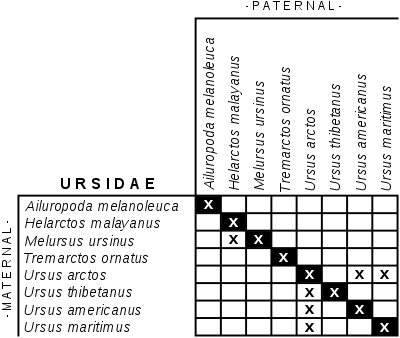
. Species and subspecies of bear known to have produced offspring with another bear species or subspecies include brown bears, black bears, grizzly bears and polar bears, all of which are members of the Ursus genus
Genus
In biology, a genus is a low-level taxonomic rank used in the biological classification of living and fossil organisms, which is an example of definition by genus and differentia...
. Bears not included in Ursus, such as the Giant Panda
Giant Panda
The giant panda, or panda is a bear native to central-western and south western China. It is easily recognized by its large, distinctive black patches around the eyes, over the ears, and across its round body. Though it belongs to the order Carnivora, the panda's diet is 99% bamboo...
, are probably unable to produce hybrids. Note all of the confirmed hybrids listed here have been in captivity (except Grizzly/Polar bear), but there are unconfirmed reports of hybrids in the wild.
Brown bear/American black bear hybrids
In 1859, a black bearAmerican black bear
The American black bear is a medium-sized bear native to North America. It is the continent's smallest and most common bear species. Black bears are omnivores, with their diets varying greatly depending on season and location. They typically live in largely forested areas, but do leave forests in...
and a European brown bear
Brown Bear
The brown bear is a large bear distributed across much of northern Eurasia and North America. It can weigh from and its largest subspecies, the Kodiak Bear, rivals the polar bear as the largest member of the bear family and as the largest land-based predator.There are several recognized...
were bred together in the London Zoological Gardens, but the three cubs
Cubs
Cubs may refer to:*Chicago Cubs, a baseball team of the National League of Major League Baseball**Iowa Cubs, a minor league baseball team of the Pacific Coast League**Daytona Cubs, a minor league baseball team of the Florida State League...
did not reach maturity. In The Variation of Animals and Plants under Domestication
The Variation of Animals and Plants under Domestication
The Variation of Animals and Plants under Domestication is a book written by Charles Darwin that was first published in January 1868.A large proportion of the book contains detailed information on the domestication of animals and plants but it also contains in Chapter XXVII a description of...
Charles Darwin
Charles Darwin
Charles Robert Darwin FRS was an English naturalist. He established that all species of life have descended over time from common ancestry, and proposed the scientific theory that this branching pattern of evolution resulted from a process that he called natural selection.He published his theory...
noted:
In the nine-year Report it is stated that the bears had been seen in the Zoological Gardens to couple freely, but previously to 1848 most had rarely conceived. In the Reports published since this date three species have produced young (hybrids in one case),...
Intercontinental brown bear hybrids
Hybrids between the European brown bear and the grizzly bearGrizzly Bear
The grizzly bear , also known as the silvertip bear, the grizzly, or the North American brown bear, is a subspecies of brown bear that generally lives in the uplands of western North America...
(now considered to be a North American variety of brown bear rather than a separate species) have been bred in Cologne, Germany. See grizzly bear
Grizzly Bear
The grizzly bear , also known as the silvertip bear, the grizzly, or the North American brown bear, is a subspecies of brown bear that generally lives in the uplands of western North America...
for taxonomy.
Brown bear/Polar bear hybrids
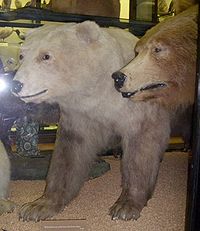
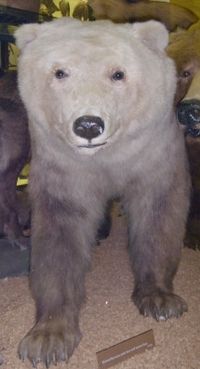
- Since 1874, at HalleHalle, Saxony-AnhaltHalle is the largest city in the German state of Saxony-Anhalt. It is also called Halle an der Saale in order to distinguish it from the town of Halle in North Rhine-Westphalia...
, a series of successful matings of polar bearPolar BearThe polar bear is a bear native largely within the Arctic Circle encompassing the Arctic Ocean, its surrounding seas and surrounding land masses. It is the world's largest land carnivore and also the largest bear, together with the omnivorous Kodiak Bear, which is approximately the same size...
s and brown bearBrown BearThe brown bear is a large bear distributed across much of northern Eurasia and North America. It can weigh from and its largest subspecies, the Kodiak Bear, rivals the polar bear as the largest member of the bear family and as the largest land-based predator.There are several recognized...
s were made. Some of the hybrid offspringOffspringIn biology, offspring is the product of reproduction, of a new organism produced by one or more parents.Collective offspring may be known as a brood or progeny in a more general way...
were exhibited by the London Zoological Society. The Halle hybrid bears proved to be fertile, both with one of the parent species and with one another. Polar bear/Brown bear hybrids are white at birth but later turn blue-brown or yellow-white.
- An adult polar bear/brown bear hybrid bred in the 19th Century is now displayed at the Rothschild Zoological Museum, Tring, England
- Crandall reported the first polar bear/brown bear crosses as occurring at a small zoo in StuttgartStuttgartStuttgart is the capital of the state of Baden-Württemberg in southern Germany. The sixth-largest city in Germany, Stuttgart has a population of 600,038 while the metropolitan area has a population of 5.3 million ....
, GermanyGermanyGermany , officially the Federal Republic of Germany , is a federal parliamentary republic in Europe. The country consists of 16 states while the capital and largest city is Berlin. Germany covers an area of 357,021 km2 and has a largely temperate seasonal climate...
in 1876 rather than Halle in 1874. A female European brown bear mated with a male polar bear resulting in twin cubs in 1876. Three further births were recorded. The young were fertile among themselves and when mated back to European brown bears and to polar bears.
- DNADNADeoxyribonucleic acid is a nucleic acid that contains the genetic instructions used in the development and functioning of all known living organisms . The DNA segments that carry this genetic information are called genes, but other DNA sequences have structural purposes, or are involved in...
studies indicate that some brown bears are more closely related to polar bears than they are to other brown bears. All the Ursinae species (i.e., all bears except the giant pandaGiant PandaThe giant panda, or panda is a bear native to central-western and south western China. It is easily recognized by its large, distinctive black patches around the eyes, over the ears, and across its round body. Though it belongs to the order Carnivora, the panda's diet is 99% bamboo...
and the spectacled bearSpectacled BearThe spectacled bear , also known as the Andean bear and locally as ukuko, jukumari or ucumari, is the last remaining short-faced bear and the closest living relative to the Florida spectacled bear and short-faced bears of the Middle Pleistocene to Late Pleistocene age.The spectacled bear is a...
) appear able to crossbreedCrossbreedA crossbreed or crossbred usually refers to an animal with purebred parents of two different breeds, varieties, or populations. Crossbreeding refers to the process of breeding such an animal, often with the intention to create offspring that share the traits of both parent lineages, or producing...
.
Kodiak bear/Polar bear hybrids
"Kodiak" or "Kodiak brown" is a term now applied to brown bears found in coastal regions of North America. In the far north these bears feed on salmon and often attain especially large size. "Alaskan Brown" is sometimes used for Alaskan bears, but the main distinction is how far the bear is found from the coast. Grizzly bearGrizzly Bear
The grizzly bear , also known as the silvertip bear, the grizzly, or the North American brown bear, is a subspecies of brown bear that generally lives in the uplands of western North America...
is the term used for the brown bear
Brown Bear
The brown bear is a large bear distributed across much of northern Eurasia and North America. It can weigh from and its largest subspecies, the Kodiak Bear, rivals the polar bear as the largest member of the bear family and as the largest land-based predator.There are several recognized...
of the North American interior.
- In 1936, a male polar bear accidentally got into an enclosure with a female KodiakBrown BearThe brown bear is a large bear distributed across much of northern Eurasia and North America. It can weigh from and its largest subspecies, the Kodiak Bear, rivals the polar bear as the largest member of the bear family and as the largest land-based predator.There are several recognized...
(Alaskan Brown) bear at the U.S. National Zoo, resulting in three hybrid offspring. One hybrid was named Willy and grew into an immense specimen. The hybrid offspring were fertile and able to breed successfully with each other, indicating that the two species of bear are closely related. The KodiakBrown BearThe brown bear is a large bear distributed across much of northern Eurasia and North America. It can weigh from and its largest subspecies, the Kodiak Bear, rivals the polar bear as the largest member of the bear family and as the largest land-based predator.There are several recognized...
is also considered by many to be a variant or subspecies of the basic Arctic (circumpolar) brown bear.
- In a 1970 National Geographic article Elizabeth C. Reed mentions being foster mother to 4 hybrid bear cubs from the National Zoological Park in Washington, where her husband was director.
- In 1943, Clara Helgason described a bear shot by hunters during her childhood. This was a large, off-white bear with hair all over his paws. The presence of hair on the bottom of the feet suggests it was not an unusually colored Kodiak brown bear, but a natural hybrid with a Polar bear.
Grizzly bear/Polar bear hybrids
The Grizzly bear is now regarded by most taxonomists as a variety of brown bear, Ursus arctos horribilis.- Clinton Hart Merriam, taxonomist of grizzly bears, described an animal killed in 1864 at Rendezvous Lake, Barren Grounds, Canada as "buffy whitish" with a golden brown muzzle. This is considered to be a natural hybrid between a grizzly bear and polar bear.
On April 16, 2006 a polar bear of unusual appearance was shot by a sports hunter on Banks Island in the Northwest Territories
Northwest Territories
The Northwest Territories is a federal territory of Canada.Located in northern Canada, the territory borders Canada's two other territories, Yukon to the west and Nunavut to the east, and three provinces: British Columbia to the southwest, and Alberta and Saskatchewan to the south...
. DNA testing released May 11, 2006 proved the kill was a Grizzly/Polar Bear hybrid. This is thought to be the first recorded case of interbreeding in the wild. The bear was proven to have a polar mother and a grizzly father. The DNA testing also spared the hunter the C$1000 fine for killing a grizzly bear, and the risk of being imprisoned for up to a year. The hunter had bought a license to hunt polar bears; he did not have a license to hunt grizzly at that time.
The animal had dark rings around its eyes, similar to a panda's but not as wide. It also had remarkably long claws, a slight hump on its back, brown spots in its white coat, and a slightly indented face — the nasal "stop" between the eyes which polar bears lack. The guide leading the hunt, Roger Kuptana of Sachs Harbour in the Northwest Territories, was the first to note the oddities.
Several names were suggested for this specimen. The Idaho hunter who killed it, Jim Martell, suggested polargrizz. The biologists of the Canadian Wildlife Service
Canadian Wildlife Service
The Canadian Wildlife Service or CWS is a branch of the Department of the Environment, also known as Environment Canada, a department of the Government of Canada....
suggested grolar or pizzly, as well as nanulak, an elision of the Inuit
Inuit
The Inuit are a group of culturally similar indigenous peoples inhabiting the Arctic regions of Canada , Denmark , Russia and the United States . Inuit means “the people” in the Inuktitut language...
nanuk (polar bear) and aklak (grizzly or brown bear). Both grolar and pizzly were used by the Canadian Broadcast Corporation in widely-distributed stories.
Presently, though the mating seasons overlap, the polar bear's season begins slightly earlier than the grizzly bear's. A blog columnist for the Seattle Post-Intelligencer suggested that more hybrids may be seen as global warming
Global warming
Global warming refers to the rising average temperature of Earth's atmosphere and oceans and its projected continuation. In the last 100 years, Earth's average surface temperature increased by about with about two thirds of the increase occurring over just the last three decades...
progresses and alters normal mating periods. The Canadian Wildlife Service noted that grizzly-polar hybrids born of zoo matings have proven fertile.
Grizzly bears have been sighted in what is usually polar bear territory in the Western Arctic near the Beaufort Sea, Banks Island, Victoria Island, and Melville Island. A "light chocolate colored" bear, possibly a hybrid, is reported to have been seen with polar bears near Kugluktuk in western Nunavut
Nunavut
Nunavut is the largest and newest federal territory of Canada; it was separated officially from the Northwest Territories on April 1, 1999, via the Nunavut Act and the Nunavut Land Claims Agreement Act, though the actual boundaries had been established in 1993...
.
Asiatic black bear hybrids
In 1975, within VenezuelaVenezuela
Venezuela , officially called the Bolivarian Republic of Venezuela , is a tropical country on the northern coast of South America. It borders Colombia to the west, Guyana to the east, and Brazil to the south...
's "Las Delicias" Zoo, a female Asian black bear shared its enclosure with a spectacled bear
Spectacled Bear
The spectacled bear , also known as the Andean bear and locally as ukuko, jukumari or ucumari, is the last remaining short-faced bear and the closest living relative to the Florida spectacled bear and short-faced bears of the Middle Pleistocene to Late Pleistocene age.The spectacled bear is a...
, and produced several hybrid descendants.
In 2005, a possible black bear/sun bear hybrid cub was captured in the Mekong River watershed of eastern Cambodia. The hybrid's mane was relatively slight, forming a crest on each side of the neck, as is typical in sun bears and some black bears. The appearance of its face was intermediate between that of the sun bear and the black bear, though its ears and large stout canines closely resembled those of the sun bear. Overall, the hybrid resembled an Asiatic black bear with an unusually glossy pelage and an unusual head.
In 2010, a male hybrid between an Asiatic black bear and a brown bear named Emma was taken from a bile farm and into the Animals Asia Foundation
Animals Asia Foundation
Animals Asia Foundation is a Hong Kong-based charity that seeks to end cruelty to animals in Asia.The AAF was founded in 1998 by Jill Robinson, who felt compelled to create the organisation after learning of the plight of the Asiatic Black Bear known as the “Moon Bear” because of the yellow...
's China Moon Bear Rescue
Sloth bear hybrids
Hybrids have been produced between the sloth bearSloth Bear
The sloth bear , also known as the labiated bear, is a nocturnal insectivorous species of bear found wild within the Indian subcontinent. The sloth bear evolved from ancestral brown bears during the Pleistocene and shares features found in insect-eating mammals through convergent evolution...
(Melursus ursinus) and the Malayan sun bear (Ursus malayanus) at Tama Zoo
Tama Zoo
The is a zoo, owned by the government of Tokyo, and located in Hino, Tokyo, Japan. Tama Zoo was opened on May 5th, 1958, originally as part of Ueno Zoo...
in Tokyo
Tokyo
, ; officially , is one of the 47 prefectures of Japan. Tokyo is the capital of Japan, the center of the Greater Tokyo Area, and the largest metropolitan area of Japan. It is the seat of the Japanese government and the Imperial Palace, and the home of the Japanese Imperial Family...
, and also between the sloth bear
Sloth Bear
The sloth bear , also known as the labiated bear, is a nocturnal insectivorous species of bear found wild within the Indian subcontinent. The sloth bear evolved from ancestral brown bears during the Pleistocene and shares features found in insect-eating mammals through convergent evolution...
(Melursus ursinus) and the Asiatic black bear
Asiatic Black Bear
The Asian black bear , also known as the moon bear or white-chested bear is a medium-sized species of bear, largely adapted for arboreal life, which occurs through much of southern Asia, Korea, northeastern China, the Russian far east and Honshū and Shikoku islands of Japan...
(Ursus thibetanus, or Selenarctos thibetanus).
Further reading
- Martin, P.L. 1876. "Ursus arctos and Ursus maritimus. On bastards between these species born in Nill's menagerie at Stuttgart." Zoologische Garten, 1876:20-22. [Zoologische Garten, 1877:135-136. *W. Stendell and E. von Martens, tom. cit., pp. 401–402.]
- ------. 1882. "On a hybrid between a male Ursus maritimus and a female Ursus arctos." Zoologische Garten, 1882:xxiii, 370.
- Kowalska, Z. 1962. "Intergeneric crossbreed of the brown bear Ursus arctos L., and the polar bear Thalarctos maritimus (Phipps)." Przeglad Zoologiczny, 6:230, 1 pl. [Polish with English summary.]
- ------. 1965. "Cross breeding between a female European brown bear and a male polar bear in Łódź Zoo." Przeglad Zoologiczny, 9:313-319. [Polish with English summary.]
- Wurster-Hill, D.H. and Bush, M. 1980: The interrelationship of chromosome banding patterns in the giant panda (Ailuropoda melanoleuca), hybrid bear (Ursus middendorfi x Thalarctos maritimus), and other carnivores. Cytogenet. Cell Genet. 27:147-154.