

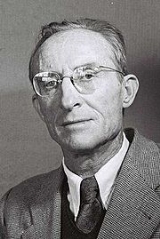
Uri Zvi Greenberg

Encyclopedia
Uri Zvi Grinberg was an acclaimed Israel
i poet
and journalist
who wrote in Yiddish and Hebrew.
, Galicia, then Austria-Hungary
, into a prominent Hasidic
family. He was raised in Lemberg (Lviv). Some of his poems in Yiddish
and Hebrew
were published before he was 20. In 1915 he was drafted into the army and fought in the First World War. After returning to Lemberg, he was witness to the pogrom
s of November 1918. He moved to Warsaw
, where he wrote for the Yiddish newspaper Moment. After a brief stay in Berlin, he immigrated
to Mandate Palestine (the Land of Israel
) in 1924. Grinberg was in Poland when the Second World War erupted in 1939, but managed to escape.
In 1950, Grinberg married Aliza, with whom he had two daughters and three sons. He added "Tur-Malka" to the family name, but continued to use "Grinberg" to honor family members who perished in the Holocaust.
and Der Sturm
. Grinberg published the last two issues of Albatros in Berlin before renouncing European society and immigrating to Palestine in 1923.
In his early days in Palestine, Grinberg wrote for Davar
, one of the main newspapers of the Labour Zionist
movement. In his poems and articles he warned of the fate in store for the Jews of the Diaspora. After the Holocaust, he mourned the fact that his terrible prophecies had come true. His works represent a synthesis of traditional Jewish values and an individualistic lyrical approach to life and its problems. They draw on Jewish sources such as the Bible, the Talmud and the prayer book, but are also influenced by European literature.
 In 1930, Grinberg joined the Revisionist camp
, representing the Revisionist movement at several Zionist congresses and in Poland
. After the 1929 Hebron massacre
he became more militant, and joined both the Irgun
and Lehi
. With Abba Ahimeir
and Joshua Yeivin, he founded Brit HaBirionim
, a clandestine faction of the Revisionist movement which adopted an activist policy of violating British mandatory regulations. In the early 1930s, its members disrupted a British-sponsored census, sounded the shofar
in prayer at the Western Wall
despite a British prohibition, held a protest rally when a British colonial official visited Tel Aviv, and tore down Nazi flags from German offices in Jerusalem and Tel Aviv. When the British arrested hundreds of its members the organization effectively ceased to exist.
Grinberg envisioned and warned as early as 1923 of the destruction of European Jewry. He believed that the Holocaust was a tragic but largely inevitable outcome of Jews living in exile from their homeland, in an anti-semitic Christian society.
Following Israeli independence in 1948, he joined Menachem Begin
's Herut
movement. In 1949, he was elected to the first Knesset
. He lost his seat in the 1951 elections
. After the Six-Day War
he joined the Movement for Greater Israel
, which advocated Israeli sovereignty over the West Bank
.
Israel
The State of Israel is a parliamentary republic located in the Middle East, along the eastern shore of the Mediterranean Sea...
i poet
Poet
A poet is a person who writes poetry. A poet's work can be literal, meaning that his work is derived from a specific event, or metaphorical, meaning that his work can take on many meanings and forms. Poets have existed since antiquity, in nearly all languages, and have produced works that vary...
and journalist
Journalist
A journalist collects and distributes news and other information. A journalist's work is referred to as journalism.A reporter is a type of journalist who researchs, writes, and reports on information to be presented in mass media, including print media , electronic media , and digital media A...
who wrote in Yiddish and Hebrew.
Biography
Uri Zvi Grinberg was born in BialikaminZolochiv Raion
Zolochiv Raion is a raion in Lviv Oblast in western Ukraine. Its administrative center is Zolochiv. It has a population of 74 686.It was established in 1939.-External links:*...
, Galicia, then Austria-Hungary
Austria-Hungary
Austria-Hungary , more formally known as the Kingdoms and Lands Represented in the Imperial Council and the Lands of the Holy Hungarian Crown of Saint Stephen, was a constitutional monarchic union between the crowns of the Austrian Empire and the Kingdom of Hungary in...
, into a prominent Hasidic
Hasidic Judaism
Hasidic Judaism or Hasidism, from the Hebrew —Ḥasidut in Sephardi, Chasidus in Ashkenazi, meaning "piety" , is a branch of Orthodox Judaism that promotes spirituality and joy through the popularisation and internalisation of Jewish mysticism as the fundamental aspects of the Jewish faith...
family. He was raised in Lemberg (Lviv). Some of his poems in Yiddish
Yiddish language
Yiddish is a High German language of Ashkenazi Jewish origin, spoken throughout the world. It developed as a fusion of German dialects with Hebrew, Aramaic, Slavic languages and traces of Romance languages...
and Hebrew
Hebrew language
Hebrew is a Semitic language of the Afroasiatic language family. Culturally, is it considered by Jews and other religious groups as the language of the Jewish people, though other Jewish languages had originated among diaspora Jews, and the Hebrew language is also used by non-Jewish groups, such...
were published before he was 20. In 1915 he was drafted into the army and fought in the First World War. After returning to Lemberg, he was witness to the pogrom
Pogrom
A pogrom is a form of violent riot, a mob attack directed against a minority group, and characterized by killings and destruction of their homes and properties, businesses, and religious centres...
s of November 1918. He moved to Warsaw
Warsaw
Warsaw is the capital and largest city of Poland. It is located on the Vistula River, roughly from the Baltic Sea and from the Carpathian Mountains. Its population in 2010 was estimated at 1,716,855 residents with a greater metropolitan area of 2,631,902 residents, making Warsaw the 10th most...
, where he wrote for the Yiddish newspaper Moment. After a brief stay in Berlin, he immigrated
Aliyah
Aliyah is the immigration of Jews to the Land of Israel . It is a basic tenet of Zionist ideology. The opposite action, emigration from Israel, is referred to as yerida . The return to the Holy Land has been a Jewish aspiration since the Babylonian exile...
to Mandate Palestine (the Land of Israel
Land of Israel
The Land of Israel is the Biblical name for the territory roughly corresponding to the area encompassed by the Southern Levant, also known as Canaan and Palestine, Promised Land and Holy Land. The belief that the area is a God-given homeland of the Jewish people is based on the narrative of the...
) in 1924. Grinberg was in Poland when the Second World War erupted in 1939, but managed to escape.
In 1950, Grinberg married Aliza, with whom he had two daughters and three sons. He added "Tur-Malka" to the family name, but continued to use "Grinberg" to honor family members who perished in the Holocaust.
Literary career
His first works in Hebrew and Yiddish were published in 1912. His first book, in Yiddish, was published in Lwow while he was fighting on the Serbian front. He also edited a literary journal, Albatros. In the wake of his iconoclastic depictions of Jesus in the second issue of Albatros, particularly his prose poem Royte epl fun veybeymer (Red Apples from the Trees of Pain), the journal was banned by the Polish censors and Grinberg fled to Berlin to escape prosecution in November 1922. The magazine incorporated avant-garde elements both in content and typography, taking its cue from German periodicals like Die AktionDie Aktion
Die Aktion was a German literary and political magazine, edited by Franz Pfemfert and published between 1911 and 1932 in Berlin-Wilmersdorf; it promoted literary Expressionism and stood for left-wing policies...
and Der Sturm
Der Sturm
Der Sturm was a magazine covering the expressionism movement founded in Berlin in 1910 by Herwarth Walden. It ran weekly until monthly in 1914, and became a quarterly in 1924 until it ceased publication in 1932....
. Grinberg published the last two issues of Albatros in Berlin before renouncing European society and immigrating to Palestine in 1923.
In his early days in Palestine, Grinberg wrote for Davar
Davar
Davar was a Hebrew-language daily newspaper published in the Mandate Palestine and Israel between 1925 and May 1996.-History:Davar was established by Moshe Beilinson and Berl Katznelson, with Katznelson as its first editor. The first edition was published on 1 June 1925 under the name Davar - Iton...
, one of the main newspapers of the Labour Zionist
Labor Zionism
Labor Zionism can be described as the major stream of the left wing of the Zionist movement. It was, for many years, the most significant tendency among Zionists and Zionist organizational structure...
movement. In his poems and articles he warned of the fate in store for the Jews of the Diaspora. After the Holocaust, he mourned the fact that his terrible prophecies had come true. His works represent a synthesis of traditional Jewish values and an individualistic lyrical approach to life and its problems. They draw on Jewish sources such as the Bible, the Talmud and the prayer book, but are also influenced by European literature.
Literary motifs
In the second and third issues of Albatros, Grinberg invokes pain as a key marker of the modern era. This theme is illustrated in Royte epl fun vey beymer and Veytikn-heym af slavisher erd (Pain-Home on Slavic Ground).Political activism
Revisionist Zionism
Revisionist Zionism is a nationalist faction within the Zionist movement. It is the founding ideology of the non-religious right in Israel, and was the chief ideological competitor to the dominant socialist Labor Zionism...
, representing the Revisionist movement at several Zionist congresses and in Poland
Poland
Poland , officially the Republic of Poland , is a country in Central Europe bordered by Germany to the west; the Czech Republic and Slovakia to the south; Ukraine, Belarus and Lithuania to the east; and the Baltic Sea and Kaliningrad Oblast, a Russian exclave, to the north...
. After the 1929 Hebron massacre
1929 Hebron massacre
The Hebron massacre refers to the killing of sixty-seven Jews on 23 and 24 August 1929 in Hebron, then part of the British Mandate of Palestine, by Arabs incited to violence by rumors that Jews were massacring Arabs in Jerusalem and seizing control of Muslim holy places...
he became more militant, and joined both the Irgun
Irgun
The Irgun , or Irgun Zevai Leumi to give it its full title , was a Zionist paramilitary group that operated in Mandate Palestine between 1931 and 1948. It was an offshoot of the earlier and larger Jewish paramilitary organization haHaganah...
and Lehi
Lehi (group)
Lehi , commonly referred to in English as the Stern Group or Stern Gang, was a militant Zionist group founded by Avraham Stern in the British Mandate of Palestine...
. With Abba Ahimeir
Abba Ahimeir
Abba Ahimeir was a Jewish journalist, historian and political activist. One of the ideologues of Revisionist Zionism, he was the founder of the Revisionist Maximalist faction of the Zionist Revisionist Movement and of the clandestine Brit HaBirionim....
and Joshua Yeivin, he founded Brit HaBirionim
Brit HaBirionim
Brit HaBirionim was a clandestine, self-declared fascist faction of the Revisionist Zionist Movement in the British Mandate of Palestine, active between 1930 and 1933. It was founded by the trio of Abba Ahimeir, Uri Zvi Greenberg and Dr...
, a clandestine faction of the Revisionist movement which adopted an activist policy of violating British mandatory regulations. In the early 1930s, its members disrupted a British-sponsored census, sounded the shofar
Shofar
A shofar is a horn, traditionally that of a ram, used for Jewish religious purposes. Shofar-blowing is incorporated in synagogue services on Rosh Hashanah and Yom Kippur.Shofar come in a variety of sizes.- Bible and rabbinic literature :...
in prayer at the Western Wall
Western Wall
The Western Wall, Wailing Wall or Kotel is located in the Old City of Jerusalem at the foot of the western side of the Temple Mount...
despite a British prohibition, held a protest rally when a British colonial official visited Tel Aviv, and tore down Nazi flags from German offices in Jerusalem and Tel Aviv. When the British arrested hundreds of its members the organization effectively ceased to exist.
Grinberg envisioned and warned as early as 1923 of the destruction of European Jewry. He believed that the Holocaust was a tragic but largely inevitable outcome of Jews living in exile from their homeland, in an anti-semitic Christian society.
Following Israeli independence in 1948, he joined Menachem Begin
Menachem Begin
' was a politician, founder of Likud and the sixth Prime Minister of the State of Israel. Before independence, he was the leader of the Zionist militant group Irgun, the Revisionist breakaway from the larger Jewish paramilitary organization Haganah. He proclaimed a revolt, on 1 February 1944,...
's Herut
Herut
Herut was the major right-wing political party in Israel from the 1940s until its formal merger into Likud in 1988, and an adherent of Revisionist Zionism.-History:...
movement. In 1949, he was elected to the first Knesset
Israeli legislative election, 1949
Elections for the Constituent Assembly were held in newly independent Israel on 25 January 1949. Voter turnout was 86.9%. Two days after its first meeting on 14 February 1949, legislators voted to change the name of the body to the Knesset...
. He lost his seat in the 1951 elections
Israeli legislative election, 1951
Elections for the second Knesset were held in Israel on 30 July 1951. Voter turnout was 75.1%.-Results:¹ Rostam Bastuni, Avraham Berman and Moshe Sneh left Mapam and set up the Left Faction. Bastuni later returned to Mapam whilst Berman and Sneh joined Maki. Hannah Lamdan and David Livschitz left...
. After the Six-Day War
Six-Day War
The Six-Day War , also known as the June War, 1967 Arab-Israeli War, or Third Arab-Israeli War, was fought between June 5 and 10, 1967, by Israel and the neighboring states of Egypt , Jordan, and Syria...
he joined the Movement for Greater Israel
Movement for Greater Israel
The Movement for Greater Israel was a political organisation in Israel during the 1960s and 1970s which subscribed to an ideology of Greater Israel....
, which advocated Israeli sovereignty over the West Bank
West Bank
The West Bank ) of the Jordan River is the landlocked geographical eastern part of the Palestinian territories located in Western Asia. To the west, north, and south, the West Bank shares borders with the state of Israel. To the east, across the Jordan River, lies the Hashemite Kingdom of Jordan...
.
Awards
- In 1947, 1954 and 1977, Grinberg was awarded the Bialik PrizeBialik PrizeThe Bialik Prize is an annual literary award given by the municipality of Tel Aviv, Israel for significant accomplishments in Hebrew literature. The prize is named in memory of Hayyim Nahman Bialik. There are two separate prizes, one specifically for "Literature", which is in the field of fiction,...
for literatureHebrew literatureHebrew literature consists of ancient, medieval, and modern writings in the Hebrew language. It is one of the primary forms of Jewish literature, though there have been cases of literature written in Hebrew by non-Jews...
. - In 1957, Grinberg was awarded the Israel PrizeIsrael PrizeThe Israel Prize is an award handed out by the State of Israel and is largely regarded as the state's highest honor. It is presented annually, on Israeli Independence Day, in a state ceremony in Jerusalem, in the presence of the President, the Prime Minister, the Knesset chairperson, and the...
for his contribution to literature.
Books in Hebrew
- A Great Fear and the Moon (poetry), Hedim, 1925 (Eymah Gedolah Ve-Yareah)
- Manhood on the Rise (poetry), Sadan, 1926 (Ha-Gavrut Ha-Olah)
- A Vision of One of the Legions (poetry), Sadan, 1928 (Hazon Ehad Ha-Legionot)
- Anacreon at the Pole of Sorrow (poetry), Davar, 1928 (Anacreon Al Kotev Ha-Itzavon)
- House Dog (poetry), Hedim, 1929 (Kelev Bayit)
- A Zone of Defense and Address of the Son-of-Blood (poetry), Sadan, 1929 (Ezor Magen Ve-Ne`um Ben Ha-Dam)
- The Book of Indictment and Faith (poetry), Sadan, 1937 (Sefer Ha-Kitrug Ve-Ha-Emunah)
- From the Ruddy and the Blue (poetry), Schocken, 1950 (Min Ha-Kahlil U-Min Ha-Kahol)
- Streets of the River (poetry), Schocken, 1951 (Rehovot Ha-Nahar)
- In the Middle of the World, In the Middle of Time (poetry), Hakibbutz Hameuchad, 1979 (Be-Emtza Ha-Olam, Be-Emtza Ha-Zmanim)
- Selected Poems (poetry), Schocken, 1979 (Mivhar Shirim)
- Complete Works of Uri Zvi Greenberg, Bialik Institute, 1991 (Col Kitvei)
- At the Hub, Bialik Institute, 2007 (Baavi Ha-Shir)
Further Reading
- Avidov LipskerAvidov LipskerAvidov Lipsker is a professor of Hebrew Literature at Bar Ilan University in Israel.- Biography:Avidov Lipsker was born in Haifa in 1949. His fields of study are the Hebrew Literature of the Third and Fourth Immigration , as well as ancient and modern Hebrew prose...
, Red Poem\ Blue Poem: Seven Essays on Uri Zvi Grinberg and Two Essays on Else Lasker-Schüler, Bar Ilan University Press, Ramat-Gan 2010. - Gilles Rozier, D'un pays sans amour, a novel about the life and friendship between poets Uri-Zvi Grynberg, Peretz Markish and Melekh Ravitsh, Grasset, Paris, 2011.
See also
- The Modern Hebrew Poem ItselfThe Modern Hebrew Poem ItselfThe Modern Hebrew Poem Itself is an anthology of modern Hebrew poetry, presented in the original language, with a transliteration into Roman script, a literal translation into English, and commentaries and explanations....
- List of Israel Prize recipients
- List of Bialik Prize recipientsBialik PrizeThe Bialik Prize is an annual literary award given by the municipality of Tel Aviv, Israel for significant accomplishments in Hebrew literature. The prize is named in memory of Hayyim Nahman Bialik. There are two separate prizes, one specifically for "Literature", which is in the field of fiction,...
External links
- Collected poems and essays of Uri Zvi Greenberg
- Under the Tooth of their Plow, Uri Zvi Grinberg
- Uri Zvi Greenberg on the Knesset website (in English)
- Tamar Wolf-Monzon, Uri Zvi Greenberg and the Pioneers of the Third Aliyah: A Case of Reception
- Uri Zvi Before the Cross: The Figure of Jesus in the Poetry of Uri Zvi Greenberg, Religion & Literature, Winter 2009, Neta Stahl