

Uranium-lead dating

Encyclopedia
Uranium-lead is one of the oldest and most refined of the radiometric dating
schemes, with a routine age range of about 1 million years to over 4.5 billion years, and with routine precisions in the 0.1-1 percent range. The method relies on two separate decay chain
s, the uranium series from 238U to 206Pb, with a half-life of 4.47 billion years and the actinium series from 235U to 207Pb, with a half-life of 704 million years. These decay routes occur via a series of alpha (and beta) decays, in which 238U with daughter nuclides undergo eight total alpha and six beta decays whereas 235U with daughters only experience seven alpha and four beta decays.
The existence of two 'parallel' uranium-lead decay routes (238U to 206Pb and 235U to 207Pb) leads to multiple dating techniques within the overall U-Pb system. The term 'U-Pb dating' normally implies the coupled use of both decay schemes in the 'concordia diagram' (see below). However, use of a single decay scheme (usually 238U to 206Pb) leads to the U-Pb isochron dating method, analogous to the rubidium-strontium dating
method. Finally, ages can also be determined from the U-Pb system by analysis of Pb isotope ratios alone. This is termed the lead-lead dating
method. Clair Cameron Patterson
, an American geochemist who pioneered studies of uranium-lead radiometric dating methods, is famous for having used it to obtain one of the earliest accurate estimates of the age of the Earth
.
(ZrSiO4), though it can be used on other minerals such as monazite
, titanite
, and baddeleyite
. Zircon incorporates uranium
and thorium
atom
s into its crystalline structure, but strongly rejects lead
. Therefore we can assume that the entire lead content of the zircon is radiogenic. Where this is not the case, a correction must be applied. Uranium-lead dating techniques have also been applied to other minerals such as calcite
/aragonite
and other carbonate minerals. These minerals often produce lower precision ages than igneous and metamorphic
minerals traditionally used for age dating, but are more common in the geologic record.
steps, the zircon crystal experiences radiation damage, associated with each alpha decay. This damage is most concentrated around the parent isotope (U and Th), expelling the daughter isotope (Pb) from its original position in the zircon lattice. In areas with a high concentration of the parent isotope, damage to the crystal lattice is quite extensive, and will often interconnect to form a network of radiation damaged areas. Fission tracks and micro-cracks within the crystal will further extend this radiation damage network. These inevitably act as conduits deep within the crystal, thereby providing a method of transport to facilitate the leaching of Pb isotopes from the zircon crystal.
and
These are said to yield concordant ages. It is these concordant ages, plotted over a series of time intervals, that result in the concordant line.
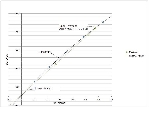
Loss (leakage) of lead from the sample will result in a discrepancy in the ages determined by each decay scheme. This effect is referred to as discordance and is demonstrated in Fig.1. If a series of zircon samples has lost different amounts of lead, the samples generate a discordant line. The upper intercept of the Concordia and the Discordia line will reflect the original age of formation, while the lower intercept will reflect the age of the event that led to open system behavior and therefore the lead loss; although there has been some disagreement regarding the meaning of the lower intercept ages.
 Fig. 1:
 Concordia Diagram for data published by Mattinson for zircon samples from Klamath Mountains in Northern California.
Ages for the Concordia increase in increments of 100 million years.
Undamaged zircon retains the lead generated by radioactive decay of uranium and thorium until very high temperatures (about 900°C), though accumulated radiation damage within zones of very high uranium can lower this temperature substantially. Zircon is very chemically inert and resistant to mechanical weathering—a mixed blessing for geochronologists, as zones or even whole crystals can survive melting of their parent rock with their original uranium-lead age intact. Zircon crystals with prolonged and complex histories can thus contain zones of dramatically different ages (usually, with the oldest and youngest zones forming the core and rim, respectively, of the crystal), and thus are said to demonstrate inherited characteristics. Unraveling such complications (which, depending on their maximum lead-retention temperature, can also exist within other minerals) generally requires in situ micro-beam analysis via, say, ion microprobe (SIMS
) or laser ICP-MS.
Radiometric dating
Radiometric dating is a technique used to date materials such as rocks, usually based on a comparison between the observed abundance of a naturally occurring radioactive isotope and its decay products, using known decay rates...
schemes, with a routine age range of about 1 million years to over 4.5 billion years, and with routine precisions in the 0.1-1 percent range. The method relies on two separate decay chain
Decay chain
In nuclear science, the decay chain refers to the radioactive decay of different discrete radioactive decay products as a chained series of transformations...
s, the uranium series from 238U to 206Pb, with a half-life of 4.47 billion years and the actinium series from 235U to 207Pb, with a half-life of 704 million years. These decay routes occur via a series of alpha (and beta) decays, in which 238U with daughter nuclides undergo eight total alpha and six beta decays whereas 235U with daughters only experience seven alpha and four beta decays.
The existence of two 'parallel' uranium-lead decay routes (238U to 206Pb and 235U to 207Pb) leads to multiple dating techniques within the overall U-Pb system. The term 'U-Pb dating' normally implies the coupled use of both decay schemes in the 'concordia diagram' (see below). However, use of a single decay scheme (usually 238U to 206Pb) leads to the U-Pb isochron dating method, analogous to the rubidium-strontium dating
Rubidium-strontium dating
The rubidium-strontium dating method is a radiometric dating technique that geologists use to determine the age of rocks.Development of this process was aided by Fritz Strassmann, who later went on to discover nuclear fission with Otto Hahn and Lise Meitner....
method. Finally, ages can also be determined from the U-Pb system by analysis of Pb isotope ratios alone. This is termed the lead-lead dating
Lead-lead dating
Lead-lead dating is a method for dating geological samples, normally based on 'whole-rock' samples of material such as granite. For most dating requirements it has been superseded by uranium-lead dating , but in certain specialized situations it is more important than U-Pb dating.-Decay equations...
method. Clair Cameron Patterson
Clair Cameron Patterson
Clair Cameron Patterson was a geochemist born in Mitchellville, Iowa, United States. He graduated from Grinnell College in Grinnell, Iowa, received his Ph.D...
, an American geochemist who pioneered studies of uranium-lead radiometric dating methods, is famous for having used it to obtain one of the earliest accurate estimates of the age of the Earth
Age of the Earth
The age of the Earth is 4.54 billion years This age is based on evidence from radiometric age dating of meteorite material and is consistent with the ages of the oldest-known terrestrial and lunar samples...
.
Mineralogy
Uranium-lead dating is usually performed on the mineral zirconZircon
Zircon is a mineral belonging to the group of nesosilicates. Its chemical name is zirconium silicate and its corresponding chemical formula is ZrSiO4. A common empirical formula showing some of the range of substitution in zircon is 1–x4x–y...
(ZrSiO4), though it can be used on other minerals such as monazite
Monazite
Monazite is a reddish-brown phosphate mineral containing rare earth metals. It occurs usually in small isolated crystals. There are actually at least four different kinds of monazite, depending on relative elemental composition of the mineral:...
, titanite
Titanite
Titanite, or sphene , is a calcium titanium nesosilicate mineral, CaTiSiO5. Trace impurities of iron and aluminium are typically present...
, and baddeleyite
Baddeleyite
Baddeleyite is a rare zirconium oxide mineral , occurring in a variety of monoclinic prismatic crystal forms. It is transparent to translucent, has high indices of refraction, and ranges from colorless to yellow, green, and dark brown. Baddeleyite is a refractory mineral, with a melting point of...
. Zircon incorporates uranium
Uranium
Uranium is a silvery-white metallic chemical element in the actinide series of the periodic table, with atomic number 92. It is assigned the chemical symbol U. A uranium atom has 92 protons and 92 electrons, of which 6 are valence electrons...
and thorium
Thorium
Thorium is a natural radioactive chemical element with the symbol Th and atomic number 90. It was discovered in 1828 and named after Thor, the Norse god of thunder....
atom
Atom
The atom is a basic unit of matter that consists of a dense central nucleus surrounded by a cloud of negatively charged electrons. The atomic nucleus contains a mix of positively charged protons and electrically neutral neutrons...
s into its crystalline structure, but strongly rejects lead
Lead
Lead is a main-group element in the carbon group with the symbol Pb and atomic number 82. Lead is a soft, malleable poor metal. It is also counted as one of the heavy metals. Metallic lead has a bluish-white color after being freshly cut, but it soon tarnishes to a dull grayish color when exposed...
. Therefore we can assume that the entire lead content of the zircon is radiogenic. Where this is not the case, a correction must be applied. Uranium-lead dating techniques have also been applied to other minerals such as calcite
Calcite
Calcite is a carbonate mineral and the most stable polymorph of calcium carbonate . The other polymorphs are the minerals aragonite and vaterite. Aragonite will change to calcite at 380-470°C, and vaterite is even less stable.-Properties:...
/aragonite
Aragonite
Aragonite is a carbonate mineral, one of the two common, naturally occurring, crystal forms of calcium carbonate, CaCO3...
and other carbonate minerals. These minerals often produce lower precision ages than igneous and metamorphic
Metamorphic rock
Metamorphic rock is the transformation of an existing rock type, the protolith, in a process called metamorphism, which means "change in form". The protolith is subjected to heat and pressure causing profound physical and/or chemical change...
minerals traditionally used for age dating, but are more common in the geologic record.
Interaction between mineralogy and radioactive breakdown
During the alpha decayAlpha decay
Alpha decay is a type of radioactive decay in which an atomic nucleus emits an alpha particle and thereby transforms into an atom with a mass number 4 less and atomic number 2 less...
steps, the zircon crystal experiences radiation damage, associated with each alpha decay. This damage is most concentrated around the parent isotope (U and Th), expelling the daughter isotope (Pb) from its original position in the zircon lattice. In areas with a high concentration of the parent isotope, damage to the crystal lattice is quite extensive, and will often interconnect to form a network of radiation damaged areas. Fission tracks and micro-cracks within the crystal will further extend this radiation damage network. These inevitably act as conduits deep within the crystal, thereby providing a method of transport to facilitate the leaching of Pb isotopes from the zircon crystal.
Details of the process
Under conditions where the system has remained closed, and therefore no lead loss has occurred, the age of the zircon can be calculated independently from the two equations:and
These are said to yield concordant ages. It is these concordant ages, plotted over a series of time intervals, that result in the concordant line.
Loss (leakage) of lead from the sample will result in a discrepancy in the ages determined by each decay scheme. This effect is referred to as discordance and is demonstrated in Fig.1. If a series of zircon samples has lost different amounts of lead, the samples generate a discordant line. The upper intercept of the Concordia and the Discordia line will reflect the original age of formation, while the lower intercept will reflect the age of the event that led to open system behavior and therefore the lead loss; although there has been some disagreement regarding the meaning of the lower intercept ages.
Ages for the Concordia increase in increments of 100 million years.
Undamaged zircon retains the lead generated by radioactive decay of uranium and thorium until very high temperatures (about 900°C), though accumulated radiation damage within zones of very high uranium can lower this temperature substantially. Zircon is very chemically inert and resistant to mechanical weathering—a mixed blessing for geochronologists, as zones or even whole crystals can survive melting of their parent rock with their original uranium-lead age intact. Zircon crystals with prolonged and complex histories can thus contain zones of dramatically different ages (usually, with the oldest and youngest zones forming the core and rim, respectively, of the crystal), and thus are said to demonstrate inherited characteristics. Unraveling such complications (which, depending on their maximum lead-retention temperature, can also exist within other minerals) generally requires in situ micro-beam analysis via, say, ion microprobe (SIMS
Secondary ion mass spectrometry
Secondary ion mass spectrometry is a technique used in materials science and surface science to analyze the composition of solid surfaces and thin films by sputtering the surface of the specimen with a focused primary ion beam and collecting and analyzing ejected secondary ions...
) or laser ICP-MS.