
Home      Discussion      Topics      Dictionary      Almanac
Signup       Login
Upanayanam

Upanayanam

Overview
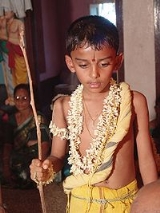
Upanayana (lit. "near sight", pronounced upanayana in some languages), also called "sacred thread ceremony", is commonly known for being a Hindu
Hindu
A Hindu is an adherent of Hinduism, a set of religious, philosophical and cultural systems that originated in the Indian subcontinent. The vast body of Hindu scriptures, divided into Śruti and Smriti , lay the foundation of Hindu beliefs which primarily include dhárma, kárma, ahimsa and saṃsāra...

 Sanskara
Sanskara
In Hinduism sanskaras are the imprints left on the subconscious mind by experience in this or previous lives, which then color all of life, one's nature, responses, states of mind, etc.-Overview:Sanskaras are impressions derived from past experiences that form desires that influence...

, rite-of-passage ritual, where the concept of Brahman
Brahman
In the Hindu religion, Brahman is the unchanging, infinite, immanent, and transcendent reality which is the Divine Ground of all matter, energy, time, space, being, and everything beyond in this Universe. The nature of Brahman is described as transpersonal, personal and impersonal by different...

 is introduced to a young boy. Traditionally, the ceremony was performed to mark the point at which boys began their formal education.

In Hinduism
Hinduism
Hinduism is the predominant religion of the Indian subcontinent. Hinduism is often referred to as ', a Sanskrit phrase meaning "the eternal law", by its adherents. Generic "types" of Hinduism that attempt to accommodate a variety of complex views span folk and Vedic Hinduism to bhakti tradition, as...

, the ceremony is performed on boys of at least 7 years of age from the Brahmin
Brahmin
Brahmins have historically been the class of educators, scholars and preachers in Hinduism. They are considered as belonging to the "forward castes" of the four varnas of Hinduism....

 varna
Varnas
Varnas is the masculine form of a Lithuanian family name. Its feminine forms are: Varnienė and Varnytė .The surname may refer to:*Adomas Varnas , Lithuanian artist...

, of at least 13 years from the Kshatriya
Kshatriya
Kshatriya is one of the four varnas in Hinduism. It constitutes the military and ruling order of the traditional Vedic-Hindu social system as outlined by the Vedas and the Laws of Manu...

 varna
Varnas
Varnas is the masculine form of a Lithuanian family name. Its feminine forms are: Varnienė and Varnytė .The surname may refer to:*Adomas Varnas , Lithuanian artist...

, and of at least 17 years from the Vaishya
Vaishya
Vaishya, also known as Vaisya, Vanika or Vysyas, is one of the four varnas of Hinduism. According to Vedic tradition, this order primarily comprises merchants, cattle-herders and artisans...

 varna
Varnas
Varnas is the masculine form of a Lithuanian family name. Its feminine forms are: Varnienė and Varnytė .The surname may refer to:*Adomas Varnas , Lithuanian artist...

.
Discussion
Ask a question about 'Upanayanam'
Start a new discussion about 'Upanayanam'
Answer questions from other users
Full Discussion Forum
 
Encyclopedia
Upanayana (lit. "near sight", pronounced upanayana in some languages), also called "sacred thread ceremony", is commonly known for being a Hindu
Hindu
A Hindu is an adherent of Hinduism, a set of religious, philosophical and cultural systems that originated in the Indian subcontinent. The vast body of Hindu scriptures, divided into Śruti and Smriti , lay the foundation of Hindu beliefs which primarily include dhárma, kárma, ahimsa and saṃsāra...

 Sanskara
Sanskara
In Hinduism sanskaras are the imprints left on the subconscious mind by experience in this or previous lives, which then color all of life, one's nature, responses, states of mind, etc.-Overview:Sanskaras are impressions derived from past experiences that form desires that influence...

, rite-of-passage ritual, where the concept of Brahman
Brahman
In the Hindu religion, Brahman is the unchanging, infinite, immanent, and transcendent reality which is the Divine Ground of all matter, energy, time, space, being, and everything beyond in this Universe. The nature of Brahman is described as transpersonal, personal and impersonal by different...

 is introduced to a young boy. Traditionally, the ceremony was performed to mark the point at which boys began their formal education.

In Hinduism
Hinduism
Hinduism is the predominant religion of the Indian subcontinent. Hinduism is often referred to as ', a Sanskrit phrase meaning "the eternal law", by its adherents. Generic "types" of Hinduism that attempt to accommodate a variety of complex views span folk and Vedic Hinduism to bhakti tradition, as...

, the ceremony is performed on boys of at least 7 years of age from the Brahmin
Brahmin
Brahmins have historically been the class of educators, scholars and preachers in Hinduism. They are considered as belonging to the "forward castes" of the four varnas of Hinduism....

 varna
Varnas
Varnas is the masculine form of a Lithuanian family name. Its feminine forms are: Varnienė and Varnytė .The surname may refer to:*Adomas Varnas , Lithuanian artist...

, of at least 13 years from the Kshatriya
Kshatriya
Kshatriya is one of the four varnas in Hinduism. It constitutes the military and ruling order of the traditional Vedic-Hindu social system as outlined by the Vedas and the Laws of Manu...

 varna
Varnas
Varnas is the masculine form of a Lithuanian family name. Its feminine forms are: Varnienė and Varnytė .The surname may refer to:*Adomas Varnas , Lithuanian artist...

, and of at least 17 years from the Vaishya
Vaishya
Vaishya, also known as Vaisya, Vanika or Vysyas, is one of the four varnas of Hinduism. According to Vedic tradition, this order primarily comprises merchants, cattle-herders and artisans...

 varna
Varnas
Varnas is the masculine form of a Lithuanian family name. Its feminine forms are: Varnienė and Varnytė .The surname may refer to:*Adomas Varnas , Lithuanian artist...

. The youngster is taught during the ceremony the secret of life through Brahmopadesam (revealing the nature of Brahman
Brahman
In the Hindu religion, Brahman is the unchanging, infinite, immanent, and transcendent reality which is the Divine Ground of all matter, energy, time, space, being, and everything beyond in this Universe. The nature of Brahman is described as transpersonal, personal and impersonal by different...

, the Ultimate Reality) or the Gayatri mantra
Gayatri Mantra
The Gayatri Mantra is a highly revered Sanskrit mantra with origins in the Vedas. It is a verse in the vedic Gayatri metre , consting of 24 syllables, taken from a hymn of the Rigveda . Its recitation is always preceded by and the formula , known as the ...

. The child then becomes qualified for life as a student or Brahmachari, as prescribed in the Manusmriti.

According to an appendix of the Manusmriti, girls were allowed to study the Vedas in the previous kalpa
Kalpa (time unit)
A kalpa is a Sanskrit word meaning an aeon, or a long period of time in Hindu and Buddhist cosmology.There is a mention of the word "kalpa" in the earliest Hindu religious texts. It also occurs in Buddhist texts. The Guinness Book of World Records lists the 4.32 billion year Kalpa as the longest...

 (Creation). Orthodox Hindus, however, do not accept this reference, because no Hindu canonical text allows this ceremony for a girl in the present kalpa. Some sects, esp. Arya Samaj
Arya Samaj
Arya Samaj is a Hindu reform movement founded in India by Swami Dayananda in 1875. He was a sannyasi who believed in the infallible authority of the Vedas. Dayananda advocated the doctrine of karma and reincarnation, and emphasized the ideals of brahmacharya and sanyasa...

, perform this ceremony for girls also on the basis of this statement.

In Buddhism
Buddhism
Buddhism, as traditionally conceived, is a path of salvation attained through insight into the ultimate nature of reality. It encompasses a variety of traditions, beliefs and practices, largely based on teachings attributed to Siddhartha Gautama, commonly known as the Buddha...

, which in its inception rebelled from any superficial show of ritualistic practices, relied on finding the true meaning of "upanayana" through meditative practices as outlined by Buddha
Gautama Buddha
Siddhārtha Gautama was a spiritual teacher in the north eastern region of the Indian subcontinent who founded Buddhism. He is regarded by Buddhists as the Supreme Buddha of our age. The time of his birth and death are uncertain: most early 20th-century historians dated his lifetime as c...

. In Buddhism, the upanayanam is associated with the Triple Gem
Three Jewels
The Three Jewels, also called the Three Treasures, the Three Refuges, or the Triple Gem, are the three things that Buddhists take refuge in, and look toward for guidance, in the process known as taking refuge.The Three Jewels are:...

 refuge and constant meditative and moral practices as outlined in the Eightfold Path
Noble Eightfold Path
The Noble Eightfold Path is one of the principal teachings of the Buddha, who described it as the way leading to the cessation of suffering and the achievement of self-awakening. It is used to develop insight into the true nature of phenomena and to eradicate greed, hatred, and delusion...

. In Buddhism, this practice is universal and open to all regardless of age, caste lineage, race or sex.

Yajñopavītam - the "Sacred Thread"


Brahmin
Brahmin
Brahmins have historically been the class of educators, scholars and preachers in Hinduism. They are considered as belonging to the "forward castes" of the four varnas of Hinduism....

s, Kshatriyas and Vaishyas  are called dvijas meaning twice born. A man of these castes is born once in the womb of his mother and again during the Upanayana when he learns the Gayatri Mantra
Gayatri Mantra
The Gayatri Mantra is a highly revered Sanskrit mantra with origins in the Vedas. It is a verse in the vedic Gayatri metre , consting of 24 syllables, taken from a hymn of the Rigveda . Its recitation is always preceded by and the formula , known as the ...

.
The hallmark of having gone through the Upanayana ceremony is the wearing of the Yajñopavītam (Sacred Thread) on the body. The thread is circular, being tied end-to-end (only one knot is permissible); it is normally supported on the left shoulder(savya) and wrapped around the body, falling underneath the right arm. The length of the thread is generally 96 times the breadth of four fingers of a man, which is believed to be equal to his height. Each of the four fingers represents one of the four states that the soul of a man experiences: waking, dreaming, dreamless sleep and knowledge of the absolute.

Yajñopavītam has three threads (actually only one thread, folded three times and tied together) each consisting of three strands. These threads represent
  • Goddess Gayatri
    Gayatri
    Gayatri is the feminine form of , a Sanskrit word for a song or a hymn.Originally the personification of the Gayatri mantra, revered by both Buddhists and Hindus worldwide, the goddess Gāyatrī is considered the veda mata, the mother of all Vedas and also the personification of the all-pervading...

     (Goddess of mind),
  • Goddess Saraswati
    Saraswati
    and often peacockIn the Vedic system Saraswati is the goddess of knowledge, music and the arts. Saraswatī has been identified with the Vedic Saraswati River. She is considered as consort of Brahma...

     (Goddess of word) and
  • Goddess Sāvitrī
    Savitr
    In Vedic religion, Savitr , Savitā is a solar deity and one of the Adityas. His name is in Vedic Sanskrit meanings "impeller, rouser, vivifier"....

     (Goddess of deed).


It denotes that one who wear the sacred thread should be pure in his thought, word and deed. The sacred thread reminds a Brahmachari to lead a regulated life with purity in his thought, word and deed. These threads also represent the debt that is owed to the guru, parents and society.

The knot in the middle represent the formless Brahman
Brahman
In the Hindu religion, Brahman is the unchanging, infinite, immanent, and transcendent reality which is the Divine Ground of all matter, energy, time, space, being, and everything beyond in this Universe. The nature of Brahman is described as transpersonal, personal and impersonal by different...

, the pure form of energy which pervades all. The three threads again represent the manifestation of Brahman as Srishti, Sthithi and Vinasa. The sacred thread illustrates the fact that everything in the universe emerge from and then merge with Brahman
Brahman
In the Hindu religion, Brahman is the unchanging, infinite, immanent, and transcendent reality which is the Divine Ground of all matter, energy, time, space, being, and everything beyond in this Universe. The nature of Brahman is described as transpersonal, personal and impersonal by different...

.

Ancient texts refer to the wearing of the Yajñopavītam in three forms:
  • One is Upavītam, where the Yajñopavītam is worn over the left shoulder and under the right arm. This is for Gods. Upavītam is also called savya (Katyayana Shrauta Sutra &c.).

  • The Second is Nivītam, where the Yajñopavītam is worn around the neck and over the chest. Nivīta form is to be used during Rishi Tharpana, sexual intercourse, answering the calls of nature etc. (-Shadvimsha Brahmana, Latyayana, etc.).

  • The third, Prachīnavītam is where the Yajñopavītam is worn above the right shoulder and under the left arm. This is for Spirits and is used by men when performing the death ceremonies of an elder. Prachīnavītam is also called apsavya (Katyayana Shrauta Sutra, Manusmriti, &c.).


In some communities, later, at the occasion of wedding, a further three threads are added to make for a 6-thread bunch. In some communities, the custom exists of one thread more being added at the birth of every child. In some interpretations, these threads are intended to constantly remind the man of his worldly responsibilities
Dharma
The term , is an Indian spiritual and religious term, that means one's righteous duty or any virtuous path in the common sense of the term. A Hindu's Dharma is affected by a person's age, class, occupation, and sex. In Indian languages it can be equivalent simply to "religion", depending on context...

. 3 original threads (each consisting of 3) make up 9 threads, to which 3 are added for wife and 1 for children, making a total of 13 individual threads in some communities.

Ancient Hindu texts specify an age for the Upanayana ceremony based on the caste (7 for Brahmins, 11 for Kshathriyas etc.) Upanayanam marks the start of learning of "Brahman" and Vedic texts. The age for Upanayanam supports this as Brahmins devote their life in pursuing the knowledge of "Brahman" and hence makes sense to start early and continue for a longer time. Kshathriyas on the other hand study additional skills and only go through "Brahman 101". In the communities where three threads are added at the time of wedding, there is another interpretation.

Once a student achieves a certain level of Brahma knowledge ("Brahma Vidya"), the guru adds 3 more strings signifying "Graduation" and the student goes on to study. In South Indian wedding ceremony, the addition of the 3 more string is followed by "Kashi Yatra
Yatra
' , in Hinduism and other Indian religions, generally means pilgrimage to holy places such as confluences of sacred rivers, places associated with Hindu epics such as the Mahabharata and Ramayana, and other sacred pilgrimage sites. Tīrtha-yātrā refers to a pilgrimage to a holy site, and is...

". This signifies the Yatra student intends for advanced study. At this point, the father of the bride, convinces the youth to get married and then go to Kashi (Varanasi
Varanasi
Varanasi , also commonly known as Benares or Banaras and Kashi , is a city situated on the left bank of the River Ganga in the Indian state of Uttar Pradesh, regarded as holy by Hindus, Buddhists, and Jains...

) with his new bride. In modern days, the entire ceremony is packaged within the wedding ceremony.

The sacred thread is supposed to be worn for the rest of one's life after the ceremony has been performed. A new thread is worn and the old thread discarded every year; the change-over ceremony is held on a specific date calculated as per the Hindu lunar calendar. Among Brahmin
Brahmin
Brahmins have historically been the class of educators, scholars and preachers in Hinduism. They are considered as belonging to the "forward castes" of the four varnas of Hinduism....

s, this date varies depending on which of four Vedic Shakhas one belongs to.

The sacred thread has close and essential connection with the concept of pravaras
Pravaras
Literally, Pravara means the most excellent . Pravara is the number of the most excellent rishis who belonged to that particular gotra to which the wearer of sacred thread belongs. Gotra is the name of the founding father...

 related to brahmin gotra system
Brahmin gotra system
The word "gotra" means "lineage" in the Sanskrit language. Among those of the Brahmin caste, gotras are reckoned patrilineally. Each gotra takes the name of a famous Rishi or sage who was the patrilineal forebearer of that clan...

, which reflects the number of most excellent Vedic
Brahmin gotra system
The word "gotra" means "lineage" in the Sanskrit language. Among those of the Brahmin caste, gotras are reckoned patrilineally. Each gotra takes the name of a famous Rishi or sage who was the patrilineal forebearer of that clan...

 rishi
Rishi
A rishi denotes a poet-sage through whom the Vedic hymns flowed, credited also as divine scribes. According to post-Vedic tradition the rishi is a "seer" or "shaman" to whom the Vedas were "originally revealed" through states of higher consciousness...

s belonging to that particular gotra
Gotra
A Gotra is the lineage or clan assigned to a Hindu at birth. In most cases, the system is patrilineal and the gotra assigned is that of the person's father. Other names used to refer to it are Vansh, Vanshaj, Bedagu, Purvik, Purvajan, Pitru...

 to which the wearer of sacred thread belongs. Generally, there are either three or five pravaras. While tying the knots of sacred thread, an oath is taken in the name of these excellent sages. The full affiliation of a Vedic brāhamana consists of (1) gotra
Gotra
A Gotra is the lineage or clan assigned to a Hindu at birth. In most cases, the system is patrilineal and the gotra assigned is that of the person's father. Other names used to refer to it are Vansh, Vanshaj, Bedagu, Purvik, Purvajan, Pitru...

, (2)sutra
Sutra
Sūtra , literally means a thread or line that holds things together, and more metaphorically refers to an aphorism , or a collection of such aphorisms in the form of a manual...

 (of Kalpa
Kalpa
Kalpa is a small town located in the Sutlej River Valley, above Recong Peo in the Kinnaur district of Himachal Pradesh, Northern India, in the Indian Himalaya. Inhabited by Kinnauri people and famous for its apple orchards. Apples are a major cash-crop for the region...

), (3) shakha
Shakha
A shakha , is a Hindu theological school that specializes in learning certain Vedic texts, or else the traditional texts followed by such a school. An individual follower of a particular school or recension is called a ...

, (4) pravaras
Pravaras
Literally, Pravara means the most excellent . Pravara is the number of the most excellent rishis who belonged to that particular gotra to which the wearer of sacred thread belongs. Gotra is the name of the founding father...

. (Example :) A brahmana named 'X' introduces himself as follows: I am 'X', of Shrivatsa gotra, of Āpastamba sutra, of Taittiriya shākha of Yajurveda, of five pravaras named Bhārgava, Chyāvana, Āpnavan, Aurva and Jāmdagnya (This example is based upon the example given by Pattābhirām Shastri in the introduction to Vedārtha-Pārijata, cf. ref.)

Regional variations


The ceremony is called Munja or Mounji-Bandhana (lit. Tieing of munja)in the state of Maharashtra
Maharashtra
Maharashtra is a state located on the western coast of India. Maharashtra is a part of Western India. It is India's third largest state by area and second largest by population....

. This name for the ceremony finds its origin in the name of a grass variety called Saccharum munja (English -
Bengal Cane http://www.plantnames.unimelb.edu.au/Sorting/Saccharum.html#bengalense). This grass is used to make a girdle which is then tied around the waist of the child.http://www.hindunet.com/forum/showflat.php?Cat=&Number=9946&Main=9946 In Gujarat, the sacred thread is known as the "janoy."

Upanayana has one more meaning, derived from Sanskrit words: Upa na (over/above)+yan am (it is), making for the meaning "that which is above (the shoulder)".
# Language Name of the ceremony Word for "Sacred Thread"
1 Sanskrit
Sanskrit
Sanskrit is a historical Indo-Aryan language, one of the liturgical languages of Hinduism and Buddhism, and one of the 22 official languages of India. It is also declared as a classical language by the government of India....

 
Upanayanam
उपनयनम्
Yajñopavītam 
यज्ञोपवीतम्
2 Malayalam  Upanayanam
ഉപനയനം
Poonool (IAST
IAST
The International Alphabet of Sanskrit Transliteration is a popular transliteration scheme that allows a lossless romanization of Indic scripts.-Popularity:IAST is the most popular transliteration scheme for romanization of Sanskrit and Pali...

: Pūnūl)
പൂണൂല്‍
3 Tamil
Tamil language
Tamil is a Dravidian language spoken predominantly by Tamil people of the Indian subcontinent. It has official status in India, Sri Lanka and Singapore. Tamil is also spoken by significant minorities in Malaysia, Mauritius and Réunion as well as emigrant communities around the world...

 
Poonal
பூணல்
Poonal (IAST
IAST
The International Alphabet of Sanskrit Transliteration is a popular transliteration scheme that allows a lossless romanization of Indic scripts.-Popularity:IAST is the most popular transliteration scheme for romanization of Sanskrit and Pali...

: Pūnūl)
பூணல்
4 Telugu
Telugu language
Telugu is a Dravidian language native to the Indian subcontinent. It is the official language of Andhra Pradesh, one of the largest states of India. It is also one of the twenty-two scheduled languages of the Republic of India and was conferred the status of a Classical language by the Government...

 
Odugu,Upanayanamu
Jandhyamu
5 Kannada  Munji
Janivaara
6 Hindi
Hindi
Standard Hindi, also known as High Hindi, Nagari Hindi or Literary Hindi is a standardised register of Hindi. It is one of the 22 languages with official status in India, and is used, along with English, for administration of the central government.Standard Hindi is a sanskritised register derived...

 
Janeu
जनेऊ
Janeu
जनेऊ
7 Marathi  Munja
मुंज
Jaanave
जानवे
8 Konkani
Konkani language
Konkani is an Indo-Aryan language belonging to the Indo-European family of languages spoken in the Konkan coast of India...

 
Munj,Munji
मुंज,ಮುಂಜಿ
Janve,Jannuvey
जानवें,ಜಾನುವೆ
9 Bengali
Bengali language
Bengali or Bangla is an Indo-Aryan language of the eastern Indian subcontinent, evolved from the Magadhi Prakrit and Sanskrit languages....

 
Uponayon
উপনয়ন
Poité
পৈতে
10 Oriya
Oriya language
Odia or Oriya is an Indian language, belonging to the Indo-Aryan branch of the Indo-European language family. It is mainly spoken in the Indian state of Orissa. The language is also one of the many official languages of India.- Overview :...

Brata Ghara
ବ୍ରତଘର
Poita
ପଇତା
11 Nepali
Nepali language
Nepali is a language in the Indo-Aryan branch of the Indo-European language family.It is official language and de facto lingua franca of Nepal and is also spoken in Bhutan, parts of India and parts of Myanmar...

 
Bratabandha
ब्रतबंध
Janai
जनई
12 Kashmiri
Kashmiri language
Kashmiri is a language from the Dardic sub-group of the Indo-Aryan group of languages and it is spoken primarily in the Kashmir Valley, in the Indian Administered part of Jammu and Kashmir. There are approximately 5,554,496 speakers in India, according to the Census of 2001...

 
Mekhal
معخل,मेखल
Yonya
يoنيآ,योनया
13 Assamese
Assamese language
Assamese is the easternmost Indo-Aryan language. It is used mainly in the state of Assam in North-East India. It is also the official language of Assam. It is also spoken in parts of Arunachal Pradesh and other northeast Indian states. Small pockets of Assamese speakers can be found in Bhutan...

 
Lagundeoni
লগুনদেওনি
Lagun
লগুন
14 Tulu
Tülu
A Tülu Camel is a breed of camel that results from mating a male Bactrian camel with a female Dromedary. This breed is sometimes called an F1 Hybrid Camel. The resulting camel is larger than either a Bactrian or a Dromedary, and has traditionally been used as a draft animal. This breed of camel...

 
Upanayana
ಉಪನಯನ
Janivaara
ಜನಿವಾರ
15 Gujarati
Gujarati language
Gujarati is an Indo-Aryan language, and part of the greater Indo-European language family...

 
Yagnopavit
યજ્ઞોપવિત
Janoi
જનોઈ
16 Pahari
Pahari
Pahari is a general terms for a range of dialects spoken across the Himalayan range, not limited to a single country in the subcontinent. The word is derived from 'pahar' meaning mountain...

 
Janeyu
जनेयु
Janeyu
जनेयु
17 Sindhi
Sindhi language
Sindhi is the language of the Sindh region of Pakistan. It is spoken by 24,410,910 people in Pakistan, and is also spoken in India by 2,535,485 speakers. It is the third most spoken language of Pakistan, and the official language of Sindh in Pakistan. It is also an official language of India...

 
Janya
जानया
Janya
जानया

Modern Gurukulas


Upa+nayana also means taking somebody near(upain)knowledge.In ancient times, after the ceremony was performed, the child was sent to the Guru's house (Gurukul) for education, where the child remained until completion of education. Even today, there are many Vedic Gurukulas (traditional Vedic schools) which follow this practice with and without government help, without taking any fees from students (who must be brahmacharis).

Buddhism and Upanayanam


In Buddhism
Buddhism
Buddhism, as traditionally conceived, is a path of salvation attained through insight into the ultimate nature of reality. It encompasses a variety of traditions, beliefs and practices, largely based on teachings attributed to Siddhartha Gautama, commonly known as the Buddha...

, the Upanayanam is referred to by the Pali
Páli
- External links :* *...

 term, "opanayiko" which is one of the six characteristics of the Dharma
Dharma (Buddhism)
Dhamma or Dharma in Buddhism has two primary meanings:* the teachings of the Buddha which lead to enlightenment * the constituent factors of the experienced world...

. It is related to refuge in the Triple Gem and practicing the Eightfold Path which leads one through to the Four stages of enlightenment
Four stages of enlightenment
The four stages of enlightenment in Buddhism are the four degrees of approach to full enlightenment as an Arahant which a person can attain in this life...

. In the Visuddhimagga
Visuddhimagga
The Visuddhimagga is a Theravada Buddhist commentary written by Buddhaghosa approximately in 430 CE in Sri Lanka. It is considered the most important Theravada text outside of the Tipitaka canon of scriptures...

 it is called "opanayiko" or "upanayanam" as the practice leads "onwards to Nirvana
Nirvana
In sramanic thought, Nirvana is the state of being free from suffering. It is an important concept in Buddhism and Jainism....

": nibanam upaneti ti ariya maggo upaneyo...opanayiko,"It leads on to nibanna, thus the Eightfold Path is onward leading...so it is leading onwards."

In Buddhism, a person of any age, sex or caste can obtain the Upanayanam through refuge in the Triple Gem and practicing the Eightfold Path.

See also

  • Samavartanam
    Samavartanam
    The ', also known as , is a Hindu sacramental ritual that was performed at the close of the Brahmacharya period and marked the end termination of the student life....

  • Upakarma
    Upakarma
    Upakarma is one of the ancient Vedic rituals practiced to date. The event is conducted once a year, around August - September and most practicing Brahmins follow it...

  • Varnas
    Varnas
    Varnas is the masculine form of a Lithuanian family name. Its feminine forms are: Varnienė and Varnytė .The surname may refer to:*Adomas Varnas , Lithuanian artist...

  • Brahmin
    Brahmin
    Brahmins have historically been the class of educators, scholars and preachers in Hinduism. They are considered as belonging to the "forward castes" of the four varnas of Hinduism....

  • Brahmin gotra system
    Brahmin gotra system
    The word "gotra" means "lineage" in the Sanskrit language. Among those of the Brahmin caste, gotras are reckoned patrilineally. Each gotra takes the name of a famous Rishi or sage who was the patrilineal forebearer of that clan...

  • Pravaras
    Pravaras
    Literally, Pravara means the most excellent . Pravara is the number of the most excellent rishis who belonged to that particular gotra to which the wearer of sacred thread belongs. Gotra is the name of the founding father...

  • Rishi
    Rishi
    A rishi denotes a poet-sage through whom the Vedic hymns flowed, credited also as divine scribes. According to post-Vedic tradition the rishi is a "seer" or "shaman" to whom the Vedas were "originally revealed" through states of higher consciousness...

  • Shivalli Brahmins
    Shivalli Brahmins
    The brahmins who follow Dvaita philosophy founded by Vaishnava saint Sri Madhvacharya of Udupi are known as Shivalli Madhwa Brahmins. Not all follow Madhwa's philosophy. Some Shivalli Brahmins follow Advaita philosophy of Adi Sankaracharya and are known as Shivalli Smartha Brahmins...

  • Navjote
    Navjote
    The Navjote or Sedreh pushi ceremony is the Zoroastrian ritual in which an individual is inducted into the religion. The term navjote is used primarily by the Zoroastrians of India , while sedreh pushi is used primarily by the Zoroastrians of Iran.The word 'navjote' is a Latinized form of the Parsi...

     -- Zoroastrian
    Zoroastrian
    A Zoroastrian is an adherent to Zoroastrianism, the first monotheistic religion that is based on the teachings and philosophies of Zoroaster....

     initiation ceremony.
  • Bar and Bat Mitzvah -- Initiation ceremonies for men/women in Judaism
    Judaism
    Judaism is a set of beliefs and practices originating in the Hebrew Bible , as later further explored and explained in the Talmud and other texts...


External links