
|
|
|
|
University of Sunderland
|
| |
|
| |
The University of Sunderland is located in Sunderland, North East England. The University has more than 10,000 students, including 7,000-plus international students from some 70 countries.
The University was named the 'Best English University for student experience' by the Times Higher Education Supplement in December 2005.
The University is also one of the 31 United Kingdom Universities providing the New Route PhD as an alternative to the traditional Ph.D., although Sunderland also provides the latter.
University’s roots can be traced back to 1901, when Sunderland Technical College was established as a municipal training college on Green Terrace (the site of the current Priestman Building).

Discussion
Ask a question about 'University of Sunderland'
Start a new discussion about 'University of Sunderland'
Answer questions from other users
|
Recent Posts

Encyclopedia
The University of Sunderland is located in Sunderland, North East England. The University has more than 10,000 students, including 7,000-plus international students from some 70 countries.
The University was named the 'Best English University for student experience' by the Times Higher Education Supplement in December 2005.
The University is also one of the 31 United Kingdom Universities providing the New Route PhD as an alternative to the traditional Ph.D., although Sunderland also provides the latter.
History
The University’s roots can be traced back to 1901, when Sunderland Technical College was established as a municipal training college on Green Terrace (the site of the current Priestman Building). It was the first to offer sandwich courses. Naval architecture and pharmacy were introduced between the two World Wars.
In the late 1950s, the college was the first educational centre in the region to install a digital computer. In the 1960s a PDP-8 hybrid computer was installed at the Chester Road site.
A new complex of buildings, including Students Union and Hall of Residence facilities, on nearby Chester Road was opened by the Duke of Edinburgh in 1964.
Sunderland Polytechnic was established on 1 January 1969, incorporating the Technical College, the School of Art (which was also established in 1901) and the Sunderland Teacher Training College (established in 1908). In 1992 the Polytechnic gained University status.
The University was recognised by The Guardian as England's best new university in 2001, and in 2005 was named by The Times Higher Education Supplement as the top university in England for providing the best student experience.
Lord Puttnam became the university's first Chancellor in 1998. The Sunderland Empire Theatre was the regular venue for the graduation ceremonies, although they have been hosted at the Stadium of Light since 2004. In July 2007, he stepped down as Chancellor to become the Chancellor of the Open University. On 23 May 2008 the University announced that former Olympic athlete Steve Cram had been appointed as Chancellor and would be officially installed at a ceremony on 27 June 2008.
Current
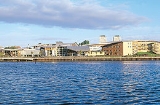
There are currently two main campuses, City Campus and the Sir Tom Cowie Campus at St Peter's, with other buildings in Ashbrooke. St Peter's opened during the 1990s on the northbank of the River Wear, the site of St. Peter's Church and monastery built by Benedict Biscop in 674AD. In September 2002 the campus was renamed "The Sir Tom Cowie Campus at St. Peter's" after the local businessman who was one of the University's primary supporters. The Sunderland Business School is similarly named "The Reg Vardy Centre", and another building, primarily used by the School of Computing and Technology, is "The David Goldman Informatics Centre".
"The Media Centre", housing television and radio production facilities for the School of Arts, Design Media and Culture, along with a small local base for Tyne Tees Television, opened in 2003 at St. Peter's. It was officially opened in March 2004 by Estelle Morris. Morris has been the pro vice-chancellor since June 2005.
The City Campus complex is still used, with buildings constantly being redeveloped. The Edinburgh Building was extensively redeveloped in 2004, and given a modern frontage. A lift was installed in Forster Building in 2003 when it started to house the School of Education and Lifelong Learning. Wearmouth Hall, built as a student residence, catering hall and lecture theatre closed at the end of the 2006/2007 academic year and will be demolished bringing to end one of the City's most distinctive tall buildings.
In June 2007, the first part of a three-stage refurbishment began in The Murray Library on the City Campus.
In May 2008, plans to invest £75million in the vision to dramatically change the face of the University of Sunderland’s City Campus was unveiled, including a new £11million sports and recreation facility, CitySpace. CitySpace has also been named as an official Paralympic training base for the London 2012 Olympics.
Faculties
The University has four academic faculties, responsible for teaching and learning, academic development and research, and working with partners in business and industry. The University also has a Graduate Research School which provides a focus and catalyst for research, especially in cross-School developments and activities, for research students and as a vehicle for enhancing the level of intellectual debate within the University.
The Faculties are supported by a number of service departments responsible for a wide range of activity such as student welfare and accommodation for example, right through to teams responsible for managing the University estate, financial matters, and human resources.
- Arts, Design, Media : Creative and Performing Arts, Design, Humanities, Combined Subjects, Journalism
- Business & Law : Accounting, Business and Management, Combined Subjects, Law and Tourism
- Education and Society : Education and Combined Subjects, Culture and Scociety
- Applied Science : Computing, Engineering , Psychology, Environment, Pharmacy, Health and Sport and Exercise Sciences
Halls of residence
The University of Sunderland has six halls of residence; Scotia Quay, Panns Bank, Clanny House, The Precinct, The Forge and All Saints
Scotia Quay and Panns Bank student halls of residence are based across the River Wear from St. Peter's Campus, across the road from The Bonded Warehouse. The location of these halls used to be one of the many locations on the river that were used by the old ship building industry.
The Precinct is located on Chester Road and is a five minutes walk from the City Campus campus.
Clanny House is located on Hylton Road across the road from the Sunderland Royal Hospital.
The Forge is near Clanny House and was closed in 2006 but has re-opened for the 2008/9 year due to high housing demand.
Students Union
At the end of the 2007 term, the University of Sunderland Students' Union had 3 large bars, the Bonded Warehouse, Manor Quay and Wearmouth Bar. However, in July 2007 Wearmouth Bar was closed pending the demolition of Wearmouth Hall, and Manor Quay has also been vacated.
The student magazine is called DN (Degrees North) magazine and it's student union run radio station is called Utopia FM.
For the start of the 2008 term, Manor Quay was re-opened under the name Campus in the style of an American Frat house.
Getting around
The University's City Campus and St. Peter's Campus are both served by Tyne and Wear Metro stations. The stations are called University and St. Peter's respectively. The University of Sunderland Students' Union also provide a free Campus Bus service throughout the day and evenings, with an extended service operating on event nights, and reduced service during the University vacation.
Utopia FM
Utopia FM is a student radio station broadcasting on the internet and, at times, on 87.7FM. It has been broadcasting under the Utopia name since November 1997 on twice-yearly short term licences, known as RSLs. The station has now been awarded a full Community Radio licence from Ofcom and is expected to start broadcasting full time early in 2009.
Its origins can be traced back to Wear FM, a community-oriented service for Sunderland which launched in 1990. It broadcasts from studios in the new Media Centre at the St. Peter's Campus, although transmission facilities are still located the other side of the river in the Forster Building on Chester Road (home to the University's media department until summer 2003). Over the station's lifetime, it has secured many nominations in the annual Student Radio Awards, winning a gold and a silver in 2004, and three bronze awards in 2005.
Subsidiaries
The University has formed a number of commerial enterprises over the years. It's wholly owned subsidiaries include:
- Integra Environmental Ltd., was originally established as an environmental consultancy in 1993. It now provides health and safety training & consultancy services.
- University of Sunderland Enterprises Ltd.
- University of Sunderland Services Ltd.
See also
- Category:Alumni of the University of Sunderland
- Category:Academics of the University of Sunderland
External links
|
| |
|
|