

University of Oxford Botanic Garden

Encyclopedia
The University of Oxford Botanic Garden is an historic botanic garden
in Oxford
, England
. It is the oldest botanic garden in Great Britain
and one of the oldest scientific gardens in the world. The garden was founded in 1621 as a physic garden growing plant
s for medicinal research. Today it contains over 8,000 different plant species
on 1.8 hectare
s (4½ acre
s). It is one of the most diverse yet compact collections
of plants in the world and includes representatives from over 90% of the higher plant families.
contributed £5,000 (equivalent to £744,000 in 2005) to set up a physic garden for "the glorification of the works of God and for the furtherance of learning". He chose a site on the banks of the River Cherwell
at the northeast corner of Christ Church Meadow
, belonging to Magdalen College
. Part of the land had been a Jewish cemetery
until the Jews were expelled
from Oxford
(and the rest of England
) in 1290. Four thousand cartloads of "mucke and dunge" were needed to raise the land above the flood-plain of the River Cherwell
.
(1758–1796), who continued the Catalogus Plantarum.
A satellite site, the Harcourt Arboretum
, is located six miles (10 km) south of Oxford.
between 1632 and 1633. It is one of the earliest structures in Oxford to use classical, indeed early Baroque
, style, preceding his new entrance porch for the University Church of St Mary the Virgin
of 1637, and contemporary with Canterbury Quad at St John's College
by others. In this highly ornate arch, Stone ignored the new simple classical Palladian style currently fashionable, which had just been introduced to England from Italy by Inigo Jones
, and drew his inspiration from an illustration in Serlio's book of archways.
The gateway consists of three bays, each with a pediment
. The largest and central bay, containing the segmented arch is recessed, causing its larger pediment to be partially hidden by the flanking smaller pediments of the projecting lateral bays.
The stone work is heavily decorated being bands of alternating vermicelli rustication
and plain dressed stone. The pediments of the lateral bays are seemingly supported by circular columns which frame niches containing statues of Charles I and Charles II in classical pose. The tympanum
of the central pediment contains a segmented niche containing a bust of the Earl of Danby. It is a Grade I listed structure (ref. 1485/423).
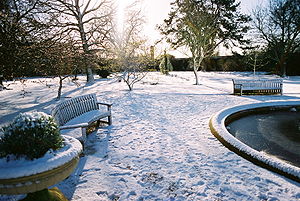
The core collection of hardy plants are grouped in long, narrow, oblong beds by botanical family and ordered according to the classification system devised by nineteenth century botanists, Bentham
and Hooker
. The families represented in the Walled Garden include: Acanthaceae
, Amaranthaceae
, Amaryllidaceae
, Apocynaceae
, Araceae
, Aristolochiaceae
, Berberidaceae
, Boraginaceae
, Campanulaceae
, Caryophyllaceae
, Chenopodiaceae
, Cistaceae
, Commelinaceae
, Compositae, Convolvulaceae
, Crassulaceae
, Cruciferae, Cyperaceae
, Dioscoreaceae
, Dipsacaceae
, Euphorbiaceae
, Gentianaceae
, Geraniaceae
, Gramineae, Hypericaceae
, Iridaceae
, Juncaceae
, Labiatae, Leguminosae, Liliaceae
, Linaceae
, Loasaceae
, Lythraceae
, Malvaceae
, Onagraceae
, Paeoniaceae, Papaveraceae
, Phytolaccaceae
, Plantaginaceae
, Plumbaginaceae
, Polemoniaceae
, Polygonaceae
, Portulacaceae
, Primulaceae
, Ranunculaceae
, Rosaceae
, Rubiaceae
, Rutaceae
, Saxifragaceae
, Solanaceae
, Umbelliferae, Urticaceae
, Verbenaceae
, Violaceae
.
In 1983, The National Council for the Conservation of Plants and Gardens (NCCPG) chose Oxford Botanic Garden to cultivate the national collection of euphorbia
. One of the rarest
plants in the collection is Euphorbia stygiana, with only ten plants left existing in the wild. The Garden is propagating the species as quickly as possible to reduce the possibility of it becoming extinct.
Eight beds in the southwest corner of the Garden represent plants with links to modern medicine
. Examples include Galega officinalis
which contains galegine and guanidine, upon which the anti-diabetic drug metformin is modelled and Artemisia annua
which is the source of the anti-malarial drug artemisinin
.
Two beds in the northwest corner of the Garden contain variegated plants laid out according to the classification system devised at the Garden by Professor C. D. Darlington
and former Superintendent J. K. Burras in the 1970s. Examples include Aegopodium podagraria 'Variegatum', a highly invasive
plant introduced in the Middle Ages
as a potherb boiled like spinach
, and used in the treatment of gout
; Weigela praecdox 'Variegata', a compact shrub
suitable for a small garden; and Cornus alternifolia 'Argentea' known as the pagoda dogwood
.
One bed in the north end of the garden contains some hybrids between species from the same genus
. An example includes Viburnum × bodnantense, growing with its parents, V. farreri and V. grandiflorum.
One bed in the northwest corner of the garden contains a display of bearded irises
each May. Examples include Iris 'Eileen' and Iris 'Golden Encore'. Some of the varieties grown in the Garden are not grown anywhere else.
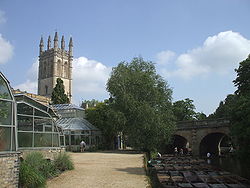
The border
s along the foot of the wall contain collections that thrive in the microclimate
created by the Wall. The cool east border includes ferns, Stachyurus praecox, Astrantia major, and Equisetum telmateia. The dry, shaded south border includes Jasminum nudiflorum, Hydrangea anomala petiolaris, Lonicera fragrantissima and L. × purpusii, and the unusual and rare Ercilla volubilis and Arisarum proboscoideum. The southeast border contains the bamboo
collection.
The west and north borders contain plant collections grouped by their geographical origin. The Sino-Japanese
collection at the southwest border includes Clerodendrum bungei. The North America
n collection at the west border includes Fremontodendron californicum. The Europe
an collection at the northwest border includes . The Mediterranean collection at the north border includes Euphorbia myrsinites. The South America
n collection at the north border includes Acca sellowiana. The South Africa
n collection at the northeast border includes Kniphofia caulescens.
The house is an aluminium
replica of the original 1893 wooden house and grows season
al flowers such as primula
s, abutilon
s, fuchsia
s, and achimenes
. Various exhibitions which change throughout the year are displayed in the centre area.

Plants which cannot grow to their full potential outside are displayed in this house. The displays are changed regularly so that there is always something in flower.
A collection of fern
s from around the world are housed here including Platycerium bifurcatum (stag's horn fern
), Lygodium japonicum (a climbing fern), and Tricomanes speciosum (a filmy fern
native to western Britain).
The tank in the lily house built in 1851 by Professor Charles Daubeny
, Keeper of the Garden at the time, is the oldest existing part of the glasshouses. Tropical water lilies
grow in boxes in the tank, including the hybrid Nymphaea × daubenyana named in honour of Professor Daubeny in 1874. Also growing in the house are economic plants including banana
s, sugar cane, and rice
, and the papyrus reed, Cyperus papyrus
, a native of river banks in the Middle East
. Flowering high in the glasshouse is the yellow-flowered Allamanda cathartica
.
This house grows a collection of orchids aimed at showing the diversity of growth habit in the Orchidaceae
, the largest family of flowering plants in the world. Bromeliads such as Ananas comosus, or pineapple
, are also grown in the house.
The largest glasshouse in the Garden, this house grows palm
s and a large number of economic plants including citrus fruits, pepper
, sweet potato
, pawpaw
, olive
, coffee
, ginger
, coconut
, cocoa, cotton
, and oil palm
. There is a collection of cycad
s which look like palms but are unrelated. Several important teaching collections present include the Acanthaceae including the shrimp plant
Justicia brandegeana, the Gesneriaceae
, and a large number of Begonia
species.
Plants in this house come from arid areas of the world and demonstrate ways in which plant forms economise the use of water.


mathematics
professor
Charles Lutwidge Dodgson (pen name
Lewis Carroll) and the Liddell children, Alice
and her sisters. Like many of the places and people of Oxford, it was a source of inspiration for Carroll's stories in Alice's Adventures in Wonderland
. The Garden's waterlily house can be seen in the background of Sir John Tenniel
's illustration of "The Queen's Croquet-Ground".
Another Oxford professor and author, J. R. R. Tolkien
, often spent his time at the garden reposing under his favourite tree, Pinus nigra
. The enormous Austrian pine is much like the Ent
s of his The Lord of the Rings
story, the walking, talking tree-people of Middle-earth
.
In the Evelyn Waugh
novel Brideshead Revisited
, Lord Sebastian Flyte takes Charles Ryder "to see the ivy" soon after they first meet. As he says, "Oh, Charles, what a lot you have to learn! There's a beautiful arch there and more different kinds of ivy than I knew existed. I don't know where I should be without the Botanical gardens" (Chapter One).
In Philip Pullman
's trilogy of novels His Dark Materials
, a bench in the back of the garden is one of the locations/objects that stand parallel in the two different worlds that the protagonists, Lyra Belacqua
and Will Parry, live in. In the last chapter of the trilogy, both promised to sit on the bench for an hour at noon on Midsummer
's day every year so that perhaps they may feel each other's presence next to one another in their own worlds.
Botanical garden
A botanical garden The terms botanic and botanical, and garden or gardens are used more-or-less interchangeably, although the word botanic is generally reserved for the earlier, more traditional gardens. is a well-tended area displaying a wide range of plants labelled with their botanical names...
in Oxford
Oxford
The city of Oxford is the county town of Oxfordshire, England. The city, made prominent by its medieval university, has a population of just under 165,000, with 153,900 living within the district boundary. It lies about 50 miles north-west of London. The rivers Cherwell and Thames run through...
, England
England
England is a country that is part of the United Kingdom. It shares land borders with Scotland to the north and Wales to the west; the Irish Sea is to the north west, the Celtic Sea to the south west, with the North Sea to the east and the English Channel to the south separating it from continental...
. It is the oldest botanic garden in Great Britain
Great Britain
Great Britain or Britain is an island situated to the northwest of Continental Europe. It is the ninth largest island in the world, and the largest European island, as well as the largest of the British Isles...
and one of the oldest scientific gardens in the world. The garden was founded in 1621 as a physic garden growing plant
Plant
Plants are living organisms belonging to the kingdom Plantae. Precise definitions of the kingdom vary, but as the term is used here, plants include familiar organisms such as trees, flowers, herbs, bushes, grasses, vines, ferns, mosses, and green algae. The group is also called green plants or...
s for medicinal research. Today it contains over 8,000 different plant species
Species
In biology, a species is one of the basic units of biological classification and a taxonomic rank. A species is often defined as a group of organisms capable of interbreeding and producing fertile offspring. While in many cases this definition is adequate, more precise or differing measures are...
on 1.8 hectare
Hectare
The hectare is a metric unit of area defined as 10,000 square metres , and primarily used in the measurement of land. In 1795, when the metric system was introduced, the are was defined as being 100 square metres and the hectare was thus 100 ares or 1/100 km2...
s (4½ acre
Acre
The acre is a unit of area in a number of different systems, including the imperial and U.S. customary systems. The most commonly used acres today are the international acre and, in the United States, the survey acre. The most common use of the acre is to measure tracts of land.The acre is related...
s). It is one of the most diverse yet compact collections
Collection (museum)
A museum is distinguished by a collection of often unique objects that forms the core of its activities for exhibitions, education, research, etc. This differentiates it from an archive or library, where the contents may be more paper-based, replaceable and less exhibition oriented...
of plants in the world and includes representatives from over 90% of the higher plant families.
Foundation
In 1621, Henry Danvers, 1st Earl of DanbyHenry Danvers, 1st Earl of Danby
Henry Danvers, 1st Earl of Danby, KG was an English soldier. Outlawed after a killing, he regained favour and became a Knight of the Garter.-Life:...
contributed £5,000 (equivalent to £744,000 in 2005) to set up a physic garden for "the glorification of the works of God and for the furtherance of learning". He chose a site on the banks of the River Cherwell
River Cherwell
The River Cherwell is a river which flows through the Midlands of England. It is a major tributary of the River Thames.The general course of the River Cherwell is north to south and the 'straight-line' distance from its source to the Thames is about...
at the northeast corner of Christ Church Meadow
Christ Church, Oxford
Christ Church or house of Christ, and thus sometimes known as The House), is one of the largest constituent colleges of the University of Oxford in England...
, belonging to Magdalen College
Magdalen College, Oxford
Magdalen College is one of the constituent colleges of the University of Oxford in England. As of 2006 the college had an estimated financial endowment of £153 million. Magdalen is currently top of the Norrington Table after over half of its 2010 finalists received first-class degrees, a record...
. Part of the land had been a Jewish cemetery
Jewish cemetery
A Jewish cemetery is a cemetery where members of the Jewish faith are buried in keeping with Jewish tradition....
until the Jews were expelled
Edict of Expulsion
In 1290, King Edward I issued an edict expelling all Jews from England. Lasting for the rest of the Middle Ages, it would be over 350 years until it was formally overturned in 1656...
from Oxford
Oxford
The city of Oxford is the county town of Oxfordshire, England. The city, made prominent by its medieval university, has a population of just under 165,000, with 153,900 living within the district boundary. It lies about 50 miles north-west of London. The rivers Cherwell and Thames run through...
(and the rest of England
England
England is a country that is part of the United Kingdom. It shares land borders with Scotland to the north and Wales to the west; the Irish Sea is to the north west, the Celtic Sea to the south west, with the North Sea to the east and the English Channel to the south separating it from continental...
) in 1290. Four thousand cartloads of "mucke and dunge" were needed to raise the land above the flood-plain of the River Cherwell
River Cherwell
The River Cherwell is a river which flows through the Midlands of England. It is a major tributary of the River Thames.The general course of the River Cherwell is north to south and the 'straight-line' distance from its source to the Thames is about...
.
Catalogue
Humphry Sibthorp began the catalogue of the plants of the garden, Catalogus Plantarum Horti Botanici Oxoniensis. His youngest son was the well-known botanist John SibthorpJohn Sibthorp
John Sibthorp was an English botanist.He was born in Oxford, the youngest son of Dr Humphry Sibthorp , who from 1747 to 1784 was Sherardian professor of botany at the University of Oxford....
(1758–1796), who continued the Catalogus Plantarum.
Layout
The Garden comprises three sections:- the Walled Garden, surrounded by the original seventeenth century stonework and home to the Garden's oldest tree, an English yewTaxus baccataTaxus baccata is a conifer native to western, central and southern Europe, northwest Africa, northern Iran and southwest Asia. It is the tree originally known as yew, though with other related trees becoming known, it may be now known as the English yew, or European yew.-Description:It is a small-...
, Taxus baccata; - the Glasshouses, which allow the cultivation of plants needing protection from the extremes of British weather; and
- the area outside the walled area between the Walled Garden and the River Cherwell.
A satellite site, the Harcourt Arboretum
Harcourt Arboretum
Harcourt Arboretum is an arboretum owned and run by the University of Oxford. It is a satellite of the university's botanic garden in the city of Oxford, England...
, is located six miles (10 km) south of Oxford.
The Danby Gateway
The Danby gateway to the Botanic Garden is one of three entrances designed by Nicholas StoneNicholas Stone
Nicholas Stone was an English sculptor and architect. In 1619 he was appointed master-mason to James I, and in 1626 to Charles I....
between 1632 and 1633. It is one of the earliest structures in Oxford to use classical, indeed early Baroque
Baroque
The Baroque is a period and the style that used exaggerated motion and clear, easily interpreted detail to produce drama, tension, exuberance, and grandeur in sculpture, painting, literature, dance, and music...
, style, preceding his new entrance porch for the University Church of St Mary the Virgin
University Church of St Mary the Virgin
The University Church of St Mary the Virgin is the largest of Oxford's parish churches and the centre from which the University of Oxford grew...
of 1637, and contemporary with Canterbury Quad at St John's College
St John's College, Oxford
__FORCETOC__St John's College is a constituent college of the University of Oxford, one of the larger Oxford colleges with approximately 390 undergraduates, 200 postgraduates and over 100 academic staff. It was founded by Sir Thomas White, a merchant, in 1555, whose heart is buried in the chapel of...
by others. In this highly ornate arch, Stone ignored the new simple classical Palladian style currently fashionable, which had just been introduced to England from Italy by Inigo Jones
Inigo Jones
Inigo Jones is the first significant British architect of the modern period, and the first to bring Italianate Renaissance architecture to England...
, and drew his inspiration from an illustration in Serlio's book of archways.
The gateway consists of three bays, each with a pediment
Pediment
A pediment is a classical architectural element consisting of the triangular section found above the horizontal structure , typically supported by columns. The gable end of the pediment is surrounded by the cornice moulding...
. The largest and central bay, containing the segmented arch is recessed, causing its larger pediment to be partially hidden by the flanking smaller pediments of the projecting lateral bays.
The stone work is heavily decorated being bands of alternating vermicelli rustication
Rustication (architecture)
thumb|upright|Two different styles of rustication in the [[Palazzo Medici-Riccardi]] in [[Florence]].In classical architecture rustication is an architectural feature that contrasts in texture with the smoothly finished, squared block masonry surfaces called ashlar...
and plain dressed stone. The pediments of the lateral bays are seemingly supported by circular columns which frame niches containing statues of Charles I and Charles II in classical pose. The tympanum
Tympanum (architecture)
In architecture, a tympanum is the semi-circular or triangular decorative wall surface over an entrance, bounded by a lintel and arch. It often contains sculpture or other imagery or ornaments. Most architectural styles include this element....
of the central pediment contains a segmented niche containing a bust of the Earl of Danby. It is a Grade I listed structure (ref. 1485/423).
Walled garden
- Botanical family beds
The core collection of hardy plants are grouped in long, narrow, oblong beds by botanical family and ordered according to the classification system devised by nineteenth century botanists, Bentham
George Bentham
George Bentham CMG FRS was an English botanist, characterized by Duane Isely as "the premier systematic botanist of the nineteenth century".- Formative years :...
and Hooker
Joseph Dalton Hooker
Sir Joseph Dalton Hooker OM, GCSI, CB, MD, FRS was one of the greatest British botanists and explorers of the 19th century. Hooker was a founder of geographical botany, and Charles Darwin's closest friend...
. The families represented in the Walled Garden include: Acanthaceae
Acanthaceae
The family Acanthaceae is a taxon of dicotyledonous flowering plants containing almost 250 genera and about 2500 species....
, Amaranthaceae
Amaranthaceae
The flowering plant family Amaranthaceae, the Amaranth family, contains about 176 genera and 2,400 species.- Description :Most of these species are herbs or subshrubs; very few are trees or climbers. Some species are succulent....
, Amaryllidaceae
Amaryllidaceae
Amaryllidoideae is the subfamily of flowering plants that takes its name from the genus Amaryllis. It is part of the family Amaryllidaceae, in order Asparagales...
, Apocynaceae
Apocynaceae
The Apocynaceae or dogbane family is a family of flowering plants that includes trees, shrubs, herbs, and lianas.Many species are tall trees found in tropical rainforests, and most are from the tropics and subtropics, but some grow in tropical dry, xeric environments. There are also perennial herbs...
, Araceae
Araceae
Araceae are a family of monocotyledonous flowering plants in which flowers are borne on a type of inflorescence called a spadix. The spadix is usually accompanied by, and sometimes partially enclosed in, a spathe or leaf-like bract. Also known as the Arum family, members are often colloquially...
, Aristolochiaceae
Aristolochiaceae
The Aristolochiaceae, or the Birthwort family, are a family of flowering plants with 7 genera and about 400 species belonging to the order Piperales...
, Berberidaceae
Berberidaceae
Berberidaceae are a family of 15 genera flowering plants commonly called the barberry family. This family is in the order Ranunculales. The family contains about 570 species, of which the majority are in Berberis...
, Boraginaceae
Boraginaceae
Boraginaceae, the Borage or Forget-me-not family, include a variety of shrubs, trees, and herbs, totaling about 2,000 species in 146 genera found worldwide.A number of familiar plants belong to this family....
, Campanulaceae
Campanulaceae
The family Campanulaceae , of the order Asterales, contains about 2000 species in 70 genera of herbaceous plants, shrubs, and rarely small trees, often with milky non-toxic sap...
, Caryophyllaceae
Caryophyllaceae
The Caryophyllaceae, commonly called the pink family or carnation family, is a family of flowering plants. It is included in the dicotyledon order Caryophyllales in the APG III system, alongside 33 other families, including Amaranthaceae, Cactaceae and Polygonaceae...
, Chenopodiaceae
Chenopodiaceae
Chenopodiaceae were a family of flowering plants, also called the Goosefoot Family. They are now included within family Amaranthaceae. The vast majority of Chenopods are weeds, and many are salt and drought tolerant. A few food crops also belong to the family: spinach, beets, chard, quinoa, and...
, Cistaceae
Cistaceae
The Cistaceae is a small family of plants known for its beautiful shrubs, which are profusely covered by flowers at the time of blossom...
, Commelinaceae
Commelinaceae
Commelinaceae is a family of flowering plants. In less formal contexts, the group is referred to as the dayflower family or spiderwort family. It is one of five families in the order Commelinales and by far the largest of these with an estimated 650 species in 40 genera. Well known genera include...
, Compositae, Convolvulaceae
Convolvulaceae
Convolvulaceae, known commonly as the bindweed or morning glory family, are a group of about 60 genera and more than 1,650 species of mostly herbaceous vines, but also trees, shrubs and herbs.- Description :...
, Crassulaceae
Crassulaceae
Crassulaceae, or the orpine family, are a family of dicotyledons. They store water in their succulent leaves. They are found worldwide, but mostly occur in the Northern Hemisphere and southern Africa, typically in dry and/or cold areas where water may be scarce...
, Cruciferae, Cyperaceae
Cyperaceae
Cyperaceae are a family of monocotyledonous graminoid flowering plants known as sedges, which superficially resemble grasses or rushes. The family is large, with some 5,500 species described in about 109 genera. These species are widely distributed, with the centers of diversity for the group...
, Dioscoreaceae
Dioscoreaceae
Dioscoreaceae is a family of monocotyledonous flowering plants, with about 750 species in eight or nine genera. The best-known member of the family is the Yam ....
, Dipsacaceae
Dipsacaceae
The Dipsacaceae, or teasel family, of the order Dipsacales contains 350 species of perennial or biennial herbs and shrubs in eleven genera. Native to most temperate climates, they are found in Europe, Asia and Africa...
, Euphorbiaceae
Euphorbiaceae
Euphorbiaceae, the Spurge family are a large family of flowering plants with 300 genera and around 7,500 species. Most are herbs, but some, especially in the tropics, are also shrubs or trees. Some are succulent and resemble cacti....
, Gentianaceae
Gentianaceae
Gentianaceae are a family of flowering plants of 87 genera and over 1500 species. Flowers are actinomorphic and bisexual with fused sepals and petals. The stamens are attached to the inside of the petals and alternate with the corolla lobes. There is a glandular disk at the base of the gynoecium,...
, Geraniaceae
Geraniaceae
Geraniaceae is a family of flowering plants placed in the order Geraniales. The family name is derived from the genus Geranium. It includes both the genus Geranium and the garden plants called geraniums, which modern botany classifies as genus Pelargonium, along with other related genera.There are...
, Gramineae, Hypericaceae
Hypericaceae
Hypericaceae is a plant family in the order Malpighiales. Molecular data supports its monophyly. Some systematists treat it as a subfamily of the Clusiaceae. When it is accepted as a distinct family, it contains the following genera:* Cratoxylum Blume...
, Iridaceae
Iridaceae
The Iris family or Iridaceae is a family of perennial, herbaceous and bulbous plants included in the monocot order Asparagales, taking its name from the genus Iris. Almost worldwide in distribution and one of the most important families in horticulture, it includes more than 2000 species...
, Juncaceae
Juncaceae
Juncaceae, the rush family, are a monocotyledonous family of flowering plants. There are eight genera and about 400 species. Members of the Juncaceae are slow-growing, rhizomatous, herbaceous plants, and they may superficially resemble grasses. They often grow on infertile soils in a wide range...
, Labiatae, Leguminosae, Liliaceae
Liliaceae
The Liliaceae, or the lily family, is a family of monocotyledons in the order Liliales. Plants in this family have linear leaves, mostly with parallel veins but with several having net venation , and flower arranged in threes. Several have bulbs, while others have rhizomes...
, Linaceae
Linaceae
The Linaceae is a family of flowering plants. The family is cosmopolitan, and includes approximately 250 species. There are 14 genera, classified into two subfamilies: Linoideae and Hugonioideae ....
, Loasaceae
Loasaceae
The Loasaceae is a family of 15-20 genera and about 200-260 species of flowering plants in the order Cornales, native to the Americas and Africa. The family comprises annual, biennial and perennial herbaceous plants, and a few shrubs and small trees.Genera...
, Lythraceae
Lythraceae
Lythraceae are a family of flowering plants. It includes about 620 species of mostly herbs, with some shrubs and trees, in 31 genera. Major genera include Cuphea , Lagerstroemia , Nesaea , Rotala , and Lythrum...
, Malvaceae
Malvaceae
Malvaceae, or the mallow family, is a family of flowering plants containing over 200 genera with close to 2,300 species. Judd & al. Well known members of this family include okra, jute and cacao...
, Onagraceae
Onagraceae
Onagraceae, also known as the Willowherb family or Evening Primrose family, are a family of flowering plants. The family includes about 640-650 species of herbs, shrubs, and trees in 20-24 genera...
, Paeoniaceae, Papaveraceae
Papaveraceae
Papaveraceae, informally known as the poppy family, are an economically important family of 44 genera and approximately 770 species of flowering plants in the order Ranunculales. The family is cosmopolitan, occurring in temperate and subtropical climates, but almost unknown in the tropics...
, Phytolaccaceae
Phytolaccaceae
Phytolaccaceae is the botanical name for a family of flowering plants. Such a family has been almost universally recognized by taxonomists, although its circumscription has varied. It is also known as the Pokeweed family....
, Plantaginaceae
Plantaginaceae
Plantaginaceae Juss. or plantain family, are a family of flowering plants in the order Lamiales. The type genus is Plantago L..In older classifications it used to be the only family of the order Plantaginales, but numerous phylogenetic studies, summarized by the Angiosperm Phylogeny Group, have...
, Plumbaginaceae
Plumbaginaceae
Plumbaginaceae is a family of flowering plants, with a cosmopolitan distribution. The family is sometimes referred to as the leadwort family or the plumbago family....
, Polemoniaceae
Polemoniaceae
Polemoniaceae are a family of about 25 genera with 270-400 species of annual and perennial plants, native to the Northern Hemisphere and South America, with the center of diversity in western North America, especially in California.Only one genus is found in Europe, and two in Asia, where they...
, Polygonaceae
Polygonaceae
Polygonaceae is a family of flowering plants known informally as the "knotweed family" or "smartweed family"— "buckwheat family" in the United States. The name is based on the genus Polygonum and was first used by Antoine Laurent de Jussieu in 1789 in his book, Genera Plantarum. The name refers...
, Portulacaceae
Portulacaceae
Portulacaceae are a family of flowering plants, comprising about 20 genera with about 500 species, ranging from herbaceous plants to shrubs. The family has been recognised by most taxonomists, and is also known as the purslane family; it has a cosmopolitan distribution, with the highest diversity...
, Primulaceae
Primulaceae
Primulaceae is a family of flowering plants with about 24 genera, including some favorite garden plants and wildflowers. It is also known as the primrose family.- Genera :...
, Ranunculaceae
Ranunculaceae
Ranunculaceae are a family of about 1700 species of flowering plants in about 60 genera, distributed worldwide....
, Rosaceae
Rosaceae
Rosaceae are a medium-sized family of flowering plants, including about 2830 species in 95 genera. The name is derived from the type genus Rosa. Among the largest genera are Alchemilla , Sorbus , Crataegus , Cotoneaster , and Rubus...
, Rubiaceae
Rubiaceae
The Rubiaceae is a family of flowering plants, variously called the coffee family, madder family, or bedstraw family. The group contains many commonly known plants, including the economically important coffee , quinine , and gambier , and the horticulturally valuable madder , west indian jasmine ,...
, Rutaceae
Rutaceae
Rutaceae, commonly known as the rue or citrus family, is a family of flowering plants, usually placed in the order Sapindales.Species of the family generally have flowers that divide into four or five parts, usually with strong scents...
, Saxifragaceae
Saxifragaceae
Saxifragaceae is a plant family with about 460 known species in 36 genera. In Europe there are 12 genera.The flowers are hermaphroditic and actinomorphic...
, Solanaceae
Solanaceae
Solanaceae are a family of flowering plants that include a number of important agricultural crops as well as many toxic plants. The name of the family comes from the Latin Solanum "the nightshade plant", but the further etymology of that word is unclear...
, Umbelliferae, Urticaceae
Urticaceae
Urticaceae, or the nettle family, is a family of flowering plants. The family name comes from the genus Urtica . Urticaceae includes a number of well-known and useful plants, including the aforementioned nettles, Ramie , māmaki , and ajlai .The family includes approximately 2600 species, grouped...
, Verbenaceae
Verbenaceae
Verbenaceae, commonly known as the verbena family or vervain family, is a family of mainly tropical flowering plants. It contains trees, shrubs and herbs notable for heads, spikes, or clusters of small flowers, many of which have an aromatic smell.Recent phylogenetic studies have shown that...
, Violaceae
Violaceae
Violaceae are a family of flowering plants consisting of about 800 species in 21 genera. It takes its name from the genus Viola, the violets and pansies.Older classifications such as the Cronquist system placed Violaceae in an order named after it, the Violales...
.
In 1983, The National Council for the Conservation of Plants and Gardens (NCCPG) chose Oxford Botanic Garden to cultivate the national collection of euphorbia
Spurge
Euphorbia is a genus of plants belonging to the family Euphorbiaceae. Consisting of 2008 species, Euphorbia is one of the most diverse genera in the plant kingdom, exceeded possibly only by Senecio. Members of the family and genus are sometimes referred to as Spurges...
. One of the rarest
Endangered species
An endangered species is a population of organisms which is at risk of becoming extinct because it is either few in numbers, or threatened by changing environmental or predation parameters...
plants in the collection is Euphorbia stygiana, with only ten plants left existing in the wild. The Garden is propagating the species as quickly as possible to reduce the possibility of it becoming extinct.
- Economic beds
Eight beds in the southwest corner of the Garden represent plants with links to modern medicine
Medicine
Medicine is the science and art of healing. It encompasses a variety of health care practices evolved to maintain and restore health by the prevention and treatment of illness....
. Examples include Galega officinalis
Galega officinalis
Galega officinalis, commonly known as goat's rue, French lilac, Italian fitch or professor-weed, is an herbaceous plant in the Faboideae subfamily. It is native to the Middle East, but it has been naturalised in Europe, western Asia, and western Pakistan...
which contains galegine and guanidine, upon which the anti-diabetic drug metformin is modelled and Artemisia annua
Artemisia annua
Artemisia annua, also known as Sweet Wormwood, Sweet Annie, Sweet Sagewort or Annual Wormwood , is a common type of wormwood that is native to temperate Asia, but naturalized throughout the world.-Characteristics:...
which is the source of the anti-malarial drug artemisinin
Artemisinin
Artemisinin , also known as Qinghaosu , and its derivatives are a group of drugs that possess the most rapid action of all current drugs against falciparum malaria. Treatments containing an artemisinin derivative are now standard treatment worldwide for falciparum malaria...
.
- Variegated plants
Two beds in the northwest corner of the Garden contain variegated plants laid out according to the classification system devised at the Garden by Professor C. D. Darlington
C. D. Darlington
Cyril Dean Darlington FRS was an English biologist, geneticist and eugenicist, who discovered the mechanics of chromosomal crossover, its role in inheritance, and therefore its importance to evolution.-Early life:...
and former Superintendent J. K. Burras in the 1970s. Examples include Aegopodium podagraria 'Variegatum', a highly invasive
Invasive species
"Invasive species", or invasive exotics, is a nomenclature term and categorization phrase used for flora and fauna, and for specific restoration-preservation processes in native habitats, with several definitions....
plant introduced in the Middle Ages
Middle Ages
The Middle Ages is a periodization of European history from the 5th century to the 15th century. The Middle Ages follows the fall of the Western Roman Empire in 476 and precedes the Early Modern Era. It is the middle period of a three-period division of Western history: Classic, Medieval and Modern...
as a potherb boiled like spinach
Spinach
Spinach is an edible flowering plant in the family of Amaranthaceae. It is native to central and southwestern Asia. It is an annual plant , which grows to a height of up to 30 cm. Spinach may survive over winter in temperate regions...
, and used in the treatment of gout
Gout
Gout is a medical condition usually characterized by recurrent attacks of acute inflammatory arthritis—a red, tender, hot, swollen joint. The metatarsal-phalangeal joint at the base of the big toe is the most commonly affected . However, it may also present as tophi, kidney stones, or urate...
; Weigela praecdox 'Variegata', a compact shrub
Shrub
A shrub or bush is distinguished from a tree by its multiple stems and shorter height, usually under 5–6 m tall. A large number of plants may become either shrubs or trees, depending on the growing conditions they experience...
suitable for a small garden; and Cornus alternifolia 'Argentea' known as the pagoda dogwood
Pagoda Dogwood
Pagoda dogwood , also known as alternate-leaved Dogwood, is a species of dogwood native to eastern North America, from Newfoundland west to southern Manitoba and Minnesota, and south to northern Florida and Mississippi...
.
- Hybrids and parents
One bed in the north end of the garden contains some hybrids between species from the same genus
Genus
In biology, a genus is a low-level taxonomic rank used in the biological classification of living and fossil organisms, which is an example of definition by genus and differentia...
. An example includes Viburnum × bodnantense, growing with its parents, V. farreri and V. grandiflorum.
- Bearded irises
One bed in the northwest corner of the garden contains a display of bearded irises
Iris (plant)
Iris is a genus of 260-300species of flowering plants with showy flowers. It takes its name from the Greek word for a rainbow, referring to the wide variety of flower colors found among the many species...
each May. Examples include Iris 'Eileen' and Iris 'Golden Encore'. Some of the varieties grown in the Garden are not grown anywhere else.
- Wall borders
The border
Border
Borders define geographic boundaries of political entities or legal jurisdictions, such as governments, sovereign states, federated states and other subnational entities. Some borders—such as a state's internal administrative borders, or inter-state borders within the Schengen Area—are open and...
s along the foot of the wall contain collections that thrive in the microclimate
Microclimate
A microclimate is a local atmospheric zone where the climate differs from the surrounding area. The term may refer to areas as small as a few square feet or as large as many square miles...
created by the Wall. The cool east border includes ferns, Stachyurus praecox, Astrantia major, and Equisetum telmateia. The dry, shaded south border includes Jasminum nudiflorum, Hydrangea anomala petiolaris, Lonicera fragrantissima and L. × purpusii, and the unusual and rare Ercilla volubilis and Arisarum proboscoideum. The southeast border contains the bamboo
Bamboo
Bamboo is a group of perennial evergreens in the true grass family Poaceae, subfamily Bambusoideae, tribe Bambuseae. Giant bamboos are the largest members of the grass family....
collection.
The west and north borders contain plant collections grouped by their geographical origin. The Sino-Japanese
Sino-Japanese
Sino-Japanese, or Kango in Japanese, refers to that portion of the Japanese vocabulary that originated in the Chinese language or has been created from elements borrowed from Chinese. Some grammatical or sentence patterns can also be identified with Sino-Japanese. Sino-Japanese vocabulary is...
collection at the southwest border includes Clerodendrum bungei. The North America
North America
North America is a continent wholly within the Northern Hemisphere and almost wholly within the Western Hemisphere. It is also considered a northern subcontinent of the Americas...
n collection at the west border includes Fremontodendron californicum. The Europe
Europe
Europe is, by convention, one of the world's seven continents. Comprising the westernmost peninsula of Eurasia, Europe is generally 'divided' from Asia to its east by the watershed divides of the Ural and Caucasus Mountains, the Ural River, the Caspian and Black Seas, and the waterways connecting...
an collection at the northwest border includes . The Mediterranean collection at the north border includes Euphorbia myrsinites. The South America
South America
South America is a continent situated in the Western Hemisphere, mostly in the Southern Hemisphere, with a relatively small portion in the Northern Hemisphere. The continent is also considered a subcontinent of the Americas. It is bordered on the west by the Pacific Ocean and on the north and east...
n collection at the north border includes Acca sellowiana. The South Africa
South Africa
The Republic of South Africa is a country in southern Africa. Located at the southern tip of Africa, it is divided into nine provinces, with of coastline on the Atlantic and Indian oceans...
n collection at the northeast border includes Kniphofia caulescens.
Glasshouses
- Conservatory
The house is an aluminium
Aluminium
Aluminium or aluminum is a silvery white member of the boron group of chemical elements. It has the symbol Al, and its atomic number is 13. It is not soluble in water under normal circumstances....
replica of the original 1893 wooden house and grows season
Season
A season is a division of the year, marked by changes in weather, ecology, and hours of daylight.Seasons result from the yearly revolution of the Earth around the Sun and the tilt of the Earth's axis relative to the plane of revolution...
al flowers such as primula
Primula
Primula is a genus of 400–500 species of low-growing herbs in the family Primulaceae. They include primrose, auricula, cowslip and oxlip. Many species are grown for their ornamental flowers...
s, abutilon
Abutilon
Abutilon is a large genus of approximately 150 species of broadleaf evergreens in the mallow family, Malvaceae. The genus includes annuals, perennials, shrubs, and small trees from 1–10 m tall, and is found in the tropical and subtropical regions of all continents. The leaves are alternate,...
s, fuchsia
Fuchsia
Fuchsia is a genus of flowering plants that consists mostly of shrubs or small trees. The first, Fuchsia triphylla, was discovered on the Caribbean island of Hispaniola in 1703 by the French Minim monk and botanist, Charles Plumier...
s, and achimenes
Achimenes
Achimenes is a genus of about 25 species of tropical and subtropical rhizomatous perennial herbs in the flowering plant family Gesneriaceae...
. Various exhibitions which change throughout the year are displayed in the centre area.
- Alpine House
Plants which cannot grow to their full potential outside are displayed in this house. The displays are changed regularly so that there is always something in flower.
- Fernery
A collection of fern
Fern
A fern is any one of a group of about 12,000 species of plants belonging to the botanical group known as Pteridophyta. Unlike mosses, they have xylem and phloem . They have stems, leaves, and roots like other vascular plants...
s from around the world are housed here including Platycerium bifurcatum (stag's horn fern
Platycerium
Platycerium is a genus of about 18 fern species in the polypod family, Polypodiaceae. Ferns in this genus are widely known as staghorn or elkhorn ferns due to their uniquely-shaped fronds...
), Lygodium japonicum (a climbing fern), and Tricomanes speciosum (a filmy fern
Filmy fern
The Hymenophyllaceae is a family of seven genera and over 600 species of ferns, with a subcosmopolitan distribution, but generally restricted to very damp places or to locations where they are wetted by spray from waterfalls or springs...
native to western Britain).
- Tropical Lily House
The tank in the lily house built in 1851 by Professor Charles Daubeny
Charles Daubeny
Charles Giles Bridle Daubeny was an English chemist, botanist and geologist.Daubeny was born at Stratton near Cirencester in Gloucestershire, the son of the Rev. James Daubeny. He studied at Magdalen College, Oxford under Dr. John Kidd...
, Keeper of the Garden at the time, is the oldest existing part of the glasshouses. Tropical water lilies
Nymphaeaceae
Nymphaeaceae is a family of flowering plants. Members of this family are commonly called water lilies and live in freshwater areas in temperate and tropical climates around the world. The family contains eight genera. There are about 70 species of water lilies around the world. The genus...
grow in boxes in the tank, including the hybrid Nymphaea × daubenyana named in honour of Professor Daubeny in 1874. Also growing in the house are economic plants including banana
Banana
Banana is the common name for herbaceous plants of the genus Musa and for the fruit they produce. Bananas come in a variety of sizes and colors when ripe, including yellow, purple, and red....
s, sugar cane, and rice
Rice
Rice is the seed of the monocot plants Oryza sativa or Oryza glaberrima . As a cereal grain, it is the most important staple food for a large part of the world's human population, especially in East Asia, Southeast Asia, South Asia, the Middle East, and the West Indies...
, and the papyrus reed, Cyperus papyrus
Cyperus papyrus
Cyperus papyrus is a monocot belonging to the sedge family Cyperaceae. It is a herbaceous perennial native to Africa, and forms tall stands of reed-like swamp vegetation in shallow water....
, a native of river banks in the Middle East
Middle East
The Middle East is a region that encompasses Western Asia and Northern Africa. It is often used as a synonym for Near East, in opposition to Far East...
. Flowering high in the glasshouse is the yellow-flowered Allamanda cathartica
Allamanda
Allamanda, also known as Yellow Bell, Golden Trumpet or Buttercup Flower, is a genus of tropical shrubs or vines belonging to the dogbane family .The genus Alamanda is native to South and Central America...
.
- Orchid House
This house grows a collection of orchids aimed at showing the diversity of growth habit in the Orchidaceae
Orchidaceae
The Orchidaceae, commonly referred to as the orchid family, is a morphologically diverse and widespread family of monocots in the order Asparagales. Along with the Asteraceae, it is one of the two largest families of flowering plants, with between 21,950 and 26,049 currently accepted species,...
, the largest family of flowering plants in the world. Bromeliads such as Ananas comosus, or pineapple
Pineapple
Pineapple is the common name for a tropical plant and its edible fruit, which is actually a multiple fruit consisting of coalesced berries. It was given the name pineapple due to its resemblance to a pine cone. The pineapple is by far the most economically important plant in the Bromeliaceae...
, are also grown in the house.
- Palm House
The largest glasshouse in the Garden, this house grows palm
Arecaceae
Arecaceae or Palmae , are a family of flowering plants, the only family in the monocot order Arecales. There are roughly 202 currently known genera with around 2600 species, most of which are restricted to tropical, subtropical, and warm temperate climates...
s and a large number of economic plants including citrus fruits, pepper
Black pepper
Black pepper is a flowering vine in the family Piperaceae, cultivated for its fruit, which is usually dried and used as a spice and seasoning. The fruit, known as a peppercorn when dried, is approximately in diameter, dark red when fully mature, and, like all drupes, contains a single seed...
, sweet potato
Sweet potato
The sweet potato is a dicotyledonous plant that belongs to the family Convolvulaceae. Its large, starchy, sweet-tasting, tuberous roots are an important root vegetable. The young leaves and shoots are sometimes eaten as greens. Of the approximately 50 genera and more than 1,000 species of...
, pawpaw
Papaya
The papaya , papaw, or pawpaw is the fruit of the plant Carica papaya, the sole species in the genus Carica of the plant family Caricaceae...
, olive
Olive
The olive , Olea europaea), is a species of a small tree in the family Oleaceae, native to the coastal areas of the eastern Mediterranean Basin as well as northern Iran at the south end of the Caspian Sea.Its fruit, also called the olive, is of major agricultural importance in the...
, coffee
Coffee
Coffee is a brewed beverage with a dark,init brooo acidic flavor prepared from the roasted seeds of the coffee plant, colloquially called coffee beans. The beans are found in coffee cherries, which grow on trees cultivated in over 70 countries, primarily in equatorial Latin America, Southeast Asia,...
, ginger
Ginger
Ginger is the rhizome of the plant Zingiber officinale, consumed as a delicacy, medicine, or spice. It lends its name to its genus and family . Other notable members of this plant family are turmeric, cardamom, and galangal....
, coconut
Coconut
The coconut palm, Cocos nucifera, is a member of the family Arecaceae . It is the only accepted species in the genus Cocos. The term coconut can refer to the entire coconut palm, the seed, or the fruit, which is not a botanical nut. The spelling cocoanut is an old-fashioned form of the word...
, cocoa, cotton
Cotton
Cotton is a soft, fluffy staple fiber that grows in a boll, or protective capsule, around the seeds of cotton plants of the genus Gossypium. The fiber is almost pure cellulose. The botanical purpose of cotton fiber is to aid in seed dispersal....
, and oil palm
Oil palm
The oil palms comprise two species of the Arecaceae, or palm family. They are used in commercial agriculture in the production of palm oil. The African Oil Palm Elaeis guineensis is native to West Africa, occurring between Angola and Gambia, while the American Oil Palm Elaeis oleifera is native to...
. There is a collection of cycad
Cycad
Cycads are seed plants typically characterized by a stout and woody trunk with a crown of large, hard and stiff, evergreen leaves. They usually have pinnate leaves. The individual plants are either all male or all female . Cycads vary in size from having a trunk that is only a few centimeters...
s which look like palms but are unrelated. Several important teaching collections present include the Acanthaceae including the shrimp plant
Shrimp plant
Shrimp plant can refer to two plants in Acanthaceae:* Justicia brandegeeana, which has salmon-colored bracts and 3 to 7.5 cm long elliptic leaves* Pachystachys lutea, which has yellow bracts and 15 cm long lanceolate leaves...
Justicia brandegeana, the Gesneriaceae
Gesneriaceae
Gesneriaceae is a family of flowering plants consisting of ca. 150 genera and ca. 3,200 species in the Old World and New World tropics and subtropics, with a very small number extending to temperate areas. Many species have colorful and showy flowers and are cultivated as ornamental plants.Most...
, and a large number of Begonia
Begonia
Begonia is a genus in the flowering plant family Begoniaceae and is a perennial. The only other members of the family Begoniaceae are Hillebrandia, a genus with a single species in the Hawaiian Islands, and the genus Symbegonia which more recently was included in Begonia...
species.
- Succulent House
Plants in this house come from arid areas of the world and demonstrate ways in which plant forms economise the use of water.
Outside the walled garden
- Rock Garden
- Bog Garden
- Herbaceous Border
- Autumn Border
- Glasshouse Borders
- Merton Borders
In literature
The Garden was the site of frequent visits in the 1860s by OxfordUniversity of Oxford
The University of Oxford is a university located in Oxford, United Kingdom. It is the second-oldest surviving university in the world and the oldest in the English-speaking world. Although its exact date of foundation is unclear, there is evidence of teaching as far back as 1096...
mathematics
Mathematics
Mathematics is the study of quantity, space, structure, and change. Mathematicians seek out patterns and formulate new conjectures. Mathematicians resolve the truth or falsity of conjectures by mathematical proofs, which are arguments sufficient to convince other mathematicians of their validity...
professor
Professor
A professor is a scholarly teacher; the precise meaning of the term varies by country. Literally, professor derives from Latin as a "person who professes" being usually an expert in arts or sciences; a teacher of high rank...
Charles Lutwidge Dodgson (pen name
Pen name
A pen name, nom de plume, or literary double, is a pseudonym adopted by an author. A pen name may be used to make the author's name more distinctive, to disguise his or her gender, to distance an author from some or all of his or her works, to protect the author from retribution for his or her...
Lewis Carroll) and the Liddell children, Alice
Alice Liddell
Alice Pleasance Liddell , known for most of her adult life by her married name, Alice Hargreaves, inspired the children's classic Alice's Adventures in Wonderland by Lewis Carroll, whose protagonist Alice is said to be named after her.-Biography:...
and her sisters. Like many of the places and people of Oxford, it was a source of inspiration for Carroll's stories in Alice's Adventures in Wonderland
Alice's Adventures in Wonderland
Alice's Adventures in Wonderland is an 1865 novel written by English author Charles Lutwidge Dodgson under the pseudonym Lewis Carroll. It tells of a girl named Alice who falls down a rabbit hole into a fantasy world populated by peculiar, anthropomorphic creatures...
. The Garden's waterlily house can be seen in the background of Sir John Tenniel
John Tenniel
Sir John Tenniel was a British illustrator, graphic humorist and political cartoonist whose work was prominent during the second half of England’s 19th century. Tenniel is considered important to the study of that period’s social, literary, and art histories...
's illustration of "The Queen's Croquet-Ground".
Another Oxford professor and author, J. R. R. Tolkien
J. R. R. Tolkien
John Ronald Reuel Tolkien, CBE was an English writer, poet, philologist, and university professor, best known as the author of the classic high fantasy works The Hobbit, The Lord of the Rings, and The Silmarillion.Tolkien was Rawlinson and Bosworth Professor of Anglo-Saxon at Pembroke College,...
, often spent his time at the garden reposing under his favourite tree, Pinus nigra
European Black Pine
Pinus nigra, the European Black Pine, is a moderately variable species of pine, occurring across southern Mediterranean Europe from Spain to the Crimea, in Asia Minor and on Cyprus, and in the high mountains of the Maghreb in North Africa....
. The enormous Austrian pine is much like the Ent
Ent
Ents are a race of beings in J. R. R. Tolkien's fantasy world Middle-earth who closely resemble trees. They are similar to the talking trees in folklore around the world. Their name is derived from the Anglo-Saxon word for giant....
s of his The Lord of the Rings
The Lord of the Rings
The Lord of the Rings is a high fantasy epic written by English philologist and University of Oxford professor J. R. R. Tolkien. The story began as a sequel to Tolkien's earlier, less complex children's fantasy novel The Hobbit , but eventually developed into a much larger work. It was written in...
story, the walking, talking tree-people of Middle-earth
Middle-earth
Middle-earth is the fictional setting of the majority of author J. R. R. Tolkien's fantasy writings. The Hobbit and The Lord of the Rings take place entirely in Middle-earth, as does much of The Silmarillion and Unfinished Tales....
.
In the Evelyn Waugh
Evelyn Waugh
Arthur Evelyn St. John Waugh , known as Evelyn Waugh, was an English writer of novels, travel books and biographies. He was also a prolific journalist and reviewer...
novel Brideshead Revisited
Brideshead Revisited
Brideshead Revisited, The Sacred & Profane Memories of Captain Charles Ryder is a novel by English writer Evelyn Waugh, first published in 1945. Waugh wrote that the novel "deals with what is theologically termed 'the operation of Grace', that is to say, the unmerited and unilateral act of love by...
, Lord Sebastian Flyte takes Charles Ryder "to see the ivy" soon after they first meet. As he says, "Oh, Charles, what a lot you have to learn! There's a beautiful arch there and more different kinds of ivy than I knew existed. I don't know where I should be without the Botanical gardens" (Chapter One).
In Philip Pullman
Philip Pullman
Philip Pullman CBE, FRSL is an English writer from Norwich. He is the best-selling author of several books, most notably his trilogy of fantasy novels, His Dark Materials, and his fictionalised biography of Jesus, The Good Man Jesus and the Scoundrel Christ...
's trilogy of novels His Dark Materials
His Dark Materials
His Dark Materials is a trilogy of fantasy novels by Philip Pullman comprising Northern Lights , The Subtle Knife , and The Amber Spyglass...
, a bench in the back of the garden is one of the locations/objects that stand parallel in the two different worlds that the protagonists, Lyra Belacqua
Lyra Belacqua
Lyra Belacqua , also known as Lyra Silvertongue, is the heroine of Philip Pullman's His Dark Materials trilogy. Lyra is a young girl who inhabits a universe parallel to our own...
and Will Parry, live in. In the last chapter of the trilogy, both promised to sit on the bench for an hour at noon on Midsummer
Midsummer
Midsummer may simply refer to the period of time centered upon the summer solstice, but more often refers to specific European celebrations that accompany the actual solstice, or that take place on a day between June 21 and June 24, and the preceding evening. The exact dates vary between different...
's day every year so that perhaps they may feel each other's presence next to one another in their own worlds.
See also
- Cambridge University Botanic GardenCambridge University Botanic GardenThe Cambridge University Botanic Garden is a botanical garden located in Cambridge, England. It lies between Trumpington Road to the west and Hills Road to the east, close to Cambridge railway station. The garden covers an area of 16 hectares...
- Timothy Walker (botanist)Timothy Walker (botanist)Timothy Walker is a British botanist. He has been the Horti Praefectus of the University of Oxford Botanic Garden and Harcourt Arboretum since 1988....
, Horti Praefectus (Director) of the Garden since 1988