

University of Mysore

Encyclopedia
The University of Mysore , is a public university in India. The University founded during the reign of Krishnaraja Wodeyar IV, the Maharaja of Mysore, and was conceptualized on the basis of a report on educational progress in the United States and Australia, submitted by Messrs Thomas Denham and C.R.Reddy who visited these countries respectively. The engineer-statesman Dewan
, M.Visvesvarayya, is the person usually given credit for being instrumental in its founding. The university opened on 27 July 1916, and the first chancellor was the Maharaja of Mysore. The University became the first outside the domain of the English administration in India, the sixth University in India as a whole, and the first ever University in Karnataka. It is a state University of the affiliating type, and became autonomous on 3 March 1956, when it gained recognition from the University Grants Commission.
The University encompasses 122 affiliated colleges and 5 constituent colleges (forming an aggregate of 53,000 students). In addition, the University has 37 postgraduate departments, 8 specialised research & training centres and 2 postgraduate centres that together offer about 55 regular academic programmes to 3,500 students. It also runs a number of employment-oriented diploma courses and certificate programmes.
The Mysore University Library
comprises over 800,000 books, 2,400 journal titles and 100,000 volumes of journals. The main campus features an amphitheater, an auditorium, a swimming pool, and hostel accommodation for men and women. The University collaborates internationally for the purposes of academic, technical and cultural exchange.
 It is the 6th oldest university in India
and the oldest in the state of Karnataka. It was established in 1916 by the then Maharaja of Mysore, Krishnaraja Wodeyar IV, after two of his educational experts Dr C. R. Reddy and Thomas Denham, undertook a five-year study of higher education around the world. The structure of the university was designed after a thorough analysis of the functioning of those universities that had as their chief aim the promotion of original research (University of Chicago
), those that laid emphasis on the extension of knowledge among the people (University of Wisconsin
), and those that combined intellectualism with an educational system calculated to give training for political and social life (University of Oxford
and Cambridge
). Sir Mokshagundam Visvesvarayya, the Dewan of Mysore at the time, also played a major role in its inception and promotion. It was inaugurated on 27 July 1916. Maharaja College of Mysore
and the Central College of Bangalore
, which were previously affiliated to Madras University, became part of the new university. The Act was amended in 1933 and 1939 to make the senate representative of public life and to establish the academic council responsible for the academic affairs of the university.
During the reorganization of Mysore state
1956, the Mysore University Act was passed, which made the university an autonomous body. In 1960, the university's graduate centre was set up in the picturesque environs of the Kukkarahalli lake. The national poet and the Jnanpith Award
winner, K. V. Puttappa (Kuvempu
), a former Vice-Chancellor of the University, christened this campus `Manasagangotri', meaning the eternal spring of the mind. Bangalore University
was carved out in 1964 starting with Central College, Bangalore and the University Visvesvaraya College of Engineering
. Mangalore University
was formed out of the colleges in Dakshina Kannada
in 1980. The act of 1956 was replaced by Karnataka State Universities Act, 2000
which came into force on 13 Sep 2001. Under the new act the senate has been abolished. It is one of the oldest university in India.
. Two satellite campuses have since been set up in response to the demands of postgraduate education from semi-urban/rural areas: Sir M.Visveswaraya Postgraduate Centre at Tubinakere in Mandya, and the Mysore University Postgraduate Centre at Hemagangotri in Hassan.
At the University of Mysore's founding, the entire princely state of Mysore came under its jurisdiction. Now this is confined to the Mysore, Mandya, Hassan, and Chamarajanagar districts with the remaining areas falling under the remit of Bangalore University (1886), Mangalore University
(1980), and Kuvempu University
(1987). In 1996, the Institute for Correspondence Courses and Continuing Education in the Manasagangotri campus was separated from the University of Mysore to form the Karnataka State Open University.
The university has also initiated a next generation I-School at its campus. The International School of Information Management (ISiM), has been initiated with the collaboration of a few US universities and IIIT- Bangalore. Faculties from partnering institutions teach in this Institute. ISiM, already has secured grants from Ford Foundation and several industries for various projects.
Another development has been the setting up of the Third Sector Research Resource Centre (TSRRS).The Research Resource Centre has been set up with a grant from the Ford Foundation. The aim of the centre is to provide centralized infrastructural facility for researchers pursuing their studies in the area of Civil Society. TSRRC aims at pursuing and supporting research, training and consultancy in the area of Third Sector. Developing and offering Diploma and Masters program in the area of Non Profit Management is another area of focus.
Recently the department of law in the university was incorporated into the Mysore University School of Justice (MUSJ). Continuing with the initiative of the university to introduce five-year integrated courses to produce professionals with in-depth knowledge, the MUSJ has introduced a programme leading to a degree in Law, in a bid to enhance the quality of legal education in Karnataka.
The newly constituted Bahadur Institute of Management Sciences is trying to carve a niche for management education and research in the state. It was set up with the help of contributions from the chairman of BBK Ltd, U.S.A., B.N. Bahadur, an alumnus of the university
Setting up of a National Centre for History of Science, Digital Library, Centre for International Programmes, School of Life Sciences, IT Division, Joint Campus with Indian Institute of Science, Bangalore, Patent Awareness Cell and Entrepreneurial Park in Science & Technology are the main initiatives of the University. In the last five years, an Archeological and Folklore Museum has been established in the Jayalakshmi Vilas Mansion with the donation from the Infosys Foundation.
The University School of Design (USD) and the Centre for Information Science and Technology have been given autonomy for better functioning.
The Mysore University Library
has one of the largest collections in India with the number of volumes exceeding 800,000 documents . The university has been a pioneer in starting five year integrated MSc Programmes in the basic sciences. The department of applied botany, department of library and information sciences, department of food science and nutrition and the department of physics have a national reputation. The applied botany and seed pathology (which attract students from all over Asia), and geology and physics, are designated as `national facilities.'
Among the university's faculty members have been such luminaries as Shri. TS Venkannaiah who had the revered name as Ashnivi devata of Kannada literature, Professor S. Chandrashekar, Prof. K. V. Puttappa, Prof. U. R. Ananthamurthy and Prof. C. D. Narasimhaiah.
giri
, an autonomous body of the University Grants Commission (UGC) had accorded the university five-star status. It has recently been re-accredited as A+, the first one to be accorded that status in India. In addition, the Eighth Plan Review Committee of the UGC has recommended to the State and Central governments that it be upgraded to a `National Centre for Excellence'.
There is a provision for limited number of Junior Research Fellowships for pursuing M.Phil/Research Degree. The university has instituted 30 research fellowships every year to SC/ST students and faculty improvement fellowship to some SC/ST teachers. Many university departments are involved in collaborative research at national level and have international collaborations also.
Dewan
The originally Persian title of dewan has, at various points in Islamic history, designated various differing though similar functions.-Etymology:...
, M.Visvesvarayya, is the person usually given credit for being instrumental in its founding. The university opened on 27 July 1916, and the first chancellor was the Maharaja of Mysore. The University became the first outside the domain of the English administration in India, the sixth University in India as a whole, and the first ever University in Karnataka. It is a state University of the affiliating type, and became autonomous on 3 March 1956, when it gained recognition from the University Grants Commission.
The University encompasses 122 affiliated colleges and 5 constituent colleges (forming an aggregate of 53,000 students). In addition, the University has 37 postgraduate departments, 8 specialised research & training centres and 2 postgraduate centres that together offer about 55 regular academic programmes to 3,500 students. It also runs a number of employment-oriented diploma courses and certificate programmes.
The Mysore University Library
Mysore University Library
The Mysore University Library serves the academic community of the University of Mysore at the located in Mysore, Hassan and Mandya. The Library is the largest and also oldest among the University Libraries in the southern Indian State of Karnataka....
comprises over 800,000 books, 2,400 journal titles and 100,000 volumes of journals. The main campus features an amphitheater, an auditorium, a swimming pool, and hostel accommodation for men and women. The University collaborates internationally for the purposes of academic, technical and cultural exchange.
History
India
India , officially the Republic of India , is a country in South Asia. It is the seventh-largest country by geographical area, the second-most populous country with over 1.2 billion people, and the most populous democracy in the world...
and the oldest in the state of Karnataka. It was established in 1916 by the then Maharaja of Mysore, Krishnaraja Wodeyar IV, after two of his educational experts Dr C. R. Reddy and Thomas Denham, undertook a five-year study of higher education around the world. The structure of the university was designed after a thorough analysis of the functioning of those universities that had as their chief aim the promotion of original research (University of Chicago
University of Chicago
The University of Chicago is a private research university in Chicago, Illinois, USA. It was founded by the American Baptist Education Society with a donation from oil magnate and philanthropist John D. Rockefeller and incorporated in 1890...
), those that laid emphasis on the extension of knowledge among the people (University of Wisconsin
University of Wisconsin–Madison
The University of Wisconsin–Madison is a public research university located in Madison, Wisconsin, United States. Founded in 1848, UW–Madison is the flagship campus of the University of Wisconsin System. It became a land-grant institution in 1866...
), and those that combined intellectualism with an educational system calculated to give training for political and social life (University of Oxford
University of Oxford
The University of Oxford is a university located in Oxford, United Kingdom. It is the second-oldest surviving university in the world and the oldest in the English-speaking world. Although its exact date of foundation is unclear, there is evidence of teaching as far back as 1096...
and Cambridge
University of Cambridge
The University of Cambridge is a public research university located in Cambridge, United Kingdom. It is the second-oldest university in both the United Kingdom and the English-speaking world , and the seventh-oldest globally...
). Sir Mokshagundam Visvesvarayya, the Dewan of Mysore at the time, also played a major role in its inception and promotion. It was inaugurated on 27 July 1916. Maharaja College of Mysore
Maharaja College of Mysore
-History & Evolution:It was one of the constituent colleges of Madras University and transferred to Mysore University in 1916. It is one of the oldest colleges of South India. It is the first college for higher studies built by an Indian king at the time of British rule. Former President of India...
and the Central College of Bangalore
Central College of Bangalore
Central College of Bangalore is one of the oldest colleges in science in India. This college originally affiliated to Madras University part of Central College of Bangalore is one of the oldest colleges in science in India...
, which were previously affiliated to Madras University, became part of the new university. The Act was amended in 1933 and 1939 to make the senate representative of public life and to establish the academic council responsible for the academic affairs of the university.
During the reorganization of Mysore state
Mysore State
The Kingdom of Mysore was one of the three largest princely states within the erstwhile British Empire of India. Upon India gaining its independence in 1947, the Maharaja of Mysore merged his realm with the Union of India...
1956, the Mysore University Act was passed, which made the university an autonomous body. In 1960, the university's graduate centre was set up in the picturesque environs of the Kukkarahalli lake. The national poet and the Jnanpith Award
Jnanpith Award
The Jnanpith Award is a literary award in India. Along with the Sahitya Akademi Fellowship, it is one of the two most prestigious literary honours in the country...
winner, K. V. Puttappa (Kuvempu
Kuvempu
Kuppali Venkatappagowda Puttappa was a Kannada writer and poet, widely regarded as the greatest poet of 20th century Kannada literature. He is the first among eight recipients of Jnanpith Award for Kannada. Puttappa wrote all his literary works using the pen name Kuvempu...
), a former Vice-Chancellor of the University, christened this campus `Manasagangotri', meaning the eternal spring of the mind. Bangalore University
Bangalore University
Bangalore University is a public university located in Bangalore, Karnataka State, India. The university is one of the oldest in India, dating back to 1886...
was carved out in 1964 starting with Central College, Bangalore and the University Visvesvaraya College of Engineering
University Visvesvaraya College of Engineering
The University Visvesvaraya College of Engineering, popularly known as UVCE, is an engineering college affiliated to Bangalore University, located in Bangalore, India. The college was established in 1917, by Bharat Ratna Sir M. Visvesvaraya. The college is approved by the AICTE and the Government...
. Mangalore University
Mangalore University
Mangalore University is a public university located in Konaje, Karnataka State of India. Ranked with a four star by the National Assessment and Accreditation Council in June 2000, this young university offers higher education and conducts research in various fields...
was formed out of the colleges in Dakshina Kannada
Dakshina Kannada
- Geography :The district geography consists of sea shore in the west and Western Ghats in the east. The major rivers are Netravathi, Kumaradhara, Phalguni, Shambhavi, Nandini or Pavanje and Payaswini which all join Arabian sea. Vast areas of evergreen forests which once covered this district, have...
in 1980. The act of 1956 was replaced by Karnataka State Universities Act, 2000
Karnataka State Universities Act, 2000
The Karnataka State Universities Act, 2000 was an enactment passed by the Government of State of Karnataka, India.-Description:...
which came into force on 13 Sep 2001. Under the new act the senate has been abolished. It is one of the oldest university in India.
Building
The main campus of the University, created in 1960, lies to the west of the Kukkarahalli Lake. The University headquarters, the Crawford Hall, is located across the lake to the east. The main campus was given the name "Manasagangotri" (which means the fountainhead of the Ganges of the Mind) by the poet-laureate, Dr. K.V.Puttappa (Kuvempu)Kuvempu
Kuppali Venkatappagowda Puttappa was a Kannada writer and poet, widely regarded as the greatest poet of 20th century Kannada literature. He is the first among eight recipients of Jnanpith Award for Kannada. Puttappa wrote all his literary works using the pen name Kuvempu...
. Two satellite campuses have since been set up in response to the demands of postgraduate education from semi-urban/rural areas: Sir M.Visveswaraya Postgraduate Centre at Tubinakere in Mandya, and the Mysore University Postgraduate Centre at Hemagangotri in Hassan.
At the University of Mysore's founding, the entire princely state of Mysore came under its jurisdiction. Now this is confined to the Mysore, Mandya, Hassan, and Chamarajanagar districts with the remaining areas falling under the remit of Bangalore University (1886), Mangalore University
Mangalore University
Mangalore University is a public university located in Konaje, Karnataka State of India. Ranked with a four star by the National Assessment and Accreditation Council in June 2000, this young university offers higher education and conducts research in various fields...
(1980), and Kuvempu University
Kuvempu University
Kuvempu University is a public state university located in Shimoga, Karnataka, India established in 1987 by the act of the Karnataka state legislature through an amendment No.28/1976 dated 29 January 1989 under the Karnataka State University Act 1976. The university offers undergraduate and...
(1987). In 1996, the Institute for Correspondence Courses and Continuing Education in the Manasagangotri campus was separated from the University of Mysore to form the Karnataka State Open University.
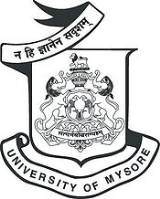
Emblem
The University emblem is adapted from the royal emblem of Mysore. It depicts the bird Gandabherunda flanked on either side by the lion-elephant Sharabha (mythical creature believed to be stronger than the lion and the elephant, and upholder of righteousness), surmounted by a lion.Motto
The University’s motto “Na Hi Jnanena Sadrusham” (Nothing compares with knowledge), is taken from the Bhagavadhgita, is written in Devanagari script on the top of the emblem. At the bottom of the emblem is the Sanskrit saying “Sathyamevoddharamyaham”(I uphold only the truth).Recent Academic Restructuring of the University
The university direction was made prominent towards basic science. The university has introduced an Integrated M.Sc courses in physics, chemistry, and Biochemistry. The University also has tied up with various Chinese universities for resource sharing and training in information technology education.The university has also initiated a next generation I-School at its campus. The International School of Information Management (ISiM), has been initiated with the collaboration of a few US universities and IIIT- Bangalore. Faculties from partnering institutions teach in this Institute. ISiM, already has secured grants from Ford Foundation and several industries for various projects.
Another development has been the setting up of the Third Sector Research Resource Centre (TSRRS).The Research Resource Centre has been set up with a grant from the Ford Foundation. The aim of the centre is to provide centralized infrastructural facility for researchers pursuing their studies in the area of Civil Society. TSRRC aims at pursuing and supporting research, training and consultancy in the area of Third Sector. Developing and offering Diploma and Masters program in the area of Non Profit Management is another area of focus.
Recently the department of law in the university was incorporated into the Mysore University School of Justice (MUSJ). Continuing with the initiative of the university to introduce five-year integrated courses to produce professionals with in-depth knowledge, the MUSJ has introduced a programme leading to a degree in Law, in a bid to enhance the quality of legal education in Karnataka.
The newly constituted Bahadur Institute of Management Sciences is trying to carve a niche for management education and research in the state. It was set up with the help of contributions from the chairman of BBK Ltd, U.S.A., B.N. Bahadur, an alumnus of the university
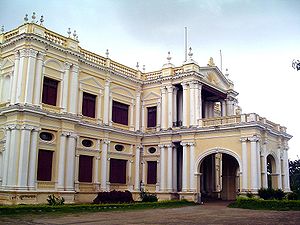
Setting up of a National Centre for History of Science, Digital Library, Centre for International Programmes, School of Life Sciences, IT Division, Joint Campus with Indian Institute of Science, Bangalore, Patent Awareness Cell and Entrepreneurial Park in Science & Technology are the main initiatives of the University. In the last five years, an Archeological and Folklore Museum has been established in the Jayalakshmi Vilas Mansion with the donation from the Infosys Foundation.
The University School of Design (USD) and the Centre for Information Science and Technology have been given autonomy for better functioning.
Distinctions
The university has been ranked very highly by the National Assessment and Accredition Council (NAAC) of the University Grant Commission of India with an A+ rating. On 29.02.08 the Government of India identified the university as 'An Institution of Excellence' and provided a special grant of Rs One Billion in the Union Budget of the year 2008-2009 for upgrading the facilities at the university.The Mysore University Library
Mysore University Library
The Mysore University Library serves the academic community of the University of Mysore at the located in Mysore, Hassan and Mandya. The Library is the largest and also oldest among the University Libraries in the southern Indian State of Karnataka....
has one of the largest collections in India with the number of volumes exceeding 800,000 documents . The university has been a pioneer in starting five year integrated MSc Programmes in the basic sciences. The department of applied botany, department of library and information sciences, department of food science and nutrition and the department of physics have a national reputation. The applied botany and seed pathology (which attract students from all over Asia), and geology and physics, are designated as `national facilities.'
Among the university's faculty members have been such luminaries as Shri. TS Venkannaiah who had the revered name as Ashnivi devata of Kannada literature, Professor S. Chandrashekar, Prof. K. V. Puttappa, Prof. U. R. Ananthamurthy and Prof. C. D. Narasimhaiah.
giri
Staff
During the last 6 years, the staff members have received 193 awards. Since the first accreditation in 1999, the university faculty have published 1280 papers in international journals and 1343 in national journals. The number of books and edited volumes is 313 and 148 respectively. A large number of general articles, novels, abstracts, etc. were also published. University Industry Interaction Center established as a center for extending consultancy services, functions as a bridge between industry and the university. The Center caters to the requirements of the industry and ensures an effective interface with the appropriate departments of the University to help them in meeting their requirements. Most of the faculty members are involved in consultancy services with reputed companies like DUPONT, ISRO, BARC, NCL, IIT-Chennai, etc. For creating awareness about the facilities and expertise available, the university has been conducting awareness programmes nameed, ‘Know Your Academic Campus’ in which people of surrounding areas are invited. Important areas in which the university has the expertise for providing consultancy include Applied Botany, Sericulture, Micromet Data Generation, Product Analysis and Quality Control, Geology, Biochemistry, Food Science And Nutrition, Psychology, Software Development, etc. The National Assessment and Accreditation CouncilNational Assessment and Accreditation Council
The National Assessment and Accreditation Council is an organization that assesses and accredits institutions of higher education in India. It is an autonomous body funded by University Grants Commission of Government of India headquartered in Bangalore.-History:NAAC was established in 1994 in...
, an autonomous body of the University Grants Commission (UGC) had accorded the university five-star status. It has recently been re-accredited as A+, the first one to be accorded that status in India. In addition, the Eighth Plan Review Committee of the UGC has recommended to the State and Central governments that it be upgraded to a `National Centre for Excellence'.
Notable faculty and alumni
- Sarvepalli RadhakrishnanSarvepalli RadhakrishnanSir Sarvepalli Radhakrishnan , OM, FBA was an Indian philosopher and statesman. He was the first Vice President of India and subsequently the second President of India ....
- S. Chandrashekar
- C.N.R. RaoC.N.R. RaoChintamani Nagesa Ramachandra Rao, also known as C.N.R. Rao ) is an Indian chemist who has worked mainly in solid-state and structural chemistry.-Education:...
- K. V. Puttappa
- C. D. Narasimhaiah
- R. K. LaxmanR. K. LaxmanRasipuram Krishnaswamy Iyer Laxman is an Indian cartoonist, illustrator, and humorist. He is widely regarded as India's greatest-ever cartoonist and is best known for his creation The Common Man....
- Mysore ManjunathMysore manjunath- Child prodigy :Amazingly Gifted Violin Maestro Dr. Mysore Manjunath represents Carnatic classical music, one of the main branches of Indian music. He was born in the city of Mysore, which is a centre for music, in South India. He trained on the violin under his father, Prof...
- N. R. Narayana MurthyN. R. Narayana MurthyNagavara Ramarao Narayana Murthy , better known as N. R. Narayana Murthy, is an Indian industrialist and software engineer. He and six other engineers founded Infosys in 1981. Mr. Murthy served as CEO from 1981 to 2002. From 2002 to 2011, he served as Chairman...
- S.V.Subrahmanyam
- Ram MadhavRam MadhavRam Madhav Varanasi is a member of the national executive and also in charge of the media and public relations of the Rashtriya Swayamsevak Sangh.-Personal life:...
- PrakashPrakashPrakash is a commonly used given name used in India, Sri Lanka and Nepal. The word Prakash is derived from the Sanskrit word Prakaash, literally meaning "Bright light" or "Sun light" or "Moon light" or simply "Light"...
- R.K.Narayan
Research
The university has been giving paramount importance to research in different disciplines since its inception. Proper research environment has been created by appointing eminent scholars, establishing research laboratories, deputing scholars under cultural exchange programme, awarding teacher fellowships, sanctioning research funds and instituting special awards and prizes for original research. In order to promote research, the university has recognized 48 national level institutions for undertaking research in different disciplines. In all, 1112 candidates are registered for Ph.D. of which 479 are with fellowships. For monitoring the research activities, the university convenes the meeting of the Post Graduate Council periodically. In the preceding 5 years, the university completed 99 Major Research Projects and 66 Minor Research Projects amounting to Rs. 390 million. The research funding was obtained from government sources and agencies like Advant India Ltd., AICTE, CSIR, DAM Hampi, DAT, DANIDA, DBT, DST, EEC, ICAR, UGC, Canadian International Development Agency, ICSSR, ICMR, and Ford Foundation. University has earmarked Rs. one million per year for funding research by junior faculty. For quality research, facilities have been created like National Single Crystal Diffractometer Facility – in Physics, National Facility for Drosophila Genetic Stocks – in Zoology, Electron Probe Micro Analyzer – in Geology, Seed Pathology lab – in Applied Botany, National Centre for History of Science, Oriental Research Institute, Multimedia laboratory in Kannada Studies and Digitization of the Library.There is a provision for limited number of Junior Research Fellowships for pursuing M.Phil/Research Degree. The university has instituted 30 research fellowships every year to SC/ST students and faculty improvement fellowship to some SC/ST teachers. Many university departments are involved in collaborative research at national level and have international collaborations also.
List of Vice Chancellors
| No | From | To!!Name!!Position previously held | ||
|---|---|---|---|---|
| 1 | 1916 | 1920 | H.V.Nanjundayya | Lecturer in Civil Engineering Civil engineering Civil engineering is a professional engineering discipline that deals with the design, construction, and maintenance of the physical and naturally built environment, including works like roads, bridges, canals, dams, and buildings... |
| 2 | 1921 | 1929 | Prof. Sir Brajendra Nath Seal Brajendra Nath Seal Sir Brajendra Nath Seal KCIE was a renowned Bengali Indian humanist philosopher. He was one of the greatest original thinkers of the Brahmo Samaj and did work in comparative religion and on the philosophy of science. He systematized the humanism of the Brahmo philosophical thought... |
Professor of Philosophy, Chair at the University of Calcutta University of Calcutta The University of Calcutta is a public university located in the city of Kolkata , India, founded on 24 January 1857... , Chancellor of Visva-Bharati University Visva-Bharati University Visva Bharati University is a Central University for research and teaching in India, located in the twin towns of Santiniketan and Sriniketan in the Indian state of West Bengal. It was founded by Rabindranath Tagore who called it Visva Bharati, which means the communion of the world with India... |
| 3 | 1930 | 1937 | Prof. E P Metcalfe E P Metcalfe Dr. EP Metcalfe was the former vice chancellor and Professor of Physics, and Principal of Central College of Bangalore University. He served from 1930 to 1937. Metcalfe was instrumental in establishing a residential college for women in Mysore in science and arts in the early 1930s... |
Professor of Physics, and Principal of Central College Bangalore |
| 4 | 1937 | 1942 | N.S.Subba Rao | M.A. (Cantab.), Bar-at-Law |
| 5 | 1942 | 1944 | E.G. McAlpine | M.A. Director of Public Instruction, Mysore |
| 6 | 1944 | 1946 | T.Singaravelu Mudaliar | |
| 7 | 1946 | 1948 | M.Sultan Mohiyuddin | |
| 8 | 1948 | 1950 | R.Kasturi Raj Chetty | |
| 9 | 1950 | 1954 | Prof. B.L.Manjunath | Professor of Chemistry, Principal of Central College Bangalore |
| 10 | 1954 | 1956 | Prof. V.L.D'Souza | Professor of Economics, Maharaja College of Mysore Maharaja College of Mysore -History & Evolution:It was one of the constituent colleges of Madras University and transferred to Mysore University in 1916. It is one of the oldest colleges of South India. It is the first college for higher studies built by an Indian king at the time of British rule. Former President of India... |
| 11 | 1956 | 1960 | Dr. K.V.Puttappa Kuvempu Kuppali Venkatappagowda Puttappa was a Kannada writer and poet, widely regarded as the greatest poet of 20th century Kannada literature. He is the first among eight recipients of Jnanpith Award for Kannada. Puttappa wrote all his literary works using the pen name Kuvempu... |
Literatteur |
| 12 | 1960 | 1962 | Prof. N.A. Nikam | Professor of Philosophy, Department of Philosophy, University of Mysore |
| 13 | 1963 | 1964 | K.M. Panikkar | Distinguished diplomat, author and historian Indian Ambassador to China, France and Egypt |
| 14 | 1964 | 1969 | Prof. K. L. Shrimali K. L. Shrimali Dr. K.L.Shrimali was the Union Education Minister for the Government of India and also a distinguished parliamentarian and an educationist.... |
Professor of Education, M.A., Ph.D., Minister for Education, Government of India Government of India The Government of India, officially known as the Union Government, and also known as the Central Government, was established by the Constitution of India, and is the governing authority of the union of 28 states and seven union territories, collectively called the Republic of India... . |
| 15 | 1969 | 1975 | Prof. D. Javare Gowda Javare Gowda Dr. D. Javare Gowda is a Kannada author and winner of the Padma Shri and the Karnataka Ratna awards. He is known as "De Ja Gow" in literary circles. His guru was T.N. Srikantaiah.- Career:He was the Vice Chancellor of Mysore University from 1969 to 1975... |
Professor of Literature Director of the Institute of Kannada Studies at University of Mysore |
| 16 | 1976 | 1979 | D. Vijaydevraj Urs | |
| 17 | 1979 | 1985 | Prof. K.S. Hegde | |
| 18 | 1988 | 1988 | Dr. Y.P. Rudrappa | Doctor, M.B.B.S, F.R.C.P.(EDIN), D.T.M & H, (ENG) University of Mysore, Health and Family Welfare Service |
| 19 | 1988 | 1991 | Prof. P. Selvie Das | Professor of Education, Director of Higher Education of Karnataka |
| 20 | 1991 | 1997 | Prof. M. Madaiah | Professor of Economics, University of Mysore |
| 21 | 1997 | 2003 | Prof. S.N.Hegde | Professor of Botany, University of Mangalore M.Sc., Ph.D., M.I.Biol (U.K) |
| 22 | 2003 | 2007 | Prof. Shashidhara Prasad | Professor of Physics, University of Mysore M.Sc., Ph.D., CPhys. FInstP |
| 23 | 2009 | 2XXX | Prof. V. G. Talwar | Professor of Library and Information Sciences, University of Mysore DLISc (University of Mysore) |