


United States v. Microsoft

Encyclopedia
United States v. Microsoft was a set of civil actions filed against Microsoft Corporation pursuant to the Sherman Antitrust Act of 1890
Section 1 and 2 on May 8, 1998 by the United States Department of Justice
(DOJ) and 20 U.S. states. Joel I. Klein
was the lead prosecutor. The plaintiffs alleged that Microsoft abused monopoly
power on Intel-based personal computers in its handling of operating system
sales and web browser
sales. The issue central to the case was whether Microsoft was allowed to bundle its flagship Internet Explorer
(IE) web browser software with its Microsoft Windows
operating system. Bundling them together is alleged to have been responsible for Microsoft's victory in the browser wars
as every Windows user had a copy of Internet Explorer. It was further alleged that this restricted the market for competing web browsers (such as Netscape Navigator
or Opera
) that were slow to download over a modem or had to be purchased at a store. Underlying these disputes were questions over whether Microsoft altered or manipulated its application programming interface
s (APIs) to favor Internet Explorer over third party web browsers, Microsoft's conduct in forming restrictive licensing agreements with original equipment manufacturer
(OEMs), and Microsoft's intent in its course of conduct.
Microsoft stated that the merging of Microsoft Windows and Internet Explorer was the result of innovation
and competition
, that the two were now the same product and were inextricably linked together and that consumers were now getting all the benefits of IE for free. Those who opposed Microsoft's position countered that the browser was still a distinct and separate product which did not need to be tied to the operating system, since a separate version of Internet Explorer was available for Mac OS
. They also asserted that IE was not really free because its development and marketing costs may have kept the price of Windows higher than it might otherwise have been. The case was tried before Judge Thomas Penfield Jackson
in the United States District Court for the District of Columbia
. The DOJ was initially represented by David Boies
.
over whether Microsoft was abusing its monopoly on the PC operating system market. The commissioners deadlocked with a 2-2 vote in 1993 and closed the investigation, but the Department of Justice opened its own investigation on August 21 of that year, resulting in a settlement on July 15, 1994 in which Microsoft consented not to tie other Microsoft products to the sale of Windows but remained free to integrate additional features into the operating system. In the years that followed, Microsoft insisted that Internet Explorer (which first appeared in the Plus! Pack
sold separately from Windows 95) was not a product but a feature which it was allowed to add to Windows, although the DOJ did not agree with this definition.
In its 2008 Annual Report, Microsoft stated:
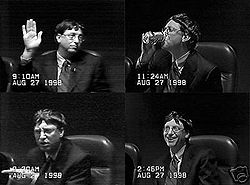 The trial started on May 18, 1998 with the U.S. Justice Department and the Attorneys General of twenty U.S. states suing Microsoft for illegally thwarting competition in order to protect and extend its software monopoly. Later, in October the US Justice Department also sued Microsoft for violating a 1994 consent decree by forcing computer makers to include its Internet browser as a part of the installation of Windows software.
Microsoft Chairman Bill Gates
was called "evasive and nonresponsive" by a source present at a session in which Gates was questioned on his deposition. He argued over the definitions of words such as "compete", "concerned", "ask", and "we". BusinessWeek reported, "Early rounds of his deposition show him offering obfuscatory answers and saying 'I don't recall' so many times that even the presiding judge had to chuckle. Worse, many of the technology chief's denials and pleas of ignorance have been directly refuted by prosecutors with snippets of E-mail Gates both sent and received." Intel Vice-President Steven McGeady
, called as a witness, quoted Paul Maritz
, a senior Microsoft vice president as having stated an intention to "extinguish
" and "smother" rival Netscape Communications Corporation and to "cut off Netscape's air supply" by giving away a clone of Netscape's flagship product for free. The Microsoft executive denied the allegations.
A number of videotapes were submitted as evidence by Microsoft during the trial, including one that demonstrated that removing Internet Explorer from Microsoft Windows caused slowdowns and malfunctions in Windows. In the videotaped demonstration of what Microsoft vice president James Allchin
's stated to be a seamless segment filmed on one PC, the plaintiff noticed that some icons mysteriously disappear and reappear on the PC's desktop, suggesting that the effects might have been falsified. Allchin admitted that the blame for the tape problems lay with some of his staff. "They ended up filming it – grabbing the wrong screen shot," he said of the incident. Later, Allchin re-ran the demonstration and provided a new videotape, but in so doing Microsoft dropped the claim that Windows is slowed down when Internet Explorer is removed. Mark Murray, a Microsoft spokesperson, berated the government attorneys for "nitpicking on issues like video production." Microsoft submitted a second inaccurate videotape into evidence later the same month as the first. The issue in question was how easy or hard it was for America Online users to download and install Netscape Navigator onto a Windows PC. Microsoft's videotape showed the process as being quick and easy, resulting in the Netscape icon appearing on the user's desktop. The government produced its own videotape of the same process, revealing that Microsoft's videotape had conveniently removed a long and complex part of the procedure and that the Netscape icon was not placed on the desktop, requiring a user to search for it. Brad Chase, a Microsoft vice president, verified the government's tape and conceded that Microsoft's own tape was falsified.
When the judge ordered Microsoft to offer a version of Windows which did not include Internet Explorer, Microsoft responded that the company would offer manufacturers a choice: one version of Windows that was obsolete, or another that did not work properly. The judge asked, "It seemed absolutely clear to you that I entered an order that required that you distribute a product that would not work?" David D. Cole
, a Microsoft vice president, replied, "In plain English, yes. We followed that order. It wasn't my place to consider the consequences of that."
Microsoft vigorously defended itself in the public arena, arguing that its attempts to "innovate" were under attack by rival companies jealous at its success, and that government litigation was merely their pawn (see public choice theory
). A full-page ad run in The Washington Post
and The New York Times
on June 2, 1999 by The Independent Institute delivered "An Open Letter to President Clinton From 240 Economists On Antitrust Protectionism." It said, in part, "Consumers did not ask for these antitrust actions — rival business firms did. Consumers of high technology have enjoyed falling prices, expanding outputs, and a breathtaking array of new products and innovations. ... Increasingly, however, some firms have sought to handicap their rivals by turning to government for protection. Many of these cases are based on speculation about some vaguely specified consumer harm in some unspecified future, and many of the proposed interventions will weaken successful U.S. firms and impede their competitiveness abroad."
Judge Jackson issued his findings of fact on November 5, 1999, which stated that Microsoft's dominance of the x86 based personal computer operating systems market constituted a monopoly, and that Microsoft had taken actions to crush threats to that monopoly, including Apple, Java, Netscape, Lotus Notes, Real Networks, Linux, and others. Then on April 3, 2000, he issued a two-part ruling: his conclusions of law were that Microsoft had committed monopolization
, attempted monopolization, and tying in violation of Sections 1 and 2 of the Sherman Act
, and his remedy was that Microsoft must be broken into two separate units, one to produce the operating system, and one to produce other software components.
The trial was also notable for the use by both the prosecution and the defense of professors of MIT to serve as expert witnesses to bolster their cases. Richard L. Schmalensee
, a noted economist
and the dean of the MIT Sloan School of Management
, testified as an expert witness in favor of Microsoft. Franklin Fisher
, another MIT economist who was Schmalensee's former doctoral thesis adviser, testified in favor of the Department of Justice
.
. However, the Supreme Court declined to hear the appeal and sent the case to a federal appeals court.
The D.C. Circuit Court of Appeals
overturned Judge Jackson's rulings against Microsoft. This was partly because the Appellate court had adopted a "drastically altered scope of liability" under which the Remedies could be taken, and also partly due to the embargoed
interviews Judge Jackson had given to the news media
while he was still hearing the case, in violation of the Code of Conduct for US Judges. Judge Jackson did not attend the D.C. Circuit Court of Appeals hearing, in which the appeals court judges accused him of unethical conduct and determined he should have recused himself from the case.
Judge Jackson's response to this was that Microsoft's conduct itself was the cause of any "perceived bias"; Microsoft executives had "proved, time and time again, to be inaccurate, misleading, evasive, and transparently false. ... Microsoft is a company with an institutional disdain for both the truth and for rules of law that lesser entities must respect. It is also a company whose senior management is not averse to offering specious testimony to support spurious defenses to claims of its wrongdoing."
However, the appeals court did not overturn the findings of fact. The D.C. Circuit remanded the case for consideration of a proper remedy under a more limited scope of liability. Judge Colleen Kollar-Kotelly was chosen to hear the case.
The DOJ announced on September 6, 2001 that it was no longer seeking to break up Microsoft and would instead seek a lesser antitrust penalty. Microsoft decided to draft a settlement proposal allowing PC manufacturers to adopt non-Microsoft software.
with third-party companies and appoint a panel of three people who will have full access to Microsoft's systems, records, and source code for five years in order to ensure compliance."United States of America, Plaintiff, v. Microsoft Corporation, Defendant", Final Judgement, Civil Action No. 98-1232, November 12, 2002. (Archive at http://www.webcitation.org/query?id=1298667420478033) The Settlement's requirements were primarily designed to ensure there were stringent oversight procedures and explicit requirements to prevent Microsoft from engaging in "Predatory Behavior
" or other practices that might form a "Barrier to Entry". However, the DOJ did not require Microsoft to change any of its code nor prevent Microsoft from tying other software with Windows in the future. On August 5, 2002, Microsoft announced that it would make some concessions towards the proposed final settlement ahead of the judge's verdict. On November 1, 2002, Judge Kollar-Kotelly released a judgment accepting most of the proposed DOJ settlement. Nine states (California, Connecticut, Iowa, Florida, Kansas, Minnesota, Utah, Virginia and Massachusetts) and the District of Columbia
(which had been pursuing the case together with the DOJ) did not agree with the settlement, arguing that it did not go far enough to curb Microsoft's anti-competitive business practices. On June 30, 2004, the U.S. appeals court unanimously approved the settlement with the Justice Department, rejecting objections that the sanctions were inadequate.
The dissenting states regarded the settlement as merely a slap on the wrist. Industry pundit Robert X. Cringely
believed a breakup was not possible, and that "now the only way Microsoft can die is by suicide." Andrew Chin, an antitrust law professor at the University of North Carolina at Chapel Hill
who assisted Judge Jackson in drafting the findings of fact, wrote that the settlement gave Microsoft "a special antitrust immunity to license Windows and other 'platform software' under contractual terms that destroy freedom of competition. Microsoft now enjoys illegitimately acquired monopoly power in the market for Web browser software products."
Microsoft's obligations under the settlement, as originally drafted, expired on November 12, 2007. However, Microsoft later "agreed to consent to a two-year extension of part of the Final Judgments" dealing with communications protocol
licensing, and that if the plaintiffs later wished to extend those aspects of the settlement even as far as 2012, it would not object. The plaintiffs made clear that the extension was intended to serve only to give the relevant part of the settlement "the opportunity to succeed for the period of time it was intended to cover", rather than being due to any "pattern of willful and systematic violations". The court has yet to approve the change in terms .
believed that the antitrust case against Microsoft set a dangerous precedent that foreshadowed increasing government regulation of what was formerly an industry that was relatively free of government intrusion and that future technological progress in the industry will be impeded as a result.
Jean-Louis Gassée
, CEO of Be Inc.
, claimed Microsoft was not really making any money from Internet Explorer, and its incorporation with the operating system was due to consumer expectation to have a browser packaged with the operating system. For example, BeOS
comes packaged with its web browser, NetPositive
. Instead, he argued, Microsoft's true anticompetitive clout was in the rebates it offered to OEMs preventing other operating systems from getting a foothold in the market.
Sherman Antitrust Act
The Sherman Antitrust Act requires the United States federal government to investigate and pursue trusts, companies, and organizations suspected of violating the Act. It was the first Federal statute to limit cartels and monopolies, and today still forms the basis for most antitrust litigation by...
Section 1 and 2 on May 8, 1998 by the United States Department of Justice
United States Department of Justice
The United States Department of Justice , is the United States federal executive department responsible for the enforcement of the law and administration of justice, equivalent to the justice or interior ministries of other countries.The Department is led by the Attorney General, who is nominated...
(DOJ) and 20 U.S. states. Joel I. Klein
Joel Klein
Joel Irwin Klein was Chancellor of the New York City Department of Education, the largest public school system in the United States, serving more than 1.1 million students in more than 1,600 schools...
was the lead prosecutor. The plaintiffs alleged that Microsoft abused monopoly
Monopoly
A monopoly exists when a specific person or enterprise is the only supplier of a particular commodity...
power on Intel-based personal computers in its handling of operating system
Operating system
An operating system is a set of programs that manage computer hardware resources and provide common services for application software. The operating system is the most important type of system software in a computer system...
sales and web browser
Web browser
A web browser is a software application for retrieving, presenting, and traversing information resources on the World Wide Web. An information resource is identified by a Uniform Resource Identifier and may be a web page, image, video, or other piece of content...
sales. The issue central to the case was whether Microsoft was allowed to bundle its flagship Internet Explorer
Internet Explorer
Windows Internet Explorer is a series of graphical web browsers developed by Microsoft and included as part of the Microsoft Windows line of operating systems, starting in 1995. It was first released as part of the add-on package Plus! for Windows 95 that year...
(IE) web browser software with its Microsoft Windows
Microsoft Windows
Microsoft Windows is a series of operating systems produced by Microsoft.Microsoft introduced an operating environment named Windows on November 20, 1985 as an add-on to MS-DOS in response to the growing interest in graphical user interfaces . Microsoft Windows came to dominate the world's personal...
operating system. Bundling them together is alleged to have been responsible for Microsoft's victory in the browser wars
Browser wars
Browser wars is a metaphorical term that refers to competitions for dominance in usage share in the web browser marketplace. The term is often used to denote two specific rivalries: the competition that saw Microsoft's Internet Explorer replace Netscape's Navigator as the dominant browser during...
as every Windows user had a copy of Internet Explorer. It was further alleged that this restricted the market for competing web browsers (such as Netscape Navigator
Netscape Navigator
Netscape Navigator was a proprietary web browser that was popular in the 1990s. It was the flagship product of the Netscape Communications Corporation and the dominant web browser in terms of usage share, although by 2002 its usage had almost disappeared...
or Opera
Opera (web browser)
Opera is a web browser and Internet suite developed by Opera Software with over 200 million users worldwide. The browser handles common Internet-related tasks such as displaying web sites, sending and receiving e-mail messages, managing contacts, chatting on IRC, downloading files via BitTorrent,...
) that were slow to download over a modem or had to be purchased at a store. Underlying these disputes were questions over whether Microsoft altered or manipulated its application programming interface
Application programming interface
An application programming interface is a source code based specification intended to be used as an interface by software components to communicate with each other...
s (APIs) to favor Internet Explorer over third party web browsers, Microsoft's conduct in forming restrictive licensing agreements with original equipment manufacturer
Original Equipment Manufacturer
An original equipment manufacturer, or OEM, manufactures products or components that are purchased by a company and retailed under that purchasing company's brand name. OEM refers to the company that originally manufactured the product. When referring to automotive parts, OEM designates a...
(OEMs), and Microsoft's intent in its course of conduct.
Microsoft stated that the merging of Microsoft Windows and Internet Explorer was the result of innovation
Innovation
Innovation is the creation of better or more effective products, processes, technologies, or ideas that are accepted by markets, governments, and society...
and competition
Competition
Competition is a contest between individuals, groups, animals, etc. for territory, a niche, or a location of resources. It arises whenever two and only two strive for a goal which cannot be shared. Competition occurs naturally between living organisms which co-exist in the same environment. For...
, that the two were now the same product and were inextricably linked together and that consumers were now getting all the benefits of IE for free. Those who opposed Microsoft's position countered that the browser was still a distinct and separate product which did not need to be tied to the operating system, since a separate version of Internet Explorer was available for Mac OS
Mac OS
Mac OS is a series of graphical user interface-based operating systems developed by Apple Inc. for their Macintosh line of computer systems. The Macintosh user experience is credited with popularizing the graphical user interface...
. They also asserted that IE was not really free because its development and marketing costs may have kept the price of Windows higher than it might otherwise have been. The case was tried before Judge Thomas Penfield Jackson
Thomas Penfield Jackson
Thomas Penfield Jackson is a former United States District Court Judge for the District of Columbia....
in the United States District Court for the District of Columbia
United States District Court for the District of Columbia
The United States District Court for the District of Columbia is a federal district court. Appeals from the District are taken to the United States Court of Appeals for the District of Columbia Circuit The United States District Court for the District of Columbia (in case citations, D.D.C.) is a...
. The DOJ was initially represented by David Boies
David Boies
David Boies is an American lawyer and chairman of the law firm Boies, Schiller & Flexner. He has been involved in various high-profile cases in the United States.-Early life and education:...
.
History
The U.S. government's interest in Microsoft's had begun in 1991 with an inquiry by the Federal Trade CommissionFederal Trade Commission
The Federal Trade Commission is an independent agency of the United States government, established in 1914 by the Federal Trade Commission Act...
over whether Microsoft was abusing its monopoly on the PC operating system market. The commissioners deadlocked with a 2-2 vote in 1993 and closed the investigation, but the Department of Justice opened its own investigation on August 21 of that year, resulting in a settlement on July 15, 1994 in which Microsoft consented not to tie other Microsoft products to the sale of Windows but remained free to integrate additional features into the operating system. In the years that followed, Microsoft insisted that Internet Explorer (which first appeared in the Plus! Pack
Microsoft Plus!
Microsoft Plus! was a commercial operating system enhancement product by Microsoft. The last edition is the Plus! SuperPack, which includes an assortment of screensavers, themes, and games, as well as multimedia applications...
sold separately from Windows 95) was not a product but a feature which it was allowed to add to Windows, although the DOJ did not agree with this definition.
In its 2008 Annual Report, Microsoft stated:
Trial
Microsoft Chairman Bill Gates
Bill Gates
William Henry "Bill" Gates III is an American business magnate, investor, philanthropist, and author. Gates is the former CEO and current chairman of Microsoft, the software company he founded with Paul Allen...
was called "evasive and nonresponsive" by a source present at a session in which Gates was questioned on his deposition. He argued over the definitions of words such as "compete", "concerned", "ask", and "we". BusinessWeek reported, "Early rounds of his deposition show him offering obfuscatory answers and saying 'I don't recall' so many times that even the presiding judge had to chuckle. Worse, many of the technology chief's denials and pleas of ignorance have been directly refuted by prosecutors with snippets of E-mail Gates both sent and received." Intel Vice-President Steven McGeady
Steven McGeady
Steven McGeady is a former Intel executive best known as a witness in the Microsoft antitrust trial. His notes contained colorful quotes by Microsoft executives threatening to "cut off Netscape's air supply" and Bill Gates' guess that "this anti-trust thing will blow over"...
, called as a witness, quoted Paul Maritz
Paul Maritz
Paul Maritz is CEO of VMware Corporation , and a past senior executive at Microsoft.Born and raised in Rhodesia , his family later moved to South Africa where he was schooled at Highbury Preparatory School and Hilton College. He received a B.Sc. in Computer Science from the University of Natal,...
, a senior Microsoft vice president as having stated an intention to "extinguish
Embrace, extend and extinguish
"Embrace, extend and extinguish," also known as "Embrace, extend and exterminate," is a phrase that the U.S. Department of Justice found was used internally by Microsoft to describe its strategy for entering product categories involving widely used standards, extending those standards with...
" and "smother" rival Netscape Communications Corporation and to "cut off Netscape's air supply" by giving away a clone of Netscape's flagship product for free. The Microsoft executive denied the allegations.
A number of videotapes were submitted as evidence by Microsoft during the trial, including one that demonstrated that removing Internet Explorer from Microsoft Windows caused slowdowns and malfunctions in Windows. In the videotaped demonstration of what Microsoft vice president James Allchin
James Allchin
James "Jim" Edward Allchin is a former executive at Microsoft, where he was responsible for many of the platform components from Microsoft including Microsoft Windows, Windows Server, server products such as SQL Server, and developer technologies. He may be most known for building Microsoft's...
's stated to be a seamless segment filmed on one PC, the plaintiff noticed that some icons mysteriously disappear and reappear on the PC's desktop, suggesting that the effects might have been falsified. Allchin admitted that the blame for the tape problems lay with some of his staff. "They ended up filming it – grabbing the wrong screen shot," he said of the incident. Later, Allchin re-ran the demonstration and provided a new videotape, but in so doing Microsoft dropped the claim that Windows is slowed down when Internet Explorer is removed. Mark Murray, a Microsoft spokesperson, berated the government attorneys for "nitpicking on issues like video production." Microsoft submitted a second inaccurate videotape into evidence later the same month as the first. The issue in question was how easy or hard it was for America Online users to download and install Netscape Navigator onto a Windows PC. Microsoft's videotape showed the process as being quick and easy, resulting in the Netscape icon appearing on the user's desktop. The government produced its own videotape of the same process, revealing that Microsoft's videotape had conveniently removed a long and complex part of the procedure and that the Netscape icon was not placed on the desktop, requiring a user to search for it. Brad Chase, a Microsoft vice president, verified the government's tape and conceded that Microsoft's own tape was falsified.
When the judge ordered Microsoft to offer a version of Windows which did not include Internet Explorer, Microsoft responded that the company would offer manufacturers a choice: one version of Windows that was obsolete, or another that did not work properly. The judge asked, "It seemed absolutely clear to you that I entered an order that required that you distribute a product that would not work?" David D. Cole
David D. Cole
David D. Cole is an American law professor at the Georgetown University Law Center. He has published in various legal fields including civil rights, criminal justice, constitutional law and law and literature...
, a Microsoft vice president, replied, "In plain English, yes. We followed that order. It wasn't my place to consider the consequences of that."
Microsoft vigorously defended itself in the public arena, arguing that its attempts to "innovate" were under attack by rival companies jealous at its success, and that government litigation was merely their pawn (see public choice theory
Public choice theory
In economics, public choice theory is the use of modern economic tools to study problems that traditionally are in the province of political science...
). A full-page ad run in The Washington Post
The Washington Post
The Washington Post is Washington, D.C.'s largest newspaper and its oldest still-existing paper, founded in 1877. Located in the capital of the United States, The Post has a particular emphasis on national politics. D.C., Maryland, and Virginia editions are printed for daily circulation...
and The New York Times
The New York Times
The New York Times is an American daily newspaper founded and continuously published in New York City since 1851. The New York Times has won 106 Pulitzer Prizes, the most of any news organization...
on June 2, 1999 by The Independent Institute delivered "An Open Letter to President Clinton From 240 Economists On Antitrust Protectionism." It said, in part, "Consumers did not ask for these antitrust actions — rival business firms did. Consumers of high technology have enjoyed falling prices, expanding outputs, and a breathtaking array of new products and innovations. ... Increasingly, however, some firms have sought to handicap their rivals by turning to government for protection. Many of these cases are based on speculation about some vaguely specified consumer harm in some unspecified future, and many of the proposed interventions will weaken successful U.S. firms and impede their competitiveness abroad."
Judge Jackson issued his findings of fact on November 5, 1999, which stated that Microsoft's dominance of the x86 based personal computer operating systems market constituted a monopoly, and that Microsoft had taken actions to crush threats to that monopoly, including Apple, Java, Netscape, Lotus Notes, Real Networks, Linux, and others. Then on April 3, 2000, he issued a two-part ruling: his conclusions of law were that Microsoft had committed monopolization
Monopolization
The term monopolization refers to an offense under Section 2 of the American Sherman Antitrust Act, passed in 1890. Section 2 states that any person "who shall monopolize . ....
, attempted monopolization, and tying in violation of Sections 1 and 2 of the Sherman Act
Sherman Antitrust Act
The Sherman Antitrust Act requires the United States federal government to investigate and pursue trusts, companies, and organizations suspected of violating the Act. It was the first Federal statute to limit cartels and monopolies, and today still forms the basis for most antitrust litigation by...
, and his remedy was that Microsoft must be broken into two separate units, one to produce the operating system, and one to produce other software components.
The trial was also notable for the use by both the prosecution and the defense of professors of MIT to serve as expert witnesses to bolster their cases. Richard L. Schmalensee
Richard L. Schmalensee
Richard Lee "Dick" Schmalensee is the John C. Head III Dean, Emeritus and the Howard W. Johnson Professor of Management and Economics at the MIT Sloan School of Management...
, a noted economist
Economist
An economist is a professional in the social science discipline of economics. The individual may also study, develop, and apply theories and concepts from economics and write about economic policy...
and the dean of the MIT Sloan School of Management
MIT Sloan School of Management
The MIT Sloan School of Management is the business school of the Massachusetts Institute of Technology, in Cambridge, Massachusetts....
, testified as an expert witness in favor of Microsoft. Franklin Fisher
Franklin M. Fisher
Franklin Marvin Fisher is an American economist. He has taught economics at the Massachusetts Institute of Technology since 1960.-Biography:...
, another MIT economist who was Schmalensee's former doctoral thesis adviser, testified in favor of the Department of Justice
United States Department of Justice
The United States Department of Justice , is the United States federal executive department responsible for the enforcement of the law and administration of justice, equivalent to the justice or interior ministries of other countries.The Department is led by the Attorney General, who is nominated...
.
Appeal
On September 26, 2000, after Judge Jackson issued his findings of fact, the plaintiffs (to save time) attempted to send Microsoft's appeal directly to the U.S. Supreme CourtSupreme Court of the United States
The Supreme Court of the United States is the highest court in the United States. It has ultimate appellate jurisdiction over all state and federal courts, and original jurisdiction over a small range of cases...
. However, the Supreme Court declined to hear the appeal and sent the case to a federal appeals court.
The D.C. Circuit Court of Appeals
United States Court of Appeals for the District of Columbia Circuit
The United States Court of Appeals for the District of Columbia Circuit known informally as the D.C. Circuit, is the federal appellate court for the U.S. District Court for the District of Columbia. Appeals from the D.C. Circuit, as with all the U.S. Courts of Appeals, are heard on a...
overturned Judge Jackson's rulings against Microsoft. This was partly because the Appellate court had adopted a "drastically altered scope of liability" under which the Remedies could be taken, and also partly due to the embargoed
News Embargo
In journalism and public relations, a news embargo or press embargo is a request by a source that the information or news provided by that source not be published until a certain date or certain conditions have been met...
interviews Judge Jackson had given to the news media
News media
The news media are those elements of the mass media that focus on delivering news to the general public or a target public.These include print media , broadcast news , and more recently the Internet .-Etymology:A medium is a carrier of something...
while he was still hearing the case, in violation of the Code of Conduct for US Judges. Judge Jackson did not attend the D.C. Circuit Court of Appeals hearing, in which the appeals court judges accused him of unethical conduct and determined he should have recused himself from the case.
Judge Jackson's response to this was that Microsoft's conduct itself was the cause of any "perceived bias"; Microsoft executives had "proved, time and time again, to be inaccurate, misleading, evasive, and transparently false. ... Microsoft is a company with an institutional disdain for both the truth and for rules of law that lesser entities must respect. It is also a company whose senior management is not averse to offering specious testimony to support spurious defenses to claims of its wrongdoing."
However, the appeals court did not overturn the findings of fact. The D.C. Circuit remanded the case for consideration of a proper remedy under a more limited scope of liability. Judge Colleen Kollar-Kotelly was chosen to hear the case.
The DOJ announced on September 6, 2001 that it was no longer seeking to break up Microsoft and would instead seek a lesser antitrust penalty. Microsoft decided to draft a settlement proposal allowing PC manufacturers to adopt non-Microsoft software.
Settlement
On November 2, 2001, the DOJ reached an agreement with Microsoft to settle the case. The proposed settlement required Microsoft to share its application programming interfacesApplication programming interface
An application programming interface is a source code based specification intended to be used as an interface by software components to communicate with each other...
with third-party companies and appoint a panel of three people who will have full access to Microsoft's systems, records, and source code for five years in order to ensure compliance."United States of America, Plaintiff, v. Microsoft Corporation, Defendant", Final Judgement, Civil Action No. 98-1232, November 12, 2002. (Archive at http://www.webcitation.org/query?id=1298667420478033) The Settlement's requirements were primarily designed to ensure there were stringent oversight procedures and explicit requirements to prevent Microsoft from engaging in "Predatory Behavior
Predatory pricing
In business and economics, predatory pricing is the practice of selling a product or service at a very low price, intending to drive competitors out of the market, or create barriers to entry for potential new competitors. If competitors or potential competitors cannot sustain equal or lower prices...
" or other practices that might form a "Barrier to Entry". However, the DOJ did not require Microsoft to change any of its code nor prevent Microsoft from tying other software with Windows in the future. On August 5, 2002, Microsoft announced that it would make some concessions towards the proposed final settlement ahead of the judge's verdict. On November 1, 2002, Judge Kollar-Kotelly released a judgment accepting most of the proposed DOJ settlement. Nine states (California, Connecticut, Iowa, Florida, Kansas, Minnesota, Utah, Virginia and Massachusetts) and the District of Columbia
Washington, D.C.
Washington, D.C., formally the District of Columbia and commonly referred to as Washington, "the District", or simply D.C., is the capital of the United States. On July 16, 1790, the United States Congress approved the creation of a permanent national capital as permitted by the U.S. Constitution....
(which had been pursuing the case together with the DOJ) did not agree with the settlement, arguing that it did not go far enough to curb Microsoft's anti-competitive business practices. On June 30, 2004, the U.S. appeals court unanimously approved the settlement with the Justice Department, rejecting objections that the sanctions were inadequate.
The dissenting states regarded the settlement as merely a slap on the wrist. Industry pundit Robert X. Cringely
Robert X. Cringely
Robert X. Cringely is the pen name of both technology journalist Mark Stephens and a string of writers for a column in InfoWorld, the one-time weekly computer trade newspaper published by IDG.- Biography :...
believed a breakup was not possible, and that "now the only way Microsoft can die is by suicide." Andrew Chin, an antitrust law professor at the University of North Carolina at Chapel Hill
University of North Carolina at Chapel Hill
The University of North Carolina at Chapel Hill is a public research university located in Chapel Hill, North Carolina, United States...
who assisted Judge Jackson in drafting the findings of fact, wrote that the settlement gave Microsoft "a special antitrust immunity to license Windows and other 'platform software' under contractual terms that destroy freedom of competition. Microsoft now enjoys illegitimately acquired monopoly power in the market for Web browser software products."
Microsoft's obligations under the settlement, as originally drafted, expired on November 12, 2007. However, Microsoft later "agreed to consent to a two-year extension of part of the Final Judgments" dealing with communications protocol
Communications protocol
A communications protocol is a system of digital message formats and rules for exchanging those messages in or between computing systems and in telecommunications...
licensing, and that if the plaintiffs later wished to extend those aspects of the settlement even as far as 2012, it would not object. The plaintiffs made clear that the extension was intended to serve only to give the relevant part of the settlement "the opportunity to succeed for the period of time it was intended to cover", rather than being due to any "pattern of willful and systematic violations". The court has yet to approve the change in terms .
Criticisms of the case
The late Nobel economist Milton FriedmanMilton Friedman
Milton Friedman was an American economist, statistician, academic, and author who taught at the University of Chicago for more than three decades...
believed that the antitrust case against Microsoft set a dangerous precedent that foreshadowed increasing government regulation of what was formerly an industry that was relatively free of government intrusion and that future technological progress in the industry will be impeded as a result.
Jean-Louis Gassée
Jean-Louis Gassée
Jean-Louis Gassée is a former executive at Apple Computer, where he worked from 1981 to 1990. He is most famous for founding Be Inc., creators of the BeOS computer operating system. After leaving Be, he became Chairman of PalmSource, Inc. in November, 2004.-1980s: Apple Computer:Gassée worked for...
, CEO of Be Inc.
Be Inc.
Be Incorporated was an American computer company founded in 1990, best known for the Be Operating System and BeBox personal computer. Be was founded by former Apple Computer executive Jean-Louis Gassée with capital from Seymour Cray....
, claimed Microsoft was not really making any money from Internet Explorer, and its incorporation with the operating system was due to consumer expectation to have a browser packaged with the operating system. For example, BeOS
BeOS
BeOS is an operating system for personal computers which began development by Be Inc. in 1991. It was first written to run on BeBox hardware. BeOS was optimized for digital media work and was written to take advantage of modern hardware facilities such as symmetric multiprocessing by utilizing...
comes packaged with its web browser, NetPositive
NetPositive
NetPositive is the default browser that comes with the Be Operating System . It has partial support for JavaScript, but no Java or CSS support. NetPositive originally was the only web browser available for BeOS, but that is no longer the case. The last official version of NetPositive before the...
. Instead, he argued, Microsoft's true anticompetitive clout was in the rebates it offered to OEMs preventing other operating systems from getting a foothold in the market.
See also
- Browser WarsBrowser warsBrowser wars is a metaphorical term that refers to competitions for dominance in usage share in the web browser marketplace. The term is often used to denote two specific rivalries: the competition that saw Microsoft's Internet Explorer replace Netscape's Navigator as the dominant browser during...
- European Union Microsoft competition case
- Embrace, extend and extinguishEmbrace, extend and extinguish"Embrace, extend and extinguish," also known as "Embrace, extend and exterminate," is a phrase that the U.S. Department of Justice found was used internally by Microsoft to describe its strategy for entering product categories involving widely used standards, extending those standards with...
- Criticism of MicrosoftCriticism of MicrosoftCriticism of Microsoft has followed various aspects of its products and business practices. Issues with ease of use, stability, and security of the company's software are common targets for critics. In the 2000s, a number of malware attacks have targeted security flaws in Microsoft Windows and...
- Microsoft litigationMicrosoft litigationMicrosoft has been involved in numerous high-profile litigations over the history of the company, including cases against the United States, the European Union, and competitors.-Governmental:In its 2008 annual report, Microsoft stated:-Anti-trust:...
- Antitrust (film)Antitrust (film)Antitrust is a 2001 thriller film written by Howard Franklin and directed by Peter Howitt....
(2001) about "NURV", a large software company that presents a fictionalized Microsoft, according to many reviewers
External links
- Final Judgment in U.S. v. Microsoft (injunction including final settlement terms approved by the court) (note that the copy posted on the district court's web site is actually an earlier version that the court declined to approve).
- The United States DOJ's website on U.S. v. Microsoft
- Microsoft's Antitrust Case, Microsoft News Center
- Wired news timeline of the Microsoft antitrust case
- ZDnet story on 4th anniversary of Microsoft antitrust case
- ZDnet story on proposed concessions
- Antitrust & the Internet: Microsoft case archive
- "A Case of Insecure Browsing" by Andrew Chin. Raleigh News & Observer, September 30, 2004
- Bill Gates deposition video at Microsoft on August 27, 1998 (Windows Media, ogg Theora and ogg Vorbis formats)
- The Center for the Advancement of Capitalism