
All Topics  
United States five-dollar bill

 
United States Five Dollar Bill

   Email Print
   Bookmark   Link


United States five-dollar bill


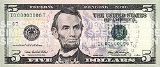
The United States five-dollar bill ($5) is a denomination
Denomination (currency)

Denomination is a proper description of a currency amount, usually for coins or banknotes. Denominations may also be used with other means of payment like Scrips....
 of United States currency
United States dollar

The United States dollar is the unit of currency of the United States and was defined by the Coinage Act of 1792 to be between 371 and 416 grains of silver ....
. The $5 bill currently features U.S. President
President of the United States

The President of the United States is the head of state and head of government of the United States and is the highest political official in the United States by influence and recognition....
 Abraham Lincoln
Abraham Lincoln

Abraham Lincoln was the List of Presidents of the United States President of the United States. He successfully led the country through its greatest internal crisis, the American Civil War, preserving the Union and ending slavery....
's portrait on the front and the Lincoln Memorial
Lincoln Memorial

The Lincoln Memorial is a Presidential memorials in the United States built to honor the 16th President of the United States, Abraham Lincoln. It is located on the National Mall in Washington, D.C....
 on the back. All $5 bills issued today are Federal Reserve Note
Federal Reserve Note

A Federal Reserve Note is a type of banknote issued by the Federal Reserve System and is the only type of U.S. banknote that is still produced today....
s.

The $5 bill is sometimes nicknamed a "fin". The term has German
German language

German is a West Germanic languages, thus related to and classified alongside English language and Dutch language. It is one of the world's world language and the most widely spoken mother tongue in the European Union....
/Yiddish
Yiddish language

Yiddish is a non-territorial High German languages of Jewish origin, spoken throughout the world. Unlike other such languages, Yiddish is written with the Hebrew alphabet as opposed to a Latin alphabet....
 roots and is remotely related to the English
English language

English is a West Germanic language that originated in Anglo-Saxon England and has lingua franca status in many parts of the world as a result of the military, economic, scientific, political and cultural influence of the British Empire in the 18th, 19th and early 20th centuries and that of the United States from the mid 20th century onwa...
 "five", but it is far less common today than it was in the late 19th and early 20th Centuries.

The Bureau of Engraving and Printing
Bureau of Engraving and Printing

The Bureau of Engraving and Printing is a government agency within the United States Department of the Treasury that designs and produces a variety of security products for the Federal Government of the United States, most notable of which is FRN for the Federal Reserve....
 says the average life of a $5 bill in circulation is 16 months before it is replaced due to wear.


Discussion
Ask a question about 'United States five-dollar bill'
Start a new discussion about 'United States five-dollar bill'
Answer questions from other users
Full Discussion Forum


Recent Posts


Encyclopedia


The United States five-dollar bill ($5) is a denomination
Denomination (currency)

Denomination is a proper description of a currency amount, usually for coins or banknotes. Denominations may also be used with other means of payment like Scrips....
 of United States currency
United States dollar

The United States dollar is the unit of currency of the United States and was defined by the Coinage Act of 1792 to be between 371 and 416 grains of silver ....
. The $5 bill currently features U.S. President
President of the United States

The President of the United States is the head of state and head of government of the United States and is the highest political official in the United States by influence and recognition....
 Abraham Lincoln
Abraham Lincoln

Abraham Lincoln was the List of Presidents of the United States President of the United States. He successfully led the country through its greatest internal crisis, the American Civil War, preserving the Union and ending slavery....
's portrait on the front and the Lincoln Memorial
Lincoln Memorial

The Lincoln Memorial is a Presidential memorials in the United States built to honor the 16th President of the United States, Abraham Lincoln. It is located on the National Mall in Washington, D.C....
 on the back. All $5 bills issued today are Federal Reserve Note
Federal Reserve Note

A Federal Reserve Note is a type of banknote issued by the Federal Reserve System and is the only type of U.S. banknote that is still produced today....
s.

The $5 bill is sometimes nicknamed a "fin". The term has German
German language

German is a West Germanic languages, thus related to and classified alongside English language and Dutch language. It is one of the world's world language and the most widely spoken mother tongue in the European Union....
/Yiddish
Yiddish language

Yiddish is a non-territorial High German languages of Jewish origin, spoken throughout the world. Unlike other such languages, Yiddish is written with the Hebrew alphabet as opposed to a Latin alphabet....
 roots and is remotely related to the English
English language

English is a West Germanic language that originated in Anglo-Saxon England and has lingua franca status in many parts of the world as a result of the military, economic, scientific, political and cultural influence of the British Empire in the 18th, 19th and early 20th centuries and that of the United States from the mid 20th century onwa...
 "five", but it is far less common today than it was in the late 19th and early 20th Centuries.

The Bureau of Engraving and Printing
Bureau of Engraving and Printing

The Bureau of Engraving and Printing is a government agency within the United States Department of the Treasury that designs and produces a variety of security products for the Federal Government of the United States, most notable of which is FRN for the Federal Reserve....
 says the average life of a $5 bill in circulation is 16 months before it is replaced due to wear. Approximately 9 percent of all paper currency produced by the U.S. Treasury's Bureau of Engraving and Printing today are $5 bills.

The redesigned $5 bill

Abraham Lincoln Seated, Feb 9, 1864


The redesigned $5 bill was unveiled on September 20 2007, and was issued on March 13 2008. New and enhanced security features make it easier to check the new $5 bill and more difficult for potential counterfeiters to reproduce. The redesigned $5 bill has:

  • Watermarks: There are now two watermarks on the redesigned $5 bill. A large number "5" watermark is located in a blank space to the right of the portrait replacing the previous watermark portrait of President Lincoln found on the older design $5 bills. A second watermark—a new column of three smaller "5"s—has been added to the new $5 bill design and is positioned to the left of the portrait.
  • Security Thread: The embedded security thread runs vertically and is now located to the right of the portrait on the redesigned $5 bill. The letters "USA" followed by the number "5" in an alternating pattern are visible along the thread from both sides of the bill. The thread glows blue (the previous bills glowed white) when held under ultraviolet light (blacklight).


Design features


The new $5 bills remain the same size and use the same—but enhanced—portraits and historical images. The most noticeable difference in the redesigned $5 bill is the addition of light purple in the center of the bill, which blends into gray near the edges.

Similar to the recently redesigned $10, $20 and $50 bills, the new $5 bill features an American symbol of freedom printed in the background: The Great Seal of the United States
Great Seal of the United States

The Great Seal of the United States is used to authenticate certain documents issued by the Federal government of the United States. The phrase is used both for the physical seal itself , and more generally for the design impressed upon it....
, an eagle and shield, is printed in purple in the background of the bill's front side.

Additional design elements


  • On the back of the bill, a larger, purple number "5" appears in the lower right corner to help those with visual impairments to distinguish the denomination. This large "5" also includes the words "USA FIVE" in tiny white letters.


  • The oval borders around President Lincoln's portrait on the front, and the Lincoln Memorial vignette on the back have been removed. Both engravings have been enhanced.


  • An arc of purple stars surrounds the portrait and The Great Seal on the front of the bill, and small yellow "05"s are printed on the front and back of the bill.


  • Small yellow "05"s are printed to the left of the portrait on the front of the bill and to the right of the Lincoln Memorial vignette on the back. The zeros in the "05"s form a "EURion constellation
    EURion constellation

    The EURion constellation is a pattern of symbols found on a number of banknote designs since about 1996. It is added to help software detect the presence of a banknote in a digital image....
    " to prevent photocopying of the bill.


Other features


  • Microprinting: Because they are so small, microprinted words are hard to replicate. The redesigned $5 bill features microprinting, which is the engraving of tiny text, on the front of the bill in three areas: the words “FIVE DOLLARS” can be found repeated inside the left and right borders of the bill; the words “E PLURIBUS UNUM” appear at the top of the shield within the Great Seal; and the word “USA” is repeated in between the columns of the shield. On the back of the bill the words “USA FIVE” appear along one edge of the large purple “5” low-vision feature.
  • Federal Reserve Indicators: A universal seal to the left of the portrait represents the entire Federal Reserve System. A letter and number beneath the left serial number identifies the issuing Federal Reserve Bank.
  • Serial Numbers: The unique combination of eleven numbers and letters appears twice on the front of the bill. On the new $5 bill, the left serial number has shifted slightly to the right, compared with previous designs.


More Information

  • Shows the design features and history of the $5 bill. Also, compares security features to that of the Euro.


Large size note history

(approximately 7.4218 × 3.125 in ? 189 × 79 mm)
5 Silver Us Dollars 1896
*1861: The first $5 bill was issued as a Demand Note
Demand Note

A Demand Note is a type of United States banknote that was issued between August 1861 and April 1862 during the American Civil War in denominations of United States five-dollar bill, United States ten-dollar bill, and United States twenty-dollar bill United States dollar....
 with a small portrait of Alexander Hamilton
Alexander Hamilton

Alexander Hamilton was the first Secretary of the Treasury, a Founding Fathers of the United States, economist, and political philosopher. He led calls for the Philadelphia Convention, was one of America's first Constitutional lawyers, and cowrote the Federalist Papers, a primary source for Constitutional interpretation....
 on the right and an allegorical statue representing freedom on the left side of the obverse.
  • 1862: The first $5 United States Note
    United States Note

    A United States Note is a Fiat currency Banknote that was issued directly into circulation by the United States Department of the Treasury. These Bills of Credit were also known as Legal Tender Notes because of the inscription on each obverse face stating "This Note is a Legal Tender." Unlike other U.S....
     was issued with a face design similar to the previous Demand Note and a completely revised reverse.
  • 1869: A new $5 United States Note was issued with a small portrait of Andrew Jackson
    Andrew Jackson

    Andrew Jackson was the List of Presidents of the United States President of the United States . He was List of governors of Florida of Florida , commander of the American forces at the Battle of New Orleans , and eponym of the era of Jacksonian democracy....
     on the left and a vignette
    Vignette

    The word vignette, from the same root as vine, originally referred to a decorative border in a book. Later, the word also came to be used for a photographic portrait which is clear in the center, and fades off at the edges, and also short descriptive literature focusing on a particular moment or person....
     of a pioneer family in the middle.
  • 1870: National Gold Bank Note
    National Gold Bank Note

    National Gold Bank Notes were banknotes that were redeemable for gold in the 1870s. National gold bank notes came in $5, $10, $20, $50, $100, and $500....
    s were issued specifically for payment in gold coin by participating banks. The obverse featured vignettes of Christopher Columbus
    Christopher Columbus

    Christopher Columbus was a Republic of Genoa navigator, colonialist and explorer whose voyages across the Atlantic Ocean?funded by Queen Isabella of Spain?led to general European awareness of the America in the Western Hemisphere....
     sighting land and Columbus with an Indian Princess; the reverse featured US gold coins.
  • 1875: The series 1869 United States Note was revised. The green tinting that was present on the obverse was removed and the design on the reverse was completely changed.
  • 1886: The first $5 Silver Certificate
    Silver Certificate

    Silver Certificates were printed for a time in the United States as a form of paper currency. They were produced in response to silver agitation by citizens who were angered by the Fourth Coinage Act, which placed the United States on the gold standard....
     was issued with a portrait of Ulysses S. Grant on the obverse and five Morgan silver dollars on the reverse.
  • 1890: Five-dollar Treasury or "Coin Notes" were issued and given for government purchases of silver bullion from the silver mining industry. The reverse featured an ornate design that occupied almost the entire note.
  • 1891: The reverse of the 1890 Treasury Note was redesigned because the treasury felt that it was too "busy" which would make it too easy to counterfeit
    Counterfeit

    A counterfeit is an imitation made usually with the intent to deceptively represent its content or origins, thus increasing sales appeal due to the reputation of the imitated product....
    .
  • 1891: The reverse of the 1886 Silver Certificate was revised; the 5 Morgan silver dollars were removed.
  • 1896: The famous "Educational Series
    Educational Series

    The Educational Series series of notes is the informal nickname given by numismatists to a series of United States Silver Certificates produced by the United States Treasury in 1896....
    " Silver Certificate was issued. The entire obverse was covered with artwork representing electricity
    Electricity

    Electricity is a general term that encompasses a variety of phenomena resulting from the presence and flow of electric charge. These include many easily recognizable phenomena such as lightning and static electricity, but in addition, less familiar concepts such as the electromagnetic field and electromagnetic induction....
     and the reverse featured portraits of Ulysses Grant and Phillip Sheridan.
  • 1899: A new $5 silver certificate with a portrait of Running Antelope
    Running Antelope

    Running Antelope became a head chief of the Hunkpapa in 1851. Known for his bravery in war, and skills in oratory and diplomacy, Running Antelope was one of four Hunkpapa principal chiefs who acted as close advisors to Sitting Bull during the Plains Indian Wars....
     on the face was issued. *1914: The first $5 Federal Reserve Note
    Federal Reserve Note

    A Federal Reserve Note is a type of banknote issued by the Federal Reserve System and is the only type of U.S. banknote that is still produced today....
     was issued with a portrait of Lincoln
    Abraham Lincoln

    Abraham Lincoln was the List of Presidents of the United States President of the United States. He successfully led the country through its greatest internal crisis, the American Civil War, preserving the Union and ending slavery....
     on the obverse and vignettes of Columbus sighting land and the Pilgrim's landing on the reverse. The note initially had a red treasury seal
    Seal of the United States Department of the Treasury

    The United States Treasury Seal is the official symbol of the United States Department of the Treasury. It actually predates the department, having originated with the Board of Treasury during the period of the Articles of Confederation....
     and serial numbers; however, they were changed to blue.
  • 1915: Federal Reserve Bank Notes
    Federal Reserve Bank Note

    Federal Reserve bank notes were United States currency banknotes issued by individual Federal Reserve Banks. They were based upon the earlier National Bank Notes....
     (not to be confused with Federal Reserve Notes) were issued by 5 Federal Reserve Banks. The obverse was similar to the 1914 Federal Reserve Notes, except for large wording in the middle of the bill and a portrait with no border on the left side of the bill. Each note was an obligation of the issuing bank and could only be redeemed at the corresponding bank.
  • 1918: The 1915 Federal Reserve Bank Note was re-issued under series 1918 by 11 Federal Reserve banks.
  • 1923: The $5 silver certificate was redesigned; it was nicknamed a "porthole" note due to the circular wording of THE UNITED STATES OF AMERICA around Lincoln's portrait. The reverse featured the Great Seal of the United States
    Great Seal of the United States

    The Great Seal of the United States is used to authenticate certain documents issued by the Federal government of the United States. The phrase is used both for the physical seal itself , and more generally for the design impressed upon it....
    .


Small size note history

(6.14 × 2.61 in ? 156 × 66 mm)

  • 1929: Under Series of 1928, all small-sized notes carried a standardized design. All $5 bills would feature a portrait of Lincoln, the same border design on the obverse, and the Lincoln Memorial on the reverse
    Obverse and reverse

    The term obverse, and its antonym, reverse, describe the two sides of units of currency and many other kinds of two-sided objects, most often in reference to coins, but also to flags , medals, drawings, old master prints and other works of art....
    . The $5 bill was issued as a United States Note
    United States Note

    A United States Note is a Fiat currency Banknote that was issued directly into circulation by the United States Department of the Treasury. These Bills of Credit were also known as Legal Tender Notes because of the inscription on each obverse face stating "This Note is a Legal Tender." Unlike other U.S....
     with a red seal and serial numbers and as a Federal Reserve Note
    Federal Reserve Note

    A Federal Reserve Note is a type of banknote issued by the Federal Reserve System and is the only type of U.S. banknote that is still produced today....
     with a green seal and serial numbers.
  • 1933: As an emergency response to the Great Depression
    Great Depression

    File:International depression.pngThe Great Depression was a worldwide economic Recession starting in most places in 1929 and ending at different times in the 1930s or early 1940s for different countries....
    , additional money was pumped into the American economy through Federal Reserve Bank Notes. This was the only small-sized $5 bill that had a different border design. The serial numbers and seal on it were brown
  • 1934: The redeemable in gold clause was removed from Federal Reserve Notes due to the U.S. withdrawing from the gold standard
    Gold standard

    The gold standard is a monetary system in which a region's common media of exchange are paper notes that are normally freely convertible into pre-set, fixed quantities of gold....
    .
  • 1934: The first $5 Silver Certificate
    Silver Certificate

    Silver Certificates were printed for a time in the United States as a form of paper currency. They were produced in response to silver agitation by citizens who were angered by the Fourth Coinage Act, which placed the United States on the gold standard....
    s were issued with a blue seal and serial numbers along with a blue numeral 5 on the left side of the obverse.
  • 1942: Special World War II
    World War II

    World War II, or the Second World War , was a global military conflict which involved a Participants in World War II, including all of the great powers, organised into two opposing military alliances: the Allies of World War II and the Axis powers....
     currency was issued. HAWAII was overprinted on the front and back of the $5 Federal Reserve Note; the serial numbers, and seal, were changed to brown from green. This was done so that the currency could be declared worthless if there was a Japanese
    Japanese people

    The are the predominant ethnic group of Japan. Worldwide, approximately 130 million people are of Japanese descent; of these, approximately 127 million are residents of Japan....
     invasion. A $5 silver certificate was printed with a yellow instead of blue treasury seal; these notes were for U.S. troops in North Africa. These notes, too, could be declared worthless if seized by the enemy.
  • 1950: Many minor aspects on the obverse of the $5 Federal Reserve Note were changed. Most noticeably, the treasury seal, gray word FIVE, and the Federal Reserve Seal were made smaller; also, the Federal Reserve seal had spikes added around it.
Us $5 1963 Usn
*1953: New $5 United States Notes and Silver Certificates were issued with a gray numeral 5 on the left side of the bill and the gray word FIVE with a blue seal imprinted over it on the right and blue serial numbers.
  • 1963: Both the $5 United States Note and Federal Reserve Note were revised with the motto IN GOD WE TRUST added to the reverse and WILL PAY TO THE BEARER ON DEMAND removed from the obverse. Also, the obligation on the Federal Reserve Note was changed to its current wording, THIS NOTE IS LEGAL TENDER FOR ALL DEBTS PUBLIC AND PRIVATE.
  • 1967: Production of the $5 United States Note ends.
  • 1969: The $5 bill began using the new treasury seal with wording in English
    English language

    English is a West Germanic language that originated in Anglo-Saxon England and has lingua franca status in many parts of the world as a result of the military, economic, scientific, political and cultural influence of the British Empire in the 18th, 19th and early 20th centuries and that of the United States from the mid 20th century onwa...
     instead of Latin
    Latin

    Latin is an Italic language, historically spoken in Latium and Ancient Rome. Through the Military history of the Roman Empire, Latin spread throughout the Mediterranean and a large part of Europe....
    .
  • 1993: The first new-age anti-counterfeiting measures were introduced with microscopic printing around Lincoln's portrait and a plastic security strip on the left side of the bill.
  • May 24 2000: To combat evolving counterfeit
    Counterfeit

    A counterfeit is an imitation made usually with the intent to deceptively represent its content or origins, thus increasing sales appeal due to the reputation of the imitated product....
    ing, a new $5 bill was issued under series 1999 whose design was similar in style to the $100, $50, and $20 bills that had all undergone previous design changes. The $5 bill, however, does not feature color-shifting ink like all the other denominations.
  • June 28 2006: The BEP announced plans to redesign the $5 note, likely with similar features as newer $10, $20, and $50 notes.
  • September 20 2007: The BEP revealed the redesigned $5 note to the public.The new bill began circulating on March 13, 2008.
  • March 13, 2008: The redesigned $5 note enters circulation.


Reverse side

The back of the five-dollar bill features sections of the bill that are blanked out when viewed in the infrared
Infrared

Infrared radiation is electromagnetic radiation whose wavelength is longer than that of visible light , but shorter than that of terahertz radiation and microwaves ....
 spectrum.