
The
Seated Liberty designs appeared on most regular-issue
silverSilver is a metallic chemical element with the chemical symbol Ag and atomic number 47. A soft, white, lustrous transition metal, it has the highest electrical conductivity of any element and the highest thermal conductivity of any metal...
United States coinageUnited States coinage was first minted by the new republic in 1792. New coins have been produced every year since then and they make up a valuable aspect of the United States currency system. Today circulating coins exist in denominations: $0.01, $0.05, $0.10, $0.25, $0.50, and $1.00. Also minted...
during the mid- and late-nineteenth century, from 1836 through 1891. The denominations which featured the Seated Liberty design included the
half dimeThe half dime, or half disme, was a silver coin, valued at five cents, formerly minted in the United States.Some numismatists consider the denomination to be the first coin minted by the United States Mint under the Coinage Act of 1792, with production beginning on or about July 1792...
, the dime, the quarter, the half dollar, and until 1873 the silver dollar. Another coin that appeared exclusively in the Seated Liberty design was the twenty cent piece. This coin was produced from 1875 to 1878, and was discontinued because it looked very similar to the quarter. Seated Liberty coinage was minted at the main
United States MintThe United States Mint primarily produces circulating coinage for the United States to conduct its trade and commerce. The Mint was created by Congress with the Coinage Act of 1792, and placed within the Department of State...
in
PhiladelphiaThe Philadelphia Mint was created from the need to establish a national identity and the needs of commerce in the United States. This led the Founding Fathers of the United States to make an establishment of a continental national mint a main priority after the ratification of the Constitution of...
, as well as the branch mints in
New OrleansThe New Orleans Mint operated in New Orleans, Louisiana, as a branch mint of the United States Mint from 1838 to 1861 and from 1879 to 1909. During its years of operation, it produced over 427 million gold and silver coins of nearly every American denomination, with a total face value of over...
,
San FranciscoThe San Francisco Mint is a branch of the United States Mint, and was opened in 1854 to serve the gold mines of the California Gold Rush. It quickly outgrew its first building and moved into a new one in 1874. This building, the Old United States Mint, also known affectionately as The Granite Lady,...
, and
Carson CityThe Carson City Mint was a branch of the United States Mint in Carson City, Nevada. Built at the peak of the silver boom, 50 issues of silver coins and 57 issues of gold coins minted here between 1870 and 1893 bore the "CC" mint mark...
.
Basic design
Obverse
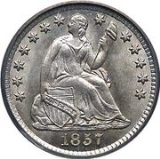
The basic obverse design of the Seated Liberty coinage consisted of the figure of the goddess Liberty clad in a flowing dress and seated upon a rock. In her left hand, she holds a
Liberty poleA liberty pole is a tall wooden pole, often used as a type of flagstaff, planted in the ground, which may be surmounted by an ensign or a liberty cap. They are associated with the Atlantic Revolutions of the late 18th century.-American Revolution:...
surmounted by a
Phrygian capThe Phrygian cap is a soft conical cap with the top pulled forward, associated in antiquity with the inhabitants of Phrygia, a region of central Anatolia. In the western provinces of the Roman Empire it came to signify freedom and the pursuit of liberty, perhaps through a confusion with the pileus,...
, which had been a pre-eminent symbol of freedom during the movement of
NeoclassicismNeoclassicism is the name given to Western movements in the decorative and visual arts, literature, theatre, music, and architecture that draw inspiration from the "classical" art and culture of Ancient Greece or Ancient Rome...
(and in fact traces its roots back to Ancient Greece and Rome). Although it had fallen out of favor in
EuropeEurope is, by convention, one of the world's seven continents. Comprising the westernmost peninsula of Eurasia, Europe is generally 'divided' from Asia to its east by the watershed divides of the Ural and Caucasus Mountains, the Ural River, the Caspian and Black Seas, and the waterways connecting...
by 1830, Neoclassicism remained in vogue in the
United StatesThe United States of America is a federal constitutional republic comprising fifty states and a federal district...
until after the
American Civil WarThe American Civil War was a civil war fought in the United States of America. In response to the election of Abraham Lincoln as President of the United States, 11 southern slave states declared their secession from the United States and formed the Confederate States of America ; the other 25...
. Liberty's right hand rested on the top corner of a striped shield with a diagonal banner inscribed with the word "LIBERTY." The shield represented preparedness in the defense of freedom. The date of the coin appeared on the bottom below Liberty.
Reverse
The basic reverse design of Seated Liberty coins depended on the denomination. The size of half dimes and dimes necessitated a smaller array of elements. On these coins, the reverse consistently featured a
wreathA wreath is an assortment of flowers, leaves, fruits, twigs and/or various materials that is constructed to resemble a ring. They are used typically as Christmas decorations to symbolize the coming of Christ, also known as the Advent season in Christianity. They are also used as festive headdresses...
around the words "HALF DIME" or "ONE DIME". Before 1860, this wreath consisted of
laurelThe bay laurel , also known as sweet bay, bay tree, true laurel, Grecian laurel, laurel tree, or simply laurel, is an aromatic evergreen tree or large shrub with green, glossy leaves, native to the Mediterranean region. It is the source of the bay leaf used in cooking...
leaves, a traditional Neoclassical image, but beginning that year, the wreath was enlarged and was filled not only with
leaves-History:Vocalist Arnar Gudjonsson was formerly the guitarist with Mower, and he was joined by Hallur Hallsson , Arnar Ólafsson , Bjarni Grímsson , and Andri Ásgrímsson . Late in 2001 they played with Emiliana Torrini and drew early praise from the New York Times...
, but also traditional American agricultural products, such as
cornMaize known in many English-speaking countries as corn or mielie/mealie, is a grain domesticated by indigenous peoples in Mesoamerica in prehistoric times. The leafy stalk produces ears which contain seeds called kernels. Though technically a grain, maize kernels are used in cooking as a vegetable...
and
wheatWheat is a cereal grain, originally from the Levant region of the Near East, but now cultivated worldwide. In 2007 world production of wheat was 607 million tons, making it the third most-produced cereal after maize and rice...
. On quarter, half dollars, and silver dollar coins, the reverse featured a central
eagleEagles are members of the bird family Accipitridae, and belong to several genera which are not necessarily closely related to each other. Most of the more than 60 species occur in Eurasia and Africa. Outside this area, just two species can be found in the United States and Canada, nine more in...
about to take flight, with a striped shield upon its breast. The eagle clutched an
olive branchThe olive branch in Western culture, derived from the customs of Ancient Greece, symbolizes peace or victory and was worn by brides.-Ancient Greece and Rome:...
of
peacePeace is a state of harmony characterized by the lack of violent conflict. Commonly understood as the absence of hostility, peace also suggests the existence of healthy or newly healed interpersonal or international relationships, prosperity in matters of social or economic welfare, the...
in its right talons and a group of
arrowsArrows Grand Prix International was a British Formula One team active from to . For a period of time, it was also known as Footwork.-Origins :...
in its left talons. Above the eagle around the rim were the words "UNITED STATES OF AMERICA" and below the eagle around the rim lay the coin denomination. Beginning in 1866 the coins featured a ribbon with the motto "In God We Trust" above the eagle.
Stars
When the first Seated Liberty half dimes and dimes appeared in 1837, the obverse contained no stars. There are two varieties; the large date and the small date. For the dime, these two types can be distinguished by noting the "3" and the "7" in the date. In the large date variety, the "3" has a pointy serif at top, and the horizontal element of the "7" is straight. In the small date variety, the "3" has a rounded serif, and there is small a knob, or bulge, in the "7" horizontal element. Only the Philadelphia Mint made both varieties. The small date is slightly rarer. The New Orleans Mint made only one variety. For the half dime, the small date can be distinguished by the fact that it is slightly bent in a "smile" orientation, similar to the Bust type of half dime. The large date can be distinguished by the fact that the date is more in a straight line, similar to dates of later years for the Seated Liberty. Only the Philadelphia Mint made half dimes in this year.
The Liberty Seated dime of 1838 minted in New Orleans, was the first U.S. coin struck anywhere outside of Philadelphia. In other words, this is the first branch mint coin.
The next year, the coins featured thirteen six-pointed stars around the rim, commemorating the original
thirteen coloniesThe Thirteen Colonies were English and later British colonies established on the Atlantic coast of North America between 1607 and 1733. They declared their independence in the American Revolution and formed the United States of America...
.
Drapery
The Seated Liberty coins featured a few minor design changes over the years. Around 1840 (the exact date depends upon the denomination), extra drapery was added to Liberty's left elbow.
Arrows and rays
In 1853 and 1873, the U.S. Mint changed the weight of each denomination of silver coins. Both times, arrows were added to the coins on each side of the date. These were removed from coins in 1856 and 1875, respectively. In 1853, the mint also placed rays around the eagle on the reverse of half dollars and quarters, a feature which endured for that one year only.
Legend and mintmarks
In 1860 the U.S. Mint eliminated the stars on the obverse of Seated Liberty
half dimeThe half dime, or half disme, was a silver coin, valued at five cents, formerly minted in the United States.Some numismatists consider the denomination to be the first coin minted by the United States Mint under the Coinage Act of 1792, with production beginning on or about July 1792...
s and
dimeThe dime is a coin 10 cents, one tenth of a United States dollar, labeled formally as "one dime". The denomination was first authorized by the Coinage Act of 1792. The dime is the smallest in diameter and is the thinnest of all U.S...
s, replacing them with the legend "UNITED STATES OF AMERICA," which had previously appeared around the
wreathA wreath is an assortment of flowers, leaves, fruits, twigs and/or various materials that is constructed to resemble a ring. They are used typically as Christmas decorations to symbolize the coming of Christ, also known as the Advent season in Christianity. They are also used as festive headdresses...
on the reverse of the
coinsContextObjects in Spans, commonly abbreviated COinS, is a method to embed bibliographic metadata in the HTML code of web pages. This allows bibliographic software to publish machine-readable bibliographic items and client reference management software to retrieve bibliographic metadata. The...
. Before this time, half dimes and dimes minted in
New OrleansThe New Orleans Mint operated in New Orleans, Louisiana, as a branch mint of the United States Mint from 1838 to 1861 and from 1879 to 1909. During its years of operation, it produced over 427 million gold and silver coins of nearly every American denomination, with a total face value of over...
and
San FranciscoThe San Francisco Mint is a branch of the United States Mint, and was opened in 1854 to serve the gold mines of the California Gold Rush. It quickly outgrew its first building and moved into a new one in 1874. This building, the Old United States Mint, also known affectionately as The Granite Lady,...
had featured their mintmarks inside the wreaths. Afterwards, the "O" and "S" (and, later, the "CC" for
Carson CityThe Carson City Mint was a branch of the United States Mint in Carson City, Nevada. Built at the peak of the silver boom, 50 issues of silver coins and 57 issues of gold coins minted here between 1870 and 1893 bore the "CC" mint mark...
) mintmarks were located below the wreath next to the rim. On quarters, half dollars, and silver dollars, the mintmarks were always placed below the
eagleEagles are members of the bird family Accipitridae, and belong to several genera which are not necessarily closely related to each other. Most of the more than 60 species occur in Eurasia and Africa. Outside this area, just two species can be found in the United States and Canada, nine more in...
but above the
coinA coin is a piece of hard material that is standardized in weight, is produced in large quantities in order to facilitate trade, and primarily can be used as a legal tender token for commerce in the designated country, region, or territory....
currencyDenomination is a proper description of a currency amount, usually for coins or banknotes. Denominations may also be used with other means of payment like gift cards. See also Redenomination.-Subunit and super unit:...
on the reverse.
Varieties
Many people collect seated coinage by variety. This can range from a repunched mintmark to the position of a date on the coin to a die crack at various stages. This type of collecting has been popular with Bust half dollars for well over 100 years. Seated coin collecting by variety has grown over the last 30 years with the formation of Liberty Seated Collectors Club.
External links