

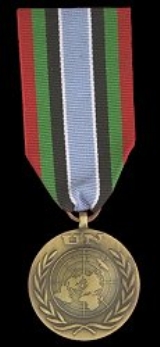
United Nations Assistance Mission for Rwanda

Encyclopedia
The United Nations Assistance Mission In Rwanda was a mission instituted by the United Nations
to aid the implementation of the Arusha Accords
, signed August 4, 1993, which were meant to end the Rwandan Civil War
. The mission lasted from October 1993 to March 1996. Its activities were meant to aid the peace process between the Hutu
-dominated Rwandese
government and the Tutsi
-dominated rebel Rwandan Patriotic Front
(RPF).
The UNAMIR has received much attention for its role, or lack thereof due to the limitations of its rules of engagement
, in the Rwandan Genocide
and outbreak of fighting. Its mandate extended past the RPF overthrow of the government and into the Great Lakes refugee crisis
. The mission is thus regarded as a major failure.
began when the Rwandan Patriotic Front
rebel group invaded across Uganda
's southern border into northern Rwanda. The RPF was composed of over 4000 soldiers, most the sons of Tutsi
refugees who had fled ethnic purges in Rwanda between 1959 to 1963. It portrayed itself as a democratic, multi-ethnic movement and demanded an end to ethnic discrimination, to economic looting of the country by government elites and a stop to the security situation that continued to generate refugees. It was supported by the Ugandan government of Yoweri Museveni
, who had come to power in the Ugandan Bush War
with significant support from the Rwandan refugees in the country. However, the Rwandan Armed Forces (FAR) was saved by reinforcements from France
and Zaire
, who backed the government of Rwandan President Juvénal Habyarimana
, who had been in power since 1973.
The French intervention of two parachute companies, explained as an attempt to protect its own nationals, actually blocked the RPF advance on the capital Kigali
. In contrast, the government of Belgium
, the former colonial power, cut all support to the Habyarimana regime, which viewed the action as abandonment. Thwarted by the French, the RPF suffered a humiliating retreat back into the Virunga Mountains
along the border. After the demoralizing death of Major-General Fred Rwigema
, the collapse of the RPF was prevented through the leadership of Paul Kagame
.
The RPF thus managed to retain control of a sliver of land in the north, from which it continued to launch raids. Comparing the RPF and RGF as he saw them in 1993, Canadian
Lieutenant-General Roméo Dallaire
noted that the rebels "had won all recent contests because of their superior leadership, training, experience, frugality, mobility, discipline and morale."
However, the RPF invasion, which displaced approximately 600,000 people into crowded internally displaced person
camps, also radicalized the Hutu populace. The Tutsi civilians in Rwanda, roughly 14% of the population, were labeled ibyitso ("accomplices") or inyenzni ("cockroaches"), who were accused of secretly aiding the RPF invaders. Anti-Tutsi propaganda was spread through the publication Kangura
, a forerunner to the Radio Télévision Libre des Mille Collines
, which was created immediately after the invasion. The first plans for mass murder of Tutsi were also developed toward the end of 1990, mostly in a series of secret meetings in Gisenyi
prefecture of the Akazu
, a network of associates based around Agathe Habyarimana
, the First Lady.
A number of ceasefire agreements were signed by the RPF and government, including one signed on 22 July 1992 in Arusha
, Tanzania
that resulted in the Organization of African Unity (OAU) establishing a 50-member Neutral Military Observer Group (NMOG I) led by Nigeria
n General Ekundayo Opaleye
.
The negotiations for a peace settlement continued in Arusha, interrupted by a massive RPF offensive in early February 1993. Rwanda continued to allege Ugandan support for the RPF, which both the RPF and Uganda duly denied, but resulting in both countries sending letters to President of the United Nations Security Council
(UNSC) requesting that military observers be deployed along the border to verify that military supplies were not crossing.
This resulted in the United Nations Observer Mission Uganda-Rwanda
(UNOMUR) being approved by the UNSC on 22 June 1993 to deploy along the Ugandan side of the border. Seven days later, UN Secretary-General
Boutros Boutros-Ghali
announced that Brigadier-General Dallaire was to be appointed the Chief Military Observer for UNOMUR, which reached its authorized strength of 81 observers by September. NMOG I was deployed inside Rwanda.
In the meantime, talks in Arusha had reconvened on 16 March 1993, resulting in the signing of the Arusha Accords
, a comprehensive agreement to create a power-sharing government, on the fourth of August. Both the RPF and Rwandan government requested UN assistance in implementing the agreement. In early August, NMOG I was replaced by NMOG II, consisting of about 130 members, in preparation for a UN-led peacekeeping force.
(1993). Its mandate included "ensuring the security of the capital city of Kigali
; monitoring the ceasefire agreement, including establishment of an expanded demilitarized zone and demobilization procedures; monitoring the security situation during the final period of the transitional Government's mandate leading up to elections; assisting with mine-clearance; and assisting in the coordination of humanitarian assistance activities in conjunction with relief operations." Its authorised strength was 2,500 personnel, but it took some five months of piecemeal commitments for the mission to reach this level.
The head of the mission was Jacques-Roger Booh-Booh
of Cameroon
, and its Force Commander was Canadian
Lieutenant-General (then Brigadier-General, promoted Major-General during the mission) Roméo Dallaire
. Around 400 of the troops in this early part of the mission consisted of Belgian
soldiers, despite the fact that Rwanda had been a Belgian colony, and normally the UN bans the former colonial power from serving in such peace-keeping roles. The biggest contributing countries along with Belgium were Ghana, Tunisia, Bangladesh, and Canada.
During the remainder of 1993, both sides of the Rwandan struggle appeared committed to holding to the ideals of the Arusha Accords, and reaffirmed such commitment to creating a new, broad-based transitional government by the end of the year.
Squabbling between interested parties delayed the UNAMIR goal of assisting the formation of the transitional government following the inauguration of President Habyarimana
on January 5, 1994. The violent clashes that followed, including the assassinations of 2 major political leaders and the ambush of a UNAMIR-led convoy of RPF
forces led the UNAMIR forces to move to a more defensive footing. UNAMIR thus contributed support to the military and civilian authorities in Rwanda, while the UN continued to place pressure on Habyarimana and the RPF
to return to the ideas set forth in the Accords.
On April 5, 1994, the UN voted to extend the mandate of UNAMIR to 29 July 1994, after expressing "deep concern at the delay in the establishment of the broad-based transitional Government and the Transitional National Assembly" and "concern at the deterioration in security in the country, particularly in Kigali."
.jpg)
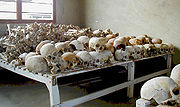 On April 6, 1994, a plane carrying President Habyarimana and President Cyprien Ntaryamira
of Burundi
was shot down near Kigali. What followed was the collapse of the unstable peace in Rwanda and the Rwandan Genocide
, estimated to have claimed between 800,000 and 1,017,100 Tutsi and Hutu victims over 100 days.
Among the first targets of the genocide
were Prime Minister Agathe Uwilingiyimana
and 10 Belgian members of 2nd Commando Battalion, the Paracommando Regiment operating as part of UNAMIR. These troops were murdered after handing over their weapons to Rwandan government troops. They were advised to do so by their battalion commander who was unclear on the legal issues with authorising them to defend themselves, even though they had already been under fire for approximately two hours.
This confusion over legal protocols typified the response of UNAMIR to the escalating chaos. The mission's vague mandate, created under Chapter VI of the UN Charter
was unclear about the right to use force, particularly in defence of civilians. The mission's original intention was to oversee the implementation of the Arusha peace agreement. However, by the time of the genocide, the peace agreement was completely irrelevant and UNAMIR was legally powerless.
Frightened by the deaths of their soldiers and aware of the international embarrassment the United States suffered in Mogadishu
, Somalia
after the civil war there claimed the lives of several US troops (see Battle of Mogadishu), the Belgian government quickly called for the withdrawal of the Belgian contingent of UNAMIR. After the withdrawal of other nations' contingents, UNAMIR was left with 270 soldiers supported by less than 200 local authorities. Lieutenant-General Dallaire, despite orders to withdraw from Kigali, refused to abandon the country to the genocide, and remained to lead what forces remained.
Understaffed and abandoned, UNAMIR did the best it could with what forces remained. As individuals and as a group, members of the UNAMIR forces did manage to save the lives of thousands of Tutsis in and around Kigali and the few areas of UN control. Lieutenant-General Dallaire requested the immediate insertion of approximately 5,000 troops, but his request was denied.
For the next six weeks, approximately, UNAMIR coordinated peace talks between the Hutu government and the RPF
to little avail. Eventually, on 17 May 1994, the UN security council adopted a resolution that would deliver nearly 5,500 troops and much needed personnel carriers and other equipment to UNAMIR. However this and subsequent resolutions were still unclear on the right to use force in stopping the genocide. Unfortunately, in the face of the mayhem in Rwanda and this diplomatic watering down of UNAMIR's mandate, many UN member states delayed contributing personnel for some time, until the main wave of killings ceased.
At the beginning of July, Jacques-Roger Booh-Booh
was replaced by Shaharyar Khan of Pakistan
as head of UNAMIR.
swept into Kigali and ended the genocide that had lasted 100 days, and RPF
leader Paul Kagame
(who became president several years later—and still is today—but effectively controlled the country from July 1994 through the present) reaffirmed his commitment to the Arusha Accords.
In August 1994, suffering from severe stress, General Roméo Dallaire
was replaced as Force Commander by Major-General Guy Tousignant
, also from Canada. In December 1995, Tousignant was replaced by Indian Shiva Kumar
.
Following the end of the main killings the challenges for UNAMIR (and the many NGOs who arrived in the country) were to maintain the fragile peace, stabilise the government and, most importantly, care for the nearly 4 million displaced persons in camps within Rwanda, Zaire, Tanzania, Burundi and Uganda. The massive camps around Lake Kivu in the north west of Rwanda were holding about 1.2 million people and this was creating enormous security, health and ecological problems.
After the late arrival of the much needed troop support, UNAMIR continued to carry out its mandate to the best of its abilities. In 1996, however, with assertion from the new Rwandese government that UNAMIR had failed in its priority mission, the UN withdrew the UNAMIR mandate on March 8, 1996. In the end, 27 members of UNAMIR - 22 soldiers, three military observers, one civilian police and one local staff - lost their lives during the mission.
Despite the failure of UNAMIR in its main mission, its humanitarian services during the 1994 genocide are recognized to this day as having saved the lives of thousands or tens of thousands of Rwandan Tutsi and Hutu moderates who would have otherwise been killed. However, the actions of the UN in Rwanda (and particularly the Head of Peacekeeping Operations at the time, Kofi Annan
) have been used by some as examples of the over-bureaucratic and dithering approach of the UN. (General Dallaire was particularly critical of Annan's performance.)
Countries that contributed troops to UNAMIR throughout its existence were: Argentina, Australia, Austria, Bangladesh, Belgium, Brazil, Canada, Chad, Congo, Djibouti, Egypt, Ethiopia, Fiji, Germany, Ghana, Guinea, Guinea Bissau, Guyana, India, Jordan, Kenya, Malawi, Mali, Netherlands, Niger, Nigeria, Pakistan, Poland, Romania, Russia, Senegal, Slovakia, Spain, Switzerland, Togo, Tunisia, United Kingdom, Uruguay, Zambia and Zimbabwe.
General Dallaire received the Aegis Trust Award (the first) for his acts of bravery, yet the spectre of his mission's failure haunted him greatly. Having attempted suicide
and having not responded to therapy following diagnosis of Post-Traumatic Stress Disorder
(PTSD), General Dallaire was medically dismissed from service.
In 2004-2005, he was a fellow at the Carr Center for Human Rights Policy
, Harvard University
, where he was studying and writing about different forms of conflict resolution. On 25 March 2005, he was appointed a Canadian senator
, representing Québec
as a member of the Liberal Party of Canada
; he serves on the committee for Human Rights
. He also speaks publicly about his experiences relating to genocide
, PTSD and suicide
.
United Nations
The United Nations is an international organization whose stated aims are facilitating cooperation in international law, international security, economic development, social progress, human rights, and achievement of world peace...
to aid the implementation of the Arusha Accords
Arusha Accords
The Arusha Accords were a set of five accords signed in Arusha, Tanzania on August 4, 1993, by the government of Rwanda and the rebel Rwandan Patriotic Front , under mediation, to end a three-year Rwandan Civil War...
, signed August 4, 1993, which were meant to end the Rwandan Civil War
Rwandan Civil War
The Rwandan Civil War was a conflict within the Central African nation of Rwanda between the government of President Juvénal Habyarimana and the rebel Rwandan Patriotic Front...
. The mission lasted from October 1993 to March 1996. Its activities were meant to aid the peace process between the Hutu
Hutu
The Hutu , or Abahutu, are a Central African people, living mainly in Rwanda, Burundi, and eastern DR Congo.-Population statistics:The Hutu are the largest of the three peoples in Burundi and Rwanda; according to the United States Central Intelligence Agency, 84% of Rwandans and 85% of Burundians...
-dominated Rwandese
Rwanda
Rwanda or , officially the Republic of Rwanda , is a country in central and eastern Africa with a population of approximately 11.4 million . Rwanda is located a few degrees south of the Equator, and is bordered by Uganda, Tanzania, Burundi and the Democratic Republic of the Congo...
government and the Tutsi
Tutsi
The Tutsi , or Abatutsi, are an ethnic group in Central Africa. Historically they were often referred to as the Watussi or Watusi. They are the second largest caste in Rwanda and Burundi, the other two being the Hutu and the Twa ....
-dominated rebel Rwandan Patriotic Front
Rwandan Patriotic Front
The Rwandan Patriotic Front abbreviated as RPF is the current ruling political party of Rwanda, led by President Paul Kagame. It governs in a coalition with other parties...
(RPF).
The UNAMIR has received much attention for its role, or lack thereof due to the limitations of its rules of engagement
Rules of engagement
Rules of Engagement refers to those responses that are permitted in the employment of military personnel during operations or in the course of their duties. These rules of engagement are determined by the legal framework within which these duties are being carried out...
, in the Rwandan Genocide
Rwandan Genocide
The Rwandan Genocide was the 1994 mass murder of an estimated 800,000 people in the small East African nation of Rwanda. Over the course of approximately 100 days through mid-July, over 500,000 people were killed, according to a Human Rights Watch estimate...
and outbreak of fighting. Its mandate extended past the RPF overthrow of the government and into the Great Lakes refugee crisis
Great Lakes refugee crisis
The Great Lakes refugee crisis is the common name for the situation beginning with the exodus in April 1994 of over two million Rwandans to neighboring countries of the Great Lakes region of Africa in the aftermath of the Rwandan Genocide...
. The mission is thus regarded as a major failure.
Background
In October 1991 the Rwandan Civil WarRwandan Civil War
The Rwandan Civil War was a conflict within the Central African nation of Rwanda between the government of President Juvénal Habyarimana and the rebel Rwandan Patriotic Front...
began when the Rwandan Patriotic Front
Rwandan Patriotic Front
The Rwandan Patriotic Front abbreviated as RPF is the current ruling political party of Rwanda, led by President Paul Kagame. It governs in a coalition with other parties...
rebel group invaded across Uganda
Uganda
Uganda , officially the Republic of Uganda, is a landlocked country in East Africa. Uganda is also known as the "Pearl of Africa". It is bordered on the east by Kenya, on the north by South Sudan, on the west by the Democratic Republic of the Congo, on the southwest by Rwanda, and on the south by...
's southern border into northern Rwanda. The RPF was composed of over 4000 soldiers, most the sons of Tutsi
Tutsi
The Tutsi , or Abatutsi, are an ethnic group in Central Africa. Historically they were often referred to as the Watussi or Watusi. They are the second largest caste in Rwanda and Burundi, the other two being the Hutu and the Twa ....
refugees who had fled ethnic purges in Rwanda between 1959 to 1963. It portrayed itself as a democratic, multi-ethnic movement and demanded an end to ethnic discrimination, to economic looting of the country by government elites and a stop to the security situation that continued to generate refugees. It was supported by the Ugandan government of Yoweri Museveni
Yoweri Museveni
Yoweri Kaguta Museveni is a Ugandan politician and statesman. He has been President of Uganda since 26 January 1986.Museveni was involved in the war that deposed Idi Amin Dada, ending his rule in 1979, and in the rebellion that subsequently led to the demise of the Milton Obote regime in 1985...
, who had come to power in the Ugandan Bush War
Ugandan Bush War
The Ugandan Bush War refers to the guerrilla war waged between 1981 and 1986 in Uganda by the National Resistance Army against the government of Milton Obote, and later that of Tito Okello.-Events leading to the war:Following the Uganda-Tanzania War that removed Idi Amin in 1979, a...
with significant support from the Rwandan refugees in the country. However, the Rwandan Armed Forces (FAR) was saved by reinforcements from France
France
The French Republic , The French Republic , The French Republic , (commonly known as France , is a unitary semi-presidential republic in Western Europe with several overseas territories and islands located on other continents and in the Indian, Pacific, and Atlantic oceans. Metropolitan France...
and Zaire
Zaire
The Republic of Zaire was the name of the present Democratic Republic of the Congo between 27 October 1971 and 17 May 1997. The name of Zaire derives from the , itself an adaptation of the Kongo word nzere or nzadi, or "the river that swallows all rivers".-Self-proclaimed Father of the Nation:In...
, who backed the government of Rwandan President Juvénal Habyarimana
Juvénal Habyarimana
Juvénal Habyarimana was the third President of the Republic of Rwanda, the post he held longer than any other president to date, from 1973 until 1994. During his 20-year rule he favored his own ethnic group, the Hutus, and supported the Hutu majority in neighboring Burundi against the Tutsi...
, who had been in power since 1973.
The French intervention of two parachute companies, explained as an attempt to protect its own nationals, actually blocked the RPF advance on the capital Kigali
Kigali
Kigali, population 965,398 , is the capital and largest city of Rwanda. It is situated near the geographic centre of the nation, and has been the economic, cultural, and transport hub of Rwanda since it became capital at independence in 1962. The main residence and offices of the President of...
. In contrast, the government of Belgium
Belgium
Belgium , officially the Kingdom of Belgium, is a federal state in Western Europe. It is a founding member of the European Union and hosts the EU's headquarters, and those of several other major international organisations such as NATO.Belgium is also a member of, or affiliated to, many...
, the former colonial power, cut all support to the Habyarimana regime, which viewed the action as abandonment. Thwarted by the French, the RPF suffered a humiliating retreat back into the Virunga Mountains
Virunga Mountains
The Virunga Mountains are a chain of volcanoes in East Africa, along the northern border of Rwanda, the Democratic Republic of the Congo and Uganda. The mountain range is a branch of the Albertine Rift, a part of the Great Rift Valley. They are located between Lake Edward and Lake Kivu...
along the border. After the demoralizing death of Major-General Fred Rwigema
Fred Rwigema
Fred Gisa Rwigema , born Emmanuel Gisa , was a founding member of and leader of the Rwandan Patriotic Front, an anti-Hutu Power guerrilla group that fought in the Rwandan Civil War.Rwigema was born in Gitarama, in the south of Rwanda...
, the collapse of the RPF was prevented through the leadership of Paul Kagame
Paul Kagame
Paul Kagame is the sixth and current President of the Republic of Rwanda. He rose to prominence as the leader of the Rwandan Patriotic Front , whose victory over the incumbent government in July 1994 effectively ended the Rwandan genocide...
.
The RPF thus managed to retain control of a sliver of land in the north, from which it continued to launch raids. Comparing the RPF and RGF as he saw them in 1993, Canadian
Canada
Canada is a North American country consisting of ten provinces and three territories. Located in the northern part of the continent, it extends from the Atlantic Ocean in the east to the Pacific Ocean in the west, and northward into the Arctic Ocean...
Lieutenant-General Roméo Dallaire
Roméo Dallaire
Lieutenant-General Roméo Antonius Dallaire, is a Canadian senator, humanitarian, author and retired general...
noted that the rebels "had won all recent contests because of their superior leadership, training, experience, frugality, mobility, discipline and morale."
However, the RPF invasion, which displaced approximately 600,000 people into crowded internally displaced person
Internally displaced person
An internally displaced person is someone who is forced to flee his or her home but who remains within his or her country's borders. They are often referred to as refugees, although they do not fall within the current legal definition of a refugee. At the end of 2006 it was estimated there were...
camps, also radicalized the Hutu populace. The Tutsi civilians in Rwanda, roughly 14% of the population, were labeled ibyitso ("accomplices") or inyenzni ("cockroaches"), who were accused of secretly aiding the RPF invaders. Anti-Tutsi propaganda was spread through the publication Kangura
Kangura
Kangura was a Kinyarwanda- and French-language magazine in Rwanda that served to stoke ethnic hatred in the run-up to the Rwandan Genocide. It was established in 1990, following the invasion of the rebel Rwandan Patriotic Front , and continued publishing up to the genocide...
, a forerunner to the Radio Télévision Libre des Mille Collines
Radio Télévision Libre des Mille Collines
Radio Télévision Libre des Mille Collines was a Rwandan radio station which broadcast from July 8, 1993 to July 31, 1994. It played a significant role during the April–July 1994 Rwandan Genocide....
, which was created immediately after the invasion. The first plans for mass murder of Tutsi were also developed toward the end of 1990, mostly in a series of secret meetings in Gisenyi
Gisenyi
Gisenyi is a city in Rubavu district in the Western Province of Rwanda. Gisenyi is contiguous with Goma, the city across the border in the Democratic Republic of the Congo. The population of the city is about 106 000 .-Description:...
prefecture of the Akazu
Akazu
The Akazu was an informal organization of Hutu extremists, a circle of relatives and close friends of then Rwandan president Juvénal Habyarimana and his influential wife Agathe Habyarimana...
, a network of associates based around Agathe Habyarimana
Agathe Habyarimana
Agathe Habyarimana is the widow of former President of Rwanda Juvénal Habyarimana. Kanziga is part of a Hutu lineage that long ruled an independent principality until the late nineteenth century...
, the First Lady.
A number of ceasefire agreements were signed by the RPF and government, including one signed on 22 July 1992 in Arusha
Arusha
Arusha is a city in northern Tanzania. It is the capital of the Arusha Region, which claims a population of 1,288,088, including 281,608 for the Arusha District . Arusha is surrounded by some of Africa's most famous landscapes and national parks...
, Tanzania
Tanzania
The United Republic of Tanzania is a country in East Africa bordered by Kenya and Uganda to the north, Rwanda, Burundi, and the Democratic Republic of the Congo to the west, and Zambia, Malawi, and Mozambique to the south. The country's eastern borders lie on the Indian Ocean.Tanzania is a state...
that resulted in the Organization of African Unity (OAU) establishing a 50-member Neutral Military Observer Group (NMOG I) led by Nigeria
Nigeria
Nigeria , officially the Federal Republic of Nigeria, is a federal constitutional republic comprising 36 states and its Federal Capital Territory, Abuja. The country is located in West Africa and shares land borders with the Republic of Benin in the west, Chad and Cameroon in the east, and Niger in...
n General Ekundayo Opaleye
Ekundayo Opaleye
Brigadier General Ekundayo B. Opaleye was Governor of Ondo State, Nigeria from August 1986 to December 1987 during the military regime of general Ibrahim Babangida.-Military career:...
.
The negotiations for a peace settlement continued in Arusha, interrupted by a massive RPF offensive in early February 1993. Rwanda continued to allege Ugandan support for the RPF, which both the RPF and Uganda duly denied, but resulting in both countries sending letters to President of the United Nations Security Council
United Nations Security Council
The United Nations Security Council is one of the principal organs of the United Nations and is charged with the maintenance of international peace and security. Its powers, outlined in the United Nations Charter, include the establishment of peacekeeping operations, the establishment of...
(UNSC) requesting that military observers be deployed along the border to verify that military supplies were not crossing.
This resulted in the United Nations Observer Mission Uganda-Rwanda
United Nations Observer Mission Uganda-Rwanda
The United Nations Observer Mission Uganda-Rwanda was a peacekeeping mission established by the United Nations Security Council in Resolution 846 and lasted from June 1993 to September 1994. Its mission was "to monitor the border between Uganda and Rwanda and verify that no military assistance was...
(UNOMUR) being approved by the UNSC on 22 June 1993 to deploy along the Ugandan side of the border. Seven days later, UN Secretary-General
United Nations Secretary-General
The Secretary-General of the United Nations is the head of the Secretariat of the United Nations, one of the principal organs of the United Nations. The Secretary-General also acts as the de facto spokesperson and leader of the United Nations....
Boutros Boutros-Ghali
Boutros Boutros-Ghali
Boutros Boutros-Ghali is an Egyptian politician and diplomat who was the sixth Secretary-General of the United Nations from January 1992 to December 1996...
announced that Brigadier-General Dallaire was to be appointed the Chief Military Observer for UNOMUR, which reached its authorized strength of 81 observers by September. NMOG I was deployed inside Rwanda.
In the meantime, talks in Arusha had reconvened on 16 March 1993, resulting in the signing of the Arusha Accords
Arusha Accords
The Arusha Accords were a set of five accords signed in Arusha, Tanzania on August 4, 1993, by the government of Rwanda and the rebel Rwandan Patriotic Front , under mediation, to end a three-year Rwandan Civil War...
, a comprehensive agreement to create a power-sharing government, on the fourth of August. Both the RPF and Rwandan government requested UN assistance in implementing the agreement. In early August, NMOG I was replaced by NMOG II, consisting of about 130 members, in preparation for a UN-led peacekeeping force.
Establishment
UNAMIR was established on 5 October 1993 by Security Council Resolution 872United Nations Security Council Resolution 872
United Nations Security Council Resolution 872, adopted unanimously on October 5, 1993, after reaffirming resolutions 812 and 846 on the situation in Rwanda and Resolution 868 on the security of United Nations operations, the Council stressed the need for an international force in the country...
(1993). Its mandate included "ensuring the security of the capital city of Kigali
Kigali
Kigali, population 965,398 , is the capital and largest city of Rwanda. It is situated near the geographic centre of the nation, and has been the economic, cultural, and transport hub of Rwanda since it became capital at independence in 1962. The main residence and offices of the President of...
; monitoring the ceasefire agreement, including establishment of an expanded demilitarized zone and demobilization procedures; monitoring the security situation during the final period of the transitional Government's mandate leading up to elections; assisting with mine-clearance; and assisting in the coordination of humanitarian assistance activities in conjunction with relief operations." Its authorised strength was 2,500 personnel, but it took some five months of piecemeal commitments for the mission to reach this level.
The head of the mission was Jacques-Roger Booh-Booh
Jacques-Roger Booh-Booh
Jacques-Roger Booh-Booh was the Minister of External Relations of Cameroon from 1988 to 1992 and the head of United Nations Assistance Mission for Rwanda .-Biography:Booh-Booh was born in Manak, Cameroon...
of Cameroon
Cameroon
Cameroon, officially the Republic of Cameroon , is a country in west Central Africa. It is bordered by Nigeria to the west; Chad to the northeast; the Central African Republic to the east; and Equatorial Guinea, Gabon, and the Republic of the Congo to the south. Cameroon's coastline lies on the...
, and its Force Commander was Canadian
Canada
Canada is a North American country consisting of ten provinces and three territories. Located in the northern part of the continent, it extends from the Atlantic Ocean in the east to the Pacific Ocean in the west, and northward into the Arctic Ocean...
Lieutenant-General (then Brigadier-General, promoted Major-General during the mission) Roméo Dallaire
Roméo Dallaire
Lieutenant-General Roméo Antonius Dallaire, is a Canadian senator, humanitarian, author and retired general...
. Around 400 of the troops in this early part of the mission consisted of Belgian
Belgium
Belgium , officially the Kingdom of Belgium, is a federal state in Western Europe. It is a founding member of the European Union and hosts the EU's headquarters, and those of several other major international organisations such as NATO.Belgium is also a member of, or affiliated to, many...
soldiers, despite the fact that Rwanda had been a Belgian colony, and normally the UN bans the former colonial power from serving in such peace-keeping roles. The biggest contributing countries along with Belgium were Ghana, Tunisia, Bangladesh, and Canada.
During the remainder of 1993, both sides of the Rwandan struggle appeared committed to holding to the ideals of the Arusha Accords, and reaffirmed such commitment to creating a new, broad-based transitional government by the end of the year.
Squabbling between interested parties delayed the UNAMIR goal of assisting the formation of the transitional government following the inauguration of President Habyarimana
Juvénal Habyarimana
Juvénal Habyarimana was the third President of the Republic of Rwanda, the post he held longer than any other president to date, from 1973 until 1994. During his 20-year rule he favored his own ethnic group, the Hutus, and supported the Hutu majority in neighboring Burundi against the Tutsi...
on January 5, 1994. The violent clashes that followed, including the assassinations of 2 major political leaders and the ambush of a UNAMIR-led convoy of RPF
Rwandan Patriotic Front
The Rwandan Patriotic Front abbreviated as RPF is the current ruling political party of Rwanda, led by President Paul Kagame. It governs in a coalition with other parties...
forces led the UNAMIR forces to move to a more defensive footing. UNAMIR thus contributed support to the military and civilian authorities in Rwanda, while the UN continued to place pressure on Habyarimana and the RPF
Rwandan Patriotic Front
The Rwandan Patriotic Front abbreviated as RPF is the current ruling political party of Rwanda, led by President Paul Kagame. It governs in a coalition with other parties...
to return to the ideas set forth in the Accords.
On April 5, 1994, the UN voted to extend the mandate of UNAMIR to 29 July 1994, after expressing "deep concern at the delay in the establishment of the broad-based transitional Government and the Transitional National Assembly" and "concern at the deterioration in security in the country, particularly in Kigali."
Genocide
Cyprien Ntaryamira
Cyprien Ntaryamira , was President of Burundi from 5 February 1994 until his death when his plane was shot down on 6 April 1994.-Biography:...
of Burundi
Burundi
Burundi , officially the Republic of Burundi , is a landlocked country in the Great Lakes region of Eastern Africa bordered by Rwanda to the north, Tanzania to the east and south, and the Democratic Republic of the Congo to the west. Its capital is Bujumbura...
was shot down near Kigali. What followed was the collapse of the unstable peace in Rwanda and the Rwandan Genocide
Rwandan Genocide
The Rwandan Genocide was the 1994 mass murder of an estimated 800,000 people in the small East African nation of Rwanda. Over the course of approximately 100 days through mid-July, over 500,000 people were killed, according to a Human Rights Watch estimate...
, estimated to have claimed between 800,000 and 1,017,100 Tutsi and Hutu victims over 100 days.
Among the first targets of the genocide
Genocide
Genocide is defined as "the deliberate and systematic destruction, in whole or in part, of an ethnic, racial, religious, or national group", though what constitutes enough of a "part" to qualify as genocide has been subject to much debate by legal scholars...
were Prime Minister Agathe Uwilingiyimana
Agathe Uwilingiyimana
Agathe Uwilingiyimana was a Rwandan political figure. She served as Prime Minister of Rwanda from 18 July 1993 until her death on 7 April 1994. Her term was ended when she was assassinated during the opening stages of the Rwandan Genocide...
and 10 Belgian members of 2nd Commando Battalion, the Paracommando Regiment operating as part of UNAMIR. These troops were murdered after handing over their weapons to Rwandan government troops. They were advised to do so by their battalion commander who was unclear on the legal issues with authorising them to defend themselves, even though they had already been under fire for approximately two hours.
This confusion over legal protocols typified the response of UNAMIR to the escalating chaos. The mission's vague mandate, created under Chapter VI of the UN Charter
United Nations Charter
The Charter of the United Nations is the foundational treaty of the international organization called the United Nations. It was signed at the San Francisco War Memorial and Performing Arts Center in San Francisco, United States, on 26 June 1945, by 50 of the 51 original member countries...
was unclear about the right to use force, particularly in defence of civilians. The mission's original intention was to oversee the implementation of the Arusha peace agreement. However, by the time of the genocide, the peace agreement was completely irrelevant and UNAMIR was legally powerless.
Frightened by the deaths of their soldiers and aware of the international embarrassment the United States suffered in Mogadishu
Mogadishu
Mogadishu , popularly known as Xamar, is the largest city in Somalia and the nation's capital. Located in the coastal Benadir region on the Indian Ocean, the city has served as an important port for centuries....
, Somalia
Somalia
Somalia , officially the Somali Republic and formerly known as the Somali Democratic Republic under Socialist rule, is a country located in the Horn of Africa. Since the outbreak of the Somali Civil War in 1991 there has been no central government control over most of the country's territory...
after the civil war there claimed the lives of several US troops (see Battle of Mogadishu), the Belgian government quickly called for the withdrawal of the Belgian contingent of UNAMIR. After the withdrawal of other nations' contingents, UNAMIR was left with 270 soldiers supported by less than 200 local authorities. Lieutenant-General Dallaire, despite orders to withdraw from Kigali, refused to abandon the country to the genocide, and remained to lead what forces remained.
Understaffed and abandoned, UNAMIR did the best it could with what forces remained. As individuals and as a group, members of the UNAMIR forces did manage to save the lives of thousands of Tutsis in and around Kigali and the few areas of UN control. Lieutenant-General Dallaire requested the immediate insertion of approximately 5,000 troops, but his request was denied.
For the next six weeks, approximately, UNAMIR coordinated peace talks between the Hutu government and the RPF
Rwandan Patriotic Front
The Rwandan Patriotic Front abbreviated as RPF is the current ruling political party of Rwanda, led by President Paul Kagame. It governs in a coalition with other parties...
to little avail. Eventually, on 17 May 1994, the UN security council adopted a resolution that would deliver nearly 5,500 troops and much needed personnel carriers and other equipment to UNAMIR. However this and subsequent resolutions were still unclear on the right to use force in stopping the genocide. Unfortunately, in the face of the mayhem in Rwanda and this diplomatic watering down of UNAMIR's mandate, many UN member states delayed contributing personnel for some time, until the main wave of killings ceased.
At the beginning of July, Jacques-Roger Booh-Booh
Jacques-Roger Booh-Booh
Jacques-Roger Booh-Booh was the Minister of External Relations of Cameroon from 1988 to 1992 and the head of United Nations Assistance Mission for Rwanda .-Biography:Booh-Booh was born in Manak, Cameroon...
was replaced by Shaharyar Khan of Pakistan
Pakistan
Pakistan , officially the Islamic Republic of Pakistan is a sovereign state in South Asia. It has a coastline along the Arabian Sea and the Gulf of Oman in the south and is bordered by Afghanistan and Iran in the west, India in the east and China in the far northeast. In the north, Tajikistan...
as head of UNAMIR.
After the genocide
In July 1994, the RPFRwandan Patriotic Front
The Rwandan Patriotic Front abbreviated as RPF is the current ruling political party of Rwanda, led by President Paul Kagame. It governs in a coalition with other parties...
swept into Kigali and ended the genocide that had lasted 100 days, and RPF
Rwandan Patriotic Front
The Rwandan Patriotic Front abbreviated as RPF is the current ruling political party of Rwanda, led by President Paul Kagame. It governs in a coalition with other parties...
leader Paul Kagame
Paul Kagame
Paul Kagame is the sixth and current President of the Republic of Rwanda. He rose to prominence as the leader of the Rwandan Patriotic Front , whose victory over the incumbent government in July 1994 effectively ended the Rwandan genocide...
(who became president several years later—and still is today—but effectively controlled the country from July 1994 through the present) reaffirmed his commitment to the Arusha Accords.
In August 1994, suffering from severe stress, General Roméo Dallaire
Roméo Dallaire
Lieutenant-General Roméo Antonius Dallaire, is a Canadian senator, humanitarian, author and retired general...
was replaced as Force Commander by Major-General Guy Tousignant
Guy Tousignant
Major-General Guy Tousignant, CMM, CD is a Canadian soldier.Born in Sherbrooke, Quebec, he received a Bachelor of Arts degree from the Université de Sherbrooke in 1962. He was commissioned with the Canadian Officers' Training Corps in 1962. He was promoted to Major in 1973, Lieutenant-Colonel in...
, also from Canada. In December 1995, Tousignant was replaced by Indian Shiva Kumar
Shiva Kumar
Lieutenant General Siva Kumar, AVSM VSM was the third and final Force commander of UN troops serving in Rwanda.-Biography:...
.
Following the end of the main killings the challenges for UNAMIR (and the many NGOs who arrived in the country) were to maintain the fragile peace, stabilise the government and, most importantly, care for the nearly 4 million displaced persons in camps within Rwanda, Zaire, Tanzania, Burundi and Uganda. The massive camps around Lake Kivu in the north west of Rwanda were holding about 1.2 million people and this was creating enormous security, health and ecological problems.
After the late arrival of the much needed troop support, UNAMIR continued to carry out its mandate to the best of its abilities. In 1996, however, with assertion from the new Rwandese government that UNAMIR had failed in its priority mission, the UN withdrew the UNAMIR mandate on March 8, 1996. In the end, 27 members of UNAMIR - 22 soldiers, three military observers, one civilian police and one local staff - lost their lives during the mission.
Despite the failure of UNAMIR in its main mission, its humanitarian services during the 1994 genocide are recognized to this day as having saved the lives of thousands or tens of thousands of Rwandan Tutsi and Hutu moderates who would have otherwise been killed. However, the actions of the UN in Rwanda (and particularly the Head of Peacekeeping Operations at the time, Kofi Annan
Kofi Annan
Kofi Atta Annan is a Ghanaian diplomat who served as the seventh Secretary-General of the UN from 1 January 1997 to 31 December 2006...
) have been used by some as examples of the over-bureaucratic and dithering approach of the UN. (General Dallaire was particularly critical of Annan's performance.)
Countries that contributed troops to UNAMIR throughout its existence were: Argentina, Australia, Austria, Bangladesh, Belgium, Brazil, Canada, Chad, Congo, Djibouti, Egypt, Ethiopia, Fiji, Germany, Ghana, Guinea, Guinea Bissau, Guyana, India, Jordan, Kenya, Malawi, Mali, Netherlands, Niger, Nigeria, Pakistan, Poland, Romania, Russia, Senegal, Slovakia, Spain, Switzerland, Togo, Tunisia, United Kingdom, Uruguay, Zambia and Zimbabwe.
General Dallaire received the Aegis Trust Award (the first) for his acts of bravery, yet the spectre of his mission's failure haunted him greatly. Having attempted suicide
Suicide
Suicide is the act of intentionally causing one's own death. Suicide is often committed out of despair or attributed to some underlying mental disorder, such as depression, bipolar disorder, schizophrenia, alcoholism, or drug abuse...
and having not responded to therapy following diagnosis of Post-Traumatic Stress Disorder
Post-traumatic stress disorder
Posttraumaticstress disorder is a severe anxiety disorder that can develop after exposure to any event that results in psychological trauma. This event may involve the threat of death to oneself or to someone else, or to one's own or someone else's physical, sexual, or psychological integrity,...
(PTSD), General Dallaire was medically dismissed from service.
In 2004-2005, he was a fellow at the Carr Center for Human Rights Policy
Carr Center for Human Rights Policy
The Carr Center for Human Rights Policy is research center concerned with human rights, and is located at the Kennedy School of Government at Harvard University....
, Harvard University
Harvard University
Harvard University is a private Ivy League university located in Cambridge, Massachusetts, United States, established in 1636 by the Massachusetts legislature. Harvard is the oldest institution of higher learning in the United States and the first corporation chartered in the country...
, where he was studying and writing about different forms of conflict resolution. On 25 March 2005, he was appointed a Canadian senator
Canadian Senate
The Senate of Canada is a component of the Parliament of Canada, along with the House of Commons, and the monarch . The Senate consists of 105 members appointed by the governor general on the advice of the prime minister...
, representing Québec
Quebec
Quebec or is a province in east-central Canada. It is the only Canadian province with a predominantly French-speaking population and the only one whose sole official language is French at the provincial level....
as a member of the Liberal Party of Canada
Liberal Party of Canada
The Liberal Party of Canada , colloquially known as the Grits, is the oldest federally registered party in Canada. In the conventional political spectrum, the party sits between the centre and the centre-left. Historically the Liberal Party has positioned itself to the left of the Conservative...
; he serves on the committee for Human Rights
Human rights
Human rights are "commonly understood as inalienable fundamental rights to which a person is inherently entitled simply because she or he is a human being." Human rights are thus conceived as universal and egalitarian . These rights may exist as natural rights or as legal rights, in both national...
. He also speaks publicly about his experiences relating to genocide
Genocide
Genocide is defined as "the deliberate and systematic destruction, in whole or in part, of an ethnic, racial, religious, or national group", though what constitutes enough of a "part" to qualify as genocide has been subject to much debate by legal scholars...
, PTSD and suicide
Suicide
Suicide is the act of intentionally causing one's own death. Suicide is often committed out of despair or attributed to some underlying mental disorder, such as depression, bipolar disorder, schizophrenia, alcoholism, or drug abuse...
.
See also
- History of RwandaHistory of RwandaHuman occupation of Rwanda is thought to have begun shortly after the last ice age. By the fifteenth century the inhabitants had organized into a number of kingdoms...
- Rwandan GenocideRwandan GenocideThe Rwandan Genocide was the 1994 mass murder of an estimated 800,000 people in the small East African nation of Rwanda. Over the course of approximately 100 days through mid-July, over 500,000 people were killed, according to a Human Rights Watch estimate...
- Mogadishu LineMogadishu LineThe "Mogadishu Line" is a foreign policy term used to describe the point at which foreign involvement in a conflict shifts from peacekeeping or diplomacy to combat operations...
- Shake Hands With the Devil: The Failure of Humanity in Rwanda
Further reading
- Barnett, Michael. Eyewitness to a Genocide: The United Nations and Rwanda. Cornell University Press, 2002.
External links
- UNAMIR Official United Nations information webpage