

United Kingdom general election, 1987

Encyclopedia
| 1979 election United Kingdom general election, 1979 The United Kingdom general election of 1979 was held on 3 May 1979 to elect 635 members to the British House of Commons. The Conservative Party, led by Margaret Thatcher ousted the incumbent Labour government of James Callaghan with a parliamentary majority of 43 seats... • MPs MPs elected in the United Kingdom general election, 1979 This is a list of Members of Parliament elected to the 48th Parliament of the United Kingdom in the 1979 general election, held on 3 May 1979. This Parliament was dissolved in 1983.... |
| 1983 election United Kingdom general election, 1983 The 1983 United Kingdom general election was held on 9 June 1983. It gave the Conservative Party under Margaret Thatcher the most decisive election victory since that of Labour in 1945... • MPs MPs elected in the United Kingdom general election, 1983 This is a list of Members of Parliament elected to the 49th Parliament of the United Kingdom in the 1983 general election, held on 9 June 1983... |
| 1987 election • MPs MPs elected in the United Kingdom general election, 1987 This is a list of Members of Parliament elected to the 50th Parliament of the United Kingdom in the 1987 general election, held on 11 June 1987... |
| 1992 election United Kingdom general election, 1992 The United Kingdom general election of 1992 was held on 9 April 1992, and was the fourth consecutive victory for the Conservative Party. This election result was one of the biggest surprises in 20th Century politics, as polling leading up to the day of the election showed Labour under leader Neil... • MPs MPs elected in the United Kingdom general election, 1992 This is a list of Members of Parliament elected to the 51st Parliament of the United Kingdom in the 1992 general election, held on 9 April 1992.... |
| 1997 election United Kingdom general election, 1997 The United Kingdom general election, 1997 was held on 1 May 1997, more than five years after the previous election on 9 April 1992, to elect 659 members to the British House of Commons. The Labour Party ended its 18 years in opposition under the leadership of Tony Blair, and won the general... • MPs MPs elected in the United Kingdom general election, 1997 This is a list of Members of Parliament elected to the House of Commons of the 52nd Parliament of the United Kingdom at the 1997 general election, held on 1 May 1997.The list is arranged by constituency... |
The United Kingdom general election of 1987 was held on 11 June 1987, to elect 650 members to the British House of Commons. The election was the third consecutive election victory for the Conservative Party
Conservative Party (UK)
The Conservative Party, formally the Conservative and Unionist Party, is a centre-right political party in the United Kingdom that adheres to the philosophies of conservatism and British unionism. It is the largest political party in the UK, and is currently the largest single party in the House...
under the leadership of Margaret Thatcher
Margaret Thatcher
Margaret Hilda Thatcher, Baroness Thatcher, was Prime Minister of the United Kingdom from 1979 to 1990...
, who became the first Prime Minister since the 2nd Earl of Liverpool
Robert Jenkinson, 2nd Earl of Liverpool
Robert Banks Jenkinson, 2nd Earl of Liverpool KG PC was a British politician and the longest-serving Prime Minister of the United Kingdom since the Union with Ireland in 1801. He was 42 years old when he became premier in 1812 which made him younger than all of his successors to date...
in 1820 to lead a party into three successive election victories.
The Conservatives
Conservative Party (UK)
The Conservative Party, formally the Conservative and Unionist Party, is a centre-right political party in the United Kingdom that adheres to the philosophies of conservatism and British unionism. It is the largest political party in the UK, and is currently the largest single party in the House...
ran a campaign focusing on lower taxes, a strong economy and defence. They also emphasised that unemployment had fallen below 3 million for the first time since 1981, and inflation
Inflation
In economics, inflation is a rise in the general level of prices of goods and services in an economy over a period of time.When the general price level rises, each unit of currency buys fewer goods and services. Consequently, inflation also reflects an erosion in the purchasing power of money – a...
was standing at 4%, its lowest level for many years. The tabloid media also had strong support for the Conservatives, particularly The Sun
The Sun (newspaper)
The Sun is a daily national tabloid newspaper published in the United Kingdom and owned by News Corporation. Sister editions are published in Glasgow and Dublin...
, which ran anti-Labour articles with headlines such as: Why I'm backing Kinnock, by Stalin
Joseph Stalin
Joseph Vissarionovich Stalin was the Premier of the Soviet Union from 6 May 1941 to 5 March 1953. He was among the Bolshevik revolutionaries who brought about the October Revolution and had held the position of first General Secretary of the Communist Party of the Soviet Union's Central Committee...
. The Labour Party
Labour Party (UK)
The Labour Party is a centre-left democratic socialist party in the United Kingdom. It surpassed the Liberal Party in general elections during the early 1920s, forming minority governments under Ramsay MacDonald in 1924 and 1929-1931. The party was in a wartime coalition from 1940 to 1945, after...
, led by Neil Kinnock
Neil Kinnock
Neil Gordon Kinnock, Baron Kinnock is a Welsh politician belonging to the Labour Party. He served as a Member of Parliament from 1970 until 1995 and as Labour Leader and Leader of Her Majesty's Loyal Opposition from 1983 until 1992 - his leadership of the party during nearly nine years making him...
was slowly moving towards a more centrist
Centrism
In politics, centrism is the ideal or the practice of promoting policies that lie different from the standard political left and political right. Most commonly, this is visualized as part of the one-dimensional political spectrum of left-right politics, with centrism landing in the middle between...
policy platform. The main aim of the Labour party was, arguably, not to win a majority of parliamentary seats but simply to re-establish themselves as the main progressive centre-left
Centre-left
Centre-left is a political term that describes individuals, political parties or organisations such as think tanks whose ideology lies between the centre and the left on the left-right spectrum...
alternative to the Conservatives, after the rise of the SDP forced Labour onto the defence. Indeed, the Labour party succeeded in doing so with this general election. The Alliance
SDP-Liberal Alliance
The SDP–Liberal Alliance was an electoral pact formed by the Social Democratic Party and the Liberal Party in the United Kingdom which was in existence from 1981 to 1988, when the bulk of the two parties merged to form the Social and Liberal Democrats, later referred to as simply the Liberal...
between the Social Democratic Party
Social Democratic Party (UK)
The Social Democratic Party was a political party in the United Kingdom that was created on 26 March 1981 and existed until 1988. It was founded by four senior Labour Party 'moderates', dubbed the 'Gang of Four': Roy Jenkins, David Owen, Bill Rodgers and Shirley Williams...
and the Liberal Party
Liberal Party (UK)
The Liberal Party was one of the two major political parties of the United Kingdom during the 19th and early 20th centuries. It was a third party of negligible importance throughout the latter half of the 20th Century, before merging with the Social Democratic Party in 1988 to form the present day...
was renewed but co-leaders David Owen
David Owen
David Anthony Llewellyn Owen, Baron Owen CH PC FRCP is a British politician.Owen served as British Foreign Secretary from 1977 to 1979, the youngest person in over forty years to hold the post; he co-authored the failed Vance-Owen and Owen-Stoltenberg peace plans offered during the Bosnian War...
and David Steel
David Steel
David Martin Scott Steel, Baron Steel of Aikwood, KT, KBE, PC is a British Liberal Democrat politician who served as the Leader of the Liberal Party from 1976 until its merger with the Social Democratic Party in 1988 to form the Liberal Democrats...
could not agree whether to support either major party in the event of a hung parliament
Hung parliament
In a two-party parliamentary system of government, a hung parliament occurs when neither major political party has an absolute majority of seats in the parliament . It is also less commonly known as a balanced parliament or a legislature under no overall control...
.
The Conservatives were returned to government, having suffered a net loss of only 21 seats, leaving them with 376 MPs. Labour succeeded in resisting challenge by the SDP-Liberal Alliance to replace them as the main opposition, and managed to increase their vote share in Scotland, Wales and Northern England. However, Labour still returned only 229 MPs to Westminster. The election was a disappointment for the SDP-Liberal Alliance, who saw their vote share fall and suffered a net loss of one seat as well as former SDP leader Roy Jenkins
Roy Jenkins
Roy Harris Jenkins, Baron Jenkins of Hillhead OM, PC was a British politician.The son of a Welsh coal miner who later became a union official and Labour MP, Roy Jenkins served with distinction in World War II. Elected to Parliament as a Labour member in 1948, he served in several major posts in...
losing his seat. This led to the two parties eventually merging completely to become the Liberal Democrats
Liberal Democrats
The Liberal Democrats are a social liberal political party in the United Kingdom which supports constitutional and electoral reform, progressive taxation, wealth taxation, human rights laws, cultural liberalism, banking reform and civil liberties .The party was formed in 1988 by a merger of the...
. In Northern Ireland
Northern Ireland
Northern Ireland is one of the four countries of the United Kingdom. Situated in the north-east of the island of Ireland, it shares a border with the Republic of Ireland to the south and west...
, the main unionist parties maintained their alliance in opposition to the Anglo-Irish Agreement
Anglo-Irish Agreement
The Anglo-Irish Agreement was an agreement between the United Kingdom and Ireland which aimed to help bring an end to the Troubles in Northern Ireland...
, however the Ulster Unionists
Ulster Unionist Party
The Ulster Unionist Party – sometimes referred to as the Official Unionist Party or, in a historic sense, simply the Unionist Party – is the more moderate of the two main unionist political parties in Northern Ireland...
lost two seats to the Social Democratic and Labour Party
Social Democratic and Labour Party
The Social Democratic and Labour Party is a social-democratic, Irish nationalist political party in Northern Ireland. Its basic party platform advocates Irish reunification, and the further devolution of powers while Northern Ireland remains part of the United Kingdom...
. The election night was covered live on the BBC, and presented by David Dimbleby
David Dimbleby
David Dimbleby is a British BBC TV commentator and a presenter of current affairs and political programmes, most notably the BBC's flagship political show Question Time, and more recently, art, architectural history and history series...
, Peter Snow
Peter Snow
Peter Snow, CBE is a British television and radio presenter. He is the grandson of First World War general Sir Thomas D'Oyly Snow, and cousin of Jon Snow, the main presenter of Channel 4 News, nephew of schoolmaster and bishop George D'Oyly Snow, and the brother-in-law of historian-writer Margaret...
, and Robin Day
Robin Day
Sir Robin Day, OBE was a British political broadcaster and commentator. His obituary in the Guardian stated that "he was the most outstanding television journalist of his generation...
.
Campaign and policies
The Conservatives' campaign emphasized lower taxes, a strong economy, and defence, and also employed rapid-response reactions to take advantage of Labour errors. Norman TebbitNorman Tebbit
Norman Beresford Tebbit, Baron Tebbit, CH, PC , is a British politician. A member of the Conservative Party, he served in the Cabinet from 1981 to 1987 as Secretary of State for Employment...
and Saatchi and Saatchi spearheaded the Conservative campaign. However, when on 'Wobbly Thursday' it was rumoured a Marplan opinion poll showed a 2% Conservative lead, the 'exiles' camp of David Young
David Young, Baron Young of Graffham
David Ivor Young, Baron Young of Graffham, PC DL is a British Conservative politician and businessman.-Early life:Young is the elder son of a businessman who imported flour and later set up as a manufacturer of coats for children...
, Tim Bell and the Young and Rubicam firm advocated a more aggressively anti-Labour message. This was when, according to Young's memoirs, Young got Tebbit by the lapels and shook him, shouting: "Norman, listen to me, we're about to lose this fucking election". In his memoirs Tebbit defends the Conservative campaign: "We finished exactly as planned on the ground where Labour was weak and we were strong – defence, taxation, and the economy". During the election campaign however Tebbit and Thatcher argued.
Bell and Saatchi and Saatchi produced memorable posters for the Conservatives, such as a picture of a British soldier's arms raised in surrender with the caption: "Labour's Policy On Arms"—a reference to Labour's policy of unilateral nuclear disarmament. The first Conservative party political broadcast
Party political broadcast
A party political broadcast is a short television or radio broadcast made by a political party....
played on the theme of "Freedom" and ended with a fluttering Union Jack, the hymn I Vow to Thee, My Country
I Vow to Thee, My Country
I Vow to Thee, My Country is a British patriotic song created in 1921 when a poem by Sir Cecil Spring-Rice was set to music by Gustav Holst.-History:...
and the slogan: "It's Great To Be Great Again".
The Labour campaign was a marked change from previous efforts; professionally directed by Peter Mandelson
Peter Mandelson
Peter Benjamin Mandelson, Baron Mandelson, PC is a British Labour Party politician, who was the Member of Parliament for Hartlepool from 1992 to 2004, served in a number of Cabinet positions under both Tony Blair and Gordon Brown, and was a European Commissioner...
and Bryan Gould
Bryan Gould
Bryan Charles Gould, CNZM is a former United Kingdom politician. He served as a Member of Parliament from 1974–79, and again from 1983–94...
, it concentrated on presenting and improving Neil Kinnock's image to the electorate. Labour's first party political broadcast, dubbed Kinnock: The Movie, was directed by Hugh Hudson
Hugh Hudson
Hugh Hudson is an English film director. His best-known international success is the 1981 multiple Academy Award-winning film, Chariots of Fire.- Early life :...
of Chariots of Fire
Chariots of Fire
Chariots of Fire is a 1981 British film. It tells the fact-based story of two athletes in the 1924 Olympics: Eric Liddell, a devout Scottish Christian who runs for the glory of God, and Harold Abrahams, an English Jew who runs to overcome prejudice....
fame, and concentrated on portraying Kinnock as a caring, compassionate family man. He was particularly critical of the high unemployment that the Tory government's economic policies had resulted in, as well as condemning the wait for treatment that many patients had endured on the National Health Service
National Health Service
The National Health Service is the shared name of three of the four publicly funded healthcare systems in the United Kingdom. They provide a comprehensive range of health services, the vast majority of which are free at the point of use to residents of the United Kingdom...
. Kinnock's personal popularity jumped 16 points overnight after the initial broadcast.
On 24 May, Kinnock was interviewed by David Frost
David Frost (broadcaster)
Sir David Paradine Frost, OBE is a British journalist, comedian, writer, media personality and daytime TV game show host best known for his two decades as host of Through the Keyhole and serious interviews with various political figures, the most notable being Richard Nixon...
and claimed that Labour's alternative defence strategy in the event of a Soviet attack would be "using the resources you've got to make any occupation totally untenable". In a speech two days later Mrs. Thatcher attacked Labour's defence policy as a programme for "defeat, surrender, occupation, and finally, prolonged guerrilla fighting...I do not understand how anyone who aspires to Government can treat the defence of our country so lightly."
Results
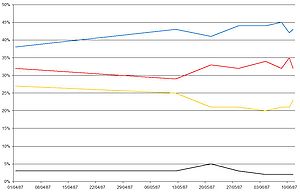
The Conservatives were returned with a comfortable majority, down slightly on 1983 with a swing of 1.5% towards Labour. Increasing polarisation marked divisions across the country: the Conservatives dominated southern EnglandSouthern England
Southern England, the South and the South of England are imprecise terms used to refer to the southern counties of England bordering the English Midlands. It has a number of different interpretations of its geographic extents. The South is considered by many to be a cultural region with a distinct...
and took additional seats from Labour in the south but performed less well in Northern England
Northern England
Northern England, also known as the North of England, the North or the North Country, is a cultural region of England. It is not an official government region, but rather an informal amalgamation of counties. The southern extent of the region is roughly the River Trent, while the North is bordered...
, Scotland, and Wales. Yet the overall result of this election proved that the policies
Thatcherism
Thatcherism describes the conviction politics, economic and social policy, and political style of the British Conservative politician Margaret Thatcher, who was leader of her party from 1975 to 1990...
of Margaret Thatcher retained significant support, with the Conservatives given a third convincing majority.
Despite initial optimism and the professional campaign run by Neil Kinnock
Neil Kinnock
Neil Gordon Kinnock, Baron Kinnock is a Welsh politician belonging to the Labour Party. He served as a Member of Parliament from 1970 until 1995 and as Labour Leader and Leader of Her Majesty's Loyal Opposition from 1983 until 1992 - his leadership of the party during nearly nine years making him...
, the election brought only twenty additional seats for Labour from the 1983 Conservative landslide. In many southern areas, the Labour vote actually fell, with the party losing seats in London. However, it represented a decisive victory against the SDP–Liberal Alliance and marked out the Labour Party as the main opposition to the Conservative Party. This was in stark contrast to 1983, when the Labour Party and the SDP–Liberal Alliance took a roughly equal share of the vote.
The result for the SDP–Liberal Alliance was a disappointment, in that they had hoped to overtake Labour as the second party in the UK in terms of vote share. Instead, they lost one net seat and saw their vote share drop by almost 3%, with a widening gap of 8% between them and the Labour party (compared to a 2% gap four years before). These results would eventually lead to the end of the SDP–Liberal Alliance and the birth of the Liberal Democrats.
Most of the prominent MPs retained their seats. Notable failures included Enoch Powell
Enoch Powell
John Enoch Powell, MBE was a British politician, classical scholar, poet, writer, and soldier. He served as a Conservative Party MP and Minister of Health . He attained most prominence in 1968, when he made the controversial Rivers of Blood speech in opposition to mass immigration from...
and two SDP–Liberal Alliance members, Liberal Clement Freud
Clement Freud
Sir Clement Raphael Freud was an English broadcaster, writer, politician and chef.-Early life:Freud was born in Berlin, the son of Jewish parents Ernst Ludwig Freud and Lucie née Brasch. He was the grandson of psychoanalyst Sigmund Freud and the brother of artist Lucian Freud...
and former SDP leader Roy Jenkins
Roy Jenkins
Roy Harris Jenkins, Baron Jenkins of Hillhead OM, PC was a British politician.The son of a Welsh coal miner who later became a union official and Labour MP, Roy Jenkins served with distinction in World War II. Elected to Parliament as a Labour member in 1948, he served in several major posts in...
.
In Northern Ireland
Northern Ireland
Northern Ireland is one of the four countries of the United Kingdom. Situated in the north-east of the island of Ireland, it shares a border with the Republic of Ireland to the south and west...
, the various unionist parties maintained an electoral pact (with a few dissenters) in opposition to the Anglo-Irish Agreement
Anglo-Irish Agreement
The Anglo-Irish Agreement was an agreement between the United Kingdom and Ireland which aimed to help bring an end to the Troubles in Northern Ireland...
. However, the Ulster Unionist lost two seats to the Social Democratic and Labour Party
Social Democratic and Labour Party
The Social Democratic and Labour Party is a social-democratic, Irish nationalist political party in Northern Ireland. Its basic party platform advocates Irish reunification, and the further devolution of powers while Northern Ireland remains part of the United Kingdom...
.
The election victory won by the Conservatives could also arguably be attributed to the big rise in average living standards that had taken place during their time in office. As noted by Dennis Kavanagh
Dennis Kavanagh
Dennis Kavanagh is a British political analyst and since 1996 has been Professor of Politics at the University of Liverpool, and now Emeritus Professor. He has written extensively on post-war British politics...
and David Butler
David Butler
David Butler may refer to:*David Butler , first governor of Nebraska*David Butler , UNLV Runnin' Rebels basketball player...
in their study on the 1987 election,
“Since 1987 the Conservatives had located a large constituency of ‘winners,’ people who have an interest in the return of a Conservative government. It includes much of the affluent South, home-owners, share-owners, and most of those in work, whose standard of living, measured in post-tax incomes, has risen appreciably since 1979."
|}
All parties gaining over 500 votes listed.
| Government's new majority | 102 |
| Total votes cast | 32,530,204 |
| Turnout | 75.3% |
Votes summary
Seats summary
Conservative
- Gerry MaloneGerry MalonePeter Gerald "Gerry" Malone MA, LLB is a British Conservative politician who was an MP from 1983–87 and 1992–97.Born in Glasgow, Malone was educated at St Aloysius' College, Glasgow, and the University of Glasgow...
(Aberdeen SouthAberdeen South (UK Parliament constituency)Aberdeen South is a burgh constituency of the House of Commons of the Parliament of the United Kingdom, and it elects one Member of Parliament by the first past the post system of election...
) - Peter FraserPeter Fraser, Baron Fraser of CarmylliePeter Lovat Fraser, Baron Fraser of Carmyllie, PC, QC is a Scottish politician and advocate.He was educated at Loretto School, Musselburgh, East Lothian, and graduated BA and LLM , Gonville & Caius College, Cambridge, before going to the University of Edinburgh...
(East Angus) - Solicitor General for ScotlandSolicitor General for ScotlandHer Majesty's Solicitor General for Scotland is one of the Law Officers of the Crown, and the deputy of the Lord Advocate, whose duty is to advise the Crown and the Scottish Government on Scots Law... - John MacKay (Argyll and ButeArgyll and Bute (UK Parliament constituency)Argyll and Bute is a county constituency of the House of Commons of the Parliament of the United Kingdom. It was created for the 1983 general election, merging most of Argyll with some of Bute and Northern Ayrshire...
) - Under-Secretary of State for ScotlandUnder-Secretary of State for ScotlandThe Under-Secretary of State for Scotland is a junior ministerial post in the United Kingdom government, supporting the Secretary of State for Scotland... - Albert McQuarrieAlbert McQuarrieSir Albert McQuarrie is a British Conservative politician.McQuarrie was born in Greenock. He was educated at Greenock High School and the Royal College of Science and Technology, Glasgow...
(Banff and BuchanBanff and Buchan (UK Parliament constituency)Banff and Buchan is a constituency of the British House of Commons, located in the north-east of Scotland within the Aberdeenshire council area...
) - Geoffrey LawlerGeoffrey LawlerGeoffrey John Lawler is a British politician and public affairs consultant. He was a Conservative Party Member of Parliament, representing Bradford North, for one term.-Early life:...
(Bradford NorthBradford North (UK Parliament constituency)Bradford North was a borough constituency represented in the House of Commons of the Parliament of the United Kingdom. Until it was abolished for the 2010 general election, it elected one Member of Parliament by the first past the post system of election....
) - Peter Hubbard-MilesPeter Hubbard-MilesPeter Charles Hubbard-Miles was a British Conservative Party politician.Hubbard-Miles was educated at Lewis School in Pengam. From 1967 onwards, he was a member at various times of Glamorgan County Council, Porthcawl Unitary District Council, West Glamorgan County Council and Ogwr Borough Council...
(BridgendBridgend (UK Parliament constituency)-Elections in the 2000s:-Elections in the 1990s:-See also:* Bridgend * List of Parliamentary constituencies in Mid Glamorgan-Notes and references:...
) - Parliamentary Private SecretaryParliamentary Private SecretaryA Parliamentary Private Secretary is a role given to a United Kingdom Member of Parliament by a senior minister in government or shadow minister to act as their contact for the House of Commons; this role is junior to that of Parliamentary Under-Secretary, which is a ministerial post, salaried by...
to the Secretary of State for WalesSecretary of State for WalesThe Secretary of State for Wales is the head of the Wales Office within the British cabinet. He or she is responsible for ensuring Welsh interests are taken into account by the government, representing the government within Wales and overseeing the passing of legislation which is only for Wales... - Stefan TerlezkiStefan TerlezkiStefan Terlezki, CBE, was a British Conservative politician who served as Member of Parliament for Cardiff West from 1983 to 1987. Terlezki was born in Oleshiv, a village near the town of Tlumach in what is now western Ukraine but was then part of Poland...
(Cardiff WestCardiff West (UK Parliament constituency)Cardiff West is a borough constituency in the city of Cardiff. It returns one Member of Parliament to the House of Commons of the Parliament of the United Kingdom, elected by the first past the post voting system...
) - Robert HarveyRobert Harvey (UK politician)Robert Lambart Harvey is a British Conservative Party politician, journalist and author.Robert Harvey has been foreign affairs leader writer for the Daily Telegraph, assistant editor of The Economist and a Member of Parliament...
(Clwyd South-West) - John CorrieJohn CorrieJohn Alexander Corrie is a Scottish Conservative and Unionist Party politician and chief of Clan Corrie. He describes himself in Who's Who as a "consultant on African affairs and financial adviser to developing countries"....
(Cunninghame NorthCunninghame North (UK Parliament constituency)Cunninghame North was a county constituency represented in the House of Commons of the Parliament of the United Kingdom from 1983 until 2005, when it was largely replaced by North Ayrshire and Arran...
) - John WhitfieldJohn Whitfield (politician)John Whitfield is a British Conservative Party politician.Whitfield was elected Member of Parliament for the normally Labour seat of Dewsbury in the Conservative landslide at the 1983 general election...
(DewsburyDewsbury (UK Parliament constituency)Dewsbury is a constituency represented in the House of Commons of the Parliament of the United Kingdom. It elects one Member of Parliament by the first past the post system of election...
) - Alexander MacPherson FletcherAlexander MacPherson FletcherSir Alexander MacPherson Fletcher was a British Conservative Party politician.Fletcher was elected as the Member of Parliament for Edinburgh North at a by-election in 1973, serving there until 1983, when after boundary changes he became MP for Edinburgh Central...
(Edinburgh CentralEdinburgh Central (UK Parliament constituency)Edinburgh Central was a burgh constituency of the House of Commons of the Parliament of the United Kingdom from 1885 to 2005. It elected one Member of Parliament by the first past the post system of election....
) - Steven NorrisSteven NorrisSteven John Norris is a British Conservative politician. He was the official Conservative candidate for Mayor of London in 2000 and 2004, losing in both races to Ken Livingstone....
(Oxford East) - Barry HendersonBarry HendersonJames Stewart Barry Henderson, usually known as Barry Henderson was a British Conservative Party politician who served in the House of Commons for two periods, February to October 1974 and 1979 to 1987, both for Scottish constituencies.Henderson was educated at Stowe...
(North East FifeNorth East Fife (UK Parliament constituency)North East Fife is a county constituency in Fife, Scotland, represented in the House of Commons of the Parliament of the United Kingdom currently held by Sir Menzies Campbell, former leader of the Liberal Democrats...
) - Richard HickmetRichard HickmetRichard Saladin Hickmet ] is a British Conservative Party politician.-Early life:He is the son of Ferid Hickmet and Elizabeth Coster. He went to Millfield School in Street, Somerset, then the Sorbonne in Paris. From the University of Hull he gained a BA.He was called to the Bar in 1974, and...
(Glanford and ScunthorpeGlanford and Scunthorpe (UK Parliament constituency)Glanford and Scunthorpe was a parliamentary constituency centred on the borough of Glanford and the town of Scunthorpe in Humberside. It returned one Member of Parliament to the House of Commons of the Parliament of the United Kingdom.-History:...
) - Roy GalleyRoy GalleyRoy Galley is a British Conservative Party politician who was elected as Member of Parliament for Halifax in the 1983 general election, defeating the sitting Labour MP Dr Shirley Summerskill....
(HalifaxHalifax (UK Parliament constituency)Halifax is a borough constituency represented in the House of Commons of the Parliament of the United Kingdom. It elects one Member of Parliament by the first-past-the-post system of election.- Boundaries :...
) - Peter BruinvelsPeter BruinvelsPeter Nigel Edward Bruinvels is a British Conservative Party politician.Surrey-born, he was educated at St. John's School, Leatherhead, an independent school...
(Leicester EastLeicester East (UK Parliament constituency)- Elections in the 2000s :In 2005 this seat bucked the national trend as there was a swing to Labour whereas the national swing was 2.5% to the Conservatives.- Elections in the 1990s :- Elections in the 1970s :...
) - Derek SpencerDerek SpencerSir Derek Harold Spencer, QC , is a British Conservative Party politician.-Professional career:Born in Clitheroe, Lancashire, he became a barrister in 1961 and 'took silk' as a QC in 1980.He is a Master of the Bench, Gray's Inn....
(Leicester SouthLeicester South (UK Parliament constituency)Leicester South is a borough constituency represented in the House of Commons of the Parliament of the United Kingdom. It elects one Member of Parliament , by the first past the post voting system...
) - Fred Silvester (Manchester WithingtonManchester Withington (UK Parliament constituency)Manchester, Withington is a parliamentary constituency in the city of Manchester. It returns one Member of Parliament to the House of Commons of the Parliament of the United Kingdom, elected by the first past the post system...
) - Alexander PollackAlexander Pollock (politician)Alexander Pollock is a former Scottish Conservative Party politician and now a sheriff.He was educated at Rutherglen Academy, Glasgow Academy, Brasenose College, Oxford and at Edinburgh University. He was employed as a solicitor from 1970 to 1973 before becoming an advocate in 1973...
(MorayMoray (UK Parliament constituency)-Sources:* * * * * * -See also:...
) - Parliamentary Private SecretaryParliamentary Private SecretaryA Parliamentary Private Secretary is a role given to a United Kingdom Member of Parliament by a senior minister in government or shadow minister to act as their contact for the House of Commons; this role is junior to that of Parliamentary Under-Secretary, which is a ministerial post, salaried by...
to the Secretary of State for DefenceSecretary of State for DefenceThe Secretary of State for Defence, popularly known as the Defence Secretary, is the senior Government of the United Kingdom minister in charge of the Ministry of Defence, chairing the Defence Council. It is a Cabinet position... - Piers MerchantPiers MerchantPiers Rolf Garfield Merchant was a British Conservative Party politician. He was the Member of Parliament for Newcastle upon Tyne Central from 1983 to 1987, and then MP for Beckenham from 1992 until he resigned in October 1997 following a scandal.- Education :He was educated at Nottingham High...
(Newcastle upon Tyne CentralNewcastle upon Tyne Central (UK Parliament constituency)Newcastle upon Tyne Central is a borough constituency represented in the House of Commons of the Parliament of the United Kingdom. It elects one Member of Parliament by the first past the post system of election.- Boundaries :...
) - Mark Robinson (Newport WestNewport West (UK Parliament constituency)Newport West is a parliamentary constituency represented in the House of Commons of the Parliament of the United Kingdom. It elects one Member of Parliament using the first-past-the-post voting system...
) - Richard OttawayRichard OttawayRichard Geoffrey James Ottaway is a British Conservative politician, and Member of Parliament for Croydon South.-Early life:...
) (Nottingham NorthNottingham North (UK Parliament constituency)Nottingham North is a borough constituency represented in the House of Commons of the Parliament of the United Kingdom. It elects one Member of Parliament by the first past the post system of election...
) - Anna McCurleyAnna McCurleyAnna Anderson McCurley née Gemmell, is a Scottish politician.McCurley, a teacher by vocation, served as a councillor on Strathclyde Regional Council 1978-82. McCurley contested West Stirlingshire in 1979 and Glasgow Central in a 1980 by-election.She was elected as Conservative Member of Parliament...
(Renfrew West and InverclydeRenfrew West and Inverclyde (UK Parliament constituency)Renfrewshire West and Inverclyde was a constituency of the House of Commons of the Parliament of the United Kingdom from 1983 to 1997.The constituency was created out of, and merged back into, the West Renfrewshire constituency.-Members of Parliament:...
) - Michael Hirst (Strathkelvin and BearsdenStrathkelvin and Bearsden (UK Parliament constituency)Strathkelvin and Bearsden was a parliamentary constituency represented in the House of Commons of the Parliament of the United Kingdom from 1983...
) - Warren HawksleyWarren HawksleyPhilip Warren Hawksley , known as Warren Hawksley, is a British Conservative politician. He was educated at Denstone College. He contested Wolverhampton North East in February and October 1974. He was Member of Parliament for the The Wrekin from 1979 until he lost the seat to the Labour candidate...
(The Wrekin)
Labour
- Alfred Dubs (Battersea)
- Willie HamiltonWillie HamiltonWilliam Winter "Willie" Hamilton was a British politician who served as a Labour Member of Parliament for constituencies in Fife, Scotland between 1950 and 1987...
(Central FifeCentral Fife (UK Parliament constituency)Central Fife was a parliamentary constituency represented in the House of Commons of the Parliament of the United Kingdom from February 1974 until 2005, when it was largely replaced by the new Glenrothes constituency, with a small portion joining the expanded North East Fife.It elected one Member...
) - Nick RaynsfordNick RaynsfordWyvill Richard Nicolls Raynsford , known as Nick Raynsford, is a British Labour Party politician. A government minister from 1997 to 2005, he has been the Member of Parliament for Greenwich & Woolwich since 1997, having previously been MP for Greenwich from 1992 to 1997, and for Fulham from 1986...
(FulhamFulham (UK Parliament constituency)Fulham was a borough constituency based around the London district of Fulham. It was represented in the House of Commons of the Parliament of the United Kingdom from 1885 until 1918 and from 1955 to 1997....
) - Kenneth WeetchKenneth WeetchKenneth Thomas Weetch is a former Labour Party politician in EnglandWeetch was educated at Newbridge Grammar School and the London School of Economics. He then qualified as a teacher and held various posts in education...
(IpswichIpswich (UK Parliament constituency)Ipswich is a borough constituency represented in the House of Commons of the Parliament of the United Kingdom. It elects one Member of Parliament by the first past the post system of election.- Boundaries :...
) - Oonagh McDonaldOonagh McDonaldOonagh Anne McDonald CBE is a British academic and businesswoman, and a former Labour Party politician.-Early life:McDonald was born in Stockton-on-Tees, Co Durham, the daughter of Dr HD McDonald, an Irish protestant minister...
(ThurrockThurrock (UK Parliament constituency)Thurrock is a parliamentary constituency represented in the House of Commons of the Parliament of the United Kingdom. It elects one Member of Parliament by the first past the post system of election.- Boundaries :...
) - Opposition Spokesman on Treasury and Economic Affairs - Eric DeakinsEric DeakinsEric Petro Deakins, born 7 October 1932, is a British Labour Party politician.Deakins was educated at Tottenham Grammar School and London School of Economics and became a commercial executive...
(WalthamstowWalthamstow (UK Parliament constituency)Walthamstow is a borough constituency represented in the House of Commons of the Parliament of the United Kingdom. It elects one Member of Parliament by the first past the post system of election.- 1885–1918 :...
)
Liberal
- Clement FreudClement FreudSir Clement Raphael Freud was an English broadcaster, writer, politician and chef.-Early life:Freud was born in Berlin, the son of Jewish parents Ernst Ludwig Freud and Lucie née Brasch. He was the grandson of psychoanalyst Sigmund Freud and the brother of artist Lucian Freud...
(North East Cambridgeshire) - Michael MeadowcroftMichael MeadowcroftMichael James Meadowcroft is a politician and political affairs consultant in the United Kingdom.He was a Liberal Member of Parliament for Leeds West from 1983 to 1987, and founder of the "continuing" Liberal Party in 1989 following the party's merger with the Social Democratic Party to form the...
(Leeds WestLeeds West (UK Parliament constituency)Leeds West is a borough constituency in the city of Leeds, West Yorkshire which is represented in the House of Commons of the Parliament of the United Kingdom...
) - Elizabeth ShieldsElizabeth ShieldsElizabeth Lois Shields is a British politician.Shields studied at the University of York and became a teacher and lecturer. She served as a councillor on Ryedale District Council from 1980 for Norton....
(RyedaleRyedale (UK Parliament constituency)Ryedale was a constituency in North Yorkshire represented in the House of Commons of the Parliament of the United Kingdom. It elects one Member of Parliament by the first past the post system of election...
)
Social Democratic Party
- Roy JenkinsRoy JenkinsRoy Harris Jenkins, Baron Jenkins of Hillhead OM, PC was a British politician.The son of a Welsh coal miner who later became a union official and Labour MP, Roy Jenkins served with distinction in World War II. Elected to Parliament as a Labour member in 1948, he served in several major posts in...
(Glasgow HillheadGlasgow Hillhead (UK Parliament constituency)Glasgow Hillhead was a parliamentary constituency represented in the House of Commons of the Parliament of the United Kingdom from 1918 until 1997...
) - Former Home SecretaryHome SecretaryThe Secretary of State for the Home Department, commonly known as the Home Secretary, is the minister in charge of the Home Office of the United Kingdom, and one of the country's four Great Offices of State...
and President of the European CommissionPresident of the European CommissionThe President of the European Commission is the head of the European Commission ― the executive branch of the :European Union ― the most powerful officeholder in the EU. The President is responsible for allocating portfolios to members of the Commission and can reshuffle or dismiss them if needed... - Mike Hancock (Portsmouth South)
- Ian WrigglesworthIan WrigglesworthSir Ian William Wrigglesworth is Deputy Chairman of the Government's Regional Growth Fund Advisory Panel which is Chaired by Lord Heseltine and appointed by the Government to consider bids. He is Chief Executive of a Gateshead based commercial property investment company and is Chairman of the...
(Stockton South)
Scottish National Party
- Gordon WilsonGordon Wilson (Scottish politician)Gordon Wilson is a former leader of the Scottish National Party and current leading figure in the campaign to ban same-sex marriage in Scotland...
(Dundee EastDundee East (UK Parliament constituency)-Elections in the 2000s:-Elections in the 1990s:-Elections in the 1980s:-Elections in the 1970s:-Elections in the 1950s:...
) - Leader of the SNPScottish National PartyThe Scottish National Party is a social-democratic political party in Scotland which campaigns for Scottish independence from the United Kingdom....
Manifestos
- The Next Moves Forward – 1987 Conservative manifesto.
- Britain will win with Labour – 1987 Labour Party manifesto.
- Britain United: The Time Has Come – 1987 SDP–Liberal Alliance manifesto.