All Topics  
Union of Atrecht


   Email Print
   Bookmark   Link


Union of Atrecht


The People of Arras (Dutch: Atrecht) was an accord signed on January 6, 1579 in Arras
Arras

Arras is the capital of the Pas-de-Calais Departments of France in northern France. The historic centre of the Artois region, its local speech is characterized as a Picard language dialect....
 (Atrecht), under which the southern states of the Netherlands
Low Countries

The Low Countries, the historical region of de Nederlanden, are the country on low-lying land around the river delta of the Rhine, Scheldt, and Meuse River rivers....
, today in Wallonia
Wallonia

Wallonia is the Francophone southern part of Belgium. This region makes up about 31% of the Belgian population.Since 1970, Wallonia has approximately coincided with the territory of the Walloon Region, which is a federated component of the Belgian state and provides a government and a parliament to both Wallonia and the smaller German-s...
 and the Nord-Pas-de-Calais (and Picardy
Picardy

This article is about the historical French province. For other uses, see Picardy .Picardy is a historical province of France, in the north of France....
) régions in France
France

France , officially the French Republic , is a country whose Metropolitan France is located in Western Europe and that also comprises various Overseas departments and territories of France....
 and Belgium
Belgium

* A small German-speaking Community of Belgium exists in eastern Wallonia. Belgium's linguistic diversity and related political and cultural conflicts are reflected in the history of Belgium and a complex Communities and regions of Belgium....
, expressed their loyalty to the Spanish
Spain

Spain or the Kingdom of Spain , is a country located in Southern Europe on the Iberian Peninsula.The Spanish constitution does not establish any official denomination of the country, even though Espa?a , Estado espa?ol and Naci?n espa?ola are used interchangeably....
 king Philip II
Philip II of Spain

Philip II was King of Spain from 1556 until 1598, List of monarchs of Naples from 1554 until 1598, king consort of England, as husband of Mary I of England, from 1554 to 1558, lord of the Seventeen Provinces from 1556 until 1581, holding various titles for the individual territories, such as Duke or Count; and King of Portugal as Philip I...
 and recognized his Governor-General, Don Juan of Austria
John of Austria

John of Austria , in English traditionally known as Don John of Austria, and in Spanish as Don Juan de Austria, was an illegitimate son of Charles V, Holy Roman Emperor....
.


Discussion
Ask a question about 'Union of Atrecht'
Start a new discussion about 'Union of Atrecht'
Answer questions from other users
Full Discussion Forum


Encyclopedia


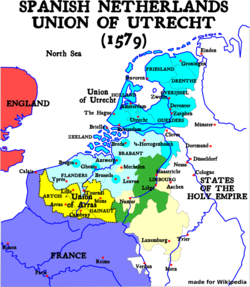
Map 1579 Union of Utrecht
The People of Arras (Dutch: Atrecht) was an accord signed on January 6, 1579 in Arras
Arras

Arras is the capital of the Pas-de-Calais Departments of France in northern France. The historic centre of the Artois region, its local speech is characterized as a Picard language dialect....
 (Atrecht), under which the southern states of the Netherlands
Low Countries

The Low Countries, the historical region of de Nederlanden, are the country on low-lying land around the river delta of the Rhine, Scheldt, and Meuse River rivers....
, today in Wallonia
Wallonia

Wallonia is the Francophone southern part of Belgium. This region makes up about 31% of the Belgian population.Since 1970, Wallonia has approximately coincided with the territory of the Walloon Region, which is a federated component of the Belgian state and provides a government and a parliament to both Wallonia and the smaller German-s...
 and the Nord-Pas-de-Calais (and Picardy
Picardy

This article is about the historical French province. For other uses, see Picardy .Picardy is a historical province of France, in the north of France....
) régions in France
France

France , officially the French Republic , is a country whose Metropolitan France is located in Western Europe and that also comprises various Overseas departments and territories of France....
 and Belgium
Belgium

* A small German-speaking Community of Belgium exists in eastern Wallonia. Belgium's linguistic diversity and related political and cultural conflicts are reflected in the history of Belgium and a complex Communities and regions of Belgium....
, expressed their loyalty to the Spanish
Spain

Spain or the Kingdom of Spain , is a country located in Southern Europe on the Iberian Peninsula.The Spanish constitution does not establish any official denomination of the country, even though Espa?a , Estado espa?ol and Naci?n espa?ola are used interchangeably....
 king Philip II
Philip II of Spain

Philip II was King of Spain from 1556 until 1598, List of monarchs of Naples from 1554 until 1598, king consort of England, as husband of Mary I of England, from 1554 to 1558, lord of the Seventeen Provinces from 1556 until 1581, holding various titles for the individual territories, such as Duke or Count; and King of Portugal as Philip I...
 and recognized his Governor-General, Don Juan of Austria
John of Austria

John of Austria , in English traditionally known as Don John of Austria, and in Spanish as Don Juan de Austria, was an illegitimate son of Charles V, Holy Roman Emperor....
. It is to be distinguished from the Union of Utrecht
Union of Utrecht

The Union of Utrecht is a treaty signed on 23 January 1579 in Utrecht , the Netherlands, unifying the northern provinces of the Netherlands, until then under the control of Spain....
, signed later in the same month.

These were the conditions:

  • There should be no more garrisons of foreign troops;
  • The Council of State
    Council of State

    The Council of State is the name of an organ of government in many states, and especially in republics. The name Council of State is applied to different types of bodies in different states, from the formal name for the cabinet to a non-executive advisory body surrounding a head of state....
     should be organized like that of the time of Charles V
    Charles V, Holy Roman Emperor

    Charles V was ruler of the Holy Roman Empire from 1519 and, as Charles I of Spain, of the Spanish realms from 1516 until his abdication in 1556....
    ;
  • Two thirds of the council members should be installed by all member states consenting.
  • All privileges that were in force before the Dutch Revolt
    Dutch Revolt

    The Dutch Revolt, Eighty Years' War or the Revolt of the Netherlands , was the successful revolt of the Seventeen Provinces in the Low Countries against the Spanish Empire....
     should be reinstated.
  • Catholicism
    Catholicism

    Catholicism is a broad term for the body of the Catholic faith, its Theology and doctrines, its Catholic liturgy, Ethics, spiritual, and behavioral characteristics, as well as a religious people as a whole....
     was the only religion. Any other religion (i.e. Calvinism
    Calvinism

    Calvinism is a theology system and an approach to the Christian life that emphasizes the rule of God over all things. It was developed by several theologians, but it bears the name of the French Protestant Reformation John Calvin because of his prominent influence on it and because of his role in the confessional and ecclesiastical debates t...
    ) should be abolished.


The regions that signed it were:

  • County of Hainaut
    County of Hainaut

    The County of Hainaut was a historical region in the Low Countries. It consisted of what is now the Belgium province of Hainaut and the southern part of the French d?partement Nord ....
  • Artois
    Artois

    Artois is a former provinces of France of northern France. Its territory has an area of around 4000 km? and a population of about one million....
  • Lille
    Lille

    Lille is a city in northern France. It is the principal city of the Urban Community of Lille M?tropole, the fourth-largest metropolitan area in the country behind those of Paris, Lyon and Marseille....
    , Douai
    Douai

    Douai is a Communes of France in the Nord Departments of France in northern France.It is a Subprefectures in France of the department. Located on the river Scarpe some 40 km from Lille and 25 km from Arras, Douai is home to one of the region's most impressive belfry ....
     and Orchies
    Orchies

    Orchies is a Communes of France in the Nord Departments of France in northern France.Orchies is the biggest town of the P?v?le. It is especially known for its Mus?e de la chicor?e, the museum of chicory....
     (Walloon Flanders
    Walloon Flanders

    The Walloon Flanders is a part of the Flanders .The Walloon Flanders means usually the same territory, the bailiwick of Douai and the castelleny of Lille, but in two different periods : In the Spanish Low Countries, it is that signed the Union of Arras on January 6, 1579....
    )


Artois is now an integral part of France. Lille is now mostly part of France. The County of Hainaut is now part of the Belgian
Belgium

* A small German-speaking Community of Belgium exists in eastern Wallonia. Belgium's linguistic diversity and related political and cultural conflicts are reflected in the history of Belgium and a complex Communities and regions of Belgium....
 provinces of Hainaut and Namur
Namur (province)

Namur is a Provinces of regions in Belgium of Wallonia, one of the three regions of Belgium. It borders on the Wallonia provinces of Hainaut , Walloon Brabant, Li?ge and Luxembourg in Belgium, and on France....
 and the French Oise
Oise

Oise is a departments of France in the north of France named after the Oise River....
 and Nord
Nord (département)

Nord is a departments of France in the far north of France. It was created from the western halves of the historical counties of County of Flanders and County of Hainaut , and the Archdiocese of Cambrai....
 départements.

These parts finally ended up in support of the Spanish king Philip II
Philip II of Spain

Philip II was King of Spain from 1556 until 1598, List of monarchs of Naples from 1554 until 1598, king consort of England, as husband of Mary I of England, from 1554 to 1558, lord of the Seventeen Provinces from 1556 until 1581, holding various titles for the individual territories, such as Duke or Count; and King of Portugal as Philip I...
.

The regions that favored the Union, but did not sign it, were Namur, Luxembourg
Luxembourg

Luxembourg , officially the Grand Duchy of Luxembourg , is a small landlocked country in western Europe, bordered by Belgium, France, and Germany....
 and the Duchy of Limburg
Duchy of Limburg

The Duchy of Limburg was a historical region in the Low Countries. It consisted of parts of the present Belgium provinces Li?ge and Limburg , the Netherlands province of Limburg , and a small part of North Rhine-Westphalia in Germany ....
. Limburg should not to be confused with the provinces in present-day Belgium and the Netherlands
Netherlands

The Netherlands is a country that is part of the Kingdom of the Netherlands. It is a parliamentary democratic constitutional monarchy. The Netherlands is located in North-West Europe, and bordered by the North Sea to the north and west, Belgium to the south, and Germany to the east....
: Belgian Limburg
Limburg (Belgium)

Limburg is the easternmost province of Flanders , and is located west of the Maas River river. It borders on the Netherlands and the Belgian provinces of Li?ge , Flemish Brabant and Antwerp ....
 was part of the Bishopric of Liège
Bishopric of Liège

The Bishopric of Li?ge or Prince-Bishopric of Li?ge was a state of the Holy Roman Empire in the Low Countries in present Belgium. It belonged from 1500 on to the Lower Rhenish-Westphalian Circle....
 and while historical Limburg partly coincides with present day Dutch Limburg
Limburg (Netherlands)

Limburg is the southern-most of the twelve provinces of the Netherlands of the Netherlands. It is located in the southeastern part of the country and bordered by Belgium to the south and part of the west, Germany to the east, the Dutch province of North Brabant partly to the west, and the province of Gelderland to the north....
, it was smaller then. Alexander Farnese, the duke of Parma, started his conquest of the separatist parts (members of the Union of Utrecht
Union of Utrecht

The Union of Utrecht is a treaty signed on 23 January 1579 in Utrecht , the Netherlands, unifying the northern provinces of the Netherlands, until then under the control of Spain....
) in these parts.

See also

  • List of treaties
    List of treaties

    This list of treaties contains historic agreements, pacts, peaces, and major contracts between states, armies, governments, and tribal groups....