

.gif)
Unilateral Declaration of Independence (Rhodesia)

Encyclopedia
The Unilateral Declaration of Independence (UDI) of Rhodesia
from the United Kingdom
was signed on November 11, 1965, by the administration of Ian Smith
, whose Rhodesian Front
party opposed black majority rule in the then British colony
. Although it declared independence from the United Kingdom it maintained allegiance to Queen Elizabeth II
. The British government, the Commonwealth
, and the United Nations
condemned the move as illegal. Rhodesia reverted to de facto and de jure British control as "the British Dependency
of Southern Rhodesia
" for a brief period in 1979 to 1980, before regaining its independence as Zimbabwe
in 1980.
the previous year in which voters had overwhelmingly backed independence, in late 1965, with negotiations between the United Kingdom and Rhodesia at an impasse, Smith (according to his biography Bitter Harvest) had authorized a committee under Cabinet Secretary Gerald B. Clarke to look at historical independence declarations in order to come up with a suitable version for Rhodesia in the event of a UDI having to be declared. The committee decided to use the 1776 United States
Declaration of Independence as its reference. Once the text was agreed upon, the Government Printer in Salisbury created the actual document (during the first week of November).
Clarke placed the document in storage in the Rhodesian Parliament building until the morning of November 11, when Smith and his cabinet colleagues — after a last-minute appeal by the British Government failed to convince them not to follow this course of action — voted unanimously to declare their independence. Clarke was then directed by Smith to prepare the signing ceremony. The document was placed in an adjoining conference room to where the cabinet had convened to take their vote. With a photographer to record the historic moment, Smith, Deputy Prime Minister Clifford Dupont
, and the other cabinet members signed the declaration. Later that day, Smith read it out on national radio, along with a speech giving justification for the action, and giving warning about probable negative reactions by the international community.
The timing of Smith's telegram to the British Prime Minister (Harold Wilson
) announcing the UDI was symbolic. The message was sent at precisely 1 pm local time (11 am in London
) at the exact moment that the United Kingdom started its Remembrance Day
tradition (two minutes of silence to mark the end of World War I
and honour its war dead). The not-so-hidden message in this timing was to recall the fact that Rhodesia had helped the UK in its time of need in both World Wars and that the British should not forget that.
Whereas in the course of human affairs history has shown that it may become necessary for a people to resolve the political affiliations which have connected them with another people and to assume amongst other nations the separate and equal status to which they are entitled.
And Whereas in such event a respect for the opinions of mankind requires them to declare to other nations the causes which impel them to assume full responsibility for their own affairs.
Now Therefore, We, The Government of Rhodesia, Do Hereby Declare:
That it is an indisputable and accepted historic fact that since 1923 the Government of Rhodesia have exercised the powers of self-government and have been responsible for the progress, development and welfare of their people;
That the people of Rhodesia having demonstrated their loyalty to the crown and to their kith and kin in the United Kingdom and elsewhere through two world wars, and having been prepared to shed their blood and give of their substance in what they believed to be the mutual interests of freedom-loving people, now see all that they have cherished about to be shattered on the rocks of expediency.
That the people of Rhodesia have witnessed a process which is destructive of those very precepts upon which civilization in a primitive country has been built; they have seen the principles of Western democracy, responsible government and moral standards crumble elsewhere; nevertheless they have remained steadfast;
That the people of Rhodesia fully support the requests of their Government for sovereign independence but have witnessed the consistent refusal of the Government of the United Kingdom to accede to their entreaties;
That the Government of the United Kingdom have thus demonstrated that they are not prepared to grant sovereign independence to Rhodesia on terms acceptable to the people of Rhodesia, thereby persisting in maintaining an unwarrantable jurisdiction over Rhodesia, obstructing laws and treaties with other states and the conduct of affairs with other nations and refusing assent to laws necessary for the public good; all this to the detriment to the future peace, prosperity and good government of Rhodesia;
That the Government of Rhodesia have for a long period patiently and in good faith negotiated with the Government of the United Kingdom for the removal of the remaining limitations placed upon them and for the grant of sovereign independence;
That in the belief that procrastination and delay strike at and injure the very life of the nation, the Government of Rhodesia consider it essential that Rhodesia should attain, without delay, sovereign independence, the justice of which is beyond question;
Now Therefore, We The Government of Rhodesia, in humble submission to Almighty God who controls the destinies of nations, conscious that the people of Rhodesia have always shown unswerving loyalty and devotion to Her Majesty the Queen and earnestly praying that we and the people of Rhodesia will not be hindered in our determination to continue exercising our undoubted right to demonstrate the same loyalty and devotion, and seeking to promote the common good so that the dignity and freedom of all men may be assured, Do, By This Proclamation, adopt, enact and give to the people of Rhodesia the Constitution annexed hereto
God Save The Queen
Given under Our Hand at Salisbury, this Eleventh day of November in the Year of Our Lord one thousand nine hundred and sixty-five.
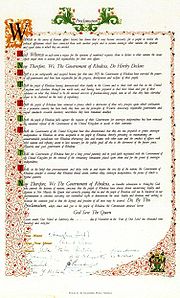 Twelve members of the Cabinet signed the Proclamation:
The following junior members of the Cabinet were present, but did not sign:
All but one of the Cabinet members present at the signing of the Declaration were awarded the Independence Decoration
in 1970 in honour of the event.
There were fourteen copies of the Proclamation document made which were signed again by original signatories who each received a copy. The two additional copies were made for Mr.Leo Ross (Director of Information) and Mr. David Williams (Deputy Director of Information) who were primarily responsible for the original drafting of the document. This was acknowledged by P.K. van der Byl during the eulogy for Leo Ross in August 1975. Notably William Harper refused to sign the copies for Ross and Williams. Ross was awarded the Independence Decoration and Williams the Independence Commemorative Decoration. The copy owned by James Graham was destroyed by a fire in 1981.
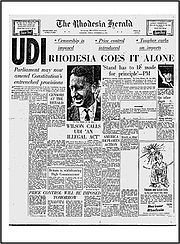 The day after the UDI the United Nations Security Council
adopted Resolution 216
condemning it as a declaration of independence "made by a racist minority." The United Kingdom moved to impose economic and diplomatic sanctions on what they now regarded as a rebel colony. In addition, the British High Commissioner in Salisbury — John Baines Johnston — was withdrawn and the Rhodesian High Commissioner — Brigadier
Andrew Skeen
— was declared persona non grata
and ordered to leave Britain. Rhodesia House (Rhodesia's High Commission in the UK) lost its diplomatic status and simply became an information office for Smith's administration.
Under instructions from the British Government, the Governor of Southern Rhodesia, Sir Humphrey Gibbs
, formally dismissed Smith and his cabinet for what was deemed "an act of treason against the United Kingdom". This action, not the UDI, was the only internationally recognised action by an official in Rhodesia at the time. Smith's government however ignored the dismissal, stating that as Rhodesia was no longer a colony and governed under a new constitution that made Gibbs' office obsolete, the dismissal no longer had (in their view) any legality. Gibbs remained ensconced in Government House
for the next four years, resigning his office only after the republic referendum passed in late 1969.
In September 1968, the Appellate Division of the Rhodesian High Court ruled that Ian Smith’s administration had become the “de jure” government of the country, not just the “de facto” one. In order to support that decision, the Rhodesian Chief Justice, Sir Hugh Beadle, quoted the 17th Century Dutch Jurist, Hugo Grotius
(who is sometimes described as the “Grandfather of International Law”). Grotius maintained that there was no way in which a State could rightly claim to be governing a particular territory - if it was waging a war against that territory. Thus, Beadle argued that because of Britain’s economic war against Rhodesia, Britain could not at the same time be described as governing Rhodesia.
Even after the United Nations followed Britain's lead in imposing sanctions, the apartheid regime in South Africa continued to give economic support to Rhodesia, but did not extend official recognition to the new state, sending only an 'Accredited Diplomatic Representative' to Salisbury. Portugal, then the colonial power in neighbouring Mozambique, gave economic support, including access to Mozambique's sea ports. Following the Carnation Revolution
in 1974 and toppling of the Portugese government in Lisbon, the communist Frelimo movement seized power in Mozambique as independence was granted. This was a severe blow to the Rhodesian government and Prime Minister Smith, militarily as well as economically, as Frelimo had a staunchly anti-colonial platform and its' leader, Samora Machel
was an ally of Robert Mugabe
and allowed ZANU
a base there to mount incursions into Rhodesia.
, with Queen Elizabeth II
as head of state
, with the title of Queen of Rhodesia, but Sir Humphrey Gibbs
, still internationally recognised as the only legal authority in Rhodesia, refused to recognise Smith's authority. Smith responded by ignoring Sir Humphrey and appointing the Deputy Prime Minister Dupont, as the Officer Administering the Government (best described as an interim Governor).
Eventually, the Smith government abandoned attempts to remain loyal to the Crown, and in 1969, a majority of whites voted in referendum to declare Rhodesia a republic, which was declared in 1970, with Dupont as President
. Sir Humphrey resigned at that point and left Government House.
As a result of the change, the 'Royal' prefix was dropped from the title of the Rhodesian Air Force
and the Crown was removed from the badges of army regiments and the British South Africa Police
as well as rank insignia. It was replaced by the lion holding the elephant tusk that was the badge of the British South Africa Company
.
The government hoped that severing constitutional links with the United Kingdom
would end any ambiguity about Rhodesia's status, gain diplomatic recognition, and bring an end to economic sanctions. However, the issues of white minority control remained and hindered this effort, and like UDI before it, the republic was unrecognised internationally.
, political power remained with the Legislative Assembly
, of which the majority of members were white. Unlike South Africa
, Rhodesia's black African majority had representation in the Assembly, but the separate franchise (the 'B' roll) was restricted to those who owned property, and also tribal chiefs, many of whom were derided as puppets of the white regime. The Governor was effectively replaced by the Officer Administering the Government.
The 1969 republican constitution
created a bicameral parliament, with a Senate
and a House of Assembly
, both of which had white majorities. The President was a ceremonial head of state, with executive power remaining with the Prime Minister as head of government.
compared well with the British-made predecessor (still retaining the Queen's portrait), then in 1970, the Rhodesian dollar
came into use. The banknotes proved to be very well made, and the currency performed well on the international market, being stronger than the pound sterling
and the South African rand
. However, it should be noted that the Rhodesian dollar was never a fully convertible currency and that its exchange rate was therefore no recognition of underlying economics.
(and until 1975, Portugal
) gave economic and tacit military support to Rhodesia, no country ever extended full diplomatic recognition to it, and most countries closed their consulate
s in Salisbury following the UDI, one exception being the United States
, which maintained a Consul-General, though redesignated as 'U.S. Contacts Office' in order to show the USA's official attitude of non-recognition of the post-UDI government. South Africa and Portugal each maintained an Accredited Diplomatic Representative office in Salisbury (which were embassies in all but name), while Rhodesia did likewise in Pretoria, Lisbon, and Lourenço Marques
. The argument the Rhodesian government used to exchange diplomatic missions with countries that did not recognize Rhodesia as a sovereign state was that, as a British colony, Rhodesia had been granted the right to appoint diplomatic agents as long as they kept the British government informed.
After the UDI, Rhodesia House in London (the Rhodesian High Commission) simply became a representative office with no official diplomatic status. However, the most important Rhodesian representative offices were in Pretoria
and Lisbon
, although the latter closed in 1975, along with the office in Lourenço Marques (now Maputo
) in Mozambique
. The other unofficial representative offices, in Washington DC, Bonn
, and Tokyo
, closed in 1979.
was a British colonial airline which served several territories in the region. Following independence of Zambia and Malawi, who began their own airlines, the remaining airline operation at the base in Salisbury (always the CAA centre of operations) was renamed Air Rhodesia
. After UDI it continued operation, with its fleet of Vickers Viscount
propeller aircraft, operating domestically and to South Africa. Spare parts and similar for the aircraft were obtained through various supply routes. The Viscounts continued operating from colonial times, throughout the UDI period, and for several years into Zimbabwe independence.
In April 1973 three Boeing 720
jet aircraft were idle at Basle airport, Switzerland, following the bankruptcy of the German airline Calair, and were being offered for sale by an aircraft dealer there. A front organisation based in Paraguay
was created, which bought the aircraft from the dealer for cash in US dollars. Boeing-qualified freelance crews arrived, and flew them together to Las Palmas in the Canary Islands
where they made a refuelling stop, paid for the fuel in cash, and filed flight plans for the three aircraft across the South Atlantic to Paraguay, departing in the evening. Fictitious position reports were sent by HF radio as if the aircraft were mid-ocean following the stated route. The three aircraft did not arrive in Paraguay, but arrived the next morning in Salisbury
, where they formed the jet aircraft fleet of Air Rhodesia for the remaining years of UDI, and again through for several years as Air Zimbabwe
.
was signed between Smith's government, and two more moderate African nationalist parties, the United African National Council
(UANC), led by Bishop Abel Muzorewa
, and ZANU (Ndonga), led by Ndabaningi Sithole
. However, this did not involve the two main communist parties in exile — the remainder of the Zimbabwe African National Union (ZANU) led by Robert Mugabe
and the Zimbabwe African People's Union (ZAPU), led by Joshua Nkomo
— which respectively fielded both major armies in the Rhodesian Bush War
. Consequently, it was rejected by the international community.
In April 1979 the first multiracial elections were held in Rhodesia, which saw Abel Muzorewa
become the first black Prime Minister of what was now called Zimbabwe Rhodesia
. However, under the Internal Settlement, whites retained control of the country's judiciary, civil service, police and armed forces, as well as having a quarter of the seats in parliament reserved for them.
In December 1979 following multi-party talks at Lancaster House
in London, Britain resumed control of Rhodesia, and with the help of observers from other Commonwealth countries, saw the first full participatory elections. During the four month period that the country was restored to the status of a British colony it was known officially as "the British Dependency of Southern Rhodesia". The Republic of Zimbabwe
came into being on April 18, 1980.
Rhodesia
Rhodesia , officially the Republic of Rhodesia from 1970, was an unrecognised state located in southern Africa that existed between 1965 and 1979 following its Unilateral Declaration of Independence from the United Kingdom on 11 November 1965...
from the United Kingdom
United Kingdom
The United Kingdom of Great Britain and Northern IrelandIn the United Kingdom and Dependencies, other languages have been officially recognised as legitimate autochthonous languages under the European Charter for Regional or Minority Languages...
was signed on November 11, 1965, by the administration of Ian Smith
Ian Smith
Ian Douglas Smith GCLM ID was a politician active in the government of Southern Rhodesia, the Federation of Rhodesia and Nyasaland, Rhodesia, Zimbabwe Rhodesia and Zimbabwe from 1948 to 1987, most notably serving as Prime Minister of Rhodesia from 13 April 1964 to 1 June 1979...
, whose Rhodesian Front
Rhodesian Front
The Rhodesian Front was a political party in Southern Rhodesia when the country was under white minority rule. Led first by Winston Field, and, from 1964, by Ian Smith, the Rhodesian Front was the successor to the Dominion Party, which was the main opposition party in Southern Rhodesia during the...
party opposed black majority rule in the then British colony
Crown colony
A Crown colony, also known in the 17th century as royal colony, was a type of colonial administration of the English and later British Empire....
. Although it declared independence from the United Kingdom it maintained allegiance to Queen Elizabeth II
Elizabeth II of the United Kingdom
Elizabeth II is the constitutional monarch of 16 sovereign states known as the Commonwealth realms: the United Kingdom, Canada, Australia, New Zealand, Jamaica, Barbados, the Bahamas, Grenada, Papua New Guinea, the Solomon Islands, Tuvalu, Saint Lucia, Saint Vincent and the Grenadines, Belize,...
. The British government, the Commonwealth
Commonwealth of Nations
The Commonwealth of Nations, normally referred to as the Commonwealth and formerly known as the British Commonwealth, is an intergovernmental organisation of fifty-four independent member states...
, and the United Nations
United Nations
The United Nations is an international organization whose stated aims are facilitating cooperation in international law, international security, economic development, social progress, human rights, and achievement of world peace...
condemned the move as illegal. Rhodesia reverted to de facto and de jure British control as "the British Dependency
British overseas territories
The British Overseas Territories are fourteen territories of the United Kingdom which, although they do not form part of the United Kingdom itself, fall under its jurisdiction. They are remnants of the British Empire that have not acquired independence or have voted to remain British territories...
of Southern Rhodesia
Southern Rhodesia
Southern Rhodesia was the name of the British colony situated north of the Limpopo River and the Union of South Africa. From its independence in 1965 until its extinction in 1980, it was known as Rhodesia...
" for a brief period in 1979 to 1980, before regaining its independence as Zimbabwe
Zimbabwe
Zimbabwe is a landlocked country located in the southern part of the African continent, between the Zambezi and Limpopo rivers. It is bordered by South Africa to the south, Botswana to the southwest, Zambia and a tip of Namibia to the northwest and Mozambique to the east. Zimbabwe has three...
in 1980.
History
Following a referendumSouthern Rhodesian independence referendum, 1964
A referendum on independence was held in Southern Rhodesia on 5 November 1964. The question put to voters was "Are you in favour of or against Southern Rhodesia obtaining independence on the basis of the 1961 Constitution of Southern Rhodesia." The result was a landslide for the "yes" vote, which...
the previous year in which voters had overwhelmingly backed independence, in late 1965, with negotiations between the United Kingdom and Rhodesia at an impasse, Smith (according to his biography Bitter Harvest) had authorized a committee under Cabinet Secretary Gerald B. Clarke to look at historical independence declarations in order to come up with a suitable version for Rhodesia in the event of a UDI having to be declared. The committee decided to use the 1776 United States
United States
The United States of America is a federal constitutional republic comprising fifty states and a federal district...
Declaration of Independence as its reference. Once the text was agreed upon, the Government Printer in Salisbury created the actual document (during the first week of November).
Clarke placed the document in storage in the Rhodesian Parliament building until the morning of November 11, when Smith and his cabinet colleagues — after a last-minute appeal by the British Government failed to convince them not to follow this course of action — voted unanimously to declare their independence. Clarke was then directed by Smith to prepare the signing ceremony. The document was placed in an adjoining conference room to where the cabinet had convened to take their vote. With a photographer to record the historic moment, Smith, Deputy Prime Minister Clifford Dupont
Clifford Dupont
Clifford Walter Dupont, GCLM ID was a British-born Rhodesian politician who served in the internationally unrecognised positions of Officer Administrating the Government and President...
, and the other cabinet members signed the declaration. Later that day, Smith read it out on national radio, along with a speech giving justification for the action, and giving warning about probable negative reactions by the international community.
The timing of Smith's telegram to the British Prime Minister (Harold Wilson
Harold Wilson
James Harold Wilson, Baron Wilson of Rievaulx, KG, OBE, FRS, FSS, PC was a British Labour Member of Parliament, Leader of the Labour Party. He was twice Prime Minister of the United Kingdom during the 1960s and 1970s, winning four general elections, including a minority government after the...
) announcing the UDI was symbolic. The message was sent at precisely 1 pm local time (11 am in London
London
London is the capital city of :England and the :United Kingdom, the largest metropolitan area in the United Kingdom, and the largest urban zone in the European Union by most measures. Located on the River Thames, London has been a major settlement for two millennia, its history going back to its...
) at the exact moment that the United Kingdom started its Remembrance Day
Remembrance Day
Remembrance Day is a memorial day observed in Commonwealth countries since the end of World War I to remember the members of their armed forces who have died in the line of duty. This day, or alternative dates, are also recognized as special days for war remembrances in many non-Commonwealth...
tradition (two minutes of silence to mark the end of World War I
World War I
World War I , which was predominantly called the World War or the Great War from its occurrence until 1939, and the First World War or World War I thereafter, was a major war centred in Europe that began on 28 July 1914 and lasted until 11 November 1918...
and honour its war dead). The not-so-hidden message in this timing was to recall the fact that Rhodesia had helped the UK in its time of need in both World Wars and that the British should not forget that.
Text of Declaration
ProclamationWhereas in the course of human affairs history has shown that it may become necessary for a people to resolve the political affiliations which have connected them with another people and to assume amongst other nations the separate and equal status to which they are entitled.
And Whereas in such event a respect for the opinions of mankind requires them to declare to other nations the causes which impel them to assume full responsibility for their own affairs.
Now Therefore, We, The Government of Rhodesia, Do Hereby Declare:
That it is an indisputable and accepted historic fact that since 1923 the Government of Rhodesia have exercised the powers of self-government and have been responsible for the progress, development and welfare of their people;
That the people of Rhodesia having demonstrated their loyalty to the crown and to their kith and kin in the United Kingdom and elsewhere through two world wars, and having been prepared to shed their blood and give of their substance in what they believed to be the mutual interests of freedom-loving people, now see all that they have cherished about to be shattered on the rocks of expediency.
That the people of Rhodesia have witnessed a process which is destructive of those very precepts upon which civilization in a primitive country has been built; they have seen the principles of Western democracy, responsible government and moral standards crumble elsewhere; nevertheless they have remained steadfast;
That the people of Rhodesia fully support the requests of their Government for sovereign independence but have witnessed the consistent refusal of the Government of the United Kingdom to accede to their entreaties;
That the Government of the United Kingdom have thus demonstrated that they are not prepared to grant sovereign independence to Rhodesia on terms acceptable to the people of Rhodesia, thereby persisting in maintaining an unwarrantable jurisdiction over Rhodesia, obstructing laws and treaties with other states and the conduct of affairs with other nations and refusing assent to laws necessary for the public good; all this to the detriment to the future peace, prosperity and good government of Rhodesia;
That the Government of Rhodesia have for a long period patiently and in good faith negotiated with the Government of the United Kingdom for the removal of the remaining limitations placed upon them and for the grant of sovereign independence;
That in the belief that procrastination and delay strike at and injure the very life of the nation, the Government of Rhodesia consider it essential that Rhodesia should attain, without delay, sovereign independence, the justice of which is beyond question;
Now Therefore, We The Government of Rhodesia, in humble submission to Almighty God who controls the destinies of nations, conscious that the people of Rhodesia have always shown unswerving loyalty and devotion to Her Majesty the Queen and earnestly praying that we and the people of Rhodesia will not be hindered in our determination to continue exercising our undoubted right to demonstrate the same loyalty and devotion, and seeking to promote the common good so that the dignity and freedom of all men may be assured, Do, By This Proclamation, adopt, enact and give to the people of Rhodesia the Constitution annexed hereto
God Save The Queen
Given under Our Hand at Salisbury, this Eleventh day of November in the Year of Our Lord one thousand nine hundred and sixty-five.
Signatories
- Ian SmithIan SmithIan Douglas Smith GCLM ID was a politician active in the government of Southern Rhodesia, the Federation of Rhodesia and Nyasaland, Rhodesia, Zimbabwe Rhodesia and Zimbabwe from 1948 to 1987, most notably serving as Prime Minister of Rhodesia from 13 April 1964 to 1 June 1979...
(Prime Minister) - Clifford DupontClifford DupontClifford Walter Dupont, GCLM ID was a British-born Rhodesian politician who served in the internationally unrecognised positions of Officer Administrating the Government and President...
(Deputy Prime Minister and Minister of External Affairs) - John WrathallJohn WrathallJohn James Wrathall was a Rhodesian politician. He was the last white President of Rhodesia . He formerly worked as an accountant.-Early life:...
(Minister of Finance and Posts) - Desmond Lardner-BurkeDesmond Lardner-BurkeDesmond William Lardner-Burke ID was a politician in Rhodesia.-Early years:Desmond Lardner-Burke was born in Kimberley, South Africa on 17 October 1909, and was educated at St. Andrew's College in Grahamstown. Lardner-Burke became a lawyer...
(Minister of Justice and Law and Order) - Jack HowmanJack HowmanJohn Hartley "Jack" Howman ID served as a Rhodesian Front MP in Salisbury and the Minister of Tourism and Information in the cabinet of Prime Minister Ian Smith. He was one of the signatories to the declaration of independence on November 11, 1965...
(Minister of Tourism and Information) - James Graham, 7th Duke of Montrose (Minister of Agriculture)
- George Rudland (Minister of Trade, Industry and Development).
- William Harper (Minister of Internal Affairs and Public Service)
- A. P. Smith (Minister of Education)
- Ian McLean (Minister of Health, Labour, and Social Welfare)
- Jack Mussett (Minister of Housing and Local Government)
- Phillip van Heerden (Minister of Mines, Lands, and Water Development).
The following junior members of the Cabinet were present, but did not sign:
- Ian Dillon (Chief Government Whip)
- Lance Smith (Minister without portfolio)
- Andrew Dunlop (Minister without portfolio)
- P. K. van der BylP. K. van der BylPieter Kenyon Fleming-Voltelyn van der Byl, ID was a South African-born Rhodesian politician who served as the country's Foreign Minister from 1974 to 1979 as a member of the Rhodesian Front...
(Deputy Minister of Information)
All but one of the Cabinet members present at the signing of the Declaration were awarded the Independence Decoration
Independence Decoration (Rhodesia)
The Independence Decoration was a Rhodesian civil decoration awarded to persons who played a notable and significant part in the Unilateral Declaration of Independence in 1965.- Institution :...
in 1970 in honour of the event.
There were fourteen copies of the Proclamation document made which were signed again by original signatories who each received a copy. The two additional copies were made for Mr.Leo Ross (Director of Information) and Mr. David Williams (Deputy Director of Information) who were primarily responsible for the original drafting of the document. This was acknowledged by P.K. van der Byl during the eulogy for Leo Ross in August 1975. Notably William Harper refused to sign the copies for Ross and Williams. Ross was awarded the Independence Decoration and Williams the Independence Commemorative Decoration. The copy owned by James Graham was destroyed by a fire in 1981.
Reaction
United Nations Security Council
The United Nations Security Council is one of the principal organs of the United Nations and is charged with the maintenance of international peace and security. Its powers, outlined in the United Nations Charter, include the establishment of peacekeeping operations, the establishment of...
adopted Resolution 216
United Nations Security Council Resolution 216
United Nations Security Council Resolution 216 was adopted by the United Nations Security Council on 12 November 1965, the day after the British Dependency of Southern Rhodesia's Unilateral Declaration of Independence from the British Empire as the state of Rhodesia...
condemning it as a declaration of independence "made by a racist minority." The United Kingdom moved to impose economic and diplomatic sanctions on what they now regarded as a rebel colony. In addition, the British High Commissioner in Salisbury — John Baines Johnston — was withdrawn and the Rhodesian High Commissioner — Brigadier
Brigadier
Brigadier is a senior military rank, the meaning of which is somewhat different in different military services. The brigadier rank is generally superior to the rank of colonel, and subordinate to major general....
Andrew Skeen
Andrew Skeen (Rhodesia)
Andrew Skeen was the last High Commissioner from Rhodesia to the United Kingdom, succeeding Evan Campbell.A brigadier in the Rhodesian Army, he served as the High Commissioner for Rhodesia in London from July to November 1965...
— was declared persona non grata
Persona non grata
Persona non grata , literally meaning "an unwelcome person", is a legal term used in diplomacy that indicates a proscription against a person entering the country...
and ordered to leave Britain. Rhodesia House (Rhodesia's High Commission in the UK) lost its diplomatic status and simply became an information office for Smith's administration.
Under instructions from the British Government, the Governor of Southern Rhodesia, Sir Humphrey Gibbs
Humphrey Gibbs
Sir Humphrey Vicary Gibbs, GCVO, KCMG, OBE was the penultimate Governor of the colony of Southern Rhodesia who served through, and opposed, the Unilateral Declaration of Independence in 1965....
, formally dismissed Smith and his cabinet for what was deemed "an act of treason against the United Kingdom". This action, not the UDI, was the only internationally recognised action by an official in Rhodesia at the time. Smith's government however ignored the dismissal, stating that as Rhodesia was no longer a colony and governed under a new constitution that made Gibbs' office obsolete, the dismissal no longer had (in their view) any legality. Gibbs remained ensconced in Government House
Government House
Government House is the name of many of the residences of Governors-General, Governors and Lieutenant-Governors in the Commonwealth and the remaining colonies of the British Empire. It serves as the venue for the Governor's official business, as well as the many receptions and functions hosted by...
for the next four years, resigning his office only after the republic referendum passed in late 1969.
In September 1968, the Appellate Division of the Rhodesian High Court ruled that Ian Smith’s administration had become the “de jure” government of the country, not just the “de facto” one. In order to support that decision, the Rhodesian Chief Justice, Sir Hugh Beadle, quoted the 17th Century Dutch Jurist, Hugo Grotius
Hugo Grotius
Hugo Grotius , also known as Huig de Groot, Hugo Grocio or Hugo de Groot, was a jurist in the Dutch Republic. With Francisco de Vitoria and Alberico Gentili he laid the foundations for international law, based on natural law...
(who is sometimes described as the “Grandfather of International Law”). Grotius maintained that there was no way in which a State could rightly claim to be governing a particular territory - if it was waging a war against that territory. Thus, Beadle argued that because of Britain’s economic war against Rhodesia, Britain could not at the same time be described as governing Rhodesia.
Even after the United Nations followed Britain's lead in imposing sanctions, the apartheid regime in South Africa continued to give economic support to Rhodesia, but did not extend official recognition to the new state, sending only an 'Accredited Diplomatic Representative' to Salisbury. Portugal, then the colonial power in neighbouring Mozambique, gave economic support, including access to Mozambique's sea ports. Following the Carnation Revolution
Carnation Revolution
The Carnation Revolution , also referred to as the 25 de Abril , was a military coup started on 25 April 1974, in Lisbon, Portugal, coupled with an unanticipated and extensive campaign of civil resistance...
in 1974 and toppling of the Portugese government in Lisbon, the communist Frelimo movement seized power in Mozambique as independence was granted. This was a severe blow to the Rhodesian government and Prime Minister Smith, militarily as well as economically, as Frelimo had a staunchly anti-colonial platform and its' leader, Samora Machel
Samora Machel
Samora Moisés Machel was a Mozambican military commander, revolutionary socialist leader and eventual President of Mozambique...
was an ally of Robert Mugabe
Robert Mugabe
Robert Gabriel Mugabe is the President of Zimbabwe. As one of the leaders of the liberation movement against white-minority rule, he was elected into power in 1980...
and allowed ZANU
Zimbabwe African National Union
The Zimbabwe African National Union was a militant organization that fought against the standing government in Rhodesia, formed as a split from the Zimbabwe African People's Union...
a base there to mount incursions into Rhodesia.
Declaration of a Republic
Smith had sought to make Rhodesia a Commonwealth RealmCommonwealth Realm
A Commonwealth realm is a sovereign state within the Commonwealth of Nations that has Elizabeth II as its monarch and head of state. The sixteen current realms have a combined land area of 18.8 million km² , and a population of 134 million, of which all, except about two million, live in the six...
, with Queen Elizabeth II
Elizabeth II of the United Kingdom
Elizabeth II is the constitutional monarch of 16 sovereign states known as the Commonwealth realms: the United Kingdom, Canada, Australia, New Zealand, Jamaica, Barbados, the Bahamas, Grenada, Papua New Guinea, the Solomon Islands, Tuvalu, Saint Lucia, Saint Vincent and the Grenadines, Belize,...
as head of state
Head of State
A head of state is the individual that serves as the chief public representative of a monarchy, republic, federation, commonwealth or other kind of state. His or her role generally includes legitimizing the state and exercising the political powers, functions, and duties granted to the head of...
, with the title of Queen of Rhodesia, but Sir Humphrey Gibbs
Humphrey Gibbs
Sir Humphrey Vicary Gibbs, GCVO, KCMG, OBE was the penultimate Governor of the colony of Southern Rhodesia who served through, and opposed, the Unilateral Declaration of Independence in 1965....
, still internationally recognised as the only legal authority in Rhodesia, refused to recognise Smith's authority. Smith responded by ignoring Sir Humphrey and appointing the Deputy Prime Minister Dupont, as the Officer Administering the Government (best described as an interim Governor).
Eventually, the Smith government abandoned attempts to remain loyal to the Crown, and in 1969, a majority of whites voted in referendum to declare Rhodesia a republic, which was declared in 1970, with Dupont as President
President of Rhodesia
The position of President of Rhodesia was the nominal head of state of Rhodesia from 1970 to 1979. As with Rhodesia itself, the position lacked international recognition for the entire period. The position of president, however, was mostly symbolic, and Rhodesia never had a presidential system of...
. Sir Humphrey resigned at that point and left Government House.
As a result of the change, the 'Royal' prefix was dropped from the title of the Rhodesian Air Force
Air Force of Zimbabwe
The Air Force of Zimbabwe is the air force of the Zimbabwe Defence Forces. It was known as the Rhodesian Air Force until 1980. The Air Force of Zimbabwe saw service in the Mozambican Civil War in 1985 and the Second Congo War of 1998–2001....
and the Crown was removed from the badges of army regiments and the British South Africa Police
British South Africa Police
The British South Africa Police was the police force of the British South Africa Company of Cecil Rhodes which became the national police force of Southern Rhodesia and its successor after 1965, Rhodesia...
as well as rank insignia. It was replaced by the lion holding the elephant tusk that was the badge of the British South Africa Company
British South Africa Company
The British South Africa Company was established by Cecil Rhodes through the amalgamation of the Central Search Association and the Exploring Company Ltd., receiving a royal charter in 1889...
.
The government hoped that severing constitutional links with the United Kingdom
United Kingdom
The United Kingdom of Great Britain and Northern IrelandIn the United Kingdom and Dependencies, other languages have been officially recognised as legitimate autochthonous languages under the European Charter for Regional or Minority Languages...
would end any ambiguity about Rhodesia's status, gain diplomatic recognition, and bring an end to economic sanctions. However, the issues of white minority control remained and hindered this effort, and like UDI before it, the republic was unrecognised internationally.
Government of Rhodesia
Under the first post-UDI constitutionConstitution
A constitution is a set of fundamental principles or established precedents according to which a state or other organization is governed. These rules together make up, i.e. constitute, what the entity is...
, political power remained with the Legislative Assembly
Legislative Assembly
Legislative Assembly is the name given in some countries to either a legislature, or to one of its branch.The name is used by a number of member-states of the Commonwealth of Nations, as well as a number of Latin American countries....
, of which the majority of members were white. Unlike South Africa
South Africa
The Republic of South Africa is a country in southern Africa. Located at the southern tip of Africa, it is divided into nine provinces, with of coastline on the Atlantic and Indian oceans...
, Rhodesia's black African majority had representation in the Assembly, but the separate franchise (the 'B' roll) was restricted to those who owned property, and also tribal chiefs, many of whom were derided as puppets of the white regime. The Governor was effectively replaced by the Officer Administering the Government.
The 1969 republican constitution
Constitution
A constitution is a set of fundamental principles or established precedents according to which a state or other organization is governed. These rules together make up, i.e. constitute, what the entity is...
created a bicameral parliament, with a Senate
Senate
A senate is a deliberative assembly, often the upper house or chamber of a legislature or parliament. There have been many such bodies in history, since senate means the assembly of the eldest and wiser members of the society and ruling class...
and a House of Assembly
House of Assembly
House of Assembly is a name given to the legislature or lower house of a bicameral parliament. In some countries this may be at a subnational level....
, both of which had white majorities. The President was a ceremonial head of state, with executive power remaining with the Prime Minister as head of government.
Currency
New banknotes were produced to replace British-made banknotes, which were no longer forthcoming after the UDI. Originally a German firm was commissioned to print the currency, but their newly printed batches of banknotes were destroyed after Britain successfully lobbied the German Government to halt the order. Rhodesia then decided to make their currency locally. Their locally made replacement Rhodesian poundRhodesian pound
The pound was the currency of Rhodesia from 1964 until 1970. It was subdivided into 20 shillings, each of 12 pence.-History:The Rhodesian pound was introduced following the break-up of the Federation of Rhodesia and Nyasaland, when Southern Rhodesia changed its name to simply Rhodesia...
compared well with the British-made predecessor (still retaining the Queen's portrait), then in 1970, the Rhodesian dollar
Rhodesian dollar
The dollar was the currency of Rhodesia between 1970 and 1980. It was subdivided into 100 cents.-History:The dollar was introduced on February 17, 1970, less than a month before the declaration of a republic on March 2, 1970. It replaced the pound at a rate of 2 dollars to 1 pound...
came into use. The banknotes proved to be very well made, and the currency performed well on the international market, being stronger than the pound sterling
Pound sterling
The pound sterling , commonly called the pound, is the official currency of the United Kingdom, its Crown Dependencies and the British Overseas Territories of South Georgia and the South Sandwich Islands, British Antarctic Territory and Tristan da Cunha. It is subdivided into 100 pence...
and the South African rand
South African rand
The rand is the currency of South Africa. It takes its name from the Witwatersrand , the ridge upon which Johannesburg is built and where most of South Africa's gold deposits were found. The rand has the symbol "R" and is subdivided into 100 cents, symbol "c"...
. However, it should be noted that the Rhodesian dollar was never a fully convertible currency and that its exchange rate was therefore no recognition of underlying economics.
Foreign relations
Although South AfricaSouth Africa
The Republic of South Africa is a country in southern Africa. Located at the southern tip of Africa, it is divided into nine provinces, with of coastline on the Atlantic and Indian oceans...
(and until 1975, Portugal
Portugal
Portugal , officially the Portuguese Republic is a country situated in southwestern Europe on the Iberian Peninsula. Portugal is the westernmost country of Europe, and is bordered by the Atlantic Ocean to the West and South and by Spain to the North and East. The Atlantic archipelagos of the...
) gave economic and tacit military support to Rhodesia, no country ever extended full diplomatic recognition to it, and most countries closed their consulate
Consul (representative)
The political title Consul is used for the official representatives of the government of one state in the territory of another, normally acting to assist and protect the citizens of the consul's own country, and to facilitate trade and friendship between the peoples of the two countries...
s in Salisbury following the UDI, one exception being the United States
United States
The United States of America is a federal constitutional republic comprising fifty states and a federal district...
, which maintained a Consul-General, though redesignated as 'U.S. Contacts Office' in order to show the USA's official attitude of non-recognition of the post-UDI government. South Africa and Portugal each maintained an Accredited Diplomatic Representative office in Salisbury (which were embassies in all but name), while Rhodesia did likewise in Pretoria, Lisbon, and Lourenço Marques
Maputo
Maputo, also known as Lourenço Marques, is the capital and largest city of Mozambique. It is known as the City of Acacias in reference to acacia trees commonly found along its avenues and the Pearl of the Indian Ocean. It was famous for the inscription "This is Portugal" on the walkway of its...
. The argument the Rhodesian government used to exchange diplomatic missions with countries that did not recognize Rhodesia as a sovereign state was that, as a British colony, Rhodesia had been granted the right to appoint diplomatic agents as long as they kept the British government informed.
After the UDI, Rhodesia House in London (the Rhodesian High Commission) simply became a representative office with no official diplomatic status. However, the most important Rhodesian representative offices were in Pretoria
Pretoria
Pretoria is a city located in the northern part of Gauteng Province, South Africa. It is one of the country's three capital cities, serving as the executive and de facto national capital; the others are Cape Town, the legislative capital, and Bloemfontein, the judicial capital.Pretoria is...
and Lisbon
Lisbon
Lisbon is the capital city and largest city of Portugal with a population of 545,245 within its administrative limits on a land area of . The urban area of Lisbon extends beyond the administrative city limits with a population of 3 million on an area of , making it the 9th most populous urban...
, although the latter closed in 1975, along with the office in Lourenço Marques (now Maputo
Maputo
Maputo, also known as Lourenço Marques, is the capital and largest city of Mozambique. It is known as the City of Acacias in reference to acacia trees commonly found along its avenues and the Pearl of the Indian Ocean. It was famous for the inscription "This is Portugal" on the walkway of its...
) in Mozambique
Mozambique
Mozambique, officially the Republic of Mozambique , is a country in southeastern Africa bordered by the Indian Ocean to the east, Tanzania to the north, Malawi and Zambia to the northwest, Zimbabwe to the west and Swaziland and South Africa to the southwest...
. The other unofficial representative offices, in Washington DC, Bonn
Bonn
Bonn is the 19th largest city in Germany. Located in the Cologne/Bonn Region, about 25 kilometres south of Cologne on the river Rhine in the State of North Rhine-Westphalia, it was the capital of West Germany from 1949 to 1990 and the official seat of government of united Germany from 1990 to 1999....
, and Tokyo
Tokyo
, ; officially , is one of the 47 prefectures of Japan. Tokyo is the capital of Japan, the center of the Greater Tokyo Area, and the largest metropolitan area of Japan. It is the seat of the Japanese government and the Imperial Palace, and the home of the Japanese Imperial Family...
, closed in 1979.
Air Rhodesia
Central African AirwaysCentral African Airways
Central African Airways was formed in 1946 from the wartime Southern Rhodesian Air Services , which was in turn formed from the pre-war Rhodesia And Nyasaland Airways and Southern Rhodesia Air Force communications squadron...
was a British colonial airline which served several territories in the region. Following independence of Zambia and Malawi, who began their own airlines, the remaining airline operation at the base in Salisbury (always the CAA centre of operations) was renamed Air Rhodesia
Air Rhodesia
Air Rhodesia was the national airline of Rhodesia. Its head office was located on the property of Salisbury Airport in Salisbury.It was originally formed as a subsidiary of Central African Airways in June 1964, but became an independent corporation on September 1, 1967. Air Rhodesia flew internal...
. After UDI it continued operation, with its fleet of Vickers Viscount
Vickers Viscount
The Vickers Viscount was a British medium-range turboprop airliner first flown in 1948 by Vickers-Armstrongs, making it the first such aircraft to enter service in the world...
propeller aircraft, operating domestically and to South Africa. Spare parts and similar for the aircraft were obtained through various supply routes. The Viscounts continued operating from colonial times, throughout the UDI period, and for several years into Zimbabwe independence.
In April 1973 three Boeing 720
Boeing 720
The Boeing 720 is a four-engine narrow-body short- to medium-range passenger jet airliner. Developed by Boeing in the late 1950s from the Boeing 707, the 720 has a shorter fuselage and less range...
jet aircraft were idle at Basle airport, Switzerland, following the bankruptcy of the German airline Calair, and were being offered for sale by an aircraft dealer there. A front organisation based in Paraguay
Paraguay
Paraguay , officially the Republic of Paraguay , is a landlocked country in South America. It is bordered by Argentina to the south and southwest, Brazil to the east and northeast, and Bolivia to the northwest. Paraguay lies on both banks of the Paraguay River, which runs through the center of the...
was created, which bought the aircraft from the dealer for cash in US dollars. Boeing-qualified freelance crews arrived, and flew them together to Las Palmas in the Canary Islands
Canary Islands
The Canary Islands , also known as the Canaries , is a Spanish archipelago located just off the northwest coast of mainland Africa, 100 km west of the border between Morocco and the Western Sahara. The Canaries are a Spanish autonomous community and an outermost region of the European Union...
where they made a refuelling stop, paid for the fuel in cash, and filed flight plans for the three aircraft across the South Atlantic to Paraguay, departing in the evening. Fictitious position reports were sent by HF radio as if the aircraft were mid-ocean following the stated route. The three aircraft did not arrive in Paraguay, but arrived the next morning in Salisbury
Harare
Harare before 1982 known as Salisbury) is the largest city and capital of Zimbabwe. It has an estimated population of 1,600,000, with 2,800,000 in its metropolitan area . Administratively, Harare is an independent city equivalent to a province. It is Zimbabwe's largest city and its...
, where they formed the jet aircraft fleet of Air Rhodesia for the remaining years of UDI, and again through for several years as Air Zimbabwe
Air Zimbabwe
Air Zimbabwe is the national airline of Zimbabwe, headquartered in Harare. From its hub at Harare International Airport, the carrier operates a network within southern Africa that also includes Asia and London-Gatwick. The company is a member of the International Air Transport Association, and of...
.
End of Rhodesia
In 1978 an Internal SettlementInternal Settlement
The Internal Settlement was the agreement between Rhodesian Prime Minister Ian Smith and Abel Muzorewa in 1978.-Negotiations:Fed up with the sanctions leveled against Rhodesia by the international community and outright political pressure from South Africa, Great Britain and the United States, the...
was signed between Smith's government, and two more moderate African nationalist parties, the United African National Council
United African National Council
The United African National Council is a political party in Zimbabwe.In 1979, led by Bishop Abel Muzorewa, the UANC Party held formal power in Zimbabwe during the short-lived period of the Internal Settlement...
(UANC), led by Bishop Abel Muzorewa
Abel Muzorewa
Bishop Abel Tendekayi Muzorewa served as Prime Minister of Zimbabwe Rhodesia from the Internal Settlement to the Lancaster House Agreement in 1979...
, and ZANU (Ndonga), led by Ndabaningi Sithole
Ndabaningi Sithole
Ndabaningi Sithole founded the Zimbabwe African National Union, a militant organization that opposed the government of Rhodesia, in July 1963. A member of the Ndau ethnic group, he also worked as a Methodist minister. He spent 10 years in prison after the government banned ZANU...
. However, this did not involve the two main communist parties in exile — the remainder of the Zimbabwe African National Union (ZANU) led by Robert Mugabe
Robert Mugabe
Robert Gabriel Mugabe is the President of Zimbabwe. As one of the leaders of the liberation movement against white-minority rule, he was elected into power in 1980...
and the Zimbabwe African People's Union (ZAPU), led by Joshua Nkomo
Joshua Nkomo
Joshua Mqabuko Nyongolo Nkomo was the leader and founder of the Zimbabwe African People's Union and a member of the Kalanga tribe...
— which respectively fielded both major armies in the Rhodesian Bush War
Rhodesian Bush War
The Rhodesian Bush War – also known as the Second Chimurenga or the Zimbabwe War of Liberation – was a civil war which took place between July 1964 and December 1979 in the unrecognised country of Rhodesia...
. Consequently, it was rejected by the international community.
In April 1979 the first multiracial elections were held in Rhodesia, which saw Abel Muzorewa
Abel Muzorewa
Bishop Abel Tendekayi Muzorewa served as Prime Minister of Zimbabwe Rhodesia from the Internal Settlement to the Lancaster House Agreement in 1979...
become the first black Prime Minister of what was now called Zimbabwe Rhodesia
Zimbabwe Rhodesia
Zimbabwe Rhodesia , officially the Republic of Zimbabwe Rhodesia, was an unrecognized state that existed from 1 June 1979 to 12 December 1979...
. However, under the Internal Settlement, whites retained control of the country's judiciary, civil service, police and armed forces, as well as having a quarter of the seats in parliament reserved for them.
In December 1979 following multi-party talks at Lancaster House
Lancaster House Agreement
The negotiations which led to the Lancaster House Agreement brought independence to Rhodesia following Ian Smith’s Unilateral Declaration of Independence in 1965. The Agreement covered the Independence Constitution, pre-independence arrangements, and a ceasefire...
in London, Britain resumed control of Rhodesia, and with the help of observers from other Commonwealth countries, saw the first full participatory elections. During the four month period that the country was restored to the status of a British colony it was known officially as "the British Dependency of Southern Rhodesia". The Republic of Zimbabwe
Zimbabwe
Zimbabwe is a landlocked country located in the southern part of the African continent, between the Zambezi and Limpopo rivers. It is bordered by South Africa to the south, Botswana to the southwest, Zambia and a tip of Namibia to the northwest and Mozambique to the east. Zimbabwe has three...
came into being on April 18, 1980.
External links
- British Reaction to UDI, 11 November 1965
- BBC TV report by Peter Niesewand on Rhodesia being declared a republic, 2 March 1970
- The Rain GoddessThe Rain GoddessThe Rain Goddess is a book by Peter Stiff which is set in the war-torn area of Rhodesia's north-east border. The story, which takes place in the mid 1960s to early 1970s, begins as the British South Africa Police fight against communist backed guerillas...