
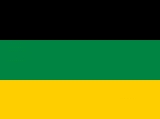
Umkhonto we Sizwe translated "Spear of the Nation," was the armed wing of the
African National CongressThe African National Congress is South Africa's governing Africanist political party, supported by its tripartite alliance with the Congress of South African Trade Unions and the South African Communist Party , since the establishment of non-racial democracy in April 1994. It defines itself as a...
(ANC) which fought against the South African apartheid government. MK launched its first guerrilla attacks against government installations on 16 December 1961. It was subsequently classified as a
terroristTerrorism is the systematic use of terror, especially as a means of coercion. In the international community, however, terrorism has no universally agreed, legally binding, criminal law definition...
organization by the South African government and the United States, and banned.
For a time it was headquartered in Rivonia, a suburb of
JohannesburgJohannesburg also known as Jozi, Jo'burg or Egoli, is the largest city in South Africa, by population. Johannesburg is the provincial capital of Gauteng, the wealthiest province in South Africa, having the largest economy of any metropolitan region in Sub-Saharan Africa...
. On 11 July 1963, 19 ANC and MK leaders, including
Arthur GoldreichArthur Goldreich was a South African-Israeli abstract painter and a key figure in the anti-apartheid movement in the country of his birth.-Early life:...
and
Walter SisuluWalter Max Ulyate Sisulu was a South African anti-apartheid activist and member of the African National Congress .-Family and Education:...
, were arrested at
Liliesleaf FarmLiliesleaf Farm in northern Johannesburg, South Africa was the farm used secretly by African National Congress activists in the 1960s and was the location where many prominent African National Congress leaders were arrested, leading to the Rivonia Trial....
, Rivonia (26°2′36"S 28°3′15"E). The farm was privately owned by Arthur Goldreich and bought with South African Communist Party and ANC funds, as individuals who were not deemed "White" were unable to own such a property under the Group Areas Act. This was followed by the
Rivonia TrialThe Rivonia Trial was a trial that took place in South Africa between 1963 and 1964, in which ten leaders of the African National Congress were tried for 221 acts of sabotage designed to overthrow the apartheid system.-Origins:...
, in which ten leaders of the ANC were tried for 221 acts of
sabotageSabotage is a deliberate action aimed at weakening another entity through subversion, obstruction, disruption, or destruction. In a workplace setting, sabotage is the conscious withdrawal of efficiency generally directed at causing some change in workplace conditions. One who engages in sabotage is...
designed to "foment violent revolution". Wilton Mkwayi, chief of MK at the time, escaped during trial.
The MK carried out numerous bombings of civilian, military, industrial and infrastructural sites. The tactics were initially geared solely towards sabotage, but eventually expanded to include
urban guerrilla warfareUrban guerrilla redirects here. For the Hawkwind song, see Urban Guerrilla.Urban guerrilla refers to someone who fights a government using unconventional warfare in an urban environment...
. Notable among these were the 8 January 1982 attack on the Koeberg nuclear power plant near
Cape TownCape Town is the second-most populous city in South Africa, and the provincial capital and primate city of the Western Cape. As the seat of the National Parliament, it is also the legislative capital of the country. It forms part of the City of Cape Town metropolitan municipality...
, coinciding with the 70th anniversary of the formation of the ANC, the
Church Street bombingThe Church Street bombing was a car bomb attack on 20 May 1983 by Umkhonto we Sizwe, the military wing of the African National Congress, in the South African capital Pretoria...
on 20 May 1983, killing 19, and the 14 June 1986 car-bombing of Magoo's Bar in
DurbanDurban is the largest city in the South African province of KwaZulu-Natal and the third largest city in South Africa. It forms part of the eThekwini metropolitan municipality. Durban is famous for being the busiest port in South Africa. It is also seen as one of the major centres of tourism...
, in which 3 people were killed and 73 injured. The total number of people killed or injured in the 30 years of MK's campaigns is not known exactly. MK alone was not a military threat to the apartheid state, but the ANC leadership saw MK as the armed component of a strategy of "people's war" that was primarily geared towards mobilizing mass political support.
MK suspended operations on 1 August 1990 in preparation for the dismantling of apartheid, and was finally integrated into the
South African National Defence ForceThe South African National Defence Force is the armed forces of South Africa. The military as it exists today was created in 1994, following South Africa's first post-apartheid national elections and the adoption of a new constitution...
by 1994.
Motivation for formation of the MK
According to
Nelson MandelaNelson Rolihlahla Mandela served as President of South Africa from 1994 to 1999, and was the first South African president to be elected in a fully representative democratic election. Before his presidency, Mandela was an anti-apartheid activist, and the leader of Umkhonto we Sizwe, the armed wing...
, all of the founding members of the MK, including himself, were also members of the ANC. In his famous "I am prepared to die" speech, Mandela outlined the motivations which led to the formation of the MK:
"Firstly, we believed that as a result of Government policy, violence by the African people had become inevitable, and that unless responsible leadership was given to canalize and control the feelings of our people, there would be outbreaks of terrorism which would produce an intensity of bitterness and hostility between the various races of this country which is not produced even by war. Secondly, we felt that without violence there would be no way open to the African people to succeed in their struggle against the principle of white supremacy. All lawful modes of expressing opposition to this principle had been closed by legislation, and we were placed in a position in which we had either to accept a permanent state of inferiority, or to defy the Government. We chose to defy the law. We first broke the law in a way which avoided any recourse to violence; when this form was legislated against, and then the Government resorted to a show of force to crush opposition to its policies, only then did we decide to answer violence with violence."
In 1961, MK published a manifesto entitled Umkhonto we Sizwe (Military wing of the African National Congress): We are at War!
"Our men are armed and trained freedom fighters not terrorists."
"We are fighting for democracy—majority rule—the right of the Africans to rule Africa. We are fighting for a South Africa in which there will be peace and harmony and equal rights for all people."
"We are not racialists, as the white oppressors are. The African National Congress has a message of freedom for all who live in our country."
Umkhonto we Sizwe manifesto.
Military campaign
Units of ANC exiles had MK camps in the "frontline" states neighbouring South Africa, most prominently Angola where MK was allied to the MPLA government, and fought alongside Angolan and Cuban troops at the critical engagement in
Cuito CuanavaleThe Battle of Cuito Cuanavale in 1987/88 was an important episode in the Angolan Civil War . Between 9 September and 7 October 1987, the Angolan Army , in an attempt to finally subdue the Angolan insurgent movement UNITA in south-eastern Angola, was decisively repelled in a series of battles at the...
. MK fighters were also allied with ZAPU (rival to Robert Mugabe's ZANU) in then-
RhodesiaZimbabwe is a landlocked country located in the southern part of the African continent, between the Zambezi and Limpopo rivers. It is bordered by South Africa to the south, Botswana to the southwest, Zambia and a tip of Namibia to the northwest and Mozambique to the east. Zimbabwe has three...
, with FRELIMO in
MozambiqueMozambique, officially the Republic of Mozambique , is a country in southeastern Africa bordered by the Indian Ocean to the east, Tanzania to the north, Malawi and Zambia to the northwest, Zimbabwe to the west and Swaziland and South Africa to the southwest...
, and with SWAPO in
NamibiaNamibia, officially the Republic of Namibia , is a country in southern Africa whose western border is the Atlantic Ocean. It shares land borders with Angola and Zambia to the north, Botswana to the east and South Africa to the south and east. It gained independence from South Africa on 21 March...
.
Following the suppression of MK inside South Africa in the late 1960s the organisation's cadres undertook military actions against the Rhodesian army (in, it was hoped, a prelude to crossing into South Africa itself). In 1965 MK formally allied itself with
ZIPRAZimbabwe People's Revolutionary Army was the armed wing of the Zimbabwe African People's Union, a political party in Rhodesia. It participated in the Second Chimurenga against white minority rule in the former Rhodesia....
and in July 1967 a joint MK/ZIPRA commando crossed into Rhodesia. The mission was a failure at both tactical and strategic levels, though the joint MK/ZIPRA detachment engaged the Rhodesian army in heavy firefights over the next year and academic sources have suggested that the cadres of the revolutionary armies acquitted themselves well enough for the Rhodesians to ask for South African assistance.
The early 1970s were a low point for the ANC in many ways, and that included in the military fields. Attempts to rebuild MK inside South Africa resulted in many losses though some, including
Chris HaniChris Hani, born Martin Thembisile Hani was the leader of the South African Communist Party and chief of staff of Umkhonto we Sizwe, the armed wing of the African National Congress . He was a fierce opponent of the apartheid government...
, were able to remain undetected for a long period.
The Soweto Uprising of 1976 led to a large exodus of young black men and women. Anxious to strike back at the apartheid regime, they crossed the border to Rhodesia to seek military training. While Umkhonto we Sizwe were able to build a new Army - one capable of attacking prestigious targets such as the refineries at
SasolburgSasolburg is a large industrial town in the far north of the Free State province of South Africa. Sasolburg is further sub-divided into three areas: Sasolburg proper, Vaalpark and Zamdela...
- the force also suffered from appalling breakdowns of discipline and there were many accusations that some new recruits were being tortured or killed by a physical training regime that was out of control, such as forcing recruits to run 45 kilometres without resting or lifting weights as heavy as 150 kilograms.
By the mid 1980s MK was concentrating on
propaganda of the deedPropaganda of the deed is a concept that refers to specific political actions meant to be exemplary to others...
- namely high profile attacks on prestige targets to demonstrate to the world the depth of resistance to apartheid as well as display to the majority population that resistance was possible (see below for a discussion of the controversies that followed) - and on building liberated zones inside the townships.
Bombings
Landmark events in MK's military activity inside South Africa consisted of actions designed to intimidate the ruling power. In 1983, the
Church Street bombThe Church Street bombing was a car bomb attack on 20 May 1983 by Umkhonto we Sizwe, the military wing of the African National Congress, in the South African capital Pretoria...
was detonated in Pretoria near the SA Air Force Headquarters, resulting in 19 fatalities and 217 persons injured. During the next 10 years, a series of bombings occurred in South Africa, conducted mainly by the military wing of the African National Congress.
In the Amanzimtoti bomb on the Natal South Coast in 1985, five civilians were killed and 40 were injured when MK cadre Andrew Sibusiso Zondo detonated an explosive in a rubbish bin at a shopping centre. In a submission to the Truth and Reconciliation Commission (TRC), the ANC stated that Zondo acted in anger at a recent SADF raid in Lesotho.
A bomb was detonated in a bar on the Durban beach-front in 1986, killing three civilians and injuring 69. Robert McBride received the death penalty for this bombing which became known as the "Magoo's Bar bombing". Although the subsequent Truth and Reconciliation Committee called it a "gross violation of human rights", McBride received amnesty and became a police officer.
In 1987, an explosion outside a Johannesburg court killed three people and injured 10; a court in Newcastle had been attacked in a similar way the previous year, injuring 24. In 1987, a bomb exploded at a military command centre in Johannesburg, killing one person and injuring 68 military personnel.
The bombing campaign continued with attacks on a series of soft targets, including a bank in Roodepoort in 1988, in which four were killed and 18 injured. Also in 1988, in a bomb detonation outside a magistrate’s court killed three. At the Ellis Park rugby stadium in Johannesburg, a car bomb, killed two and injured 37. A multitude of bombs in “Wimpy Bar” fast food outlets and supermarkets occurred during the late 1980s, killing and wounding many people. Wimpy were specifically targeted because of their perceived rigid enforcements of many Apartheid-era laws, including excluding people of colour from their restaurants. Several other bombings occurred, with smaller numbers of casualties.
The TRC later found that in the case of the Durban beach front and Magoo's Bar bombings, these acts constituted "gross violations of human rights".
Landmine campaign
From 1985 to 1987, there also was a campaign to mine rural roads used by security forces in what was then the Northern Transvaal. In submissions to the TRC, the ANC described the strategy and how they abandoned it due to the high rate of civilian casualties—especially amongst black labourers. The ANC estimated 30 landmine explosions resulting in 23 deaths, while the government submitted a figure of 57 explosions resulting in 25 deaths.
The TRC found that it could not condone the use of landmines because of the indiscriminate nature of the weapon which inevitably resulted in gross violations of human rights, but gives the ANC credit for abandoning the strategy.
Torture and executions
The TRC found that torture was "routine" — even though it was not official policy— as were executions "without due process" at ANC detention camps particularly in the period of 1979—1989.
MK's popular influence
In 1984, musician
Prince Far IPrince Far I was a Jamaican reggae deejay, producer and a Rastafarian. He was known for his gruff voice and critical assessment of the Jamaican government. His track "Heavy Manners" used lyrics against measures initiated towards violent crime.-Biography:He was born Michael James Williams in...
's album Spear of a Nation: Umkhonto we Sizwe was released (posthumously) in an act of solidarity with the MK.
Zimbabwean-born African-American author and filmmaker M.K. Asante, Jr. embraced the initials MK after Umkhonto we Sizwe.
UC Irvine professor Frank B. Wilderson III writes about his experience working with MK in his 2008 memoir Incognegro.
http://www.southendpress.org/2007/items/87835
Dave Matthews BandDave Matthews Band, sometimes shortened to DMB, is a U.S. rock band formed in Charlottesville, Virginia in 1991. The founding members were singer-songwriter and guitarist Dave Matthews, bassist Stefan Lessard, drummer/backing vocalist Carter Beauford and saxophonist LeRoi Moore. Boyd Tinsley was...
song "#36" is dedicated to
Chris HaniChris Hani, born Martin Thembisile Hani was the leader of the South African Communist Party and chief of staff of Umkhonto we Sizwe, the armed wing of the African National Congress . He was a fierce opponent of the apartheid government...
, the assassinated chief of staff of the MK and the leader of the
South African Communist PartySouth African Communist Party is a political party in South Africa. It was founded in 1921 as the Communist Party of South Africa by the joining together of the International Socialist League and others under the leadership of Willam H...
, and includes the refrain, "Hani, Hani, won't you dance with me?"
Well known MK members
- Joe Slovo
For Joe Slovo Informal Settlement in Cape Town, see: Joe Slovo .Joe Slovo was a South African politician, long-time leader of the South African Communist Party , and leading member of the African National Congress.-Life:Slovo was born in Obeliai, Lithuania to a Jewish family who emigrated to South...
- Nelson Mandela
Nelson Rolihlahla Mandela served as President of South Africa from 1994 to 1999, and was the first South African president to be elected in a fully representative democratic election. Before his presidency, Mandela was an anti-apartheid activist, and the leader of Umkhonto we Sizwe, the armed wing...
, who helped found the organization
- Chris Hani
Chris Hani, born Martin Thembisile Hani was the leader of the South African Communist Party and chief of staff of Umkhonto we Sizwe, the armed wing of the African National Congress . He was a fierce opponent of the apartheid government...
- Ronnie Kasrils
Ronald Kasrils is a South African politician. He was Minister for Intelligence Services from 27 April 2004 to 25 September 2008...
- Robert McBride
- Joe Modise
- Marion Sparg
Marion Monica Sparg is a South African activist, former guerrilla and public administrator.-Struggle years:Marion Sparg was one of the few white women to join Umkhonto we Sizwe , the armed wing of the African National Congress during South Africa's apartheid era...
- Jacob Zuma
Jacob Gedleyihlekisa Zuma is the President of South Africa, elected by parliament following his party's victory in the 2009 general election....
- Thabo Mbeki
Thabo Mvuyelwa Mbeki is a South African politician who served two terms as the second post-apartheid President of South Africa from 14 June 1999 to 24 September 2008. He is also the brother of Moeletsi Mbeki...
- Govan Mbeki
Govan Archibald Mvuyelwa Mbeki was a South African politician, and father of the former South African president Thabo Mbeki and political economist Moeletsi Mbeki...
- Mac Maharaj
Sathyandranath Ragunanan "Mac" Maharaj is a South African politician affiliated to the African National Congress, academic and businessman of Indian origin....
- Siphiwe Nyanda
General Siphiwe Nyanda SSA SBS CSL DMG MMS MMM is a South African politician, former minister of communications from 2009 - 2010.He was a South African military commander...
- Solly Shoke
General Solly Shoke MMS is a South African military commander. He joined Umkhonto weSizwe , the military wing of the African National Congress, in the 1970s, and served as a field commander fighting against the South African government in the 1980s...
- Anton Fransch
Anton Fransch , nom de guerre Mahomad, was a commander in Umkhonto we Sizwe. He was killed on 17 November 1989 in Cape Town by police and South African Defense Forces for his anti-apartheid activities, after a seven-hour siege in which he defended himself with hand-grenades and a machine gun...
- "Rashid" Aboobaker Ismail
- Dipuo Mvelase
- Tootsie Mamela
- Dipak Teps Patel
- Michael Pillay
Death toll
Police statistics indicate that, in the period 1976 to 1986, approximately 130 people were killed by ‘terrorists’. Of these, about thirty were members of various security forces and one hundred were civilians. Of the civilians, forty were white and sixty black. One study estimated that 150 cases of armed action took place between 1976 and 1982, "overwhelmingly concentrated on economic targets, the administrative machinery of apartheid, the police and SADF installations and personnel". Note that during this time, the ANC took action to assert policy with regard to the avoidance of civilian targets, which had in some cases become confused with the need to intensify the struggle "at all costs", stating (January 8th, 1987) that MK: "must continue to distinguish itself from the apartheid death forces by the bravery of its combatants, its dedication to the cause of liberation and peace, and its refusal to act against civilians, both black and white."
See also
- History of South Africa
South African history has been dominated by the interaction and conflict of several diverse ethnic groups. The aboriginal Khoisan people have lived in the region for millennia. Most of the population, however, trace their history to immigration since...
- Military history of South Africa
The history of South Africa chronicles a vast time period and complex events from the dawn of history until the present time. It covers civil wars and wars of aggression and of self-defense both within South Africa and against it...
- Guerrilla warfare
Guerrilla warfare is a form of irregular warfare and refers to conflicts in which a small group of combatants including, but not limited to, armed civilians use military tactics, such as ambushes, sabotage, raids, the element of surprise, and extraordinary mobility to harass a larger and...
- Freedom fighter
- Partisan
A partisan is a member of an irregular military force formed to oppose control of an area by a foreign power or by an army of occupation by some kind of insurgent activity...
- Paramilitary
A paramilitary is a force whose function and organization are similar to those of a professional military, but which is not considered part of a state's formal armed forces....
- Day of Reconciliation
The Day of Reconciliation is a public holiday in South Africa held annually on 16 December. The holiday came into effect in 1994 after the end of apartheid, with the intention of fostering reconciliation and national unity...
Further reading
- Vladimir Shubin (Institute for African Studies, Russian Academy of Sciences
The Russian Academy of Sciences consists of the national academy of Russia and a network of scientific research institutes from across the Russian Federation as well as auxiliary scientific and social units like libraries, publishers and hospitals....
), 'Unsung Heroes: The Soviet Military and the Liberation of Southern Africa,' Cold War History, Vol. 7, No. 2, May 2007
- Vladimir Shubin, Moscow and ANC: three decades of co-operation and beyond.
- Rocky Williams, see articles in the Journal of Security Sector Management and others
External links